
This article is also available in: 繁體中文 · 日本語 · 한국어 · Bahasa Indonesia · Bahasa Melayu · ไทย · Português (Brasil) · Español · Türkçe · Tiếng Việt · Deutsch · हिन्दी
Contents (45)
The instant camera business (in Japan, Fujifilm’s instax cameras go by the nickname Cheki, チェキ) died once in the digital era and came back to life in the smartphone era, bigger than before. Polaroid, the company that invented it, went bankrupt twice, in 2001 and 2008, and stopped making film in 2008. The company that carries the Polaroid name today is a Dutch firm whose founders, a group of fans, bought the old production line for $3.1 million and nine years later turned around and bought the brand itself. The latecomer, Fujifilm instax, went from selling 1 million units in 2002 to only about 100,000 a year around 2004, then climbed all the way to 10.02 million units in fiscal 2018. It has now sold more than 100 million units in total, brought in ¥200 billion in FY2025, and is the single biggest business inside Imaging, Fujifilm’s most profitable division.
This article answers four questions:
- How did Polaroid go from inventor to two bankruptcies, and how did a small Dutch company take it over?
- How many instax units were sold each year, and when did the trough and the rebound happen?
- How important is instax to Fujifilm really, and which of the numbers circulating online are right and which are wrong?
- Why did a product that was “killed by digital” turn into something people give as a gift in the smartphone era, and even into a kind of currency?
Every figure is labeled with its source and basis. Anything I couldn’t find is listed separately at the end, rather than filled in with estimates.
1. The invention of Polaroid: a three-year-old’s question in 1943
A company that made polarizing materials
Polaroid was founded by Edwin Land in Cambridge, Massachusetts, in 1937. Its first products weren’t cameras but polarizing materials; the “Polar” in the company name stands for polarizing.
Instant photography began with a family story. According to Harvard Business School’s Baker Library exhibit on its Polaroid collection and the records of the American Chemical Society (ACS), Land was on vacation in Santa Fe, New Mexico, in 1943, taking pictures of his three-year-old daughter Jennifer, when she asked him: why can’t I see the picture now? Land later said that within an hour he had worked out how the camera, the film, and the chemistry should work, and he went to see a patent attorney that same day.

Polaroid founder Edwin Land; the Library of Congress catalogs the photo as taken around 1971. Photo: Bernard Gotfryd (taken for Newsweek; the original is held by the Library of Congress), public domain, original.
On February 21, 1947, Land publicly demonstrated the instant camera and film at the Optical Society of America.
1948: the Model 95 sells out on day one
The first commercial model, the Polaroid Model 95, went on sale in November 1948 at the Jordan Marsh department store in Boston, priced at $89.75. According to History.com, the first batch of 57 cameras sold out on the first day, along with the film. Sources disagree on the exact launch date: History.com says November 26, others say the 28th, and English Wikipedia gives only the month, so this article stops at the month.
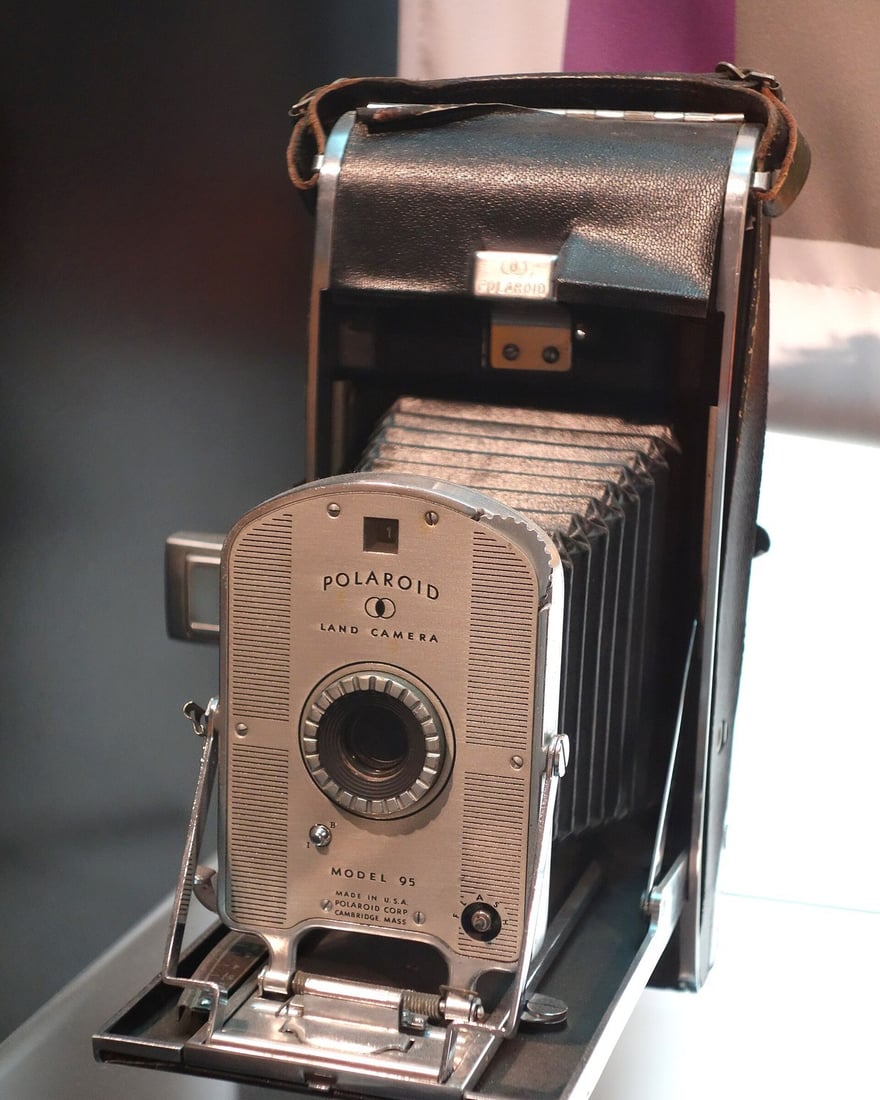
The Model 95 (1948), Polaroid’s first commercial instant camera, photographed at the MIT Museum. It used peel-apart film: you had to wait a while after the shot, then peel the positive away from the negative. Photo: Daderot, CC0 public domain, original.
1972: the SX-70 puts the darkroom inside the photo
Early Polaroid cameras used peel-apart film: after the print came out, you waited a while and then peeled the positive away from the negative, leaving chemical residue on your hands. The SX-70 of 1972 changed that.
The SX-70 was unveiled at the shareholders’ meeting in April 1972, went on sale first in Miami at the end of that year, and reached stores nationwide only in the fall of 1973. It cost $180, and a pack of 10 shots cost $6.90. It was the first folding SLR to use “integral” film: the photo ejected itself and developed inside the print, with nothing to peel and no residue. The instant photo most people picture today, a white-framed print that slides out and slowly appears before your eyes, took its shape from the SX-70. By mid-1974, the SX-70 had sold 700,000 units.
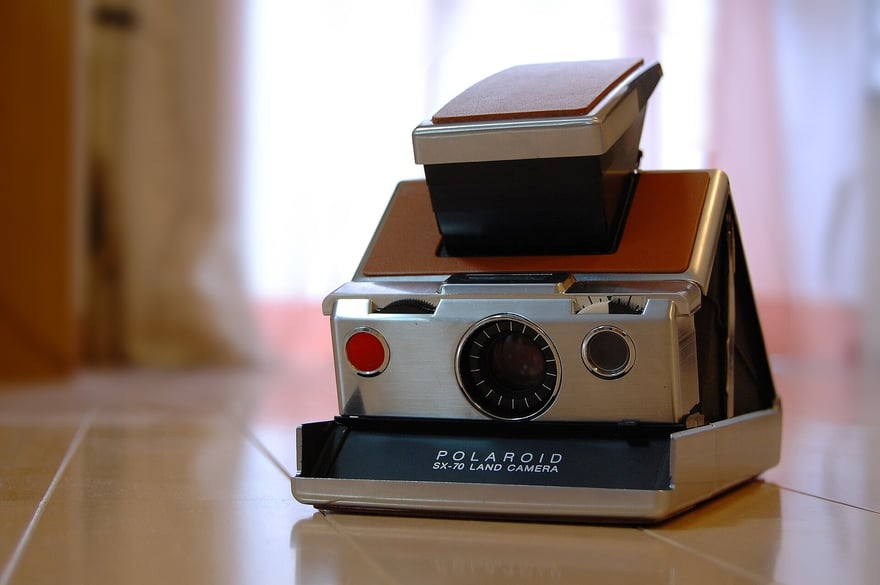
The Polaroid SX-70, a folding SLR unveiled in 1972 and the first model to use integral film: the photo ejects from the slot at the bottom and develops on its own inside the print. This article’s cover image is cropped from this photo. Photo: Fabian Reus, CC BY-SA 2.0, original.
At its peak, the company had 21,000 employees in 1978 and revenue of $3 billion in 1991.
2. Polaroid vs. Kodak: a fifteen-year patent war
In 1976, Kodak launched its own instant cameras and film. Its film chemistry was close to the SX-70’s, but its format wasn’t compatible with Polaroid’s. Polaroid sued that same year for patent infringement.
The most common mistake in accounts of this case is folding the infringement ruling and the damages ruling into the same year. The actual timeline:
| Year | What happened |
|---|---|
| 1976 | Kodak launches instant cameras; Polaroid sues for patent infringement |
| 1985 | The court finds that Kodak infringed; Polaroid wins |
| January 1986 | The injunction takes effect; Kodak must stop making and selling instant cameras and film |
| October 1990 | The court orders Kodak to pay $909.5 million in damages |
| 1991 | The two sides settle for about $925 million |
The key point of this table: Kodak was forced out of instant photography in 1986, but the damages weren’t decided until 1990, and the case wasn’t settled until 1991. Polaroid had originally sought about $5.7 billion (lost profits, including interest); what it finally got was less than 20% of that.
Kodak lost more than money. It lost an entire product line. According to a summary by the photography site Fstoppers (a secondary source), Kodak had already sold about 16.5 million instant cameras when it was forced out. From then on, film for those cameras was unavailable, and Kodak could only offer refunds or credit toward other Kodak cameras.
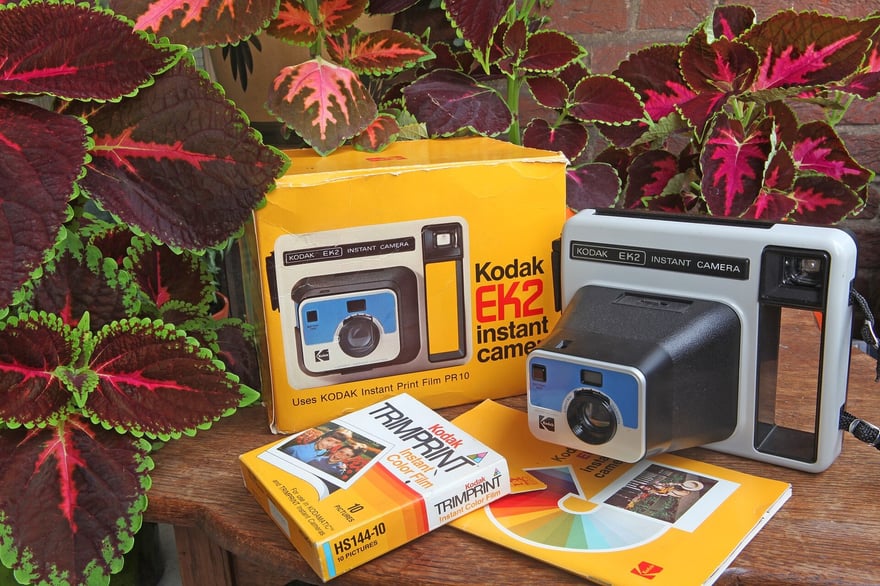
Kodak’s EK2 instant camera and the Trimprint instant film it used. After the injunction took effect in January 1986, Kodak stopped making and selling instant cameras and film, and cameras like this one could no longer get new film. Photo: Joost J. Bakker, CC BY 2.0, original.
In terms of industry structure, the outcome was this: after 1986, Polaroid was the only company left in the US instant photography market. It had no competitors, and nobody forcing it to change.
3. Polaroid’s first death: 2001
The monopoly didn’t save Polaroid. After its $3 billion revenue year in 1991, digital cameras started to spread, and most of Polaroid’s revenue was tied to film. English Wikipedia describes the cause of the 2001 bankruptcy as management failing to foresee the impact of digital cameras on the film business, the so-called “success trap”: what used to make money made so much money that the company couldn’t see it disappearing.
The timeline:
- October 11, 2001: Polaroid Corporation files for Chapter 11 bankruptcy protection.
- 2002: One Equity Partners, the investment arm of Bank One, buys nearly all of the assets and continues the business as Polaroid Holding Company; the original corporation is renamed Primary PDC.
- April 2005: Petters Group Worldwide announces its acquisition of Polaroid Holding Company.
The Polaroid name survived, but the company behind it was no longer the one Land had founded.
4. Polaroid’s second death: film ends in 2008, followed by another bankruptcy
On February 8, 2008, Polaroid, then controlled by the Petters group, announced that it would phase out production during the year and exit analog instant film entirely. In effect, it declared that Polaroid instant photography, which began in 1948, was over.
On December 18 of the same year, Polaroid filed for Chapter 11 a second time. This time the direct cause wasn’t the business but the parent company: the head of the Petters group was implicated in a fraud case, and the group was placed in court receivership. At an asset auction in April 2009, Polaroid’s name, intellectual property, and photography collection went to a joint venture of Hilco Consumer Capital and Gordon Brothers Brands.
The two bankruptcies had different causes: the first was digital cameras, the second was the parent company. But the result was the same. By the end of 2008, no factory in the world was producing Polaroid instant film.
5. The Impossible Project: buying the factory for $3.1 million and the brand nine years later
2008: a group of fans buys the production line
In the same year Polaroid announced the end of its film, Florian Kaps, André Bosman, and Marwan Saba founded The Impossible Project with one goal: keep Polaroid film alive. In October 2008, they bought Polaroid’s remaining film production equipment for $3.1 million and leased the north building of the old plant in Enschede, the Netherlands. Mass production began in 2010.
Owning the machines didn’t mean they could make film. According to a 2024 report in the Dutch trade publication Kunststof & Rubber, the Enschede plant had about 1,200 employees at its peak, while Impossible started with a team of only about 10 people. The original developing-reagent formulas and supply chain had been lost, and they spent several years reverse-engineering the chemistry.
2017: buying Polaroid itself
In May 2017, Impossible’s largest shareholder, Wiaczesław Smołokowski (father of CEO Oskar Smołokowski), bought the Polaroid brand and intellectual property; in September of that year, the company changed its name to Polaroid Originals. In March 2020 it switched back to the single name “Polaroid” and launched a new camera, the Polaroid Now, priced at about $100.
This is the most dramatic chapter in the industry’s history: a company created to “save Polaroid film” ended up becoming Polaroid itself. Today’s Polaroid is a Dutch company (Polaroid B.V.), and its film is made by Polaroid Film B.V. in Enschede, in the very same factory.

The old Polaroid site in Enschede, the Netherlands, in May 2024, with today’s polaroid lettering and rainbow stripes on the roof. What Impossible leased in 2008 was part of this old plant, and Polaroid film is still made in Enschede today; the photographer didn’t note what this particular building is used for. Photo: Gewild, CC0 public domain, original.
How big is Polaroid today: only one source
Polaroid is now a private company and doesn’t publish financial statements. The only figures I found come from a case-study page on the website of an engineering contractor that works for the Enschede plant: in 2024, the Enschede plant produced 8.4 million packs of film, the company had revenue of €220 million, and the Enschede plant had more than 150 employees. These aren’t figures Polaroid published itself, and the page isn’t dated, so treat them only as a rough sense of scale.
Even taking those numbers at face value, Polaroid is only a small fraction of its 1991 peak, and far smaller than instax, covered in the next section. Its current lineup includes the Now (2020), the tiny Go (2021), the I-2 with manual controls and LiDAR autofocus (2023, $600), and the third-generation Now from March 2025.
Prices reflect its position too. Based on Taiwan retail prices checked on September 25, 2026, one Polaroid (i-Type) shot costs about as much as 2.5 instax mini shots.
6. The birth of instax: 1998, and Cheki = “check it”
Fujifilm took a different technical path
Fujifilm was making instant cameras before instax. In the early 1980s it launched Fotorama instant cameras in Japan and Asia, using technology closer to Kodak’s than to Polaroid’s. Fujifilm also made peel-apart film; the last one, FP-100C, was announced as discontinued in February 2016.
The lawsuit that knocked Kodak out in 1986 took place in the US and was aimed at Kodak. Fujifilm’s instant photography business was mainly in Japan and Asia, and it carried on.
instax launched in 1998. English Wikipedia says the instax mini 10 and mini film were released on November 10, 1998; Japanese Wikipedia says it went on sale in Japan in December 1998; and Fujifilm’s own IR presentation says “sales began in Japan in 1998, and November 2023 marked the 25th anniversary.” The three film formats arrived one after another: mini (1998), WIDE (1999), and SQUARE (2017). Print sizes for each format are covered in instax and Polaroid photo sizes.
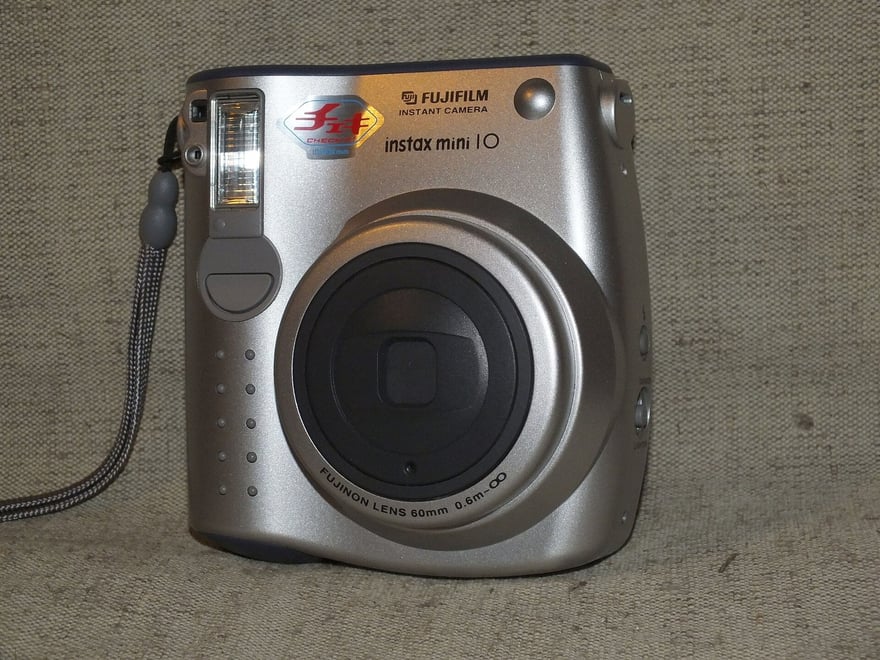
The original instax mini 10, launched together with instax mini film in 1998: a rounded, chunky silver body, and in Japan, the first-generation Cheki. The photo was taken in 2013 of a surviving older camera. Photo: Andshel, CC BY-SA 3.0, original.
Technically, instax film is exposed from the back, with the dye layers stacked in reverse order, so the camera doesn’t need a mirror like the SX-70’s to flip the image the right way around. That lets the camera be simpler and cheaper.
The name Cheki
In Japan, instax is nicknamed “Cheki” (チェキ). According to Cheki Press, instax’s official media outlet, the name is a coined word shortened from the English “check it.” The official brand name is instax; Cheki is used only in Japan.
This contrast will keep coming up: a product whose Japanese nickname is its best-known name now earns 90% of its revenue outside Japan.
7. instax unit sales by year: 1 million, 100,000, 10.02 million, then 100 million in total
The annual instax sales figures Fujifilm has published are scattered across several documents. Put together, they look like this:
| Year / fiscal year |
Units sold | Source and basis |
|---|---|---|
| 2002 | 1 million | First peak; Works Institute, Fujifilm IR presentation |
| 2004–2006 | About 100,000–120,000 | Trough; Works Institute |
| 2007 | 200,000 | Works Institute |
| 2008 | 250,000 | Works Institute |
| 2009 | 490,000 | Works Institute |
| 2010 | 870,000 | Works Institute |
| 2011 | 1.27 million | Works Institute |
| 2014 | About 3 million | Japanese Wikipedia (secondary) |
| FY2015 | About 5 million | Cited on English Wikipedia; some media say 2016, so the year basis varies |
| FY2018 | 10.02 million | First time above 10 million; Works Institute, President |
| FY2020 onward | Not published | Fujifilm switched to publishing only revenue and cumulative units |
The shape of this table is a big capital V: 1 million units in 2002, only a tenth of that two years later, then fourteen years of growth to about 100 times the trough. In its own 2023 IR presentation, Fujifilm divides this history into five stages, “dawn, boom, disillusionment, recovery, and stable growth,” and marks three milestones: “annual sales exceed 1 million units,” “annual sales fall to 100,000 units,” and “annual sales exceed 10 million units.”
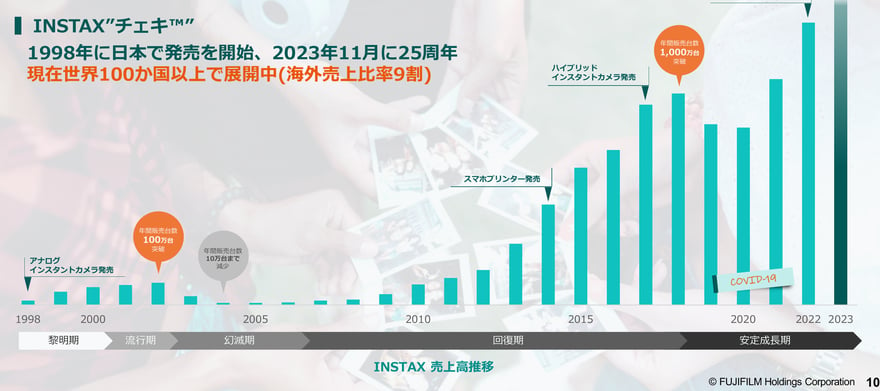
Twenty-five years of instax, as drawn by Fujifilm itself: the bars are revenue (売上高) with no scale shown; the three circular markers are the annual unit sales milestones, and the bottom of the V falls in 2004 to 2006. Screenshot from page 10 of Fujifilm’s イメージングソリューション事業説明会 (Imaging Solutions business briefing) presentation (captured September 25, 2026, showing only the chart and title), original PDF
There are no official annual sales figures from fiscal 2020 onward. Only two cumulative figures are certain: the December 2023 presentation says more than 80 million units in total, and on April 8, 2025, Fujifilm announced that cumulative global sales of cameras plus smartphone printers had passed 100 million units; its October 2026 press release dates that milestone to “before the end of FY2024” (before the end of March 2025). That’s roughly 20 million more units between the two dates, which works out to about 10 million a year on average. That figure is my own estimate from subtracting one cumulative total from the other, not an official annual sales number.

The cumulative figure as of December 2023: more than 80 million units. Screenshot from page 5 of Fujifilm’s イメージングソリューション事業説明会 presentation (captured September 25, 2026, showing only the panel with instax cumulative sales), original PDF
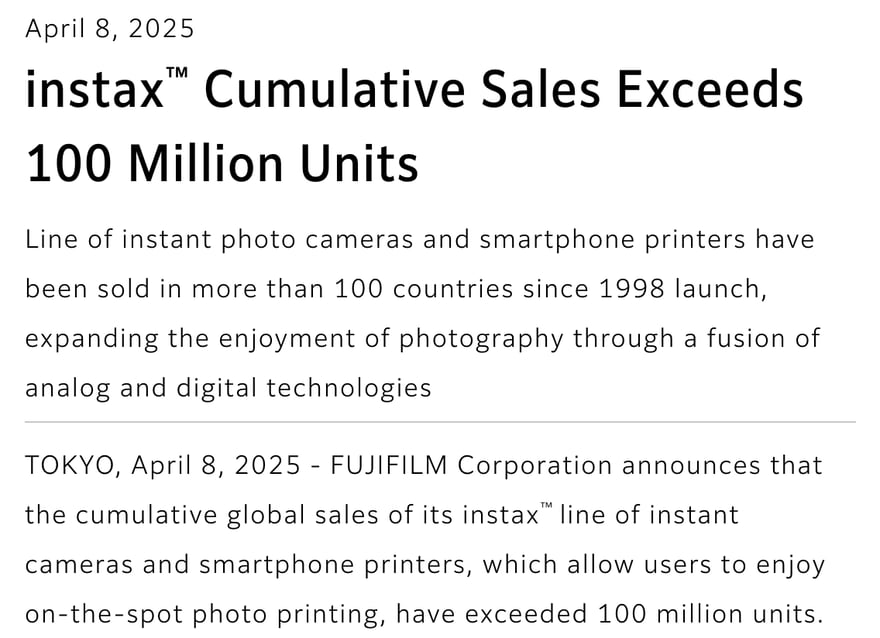
One year and four months later, the cumulative figure crossed 100 million units; the press release states that the number includes both cameras and smartphone printers. Screenshot from a Fujifilm press release (captured September 25, 2026, showing only the date, title, and first paragraph), original page
The first peak in 2002: the same wave as photo booths
A 2019 case article by Works Institute attributes the 2002 peak to the boom in Utsurundesu (写ルンです, Fujifilm’s disposable camera) and sticker photo booths (プリクラ, purikura), with Japanese high school girls as the main customers.
What follows is my own observation, not a conclusion from Fujifilm or any report: this wave of “physical photo consumption” among young women in East Asia rose and fell at almost the same time in several markets.
- Japanese sticker photo booths peaked in 1997, with arcade revenue of ¥101.3 billion a year; after being cut in half in 1998, revenue recovered to ¥60.5 billion in 2002 and then slid steadily, to ¥42.3 billion in 2005 and ¥30.7 billion in 2007 (figures from the Japan Amusement Industry Association, compiled in thirty years of Japanese photo booths).
- In Taiwan, Japanese-style photo booths were brought in around 2000 by 蓋酷家族, a Taiwanese photo booth operator, and became a craze, then faded as phones and photo-editing apps spread (see the history of Taiwan’s photo booth industry).
- instax hit its first peak of 1 million units in 2002 and fell to about 100,000 units a year from 2004 to 2006.
All three peaks fall between 1997 and 2002, and all three cooled off in the mid-2000s. They were selling the same thing: a photo you could hold in your hand on the spot and share with friends.
The 2004 trough: camera phones
Two Japanese sources agree on why sales fell. President reports that digital cameras spread, and a little later phones started shipping with built-in cameras; Works Institute puts it more bluntly, saying sales plunged as “phones with cameras” spread. Around 2005, annual instax sales were only about a tenth of the peak.
The decline of photo booths has been attributed to the same cause. Both Japanese and Taiwanese sources say so.
The 2007 rebound: a Korean drama, but I couldn’t find which one
According to Works Institute, the rebound started in 2007, when Cheki appeared in a Korean TV romance drama while a well-known model in China introduced it on her blog. It caught on in East Asia first and then spread to North America and Europe.
I couldn’t find out which Korean drama it was. Some people online link it to The 1st Shop of Coffee Prince from the same year, but I found no reliable source making that connection, so I’m not naming a title here.
The numbers after that: 200,000 units in 2007, 490,000 in 2009, and 1.27 million in 2011. That’s more than a sixfold increase in four years, and by 2011 sales had already surpassed the old 2002 peak.
90% overseas, but “Cheki” is used only in Japan
After the rebound, instax was no longer a Japanese product. Fujifilm’s 2023 IR presentation states that instax is sold in more than 100 countries and that about 90% of its revenue comes from overseas; Works Institute also puts the overseas share at 90% in 2018. According to Works Institute, the core customers are women in their teens through twenties, in other words Gen Z.
A product that started with Japanese high school girls took off a second time thanks to a Korean TV drama and a Chinese blogger, and ended up earning 90% of its money overseas. Its Japanese nickname, Cheki, is used only by the crowd from its first peak.
8. The money: how important instax really is to Fujifilm
Imaging: Fujifilm’s most profitable division
instax belongs to Fujifilm’s Imaging division. The division also includes film, photofinishing equipment, and digital cameras such as the GFX and X series. Its recent revenue looks like this:
| Fiscal year | Imaging revenue (¥100 million) |
|---|---|
| FY2019 | 3,326 |
| FY2020 | 2,852 |
| FY2021 | 3,334 |
| FY2022 | 4,103 |
| FY2023 | 4,697 |
| FY2024 | 5,420 |
| FY2025 | 6,271 |
Fujifilm’s fiscal year runs from April to March of the following year, so FY2025 = April 2025 to March 2026. What this table shows: leaving out the pandemic year, Imaging revenue nearly doubled in six years, reaching ¥627.1 billion, or 18.7% of group revenue, in FY2025.
---
config:
  xyChart:
    width: 360
    height: 300
  themeVariables:
    xyChart:
      plotColorPalette: "#3a4a9d"
---
xychart-beta
    title "Imaging revenue (¥100M)"
    x-axis ["FY19", "20", "21", "22", "23", "24", "25"]
    y-axis 0 --> 7000
    bar [3326, 2852, 3334, 4103, 4697, 5420, 6271]
The bar chart makes it clearer: FY2020 is the only year that went down, and each of the five years since has been higher than the one before.
instax is about a third of Imaging, not more than half
Fujifilm has published two figures for instax’s own revenue:
- In FY2023 (fiscal year ended March 2024), instax-related revenue (cameras, film, and accessories) reached ¥150 billion. The original sentence in the earnings release says “the FY2025 target of ¥150 billion in revenue was achieved one year ahead of schedule”; using the fiscal-year definition in the same release, that works out to two years early. The two don’t match, so I’m quoting the original sentence here rather than converting it myself. Imaging revenue that year was ¥469.7 billion, so instax was about 32%.
- In FY2025 (fiscal year ended March 2026), instax revenue was ¥200 billion; Fujifilm’s October 20, 2026 press release states that this was a record for the fifth consecutive year, starting from FY2021. Imaging revenue that year was ¥627.1 billion, so instax was still about 32%.
The share was almost identical in both years: instax has grown along with the whole Imaging division and makes up about a third of it.
Another claim often seen online is that “instax accounts for more than half of Fujifilm’s imaging business.” It comes from a December 2023 PetaPixel article citing Nikkei, but Fujifilm’s official figures put it at only about a third. A more likely explanation is that “more than half” refers to the Consumer Imaging sub-segment within Imaging, not the whole division. Fujifilm doesn’t publish Consumer Imaging revenue, so I can’t verify that explanation; all I can confirm is that “more than half of Imaging” doesn’t match the official figures.
In addition, Masato Yamamoto, head of Fujifilm Imaging Solutions, said at a product launch in January 2025 that instax revenue had set a record three years in a row from FY2021 to FY2023 and would set another in FY2024; FY2024 and FY2025 both delivered.
FY2025: Imaging has the highest operating income of the four divisions
Revenue and operating income for the four divisions in FY2025, all in ¥100 million:
| Division | Revenue | Op. income |
Margin |
|---|---|---|---|
| Healthcare | 10,989 | 636 | 5.8% |
| Electronics | 4,562 | 1,009 | 22.1% |
| Business Innovation | 11,748 | 637 | 5.4% |
| Imaging | 6,271 | 1,600 | 25.5% |
This table comes from Fujifilm’s FY2025 results, released in May 2026. Imaging ranks only third in revenue but first in operating income: its ¥160 billion is about 40% of the four divisions’ combined operating income (my own calculation from adding up the four). Its operating margin is 25.5%, against a group average of only 10.4%.
---
config:
  xyChart:
    width: 360
    height: 300
  themeVariables:
    xyChart:
      plotColorPalette: "#3a4a9d"
---
xychart-beta
    title "Segment profit (¥100M)"
    x-axis ["Health", "Electro", "BizInno", "Imag."]
    y-axis 0 --> 1800
    bar [636, 1009, 637, 1600]
The four bars are, in order, Healthcare, Electronics, Business Innovation, and Imaging (labeled Imag.): Business Innovation and Healthcare, the two largest by revenue, each earn only about 40% of what Imaging does.
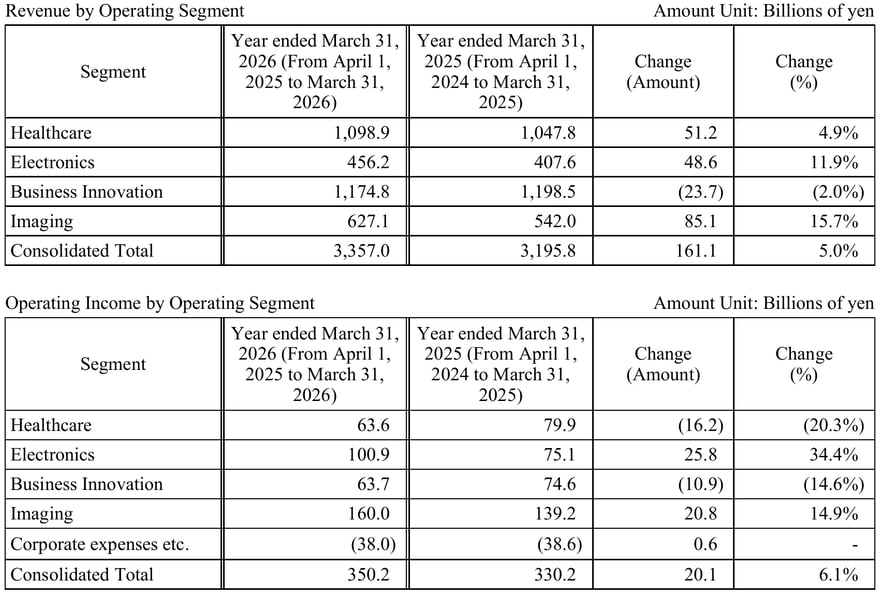
The original tables are in billions of yen, so 160.0 means ¥160 billion; Imaging has the highest operating income of the four divisions. Screenshot from page 2 of the English edition of Fujifilm’s FY2025 earnings summary (captured September 25, 2026, showing only the two segment tables for revenue and operating income), original PDF
One thing needs to be clear, though: this ¥160 billion includes digital cameras, so not all of it can be credited to instax. Fujifilm doesn’t publish instax’s operating income separately. The earnings release describes Consumer Imaging this way: instax revenue kept growing, cumulative sales passed 100 million units, and the main models were the mini 12 and mini Evo, along with the WIDE 400, Link 3, WIDE Evo, and others.
Four capacity expansions, and still a price increase
How strong is demand? Capacity and pricing tell you.
Since 2022, Fujifilm has expanded instax film production three times, investing about ¥11.5 billion in total and raising capacity by about 50% over FY2022. The third expansion, announced on December 18, 2025, invests about ¥5 billion to add roughly 10% more capacity at the Ashigara plant in Kanagawa, starting in spring 2026 and reaching full operation in the fall.
Before the third expansion was even fully running, Fujifilm announced a fourth on October 20, 2026: about ¥3 billion at the same Ashigara plant, coming online in stages from spring 2027 and reaching full operation in spring 2028, adding about 20% more capacity over FY2026. All four together put capacity about 70% above FY2022.
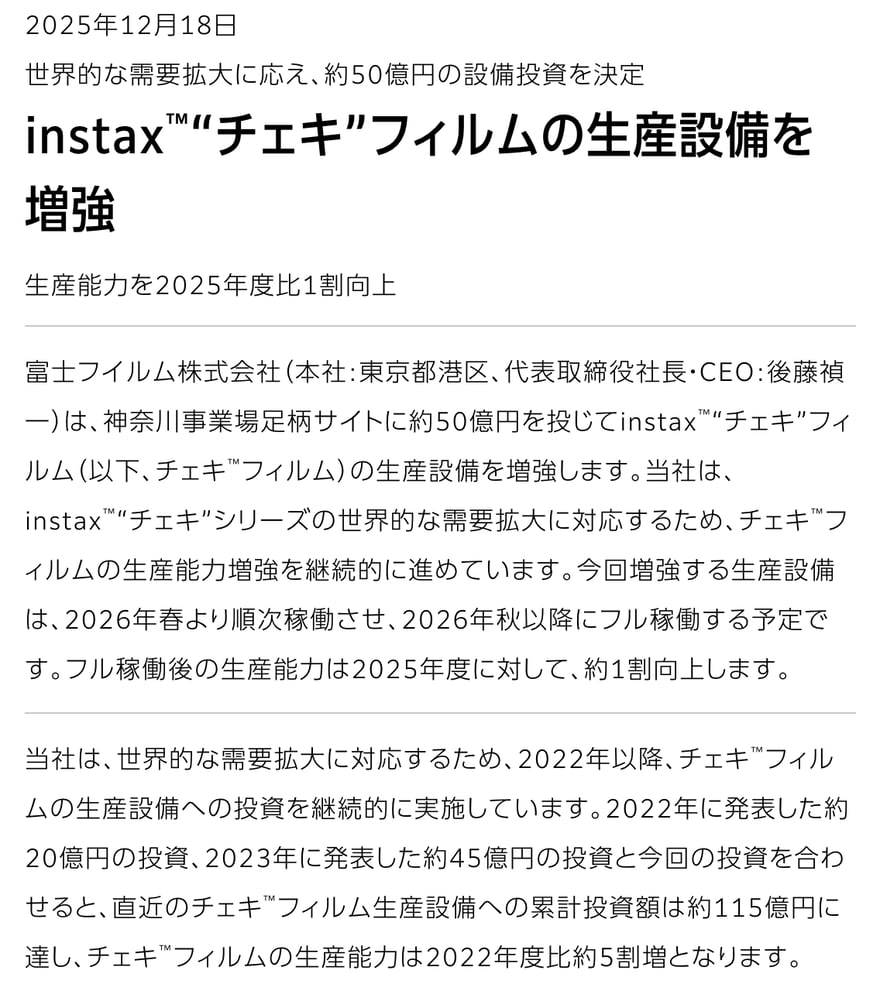
The amounts and capacity figures for the first three expansions all come from Fujifilm’s own announcement. Screenshot from a Fujifilm press release (captured September 25, 2026, showing only the title, the first paragraph, and the paragraph on cumulative investment, with the brand introduction in between omitted), original page
While expanding capacity, Fujifilm raised instax film prices in Japan, effective April 1, 2026:
| Film format | April 2026 increase (Japan) |
|---|---|
| instax mini | About +22% to +27% |
| instax SQUARE | About +8% to +22% |
| instax WIDE | About +3% to +13% |
The official reason was rising costs for parts, raw materials, and shipping that the company could no longer absorb on its own. Generally speaking, raising prices after adding 50% more capacity, then announcing yet another expansion half a year later, means demand is strong enough to absorb the increase; if demand were weak, the normal move after expanding would be to cut prices to clear the extra capacity, not raise them. The biggest increase was on mini, which also happens to be the best-selling format.
Over the same period, Fujifilm’s regular roll-film strategy went in a different direction: some of its color negative films are now made for it by Kodak.
9. Correcting a popular claim: instax did not outsell “the entire digital camera industry”
A 2022 PetaPixel article said that in 2019, instax outsold the entire digital camera industry (excluding phones). The line gets repeated a lot, but checked against the official shipment statistics of the camera industry group CIPA, it doesn’t hold up.
| Year | Total | Inter- changeable lens |
Built-in lens |
|---|---|---|---|
| 2018 | 19.42 million | 10.76 million | 8.66 million |
| 2019 | 15.22 million | 8.46 million | 6.76 million |
| 2025 | 9.44 million | 7.00 million | 2.44 million |
These are CIPA’s figures for global digital camera shipments (calendar years). “Interchangeable-lens” means DSLRs plus mirrorless cameras; “built-in lens” means cameras whose lens can’t be changed. instax sold 10.02 million units in FY2018 and about 10 million in 2019 (that 2019 figure comes from PetaPixel, which didn’t cite a source). Comparing the two, the correct statement is: instax’s annual sales of about 10 million units exceeded global shipments of interchangeable-lens cameras, but not all digital cameras.
There’s also a difference in basis: instax uses Fujifilm’s fiscal year (April to March of the following year), while CIPA uses calendar years. The two are three months apart, so only the order of magnitude can be compared.
By 2025, CIPA’s total digital camera shipments had fallen to 9.44 million units. If instax still sells around 10 million units a year, the claim that it “outsold the entire digital camera industry” might actually be true today. But Fujifilm hasn’t published annual unit sales since fiscal 2020, so I can’t verify it, and this article goes no further than “might.”
10. Instant photos as currency: Cheki tickets, maid cafes, and idol photo booth frames
After instax’s rebound, it grew a use that the camera company never designed: the photo itself became something that could be bought and sold. What’s being sold isn’t image quality but proof that “I was with this person (or this character) at the same time, in the same place.”
This business is most visible in five settings:
- Cheki tickets at Japanese underground idol shows.
- Maid and concept cafes (コンカフェ, “concafe”) in Japan.
- Maid cafes and underground idol restaurants in Taiwan.
- Signed instant photos and birthday cafes in K-pop fandom.
- Idol collaboration frames in Korean self-service photo booths. This one doesn’t use instax, but it sells the same thing.
Cheki tickets at Japanese underground idol shows
At Japanese underground idol shows there’s something called a “Cheki ticket” (チェキ券): fans pay for a ticket and get to take an instax photo with an idol, who then writes on or signs the photo. A November 2024 report by Business Insider Japan laid out the economics:
- A Cheki ticket typically goes for about ¥1,000 to ¥2,000; the report used about ¥1,500 for its calculations.
- The idol gets 30% to 40%, about ¥500 per photo, and the rest goes to the management agency.
- One sheet of instax film costs about ¥100.
- The report multiplied about 1,000 female underground idol groups in Tokyo, with an average of 5 members each, by about ¥2.7 million per member per year, arriving at a “¥10 billion Cheki economy.”
That ¥10 billion is the reporter’s own estimate, not a statistic, and should be taken only as a sense of scale. What it shows is the structure: a sheet of film that costs about ¥100 can sell for more than ten times that at an idol show, because what buyers are paying for isn’t the photo but “proof that I met this person.”
Fujifilm has noticed this too. Its 2023 IR presentation lists “チェキ撮影会、ファンミーティング” (Cheki photo sessions and fan meetings) as business use cases for instax, and Japanese Wikipedia notes that the instant photos taken with idols at handshake events are themselves called “Cheki” and are an important source of income.
Japanese maid cafes: you can’t take your own photo, you can only buy a Cheki
Maid cafes have made “paying for a photo together” a fixed item on the menu. Official price lists of two major chains, checked on October 28, 2026:
- Maidreamin (めいどりーみん): a regular Cheki for ¥900, a large デカチェキ (“deka-Cheki”) for ¥1,150, and a ボイスチェキ (“voice Cheki”) with a voice message for ¥1,750 (tax included), handed to customers in an original mount; the chain also sells an original Cheki album that holds 120 photos.
- @home cafe (あっとほぉーむカフェ): a business-card-size Cheki with a maid of your choice for ¥900, an L-size one for ¥1,110, and a “コレクションチェキ” (“collection Cheki”) of a maid alone, with doodles drawn on the photo on the spot, for ¥1,200. Every set menu includes a souvenir photo with a maid, and the gifts for moving up a membership tier are a solo Cheki ticket and an album.
Why can you only buy them? Maidreamin’s official FAQ spells it out: you can take photos inside the cafe, but not of the maids, the kitchen staff, or other customers, and you can’t touch the maids. The only legitimate way to get a photo with a maid is to pay for a Cheki. A sheet of film that costs about ¥100 becomes a product starting at ¥900 here.

@home cafe’s flagship store in Akihabara in November 2011, with a banner announcing that visits (which the cafe calls ご帰宅, “coming home”) had passed 2 million. Today every set menu in the cafe includes a Cheki taken with a maid. Photo: Ryo FUKAsawa, CC BY 2.0, original.
There are no public figures in Japan on how important Cheki are to these cafes. The closest example I could find is from Korea: a July 2026 report by the Korean news agency news1 (republished by AFPBB) said that content products such as Cheki and performances make up the bulk of maid cafe revenue, and that maids generally receive 30% of the sale price as a bonus; at one cafe in Busan, a Cheki costs 12,000 won, with 4,000 going to the maid and 8,000 to the cafe. This is a single cafe, reported secondhand, and should be read only as an illustration of the structure.
Maid cafes and underground idol restaurants in Taiwan
The same model has reached Taiwan. As of September 22, 2026, the author’s (Joe’s) database of venues across Taiwan listed 59 maid/butler cafes and underground idol restaurants, 44 of them open; the current picture is covered in maid cafes in Taiwan. Most of these venues likewise don’t let customers photograph staff themselves; if you want a keepsake, you buy the cafe’s instant photo.
Few of them publish prices. According to announcements on two venues’ official accounts: Noir-island, a themed bistro in Taichung, charges NT$300 (about US$10) per instant photo, and its minimum spend is NT$600 (about US$19) for men and NT$400 (about US$13) for women, so one photo costs roughly half to three-quarters of the minimum spend. At 冥酩カフェ&バー in Taipei’s Ximending, a physical or phone photo with a guest staff member costs NT$300 each.

Kirabase, an underground idol restaurant in Taiwan where the staff are the idols and perform on a small stage in the restaurant. A still from a video taken by the author (Joe) during his visit; the visit is written up in my visit to Kirabase.
Signed instant photos in K-pop
In Korea, it took a different form. K-pop fan signing events and album lucky draws give out instant photos personally signed by idols, known in Korean fandom by the shorthand “폴라” (pola). Fans in Taiwan have followed suit, calling them by the Chinese word for instant photos and using terms such as “unreleased” instant photos, and the secondhand market is active enough that authenticating them has become a need in itself. On this I found only forum discussions and no market-size figures at all, so it’s a description of the phenomenon only. Fandom terminology is collected in the Chinese fandom glossary.
Another K-pop fan ritual is the birthday cafe (생일카페): fans rent out a cafe to celebrate an idol’s birthday, and anyone who orders a drink receives freebies such as cup sleeves and photocards. Korean sports outlet Xports News reported in 2023 on a birthday cafe for aespa’s Karina that, besides the cup sleeves and photocards, featured a Karina-themed photo booth and a photo wall. Birthday cafe freebies are mainly photocards; I found no reliable report of instant photos being given out. How birthday cafes are organized and what they cost is covered in what is a birthday cafe.
Another machine selling the same thing: idol frames in photo booths
If you treat “paying for a physical photo of yourself in the same frame as someone you like” as a single need, photo booths are in the same business, except the person doesn’t have to be there.
PHOTOISM, Korea’s largest self-service photo brand, offers an “Artist Frame”: the screen shows a celebrity’s photo, and when customers step in, it looks as if they’re in the shot with the star. According to an October 2023 report by Korea JoongAng Daily, partners have included BTS, ATEEZ, TWICE, Kep1er, the Korean national football team, the esports team T1, and actors Jung Hae-in and Kim Seon-ho; these frames cost extra, starting at 7,000 won for two prints. The manager of a Life4Cuts store in Melbourne, Australia, also told Australia’s SBS that frames made with idols such as SEVENTEEN, Hwasa, and BTS are very popular.
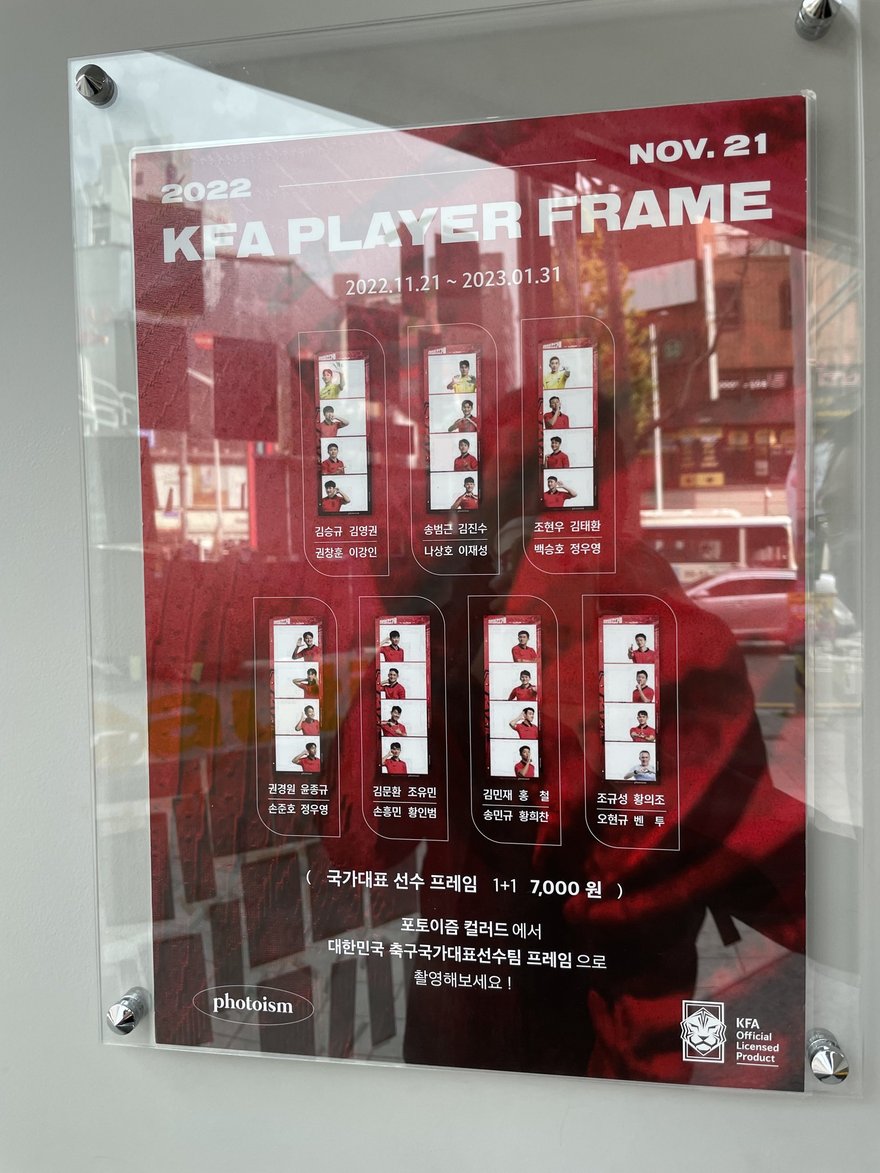
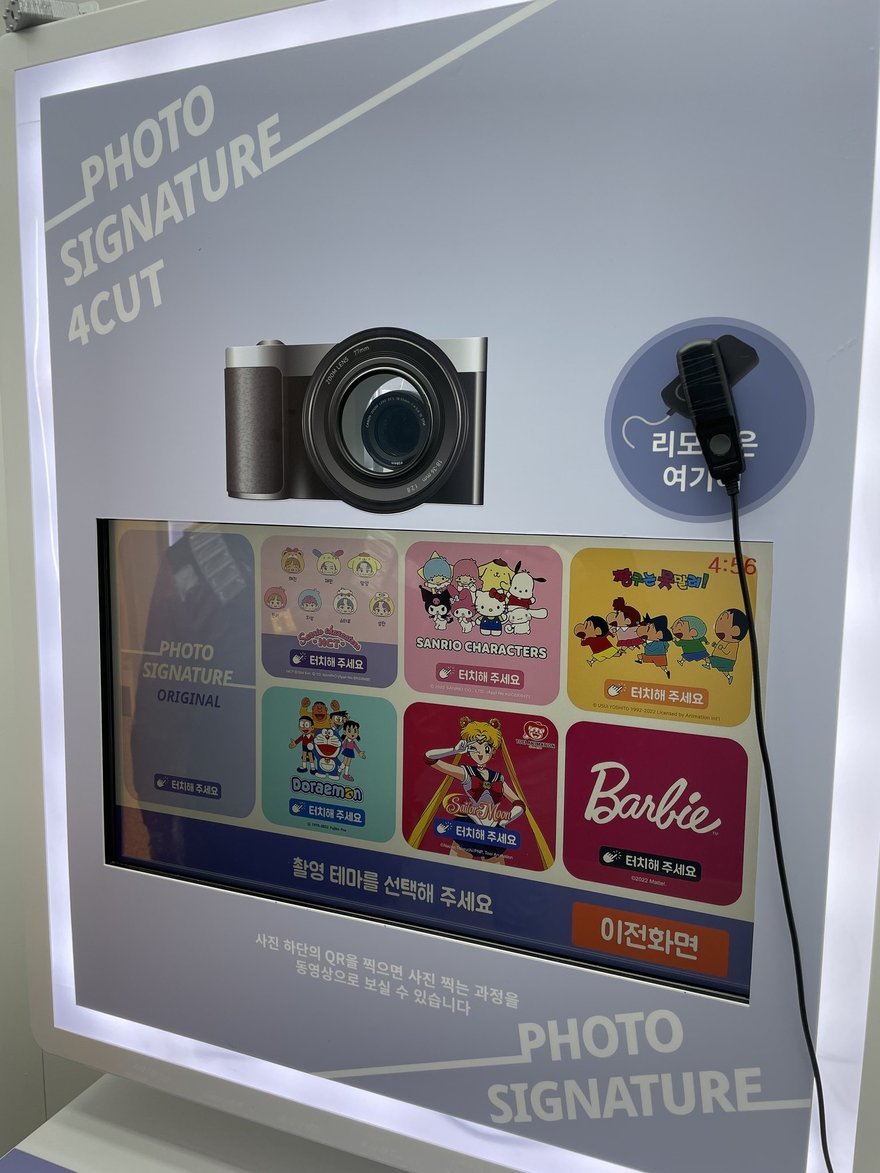
Taiwan has had machines like this for a while. At the 2016 Taipei International Comics & Animation Festival, a publisher set up a “Cheese! 拍拍樂” photo booth at its stand, charging NT$100 (about US$3) per session, with sample prints showing readers in the same frame as manga characters.



A character photo booth at the Taipei International Comics & Animation Festival in February 2016, NT$100 per session, selling photos with manga characters. We cropped out a passerby on the left. Photo: Solomon203, CC BY-SA 4.0, original.

The five settings side by side
| Setting | Price per photo |
What you’re buying |
|---|---|---|
| Underground idol Cheki ticket | About ¥1,000–2,000 | A photo with an idol, signed by the idol |
| Japanese maid cafe | ¥900–1,750 | A photo with a maid, with doodles or a voice message |
| Taiwanese maid cafe | About NT$300 (≈US$10) | A photo with a staff member |
| K-pop signed instant photo | Not sold; given out in lucky draws | A single photo signed by the idol |
| Korean photo booth idol frame | From 7,000 won for 2 prints | Being in the same frame as an idol’s photo |
Prices and sources are given in the text above. For Taiwan, there are only two cafes’ published prices, and for Japan, the official price lists of two big chains; none of these are market averages. The column to look at is the one on the right: none of the five settings is really selling a photo. They’re all selling proof that “we met” or “we were in the same frame.”
This also explains why instant cameras and photo booths have always risen and fallen together: they meet the same need. As Chapter 7 showed, instax’s first peak in 2002 coincided with the Japanese photo booth boom; today, maid cafes use instax to sell photos with their staff, and photo booths use collaboration frames to sell a place in the frame next to idols. The two lines have ended up in the same place again.
Digital photos can be copied endlessly, so they have no value; an instant photo or a printed photo booth sticker exists only once in the world, so it does.
11. Why something “killed by digital” came back to life in the smartphone era
Looking back at instax’s V, the most counterintuitive part is the timing: sales fell by about 90% as digital cameras and camera phones spread, yet grew about 100 times after smartphones took over.
My reading is this: digitization killed the use of “taking pictures,” but not the use of “getting a photo.”
In the mid-2000s, the main function of instant cameras and photo booths was taking pictures; at the time, many people had no other way to shoot something and see it on the spot. Once phones had built-in cameras, that function was replaced, and both faded together. In the smartphone era, everyone takes dozens of photos a day, so many that photos have lost all weight. That’s when “a photo you can touch, that exists only once, and that you can give to someone” became the scarce thing.
Fujifilm’s positioning followed exactly this path. It packaged instax as a communication tool rather than a camera, with the brand slogan “don’t just take, give.” Works Institute also notes that Fujifilm focused its marketing on scenarios for what to do with instax, rather than on specs.
The clearest illustration is instax’s smartphone printers. Starting with the SP-1 in 2014 and continuing through the mini Link in 2019 and the later Link series, these devices don’t take pictures at all; they only print photos from your phone onto real instax film. In its 2023 IR presentation, Fujifilm gave its own figures: 6.8 billion smartphones in use worldwide, while the penetration rate of compact photo printers is less than 0.1% (internal company survey). For Fujifilm, the phone isn’t instax’s enemy but its biggest source of film demand.
This is also where instax and Japanese photo booths parted ways in their second twenty years (again, my own observation). Japanese photo booths never returned to their peak: arcade revenue in 2023 was only about 20% of the 1997 level, and the main manufacturer, FURYU, now earns most of its revenue from character merchandise. instax, meanwhile, went global and grew about 100 times. The second wave for photo booths was the Korean-style self-service photo booth that expanded rapidly in Korea around 2020, whose selling point is likewise “the print comes out right after you shoot,” not the photo-taking itself.
As for Polaroid, when it stopped making film in 2008 it was seen as a casualty of the digital age. Today it survives on the same demand for physical photos, only on a far smaller scale than instax. It died twice, not because people stopped wanting physical photos, but because the company itself never found its way to that demand.
Conclusion
- Instant photography was conceived in 1943 by Polaroid founder Edwin Land, prompted by something his daughter said. The Model 95 went on sale in 1948, and the 1972 SX-70 set the form instant photos still have today: the print slides out and develops on its own.
- In Polaroid’s patent case against Kodak, the court found infringement in 1985, Kodak exited instant photography in January 1986, damages of $909.5 million were ordered in 1990, and the case settled for about $925 million in 1991. The damages were not decided in 1986.
- Polaroid was brought down by digital cameras in 2001 and by its parent company’s fraud case in 2008, going bankrupt twice, and stopped making instant film in 2008.
- The Impossible Project bought the old production line for $3.1 million in 2008, spent several years rebuilding the chemistry, bought the Polaroid brand in May 2017, and renamed itself Polaroid in 2020. There are no official figures for its recent revenue, only the €220 million for 2024 cited on a contractor’s page.
- instax launched in 1998. Annual sales were 1 million units in 2002, about 100,000 a year from 2004 to 2006, and 10.02 million in FY2018, about 100 times the trough. Fujifilm has not published annual sales since fiscal 2020; cumulative sales passed 100 million units before the end of FY2024.
- instax’s first peak in 2002 coincided with the photo booth boom in Japan and Taiwan, and both cooled off in the mid-2000s because of camera phones. In 2007, instax rebounded in East Asia thanks to a Korean drama and a Chinese blogger; I couldn’t find the drama’s title.
- instax revenue was ¥150 billion in FY2023 and ¥200 billion in FY2025 (a record for the fifth straight year), about a third of the Imaging division in both years. Imaging’s FY2025 operating income of ¥160 billion is the highest of Fujifilm’s four divisions, but it includes digital cameras.
- Since 2022, three capacity expansions totaling about ¥11.5 billion have raised capacity by about 50%, yet mini film prices still rose 22% to 27% in April 2026, and in October 2026 Fujifilm announced a fourth expansion (about ¥3 billion; once fully running in spring 2028, capacity will be about 70% above FY2022). That means demand is strong enough to absorb the price increases.
- The claim that “instax outsold the entire digital camera industry” doesn’t hold up. The correct version is that it outsold global shipments of interchangeable-lens cameras.
- The instant photo has gone from a picture-taking tool to a physical photo you give to someone, and to a kind of currency in the idol economy: underground idol Cheki tickets at about ¥1,000 to ¥2,000, Japanese maid cafes from ¥900, and Taiwanese maid cafes at about NT$300. Idol collaboration frames in Korean photo booths sell the same thing. That is why it came back to life in the smartphone era.
Further reading
- How to store instant film and photos: developing, temperature, expired film, and airport X-rays.
- instax and Polaroid photo sizes: size comparison for instax mini, WIDE, SQUARE, and Polaroid.
- Thirty years of Japanese sticker photo booths: another line in the same wave of East Asian photo consumption.
- The history of Taiwan’s photo booth and Korean-style photo booth industry: an overview of the photo booth industry and its Taiwan story.
Appendix 1: What I couldn’t find
I looked into these questions but couldn’t find reliable answers, so this article doesn’t cover them and doesn’t fill them in with estimates:
- Which Korean drama set off Cheki’s rebound in East Asia in 2007; no reliable source ties it to any specific title.
- Official instax annual sales from fiscal 2020 onward; Fujifilm publishes only revenue and cumulative units. The “about 10 million a year on average” in this article is my own estimate from subtracting two cumulative figures.
- instax’s operating income on its own; Imaging’s ¥160 billion includes digital cameras, and Fujifilm doesn’t break it out.
- The original basis for “instax is more than half of the imaging business”; it is probably the Consumer Imaging sub-segment, but Fujifilm doesn’t publish sub-segment revenue, so it can’t be verified.
- Polaroid’s official revenue in recent years; the only figure (€220 million in 2024) comes from a contractor’s case-study page, not from the company.
- Global market shares for instant cameras; market research reports contradict one another, so this article doesn’t use them.
- The launch price of the original instax mini 10 (1998), and the exact date instax went on sale in Japan (English Wikipedia says November 10, Japanese Wikipedia says December).
- The exact launch date of the Polaroid Model 95 (the 26th or the 28th).
- The actual size of the Cheki ticket market; the ¥10 billion is a reporter’s estimate. There are no figures at all for the secondhand market in signed K-pop instant photos.
- What share of Japanese maid cafe revenue comes from Cheki; the only figure I found is a secondhand report on a single cafe in Busan, Korea.
- Reliable reports of K-pop birthday cafes giving out instant photos; the freebies I found were all cup sleeves and photocards.
- Official press releases, frame counts, or sales figures for idol frames made by PHOTOISM, Life4Cuts, and entertainment agencies.
Appendix 2: Sources
- Harvard Business School Baker Library, Polaroid collection exhibit, on how Land conceived instant photography in 1943: https://www.library.hbs.edu/hc/polaroid/instant-photography/the-idea-of-instant-photography (checked 2026-09-25)
- American Chemical Society (ACS), National Historic Chemical Landmark page on instant photography, on the 1943 starting point and the February 21, 1947 public demonstration: https://www.acs.org/education/whatischemistry/landmarks/land-instant-photography.html (checked 2026-09-25)
- History.com, on the Model 95’s launch date, price, and first-day sales: https://www.history.com/this-day-in-history/november-26/first-polaroid-camera-sold (checked 2026-09-25)
- Wikipedia, “Polaroid Corporation,” on the 1937 founding, 1978 headcount, 1991 revenue, the 2001 and 2008 bankruptcies, One Equity Partners in 2002, Petters in 2005, and the 2009 auction: https://en.wikipedia.org/wiki/Polaroid_Corporation (checked 2026-09-25)
- Wikipedia, “Polaroid SX-70,” on its unveiling, launch, price, and 1974 sales: https://en.wikipedia.org/wiki/Polaroid_SX-70 (checked 2026-09-25)
- Wikipedia, “Instant camera,” on Kodak’s 1976 instant cameras and Fujifilm’s Fotorama: https://en.wikipedia.org/wiki/Instant_camera (checked 2026-09-25)
- IPWatchdog, on the rulings, injunction, settlement, and damages sought in Polaroid v. Kodak: https://ipwatchdog.com/2015/08/23/the-case-that-launched-10000-patent-suits/id=60795/ (2015-08-23)
- The Washington Post, report on the 1990 order to pay $909 million (only the headline is readable): https://www.washingtonpost.com/archive/business/1990/10/13/judge-orders-kodak-to-pay-909-million/ecdcd4b2-55b6-4a23-8b5f-7efd070d7306/ (1990-10-13)
- Fstoppers, on the roughly 16.5 million instant cameras Kodak had sold when it exited (secondary): https://fstoppers.com/historical/patent-war-changed-photography-forever-714881 (checked 2026-09-25)
- Star Tribune, on Polaroid’s 2008 bankruptcy filing along with the Petters group: https://www.startribune.com/polaroid-is-latest-petters-firm-to-file-chapter-11/36404444 (2008-12)
- Wikipedia, “Polaroid B.V.,” on the founding of the Impossible Project, the $3.1 million equipment purchase, the May 2017 brand acquisition, and the September rename to Polaroid Originals: https://en.wikipedia.org/wiki/Polaroid_B.V. (checked 2026-09-25)
- Kunststof & Rubber, on the Enschede plant’s peak headcount and the rebuilding of the chemistry: https://kunststofenrubber.nl/2024/09/17/polaroid-spuitgiet-miljoenen-filmpacks-per-jaar/ (2024-09-17)
- Dezeen, on the rename to Polaroid Originals: https://www.dezeen.com/2017/09/19/polaroid-originals-pays-homage-iconic-cameras-ever-created-photography-visual-identity/ (2017-09-19)
- TechCrunch, on the 2020 rename to Polaroid and the launch of the Polaroid Now: https://techcrunch.com/2020/03/27/weve-come-full-rectangle-polaroid-is-reborn-out-of-the-impossible-project (2020-03-27)
- TechCrunch, on the launch of the Polaroid Go: https://techcrunch.com/2021/04/21/polaroid-go-very-tiny-indeed (2021-04-21)
- PetaPixel, on the launch and price of the Polaroid I-2: https://petapixel.com/2023/09/07/polaroids-new-i-2-is-a-600-instant-camera-packed-with-features/ (2023-09-07)
- Polaroid press release, on the third-generation Now and Now+: https://press.polaroid.com/246847-introducing-polaroid-now-now-generation-3/ (2025-03-04)
- TCPM, engineering contractor case-study page, on Polaroid’s 2024 film output, revenue, and headcount (not published by the company; page undated): https://www.tcpm.nl/project/hands-on-engineering-ondersteuning-voor-polaroid/ (checked 2026-09-25)
- Wikipedia, “Instax,” on the 1998 launch, the three formats, and back-exposure technology: https://en.wikipedia.org/wiki/Instax (checked 2026-09-25)
- Japanese Wikipedia, “インスタントカメラ・チェキ,” on the month of the Japanese launch, 2014 sales, and use at idol events: https://ja.wikipedia.org/wiki/インスタントカメラ・チェキ (checked 2026-09-25)
- Wikipedia, “List of Instax cameras and printers,” on the SP-1, mini Link, and other printers and the release dates of each model: https://en.wikipedia.org/wiki/List_of_Instax_cameras_and_printers (checked 2026-09-25)
- PetaPixel, on the discontinuation of FP-100C: https://petapixel.com/2016/02/29/fujifilm-putting-end-fp-100c-peel-apart-instant-film/ (2016-02-29)
- Cheki Press, instax’s official media outlet, on the origin of the name Cheki: https://magazine.instax.jp/cheki-press/summary/29250/ (2026-02-27)
- Fujifilm イメージングソリューション事業説明会 (Imaging Solutions business briefing) presentation, on the five instax stages, the 80 million cumulative units, the 90% overseas share, business use cases, and smartphone and printer penetration: https://ir.fujifilm.com/ja/investors/ir-materials/presentations/session/main/0118/teaserItems1/0/tableContents/0115/multiFileUpload2_1/link/ff_presentation_jp_20231214_001im.pdf (2023-12-14)
- Works Institute, on instax unit sales by year, the background of the 2002 peak, the 2007 Korean drama and Chinese model’s blog, and the overseas share: https://www.works-i.com/works/series/seikou/detail028.html (2019-12-10)
- President, on 10 million units in FY2018 and the slump around 2005: https://president.jp/articles/-/38774?page=1 (2020-09-17)
- Fujifilm press release, on 100 million cumulative instax units and “don’t just take, give.”: https://www.fujifilm.com/jp/en/news/hq/12295 (2025-04-08)
- Fujifilm Holdings news, on ¥150 billion in FY2023 instax revenue (the original “FY2025 target achieved one year ahead of schedule” sentence) and Imaging revenue: https://holdings.fujifilm.com/en/news/list/1720 (2024-05-09)
- PetaPixel, citing Nikkei on “instax is more than half of the imaging business”: https://petapixel.com/2023/12/07/instax-is-more-than-50-of-fujifilms-imaging-business-and-is-still-growing/ (2023-12-07)
- PetaPixel, on instax’s consecutive revenue records: https://petapixel.com/2025/01/24/fujifilm-instax-poised-to-set-record-revenue-in-four-consecutive-years/ (2025-01-24)
- Fujifilm FY2025 results, on revenue and operating income by segment and the Consumer Imaging commentary: https://ir.fujifilm.com/en/investors/ir-news/auto_20260508520086/pdfFile.pdf (2026-05-08)
- Fujifilm press release, on ¥200 billion in FY2025 instax revenue (a record for the fifth straight year), the timing of the 100 million cumulative units, and the fourth film expansion of about ¥3 billion and its capacity: https://www.fujifilm.com/de/en/news/hq/14128 (2026-10-20)
- Fujifilm press release, on the third instax film expansion and the cumulative ¥11.5 billion investment: https://www.fujifilm.com/jp/ja/news/list/13167 (2025-12-18)
- Fujifilm Imaging Systems price revision notice, on the April 2026 instax film price change: https://www.fujifilm.com/ffis/ja/news/188 (2026-03-31)
- Digital Camera Watch (Japan), report on the April 2026 instax film price change: https://dc.watch.impress.co.jp/docs/news/2098168.html (2026-04-01)
- CIPA, 2018 digital camera production and shipment statistics: https://www.cipa.jp/stats/documents/e/d-2018_e.pdf (checked 2026-09-25)
- CIPA, 2019 digital camera production and shipment statistics: https://www.cipa.jp/stats/documents/e/d-2019_e.pdf (checked 2026-09-25)
- CIPA, 2025 digital camera production and shipment statistics: https://www.cipa.jp/stats/documents/e/d-2025_e.pdf (checked 2026-09-25)
- PetaPixel, the original claim that “instax outsold the entire digital camera industry in 2019”: https://petapixel.com/2022/04/26/the-biggest-camera-manufacturer-in-the-world-is-fujifilm/ (2022-04-26)
- Business Insider Japan, on Cheki ticket revenue splits and the ¥10 billion economy estimate: https://www.businessinsider.jp/article/297059/ (2024-11-21)
- Maidreamin official site, on Cheki prices, mounts, and albums: https://maidreamin.com/joy/amusement.html (checked 2026-10-28)
- Maidreamin official FAQ, on the ban on photographing or touching maids in the cafe: https://maidreamin.com/faq/ (checked 2026-10-28)
- @home cafe official site, on Cheki prices, collection Cheki, and set menu contents: https://www.cafe-athome.com/amusement-menu (checked 2026-10-28)
- AFPBB, republishing news1, on the revenue structure of Korean maid cafes and the Cheki split at a Busan cafe (secondary): https://www.afpbb.com/articles/-/3646019 (2026-07-28)
- Noir-island themed bistro, official account and reservation page, on instant photo and minimum-spend prices: https://www.instagram.com/noir_taichung/ , https://shop.ichefpos.com/store/NpmfqAzh/reserve (checked 2026-09-22)
- 冥酩カフェ&バー, official account, on the price of photos with guest staff: https://www.instagram.com/meimei.cafebar/ (checked 2026-09-22)
- Xports News, on the freebies and photo booth at aespa Karina’s birthday cafe: https://www.xportsnews.com/article/1715275 (2023-04-23)
- Korea JoongAng Daily, on PHOTOISM Artist Frame partners and pricing: https://www.koreajoongangdaily.com/korea/koreas-photo-booths-offer-creative-ways-of-leaving-memories/12031344 (2023-10-17)
- SBS (Australia), on idol collaboration frames at the Life4Cuts store in Melbourne: https://www.sbs.com.au/language/korean/en/article/making-memories-retro-trend-from-korea-a-hit-among-australias-digital-savvy-youth/t7wm2kf6k (2023-12-13)
- Japanese sticker photo booth revenue series: Japan Amusement Industry Association (日本アミューズメント産業協会), プリントシール機20年史 (20 years of print sticker machines), compiled on this site in thirty years of Japanese sticker photo booths; the timeline of Japanese-style photo booths in Taiwan is compiled on this site in the history of Taiwan’s photo booth industry.
Image sources
Apart from the author’s own photos and video still in Chapter 10, the photos in this article are openly licensed or public domain files from Wikimedia Commons, with photographers and licenses also credited under each image. There are also 5 screenshots of official Fujifilm documents, used as supporting citations and cropped to only the parts relevant to the text.
- Cover image and the Polaroid SX-70 in Chapter 1: Fabian Reus, CC BY-SA 2.0; the cover is a 16:9 crop. Original: https://commons.wikimedia.org/wiki/File:Polaroid_SX-70_Land_Camera_(3838125863).jpg
- Polaroid Model 95 at the MIT Museum (Chapter 1): Daderot, CC0. Original: https://commons.wikimedia.org/wiki/File:Polaroid_Land_Camera_Model_95_-_MIT_Museum_-_DSC03766.JPG
- Kodak EK2 instant camera and Trimprint film (Chapter 2): Joost J. Bakker, CC BY 2.0. Original: https://commons.wikimedia.org/wiki/File:Kodak_EK_2_Instant_Camera_and_Trimprint_film_(51888664791).jpg
- The Polaroid site in Enschede, 2024 (Chapter 5): Gewild, CC0. Original: https://commons.wikimedia.org/wiki/File:PolaroidEnschede2024-01.jpg
- instax mini 10 (Chapter 6): Andshel, CC BY-SA 3.0. Original: https://commons.wikimedia.org/wiki/File:Fujifilm_instax_mini_10_%D1%84%D0%BE%D1%82%D0%BE1.JPG
- Edwin Land, around 1971 (Chapter 1): Bernard Gotfryd, held by the Library of Congress, public domain. Original: https://commons.wikimedia.org/wiki/File:Edwin_H._Land,_founder,_Polaroid.jpg
- Screenshot: instax revenue over time (Chapter 7), page 10 of Fujifilm’s イメージングソリューション事業説明会 presentation, https://ir.fujifilm.com/ja/investors/ir-materials/presentations/session/main/0118/teaserItems1/0/tableContents/0115/multiFileUpload2_1/link/ff_presentation_jp_20231214_001im.pdf , captured September 25, 2026, supporting citation.
- Screenshot: instax cumulative 80 million units (Chapter 7), page 5 of the same presentation, captured September 25, 2026, supporting citation.
- Screenshot: press release on 100 million cumulative instax units (Chapter 7), Fujifilm, https://www.fujifilm.com/jp/en/news/hq/12295 , captured September 25, 2026, supporting citation.
- Screenshot: FY2025 revenue and operating income by segment (Chapter 8), Fujifilm FY2025 earnings summary, https://ir.fujifilm.com/en/investors/ir-news/auto_20260508520086/pdfFile.pdf , captured September 25, 2026, supporting citation.
- @home cafe in Akihabara, 2011 (Chapter 10): Ryo FUKAsawa, CC BY 2.0. Original: https://commons.wikimedia.org/wiki/File:Outside_of_@home_cafe_20111128.jpg
- “Cheese! 拍拍樂” photo booth at the Taipei International Comics & Animation Festival, 2016 (Chapter 10): Solomon203, CC BY-SA 4.0; a passerby on the left was cropped out. Original: https://commons.wikimedia.org/wiki/File:Photo_booth_in_Taipei_International_Comics_%26_Animation_Festival_by_Ever_Glory_Publishing_20160211.jpg
- Kirabase’s in-store stage, the PHOTOISM KFA collaboration frame poster, and the Photo Signature Barbie collaboration frame (Chapter 10): photos by the author (Joe).
- Screenshot: press release on instax film capacity expansion (Chapter 8), Fujifilm, https://www.fujifilm.com/jp/ja/news/list/13167 , captured September 25, 2026, supporting citation.
Keywords: instant camera history, history of Polaroid, Polaroid bankruptcy, Impossible Project, instax sales, instax history, Fujifilm instax, Cheki, Fujifilm Imaging division, Polaroid vs Kodak patent case, maid cafe Cheki, idol photo booth frames, Polaroid Now
Frequently asked questions
Who invented the instant camera?
Instant photography was invented by Edwin Land, the founder of Polaroid. In 1943 he was taking pictures of his three-year-old daughter, and she asked why she couldn’t see the photo right away. Land later said that within an hour he had worked out the camera, the film, and the chemistry. The first commercial model, the Model 95, went on sale in Boston in November 1948. Today, both Polaroid and Fujifilm instax make instant cameras.
Did Polaroid go out of business? Is today’s Polaroid the original company?
The original Polaroid company filed for bankruptcy twice, in 2001 and 2008, and stopped making instant film in 2008. Today’s Polaroid is a different company: the Dutch firm The Impossible Project bought the old production line for $3.1 million in 2008, its largest shareholder bought the Polaroid brand and intellectual property in May 2017, and the company officially renamed itself Polaroid in 2020. The factory is still the same one in Enschede, the Netherlands.
How many instax cameras are sold each year?
The annual sales figures Fujifilm has published are: 1 million units in 2002, about 100,000 to 120,000 units a year from 2004 to 2006, 1.27 million in 2011, and 10.02 million in fiscal 2018. From fiscal 2020 onward, Fujifilm has published only revenue and cumulative units, not annual sales. Cumulative sales of cameras plus smartphone printers passed 100 million units before the end of FY2024 (announced in April 2025).
What does Cheki (チェキ) mean?
Cheki (チェキ) is instax’s nickname in Japan. According to Fujifilm, it is a coined word shortened from the English “check it.” The official brand name is instax, and the name Cheki is used only in Japan, even though about 90% of instax revenue comes from outside Japan.
How much does an instant photo (Cheki) cost at a maid cafe?
According to official price lists checked on October 28, 2026, Maidreamin (めいどりーみん) in Japan charges ¥900 for a regular Cheki, ¥1,150 for a large one, and ¥1,750 for one with a voice message; @home cafe (あっとほぉーむカフェ) charges ¥900 for a business-card-size Cheki, ¥1,110 for an L-size print, and ¥1,200 for a solo maid shot with doodles. In Taiwan, only a few cafes publish their prices; Noir-island in Taichung, for example, charges NT$300 (about US$10) per photo. Most cafes don’t let customers photograph staff themselves, so the only way to get a photo together is to buy the cafe’s instant photo.
Did instax really outsell the entire digital camera industry?
No. That claim is exaggerated. According to CIPA statistics, global digital camera shipments totaled about 15.22 million units in 2019, of which interchangeable-lens cameras were about 8.46 million; instax was selling about 10 million units a year at the time. The accurate version is that instax outsold global interchangeable-lens camera shipments, but not all digital cameras. On top of that, instax figures use Fujifilm’s fiscal year while CIPA uses calendar years, so the two are three months apart.
Sources: Chinese original first published on 2026-09-25 (Taipei) and revised on 2026-10-28. Data was checked on 2026-09-25; official maid cafe price lists were checked on 2026-10-28, and Fujifilm's 2026-10-20 press release has been incorporated.
This English version is based on original Traditional Chinese content on joelin.cc. The language and explanations are localised for international readers. The Traditional Chinese original is the authoritative version — for its complete meaning, please read the original article.