
This article is also available in:繁體中文 · 日本語 · Tiếng Việt
Summary
This article brings together research on Japan’s sticker photo booth industry—プリクラ/プリントシール機—from 1995 to 2026, alongside the main articles on Taiwan and South Korea. On July 25, 1995, プリント倶楽部 debuted: Atlus developed the concept, SEGA handled the camera and cabinet, and Sony supplied the printer. In 1996, more than a dozen game companies, including SNK, Capcom, Konami, Sammy, and Namco, followed, along with Omron and 船井電機. According to 日本アミューズメント産業協会’s プリントシール機20年史 (“Twenty Years of Sticker Photo Booths”), the market peaked in 1997: arcade revenue from sticker photo booths reached ¥101.3 billion, manufacturers’ domestic sales reached ¥48.9 billion, and 50,228 machines were installed. The frequently cited figures of “¥100 billion” and “¥48 billion” measure two different kinds of revenue in the same year. Arcade revenue fell to ¥41.8 billion in 1998.
According to JAIA’s industry surveys, arcade revenue from sticker photo booths was ¥19.3 billion in 2023, with 7,441 machines installed—roughly 20% and 15% of their respective peaks. Annual revenue per machine, however, was approximately ¥2.59 million, above the roughly ¥2.02 million recorded in 1997. Among manufacturers, Atlus ended its commercial arcade game business at the end of March 2009, following heavy losses in 1999; トーワジャパン went bankrupt in 1999, and メイクソフトウェア in 2018. The active manufacturers in the core arcade market are FURYU and SEGA, which reentered with fiz in 2020. 辰巳電子工業 has shifted to machines for events and tourist attractions, while 加賀デバイス mainly supplies components.
More than ten listed companies participate in the industry’s supply chain, including FURYU 6238, セガサミー 6460, GENDA 9166, ラウンドワン 4680, イオンファンタジー 4343, カプコン 9697, and バンダイナムコ 7832. Only FURYU discloses sticker photo booth revenue separately in its financial statements. FURYU began as an internal Omron venture in 1997, entered sticker photo booths in 1998, became a subsidiary in 2003, and gained independence through a management buyout in 2007. It listed directly on the Tokyo Stock Exchange’s First Section on December 18, 2015, and completed a three-for-one stock split in 2017. Its share of installed machines rose from roughly 30–40% in the early 2010s to approximately 98% in 2019, according to its own research, as competitors exited.
FURYU supplies arcades rather than operating them, earning money from sticker consumables and cloud memberships. In the fiscal year ended March 2026, cloud membership revenue exceeded machine and consumable revenue for the first time. Its “Worldview” business, including character merchandise, already accounted for 61.9% of revenue as it moved toward becoming an IP company. Challenges in the 2020s came from SEGA’s return and Korean-style self-service photo studios, which entered Japan in 2021; PHOTOISM had approximately 100 locations.
Key facts
- Japan’s first sticker photo booth, プリント倶楽部, launched on July 25, 1995. Atlus developed the concept, SEGA handled the camera and cabinet, and the printer was supplied by Sony.
- Both プリント倶楽部 and プリクラ are registered SEGA trademarks. The industry’s formal category name is プリントシール機.
- Japan’s sticker photo booth market peaked in 1997: arcade revenue was ¥101.3 billion, manufacturers’ domestic sales were ¥48.9 billion, and 50,228 machines were installed, according to JAIA’s プリントシール機20年史.
- The frequently cited 1997 figures of “¥100 billion” and “¥48 billion” refer to different measures in the same year: arcade revenue and manufacturers’ sales, respectively.
- Arcade revenue from sticker photo booths fell to ¥41.8 billion in 1998, a decline of approximately 60% in one year. Manufacturers’ sales fell to ¥14.5 billion.
- In 2023, arcade revenue from sticker photo booths was ¥19.3 billion, with 7,441 machines installed—approximately 20% and 15% of the 1997 peaks, according to JAIA’s industry survey.
- Annual revenue per machine rose from roughly ¥2.02 million in 1997 to ¥2.59 million in 2023. Machine numbers fell by approximately 85%, while revenue per machine rose by roughly 30%. These figures were calculated by this site by dividing revenue by machine count.
- Of manufacturers’ ¥5.6 billion in sales in 2023, stickers, consumables, and ink accounted for ¥4.1 billion, or approximately 73%.
- Atlus did not exit in 1999. After reporting a ¥5.8 billion ordinary loss for the fiscal year ended March 1999, it resolved on February 6, 2009, to close its commercial arcade game business, including sticker photo booths, on March 31.
- トーワジャパン went bankrupt in 1999. メイクソフトウェア, formerly the industry’s second-largest manufacturer, went bankrupt in October 2018, and 加賀デバイス took over its business.
- The active sticker photo booth manufacturers in the core arcade market are FURYU and SEGA, which reentered in October 2020 with fiz. 辰巳電子工業 has shifted to machines for event promotions and tourist souvenirs. 加賀デバイス, a wholly owned subsidiary of 加賀電子, mainly supplies components such as printers and stickers after taking over メイクソフトウェア’s business.
- More than ten listed companies participate in Japan’s sticker photo booth supply chain, but only FURYU, TSE 6238, discloses sticker photo booth revenue separately in its financial statements.
- FURYU began as an internal Omron venture in April 1997, entered sticker photo booths in April 1998, became the subsidiary オムロンエンタテインメント in July 2003, and gained independence through a management buyout in April 2007.
- FURYU listed directly on the Tokyo Stock Exchange’s First Section on December 18, 2015, at an offering price of ¥3,200. A three-for-one stock split in March 2017 makes the adjusted offering price approximately ¥1,067.
- FURYU’s share of installed machines rose from approximately 30–40% in the early 2010s to roughly 98% in 2019, according to the company’s own research, primarily as competitors exited.
- FURYU supplies arcades rather than operating them. In its sticker photo booth business for the fiscal year ended March 2026, cloud membership revenue of ¥6.82 billion exceeded revenue from machines and consumables sold to arcades, ¥6.12 billion, for the first time.
- FURYU’s Worldview business, including character merchandise, accounted for 61.9% of revenue in the fiscal year ended March 2026, rising to 67.9% in April–June 2026.
- Korean-style self-service photo studios entered Japan in February 2021. PHOTOISM had approximately 100 locations by June 2025.
The original Chinese article was published on September 24, 2026, and updated on October 6, 2026. The research dates and market figures below reflect that historical snapshot.
Japan is the birthplace of sticker photo booths. On July 25, 1995, game companies Atlus and SEGA launched プリント倶楽部, or Print Club. Two years later, in 1997, arcades across Japan collected ¥101.3 billion from sticker photo booths in a single year, with 50,000 machines installed nationwide. Revenue more than halved the following year. The more than thirty manufacturers that had rushed into the market dropped out one after another over the next twenty years. By 2023, annual arcade revenue from sticker photo booths had fallen to ¥19.3 billion, roughly 20% of its peak. Today, approximately 90% of Japan’s sticker photo booths come from one company—FURYU—yet 60% of that company’s own revenue already comes from something other than sticker photo booths.
After writing about Taiwan and South Korea, this article returns to the industry’s origins. It answers three questions:
- When did sticker photo booths begin in Japan, and which companies defined each period?
- Which listed companies participate in this supply chain, and when did each go public?
- How did FURYU grow from an Omron division into an almost exclusive machine supplier, and where is it heading now?
Every figure is accompanied by its source and definition. Questions I could not resolve are listed separately at the end; I have not filled the gaps with estimates.
1. Invention and the First Bubble, 1995–1999
Print Club: A Software Company Meets an Arcade Machine Company
The Print Club concept came from Atlus. At the time, Atlus made game software and had no hardware of its own, so the division of labor was straightforward: Atlus supplied the idea and software, SEGA handled the camera and cabinet, and the printer came from Sony. The first machine launched on July 25, 1995. A session cost ¥300 and produced a small sheet of peel-off stickers.
Both プリント倶楽部 and its abbreviated form, プリクラ, are registered SEGA trademarks. Japan’s industry therefore uses プリントシール機, meaning “photo sticker machine,” as the formal category name rather than プリクラ. I explain the terminology’s origins separately in What Are Sticker Photo Booths Called in Japanese?.
Why 1995 in particular? I could not find any official or academic source that directly answers this question. All I found were accounts saying that development was completed and the product launched, so I will not invent a reason here.
1996: More Than Thirty Companies Rush In
Once Print Club became a hit, other game companies rushed to follow. プリントシール機20年史, published in 2015 by 日本アミューズメント産業協会—JAIA, formerly JAMMA—names the following companies as having begun developing competing products in 1996:
- Game companies: エス・エヌ・ケイ (SNK), 大平技研工業, カプコン (Capcom), コナミ (Konami), サミー (Sammy), ジャレコ (Jaleco), データイースト (Data East), ナムコ (Namco), ビデオシステム, ビスコ, and ヒューマン.
- Major electrical equipment manufacturers: オムロン (Omron, the company known for blood pressure monitors and sensors) and 船井電機.
- Major companies participating through partnerships: 松下電器産業, パイオニア, コニカ, and 第一興商.
A frequently repeated account says that “around thirty companies entered at the peak.” This list is the basis for that figure; the original list also includes SEGA. Of the companies on it, SEGA is the only one I can confirm still makes sticker photo booths today, and even it withdrew for twenty years. Omron’s business later became the independent company FURYU, the subject of Section 6.
The 1997 Peak Actually Has Two Figures
Two seemingly conflicting figures frequently appear in accounts of Japan’s sticker photo booth heyday: some say the market exceeded ¥100 billion in 1997, while others say ¥48 billion. Both are correct, because they measure different flows of money.
| Measure | 1997 | What it measures |
|---|---|---|
| Arcade revenue | ¥101.3 billion | Money players spent at the machines and arcades collected |
| Manufacturers’ domestic sales | ¥48.9 billion | Money manufacturers received from selling machines, software, and sticker consumables to arcades |
| Installed machines | 50,228 | Sticker photo booths installed throughout Japan |
All three figures come from different pages of the same JAIA document, プリントシール機20年史. Thus, when you read “¥100 billion in 1997,” it refers to consumer spending; “¥48 billion” refers to manufacturers’ sales. This site’s main article on Taiwan and FURYU company study each cited one of these figures. Placing them side by side here makes their definitions clear.
1998: More Than Halved in One Year
The bubble burst quickly. Arcade revenue from sticker photo booths fell from ¥101.3 billion in 1997 to ¥41.8 billion in 1998, a decline of 60% in one year. Manufacturers fared even worse: sales fell from ¥48.9 billion to ¥14.5 billion, less than 30% of the previous year’s level. Machine numbers declined more slowly, from 50,228 to 46,768. The machines were still there, but fewer people were using them, and new machines were no longer selling.
The most emblematic casualty was the inventor, Atlus itself. At the peak, it mass-produced a new machine, スーパープリクラ21, targeting 2,500 units but selling only about half. In the fiscal year ended March 1999, it reported an ordinary loss of ¥5.8 billion, including ¥3.1 billion in inventory write-downs alone. These two figures come from a case study by 國學院大學 and are secondary citations. Another company, トーワジャパン, which had opened up the market for full-body photography, went bankrupt in 1999.
Atlus did not exit in 1999. After the financial blow, it continued selling sticker photo booths on a steadily shrinking scale. It did not resolve to close its entire commercial arcade game business, including sticker photo booths, until February 6, 2009, with the closure taking effect on March 31. According to contemporary reports by Nikkei xTECH and ITmedia, rising raw material and development costs, together with the industry downturn, led it to conclude that a return to profitability would be difficult. I could not find a source for the common claim that “Atlus exited in 1999.” It appears to conflate the losses in 1999 with the withdrawal in 2009.
2. How Large Was the Market? 1996–2013
JAIA’s Twenty-Year History includes annual figures from 1996 to 2013. It is the only official source I have found that covers the entire industry with a continuous annual series.
| Year | Arcade revenue (¥ billion) | Installed machines | Manufacturers’ sales (¥ billion) |
|---|---|---|---|
| 1996 | 60.4 | 35,436 | 32.0 |
| 1997 | 101.3 | 50,228 | 48.9 |
| 1998 | 41.8 | 46,768 | 14.5 |
| 1999 | 39.5 | 39,770 | 10.4 |
| 2000 | 51.1 | 41,814 | 13.1 |
| 2002 | 60.5 | 36,546 | 18.8 |
| 2005 | 42.3 | 20,572 | 19.3 |
| 2007 | 30.7 | 19,760 | 16.9 |
| 2010 | 24.7 | 15,053 | 11.0 |
| 2013 | 26.7 | 13,050 | 13.3 |
This table shows three turning points. The first was the collapse in 1998. The second was the recovery from 2000 to 2002, when revenue returned to above ¥60 billion. This coincided with the new technologies discussed in Section 3: facial recognition and the establishment of drawing and annotation features. The third was the long decline after 2002. By 2013, revenue had fallen to ¥26.7 billion, roughly a quarter of the peak; machine numbers stood at 13,050, also roughly a quarter of the peak.
Manufacturers’ sales also remained between roughly ¥10 billion and ¥20 billion after 1998, with sticker consumables accounting for an increasing share. Consumables represented approximately 30% of manufacturers’ sales in 1997—¥15.2 billion out of ¥48.9 billion—and approximately 65% in 2013—¥8.6 billion out of ¥13.3 billion. Once machines became harder to sell, more and more of the business’s money came from “the paper used up with every session.” This is the first clue to understanding FURYU’s business model.
2.2. After 2014: Down to 20% of the Peak
For figures after 2013, a different source is needed: JAIA’s annual アミューズメント産業界の実態調査, its survey of the amusement industry. Manufacturers’ sales match exactly in the four overlapping years from 2010 to 2013—¥11.0 billion, ¥14.0 billion, ¥14.0 billion, and ¥13.3 billion—so that column can be joined directly. JAIA did not separately identify sticker photo booth arcade revenue and machine counts until the 2019 reporting year. The report explicitly notes that all revenue in this category comes from sticker photo booths. Separate figures cannot be extracted for 2014–2018.
| Year | Arcade revenue (¥ billion) | Installed machines | Manufacturers’ sales (¥ billion) |
|---|---|---|---|
| 2014 | — | — | 10.0 |
| 2015 | — | — | 9.4 |
| 2016 | — | — | 8.7 |
| 2017 | — | — | 9.5 |
| 2018 | — | — | 10.3 |
| 2019 | 25.7 | — | 13.7 |
| 2020 | 24.0 | — | 3.9 |
| 2021 | 17.2 | 7,711 | 5.4 |
| 2023 | 19.3 | 7,441 | 5.6 |
The report for the 2022 reporting year only published percentage changes for 2023 relative to the previous year, without providing the 2022 figures themselves. The 2024 edition was not published until May 2026 and is a paid publication; I could not find detailed figures in public sources. I have left both years blank rather than filling them with calculations.
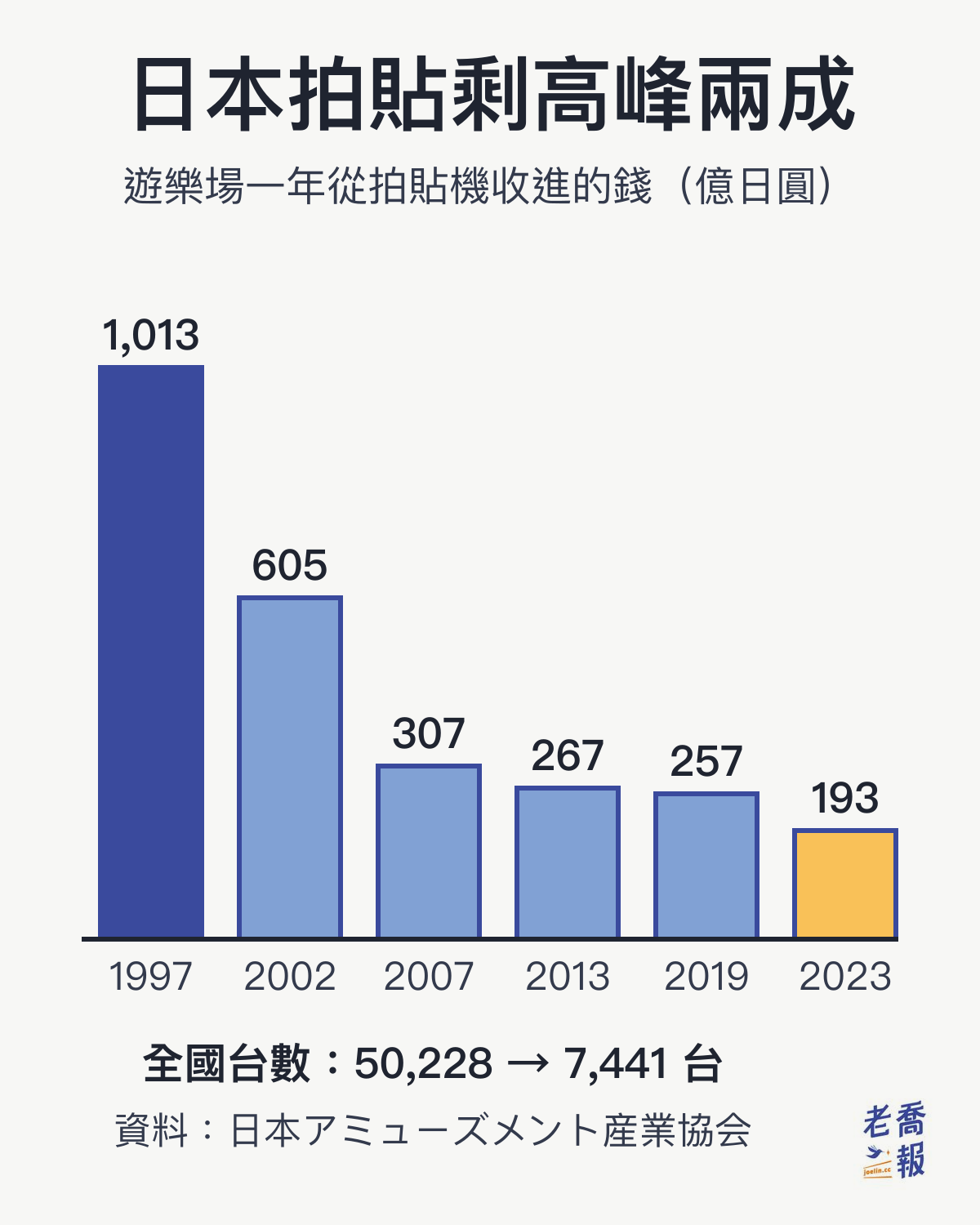
This table tells us three things.
First, in 2023, arcades collected ¥19.3 billion from sticker photo booths in a year, approximately 20% of the 1997 peak. The 7,441 machines nationwide represented roughly 15% of the peak count. This is what media reports mean when they say the market is “down to 20% of its heyday.”
Second, the pandemic hit manufacturers harder than arcades. Arcade revenue fell by less than 10% in 2020, from ¥25.7 billion to ¥24.0 billion, but manufacturers’ sales dropped from ¥13.7 billion to ¥3.9 billion, less than 30% of the previous level. Arcades still earned revenue while they were operating, but stopped buying new machines.
Third, there were fewer machines, but each generated more revenue. Dividing revenue by machine count gives approximately ¥2.02 million per machine per year in 1997, ¥2.04 million in 2013, and ¥2.59 million in 2023. These are my calculations; JAIA’s report for the 2021 reporting year separately published a figure of ¥2.235 million per machine. Machine numbers fell by 85%, yet revenue per machine was 30% higher than during the heyday. Meanwhile, stickers, consumables, and ink accounted for ¥4.1 billion of manufacturers’ ¥5.6 billion in sales in 2023, approximately 73%. Revenue has become increasingly concentrated on “each session,” a pattern that has continued from 1997 to the present.
3. Technology Generations: From Stickers to Big Eyes to a Natural Look
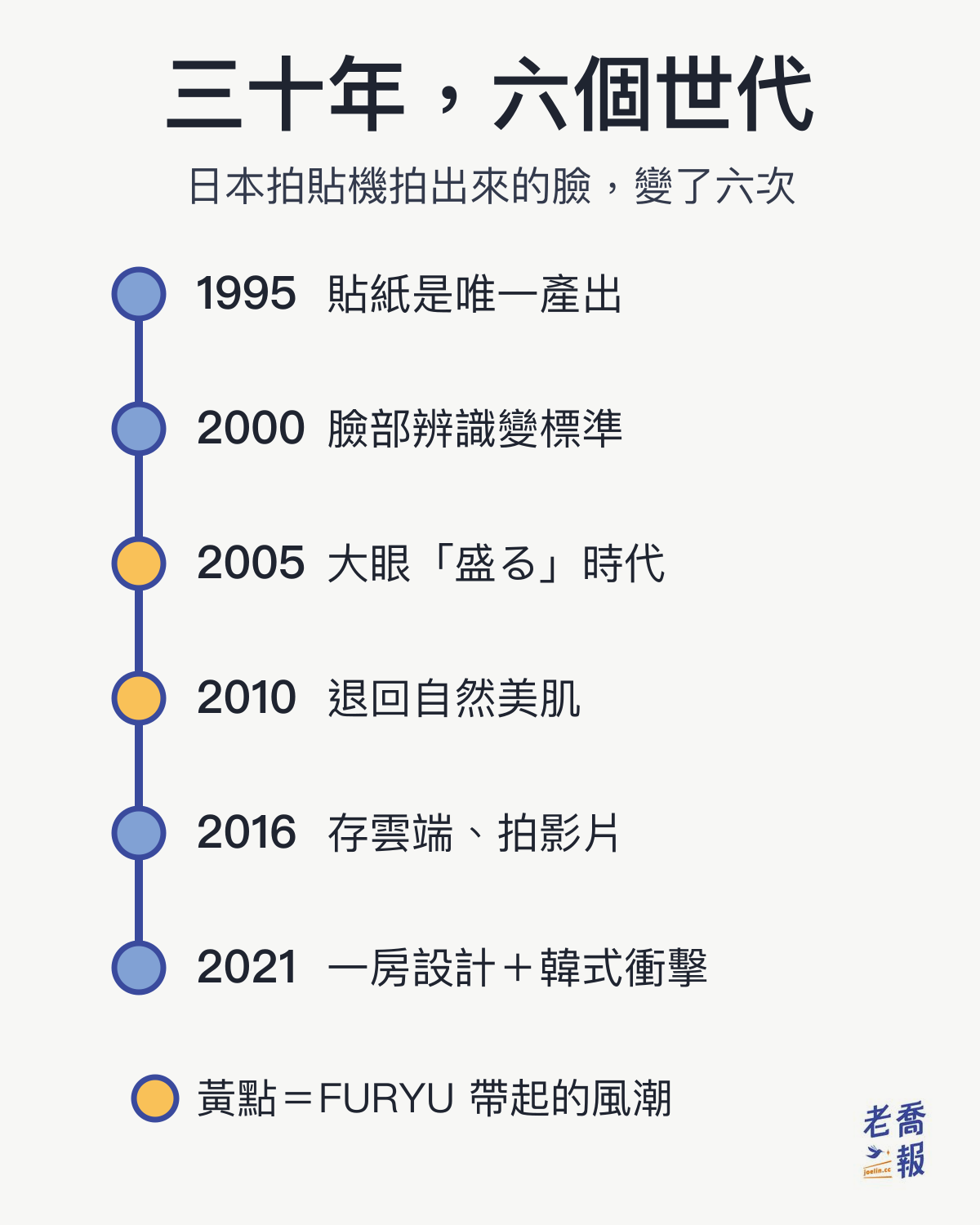
Over thirty years of Japanese sticker photo booths, the faces they produce have changed several times. For the period before 2015, I draw on the three eras in JAIA’s Twenty-Year History: photography and play in balance, big eyes, and a natural look. The divisions after 2016 are my own, giving six generations in total:
| Generation | Years | Representative machines (manufacturer) | What changed |
|---|---|---|---|
| Birth and collapse | 1995–1999 | プリント倶楽部 (Atlus/SEGA), ストリートスナップ (トーワジャパン) | Stickers were the only output. In 1997, トーワジャパン launched the first machine capable of full-body photography, which became a standard feature thereafter. |
| Technological maturity | 2000–2004 | Hitomi (アイ・エム・エス, 2000), 花鳥風月 (ナムコ, 2003) | Facial recognition became an industry standard, drawing and annotation features took their established form, and separate photography and editing areas allowed two groups to use a machine simultaneously. |
| Big-eye era | 2005–2009 | 女神のレシピ (辰巳電子, 2006), 美人-プレミアム- (FURYU, 2007), CUBE (メイクソフトウェア, 2008) | Eyes were enlarged enough for the editing to be obvious. 盛る—enhancing a photo to look more attractive—became the core appeal. Sticker photo image files could now be sent to mobile phones. |
| Turn toward a natural look | 2010–2015 | LADY BY TOKYO (FURYU, 2011), PLATINUM BALANCE (バンダイナムコ, 2014) | The look moved away from enlarged eyes toward natural-looking skin enhancement. Machine exteriors began featuring photographs of real models. |
| Cloud and video | 2016–2020 | fiz (SEGA, 2020) | Photos moved to cloud membership services. SEGA returned and introduced moving images. |
| Single-room design and outside competition | 2021–2026 | GIMMI (SEGA, 2024), NICO MAKE (SEGA, 2025) | Photography, drawing, and printing were combined in one room. Korean-style self-service photo studios introduced the opposing aesthetic of “no retouching.” |
The most striking detail in this table is that the same company drove both aesthetic turning points: 美人-プレミアム- launched the big-eye trend in 2007, and LADY BY TOKYO brought the market back toward a natural look in 2011. Both were FURYU products. A company that twice determined the aesthetic direction of the entire market probably had one of the ingredients for its later dominance. I return to this in Section 6.
JAIA’s original periodization stops at 2015. There is no industry consensus on how to divide the period after 2016; the final two periods are simply a way to make the history easier to read.
Sticker Photo Booths Through the Years
The four photographs below show sticker photo booth settings in Japan in different years. They come from openly licensed photographs on Wikimedia Commons. They do not show the specific models named in the table above: most official manufacturer photographs from the 1990s through the early 2010s have been taken down, and these are the images available for lawful reuse. They do, however, show what sticker photo booth areas looked like in each period.
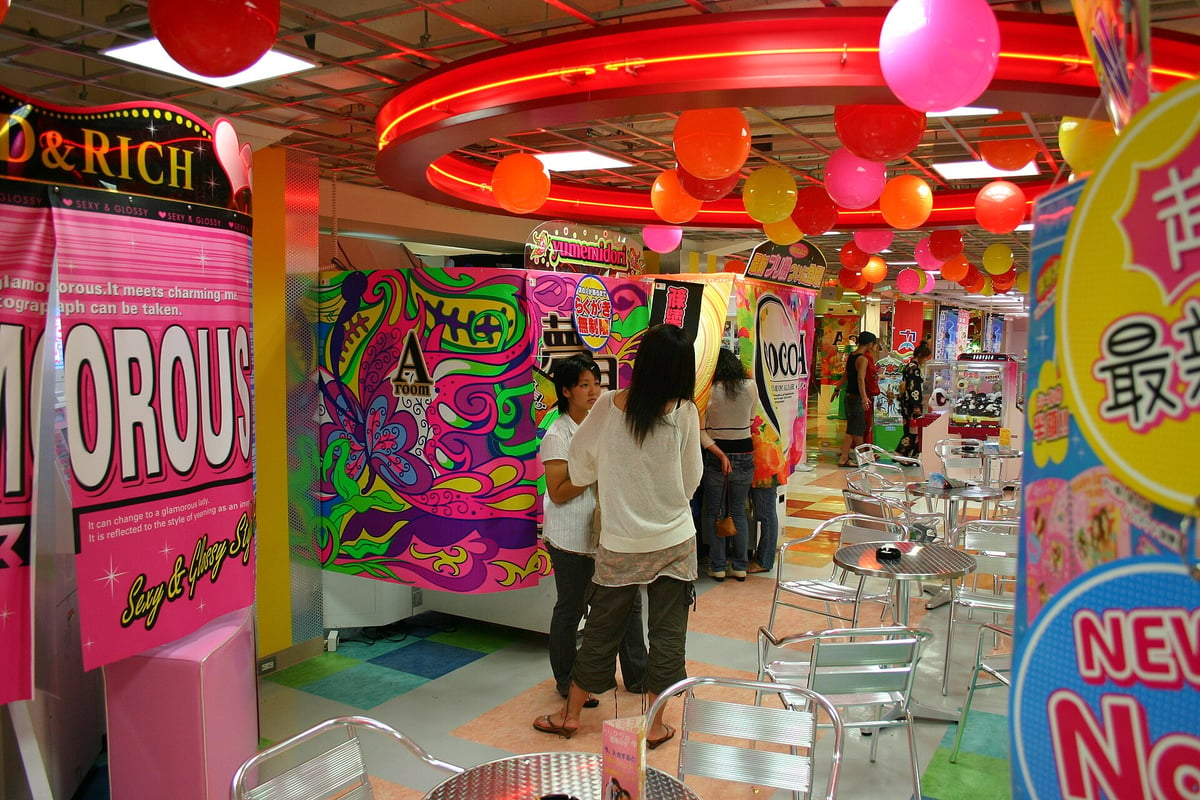
A sticker photo booth area in a Japanese arcade in 2005; the location is unspecified. These areas were usually decorated more elaborately than the rest of the arcade, with tables and chairs where customers could divide their stickers immediately after taking photos. Photograph: Tom Page, CC BY-SA 2.0, original image.
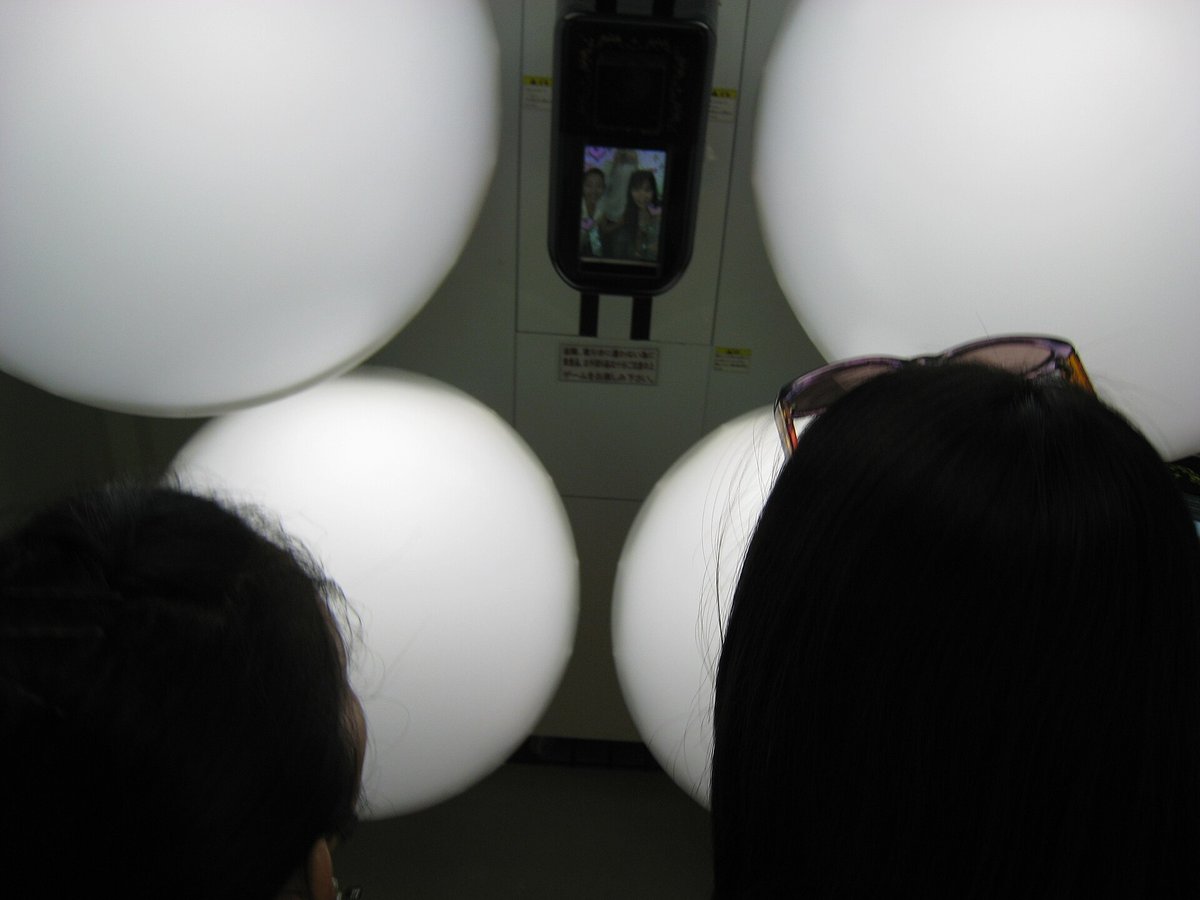
Inside a sticker photo booth in Osaka, August 2007. Four large fill lights illuminate the face, providing the hardware foundation for the “beautiful skin” effect. This was during the third generation, the big-eye era. Photograph: Syced, CC0 public domain dedication, original image.
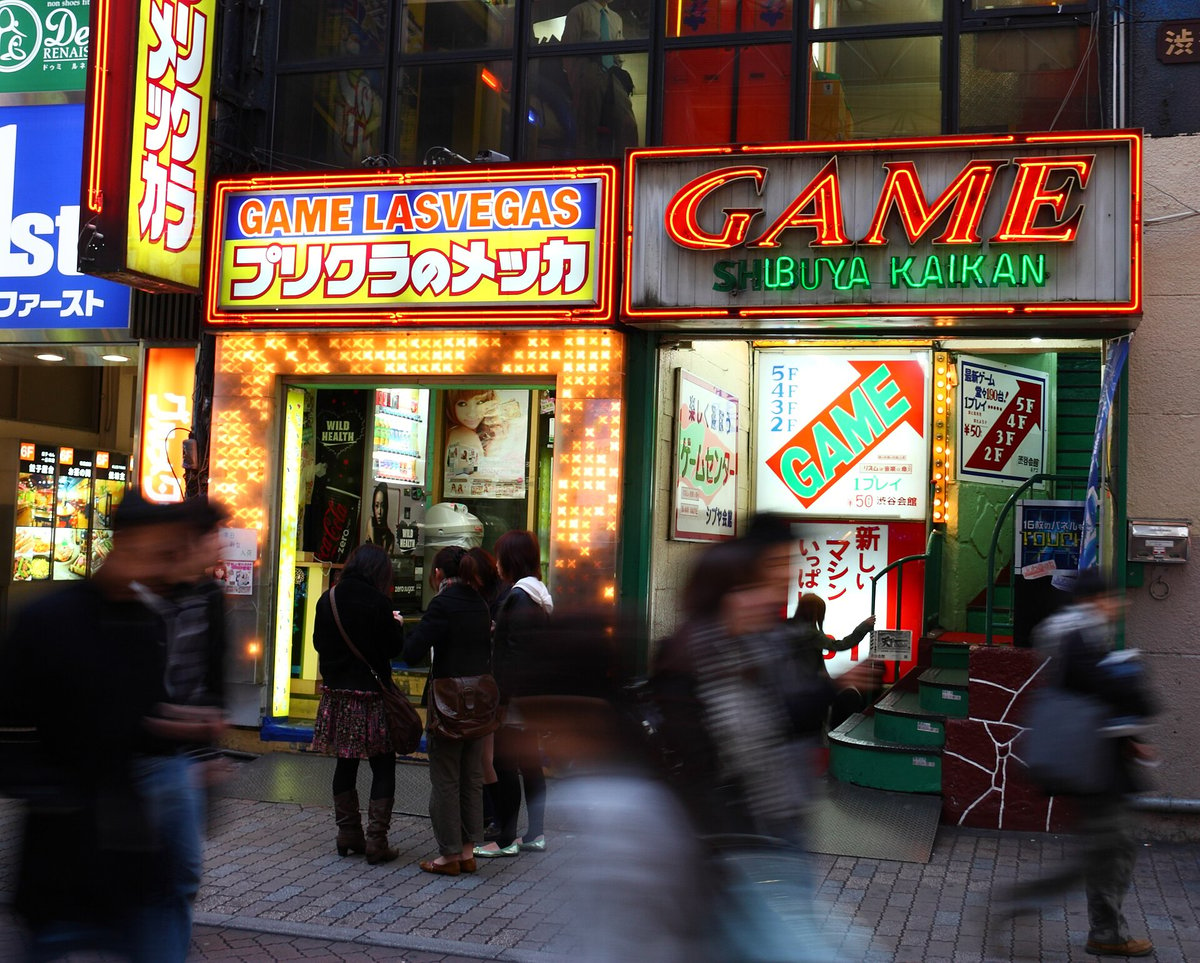
Shibuya, Tokyo, April 2010. GAME LASVEGAS explicitly advertised itself as プリクラのメッカ, “the mecca of sticker photo booths.” These were the years when sticker photo booths were moving from big eyes toward a natural look, and Shibuya was the center of high-school girls’ sticker photo culture. Photograph: Wenjie Zhang, CC BY 2.0, original image.
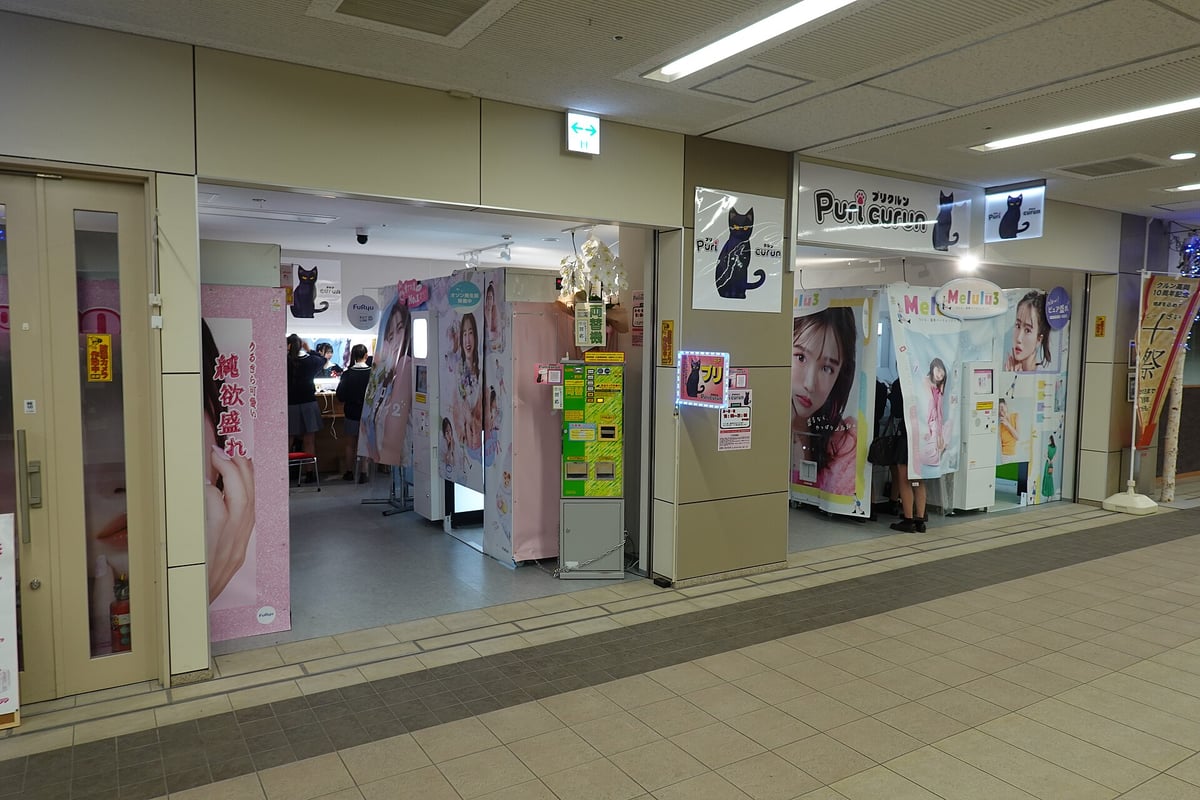
The dedicated sticker photo booth shop Puri curun in Takaoka, Toyama Prefecture, May 2024. 盛れ—the promise of looking better in the resulting photos—remains a selling point on the machines’ curtains, and FURYU’s logo hangs at the entrance. Thirty years later, almost all the machines in the shop come from the same company. Photograph: Smiley.toerist, CC BY-SA 4.0, original image.
Men Cannot Enter on Their Own
Japanese sticker photo booth areas have a rule that often catches foreign visitors by surprise: men cannot enter on their own and must be accompanied by a woman. The reasons usually given are preventing covert photography, harassment, and unwanted approaches. The earliest reference I found was a 2024 interview in which タイトー (Taito) said it had introduced restrictions “more than ten years ago.” I could not establish the first year or the first operator to adopt the rule.
4. Who Dropped Out, and When?
Looking at manufacturers one by one shows how the market reached the point where “only FURYU remained.”
| Manufacturer | Representative products | Outcome |
|---|---|---|
| アトラス (Atlus) | Print Club, 1995 | Heavy losses from overproduction in 1999; ended its commercial arcade game business, including sticker photo booths, at the end of March 2009 |
| セガ (SEGA) | Print Club hardware, 1995 | Withdrew around 2000; reentered with fiz in October 2020; transferred the business to subsidiary セガ フェイブ in April 2024; still active |
| トーワジャパン | ストリートスナップ, 1997 | Bankrupt in 1999 |
| 日立ソフトウェアエンジニアリング | Joint development with トーワジャパン in 1997; 美写 series in the 2000s | Exit year could not be established |
| アイ・エム・エス | Hitomi, 2000; DONNA・MA・PURI, 2012 | Exit year could not be established |
| ナムコ, later バンダイナムコ | 花鳥風月, 2003; PLATINUM BALANCE, 2014 | Manufacturing exit year could not be established; the group now operates sticker photo booth areas as a venue operator |
| 辰巳電子工業 | ティンクルベリー, 2004; 女神のレシピ, 2006 | Still makes machines, but has shifted to event promotions, with totte Me!, and tourist souvenirs, with ファミプリ, outside the core arcade market |
| メイクソフトウェア | CUBE, 2008, the first machine to produce square stickers | Formerly the industry’s second-largest manufacturer; bankrupt in October 2018 with approximately ¥2.1 billion in liabilities |
| 加賀デバイス | Took over メイクソフトウェア’s sticker photo booth business in 2018 | Its parent company’s website currently emphasizes components for sticker photo booths, including printers, stickers, cameras, and touchscreens; I could not establish whether it launched its own new models after 2018 |
| オムロン → FURYU | ハイキーショット, 1999; 美人-プレミアム-, 2007 | Still active; claims more than 90% of installed machines |
The table’s message is that most of the large wave of game companies entering in 1996 had disappeared from the market before 2000. Records of exactly when and why each exited are unavailable. There are only three departures whose causes can be established: Atlus survived for ten years after the damage from overproduction before closing the business in 2009, while トーワジャパン and メイクソフトウェア went bankrupt. After メイクソフトウェア collapsed in 2018, the four companies still in the industry were in very different positions:
- FURYU dominates. Among the branches of ten arcade chains recorded by this site, 98% have FURYU machines.
- SEGA is the only manufacturer still competing directly with FURYU in arcades. Approximately one-quarter of the same branches have SEGA machines.
- 辰巳電子工業 is a midsize company founded in 1970, with capital of ¥30 million and two to three hundred employees, most working on contract development of arcade machines. Its current sticker photo booths are designed for event promotions and tourist souvenirs, rather than high-school girls in arcades.
- 辰巳’s tourist-attraction model is called ファミプリ. In September 2026, its official installation locator listed 264 machines individually across 46 prefectures. Zoos, aquariums, theme parks, and tourist attractions accounted for nearly 60%; the rest were spread across museums, observation towers, hot spring facilities, stations, and airports. Its business website states that installation costs ¥0, machine exteriors and photo frames are customized for each facility free of charge, and the facility pays only for electricity. Photos can be downloaded by scanning the QR code on the stickers, while saving the complete set requires a monthly subscription. The official terms record a monthly fee increase from ¥440 to ¥498 in August 2022, then to ¥598 in February 2026. The business website also claims “at least 300 locations nationwide” and “the leading market share for sticker photo booths at tourist attractions,” but provides no statistical basis. The individually verifiable count is 264 machines.
- 加賀デバイス is a wholly owned subsidiary of listed company 加賀電子, with 81 employees across the company as of March 2026. Since taking over メイクソフトウェア, its website has emphasized selling components such as printers and stickers for sticker photo booths.
Thus, “Japan has only FURYU left” needs to be stated more precisely: in the core arcade market, there are two manufacturers, FURYU and SEGA. 辰巳 has moved into tourist facilities outside the arcade setting, and 加賀 into components. Machine information in this site’s Japan database comes from installation locators published by manufacturers. In addition to FURYU and SEGA, 辰巳’s ファミプリ was added in September 2026. 加賀 does not publish such a locator, so the site has no machines recorded for it. That “zero” means no information could be found, not that no machines exist.
5. Listed Companies in the Supply Chain
Japan’s sticker photo booth industry has three layers: manufacturers make the machines, arcade chains install them, and a small number of brands run dedicated shops. The division of labor is explained in More Than 40% of Japan’s Sticker Photo Booth Locations Are in Arcades. Listed companies stand behind every layer, but the timing and reasons for their listings almost never had anything to do with sticker photo booths.
| Company | Stock code | Listing | Position in the sticker photo booth supply chain |
|---|---|---|---|
| フリュー (FURYU) | 6238 | December 18, 2015, TSE First Section; moved to the Prime Market in April 2022 | Machine manufacturing, directly operated specialty shops, cloud memberships |
| セガサミーホールディングス | 6460 | October 1, 2004, formed through the merger of SEGA and Sammy | Machine manufacturing through SEGA |
| Former セガ | — | TSE First Section; delisted after becoming a wholly owned subsidiary of セガサミー in 2004 | Hardware partner for Print Club in 1995 |
| アトラス, original company | 7866 | October 7, 1997, over-the-counter market, later JASDAQ; delisted after becoming a wholly owned subsidiary of インデックス in 2006 | Concept developer for Print Club in 1995 |
| オムロン | 6645 | 1962, Kyoto and Osaka stock exchanges | Former parent of the business that became FURYU, 1998–2007 |
| GENDA | 9166 | July 28, 2023, TSE Growth Market | Venue operator: parent of GiGO |
| ラウンドワン | 4680 | August 1997, Osaka Stock Exchange Second Section; moved to the First Section in September 1999 | Venue operator: ROUND1 |
| イオンファンタジー | 4343 | February 2002, JASDAQ; February 2005, TSE First Section | Venue operator: モーリーファンタジー |
| カプコン | 9697 | October 1993, Osaka Stock Exchange Second Section; October 2000, TSE First Section | Venue operator: プラサカプコン |
| バンダイナムコホールディングス | 7832 | September 29, 2005, newly listed after the merger of Bandai and Namco | Venue operator: namco; also a manufacturer in the early years |
| スクウェア・エニックス・ホールディングス | 9684 | Group already listed; タイトー delisted after becoming a wholly owned subsidiary in 2006 | Venue operator: タイトーステーション |
| KeyHolder, formerly アドアーズ | 4712 | Remains listed; spun off the arcade business in 2017 and sold it to unlisted ワイドレジャー the following year | Venue operator: アドアーズ, now outside the listed company |
Unlisted companies also deserve mention because they are important venue operators: マルハン, the largest company in the pachinko industry, operates ME TOKYO; ワイドレジャー operates 楽市楽座 and アドアーズ; and カーゾック operates NICOPA.
This table illustrates one point: Japan’s sticker photo booth supply chain includes many listed companies, but the vast majority are game companies or arcade chains that “happen to operate sticker photo booths.” After going through their financial statements, FURYU is the only company for which sticker photo booth revenue can be isolated. For the others, the business is too small relative to their core operations to warrant separate disclosure. In other words, if you want to examine Japan’s sticker photo booth industry through the stock market, there is only one stock to examine: TSE 6238.
Two other common misconceptions are worth correcting:
- FURYU did not begin on a startup board. It listed directly on the TSE First Section in 2015.
- The listed legal entity アドアーズ did not delist. It changed its name to KeyHolder and remains listed. What was sold was the spun-off arcade business.
6. FURYU: From an Omron Division to an IP Company

FURYU’s financial statements are discussed separately in the FURYU company study. This section focuses on its relationship with the broader industry: how it entered, how it became an almost exclusive supplier, how its way of making money shaped Japanese sticker photo booths, and where it is heading.
Before FURYU: Omron Entered in 1998
You often see the statement “FURYU entered the sticker photo booth market in 1998,” but FURYU did not yet exist as a company in 1998. According to its official corporate history, the timeline is:
- April 1997: Omron launched an internal venture in entertainment.
- April 1998: The venture entered the sticker photo booth business.
- 1999: It launched ハイキーショット under Omron’s name, featuring eight levels of skin-brightening adjustment.
- January 2002: It began making prizes for claw machines—the origin of what is now FURYU’s largest business.
- July 2003: The business became the wholly owned subsidiary オムロンエンタテインメント.
- April 2007: Management bought the entire business and established the independent フリュー株式会社.
Omron was a relatively late entrant in that wave, and the participant least like a game company. Its foundation was image processing and facial recognition. That foundation later proved more important than the game companies’ IP.
Independence in 2007: The Parent Company Offered Three Choices
According to an interview with the first president, 田坂吉朗, Omron recorded its first loss since listing around 2001, and the entertainment business was told to choose among “withdrawal, sale, or independence.” The interview was in a paid publication; I read only the summary, so this is a secondary account. The sticker photo booth business had already become profitable in the fiscal year ended March 2000, and the team chose independence.
Management first established a holding company in October 2006, renamed it フリュー in February 2007, and took over all of オムロンエンタテインメント’s business and employees on April 1. I could not find any public information about who financed the acquisition, how much it cost, or whether an investment fund was involved.
Growth: Twice Setting the Entire Market’s Aesthetic Direction
Three months after independence, FURYU launched 美人-プレミアム- in July 2007, starting the big-eye trend. LADY BY TOKYO, launched in July 2011, then brought the trend back toward a natural look. During the same period, it was also operating its own cloud membership service, ピクトリンク (Pictlink), allowing customers to save their photos to their phones and charging a monthly membership fee.
Two sources can be combined to give a rough picture of its share of machines nationwide:
| Point in time | FURYU machines | Total machines nationwide | Approximate FURYU share |
|---|---|---|---|
| Fiscal year ended March 2011 / calendar year 2010 | 5,110 | 15,053 | Approximately 34% |
| Fiscal year ended March 2013 / calendar year 2012 | 5,368 | 12,711 | Approximately 42% |
| 2019 | — | — | Approximately 98%, according to FURYU’s own research |
| Summer 2021 | — | — | Approximately 94%, according to FURYU’s own research |
For the first two rows, I divided “domestic machines in operation” in FURYU’s investor presentation materials by JAIA’s nationwide installed machine count. The reporting periods do not align—one uses fiscal years and the other calendar years—so these figures indicate only the general scale. The last two rows are installed-machine market shares published by FURYU in its investor presentations, based on company research rather than third-party statistics.
Together, the figures suggest that FURYU accounted for roughly 30–40% of Japan’s machines in the early 2010s, rising to 98% in 2019. What happened in between is shown in the table in Section 4: competitors exited one by one, with the last sizable competitor, メイクソフトウェア, going bankrupt in 2018. FURYU’s share came from outlasting its competitors rather than taking their business away.
Listing: Directly on the TSE First Section in 2015
FURYU listed on the TSE First Section on December 18, 2015. Its offering price was ¥3,200, and it opened at ¥3,220 on the first day. 野村證券 was the lead underwriter. According to contemporary listing reports citing the prospectus, revenue in the year before listing—the fiscal year ended March 2015—was approximately ¥23.9 billion.
One adjustment is necessary when looking at its share price: FURYU completed a three-for-one stock split in March 2017, so the ¥3,200 offering price corresponds to approximately ¥1,067 on today’s share basis. On a split-adjusted basis, its lowest price since listing was ¥747 in March 2020, early in the pandemic, and its highest was ¥1,966 in September 2021. In late September 2026, it was trading around ¥1,450, more than 30% above the adjusted offering price. With 28,296,000 issued shares, its market capitalization was approximately ¥40 billion.
2016–2026: Four Stages
| Stage | Fiscal years ended March | Revenue (¥ billion) | What happened |
|---|---|---|---|
| Stable period | 2016–2019 | 24.2 → 27.1 | Four businesses operated in parallel: sticker photo booths, content, character merchandise, and games. Operating margins ranged from 9.7% to 15.8%. |
| Pandemic shock | 2020–2021 | 27.4 → 24.8 | Total sticker photo sessions fell from 45.49 million to 30.18 million, a decline of 30% in one year. |
| Volatile period | 2022–2023 | 34.1 → 36.4 | Revenue grew, but the operating margin fell from 10.9% to 5.9%; character merchandise temporarily became loss-making. |
| Transformation | 2024–2026 | 42.8 → 44.8 | The company reorganized into three major business divisions. Character merchandise, within the Worldview business, accounted for 60% of revenue, while sticker photo booths fell to 30%. |
The figures in this table come from FURYU’s annual earnings releases. Figures for the fiscal years ended March 2020 and March 2021 are non-consolidated and cannot be directly compared with the consolidated figures for surrounding years.
One thread runs through all four stages: the sticker photo booth business is shrinking, and the company is shifting its center of gravity. Annual photo sessions fell from around 45 million in the year before the pandemic to just 27.87 million in the fiscal year ended March 2026, without returning to their pre-pandemic level. Over the same period, the Worldview business—claw machine prizes, figurines, and related products—moved from a supporting role to the lead. It accounted for 61.9% of revenue in the fiscal year ended March 2026, rising to 67.9% in the April–June 2026 quarter. That quarter, profits from the two divisions were only ¥25 million apart: ¥866 million for Worldview and ¥841 million for sticker photo booths. Sticker photo booths were close to relinquishing even their position as the most profitable division.
How It Makes Money Determines What Japanese Sticker Photo Booths Look Like
In arcades, FURYU is a supplier rather than the venue operator. It sells machines to operators such as GiGO, ROUND1, and namco at prices close to cost. The real profit comes from the stickers consumed in every photo session and the cloud membership fees paid afterward to save photos to a phone. In the fiscal year ended March 2026, cloud membership revenue within the sticker photo booth business, ¥6.82 billion, exceeded revenue from machines and consumables sold to arcades, ¥6.12 billion, for the first time.
This model explains several things:
- Most Japanese sticker photo booths are installed in arcades rather than standalone shops. For FURYU, more installed machines and more sessions mean more consumable sales and memberships; it does not need to operate the premises itself. Of the 2,226 Japanese sticker photo booth locations recorded in this site’s database as of September 25, 2026, 965 were branches of ten arcade chains. See the Japan page on photobooth.joelin.cc. Of these branches, 98% had FURYU machines.
- When competitors leave, FURYU can fill the gap with very little effort, because venue operators simply need “a machine to install.”
- Its own dedicated shops, including girls mignon, are few in number: just 32 as of June 2026. They function more like showcases than a major source of revenue.
No public information is available about revenue-sharing or sales-price terms between FURYU and venue operators, so the discussion here can go no further than the structure.
One further detail: across 24 sets of earnings materials from 2016 to 2026, FURYU did not mention SEGA even once, including after SEGA reentered in 2020. It does not publicly comment on named competitors.
Where It Is Heading
FURYU’s current medium-term plan is called フリュー中期ビジョン2027. Announced in May 2023, it targets a return on equity of at least 15% and an operating margin of at least 10% for the fiscal year ending March 2028. The actions it has already taken point in the same direction:
- June 2024: Established FURYU of America in California.
- June 2025: Spun off animation company フリュー・ピクチャーズ to produce animation itself.
- July 2025: Consolidated its cloud membership plans into a single paid plan and standardized sticker photo session prices across the board.
- May 2026: Established a subsidiary in Guangzhou.
- June 2026: Announced its entry into the capsule toy market.
None of these actions is about “making more sticker photo booths.” The following is my inference, not the company’s statement: FURYU is turning sticker photo booths from its “main product” into “one entry point that young women encounter in everyday life.” What it ultimately wants to sell is character merchandise and IP. Sticker photo booths remain its most reliable source of cash, but it is not staking its future on them.
7. The 2020s: SEGA Returns, and Korean Operators Arrive


After 2020, FURYU’s near-monopoly faced challenges from two directions for the first time.
The first came from an old competitor. SEGA launched fiz in October 2020, twenty years after its previous withdrawal, with the selling point of introducing moving images to the industry for the first time. In April 2024, it transferred the business to subsidiary セガ フェイブ, then launched GIMMI in July 2024, combining photography, drawing, and printing in one room, followed by NICO MAKE in July 2025. Approximately one-quarter of the branches of ten arcade chains recorded by this site had SEGA machines, with タイトーステーション having the highest proportion.
The second came from South Korea. Korean-style self-service photo studios entered Japan in February 2021, selling the opposite of Japanese sticker photo booths: no retouching, high image quality, no drawing, and ordinary photo prints rather than stickers. PHOTOISM first appeared as a pop-up in Shibuya in October 2022 and had approximately 100 locations by June 2025. Some were installed directly in arcades such as GiGO, competing with FURYU for the same venues.
These two challenges have not yet shaken FURYU’s share: its 2026 investor presentations still state “90% market share.” In terms of direction, however, Japanese sticker photo booths have, for the first time, encountered an aesthetic that FURYU did not define.
8. Comparing Japan, South Korea, Taiwan, and Hong Kong
The same basic activity—taking sticker photos—has developed into four very different businesses in these four markets.
| Japan | South Korea | Taiwan | Hong Kong | |
|---|---|---|---|---|
| Main format | Machines in arcades | Unstaffed self-service sticker photo shops | Branded shops plus machines placed in claw machine shops through venue operators | Machines integrated into shopping mall circulation routes |
| Who owns the machines? | Arcades, which buy them from manufacturers | Franchisees who open the shops | Brands or venue operators | Operators that place them in malls |
| Concentration | One manufacturer accounts for 90% | Thirty registered brands | Twelve brands recorded in the database | SNAPIO’s network spans 38 locations; multiple brands often share the same mall |
| This site’s main article | This article | Thirty Years of Sticker Photo Booths in South Korea | The History of Taiwan’s Sticker Photo Booth Industry | SNAPIO’s Model Without Standalone Shops |
The differences in this table all begin with “who owns the machines.” In Japan, arcades own the machines after buying them outright, while manufacturers continue collecting revenue from consumables and memberships. In South Korea and Taiwan, machines belong to the people opening the shops, giving rise to numerous small brands and franchises. In Hong Kong, rents are so high that machines skip standalone shops altogether and are integrated directly into malls. Japan is the only one of these four markets led by manufacturers.
9. Further Reading
- FURYU Company Study: Photo Sessions Fell by 40%, but Revenue from Selling Photos Exceeded Machines—FURYU’s financial statements, membership economics, and unit economics.
- More Than 40% of Japan’s Sticker Photo Booth Locations Are in Arcades—The three layers of manufacturing, venue operation, and specialty shops, plus ten venue operators and their parent companies.
- How 平成プリ Became Popular—FURYU’s nostalgic 30th-anniversary project bringing a famous 2006 model back through existing machines: implementation, search volume, photo session counts, and the cooling of interest seven months later.
- What Are Sticker Photo Booths Called in Japanese?—プリクラ, プリントシール機, and related terminology.
- A Historical Report on Taiwan’s Sticker Photo Booth and Korean-Style Sticker Photo Booth Industries—An industry overview and complete index of sources.
- Thirty Years of Sticker Photo Booths in South Korea—South Korea’s two waves of growth and decline, listed companies in the supply chain, and seven years of market leader 서북.
- A Century of Photo Booths in Europe and North America—The photo booth itself was invented in New York in 1925. Europe and North America developed ID photo machines and event rentals, without developing a sticker photo culture.
- ME Group, the Leading Photo Booth Company in Europe and North America—The UK-listed ID photo booth company, which also acquired 富士軟片’s Japanese ID photo machine business in 2023.
- Japan on photobooth.joelin.cc—A database of Japanese sticker photo booth locations, searchable by region and brand.
Conclusion
- Japanese sticker photo booths were launched by Atlus and SEGA on July 25, 1995. The peak came in 1997: arcade revenue of ¥101.3 billion, manufacturers’ sales of ¥48.9 billion, and 50,228 installed machines.
- Revenue fell by 60% in a single year in 1998. The more than thirty manufacturers that rushed in during 1996 dropped out over the next twenty years. Confirmed causes include Atlus’s overproduction, followed by its business closure in 2009, and the bankruptcies of トーワジャパン and メイクソフトウェア.
- In 2023, arcade revenue from sticker photo booths was ¥19.3 billion, with 7,441 machines nationwide—roughly 20% and 15% of their respective peaks. Machine numbers fell by 85%, yet annual revenue per machine was approximately 30% higher than in 1997.
- In today’s core arcade market, there are two manufacturers: FURYU, which claims 90% of installed machines, and SEGA. 辰巳電子工業 has shifted to machines for events and tourist attractions, while 加賀デバイス mainly supplies components.
- More than ten listed companies participate in the supply chain, but only FURYU discloses sticker photo booth revenue separately. It is Japan’s only “pure-play listed sticker photo booth stock.”
- FURYU’s predecessor was an internal Omron business that entered sticker photo booths in 1998. Management bought it and established its independence in 2007, and it listed directly on the TSE First Section in December 2015.
- FURYU’s share was inherited as competitors left rather than won away from them: approximately 30–40% in the early 2010s, rising to roughly 98% in 2019.
- FURYU supplies arcades rather than operating them, making money from sticker consumables and cloud memberships. Cloud membership revenue exceeded machine and consumable revenue for the first time in the fiscal year ended March 2026.
- FURYU itself is shifting its center of gravity: character merchandise already accounts for more than 60% of revenue, and sticker photo booths are changing from the main product into an entry point.
- Two challenges emerged in the 2020s: SEGA returned in 2020, and Korean-style self-service photo studios arrived in 2021, with PHOTOISM reaching approximately 100 locations. For the first time, Japanese sticker photo booths encountered an aesthetic that FURYU did not define.
Brand Identification Guide
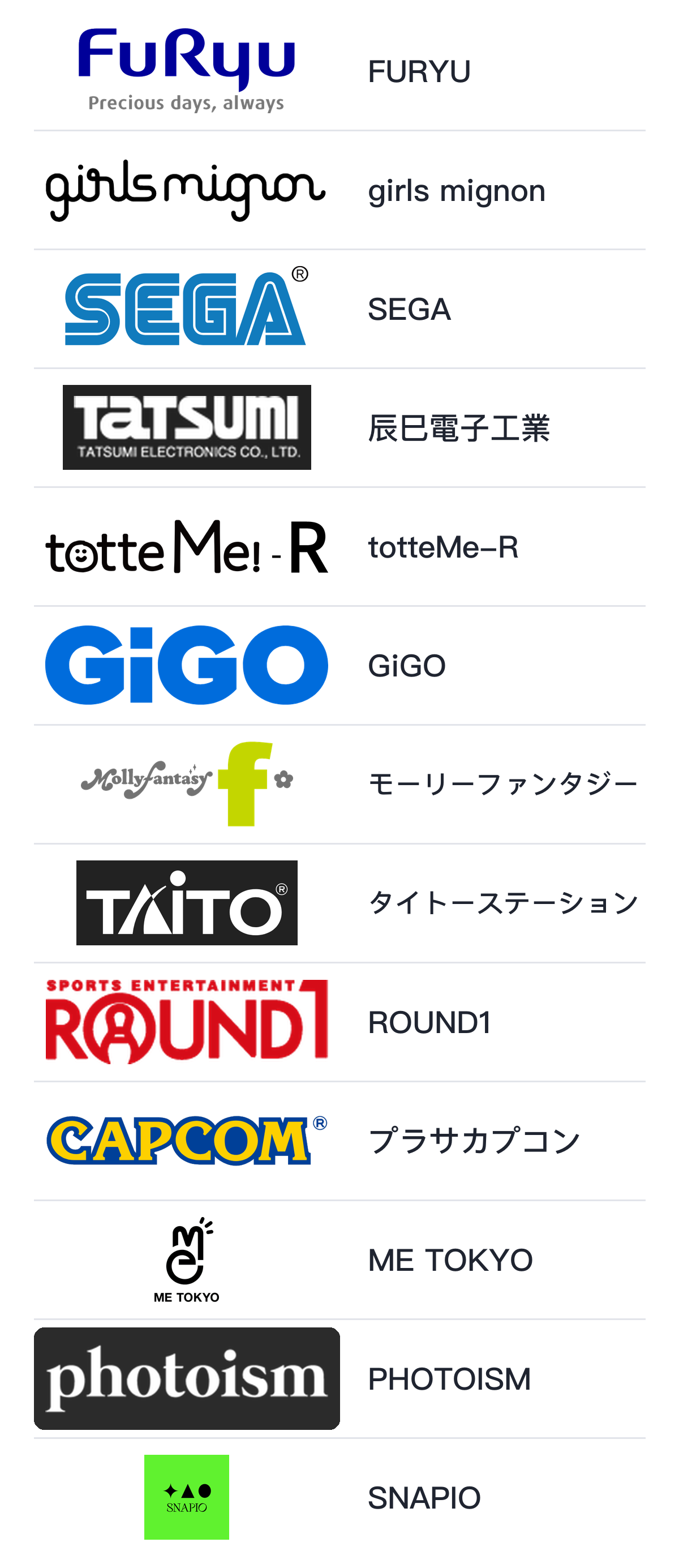
Official logos were obtained for the following brands mentioned in this article, from their respective official websites. If you see a sign and cannot identify the operator, return to this image.
.jpg)

.jpg)

- FURYU: Machine manufacturer, accounting for approximately 90% of installed machines in Japan.
- girls mignon: Dedicated sticker photo booth shops operated directly by FURYU.
- SEGA: Hardware partner for Print Club in 1995; reentered the market in 2020.
- 辰巳電子工業: A manufacturer active in the 2000s, now making machines for events and tourist attractions. Its tourist-attraction model is ファミプリ.
- totteMe-R: 辰巳電子工業’s sticker photo booth for event promotions.
- GiGO: Venue operator; GENDA’s arcade chain, formerly SEGA’s arcades.
- モーリーファンタジー: Venue operator owned by イオンファンタジー.
- タイトーステーション: Venue operator owned by スクウェア・エニックス.
- ROUND1: Venue operator, ラウンドワン.
- プラサカプコン: Venue operator; カプコン’s arcades.
- ME TOKYO: Venue operator owned by マルハン.
- PHOTOISM: Korean-style self-service photo studios entering Japan from 2021.
- SNAPIO: A comparison case—a network of sticker photo booths integrated into Hong Kong shopping malls.
This image includes only brands for which official logos were obtained. Atlus, Omron, トーワジャパン, メイクソフトウェア, アイ・エム・エス, 加賀デバイス, namco, and 辰巳電子工業’s ファミプリ are mentioned in the article, but official logos were not obtained. Their entries are left blank rather than replaced with other images. Usable official sources could not be found for the defunct brands トーワジャパン and メイクソフトウェア either.
Appendix 1: Japanese Terms Used in This Article
| Japanese | Pronunciation | Meaning |
|---|---|---|
| プリクラ | purikura | Common name for sticker photo booths; a registered SEGA trademark |
| プリントシール機 | purinto shīru ki | Photo sticker machine; the industry’s formal category name |
| 盛る | moru | Enhance a photo to make the subject look more attractive |
| デカ目 | deka me | Enlarged-eye effect |
| ナチュラル | nachuraru | Natural look |
| 落書き | rakugaki | Drawing or doodling |
| ゲームセンター | gēmu sentā | Arcade |
| セルフ写真館 | serufu shashinkan | Self-service photo studio; the term used in Japan for Korean-style sticker photo booths |
| 自社調べ | jisha shirabe | Research conducted by the company itself |
These are the terms that appear most frequently in Japanese sources. プリクラ is a trademark, so industry reports and financial statements consistently use プリントシール機. When you see 自社調べ, it means the company calculated the figure itself; it is not a third-party statistic.
Appendix 2: Questions I Could Not Resolve
I investigated the following questions but could not find reliable answers, so I have not supplied answers in this article or filled the gaps with estimates:
- Why Print Club launched specifically in 1995.
- Which models each of the more than a dozen game companies entering in 1996 released, when each withdrew, and why.
- The years in which 日立ソフトウェアエンジニアリング, アイ・エム・エス, and ナムコ exited manufacturing.
- Arcade revenue from sticker photo booths and machine counts for 2014–2018, when JAIA did not list sticker photo booths separately, and detailed figures for the 2022 and 2024 reporting years. Only percentage changes were published for 2022, and the 2024 edition is a paid publication.
- Which operator first prohibited men from entering sticker photo booth areas on their own, and in what year.
- Where the financing came from for FURYU’s 2007 management buyout, and how much it cost.
- The launch date of FURYU’s cloud membership service ピクトリンク. Only secondary sources point to December 2011.
- Revenue-sharing or sales-price terms between FURYU and venue operators such as GiGO and ROUND1.
Appendix 3: Sources
- Primary source, industry association: 日本アミューズメント産業協会, プリントシール機20年史 (2015), covering revenue, installed machines, manufacturers’ sales, and successive machine models for 1996–2013.
- Primary source, industry association: Summaries of JAIA’s アミューズメント産業界の実態調査 for the 2019, 2020, 2021, and 2023 reporting years, published on JAIA’s official website and in JAIAプレス, covering revenue, installed machines, and manufacturers’ sales from 2014 onward.
- Contemporary reporting: Nikkei xTECH and ITmedia reports from February 2009 on Atlus ending its commercial arcade game business.
- Primary sources, companies: FURYU’s official corporate history; earnings releases and investor presentation materials from the fiscal year ended March 2016 through the first quarter of the fiscal year ending March 2027; フリュー中期ビジョン2027; GENDA’s listing announcement; and the official investor-relations histories of カプコン and コナミ.
- Primary source, company press release: Photoism Japan’s press release announcing its first directly operated shop, distributed through PR TIMES.
- Photographs: The lead image and the four photographs in Section 3 all come from openly licensed files on Wikimedia Commons, with photographer and license identified below each image. The lead image was photographed by Wenjie Zhang in Shibuya in 2010, licensed under CC BY 2.0, and cropped by this site to 16:9.
- Primary sources, official company websites: ファミプリ’s official installation locator at famipri.jp, with 264 machines individually enumerated on September 25, 2026; installation terms on ファミプリ’s business website; the history of monthly membership fees in the terms of use at famipri.jp; product pages on 辰巳電子工業’s official website for totte Me! and ファミプリ; and the 加賀電子 group company page detailing 加賀デバイス’s business, employee count, and ownership. 辰巳電子工業’s capital, founding year, and employee count come from company profiles on recruitment websites and are secondary sources.
- Secondary sources, financial data websites, with dates cross-checked: Historical share prices on Nikkei’s digital edition and listing-information aggregators; listing and delisting dates for セガサミー, ラウンドワン, イオンファンタジー, タイトー, and KeyHolder.
- Secondary sources, academic case studies and media: 國學院大學’s FURYU case study for Atlus’s loss figures; reports by 東洋經濟 and Nikkei xTREND; and summaries of executive interviews.
FAQ
When was the world’s first sticker photo booth launched, and who made it?
プリント倶楽部, or Print Club, launched in Japan on July 25, 1995. The concept came from game software company Atlus; SEGA handled the camera and cabinet; and the printer came from Sony. A session cost ¥300. The abbreviation プリクラ is a registered SEGA trademark.
How large was Japan’s sticker photo booth market at its peak?
The peak was in 1997. According to 日本アミューズメント産業協会, arcades collected ¥101.3 billion from sticker photo booths that year, manufacturers received ¥48.9 billion from selling machines and consumables, and 50,228 machines were installed nationwide. By 2023, arcade revenue had fallen to ¥19.3 billion and machine numbers to 7,441, approximately 20% and 15% of their respective peaks.
Why are almost all Japanese sticker photo booths made by FURYU?
Because competitors withdrew one after another. More than a dozen game companies followed the initial launch in 1996, and most disappeared around 2000. Atlus closed the business in 2009; トーワジャパン went bankrupt in 1999, and メイクソフトウェア in 2018. FURYU’s share of installed machines rose from roughly 30–40% in the early 2010s to approximately 98% in 2019, according to its own research. Today, SEGA is its only remaining competitor in arcades. 辰巳電子工業 has shifted to machines for events and tourist attractions, while 加賀デバイス mainly supplies sticker photo booth components.
When did FURYU go public?
On December 18, 2015, directly on the Tokyo Stock Exchange’s First Section, under stock code 6238, at an offering price of ¥3,200. It moved to the Prime Market in April 2022 as part of the TSE’s market restructuring. A three-for-one stock split in March 2017 makes the offering price approximately ¥1,067 on today’s share basis.
What is the relationship between FURYU and Omron?
FURYU began as an internal Omron business. Omron launched the entertainment venture in April 1997, entered sticker photo booths in April 1998, and spun it into subsidiary オムロンエンタテインメント in July 2003. In April 2007, management bought the business and established the independent フリュー株式会社.
Does SEGA still make sticker photo booths?
Yes. SEGA withdrew around 2000 and reentered in October 2020 with fiz. In April 2024, it transferred the business to subsidiary セガ フェイブ, subsequently launching GIMMI and NICO MAKE.
Article keywords: history of Japanese sticker photo booths, プリクラ, Print Club, FURYU, フリュー, SEGA, sticker photo booth industry, listed companies in Japan’s sticker photo booth industry
Sources: The Chinese original was first published on 2026-09-24 and last updated on 2026-10-06. Data and observations retain the historical dates and markets stated in the article.
This English version is based on original Traditional Chinese content on joelin.cc. The language and explanations are localised for international readers. The Traditional Chinese original is the authoritative version — for its complete meaning, please read the original article.