
This article is also available in:繁體中文 · 日本語 · 한국어 · Bahasa Indonesia · Bahasa Melayu · ไทย · Português (Brasil) · Español · Türkçe
Joe first encountered these practices through work. His earlier image of Japanese fan groups differed substantially from Korean idol-support culture, so the Chinese original, first published in February 2023 and expanded through September 2026, records the terms encountered along the way. In many words below, 飯 is a phonetic borrowing of English fan. Keeping the Chinese spellings helps readers recognize the vocabulary used on Taiwanese fan accounts.
What is fan support?
應援 refers to actions supporting an idol: chants and signs at performances, posters and banners, and purchases of merchandise, among other practices. Fandom and organized support are particularly prominent social activities in Korea and Japan, where communities form around a shared idol.
Core vocabulary
飯姐: a devoted fan
This internet term is used in Taiwan and mainland China. 飯 means fan, while 姐 literally means an older sister. It commonly describes a devoted fan, often suggesting seniority or experience, although actual usage does not strictly distinguish age. The source connects its spread to K-pop culture. Active promotion of an idol on social media is part of the role described here.
飯圈: a fandom community
A 飯圈 is a social group whose members share an interest in an idol. Through social media and group chats they exchange photos, videos and songs, make banners and posters, and may collectively purchase advertising such as metro panels.
Joe photographed one such advertisement at Xinyi Anhe after becoming aware of the practice:
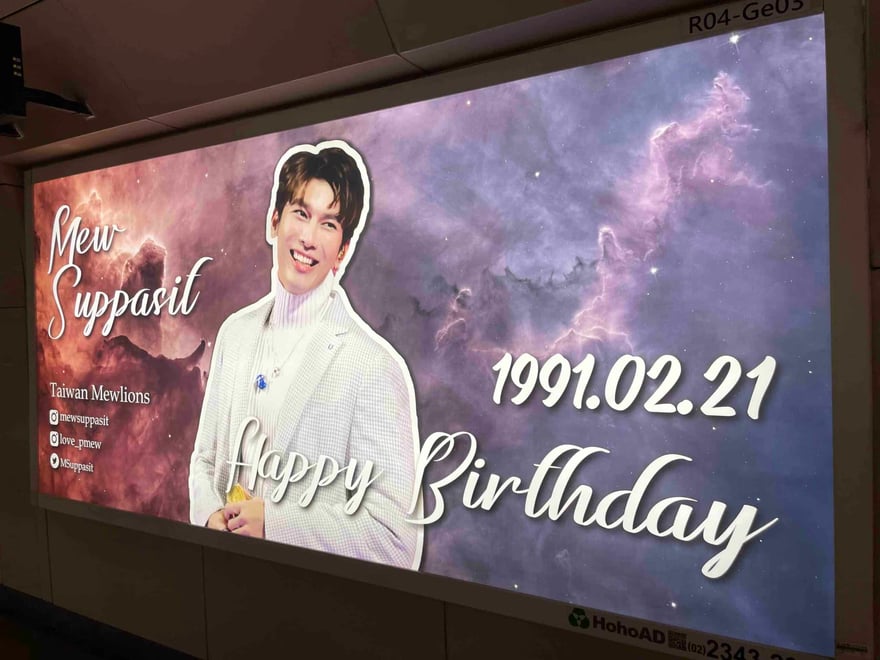
These communities can be relatively closed, with distinctive discussion rules, expressions and abbreviations. Although much activity is online, fan clubs can also mobilize people in the physical world, particularly in the Korean context described by the source. The word literally joins fan and circle: it names a group, not an action.
飯圈化: fandom-style behaviour spreading elsewhere
This evaluative expression describes an unrelated field adopting patterns associated with organized fandom: supporters’ clubs, pooled efforts to drive metrics, group attacks on critics, and treating the supported person as beyond question. It is used as a verb or adjective, such as saying a community has become fandom-like.
The source notes sports, esports, entertainment and political commentary as common settings, usually with a critical tone suggesting that ordinary discussion has become difficult. 飯圈 is a neutral description of people sharing a favourite; 飯圈化 criticizes a pattern spreading into another field. People searching the latter may simply have seen it in an article rather than belong to a fandom.
飯繪: fan art
Fan-made illustrations or comics depict an idol or group and express admiration. Styles range from cartoon or anime-inspired designs to realistic portraits; Joe’s observations were mainly of the former, often cute miniature or chibi versions.
Artwork is particularly common around birthdays, as gifts or displays. Most creators described in the source do it out of affection; some make a business of it. Fans also commission illustrators or outsource artwork to present an idol in their preferred style. Examples include a Snapshot support event. Social sharing then enables interaction with other fans.
When that art, or fansite photographs, is printed on photocards, stickers or stands for other fans, the physical goods are called 飯制 or 飯製. See Fan-made goods, official goods and fan art for the differences and authenticity questions.
飯拍: fan photography and fancams
This means photographs or videos taken by fans at concerts, events or public appearances. They record performances, interactions and atmosphere, and allow people who were not present to follow what happened. They may also supply material for fan-made music videos or documentaries.
Rules differ by artist and event. Some allow or encourage filming, including a designated filming period; others ban professional cameras or video equipment. Copyright disputes are another issue. Follow the actual rules rather than assuming that fan enthusiasm grants permission.
The Chinese original leaves the question of which camera is best for fan photography as a possible future topic, without recommending a model here.
飯撒: fan service
This is an idol’s response to fans: waving, making a heart, blowing a kiss, smiling or nodding at a banner, or performing a gesture requested on a fan’s sign. Receiving such a response can be a highlight of an event.
The word travels from English fan service through Japanese ファンサービス, shortened to ファンサ, and then into Chinese (Wiktionary, Baidu entry).
Its direction is the reverse of 飯拍: fans photograph idols; idols give fan service to fans. A 飯撒 cam is footage capturing that response, so it is a type of 飯拍 whose subject is 飯撒. An example of usage is a fan saying that the idol made a heart toward them today.
飯傻 and 飯撤: misspellings of 飯撒
The source found no separate established definitions for these spellings. They refer to the same idol-to-fan gestures.
飯撤 can result from confusing two similar-looking characters: 撒 and 撤 both have a hand radical on the left and similar right-hand shapes. 飯傻 is more plausibly a sound-based error: Taiwanese pronunciation may blur the relevant s/sh distinction, and phonetic or voice input can produce 傻 instead of 撒. That explanation is a pronunciation-based inference, not evidence of a distinct meaning.
飯咪: a fan meeting
From English fan meeting, this is an event designed around interaction. A host may lead questions, games or a raffle, and the idol commonly prepares one or two performances (Beauty321 glossary).
It sits between a fan-signing event, which offers very short one-to-one interactions, and a concert, which provides a full stage, lighting and dancers but little personal interaction. A fan concert, or fancon, combines roughly equal portions of performance and interaction, placing it between a fan meeting and a concert.
A fan meeting’s smaller venue makes it easier for an idol to see faces, banners and signs, increasing opportunities for fan service compared with a large arena. A typical usage would be hoping for fan service after securing a third-row seat.
飯頌: a fan song
A Fan Song is written and sung by an idol for fans, often expressing gratitude, shared memories or a commitment to continue together. Sometimes the fandom’s name is in the title, such as TOMORROW X TOGETHER’s MOA Diary for MOA (Agentm feature, Beauty321 examples).
Examples preserved in the Chinese original:
- BTS: 2!3! on the 2016 album WINGS, regarded by fans as an important closing-concert song.
- SEVENTEEN: Thanks, the title track of the 2018 special album DIRECTOR’S CUT, for CARAT.
- TWICE: ONE IN A MILLION, released in 2016 as the group’s first fan song for ONCE.
- Apink: the source describes an annual fan-song tradition from 2012; I want you to be happy marked the eleventh debut anniversary in 2022.
Like fan service, the direction is idol to fans. It differs from fan photography or art, and from a fan chant: a chant is shouted by fans along with a performance, whereas a fan song is a full song sung by the artist.
手幅: a hand-held banner
A long paper or fabric banner carries a name, nickname, slogan or image. Fans hold it up at concerts or signing events so the idol can see it and other fans can identify a shared favourite.
It may be self-made or produced by a project team. Its strip shape allows one or two hands to hold it and reduces obstruction for people behind. The exact origin of the Chinese term remains unverified in the source; it is described as an item that developed with Korean-style support.
應援棒: a lightstick
Also called a hand light or glow stick, this is used to cheer at concerts. An official lightstick is an agency-issued, group-specific product, with its own shape and colour; some synchronize with stage lighting. It differs from a generic glow stick.
The account traces early support colours to H.O.T’s 1996 debut and fans’ coloured balloons, which later evolved into distinctive lightsticks. G-Dragon’s three-dimensional BIGBANG bang stick is cited as an important reference for later shapes (Jiemian, The Idol Cast).
燈牌: an illuminated support sign
A sign displays an idol’s name, birthday wishes or a slogan. Early handwritten cardboard signs evolved into electronic signs with editable text and LED effects. Fans hold them at concerts, airport arrivals or fan signings to be noticed and identify their favourite.
As LED technology spread, changing-text signs gradually replaced many cardboard versions, and fans developed a subculture of competing in creativity and brightness (Jiemian).
How these three support items differ
Banners and signs are meant to be seen by people: idols and other fans identify you in the crowd. Lightsticks contribute to the venue as a whole, making an audience glow in the same colour. That distinction helps decide what to bring.
For the next step, see types of support goods, drawing and layout apps, and 85 × 55 mm photocards and sleeve matching. Photocards do not have an official universal size standard.
Other terms encountered in the source
| Chinese term | Meaning in this glossary |
|---|---|
| 毒唯 | A fan who likes one group member and disparages the other members. |
| 唯粉 | A fan interested in just one member without concern for the others. |
| 應援 | Actions can include donations, flower displays, adoption or planting projects for animals or plants, café displays and giveaways, transit or department-store panels, bus or promotional-vehicle ads, and giveaways outside concerts. |
| 互撕 | Fans attacking one another, often over how resources are allocated among members. |
| 分豬肉 | An awards-show expression suggesting attending groups all receive an award; sometimes implying opaque allocation. |
| 私生飯 | An intrusive fan who invades an idol’s private life, such as stalking, waiting outside accommodation or purchasing flight details. |
| 刷瓜 | Repeatedly playing a comeback song on Korea’s MELON service to improve its real-time chart position. |
| 小卡 | The original account links album photocards to members’ selfie cards randomly included in Girls’ Generation’s second studio album Oh!. |
| 咕卡 | Decorating a rigid card holder to make a photocard display cuter or more distinctive. |
| 卡磚 | The decorated holder after that process, in the usage described here. |
| 上帶下,中下可單帶 | A photocard seller arranges members in three rows: buying an upper-row member requires buying a lower-row card too; middle- and lower-row cards can be bought alone. |
Some terms describe objects, while others describe community behaviour or trading conditions. They are not interchangeable labels for fan support.
More support vocabulary
- 生咖: short for birthday café, where fans book a café or decorate a space for an idol’s birthday. The practice originated in Korea and spread in global K-pop fandoms. See origins, process and costs.
- 站姐: a core fan who follows and photographs an idol, creates high-quality images and runs a fan account. 站子 refers to the account or operating unit. See fansite terminology.
- 應援物: the umbrella term for things fans make or buy for support, covering food, merchandise, advertising and birthday-event categories. See the goods guide and design tools.
- 生誕祭: a Japanese word originally for commemorating a deceased distinguished person’s birth, adopted for idol birthday events with a respectful tone. See the Japanese explanation.
Further reading and common questions
The fan-support culture overview explains the larger context. For practical items use the goods guide, the app guide, fansite account terminology and birthday cafés.
The key distinctions to remember are that 飯繪 is artwork, 飯拍 is photography, 飯撒 is the idol’s response, 飯咪 is an interactive event, and 飯頌 is a song for fans. 飯傻 and 飯撤 are misspellings in the source, not separate categories. Event photography rules still depend on the artist and organizer and can involve copyright issues.
To move from vocabulary to a particular person, browse the birthday calendar by month or the recipient index for birthdays, aliases and group affiliations. The fansite guide explains 站姐, 站子 and 神站 in more detail.
Sources: Chinese original first published 2023-02-25; original last updated 2026-09-30. Historical research dates and geographical scope are retained.
This English version is based on original Traditional Chinese content on joelin.cc. The language and explanations are localised for international readers. The Traditional Chinese original is the authoritative version — for its complete meaning, please read the original article.