
This article is also available in:繁體中文 · 日本語 · 한국어 · Bahasa Melayu · ไทย · Português (Brasil) · Español · Türkçe · Tiếng Việt
Instant photos come in four mainstream formats: Fujifilm instax mini, instax WIDE, instax SQUARE and classic Polaroid (600 / i-Type). Each format has two different measurements, and mixing them up is the most common mistake: the size of the whole card including the white border, and the size of the actual image area.
The short answer: an instax mini card is 86 × 54 mm, but the picture on it is only 62 × 46 mm. A Polaroid 600 / i-Type card is 107.9 × 88.1 mm, with a 79 × 77 mm image.
The four instant film formats
| Format | Card size (with border) | Image area | Image shape | Typical use |
|---|---|---|---|---|
| instax mini | 86 × 54 mm | 62 × 46 mm | close to 4:3 | the mainstream format, fits in a wallet |
| instax WIDE | 108 × 86 mm | 99 × 62 mm | close to 8:5 | group shots, weddings, landscapes |
| instax SQUARE | 86 × 72 mm | 62 × 62 mm | 1:1 square | square, social-media look |
| Polaroid 600 / i-Type | 107.9 × 88.1 mm | 79 × 77 mm | close to 1:1 | classic retro look |
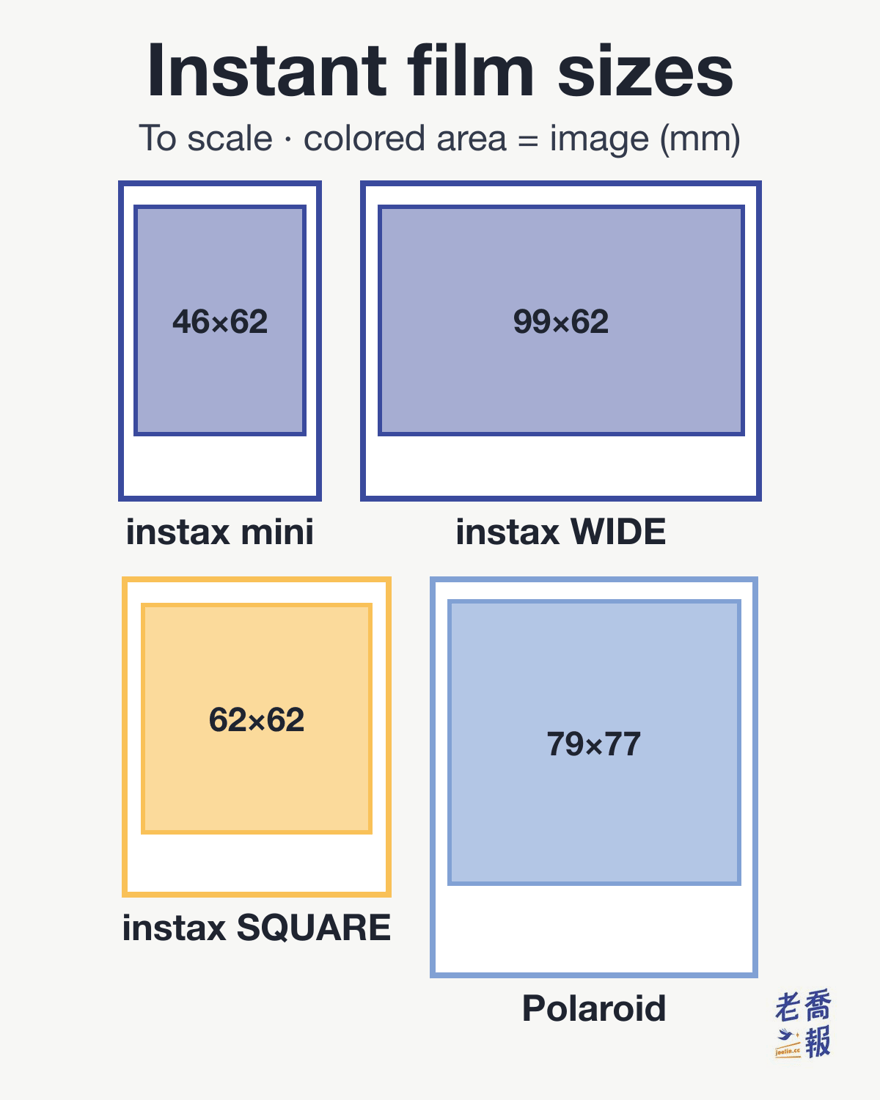
The Polaroid image area is often quoted as a 79 × 79 mm square, including on some retailer product pages. Polaroid’s own product pages for i-Type and 600 film list 79 × 77 mm (3.1 × 3.0 in): slightly wider than it is tall, not a perfect square. This article uses the official figure. Sources: Polaroid i-Type film product page and Polaroid 600 film product page (checked September 25, 2026).
Why the card size and the image size are different numbers
Many people search for the instax mini size, find 86 × 54 mm, and assume that is the photo. The picture itself is 62 × 46 mm, only about 60% of the card’s area.
The difference is the familiar white border, and it is not decoration. It is part of how the film works:
- The bottom border, which is noticeably wider, holds the pod of developing reagent.
- The top border catches the excess reagent once it has spread across the picture.
- The side borders are part of the film frame.
In other words, you cannot enlarge the picture to fill the whole card, because the border is part of the physical film.
Why the bottom border is wider: chemistry, not styling
The wide bottom edge goes back to the design of Edwin Land’s instant photography in the 1940s. It holds the pod of developing reagent. When the film is ejected, rollers inside the camera burst the pod and spread the reagent evenly across the film, starting development.
Fujifilm instax film keeps the same layout with the wide edge at the bottom, and that wide bottom edge has become the cultural shorthand for an instant photo.
Joe’s note from the photo booth industry: the biggest difference between an instant photo and an ordinary 4 × 6 print is not the size but the border ratio. That is the identity. A photo with equal top and bottom borders is not read as an instant photo.
Instant photos vs. 4 × 6, A6 and business cards
| Item | Size (mm) | Compared with an instax mini card |
|---|---|---|
| instax mini card | 86 × 54 | baseline |
| Business card (EU 85 × 55; US 89 × 51) | 85 × 55 | almost the same size |
| instax SQUARE | 86 × 72 | 18 mm wider (72 vs 54 mm) |
| Polaroid 600 | 107.9 × 88.1 | about 2 times the area |
| instax WIDE | 108 × 86 | about 2 times the area |
| 4 × 6 photo | 152 × 102 | about 3.3 times the area |
| A6 (postcard size) | 148 × 105 | about 3.3 times the area |
An instax mini is about the size of a business card, which is why it fits in a wallet. The 4 × 6 print is a separate system; see 4 × 6 photo size in cm for the full guide.
How many pixels do you need to print instant-size photos? 300 DPI table
To print phone photos at instant-film size (with printers such as the instax mini Link or Polaroid Lab), the file needs at least:
| Format | Image area (mm) | Image area (in) | Pixels at 300 DPI | Megapixels |
|---|---|---|---|---|
| instax mini | 62 × 46 | 2.44 × 1.81 | 732 × 543 | 0.40 MP |
| instax WIDE | 99 × 62 | 3.90 × 2.44 | 1,170 × 732 | 0.86 MP |
| instax SQUARE | 62 × 62 | 2.44 × 2.44 | 732 × 732 | 0.54 MP |
| Polaroid classic | 79 × 77 | 3.11 × 3.03 | 933 × 909 | 0.85 MP |
Is a phone photo good enough for instant-size prints? More than enough. Main cameras from the iPhone 6 onward start at 8 MP, more than ten times what an instant print needs.
The reverse is the problem: will an instant photo look blurry if you print it at 4 × 6? Yes. The instax mini image area is only 732 × 543 px, while a 4 × 6 print needs 1,200 × 1,800 px, so you have less than half the pixels. To enlarge it, use an AI upscaling tool, or keep the white border and place the instant photo on a 4 × 6 layout as a collage.
Instax printers print at roughly 318 DPI natively, close to the 300 DPI printing standard, so an 800 × 600 px phone image prints at instax mini size without blurring.
Cameras by format
| Series | Common models | Character |
|---|---|---|
| Fujifilm instax mini | mini 11 / 12 / Evo | entry level, the mainstream choice |
| Fujifilm instax WIDE | WIDE 400 | weddings and group photos |
| Fujifilm instax SQUARE | SQ40 / SQ1 | square format |
| Polaroid | Now / Now+ / Go | retro enthusiasts |
Film is specific to each format. instax mini, WIDE and SQUARE film cannot be used across camera types, so check your camera model before buying film. To turn phone photos into instant prints, use a printer app such as instax mini Link or Polaroid Lab.
Instant photos are not the same as Korean-style photo booths
The two are often confused, but they are different products:
| Item | Instant photo | Korean-style photo booth (four-cut) |
|---|---|---|
| Format | instax mini 86 × 54 mm, etc. | 4 × 6, or 2 × 6 (a 4 × 6 cut in half) |
| How it is taken | your own camera | a booth takes the photo |
| Development | chemical, on the film | digital print |
| Price in Taiwan | NT$10–30 per shot of film | NT$200–300 per session, several prints |
| Cultural role | personal keepsake, retro | group entertainment |
For photo booth print sizes, see Photo booth strip sizes in Taiwan and Korea: 2 × 6 and 4 × 6. For the industry background, see the history of Korean-style photo booths in Taiwan.
Frequently asked questions
How big is an instax mini photo in inches?
The instax mini card is about 2.1 × 3.4 inches (54 × 86 mm). The image area is about 1.8 × 2.4 inches (46 × 62 mm).
Which is bigger, instax mini or Polaroid?
Polaroid (107.9 × 88.1 mm) has almost twice the area of an instax mini (86 × 54 mm). Polaroid is the classic retro size; instax mini is the compact modern format.
Can I print an instant photo at 4 × 6?
Yes, but enlarging it directly will look blurry: an instax mini image is 732 × 543 px, while 4 × 6 needs 1,200 × 1,800 px. Use an AI upscaler, or keep the white border and lay the photo out on a 4 × 6 page.
Can I use one instax film type in another camera?
No. mini, WIDE and SQUARE film are each made for their own cameras and cannot be swapped.
What resolution do instant printers use?
Instax printers print at roughly 318 DPI natively, close to the 300 DPI standard, so an 800 × 600 px phone photo will not look blurry at instax mini size.
This article is Joe’s summary of sizes looked into through the photo booth industry, not an official Fujifilm or Polaroid specification sheet. Before printing, follow the instructions for your specific film.
Sources: Chinese original first published 2026-05-12; original last updated 2026-10-18. Polaroid image-area figures follow Polaroid's official i-Type and 600 film product pages as checked on 2026-09-25. Prices in the photo booth comparison are Taiwan market figures from the original.
This English version is based on original Traditional Chinese content on joelin.cc. The language and explanations are localised for international readers. The Traditional Chinese original is the authoritative version — for its complete meaning, please read the original article.