
This article is also available in: 繁體中文 · 日本語 · 한국어 · Bahasa Indonesia · Bahasa Melayu · ไทย · Português (Brasil) · Español · Türkçe · Tiếng Việt · Deutsch · हिन्दी
Contents (14)
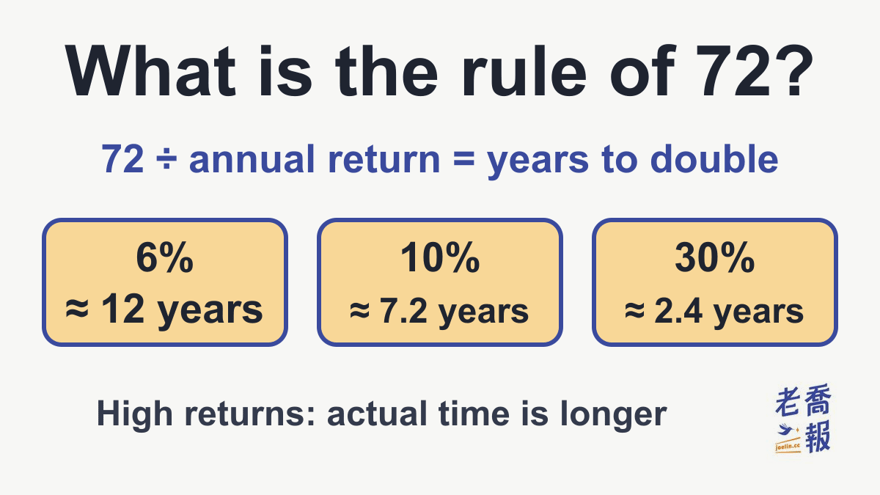
The rule of 72 in one sentence: divide 72 by your annual rate of return, and you get roughly how many years it takes your money to double. At 6% a year that is about 12 years, at 10% about 7.2 years, and you can work it out in your head without a calculator.
| Item | One-line answer |
|---|---|
| Formula | Years to double ≈ 72 ÷ annual return (for 6%, divide by 6) |
| Examples | 6% → about 12 years; 10% → about 7.2 years |
| In reverse | To double in 10 years, you need about 72 ÷ 10 = 7.2% a year |
| Accuracy | Off by about 0.1 year at 6%–10%; the higher the return, the more it underestimates the time |
| Not for | Monthly regular investing, or a single year’s return that swings up and down |
That table covers the five key points of the rule of 72. Below, in order: what it is, the doubling-time table, how to calculate it in Excel, and how it differs from the rules of 70 and 69.3.
What is the rule of 72?
You have probably heard of the “rule of 72”, but what does it actually mean? Put simply, it is a quick way to estimate how long an investment takes to grow, or what rate it needs. The core idea: if you want to know how long it will take for your money to double, divide 72 by the annual rate of return. The result is the approximate number of years.
For example, if your investment earns 6% a year, divide 72 by 6 and you get 12. In other words, at 6% a year your money will take roughly 12 years to double. The calculation is simple enough to do in your head, which makes it handy for quick financial decisions.
flowchart TD
    A["Annual return: r%"] --> B["72 ÷ r"]
    B --> C["≈ years to double"]
    C --> D["6% → 12 years"]
    C --> E["10% → 7.2 years"]
    C --> F["30% → 2.4 years"]
In one sentence: divide 72 by the annual return, and 6% doubles in about 12 years, 10% in about 7.2, and 30% in about 2.4.
Keep in mind that the rule of 72 is a convenient estimate, not an exact figure. In practice you still have to account for market volatility, inflation and other factors. Even so, for anyone interested in marketing, making money or business, it is a neat little trick that adds real insight to your toolkit.
For a full worked example of the rule applied to “how many years does it take to save NT$100 million”, see The science of 100 million: the truth about compounding, time and principal (Chinese original), which lists the years needed for different monthly savings amounts and rates of return.
How do you calculate the rule of 72? It works in both directions
You can use the rule of 72 forwards or in reverse:
- Know the rate of return, find the years to double: years to double ≈ 72 ÷ annual return. At 8% a year, 72 ÷ 8 = 9 years.
- Know how many years you want to double in, find the rate you need: annual return ≈ 72 ÷ years. To double in 10 years, 72 ÷ 10 = 7.2% (the exact value is 7.18%).
Note that you plug in the percentage as a plain number: for 6% it is 72 ÷ 6, not 72 ÷ 0.06. A common exam-style question, “how many years to double at 2% interest”, works out to 72 ÷ 2 = 36 years with the rule of 72. The exact answer is 35 years; the gap is because the rule of 72 slightly overestimates the time at low rates.
Rule of 72 table: years to double at returns from 1% to 30%
| Return | Rule of 72 | Actual |
|---|---|---|
| 1% | 72 years | 69.66 years |
| 2% | 36 years | 35.00 years |
| 3% | 24 years | 23.45 years |
| 4% | 18 years | 17.67 years |
| 5% | 14.4 years | 14.21 years |
| 6% | 12 years | 11.90 years |
| 7% | 10.29 years | 10.24 years |
| 8% | 9 years | 9.01 years |
| 9% | 8 years | 8.04 years |
| 10% | 7.2 years | 7.27 years |
| 12% | 6 years | 6.12 years |
| 15% | 4.8 years | 4.96 years |
| 20% | 3.6 years | 3.80 years |
| 24% | 3 years | 3.22 years |
| 30% | 2.4 years | 2.64 years |
For returns between 6% and 10%, the rule of 72 and the actual time differ by only about 0.1 year (6% has the largest gap, 12 years against 11.90), so it is perfectly good for mental math. Once the return goes above roughly 8%, the rule of 72 starts to underestimate the time, and the higher the return the bigger the gap: at 30% it actually takes 2.64 years, not 2.4. The “actual doubling time” is calculated as ln2 ÷ ln(1 + rate of return), assuming interest compounds once a year.
How to calculate doubling time in Excel or Google Sheets
To get a more precise answer than the rule of 72, three steps in a spreadsheet are all it takes, and the formulas are the same in Excel and Google Sheets:
- In A2, type the annual return directly as
6%(if you type6, it is treated as 600%, and the first formula below gives only 0.36 years). - In B2, type any one of the formulas below and press Enter.
- B2 now shows the number of years to double; to show one decimal place, wrap the formula in
ROUND(…,1).
| Formula | If A2 = 6% |
|---|---|
=LN(2)/LN(1+A2) |
11.90 years (exact value) |
=NPER(A2,0,-1,2) |
11.90 years (same, using a financial function) |
=72/(A2*100) |
12 years (rule-of-72 estimate) |
The first two formulas calculate the exact number of years with once-a-year compounding, and they give exactly the same result; the third simply writes the rule of 72 as a formula. NPER’s four arguments are, in order: the rate of return, the amount added each period (0), the starting principal (entered as a negative number, −1) and the target amount (2, meaning doubled).
The two most common mistakes:
- Writing
=72/A2: the 6% in A2 is actually stored as 0.06, so you get 1200. Write=72/(A2*100)instead, or type the plain number 6 in A2. - Entering the principal in NPER as a positive number,
=NPER(A2,0,1,2): you get #NUM!. The principal must be negative.
Google Sheets also has the LN and NPER functions with the same argument order, so you can paste the formulas above straight in.
Rule of 72 vs rule of 70 vs rule of 69.3: what’s the difference?
All three rules are “some number ÷ rate of return”; the only difference is the number being divided (72, 70 or 69.3). Take a 6% annual return, where the actual doubling time is 11.90 years:
| Rule | When it is more accurate |
|---|---|
| Rule of 72 | Annual returns of about 5% or more (6% gives 12 years) |
| Rule of 70 | Annual returns of about 5% or less (2% gives 35 years, almost exactly the actual 35.00) |
| Rule of 69.3 | The theoretical value for continuous compounding (6% gives 11.55 years, which underestimates the time with once-a-year compounding) |
“More accurate” in the table means closer to the actual doubling time, assuming interest compounds once a year. So for figures in the 1%–4% range, such as savings, low interest rates and inflation, dividing by 70 gets you closer; for returns of 6%–10%, typical of stocks and funds, 72 fits nicely. The 69.3 comes from 100 × ln2 ≈ 69.3, and mathematically it is exact only for continuous compounding.
72 is the most popular choice not only because it is accurate around common rates of return, but also because it divides so easily: 72 is divisible by 2, 3, 4, 6, 8, 9 and 12, so the mental math almost never involves decimals. In Chinese-language sources you may also see it called 72定律 or 七二法則; these all refer to the same rule.
Three things to watch when using the rule of 72
The rule of 72 is handy, but it answers only one question: “if I earn a steady r% every year, how long until my money doubles?” When you actually use it, it is worth thinking about three more things:
- Inflation follows the rule of 72 too: at 2% inflation, 72 ÷ 2 = 36, which means your money loses about half its purchasing power in roughly 36 years. When you look at how fast your assets double, the “real return” after inflation is how fast you are actually getting richer.
- Returns are not the same every year: a stock rising 30% one year and falling 15% the next is common. The rule of 72 should be applied to the long-run average annualized return (that is, the CAGR, compound annual growth rate), not to a single year’s gain.
- High returns usually come with high risk: when you see “20% annualized, doubles in 3.6 years”, don’t get excited just yet. First ask how that return was calculated, and from which year to which year.
If you invest a fixed amount every month rather than a single lump sum, the doubling speed has to be worked out differently. You can run the numbers directly with the DCA compound calculator that Joe built; its interface is currently in Traditional Chinese only, but the numbers work as usual.
Once you know your doubling time, you may want to see where the doubled wealth would place a household in Taiwan. Compare it with Taiwan’s ten household wealth tiers and net-worth thresholds (Chinese original), or read Wealth Thresholds in Taiwan: Where NT$10 Million Sits, which uses the official household net-worth deciles.
Frequently asked questions (FAQ)
What is the rule of 72?
The rule of 72 is a mental-math shortcut for estimating how many years it takes your money to double: divide 72 by the annual rate of return and you get the approximate number of years. For example, at a 6% annual return, 72 ÷ 6 = 12, so it takes about 12 years to double. It is only an estimate and does not account for inflation or market volatility.
How do you calculate the rule of 72?
Years to double ≈ 72 ÷ annual return, where you plug in the percentage as a plain number (for 6%, use 6, not 0.06). It also works in reverse: to double your money in N years, you need an annual return of roughly 72 ÷ N. For example, doubling in 10 years takes about 7.2%. The exact value is ln2 ÷ ln(1 + rate of return), assuming interest compounds once a year.
How many years does it take to double money at 6% a year?
With the rule of 72 it is 72 ÷ 6 = 12 years; calculated exactly (compounding once a year) it is 11.90 years, a gap of only about 0.1 year. At 10% it is 7.2 years (actually 7.27), and at 2% it is 36 years (actually 35.00).
How accurate is the rule of 72?
For returns between 6% and 10%, the error is within about 0.1 year, which is plenty for mental math. The higher the return, the more the rule of 72 underestimates the time: at 30% it estimates 2.4 years, but it actually takes 2.64. At very low returns it overestimates instead: at 1% it estimates 72 years, but it actually takes 69.66.
What is the difference between the rule of 72, the rule of 70 and the rule of 69.3?
All three are “some number ÷ rate of return”; only the number being divided (72, 70 or 69.3) differs. With interest compounding once a year, the rule of 70 is more accurate for returns of about 5% or less (at 2%, 70 ÷ 2 = 35 years, almost exactly the actual 35.00), and the rule of 72 is more accurate for returns of about 5% or more. The 69.3 comes from 100 × ln2 and is exact only for continuous compounding; with ordinary once-a-year compounding it actually underestimates the time.
How do you calculate doubling time in Excel or Google Sheets?
Type the annual return in A2 (for example, 6%), type =LN(2)/LN(1+A2) in B2 and press Enter: you get about 11.9 years. You can also use =NPER(A2,0,-1,2), which gives the same result. To get the rule-of-72 estimate, write =72/(A2*100); writing =72/A2 directly gives 1200, because the 6% in the cell is actually stored as 0.06.
Does the rule of 72 go by other names?
Its standard English name is the rule of 72. Chinese-language sources write it several ways (72法則, 72定律 and 七二法則), and all of them refer to the same estimation method.
This is a personal research note, not investment advice.
Keywords: rule of 72, rule of 72 formula, how to calculate the rule of 72, years to double money, rule of 70, rule of 69.3, rule of 72 in Excel
Sources: Chinese original first published 2024-12-29; revised 2026-10-27. The rule of 72 is an estimate and does not account for inflation or market volatility.
This English version is based on original Traditional Chinese content on joelin.cc. The language and explanations are localised for international readers. The Traditional Chinese original is the authoritative version — for its complete meaning, please read the original article.