
Contents (7)
The short answer
Taiwan’s official year-end 2021 household net-worth distribution puts the median at NT$8.94 million and the 60th-percentile boundary at NT$11.71 million. NT$10 million falls between them.
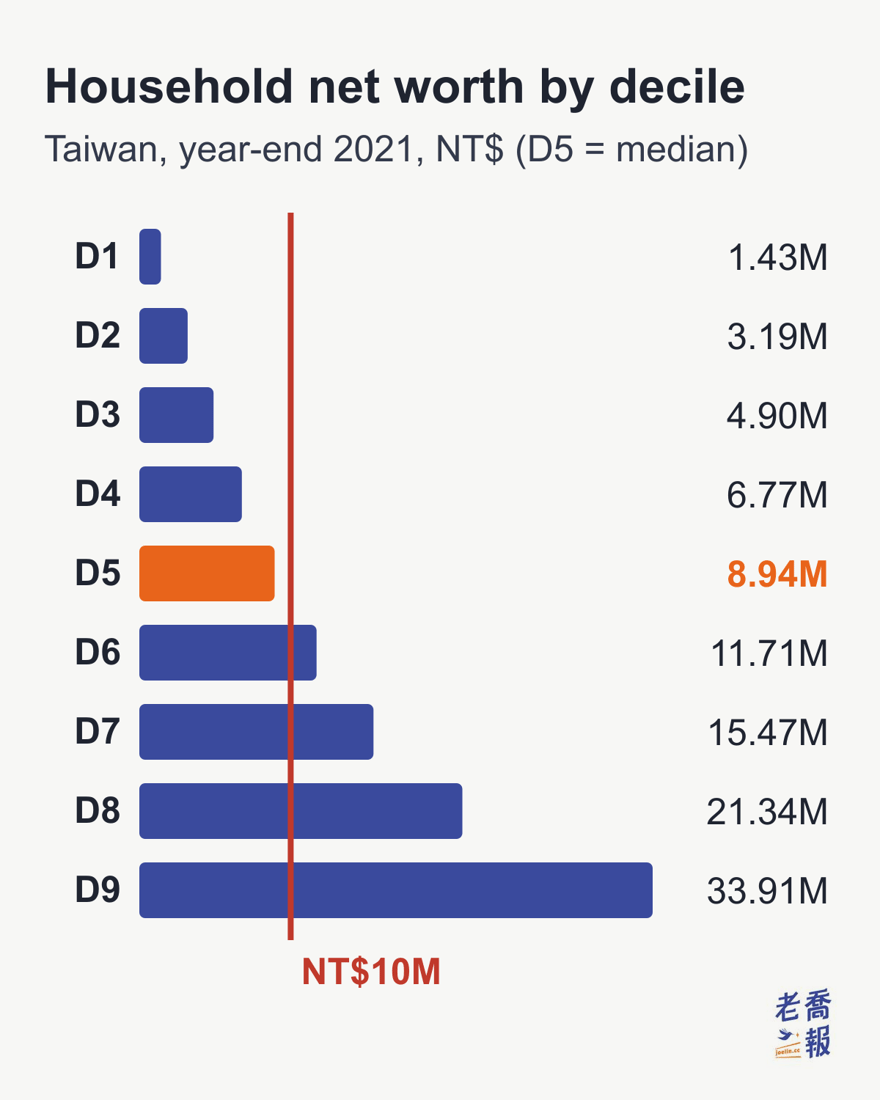
A linear interpolation gives:
50 + (10.00 − 8.94) ÷ (11.71 − 8.94) × 10 ≈ 53.8
On that limited assumption, NT$10 million is near the 53.8th household percentile, leaving roughly 46.2% of households above it.
Why this is an estimate
DGBAS publishes decile boundaries, not a direct count at NT$10 million. The actual distribution within the D5-D6 interval may not be linear. The calculation is therefore an orientation point based on 2021 data, not an official current household count.
Net worth includes real estate and subtracts liabilities. It is different from cash, investable assets or annual income.
How many people in Taiwan have NT$10 million in cash?
No official statistic counts the people who personally hold NT$10 million in cash or deposits, so no official source answers this question directly.
The closest official figure is the household net-worth estimate above: NT$10 million sits near the 53.8th household percentile, with about 46.2% of households above it. But that measures a whole household’s total wealth after debts, which is very different from cash in hand.
- Household net worth counts real estate, shares, insurance and deposits, then subtracts liabilities such as mortgages. A household with more than NT$10 million in net worth does not necessarily have NT$10 million in deposits.
- In DGBAS’s national wealth statistics for year-end 2024, the household sector’s “cash and demand deposits” made up 12.94% of net worth and “time deposits and foreign-currency deposits” 12.51%, together about a quarter. Real estate, life insurance and pension reserves, and securities make up most of the rest.
- Official wealth statistics count households, and a household’s deposits cannot be split into deposits held by each individual, so the number of individuals with more than NT$10 million in deposits cannot be derived either.
When you see a claim such as “more than 40% of people in Taiwan have NT$10 million”, check whether it refers to household net worth or cash, and remember that it is a share of households, not a number of people.
It cannot answer the individual question
The household table cannot tell us how many individuals personally own NT$10 million. Dividing every household boundary by an average household size does not transform household percentiles into individual percentiles. It ignores ownership shares, household composition and the relationship between household size and wealth.
For a separate view of the high-asset population, see Taiwan’s NT$100 million-plus population estimates; that page uses different survey scopes and should be read separately from these household boundaries.
Taiwan’s household data can support the household estimate above. A population-wide individual estimate would need a separate individual or adult wealth distribution.
The official decile table
DGBAS’s year-end 2021 household net-worth boundaries (net worth = assets, including real estate, minus liabilities):
| Boundary | Household net worth |
|---|---|
| D1 (10th percentile) | NT$1.43 million |
| D2 (20th) | NT$3.19 million |
| D3 (30th) | NT$4.90 million |
| D4 (40th) | NT$6.77 million |
| D5 (median) | NT$8.94 million |
| D6 (60th) | NT$11.71 million |
| D7 (70th) | NT$15.47 million |
| D8 (80th) | NT$21.34 million |
| D9 (90th) | NT$33.91 million |
Mean household net worth was NT$16.38 million. Because the mean is far above the median, it is less representative of the household in the middle of the distribution.
The boundaries should not be mechanically updated by multiplying them by growth in a newer aggregate mean. An aggregate wealth series and a distribution survey use different methods and do not tell us that every percentile moved by the same rate.
Higher official boundary
The D9 boundary is NT$33.91 million in household net worth, meaning it marks entry into the top 10% of households in the 2021 distribution. It is a net-worth threshold, not a liquid-assets threshold: a home counts as an asset and a mortgage counts as a liability.
Source
Sources: Taiwan DGBAS household net-worth deciles, year-end 2021. The NT$10 million position is a linear interpolation, not an official count.
This English version is based on original Traditional Chinese content on joelin.cc. The language and explanations are localised for international readers. The Traditional Chinese original is the authoritative version — for its complete meaning, please read the original article.
Use Google Search a lot?
Set joelin.cc as a preferred source to see more of its articles when you search.