
Other languages (19)
繁體中文 · 日本語 · 한국어 · Bahasa Indonesia · ไทย · Português (Brasil) · Español · Türkçe · Tiếng Việt · Deutsch · العربية · Français · Русский · Italiano · Polski · Čeština · עברית · Magyar · Svenska
Contents (21)
A disposable camera (in Taiwan commonly called 即可拍, in Hong Kong 即棄相機) is a plastic camera that leaves the factory with a roll of 135 color negative film, a lens, a shutter, a flash and a battery already built in. You can’t change the film, there are no settings to adjust, and when you finish the roll you hand the whole camera to a film lab and get scans or prints a few days later.
There are only four steps: turn the film wheel, push the flash switch up and wait for the indicator light if you want the flash, look through the viewfinder and press the shutter from at least 1 meter away, and stop when the counter reaches 0. A Fujifilm 写ルンです takes 27 shots; the Kodak FunSaver comes in 27-shot and 39-shot versions. When you finish, don’t open it; hand the whole unit to a lab. On a plane, keep it in your carry-on and ask security for a hand inspection if you can. Fujifilm officially advises against using expired units.
This article is the operating manual: how to shoot, why shots fail, and what to do afterwards. What one costs and what each shot costs is covered in How much does a disposable camera cost (in Chinese). Here is just one line: in September 2026 in Taiwan, a 27-shot Fujifilm mostly costs NT$650–790, and with developing and scanning each shot comes to about NT$21–43.
1. What is a disposable camera
A disposable camera is basically “film with a lens attached”. When Fujifilm launched the 写ルンです in 1986, the idea was to sell a roll of film already fitted with a lens and shutter, so users wouldn’t have to buy a camera or load and unload film; they just send the whole unit in for developing when it’s finished. How it went from 1986 to today and why it has become popular again in recent years is told in 40 years of 写ルンです (in Chinese).
It has many names, all for the same thing:
- Taiwan: 即可拍, 一次性相機, 拋棄式相機 (in Taiwan these are the local names for it). Fujifilm’s official online store in Taiwan lists the product as “Quick Snap 即可拍”.
- Japan: Fujifilm’s is called 写ルンです (Utsurundesu); the generic term is レンズ付きフィルム (“film with a lens”).
- English: disposable camera, single-use camera; Fujifilm’s overseas version is called QuickSnap.
“Disposable” sounds like you throw it away after use, but in practice you only hand it to the lab: the lab opens the body to take out the film, and the body is collected for recycling. Fujifilm has run a recycling center since 1990, where the main parts are cleaned, inspected and reassembled.
The biggest difference from an instant camera or a point-and-shoot is when the photo reaches your hands: an instant camera ejects a physical print the moment you press the shutter, while a disposable camera makes you wait for developing; a point-and-shoot can keep taking new film or keep shooting, while a disposable camera can shoot only one roll. The full comparison of the three is in Disposable cameras, instant cameras and point-and-shoots: what’s the difference.
Specs of the two most common models
| Spec | Fujifilm | Kodak |
|---|---|---|
| Film | Color negative, ISO 400 | Color negative, ISO 800 on Taiwan listings |
| Frames | 27 | 27 or 39 |
| Lens | 32mm, F10 | Fixed focal length and aperture |
| Shutter | 1/140 s | Fixed |
| Sharp from | 1 m | 1 m |
| Flash | 1–3 m | 1.2–3.5 m |
| Battery | Built-in AAA | Built-in |
| Weight | 90 g | Not found |
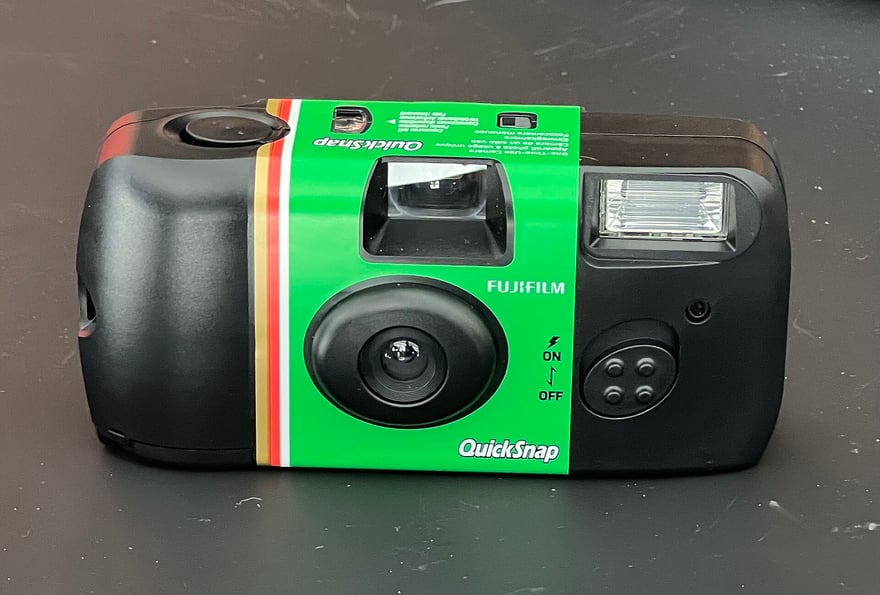
The table compares the Fujifilm 写ルンです with the Kodak FunSaver. Fujifilm’s 写ルンです is called QuickSnap overseas, and the standard Japanese model also comes in Simple Ace packaging with the same specifications. Kodak’s “from 1 m” is a retailer’s figure; Kodak officially lists only the flash distance. Only two numbers in this table matter: 1 meter and 3 meters. Closer than 1 m, the shot comes out blurry; farther than 3 m, the flash can’t reach, and nights and indoor shots come out black. Everything else is fixed, and all you control is “flash on or off” and “how far you stand”.

2. How to use it: four steps
flowchart TD
    A[Wind film until it stops] --> B{Dark or indoors?}
    B -->|Yes| C[Push flash switch up]
    C --> D[Wait for the light]
    B -->|Sunny outdoors| E[Stand 1 m or more away]
    D --> E
    E --> F[Look in viewfinder, shoot]
    F --> G{Counter at 0?}
    G -->|Not yet| A
    G -->|At 0| H[Send whole unit to lab]
Diagram: joelin.cc · Joe Lin
The diagram above is the entire operation of a disposable camera. For every shot you go through it from the top: wind, decide whether to use the flash, stand at the right distance, press the shutter. The roll is finished when the counter reaches 0, and the only thing left to do is send the whole unit in.
1. Turn the film wheel until it stops
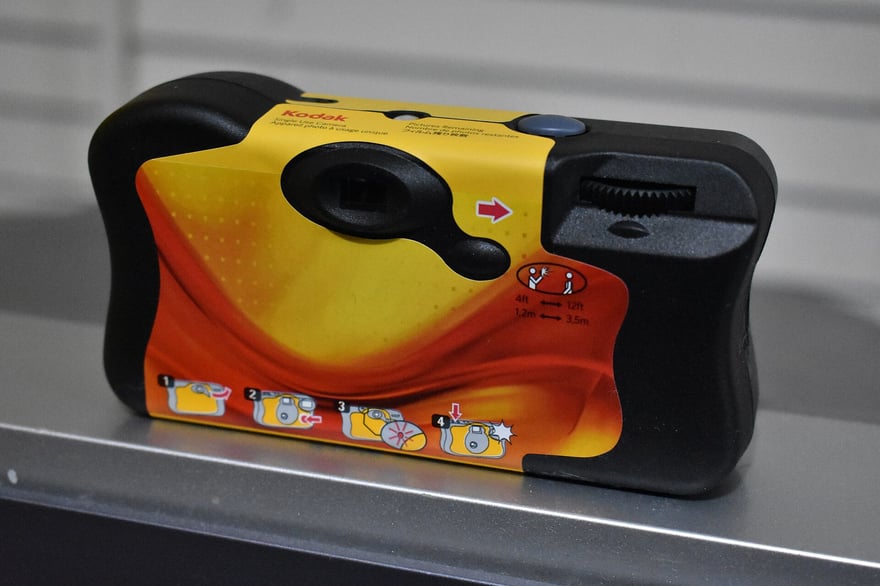
At the upper right of the back is a wheel you turn with your thumb. Turn it in the direction of the arrow until it won’t turn any more; that winds one frame, and the counter on top goes down by 1. You can’t press the shutter before winding; once wound, the shutter is armed, so if the camera is pressed inside a bag you’ll waste a shot. The Japanese lifestyle magazine ROOMIE advises winding only right before you shoot, not winding in advance and carrying it around.

2. To use the flash: push the switch up and wait for the red light
On the Fujifilm 写ルンです, pushing the flash switch on the front upward turns it on. Wait until the red indicator light on top comes on; only then is the flash charged and ready. If you press the shutter before the light is on, the flash won’t fire. ROOMIE also reminds you to push the switch back to turn the flash off after you finish.
When should you turn it on? Fujifilm’s official shooting advice is close to “use it whenever you can”: turn it on indoors, in a car, on cloudy days, in shade or under trees, against the light and at night, and also when you’re unsure. The reason is that the 写ルンです has a fixed aperture of F10 and a fixed shutter speed of 1/140 s, and only the light of a sunny day outdoors is enough; in any other situation, shooting without the flash gives a dark or black photo. With color negative film, it’s better to give it extra light than too little.
3. Look through the viewfinder and shoot from at least 1 meter away
A disposable camera has no focusing; the lens is fixed to render everything from 1 meter to infinity sharp. Fujifilm officially says it is weak at close range and recommends standing at least 1 meter away. Selfies at arm’s length and close-ups of food on a table are usually within 1 meter and come out blurry. With the flash on, the subject must be within 3 meters; any farther and the flash can’t reach.
The viewfinder and the lens are not in the same position, so what you see differs slightly from what is captured; don’t put the subject right against the edge of the frame. When you press the shutter, keep your fingers off the lens and flash on the front, hold the camera steady, press gently and let go only after pressing.
4. When the counter reaches 0, you’re done
The counter on top shows how many shots remain, counting down from 27 (or 39). Fujifilm’s wording is: when the counter reaches 0 and the film wheel turns without getting stuck, the roll is finished. By then all the film has been wound back into its cartridge, so you don’t need to rewind it yourself like with an ordinary film camera; just send it in.
3. How many shots does it take
| Model | Stated frames |
|---|---|
| Fujifilm 写ルンです (QuickSnap / Simple Ace) | 27 |
| Fujifilm QuickSnap Waterproof | 27 |
| Kodak FunSaver | 27 or 39 |
The number of shots a disposable camera takes is the number printed on the box, mostly 27, with a 39-shot version of the Kodak as well; check the package when you buy. Fujifilm Japan used to sell a 39-shot 写ルンです too, but shipments stopped in May 2018, and every 写ルンです you can buy now has 27 shots. The number 27 has a history: Fujifilm engineers wrote in a 2000 technical journal that because the film is loaded precisely at the factory, a roll that would normally hold 24 frames can squeeze in 3 more, which is why the 写ルンです takes 27 shots.
The number of usable shots is often fewer than stated: dim light, blur and fingers in the way each eat into your count. The next section lists the four most common failures and how to avoid them.
4. Why shots go wrong: four common cases
The table’s rows are the four most common failures.
| Result | Cause | Fix |
|---|---|---|
| Dark or black | No flash, or more than 3 m away | Use the flash unless sunny outdoors |
| Blurry subject | Less than 1 m away | Step back beyond 1 m |
| Dark corners or red haze | Finger over lens or flash | Hold the top and bottom edges |
| One extra stray shot | Wound in advance, pressed in a bag | Wind only when you shoot |
What these four failures have in common is that a disposable camera decides everything for you and leaves just two things to you: distance and light. The first two rows are the most common and the easiest to avoid; remember “flash on when it’s dark, and stay between 1 and 3 meters” and you avoid most failures.
5. When you’re done: send the whole unit to a lab
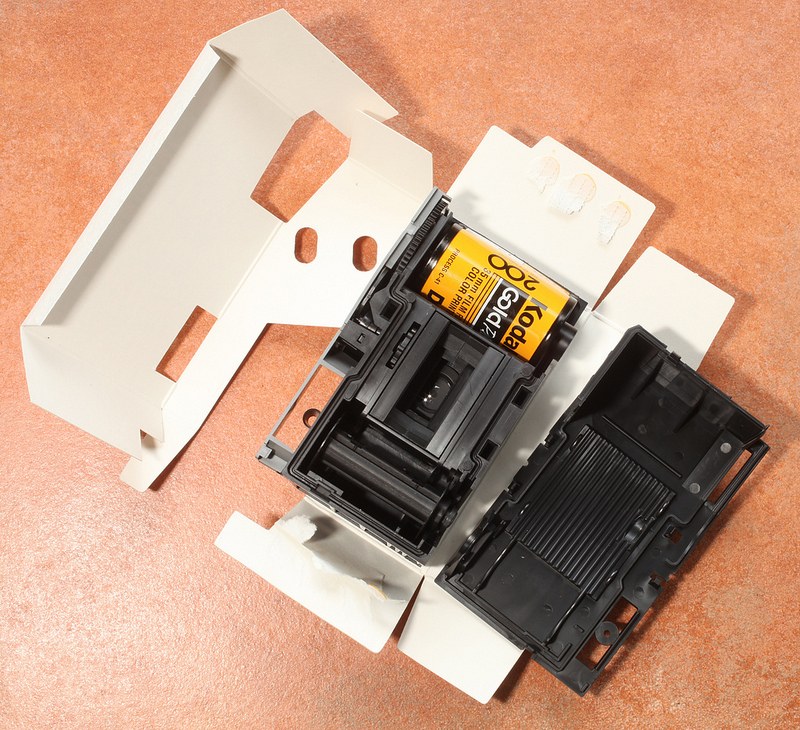
Don’t open the finished camera yourself. The film inside hasn’t been developed, so opening the back or tearing off the paper sleeve exposes it and ruins it; the Kodak body also carries a warning that the flash circuit inside has high voltage and must not be taken apart.

Sending it in is simple. The details below describe Taiwan:
- Where to get it developed: for ordinary color models, any film lab that can process 135 color negative film (C-41) will do, just as for ordinary film; you don’t need a special shop. The prices, turnaround days and mailing methods of 12 labs across northern, central and southern Taiwan are collected in Taiwan film developing prices (in Chinese).
- How to send it: most shops accept walk-ins and also mail or 7-11 store-to-store shipping; just pack the whole camera and send it. Convenience stores in Taiwan currently offer only digital photo printing, and no film-developing drop-off service could be found.
- Which plan to choose: if you only want files to view on your phone, “develop + scan” is enough; printing photos costs extra. Developing plus scanning one roll in Taiwan is mostly NT$100–170.
- What you get back: scans are delivered through cloud storage; the negatives can mostly be returned, and mailing them back costs extra postage. The camera body is not returned; it goes to recycling.
Black-and-white models are the exception. The Ilford HP5 Plus disposable camera must be sent for conventional black-and-white developing, and fewer labs can do that; Ilford XP2 is black-and-white film but is designed to run through color C-41, so an ordinary color lab can process it. If you get a black-and-white model, check the developing method printed on the package first, then ask the shop whether it can process it.
Don’t leave a finished camera for too long either: Fujifilm gives no number of days within which it must be developed after the last shot, but film slowly deteriorates over time, so develop it as soon as you can.
6. Can it go through airport X-ray
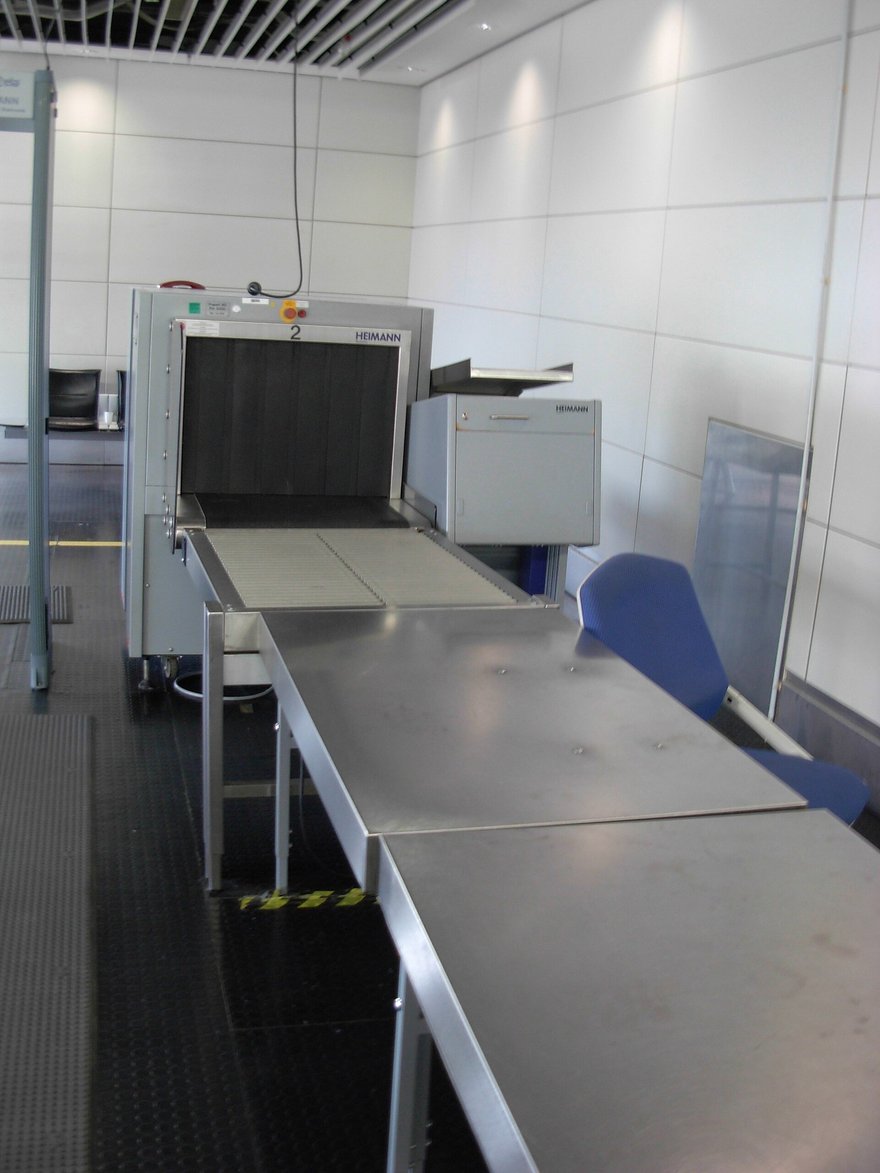
Don’t check it in; put it in your carry-on, and ask for a hand inspection at the security checkpoint. An undeveloped disposable camera is vulnerable to X-ray, whether or not you’ve shot it; film negatives, prints and scan files that are already developed are not.
The three official statements point the same way, with different degrees of strictness:
- Fujifilm: the official FAQ says the 写ルンです holds high-speed film, and neither the body nor the foil packaging can block X-rays, so it shouldn’t go in checked baggage and should be carried onto the plane; when going abroad, or on a domestic flight with several security checks, asking for a hand inspection at the checkpoint is safest. In 2020 Fujifilm also issued a separate warning that the new types of scanners being installed progressively at US airports affect undeveloped film more.
- Kodak Alaris: it strongly recommends that no undeveloped film go through a CT scanner, and says that when flying you should assume the major airports around the world are already using CT scanners, and checked baggage gets CT scanned too; a hand inspection is not guaranteed at every airport, so it suggests contacting the airport in advance, and if a hand inspection isn’t possible, considering buying locally and developing locally.
- The US Transportation Security Administration (TSA): it suggests putting undeveloped film and cameras containing film in carry-on baggage, or bringing them to the checkpoint to request a hand inspection; whether it is let through is decided by the officers on site.

Turned into practical steps:
- Put the disposable camera in your carry-on, not in checked baggage.
- Before the checkpoint, take the camera out, put it in a clear zip bag and hand it to the officer asking for a hand inspection; don’t just put it on the conveyor belt.
- A hand inspection is a “request” and not every airport will agree; you can ask the airport before you travel. If they can’t, carrying it through the X-ray machine is still better than checking it in.
- If you don’t want to take the risk, buy it at your destination, develop it there, and bring it back; developed negatives and scan files aren’t affected by X-ray.
How instant-film packs fare at airports, and screenshots of the original Fujifilm and Polaroid warnings, are covered in section 8 of How to store instant film, develop it and fly with it.
7. Can you still use an expired disposable camera
You can shoot with it, but Fujifilm officially advises against it. Fujifilm’s FAQ says film slowly deteriorates like fresh food, so please use it within the expiry date printed on the box; expired film loses sensitivity, gets grainier and its colors look dull.
Expired disposable cameras many years past their date are common on secondhand markets and auctions, and enthusiasts use them for a “retro color” look. The effect is different on every unit; the longer past expiry and the hotter the storage, the more likely it is to shift color or fog, and the whole roll may even come out blank. A built-in battery that has sat for many years may also no longer power the flash. You can try it, but don’t use it for one-time occasions like a wedding or a graduation.
Conclusion
A disposable camera decides everything for you, and only three things are yours to manage: use the flash in dark places, keep the subject between 1 and 3 meters away, and send the whole unit in when you’re done. Every other “technique” is just a variation on these three things.
Its limits are also its selling points: a fixed number of shots, no preview, and waiting for developing. If you want the photo on the spot, an instant camera is the right choice; if you want to shoot several rolls a year, buying a camera that takes replaceable film is cheaper. How to work out these two choices is covered in Disposable cameras, instant cameras and point-and-shoots: what’s the difference and How much does a disposable camera cost (in Chinese).
Further reading
- How much does a disposable film camera cost? 2026 Taiwan prices, developing fees and cost per shot (in Chinese)
- Disposable cameras, instant cameras and point-and-shoots: what’s the difference
- Why disposable cameras are popular again: 40 years of 写ルンです (in Chinese)
- 2026 Taiwan film developing prices: 12 labs in northern, central and southern Taiwan (in Chinese)
- How to store instant film, develop it and fly with it
- What is a point-and-shoot camera? 1977 to 2026
Appendix 1: What I could not find
- Kodak FunSaver’s full official specifications (lens focal length, aperture, shutter speed, weight): Kodak’s website lists only the flash distance, and the ISO shown on Taiwan listings differs from some overseas listings (both ISO 400 and 800 appear), so go by the packaging of the unit in your hand.
- How long after finishing a disposable camera you can wait before developing: Fujifilm gives no number of days.
- The official rules of Taiwan’s airports (Taoyuan, Songshan, Kaohsiung) on hand inspection of film: the Aviation Police Bureau’s website has no statement specific to film, so whether a hand inspection is possible depends on the security officers on site.
- Which developing process the new Fujifilm 写ルンです Black and White released in 2026 uses: no official description could be found, so ask the shop before sending it in.
- Fujifilm’s official page says the roll is finished when “the counter reaches 0 and the film wheel no longer sticks”, while the Japanese magazine ROOMIE writes “after the last shot, turn the film wheel until it stops”. The two describe the same closing action, and I could not find a more detailed Fujifilm explanation of how to wind after the last frame.
Appendix 2: Sources
- Fujifilm 写ルンです official specifications (ISO 400, 27 shots, 32mm, F10, 1/140 s, from 1 m, flash 1–3 m, built-in AAA battery, 90 g): https://www.fujifilm.com/jp/ja/consumer/films/utsurundesu/specifications (checked 2026-10-28)
- Fujifilm 写ルンです product page (counter at 0 and film wheel no longer sticking means finished; flash switch on the front pushed up to turn it on; flash 3 m): https://www.fujifilm.com/jp/ja/consumer/films/utsurundesu/standard (checked 2026-10-28)
- Fujifilm official shooting tutorial (red light means the flash is ready; flash on indoors, in cars, on cloudy days, against the light, at night and in shade; stand at least 1 m away, flash up to 3 m): https://kurashi.fujifilm.com/category/howto/354.html (updated 2026-02-25, checked 2026-10-28)
- Fujifilm official FAQ, airport X-ray: https://filmandcamera-support-jp.fujifilm.com/filmandcamerapcdetail?aid=000001216 (updated 2023-04-06)
- Fujifilm official FAQ, expired film and the 写ルンです: https://filmandcamera-support-jp.fujifilm.com/filmandcamerapcdetail?aid=000001232 (updated 2020-11-12)
- Fujifilm, “Protecting film from X-ray / CT scanning in airport carry-on baggage inspection” (空港手荷物検査における X 線/CT スキャンからのフィルムの保護について): https://asset.fujifilm.com/www/jp/files/2020-02/4ea03c30a569b6b817ec39e034dbdb9c/20200227_01.pdf (2020-02-10)
- Kodak Alaris, “CT Scanning X-Ray Technology and Film” (undeveloped film should not go through CT scanners, checked baggage is also CT scanned, hand inspection not guaranteed, contact the airport in advance, buy and develop locally as an alternative): https://kodakprofessional.com/taxonomy/term/329 (checked 2026-10-28)
- US TSA, “Film” (undeveloped film and cameras with film go in carry-on, or request a hand inspection at the checkpoint): https://www.tsa.gov/travel/security-screening/whatcanibring/items/film (updated 2017-05-04, checked 2026-10-28)
- 39-shot 写ルンです shipments stopped in May 2018: https://ja.wikipedia.org/wiki/写ルンです (checked 2026-09-25, already cited in this site’s /p/8078)
- How Ilford black-and-white disposable cameras are developed (HP5 Plus conventional black-and-white, XP2 C-41): this site’s /p/9841 (in Chinese), section 5
- ROOMIE, “Nostalgic 写ルンです is the best after all” (懐かしの「写ルンです」やっぱ最高!) (wind only before shooting, turn the flash off after finishing): https://www.roomie.jp/2025/10/1599727/ (2025-10-28)
- Digital Camera World, Kodak FunSaver review (counter counts down, flash indicator light, high-voltage do-not-open warning): https://www.digitalcameraworld.com/reviews/kodak-funsaver-single-use-camera-review (checked 2026-10-28)
- Kodak FunSaver specifications (flash 1.2–3.5 m): https://business.kodakmoments.com/product/kodak-fun-saver-single-use-camera (checked 2026-09-25)
- Why the 写ルンです has 27 shots, and the recycling process: FUJIFILM RESEARCH & DEVELOPMENT No. 45 (2000), compiled on this site in section 4 of /p/9842 (in Chinese)
- Taiwan retail prices, developing and scanning prices and convenience store services: this site’s /p/8078 and /p/9841 (in Chinese) (checked 2026-09-25)
Image sources
All photos in this article come from Wikimedia Commons and are used under their respective open licenses.
- Front of the Fujifilm QuickSnap disposable camera: TaurusEmerald, CC BY-SA 4.0, https://commons.wikimedia.org/wiki/File:Fujifilm_QuickSnap_Camera.jpg
- Back of a Kodak disposable camera with flash: Matthew Paul Argall, CC BY 2.0, https://commons.wikimedia.org/wiki/File:Back_of_Kodak_Flash_Single_Use_Camera_%2843329081655%29.jpg
- Opened Kodak Fun Panoramic disposable camera: Joost J. Bakker, CC BY 2.0, https://commons.wikimedia.org/wiki/File:Kodak_Fun_Panoramic_camera_open_(51887209924).jpg
- Carry-on baggage X-ray machine at an airport: Piotrus, CC BY-SA 3.0, https://commons.wikimedia.org/wiki/File:Airport_security_01.JPG
Common questions
Does a disposable camera need charging or batteries?
No. A disposable camera comes with its battery built in. The Fujifilm 写ルンです contains one AAA alkaline battery and is ready to shoot out of the box. The battery powers only the flash, so you can shoot without the flash, but photos in dim places will come out dark.
Can I send a disposable camera for developing before the roll is finished?
Yes. The lab will still open the camera and develop the film. The frames you didn’t shoot are simply wasted, and the fee is the same as for a full roll.
Can I load new film into a disposable camera and keep using it?
No. A disposable camera is designed to be handed whole to the lab, which takes it apart. Opening it yourself exposes the film, and the flash circuit carries high voltage. If you want a reusable camera, buy one that takes replaceable film, such as the Lomography reusable 即可拍 (about NT$790 on PChome in Taiwan in September 2026), or a film point-and-shoot; see What is a point-and-shoot camera.
Keywords: what is a disposable camera, how to use a disposable camera, how many shots a disposable camera has, disposable camera developing, disposable camera airport X-ray, expired disposable camera, 写ルンです, QuickSnap, single-use camera, 即可拍
Sources: Chinese original first published on 2026-10-28 (Taipei). Sources checked on 2026-10-28; Taiwan prices and lab fees are as of September 2026 and apply to Taiwan only. Camera specifications are the manufacturers' official figures.
This English version is based on original Traditional Chinese content on joelin.cc. The language and explanations are localised for international readers. The Traditional Chinese original is the authoritative version — for its complete meaning, please read the original article.
Use Google Search a lot?
Set joelin.cc as a preferred source to see more of its articles when you search.