
This article is also available in: 繁體中文 · 日本語 · 한국어 · Bahasa Indonesia · Bahasa Melayu · ไทย · Português (Brasil) · Español · Türkçe · Tiếng Việt · Deutsch · हिन्दी
Contents (37)
A point-and-shoot camera is a small camera with autofocus, automatic exposure and a built-in flash that takes a picture as soon as you press the shutter button. It’s also called a compact camera. It doesn’t ask you to understand aperture or shutter speed, and it isn’t the same thing as a disposable camera, which you hand back to the photo lab whole after shooting, or an instant camera, which spits out a print on the spot.
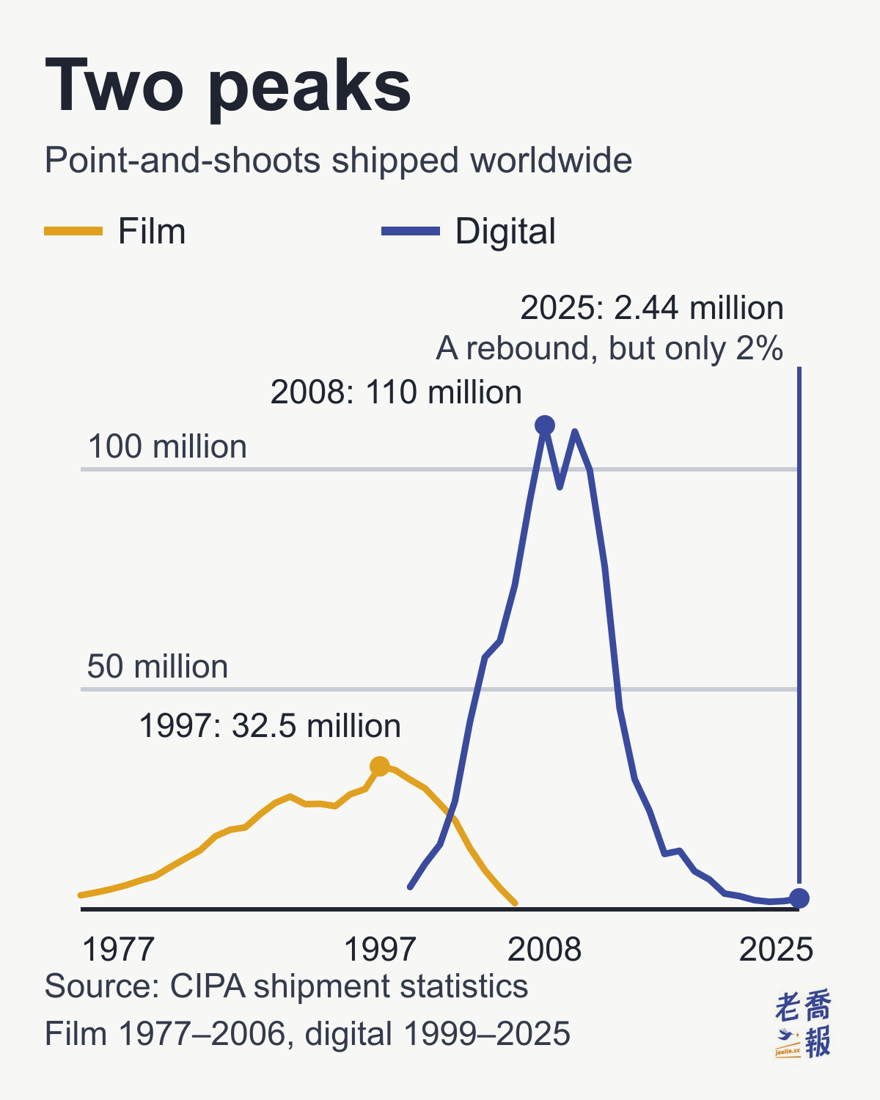
This category has peaked twice worldwide and died twice. Film point-and-shoots shipped 32.52 million units in 1997 and only 1.4 million in 2006; digital point-and-shoots shipped 110.07 million units in 2008 and only 1.72 million in 2023. From 2024 they came back: 2.44 million units shipped in 2025, up nearly 30% from the year before, while the average shipment price was nearly 7 times what it had been at the bottom.
This article uses shipment statistics from CIPA (Camera & Imaging Products Association), the industry association of Japanese camera makers, going back to 1977. It joins the film and digital lines into one timeline to answer four questions:
- Where the boundaries of a point-and-shoot lie, and what it’s called in different countries.
- When film point-and-shoots started, when they peaked, and how they disappeared.
- Which year digital point-and-shoots actually peaked, and how phones replaced them.
- Whether the recovery since 2024 is real or an illusion, and what exactly came back.
Every figure is labeled with its source and definition. Things I couldn’t find are listed separately at the end, not filled in with estimates.
1. What is a point-and-shoot: definition and boundaries
Three “automatics” plus a flash
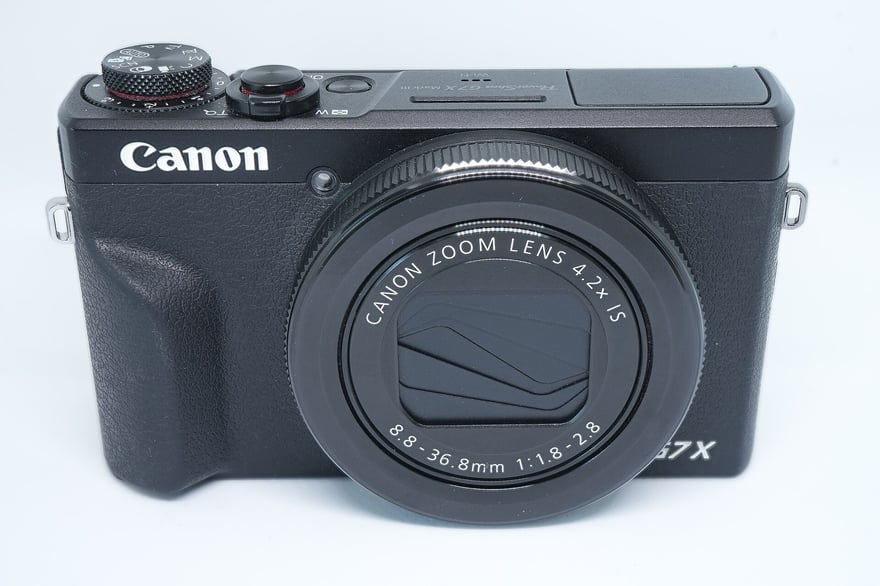
English Wikipedia defines a point-and-shoot as a film or digital camera designed primarily for simple operation, usually with autofocus (or a fixed-focus lens), automatic exposure and a built-in flash. Chinese Wikipedia puts it even more plainly: a small, fully automatic camera that’s easy to operate and made for ordinary people, and its Chinese name literally means a camera “even a fool can use.”
In everyday terms, a point-and-shoot does three things for you:
- A point-and-shoot focuses by itself, so you don’t have to turn a focus ring.
- A point-and-shoot picks the aperture and shutter speed by itself, so you don’t have to read a light meter.
- A point-and-shoot fires its flash by itself when there isn’t enough light, so you don’t have to carry a separate flash.
All that’s left is framing and pressing the shutter. The lens is usually fixed to the body and can’t be swapped, and the body is small enough to fit in a pocket. Those two traits put it in a different world from “interchangeable-lens cameras” such as SLRs and mirrorless cameras.

How it differs from disposable and instant cameras
These three kinds of camera are often lumped together because they’re all “simple,” but the way the photo reaches your hands is completely different:
| Item | Point-and-shoot | Disposable | Instant |
|---|---|---|---|
| Reusable | Yes | No (sent to lab) | Yes (new film pack) |
| Inside | Film: own 135 roll; digital: card | Factory-loaded 135 roll | Instant film pack |
| Photos ready | Film: after developing; digital: at once | After developing | On the spot |
| Examples | Olympus mju-II, Ricoh GR, Canon PowerShot | Fujifilm QuickSnap (写ルンです) | Fujifilm instax, Polaroid |
The table compares the three types by reuse, what goes inside, when you get to see the pictures, and representative products. A film point-and-shoot takes a 135 roll you load yourself, while a digital one records to a memory card; an instant print appears on the spot and takes anywhere from tens of seconds to over ten minutes to fully develop.
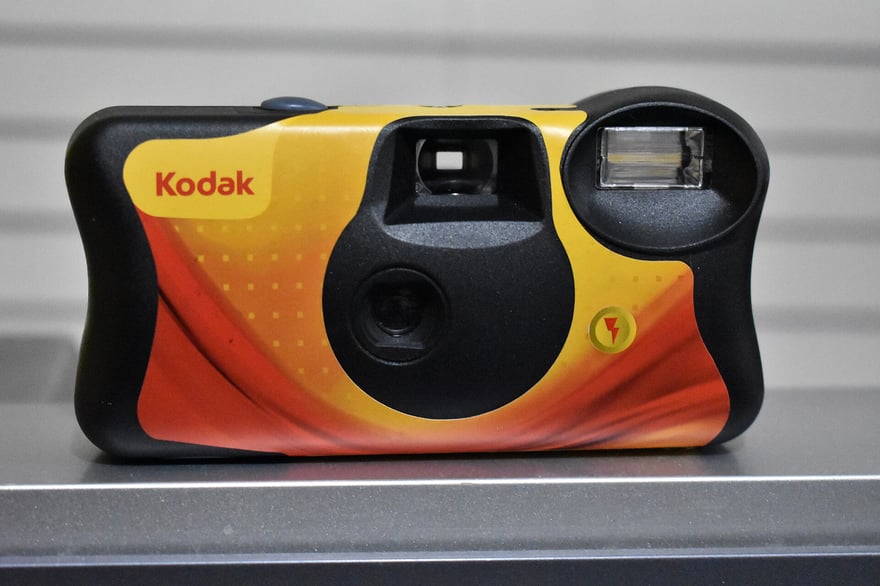
The difference between a disposable camera and a point-and-shoot is that “the body is used up along with the film”: Fujifilm’s QuickSnap, launched in 1986, is sold as a whole unit with the film inside, and after shooting you hand it to the photo lab, which recycles it, while with a point-and-shoot you load film yourself again and again (the industry history of the disposable is covered in 40 years of 写ルンです (in Chinese)). The difference with an instant camera is that “no developing is needed”: press the shutter and you get a physical print.
A full comparison of how the three produce photos, what each shot costs and how to choose is in the series overview, disposable cameras, instant cameras and point-and-shoots: what’s the difference (in Chinese).

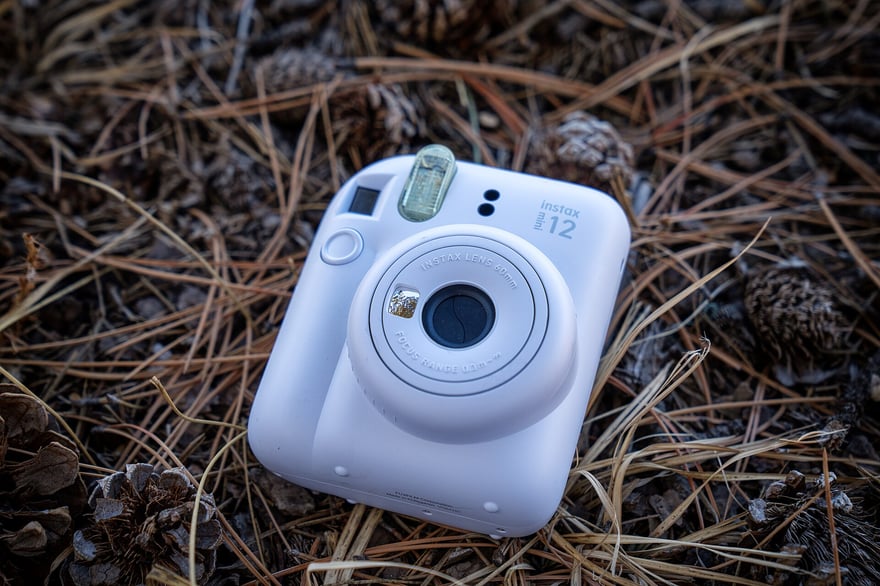

The boundary gets blurry in places. Japan’s BCN retail statistics count hybrids like the Fujifilm instax mini Evo, which can save digital files and also print photos on the spot, in the compact digital camera category, and in 2025 that series ranked No. 2. So whenever you see a “compact camera ranking,” check first what’s included in it.
In English: point-and-shoot, or compact camera
The standard English names are point-and-shoot camera, meaning you just point it and shoot, and compact camera. English Wikipedia notes a small difference between British and American usage: when British speakers say point-and-shoot they stress “fully automatic,” while Americans stress “small size” and care less about how automated it is. So a high-end compact that lets you set the aperture by hand is still often called a point-and-shoot in the US.
What other countries call it: from “fool” to “soap dish”
The same camera is named from very different angles around the world. The table below is compiled from each language’s Wikipedia and from local dictionaries and retailers, and lists the most common name in each place:
| Region / language |
Name | Literally |
|---|---|---|
| English | point-and-shoot | Point and shoot |
| Taiwan | 傻瓜相機 | Fool’s camera |
| Hong Kong | 傻瓜機 | Fool’s camera |
| Mainland China |
卡片機 | Card camera |
| Japan | コンパクトカメラ | Compact camera |
| Japan (digital) |
コンデジ | Compact digital |
| Korea | 똑딱이 | “Click” sound |
| Spanish | cámara compacta | Compact camera |
| Portuguese (Brazil) |
câmera compacta | Compact camera |
| German | Kompaktkamera | Compact camera |
| Russian | мыльница | Soap dish |
| Indonesian | kamera saku | Pocket camera |
| Vietnamese | máy ảnh du lịch | Travel camera |
In the three Chinese rows, 傻瓜 means “fool,” so 傻瓜相機 literally says the camera is so simple that even a fool can use it. Hong Kong’s 傻瓜機 is simply a shortened form of 傻瓜相機. Mainland China uses 卡片機 instead, a name for small digital cameras in particular, because the body is as thin as a card. Japan’s コンデジ is short for “compact digital camera.”
The table shows four naming approaches:
- Poking fun at the user: Chinese 傻瓜 and the old Japanese name バカチョン both stress that even someone who knows nothing about cameras can use it.
- Describing the action: English point-and-shoot, plus the literal equivalents in Spanish (cámara de apuntar y disparar) and Brazilian Portuguese (câmera aponte-e-dispare), all mean “aim and shoot.”
- Imitating the sound: Koreans call it 똑딱이 (also 똑딱이 카메라), an onomatopoeia for the “click” of the shutter. Colloquial German Knipse also comes from knipsen (to snap a casual picture), but German dictionaries treat it as a general word for any camera, not specifically a small one.
- Describing the shape or use: Russian calls it мыльница (soap dish), because the rounded plastic body looks like one; mainland China calls small digital cameras 卡片機 (card camera); Indonesian kamera saku and Vietnamese máy ảnh bỏ túi mean “pocket camera,” and another common Vietnamese term, máy ảnh du lịch, means “travel camera.”
Most other languages simply translate or transliterate “compact”: Thai uses กล้องคอมแพค or กล้องกะทัดรัด, Malay uses kamera kompak, and Turkish uses kompakt fotoğraf makinesi. I didn’t find any other colloquial name in these three languages. Vietnamese also has the plain máy ảnh compact alongside the two descriptive names above. Even within Chinese, the three regions differ: Taiwan says 傻瓜相機, Hong Kong usually shortens it to 傻瓜機, and in mainland China the colloquial name for small digital cameras is 卡片機.
Japanese バカチョンカメラ: three theories of origin, later replaced by コンパクトカメラ
The early colloquial name in Japan was バカチョンカメラ. Japanese Wikipedia lists three theories about where it came from:
- The first theory is that “even a fool (バカ) can use it.”
- The second theory is that “you just press (チョン) the shutter once to take a picture.”
- The third theory is that it’s a sound shift from the English “vacation camera.”
The word later became a problem: チョン came to be recognized as a slur against Koreans, and the whole word was placed on broadcasters’ list of terms not to be used on air. Japanese Wikipedia records that NHK set guidelines around 2008 saying it shouldn’t be broadcast, and other TV stations followed; the 3rd edition (1981) of the Sanseido Japanese dictionary included the word, but the 7th edition (2011) dropped it. The Weblio dictionary records that the word was in general use until the early 1980s and was then voluntarily avoided because of its discriminatory meaning. In formal contexts the term is コンパクトカメラ (compact camera).
If you need this word when reading Japanese sources or talking with Japanese people, コンパクトカメラ is the one to use.
Where this article’s numbers come from: who CIPA is, and which two categories it uses
Almost all the shipment figures in this article come from CIPA (Camera & Imaging Products Association). It is the industry association of Japanese camera makers. Its predecessor, the Japan Camera Industry Association, was founded in 1954 and reorganized into today’s CIPA in 2002. Its regular members include camera makers such as Canon, Nikon, Sony, Fujifilm, Panasonic, OM Digital Solutions (formerly Olympus’s camera division) and Ricoh Imaging (Pentax, GR). Members report their unit shipments every month, and CIPA compiles them into public statistics; around the 1st of each month it publishes the figures for two months earlier.
So you can read CIPA’s numbers as “shipments of Japanese-brand cameras to the whole world.” There are two limits to know up front:
- CIPA counts factory shipments, not how many cameras were sold in stores; after a maker ships to retailers, it takes a while for stores to sell through.
- It only counts participating makers. In 2026, 9 companies take part in the digital camera statistics: Canon, Nikon, Sony, Fujifilm, Panasonic, OM Digital Solutions, Ricoh Imaging, Sigma and Kenko Tokina. Leica, and PixPro cameras sold under the Kodak brand (made under license by JK Imaging in the US), are not in CIPA’s numbers.
CIPA has no statistical category called “point-and-shoot,” so this article uses the two closest categories:
- For the film era, “lens-shutter cameras” (レンズシャッター in Japanese). There are two places to put a camera’s shutter: an SLR puts it inside the body, right in front of the film; a small camera puts it between the lens elements, which is called a lens shutter. Almost all small film cameras use a lens shutter, so CIPA’s category notes map this category directly to what people generally call compact cameras (コンパクトカメラ), including half-frame cameras. This category was counted through 2006 and stopped being listed separately from 2007.
- For the digital era, “cameras with built-in lenses” (レンズ一体型 in Japanese), meaning digital cameras whose lens and body are made as one and can’t swap lenses, as opposed to SLRs and mirrorless cameras that can. This article sometimes calls them “built-in-lens cameras” for short.
Note that not every digital built-in-lens camera is a point-and-shoot. The category also includes full-frame fixed-lens cameras like the Sony RX1R III, which costs more than US$5,000, and big-zoom models like the Nikon Coolpix P1100. So the figures below are “an upper bound for point-and-shoots,” not an exact point-and-shoot count; but in the volumes of 1999 to 2012, high-end models were only a rounding error, so the figures are good enough for reading trends.
2. Film point-and-shoots: autofocus arrives in 1977, sales reach 32.52 million in 1997
Key models: from “never out of focus” to “a great lens in your pocket”
| Year | Model | Why it matters |
|---|---|---|
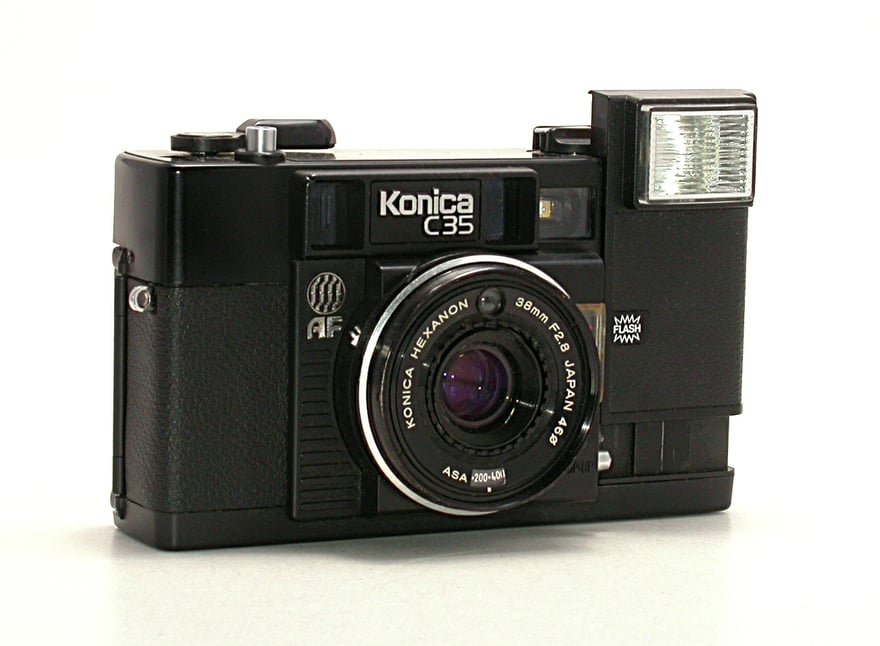
| November 1977 | Konica C35 AF (ジャスピンコニカ) | World’s first mass-produced autofocus camera, using Honeywell’s Visitronic AF module and a 38mm f/2.8 lens |
| 1979 | Olympus XA | Sliding-cover rangefinder small enough to fit in a pocket, designed by Yoshihisa Maitani |
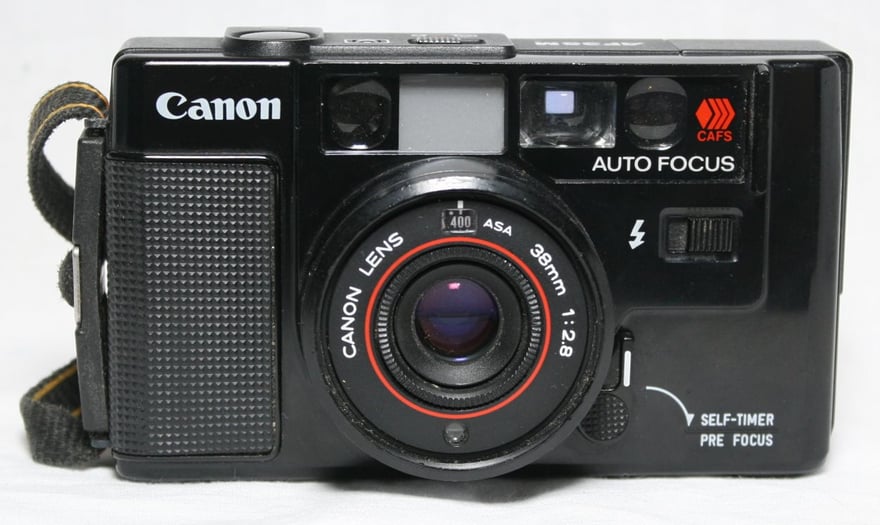
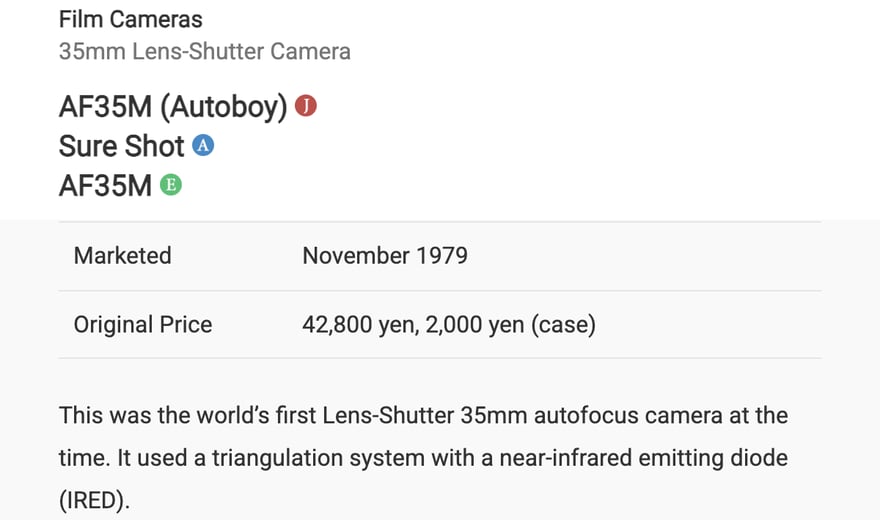
| November 1979 | Canon AF35M (Sure Shot in the US, Autoboy in Japan) | World’s first 35mm lens-shutter camera with active infrared autofocus; Japanese list price 42,800 yen |
| 1990 or 1991 | Contax T2 | Carl Zeiss Sonnar 38mm f/2.8 lens, the classic premium point-and-shoot; sources differ on release year; discontinued in 2002 |
| 1993 | Nikon 35Ti | 35mm f/2.8 Nikkor lens |
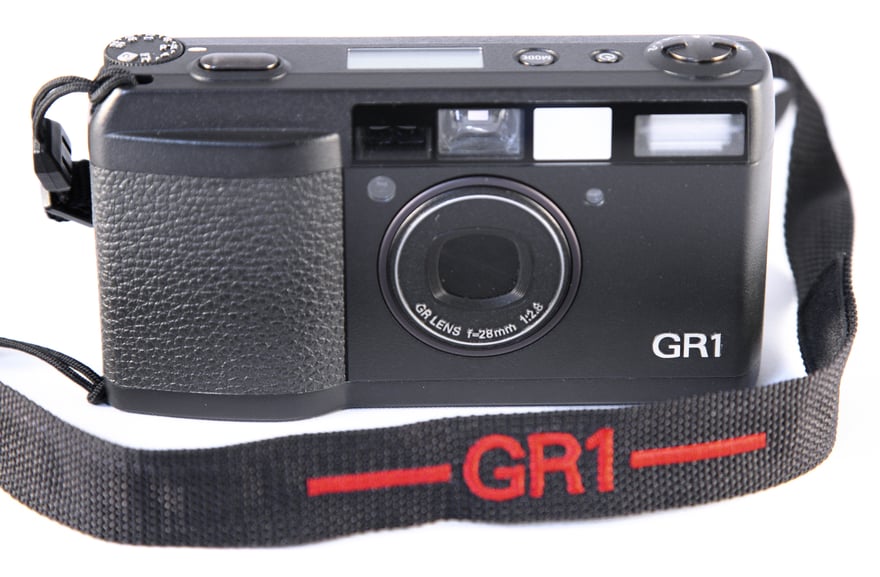
| 1996 | Ricoh GR1 | GR 28mm f/2.8 lens; went digital as the GR Digital in 2005, the start of today’s GR series |
| 1997 | Olympus mju-II (Stylus Epic in the US) | 35mm f/2.8; about 3.8 million made |
| 2001 | Contax T3 | Japanese list price 98,000 yen; Kyocera ended camera production in March 2005 |
The table lists representative film point-and-shoots in order of release, with the reason each one matters.
This timeline has two parts. From 1977 to 1979 the problem being solved was focus: the Konica C35 AF’s Japanese nickname, ジャスピン, means “focus just right,” and English Wikipedia says it sold about 1 million units; two years later the Canon AF35M used infrared rangefinding and made autofocus standard equipment on point-and-shoots. The 1990s took a different path: the Contax T2, Nikon 35Ti and Ricoh GR1 squeezed premium fixed lenses into small bodies, turning the point-and-shoot from “a camera that can’t fail” into “a great camera in your pocket.” These models are also the most expensive group on today’s used market.



CIPA shipment table: point-and-shoots took 90% of the film camera market
| Year | Units (k) |
Film share |
Avg. price (yen) |
|---|---|---|---|
| 1977 | 3,191 | 35% | 15,600 |
| 1979 | 4,549 | 34% | 15,400 |
| 1981 | 6,565 | 39% | 15,400 |
| 1983 | 9,625 | 59% | 15,200 |
| 1985 | 13,468 | 67% | 14,400 |
| 1987 | 18,101 | 80% | 12,100 |
| 1990 | 24,196 | 85% | 10,600 |
| 1993 | 23,982 | 90% | 9,200 |
| 1995 | 26,133 | 88% | 7,900 |
| 1997 | 32,516 | 89% | 8,100 |
| 1998 | 31,654 | 88% | 8,600 |
| 2000 | 27,483 | 87% | 7,200 |
| 2001 | 23,928 | 87% | 6,600 |
| 2002 | 20,236 | 86% | 6,300 |
| 2003 | 13,931 | 85% | 5,300 |
| 2004 | 8,871 | 88% | 3,700 |
| 2005 | 4,829 | 90% | 2,900 |
| 2006 | 1,401 | 86% | 2,900 |
Units are worldwide shipments of CIPA lens-shutter cameras (film point-and-shoots) in thousands (k), and “film share” is their share of all film camera shipments. The source is CIPA’s historical film camera statistics; the average shipment price was calculated by this site by dividing shipment value by units shipped, and it is the maker’s shipment price, not the store price.
This table says three things:
- Autofocus let point-and-shoots take over the whole film camera market: in 1977 lens-shutter cameras made up only 35% of all film camera shipments, by 1987 they reached 80%, and through the 1990s they stayed around 90%.
- The more point-and-shoots sold, the cheaper they got: the average shipment price fell from 15,600 yen in 1977 to 8,100 yen in 1997, turning them from a mid-priced product into a mass-market consumer good over twenty years.
- The 32.52 million units of 1997 were the top of the entire film point-and-shoot curve, and it never got back there.
The first death: 1997 to 2006, down 96% in nine years
After 1997, film point-and-shoots shrank every year, and the decline sped up from 2003: 13.93 million units in 2003, 8.87 million in 2004, 4.83 million in 2005, and only 1.4 million in 2006, 4.3% of the peak. From 2007 CIPA no longer listed lens-shutter cameras separately, and all film cameras combined came to only 790,000 units in 2007.
This collapse overlaps exactly with the rise of digital cameras. Putting the two CIPA tables side by side, in 2001 there were still 23.93 million film point-and-shoots and 14.75 million digital built-in-lens cameras; in 2002, digital built-in-lens cameras reached 24.55 million, overtaking film point-and-shoots at 20.24 million for the first time. 2002 was the year the point-and-shoot passed the baton from film to digital.
To see how fast film point-and-shoots died, compare them with the later collapse of digital point-and-shoots: nine years after their 2008 peak, in 2017, digital built-in-lens cameras still had 12% of peak volume; nine years after their 1997 peak, film point-and-shoots had only 4%.
3. Digital point-and-shoots: 110 million units in 2008, then down to 1.72 million
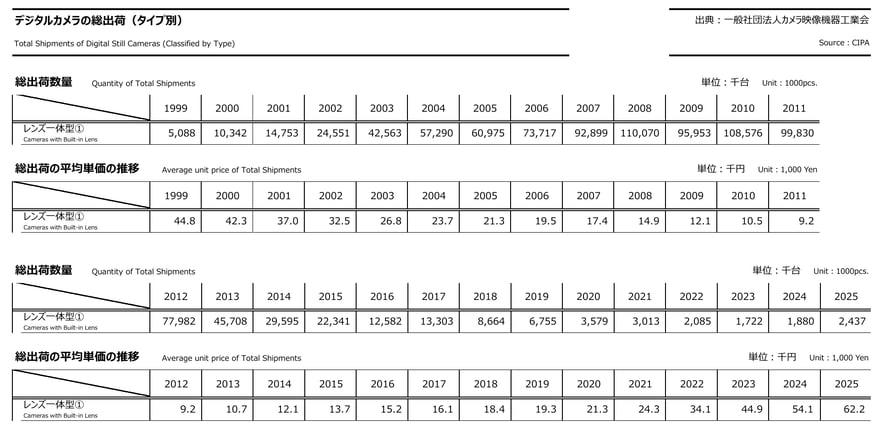
CIPA built-in-lens camera shipments (1999–2025)
| Year | Units (k) |
YoY | Avg. price (yen) |
|---|---|---|---|
| 1999 | 5,088 | — | 44,800 |
| 2000 | 10,342 | +103.3% | 42,300 |
| 2001 | 14,753 | +42.7% | 37,000 |
| 2002 | 24,551 | +66.4% | 32,500 |
| 2003 | 42,563 | +73.4% | 26,800 |
| 2004 | 57,290 | +34.6% | 23,700 |
| 2005 | 60,975 | +6.4% | 21,300 |
| 2006 | 73,717 | +20.9% | 19,500 |
| 2007 | 92,899 | +26.0% | 17,400 |
| 2008 | 110,070 | +18.5% | 14,900 |
| 2009 | 95,953 | -12.8% | 12,100 |
| 2010 | 108,576 | +13.2% | 10,500 |
| 2011 | 99,830 | -8.1% | 9,200 |
| 2012 | 77,982 | -21.9% | 9,200 |
| 2013 | 45,708 | -41.4% | 10,700 |
| 2014 | 29,595 | -35.3% | 12,100 |
| 2015 | 22,341 | -24.5% | 13,700 |
| 2016 | 12,582 | -43.7% | 15,200 |
| 2017 | 13,303 | +5.7% | 16,100 |
| 2018 | 8,664 | -34.9% | 18,400 |
| 2019 | 6,755 | -22.0% | 19,300 |
| 2020 | 3,579 | -47.0% | 21,300 |
| 2021 | 3,013 | -15.8% | 24,300 |
| 2022 | 2,085 | -30.8% | 34,100 |
| 2023 | 1,722 | -17.4% | 44,900 |
| 2024 | 1,880 | +9.2% | 54,100 |
| 2025 | 2,437 | +29.6% | 62,200 |
Units are worldwide shipments of CIPA digital cameras with built-in lenses, in thousands (k). Units and average shipment price are CIPA’s published figures (the price was originally in thousands of yen and has been converted to yen by this site); year-on-year change was calculated by this site from units shipped.
You can read this table in four stages:
- 1999 to 2008 was the takeoff: shipments grew to 21 times the 1999 level, and the average price fell from 44,800 yen to 14,900 yen, making small digital cameras something everyone could afford.
- 2009 to 2012 was the plateau: shipments hovered around 100 million units, and the average price hit its low of 9,200 yen in 2011 and 2012.
- 2013 to 2023 was the collapse: ten of those eleven years saw declines, with shipments falling from 77.98 million to 1.72 million.
- 2024 onward is the recovery: shipments have come back a little, and the average price keeps climbing.

The peak was 2008, not 2010
Many reports in Chinese and English describe 2010 as the heyday of the point-and-shoot, which isn’t accurate. CIPA’s January 2009 press release is clear: built-in-lens camera shipments in 2008 were 110.07 million units, up 18.5%. In 2010, built-in-lens cameras came to 108.58 million units, about 1.5 million fewer than in 2008.
What set a record in 2010 was “total digital cameras”: built-in-lens cameras plus interchangeable-lens cameras, 121.46 million units in all. Interchangeable-lens cameras were still growing in those years and pushed the total past 2008, but the point-and-shoot itself peaked in 2008. CIPA attributed the 2009 dip to the global recession.
2013: 32.27 million units gone in a single year
Built-in-lens cameras shipped 45.71 million units in 2013, 41.4% fewer than in 2012. In its February 2014 press release, CIPA described that year’s drop for built-in-lens cameras as “particularly pronounced.”
To be precise: in percentage terms, 2016 (-43.7%) and 2020 (-47.0%) fell harder than 2013; but in units, 2013 lost 32.27 million in one year, the biggest single-year loss on the whole curve. From the 2008 peak to 2023, built-in-lens cameras fell 98.4% in total.
Phone substitution: what CIPA said and what outsiders said, read separately
The point at which built-in-lens cameras started to collapse overlaps closely with the spread of smartphones. But CIPA itself only said “phones killed the point-and-shoot” in stages, and the two versions need to be stated separately:
- In its February 2012 press release, CIPA blamed the 2011 drop in shipments on the Great East Japan Earthquake and the Thai floods that spread from late October, with no mention of phones anywhere in the text.
- In its February 2014 press release, CIPA wrote that low-end products faced fierce competition because of the arrival of smartphones; among the CIPA annual press releases from 2009 to 2015 that I read, this was the first mention of phones.
- In its February 2015 press release, CIPA wrote directly that built-in-lens cameras faced fierce competition because of the arrival of smartphones, while saying interchangeable-lens cameras were relatively stable because their expressive power set them apart from phones.
Outside data pointed to phones earlier. English Wikipedia cites NPD data from the US: in the year to November 2011, the share of Americans’ photos taken with a point-and-shoot fell from 52% in 2010 to 44%, and the share taken with a phone rose from 17% to 27%, while point-and-shoot sales fell 17% year on year over the same period.
So the more accurate account is: the 2011 drop was attributed at the time by the industry body to natural disasters; in 2012, production capacity recovered after the disasters but shipments didn’t come back, and by 2014 CIPA itself acknowledged that phones were a structural cause. The second death wasn’t a one-off disaster; the demand itself was taken away.
Prices climbing up from a 9,200-yen floor
Even as volume collapsed, the price started rising again from 2013: 9,200 yen (2012), 10,700 (2013), 15,200 (2016), 21,300 (2020), all the way to 44,900 yen in 2023.
Part of this rise is a “change in mix”: the cheapest models were eaten by phones first, and what stayed on the market were higher-priced models phones can’t replace, such as big-zoom cameras, 1-inch-sensor cameras and full-frame fixed-lens cameras. CIPA’s figures don’t break out price bands, so this article can’t tell how much of the price rise is “the same camera getting more expensive” and how much is “cheap cameras disappearing.”
4. Alive again: a recovery since 2024, and what came back was price and young people
Shipments: two straight years of growth, up 29.6% in 2025
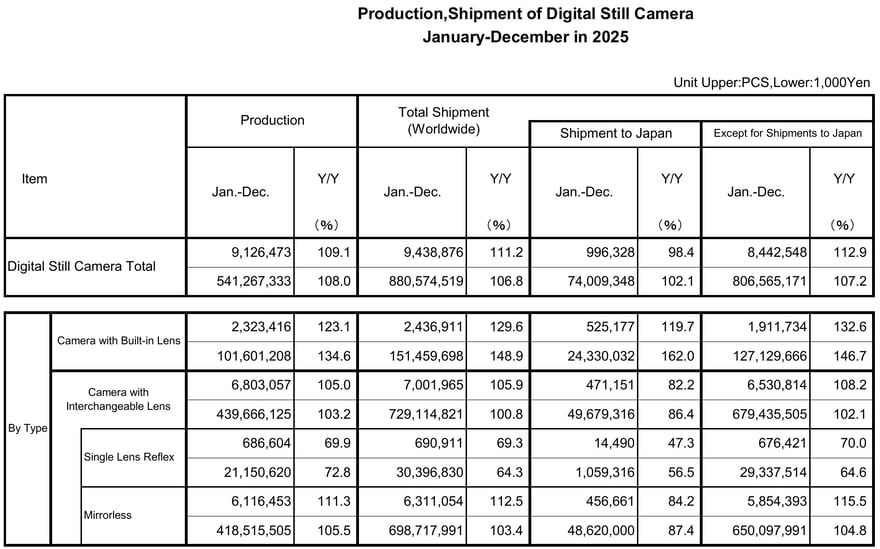
Built-in-lens cameras bottomed out in 2023 with 1.72 million units shipped (1,721,592 units in CIPA’s 2023 annual report). They then recovered for two years in a row:
- In 2024, built-in-lens cameras shipped 1,880,414 units, up 9.2% year on year.
- In 2025, built-in-lens cameras shipped 2,436,911 units, up 29.6%; shipment value was 151.46 billion yen, up 48.9%.
PetaPixel noted that 2025 was the first time in nearly 20 years that digital camera shipments grew “two years in a row.” In 2025, built-in-lens shipments grew in every region:
- In China, built-in-lens shipments grew 50.5% year on year in 2025, to about 340,000 units, just below the 52.5% of “other regions”; China’s shipment curve and used-market prices are covered separately in How big is China’s CCD camera craze (in Chinese).
- Asia outside China grew 37.6%.
- The Americas grew 25.6%, and Europe grew 24.8%.
- Japan’s domestic market grew 19.7%.
Compared with SLRs, the positions have flipped: in 2025, SLRs shipped only 690,911 units, down 30.7%, so built-in-lens cameras outsold them 3.5 to 1. To be fair, though, mirrorless cameras shipped 6.31 million units in 2025, still 2.6 times as many as built-in-lens cameras, so worldwide, interchangeable-lens cameras as a whole remain the mainstream.
The flip is even more complete in Japan: in 2025, Japan’s domestic built-in-lens shipments were 525,177 units versus 471,151 interchangeable-lens cameras, so built-in-lens cameras made up 52.7% of Japan’s camera shipments and outnumbered all interchangeable-lens cameras combined.
2026: January to August still up 15%
In CIPA’s August statistics, released on October 1, 2026, built-in-lens cameras shipped a cumulative 1,694,289 units from January to August, 15.3% more than the same period a year earlier; August alone shipped 244,822 units, 32.9% more than the same month a year earlier.
July saw a single-month year-on-year drop of 3.1% (223,490 units), which at the time looked like the craze starting to cool; August went straight back to growth of about 30%, and the cumulative growth rate rose from 12.7% for January to July back to 15.3%. So as of August 2026, the recovery showed no sign of weakening yet. The growth is smaller than the 29.6% for all of 2025, though, and monthly numbers swing a lot, so read the trend from the cumulative figures rather than from a single month.
Who’s buying: Japanese buyers’ ages turned over in two years
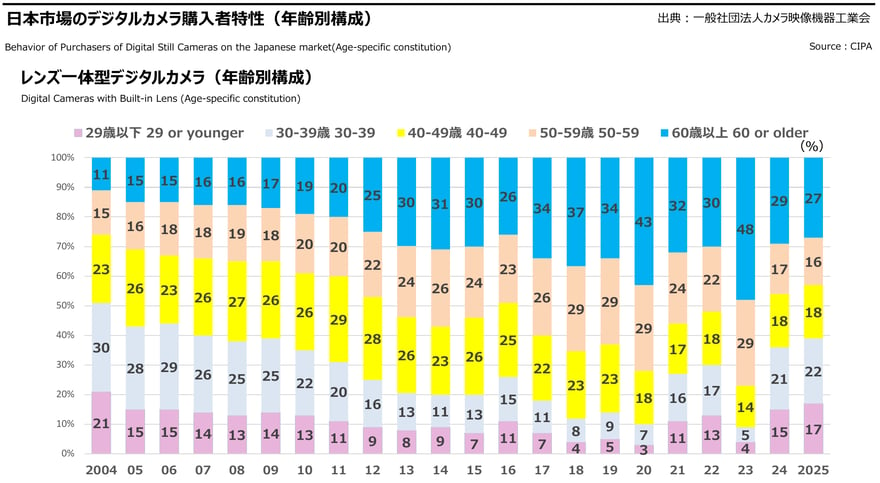
CIPA runs a survey of digital camera buyer characteristics in the Japanese market that breaks down built-in-lens camera buyers by age:
| Year | ≤29 | 30–39 | ≥60 |
|---|---|---|---|
| 2004 | 21% | 30% | 11% |
| 2018 | 4% | 8% | 37% |
| 2020 | 3% | 7% | 43% |
| 2021 | 11% | 16% | 32% |
| 2022 | 13% | 17% | 30% |
| 2023 | 4% | 5% | 48% |
| 2024 | 15% | 21% | 29% |
| 2025 | 17% | 22% | 27% |
Columns are buyer ages in years: ≤29 means 29 and under, and ≥60 means 60 and over. The values were read by this site from the labels on CIPA’s chart; the chart itself doesn’t state the sample size or survey method.
In Japan’s 2023 built-in-lens market, nearly half (48%) of buyers were 60 and over, and those 29 and under made up only 4%; two years later, the 29-and-under share rose to 17% and the 60-and-over share fell to 27%. This is the hardest first-hand data behind “young people are buying point-and-shoots again.”
But read the whole table and “4% jumping to 17%” deserves a discount: in 2021 and 2022, those 29 and under already made up 11% to 13%, so the 4% of 2023 looks more like an unusual low, and part of the jump comes from a very low base.
Looking further back, in 2004, when digital point-and-shoots were taking off, people 29 and under already made up 21%. Young people buying small cameras is nothing new; the period from 2018 to 2023, when “small cameras were mostly bought by people 60 and over,” was the exception.
At the same time: CCD cameras and photo booths took off too
In the years point-and-shoots were recovering, two other things were happening around young people:
- Small CCD cameras from the 2000s were being dug back out of the used market. A December 2024 Xinhuanet report said CCD-related topics on China’s Xiaohongshu had 4.04 billion views and 1.65 million notes in total, and more than 3,000 units had sold on the secondhand platform Xianyu in just the previous 7 days. Most of these cameras are digital point-and-shoots too, just used ones; how to tell a real CCD from a fake and which models are worth buying are covered in What is a CCD camera.
- In Taiwan, Korean-style photo booths opened in large numbers. CommonWealth Magazine’s list of the ten hottest keywords of 2023 put Korean-style photo booths at No. 1; this site noticed back in 2022 that Google search interest in “photo booth” (拍貼機) in Taiwan grew nearly fivefold from 2020 to June 2022 (the observation at the time (in Chinese)).
What the three have in common is young people’s willingness to pay for “photos a phone can’t take”: grainy or color-shifted images, a physical photo printed out to hold in your hand, and a moment that exists purely for taking pictures. The point-and-shoot’s recovery is part of this wave, not something happening on its own; that’s also why the buyers who came back are young people, not the crowd that used to buy one for family trips.
Volume down to 2%, price nearly 7 times higher
Put volume and price side by side for the recovery period:
- Volume: 2.437 million built-in-lens cameras in 2025, 2.2% of the 2008 peak. Digital Camera World, using 2010 as the heyday, got 2.24%; different baseline, same conclusion.
- Average shipment price: 62,200 yen in 2025, 6.8 times the 2011–2012 low of 9,200 yen, and higher than the 44,800 yen of 1999, when digital cameras were just getting started.
- Shipment value: 151.46 billion yen in 2025, 9% of 2008 (1.6387 trillion yen), but already back to 80% of 2016 (190.7 billion yen).
In other words, makers are shipping only about 1/45 as many units as at the peak, but taking in about 1/11 as much money. For camera companies, this is a low-volume, high-price business, not a return to the past.
New models and shortages: evidence that makers are betting again
The clearest signal of the recovery is that big makers have started launching new small cameras, and several of them are hard to get:
- The Canon PowerShot G7 X Mark III went on sale in 2019 at a US launch price of $749.99; in 2024, 5 years after launch, it suddenly went viral and sold out because of a parts shortage. Canon resumed taking orders in Japan in August 2025 and began working through the backlog in September. It now sells new in the US for $879, and in August 2026 US used-camera shops were still selling it for $1,500 or more, about 1.7 times the current new price and 2 times the launch price.
- The Fujifilm X100VI launched in March 2024 at $1,599. Reuters reported that even after Fujifilm doubled production from the initial run, it still wasn’t enough; Fujifilm’s imaging division accounted for 37% of operating profit in fiscal 2023, up from 27% the year before.
- The Ricoh GR III was discontinued in July 2025 because parts were hard to get; its successor, the GR IV, was announced on August 20, 2025, at $1,499.95.
- The Fujifilm X half was announced on May 22, 2025, with a vertical 1-inch sensor and a US launch price of $849.
- No. 1 in Japan’s BCN 2025 ranking of compact digital camera series was the Kodak PixPro FZ55, and Kodak held 4 of the top ten spots; this Kodak is actually a brand licensed by JK Imaging in the US, and the FZ55 uses CMOS, not CCD.
Film point-and-shoots have new models too, something almost unimaginable in the 2010s:
- The Kodak Ektar H35, from Hong Kong company Reto Project under a Kodak brand license, opened for preorder in May 2022 as a $49.99 half-frame camera; an improved H35N followed in 2023 at $64.99.
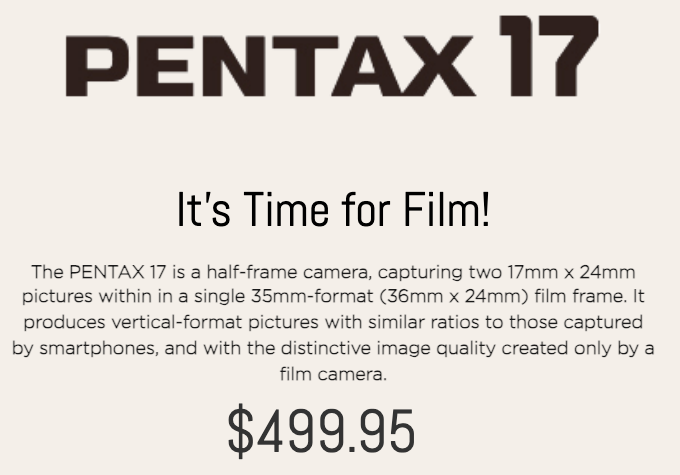
- The Pentax 17 was announced on June 17, 2024, as a $499.95 half-frame camera, described as the first all-new film camera design from a major maker in nearly 20 years, and was often out of stock in its first year.
- MiNT’s Rollei 35AF opened for preorder in September 2024 at $799, with LiDAR autofocus.
- The Kodak Snapic A1 shipped in December 2025 at $99.
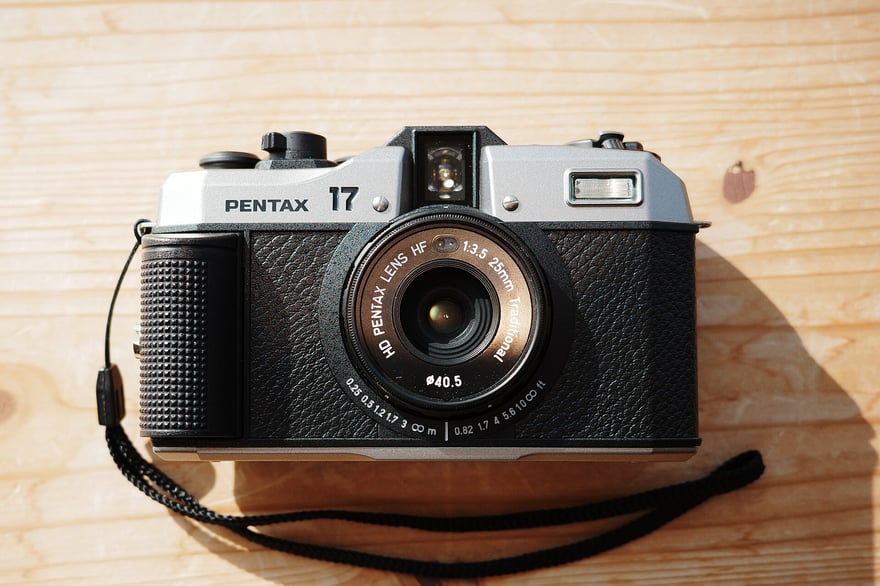

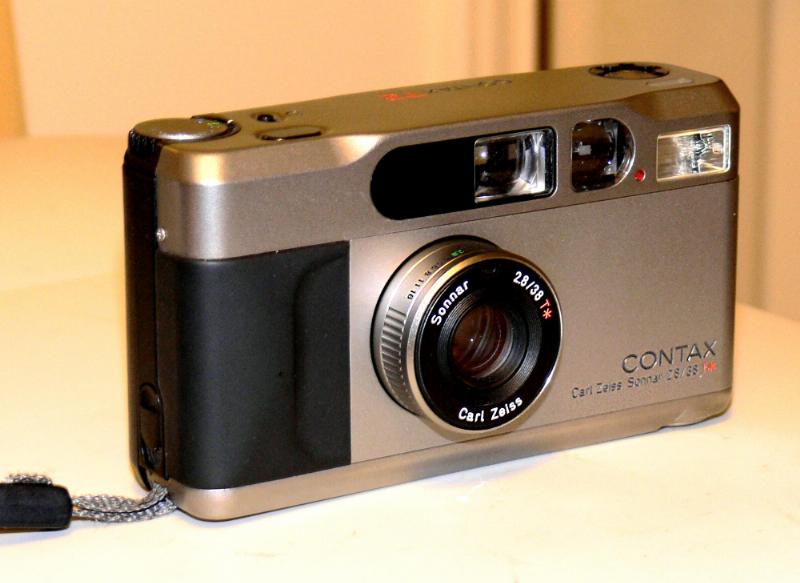
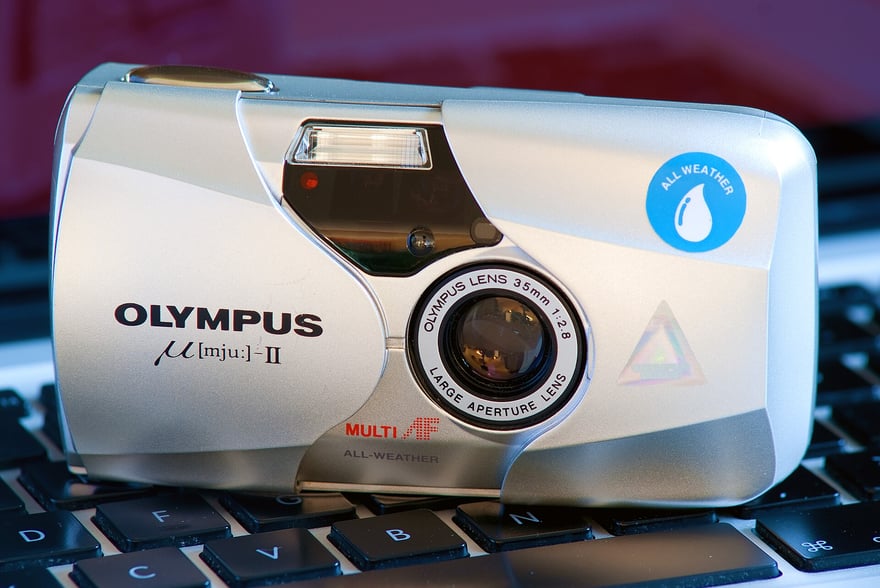
Used prices for premium 1990s film point-and-shoots took off over the same period. The Contax T2 was about $170 around 2015 and was reported in 2018 to have risen tenfold; a New York used-camera shop’s 2026 article put a serviced body at about $2,000 (this is the seller’s own article, so it has a stake). The Olympus mju-II was about $40 in 2013 and about $200 in 2020. Korea JoongAng Daily reported in September 2026 that LE SSERAFIM member Sakura bought a titanium Contax T3 for 544,000 yen; its Japanese list price in 2001 was 98,000 yen.


5. Conclusion: what came back this time isn’t volume, it’s price and a new crowd
Joining 1977 to 2026 together, the point-and-shoot’s curve looks like this:
- From 1977 to 1997, autofocus let film point-and-shoots take 90% of the film camera market, with volume reaching 32.52 million units and the price falling to 8,100 yen.
- From 1997 to 2006, digital replaced film and film point-and-shoots fell 96% in nine years: the first death. In 2002, digital built-in-lens shipments overtook film point-and-shoots.
- From 1999 to 2008, digital point-and-shoots grew to 110.07 million units, and the average shipment price fell from 44,800 yen to 14,900 yen.
- From 2008 to 2023, smartphones took away the demand for “snapping casually,” and digital point-and-shoots lost 98%: the second death.
- From 2024, built-in-lens cameras recovered two years in a row, reaching 2.44 million units in 2025, up 29.6%; January to August 2026 was still up 15.3% year on year cumulatively.
The third life is completely different from the first two. The first two times, the point-and-shoot was a tool “everyone had one of,” and what it sold was convenience; this time, it sells what a phone can’t give you: a certain image quality, and an object that exists just for taking pictures. The buyers have shifted from people 60 and over to people in their 20s. Volume is only 2% of the peak, but the price is 7 times the low, and shipment value is back to around one-tenth of the peak. So this isn’t the point-and-shoot “returning” to the past; it has survived by taking on a new identity, from mass-market consumer good to low-volume, high-price style product.
That identity also defines its risks. A market propped up by a trend swings more than a mass-market product: July 2026 saw a single month of negative growth, and August went back to growth of about 30%; shortages of new models mostly come from parts shortages and makers’ reluctance to ramp up production, not from unlimited demand. If you’re a reader thinking of “getting a point-and-shoot,” the sensible approach is to first figure out which kind you want:
- If you want the “CCD look” on a limited budget, used small cameras from the 2000s are the main option, but used prices swing a lot and batteries and memory cards have gaps in supply; what to look for and current prices are in What is a CCD camera, and how to pick a used one.
- If you want to shoot concerts and fan events, what you need is a long zoom and high ISO, and a point-and-shoot isn’t the answer; how to choose a camera and lens for that is covered in a guide to cameras and lenses for fans (in Chinese).
- If you want film, the supply and price of film itself is the long-term cost; the state of the supply chain is in Who still makes film.
Further reading
- Disposable cameras, instant cameras and point-and-shoots: what’s the difference (in Chinese): how the three produce photos, what each shot costs, and how to choose.
- What is a CCD camera, and how to pick a used one: the technical basis of the “CCD look,” plus used prices and common pitfalls.
- Why disposable cameras are popular again: 40 years of 写ルンです (in Chinese): the rise and fall of the disposable camera over the same period.
- The instant camera industry: how Polaroid and instax went through the same shift to digital.
- Who still makes film: whether the film supply chain can keep up now that film point-and-shoots are back.
- A guide to cameras and lenses for fans (in Chinese): another line of camera demand.
Appendix 1: What I couldn’t find
I looked into these questions but couldn’t find reliable answers, so this article doesn’t cover them and doesn’t fill them in with estimates:
- The Japanese launch price of the Konica C35 AF: a search result snippet showed 44,800 yen, but the original page couldn’t be opened to verify it, so this article doesn’t state it.
- The exact release year of the Contax T2: camera-wiki says 1991 and another source says 1990, so this article says “1990 or 1991.”
- The sample size and survey method of CIPA’s Japanese buyer characteristics survey, and why the 29-and-under share was so low in 2023.
- How CIPA’s built-in-lens shipments split between point-and-shoots and high-end models (big zoom, 1-inch, full frame); so it isn’t possible to break down how much of the average price rise comes from individual cameras getting more expensive and how much from cheap models disappearing.
- The new photo-oriented PowerShot Canon was rumored to announce in September 2026: as of the check on September 25, 2026, no official announcement had been seen.
- Figures outside CIPA’s statistics: instant cameras and instant film, and disposable cameras, are not in any CIPA statistical category; CIPA’s shipment statistics for compact photo printers (A4 and smaller) only ran through 2013 and stopped from 2014, so this article can’t use CIPA figures to discuss the recent state of photo booths and photo printing. For instant camera figures, look at Fujifilm’s financial reports (covered in The instant camera industry); for dye-sublimation photo printers, look at public data from makers such as DNP and Citizen.
Appendix 2: Sources
- CIPA historical film camera statistics (lens-shutter camera units and value shipped, 1977–2008): https://www.cipa.jp/stats/documents/common/cr400.pdf , checked 2026-09-25.
- CIPA historical digital camera statistics (built-in-lens units, value, average price and Japan domestic shipments, 1999–2025): https://www.cipa.jp/stats/documents/common/cr300.pdf , checked 2026-09-25.
- CIPA digital camera buyer characteristics in the Japanese market (by age): https://www.cipa.jp/stats/documents/common/cr800.pdf , checked 2026-09-25.
- CIPA compact photo printer (A4 and smaller) shipment statistics, 2004–2013, stopped from 2014: https://www.cipa.jp/stats/documents/common/cr600.pdf , checked 2026-10-28.
- CIPA statistical category notes (definitions of lens-shutter and built-in-lens cameras): https://www.cipa.jp/stats/documents/e/cr100_e.pdf , checked 2026-09-25.
- CIPA 2023 annual digital camera shipment report: https://www.cipa.jp/stats/documents/e/d-2023_e.pdf , checked 2026-09-25.
- CIPA 2024 annual digital camera shipment report: https://www.cipa.jp/stats/documents/e/d-2024_e.pdf , checked 2026-09-25.
- CIPA 2025 annual digital camera shipment report (by region, Japan domestic built-in-lens and interchangeable-lens cameras): https://www.cipa.jp/stats/documents/e/d-2025_e.pdf , checked 2026-09-25.
- CIPA July 2026 digital camera shipment statistics (released 2026-09-01): https://www.cipa.jp/stats/documents/e/d-202607_e.pdf , checked 2026-09-25.
- CIPA August 2026 digital camera shipment statistics (released 2026-10-01): https://www.cipa.jp/stats/documents/e/d-202608_e.pdf , checked 2026-10-27.
- About CIPA (predecessor founded in 1954, reorganized in 2002): https://www.cipa.jp/e/guide/aboutcipa.html , checked 2026-10-28.
- CIPA member list: https://www.cipa.jp/e/guide/member-list.html , checked 2026-10-28.
- CIPA list of makers participating in the statistics (2026-05-01 edition): https://www.cipa.jp/stats/documents/e/list_e.pdf , checked 2026-10-28.
- Xinhuanet, “CCD cameras back in focus” (republished by CCTV.com’s economy channel), 2024-12-04: https://jingji.cctv.com/2024/12/04/ARTIk3BVOAtQpkbF8sWUrkv0241204.shtml
- CommonWealth Magazine’s top ten hot keywords of 2023 in Taiwan (post on CommonWealth Magazine’s Facebook page): https://www.facebook.com/cwgroup/posts/pfbid0JSn2gzC6cXM6wZV8dgx4xDRbwauUBZdGPZUoh7hNTnCcUEm9M7846t822gk6hH2Dl
- CIPA press release (2008 built-in-lens shipments), 2009-01-27: https://www.cipa.jp/documents/e/press090127_e.pdf
- CIPA press release (record total digital camera shipments in 2010), 2011-02-09: https://www.cipa.jp/documents/e/press110209_e.pdf
- CIPA press release (2011 shipments, the earthquake and the Thai floods), 2012-02-09: https://www.cipa.jp/documents/e/PRESSRELASE201202091_e.pdf
- CIPA press release (built-in-lens cameras down 41.4% in 2013, low-end models facing phone competition), 2014-02-03: https://www.cipa.jp/documents/e/PRESSRELEASE20140203_e.pdf
- CIPA press release (built-in-lens cameras facing phone competition in 2014), 2015-02-02: https://www.cipa.jp/documents/e/PRESSRELEASE20150202_e.pdf
- Chinese Wikipedia, “傻瓜相機”: https://zh.wikipedia.org/wiki/%E5%82%BB%E7%93%9C%E7%9B%B8%E6%9C%BA , checked 2026-09-25.
- English Wikipedia, “Point-and-shoot camera” (definition, British and American usage, NPD data): https://en.wikipedia.org/wiki/Point-and-shoot_camera , checked 2026-09-25.
- Japanese Wikipedia, “バカチョン” (three theories of origin, broadcast ban and dictionary removal): https://ja.wikipedia.org/wiki/%E3%83%90%E3%82%AB%E3%83%81%E3%83%A7%E3%83%B3 , checked 2026-09-25.
- Weblio dictionary, “バカチョンカメラ”: https://www.weblio.jp/content/%E3%83%90%E3%82%AB%E3%83%81%E3%83%A7%E3%83%B3%E3%82%AB%E3%83%A1%E3%83%A9 , checked 2026-09-25.
- Korean Wikipedia, “컴팩트 카메라” (똑딱이 카메라): https://ko.wikipedia.org/wiki/%EC%BB%B4%ED%8C%A9%ED%8A%B8_%EC%B9%B4%EB%A9%94%EB%9D%BC , checked 2026-10-27.
- Russian Wikipedia, “Компактная камера” (мыльница): https://ru.wikipedia.org/wiki/%D0%9A%D0%BE%D0%BC%D0%BF%D0%B0%D0%BA%D1%82%D0%BD%D0%B0%D1%8F_%D0%BA%D0%B0%D0%BC%D0%B5%D1%80%D0%B0 , checked 2026-10-27.
- Japanese Wikipedia, “コンパクトカメラ” (コンデジ, avoidance of バカチョンカメラ): https://ja.wikipedia.org/wiki/%E3%82%B3%E3%83%B3%E3%83%91%E3%82%AF%E3%83%88%E3%82%AB%E3%83%A1%E3%83%A9 , checked 2026-10-27.
- Spanish Wikipedia, “Cámara compacta”: https://es.wikipedia.org/wiki/C%C3%A1mara_compacta , checked 2026-10-27.
- Portuguese Wikipedia, “Câmera compacta”: https://pt.wikipedia.org/wiki/C%C3%A2mera_compacta , checked 2026-10-27.
- German Wikipedia, “Kompaktkamera”: https://de.wikipedia.org/wiki/Kompaktkamera , checked 2026-10-27.
- DWDS German dictionary, “Knipse”: https://www.dwds.de/wb/Knipse , checked 2026-10-27.
- Thai Wikipedia, “กล้องกะทัดรัด”: https://th.wikipedia.org/wiki/%E0%B8%81%E0%B8%A5%E0%B9%89%E0%B8%AD%E0%B8%87%E0%B8%81%E0%B8%B0%E0%B8%97%E0%B8%B1%E0%B8%94%E0%B8%A3%E0%B8%B1%E0%B8%94 , checked 2026-10-27.
- ifanr (the term 卡片機): https://www.ifanr.com/797678 , checked 2026-10-27.
- Bisnis.com (Indonesian kamera saku): https://teknologi.bisnis.com/read/20190725/282/1128738/teknologi-kamera-ponsel-ancam-bisnis-kamera-saku-digital , checked 2026-10-27.
- Viettel Store (Vietnamese máy ảnh compact, du lịch, bỏ túi): https://viettelstore.vn/tin-tuc/may-anh-compact-la-gi-uu-nhuoc-diem-va-kinh-nghiem-chon-mua-phu-hop , checked 2026-10-27.
- ProductNation (Malay kamera kompak): https://productnation.co/my-bm/28742/kamera-kompak-pertumbuhan-2026-malaysia-klik-xxyx/ , checked 2026-10-27.
- Teknoblog (Turkish kompakt fotoğraf makinesi): https://www.teknoblog.com/2009dan-beklentiler-dijital-fotograf-makineleri , checked 2026-10-27.
- English Wikipedia, “Disposable camera” (Fujifilm QuickSnap, 1986): https://en.wikipedia.org/wiki/Disposable_camera , checked 2026-09-25.
- BCN 2025 annual compact digital camera ranking (republished by excite), 2026-01-12: https://www.excite.co.jp/news/article/BcnRetail_588749/
- English Wikipedia, “Konica C35 AF”: https://en.wikipedia.org/wiki/Konica_C35_AF , checked 2026-09-25.
- Camera no Naniwa blog (Konica C35 AF release month), 2021-08-13: https://www.cameranonaniwa.co.jp/blogs/2220575225/
- Canon Camera Museum, “AF35M”: https://global.canon/en/c-museum/product/film102.html , checked 2026-09-25.
- camera-wiki, “Olympus XA”: https://camera-wiki.org/wiki/Olympus_XA , checked 2026-09-25.
- camera-wiki, “Contax T2”: https://camera-wiki.org/wiki/Contax_T2 , checked 2026-09-25.
- The Phoblographer, Contax T2 release, discontinuation and used prices, 2018-10-01: https://www.thephoblographer.com/2018/10/01/how-the-contax-t2-became-the-most-expensive-point-and-shoot-camera/
- camera-wiki, “Nikon 35Ti”: https://camera-wiki.org/wiki/Nikon_35Ti , checked 2026-09-25.
- camera-wiki, “Ricoh GR1”: https://camera-wiki.org/wiki/Ricoh_GR1 , checked 2026-09-25.
- camera-wiki, “Olympus mju II”: https://camera-wiki.org/wiki/Olympus_mju_II , checked 2026-09-25.
- English Wikipedia, “Contax T” (T3 price and Kyocera’s exit): https://en.wikipedia.org/wiki/Contax_T , checked 2026-09-25.
- Korea JoongAng Daily, Contax T3 used prices in Korea and Sakura’s purchase price, 2026-09-04: https://www.koreajoongangdaily.com/lifestyle/the-3400-camera-sakura-just-bought-is-notorious-for-breaking-mine-lasted-two-days/12848288
- Brooklyn Film Camera, Contax T2 prices in 2026 (a used-camera dealer’s own article), 2026-04-06: https://brooklynfilmcamera.com/blogs/guides/is-the-contax-t2-worth-2-000-in-2026-an-honest-buyers-guide
- DPReview, Olympus mju-II used prices, 2020-05-15: https://www.dpreview.com/articles/5553111594/film-fridays-olympus-mju-ii-review-great-camera-too-expensive-for-what-it-is/
- Kosmo Foto, Kodak Ektar H35 preorders, 2022-05: https://kosmofoto.com/2022/05/reto-announces-kodak-branded-ektar-h35-half-frame-camera/
- Kosmo Foto, Kodak Ektar H35N announcement, 2023-08: https://kosmofoto.com/2023/08/reto-project-announces-new-kodak-ektar-h35n-half-frame-camera/
- DPReview, Pentax 17 announcement, 2024-06: https://www.dpreview.com/news/9002061674/ricoh-launches-pentax-17-half-frame-fixed-lens-film-camera/
- Kosmo Foto, Pentax 17 announcement, 2024-06: https://kosmofoto.com/2024/06/ricoh-imaging-releases-the-pentax-17-the-first-pentax-film-camera-in-20-years/
- Kosmo Foto, MiNT Rollei 35AF preorders, 2024-08: https://kosmofoto.com/2024/08/mint-cameras-rollei-35af-pre-orders-launch-on-10-september/
- PetaPixel, Kodak Snapic A1, 2025-11-24: https://petapixel.com/2025/11/24/the-kodak-snapic-a1-is-a-99-film-camera-with-a-double-exposure-switch/
- PetaPixel, digital camera shipments grew two years in a row in 2025, 2026-02-03: https://petapixel.com/2026/02/03/camera-shipments-increased-for-consecutive-years-for-the-first-time-in-nearly-20-years/
- Digital Camera World, 2025 compact camera shipments only a fraction of the heyday, 2026-02-03: https://www.digitalcameraworld.com/cameras/compact-cameras/the-compact-camera-came-from-the-dead-but-last-years-sales-were-still-a-fraction-of-the-point-and-shoots-heyday
- DPReview, roundup of CIPA’s 2025 shipment data, 2026-02-02: https://www.dpreview.com/articles/2386206926/cipa-data-2025-camera-lens-shipments-fixed-lens-cameras-interchangable/
- Reuters report (republished by BusinessWorld), Fujifilm X100 series demand outstripping supply and imaging division profit, 2024-06-28: https://bworldonline.com/technology/2024/06/28/604906/fujifilm-once-struggled-to-sell-cameras-now-it-cant-keep-up-with-demand/
- DPReview, Canon G7 X Mark III production resuming and back orders, 2025-09-16: https://www.dpreview.com/news/1514834866/canon-powershot-g7x-iii-production-resuming-parts-shortage-back-orders/
- Digital Camera World, G7 X Mark III used prices nearly twice the new price, 2026-08-21: https://www.digitalcameraworld.com/cameras/compact-cameras/a-year-after-canon-increased-production-this-powershot-compact-camera-is-still-so-viral-that-used-models-are-nearly-twice-the-new-cost
- DPReview, Ricoh GR III discontinued, 2025-08: https://www.dpreview.com/news/0025344964/ricoh-gr-iii-discontinued/
- Ricoh Imaging US press release, GR IV announcement, 2025-08-20: https://us.ricoh-imaging.com/ricoh-launches-latest-model-in-acclaimed-gr-compact-camera-series-ricoh-gr-iv-2/
- Fujifilm US press release, X half announcement, 2025-05-22: https://www.fujifilm.com/us/en/news/digital-cameras/fujifilm-introduces-x-half-premium-compact-digital-camera (when checked on 2026-10-27, it redirected to Fujifilm US’s newsroom home page)
- Tom’s Guide, X half announcement and US launch price of $849: https://www.tomsguide.com/cameras-photography/fujifilm-just-announced-the-x-half-a-digital-camera-that-offers-a-unique-film-experience-unlike-any-other , checked 2026-10-27.
- Imaging Resource, Canon G7 X Mark III specifications (US launch price $749.99, released 2019-08-05): https://www.imaging-resource.com/PRODS/canon-g7x-iii/canon-g7x-iiiDAT.HTM , checked 2026-10-27.
- English Wikipedia, “Kodak Pixpro” (JK Imaging license, FZ55 sensor): https://en.wikipedia.org/wiki/Kodak_Pixpro , checked 2026-09-25.
- Canon Rumors, new PowerShot rumor: https://www.canonrumors.com/the-next-canon-powershot-is-coming-this-year/ , checked 2026-09-25.
Image sources
All photos in this article come from openly licensed files on Wikimedia Commons and are credited according to each license below; the cover image is the Konica C35 AF photo padded left and right and cropped to 16:9. There are also 5 screenshots of official pages and official statistics, used as supporting citations in the text and listed after the photos; the shipment line chart at the top was drawn by this site from CIPA statistics.
- Canon PowerShot G7 X Mark III (Chapter 1): Strubbl, CC BY-SA 4.0, https://commons.wikimedia.org/wiki/File:Canon_G7X_Mark_III_von_vorne_2026-03-13.jpg
- Kodak disposable camera with flash (Chapter 1): Matthew Paul Argall, CC BY 2.0, https://commons.wikimedia.org/wiki/File:Kodak_Flash_Single_Use_Camera_%2828920754637%29.jpg
- Fujifilm instax mini 12 (Chapter 1): Tony Webster, CC BY 2.0, https://commons.wikimedia.org/wiki/File:Fujifilm_Instax_Mini_12_-_Instant_Film_Camera_%2852950271338%29.jpg
- Konica C35 AF, front view (cover and Chapter 2): John Nuttall, CC BY 2.0, https://commons.wikimedia.org/wiki/File:Konica_C35_AF_(3852684227).jpg
- Canon AF35M, front view (Chapter 2): E Magnuson, CC BY 2.0, https://commons.wikimedia.org/wiki/File:My_Canon_AF35M_(4307694589).jpg
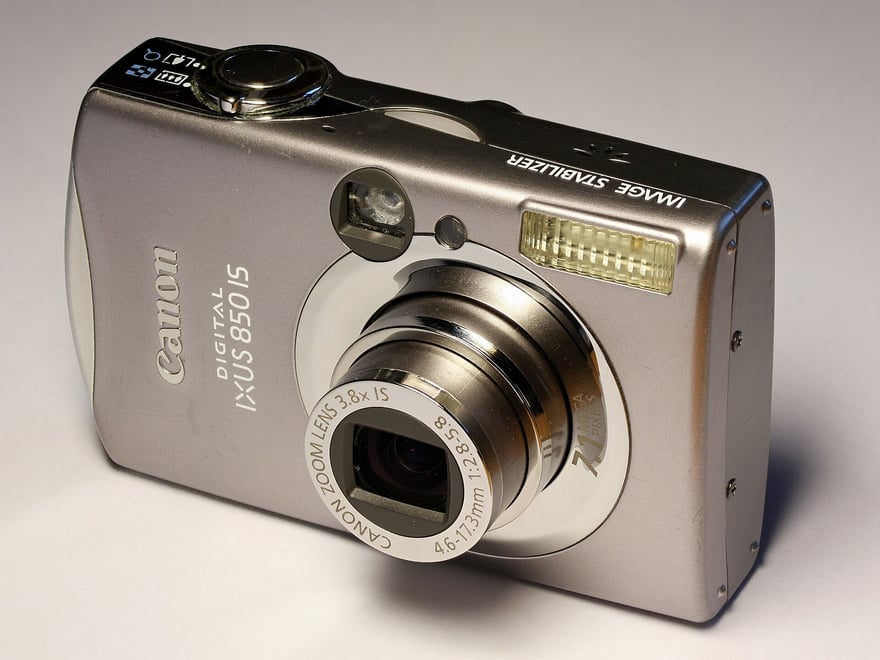
- Canon Digital IXUS 850 IS (Chapter 3): D-Kuru, CC BY-SA 3.0 AT, https://commons.wikimedia.org/wiki/File:Canon_Digital_IXUS_850_IS-ar_4to3-fs_PNr%C2%B00268a.jpg
- Pentax 17 (Chapter 4): MIKI Yoshihito, CC BY 2.0, https://commons.wikimedia.org/wiki/File:PENTAX_17;_October_2024_(02).jpg
- Olympus mju-II (Chapter 4): Ashley Pomeroy, CC BY-SA 4.0, https://commons.wikimedia.org/wiki/File:Olympus_Stylus_Epic_1118.jpg
- Ricoh GR1 (Chapter 2): Zebrio (Brian Scott Peterson), CC BY-SA 2.0, https://commons.wikimedia.org/wiki/File:0313_Ricoh_GR1_(5599549421).jpg
- Contax T2 (Chapter 4): Gisling, CC BY-SA 3.0, https://commons.wikimedia.org/wiki/File:CONTAX_T2.jpg
- Screenshot: Canon Camera Museum AF35M page (Chapter 2), https://global.canon/en/c-museum/product/film102.html , captured September 25, 2026, supporting citation
- Screenshot: CIPA historical digital camera statistics, built-in-lens units and average price (Chapter 3), https://www.cipa.jp/stats/documents/common/cr300.pdf , captured September 25, 2026, supporting citation
- Screenshot: CIPA 2025 annual digital camera shipment report (Chapter 4), https://www.cipa.jp/stats/documents/e/d-2025_e.pdf , captured September 25, 2026, supporting citation
- Screenshot: CIPA digital camera buyer characteristics in the Japanese market, built-in-lens buyers by age (Chapter 4), https://www.cipa.jp/stats/documents/common/cr800.pdf , captured September 25, 2026, supporting citation
- Screenshot: PENTAX 17 product page on Ricoh Imaging’s US website (Chapter 4), https://us.ricoh-imaging.com/product/pentax-17/ , captured September 25, 2026, supporting citation
Keywords: point-and-shoot camera, what is a point-and-shoot camera, compact camera, point-and-shoot history, point-and-shoot in other languages, film point-and-shoot, digital camera shipments, CIPA shipment statistics, point-and-shoot comeback, Canon G7 X Mark III, Contax T2
Frequently asked questions
What is a point-and-shoot camera?
A point-and-shoot is a small camera with autofocus, automatic exposure and a built-in flash that takes a picture as soon as you press the shutter button. You don’t have to set the aperture, shutter speed or focus yourself. It’s also called a compact camera; the standard Japanese term is コンパクトカメラ, and in Hong Kong it’s often called 傻瓜機. There are film versions and digital versions.
What is a point-and-shoot called in other languages?
In English the most common term is point-and-shoot camera (you point it and shoot), also compact camera. When British speakers say point-and-shoot they stress full automation; Americans stress the small body. The standard Japanese term is コンパクトカメラ, shortened to コンデジ for digital models; Korean slang is 똑딱이, Russian slang is мыльница (soap dish), and mainland China calls small digital cameras 卡片機 (card camera). In Taiwan it’s 傻瓜相機, a camera so simple that even a fool can use it.
How is a point-and-shoot different from a disposable camera or an instant camera?
A point-and-shoot can be used again and again: with a film model you load new film yourself and send it to be developed, and a digital model gives you files as soon as you shoot. A disposable camera is sold as a whole unit with the film inside, and after you finish the roll you hand the entire camera to the photo lab, which recycles it. An instant camera ejects a physical print on the spot when you press the shutter, with no developing needed.
In which year did point-and-shoot cameras sell the most?
There are two separate lines. According to the Camera & Imaging Products Association (CIPA) of Japan, film point-and-shoots (lens-shutter cameras) peaked in 1997 at 32.52 million units shipped; digital point-and-shoots (cameras with built-in lenses) peaked in 2008 at 110.07 million units. The common claim that 2010 was the heyday refers to total digital camera shipments, not point-and-shoots.
Were digital point-and-shoots killed by smartphones?
The timing lines up, but the story needs to be told in parts. In its 2012 press release, CIPA blamed the 2011 drop in shipments on the Great East Japan Earthquake and the floods in Thailand, with no mention of phones; only from 2014 did it write that low-end models faced competition from smartphones. In the US, NPD data showed that in 2011 the share of photos taken with phones rose from 17% to 27%, while the share taken with point-and-shoots fell from 52% to 44%.
Are point-and-shoot cameras popular again?
Shipments really have recovered. CIPA’s figures for digital cameras with built-in lenses hit bottom in 2023 at 1.72 million units, grew 9.2% in 2024, and grew another 29.6% in 2025 to 2.44 million; but that is only 2.2% of the 2008 peak. What came back is mainly price and young buyers: the average shipment price rose from 9,200 yen in 2011 to 62,200 yen in 2025, and the share of Japanese buyers aged 29 and under rose from 4% in 2023 to 17% in 2025. Cumulative shipments for January to August 2026 were still up 15.3% year on year; after a 3.1% year-on-year drop in July, August was up 32.9%.
Why don’t Japanese people say バカチョンカメラ anymore?
バカチョンカメラ was an early Japanese colloquial name for the point-and-shoot. The チョン part is considered a slur against Koreans, so the whole word was placed on broadcasters’ list of terms not to be used on air, and the 7th edition (2011) of the Sanseido Japanese dictionary dropped the entry. In formal contexts the term used instead is コンパクトカメラ.
Sources: Chinese original first published on 2026-09-25 (Taipei) and revised on 2026-10-27 and 2026-10-28. Shipment figures checked through CIPA's August 2026 statistics (released 2026-10-01).
This English version is based on original Traditional Chinese content on joelin.cc. The language and explanations are localised for international readers. The Traditional Chinese original is the authoritative version — for its complete meaning, please read the original article.