
This article is also available in: 繁體中文 · 日本語 · 한국어 · Bahasa Indonesia · Bahasa Melayu · ไทย · Português (Brasil) · Español · Türkçe · Tiếng Việt · Deutsch · हिन्दी
Contents (33)
A CCD camera is a digital camera that uses a CCD image sensor. When people say “CCD camera” today, they usually mean the pocket-size compact digital cameras of the 2000s, the kind English speakers call point-and-shoots. Young people have been chasing the “CCD look” for the past two years: dark, warm, flash-blasted, slightly soft pictures. The technical evidence I could find suggests that look comes mainly from the whole package of conditions those cameras had: small sensors, direct flash, each maker’s color tuning at the time, and low-resolution JPEGs straight out of the camera. It isn’t magic in the CCD chip itself.
This article answers five questions:
- What’s the real difference between CCD and CMOS, how much support is there for the “CCD look,” and how strong is that evidence?
- Why are so many new cameras sold as “CCD cameras” not CCD at all?
- How big is the craze in China, the US, and Japan?
- Which ten popular models really use a CCD, and how do you choose among them?
- What are the six most common pitfalls when buying a used CCD camera, and how do you check for each one?
Prices and figures in this article are as of the date they were checked: the Chinese original was researched on September 25, 2026, and the model specs in Chapter 6 and later corrections were verified on October 27, 2026. Things I couldn’t find are listed separately at the end.
The full history of point-and-shoot cameras from 1977 to 2026, with CIPA shipment figures, is in What is a point-and-shoot camera (in Chinese). For how disposable cameras, instant cameras, and point-and-shoots differ, see the series overview (in Chinese).
1. What is a CCD camera: a sensor that became the name of an era
How CCD and CMOS differ: one shared microphone, or one on every desk
A digital camera’s sensor holds millions to tens of millions of tiny cells (pixels), and each one turns the light it receives into an electrical charge. The difference between CCD and CMOS is how those charges get read out.
A CCD is like a classroom with only one microphone. Everyone’s charge has to be passed forward row by row, lining up for the single exit, where it is finally amplified and read as a number.
A CMOS sensor is like giving every student a microphone on their own desk. Each pixel has its own amplifier next to it, so many cells can be read at once.
That difference decided who won. CMOS reads faster, allows live preview, uses less power, and runs cooler. The tech outlet PetaPixel sees the 2007 generation of cameras, such as the Nikon D3 and Sony a700, as the turning point when CMOS began pulling ahead faster. A 2024 report from Xinhuanet says CMOS had become mainstream by around 2010. The same report also lists CCD’s drawbacks: it’s hard to make large or high-resolution, it’s noisy in low light, and it has limited dynamic range.
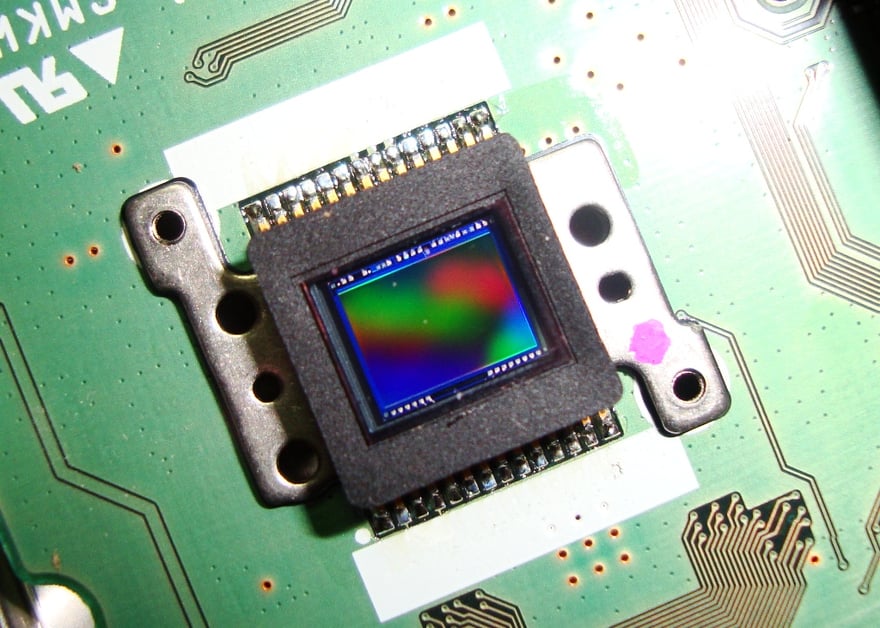
This is the part that gives the “CCD camera” its name: a CCD the photographer removed from his own old 6-megapixel digital camera, photographed in 2009. Charges move across this surface row by row, which is the “lining up for one microphone” described above. Photo: Ahmed2IQ, public domain, original.
So “CCD camera” really means an era
After CMOS won in DSLRs and high-end cameras, CCDs mostly stayed in compact digital cameras, until phones swallowed that category. According to the Camera & Imaging Products Association (CIPA) in Japan, global shipments of digital cameras with built-in lenses peaked in 2008 at 110.07 million units a year. By the 2023 low point, only 1.72 million were shipped.
The “CCD cameras” people talk about today are the cameras made during that period that have now flowed into the used market. The term originally described a component. Now it describes a feeling of an era, and that’s where the next point starts: many “CCD cameras” aren’t CCD at all.
2. Is the “CCD look” real? The pictures do differ, but the chip isn’t the whole story
What people mean by the “CCD look”
Online descriptions of CCD camera images mostly come down to three things:
- Color: a common impression is deeper blues, more accurate reds, and warmer midtones (user impressions compiled by PetaPixel).
- Brightness: CCD dynamic range leans toward the shadows, so highlights are easier to hold and the overall image is darker, which looks more “cinematic” (PetaPixel; an article from a used-camera seller says the same).
- Portraits: people interviewed by Xinhuanet said CCD portraits are less sharp than phone photos, so skin blemishes are less visible, like a built-in beauty filter.
But the same PetaPixel piece also notes that in several blind tests, CMOS photos adjusted with HSL (hue, saturation, lightness) came very close to CCD photos. The difference mostly comes from each manufacturer’s color processing, not the sensor itself.
The four sources of the “CCD look”
Break these claims apart and the explanation that holds up best is this: the “CCD look” is the whole recipe of a 2000s compact camera, and the CCD is just one ingredient.
| Source | Back then | What you see |
|---|---|---|
| Small sensor | Pocket cameras mostly used small 1/2.3-inch-class sensors (e.g. Canon IXUS 130) |
More noise in low light, limited dynamic range; hard to hold highlights and shadows at once |
| Direct flash | Flash built into the body, right next to the lens, firing straight ahead |
Subject lit up, background falls dark; a flat “direct flash” feel at night |
| Color tuning | Each maker’s in-camera JPEG engine had its own colors |
Deep blues, accurate reds, warm midtones: “that color” |
| Low-res JPEG | Roughly 5 to 14 megapixels, compressed in camera, no editing afterward |
Lower sharpness, less skin detail, “softer” than a phone |
The takeaway from this table: of the four sources, only the first is directly tied to the sensor, and what matters there is that it’s small, not whether it’s CCD or CMOS. Color tuning was set by each maker’s image engine, direct flash by the body design, and low-resolution JPEGs by the specs of the era. Swap in an equally small CMOS sensor, use the same direct flash, skip editing the same way, and you get something very close. That’s exactly why the “CMOS CCD cameras” in the next chapter sell.
How strong is the evidence?
For the claim that the “CCD look” mainly comes from the whole package, the evidence I could find falls into these categories:
- Tech media: PetaPixel’s 2021 roundup of how CCD and CMOS work, plus blind tests, is this article’s main basis.
- News interviews: comments from businesses and users in Xinhuanet’s December 2024 report, which are descriptions of experience.
- Seller articles: CCD vs. CMOS color comparisons written by used-camera sellers, who have a sales interest.
- Academic research: none found. I searched with queries like “CCD vs CMOS color blind test study” and found no peer-reviewed comparison.
So the most this article can say is “tech media and blind tests point this way,” not “science has proven it.” On the other side, those who claim the CCD chip itself has special color don’t have stronger evidence either.
3. The twist: many new cameras sold as “CCD cameras” are actually CMOS
Once “CCD camera” took off, it went from a component name to a style label. New cameras with “CCD” in their online listing titles don’t necessarily use a CCD. The two most common examples:
- The Kodak PixPro FZ55 uses a 1/2.3-inch CMOS sensor. It’s designed and made by JK Imaging of Gardena, California, which has held a license from Eastman Kodak since 2013; Kodak itself doesn’t make this camera. According to BCN, which tracks Japanese retail sales, the FZ55 was the No. 1 compact digital camera series by sales in Japan in 2025, and Kodak-branded models took 4 of the top 10 spots.
- The Canon IXUS 285 HS A is also CMOS. It’s a revised version of the 2016 IXUS 285 HS; the original already had Wi-Fi and NFC, and the main change in the revision is a switch to microSD cards.
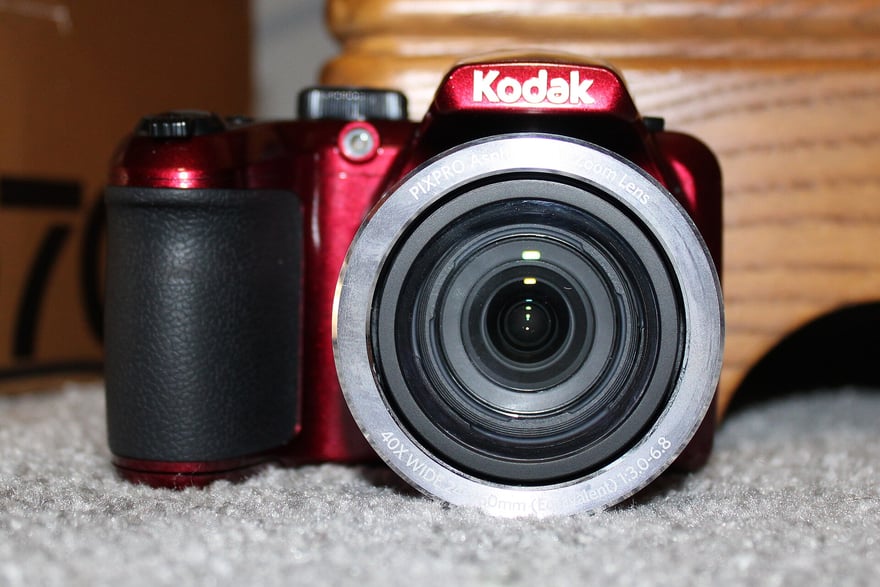
The Kodak PixPro AZ401 belongs to the same PixPro line as the FZ55, made by JK Imaging under license (this is not the FZ55; I couldn’t find an openly licensed photo of the FZ55 on Commons). The Kodak logo on the body is a licensed brand and doesn’t mean Kodak itself still makes cameras. Photo: Greyfiveys, CC BY-SA 4.0, original.
The FZ55’s manufacturer specs call for a 1/2.3-inch CMOS sensor (source: Wikipedia’s Kodak Pixpro article), so an FZ55 listed as a “CCD camera” is a CMOS camera by its own specs.
Checking whether a camera really has a CCD is simple:
- For a new camera, look at the “Image sensor” line on the manufacturer’s spec sheet and see whether it says CCD or CMOS.
- “CCD” in a product title or listing copy doesn’t count. That’s marketing language.
- For an old used camera, look up the model on the review site DPReview; the “Sensor type” field on its spec page will say.
Buying CMOS doesn’t mean you bought the wrong thing. Following the reasoning in Chapter 2, the look you like probably doesn’t come from the chip, and a small CMOS camera can produce it too, new and under warranty. Just know what you’re paying for if you paid extra for the word “CCD.”
4. How big is the craze: three sets of numbers from China, the US, and Japan
China: the biggest buzz on social platforms
Xinhuanet’s December 4, 2024 report, “CCD Cameras Back in the Spotlight,” has the most complete numbers so far:
- CCD-related topics on Xiaohongshu (RedNote) had 4.04 billion views and 1.65 million posts in total.
- CCD-related topics on Douyin had 8.02 billion plays in total.
- On the secondhand platform Xianyu, more than 3,000 units sold in the past 7 days, at 135 to 400 yuan each, and more than 19,000 people searched for them in a single day.
- According to Chanmofang data, camera products marketed as “retro” in Douyin’s e-commerce camera category had sales of more than 75 million yuan in the first half of 2024, up 170% year over year.
- One electronics mall in Shenzhen’s Huaqiangbei district had dozens of CCD camera stalls, plus shops dedicated to buying and repairing them.
On single-model price jumps, ETtoday in March 2026 quoted the manager of a CCD camera rental and sales shop in Wuhan: a certain Canon cost about 1,000 yuan two years ago, then 3,000, and now more than 4,000 yuan, and the manager admitted “there’s a lot of speculation in it.” In February 2026, United Daily News relayed a Yangcheng Evening News story about a Canon bought six years earlier for 2,459 yuan that now sells used for 4,048 yuan.
Another claim circulating on the Chinese-language internet says “CCD trading volume rose 280% year over year in 2025.” It comes from a user post on the consumer community SMZDM, and the source of the underlying data is unclear, so this article doesn’t use it.
The US: TikTok and eBay
- The New York Times reported on January 7, 2023 (“The Hottest Gen Z Gadget Is a 20-Year-Old Digital Camera”) that the #digitalcamera hashtag on TikTok had 184 million views at the time. The same article quoted an eBay spokesperson saying searches for the Nikon Coolpix rose 90% from 2021 to 2022 (I read this eBay line through a Spanish-language outlet quoting the Times, not in the original English). The “220 million” figure often seen on the Chinese-language internet is from a different article: Fox News wrote in February 2023 that the tag had “more than 220 million” views over roughly the past year. The two figures measure different things, so don’t mix them up.
- NPR ran a feature on December 9, 2024 about Gen Z’s love of compact digital cameras.
- The Canon PowerShot G7 X Mark III came out in 2019 but only went viral in 2024, and at one point it was out of stock because of a parts shortage. It launched at US$749.99 in 2019 and now lists at US$879.99 in the US, but Digital Camera World reported in August 2026 that reputable used-camera stores in the US were still selling it for US$1,500 or more, about 1.7 times the current new price.
- Reuters reported in June 2024 that demand for Fujifilm’s X100 series, driven by the TikTok crowd, had outstripped supply, and that the imaging division (including cameras) made up 37% of Fujifilm’s operating profit in fiscal 2023, up from 27% the year before.
Japan: the only first-hand data on who’s buying
The numbers above are all buzz or individual cases. What can actually answer “is it young people who are buying?” is CIPA’s data on the age of camera buyers in Japan:
---
config:
  xyChart:
    width: 360
    height: 300
  themeVariables:
    xyChart:
      plotColorPalette: "#3a4a9d"
---
xychart-beta
    title "Buyers 29 and under (%)"
    x-axis ["2005", "07", "09", "11", "13", "15", "17", "19", "21", "23", "25"]
    y-axis 0 --> 20
    line [15, 14, 14, 11, 8, 7, 7, 5, 11, 4, 17]
| Year | Buyers 29 and under |
|---|---|
| 2004 | 21% |
| 2005, 2006 | 15% |
| 2007 | 14% |
| 2010 | 13% |
| 2013 | 8% |
| 2018 | 4% |
| 2019 | 5% |
| 2020 | 3% |
| 2021 | 11% |
| 2022 | 13% |
| 2023 | 4% |
| 2024 | 15% |
| 2025 | 17% |
Both the chart and the table come from the “built-in lens” column of CIPA’s survey of digital camera buyers in the Japanese market: among people in Japan buying compact digital cameras, the share aged 29 and under. To keep the chart readable on phones, it only shows odd years from 2005 to 2025; see the table for the other years. What to look for is a curve that falls and then rises. In 2004, when compact cameras had just gone mainstream, 21% of buyers were 29 or younger, and from 2005 to 2007 it was still 14% to 15%. Then young people switched to taking photos with their phones, and the share fell all the way to 3% to 5% from 2018 to 2020. It started rising again in 2021 and was back to 17% in 2025.
So the common claim that the share “jumped from 4% to 17%” needs to be read on two levels:
- The starting point is the bottom: the 4% in 2018 was from the years when young people were least likely to buy compact cameras, and the 4% in 2023 looks more like an unusual low.
- The end point isn’t an all-time high: 17% in 2025 is a return to the level of the mid-to-late 2000s. Young people came back after more than a decade away.
In the same survey, the share of buyers aged 60 and over fell from 48% in 2023 to 27% in 2025, which is still more than the 29-and-under group. The craze isn’t just a media story; the buyer base really is shifting younger, though not so dramatically that one set of buyers has replaced another.
Used prices in Japan have been rising at the same time. In June 2026, Taiwan’s Liberty Times 3C relayed figures from Japanese media and used-camera dealers: compact CCD cameras that used to sell for about 5,000 to 10,000 yen now go for 20,000 to 40,000 yen, up to about 4 times as much.
Overall shipments have followed. CIPA reports that global shipments of compact digital cameras with built-in lenses reached 2.437 million units in 2025, up 29.6% year over year. Domestic shipments of built-in-lens cameras in Japan were 525,000 units, more than the 471,000 units for all interchangeable-lens cameras combined. Shipments in July 2026 alone were down 3.1% year over year, but August shipments were 245,000 units, up 32.9%, and the January–August total was 1.694 million units, up 15.3%. As of August 2026, there’s no sign of a slowdown.
Celebrity models
Popular models are often tied to celebrities. A January 2026 roundup by Liberty Times 3C said BLACKPINK’s Lisa uses a Sony Cyber-shot DSC-T77 and Chinese actress Shen Yue uses a Canon IXUS 95 IS. These “same as the star” labels show up directly in used asking prices; for the models involved, see the model table in Chapter 6.
5. Six pitfalls when buying a used CCD camera, and how to check each one
- The CCD defects Sony announced in 2005 and 2006 are the best-known flaw. The adhesive used to package the CCD degrades when exposed to moisture, and the symptoms are a distorted or completely black image in the viewfinder or on the LCD, or the camera being unable to take pictures at all. Sony dealt with it in two rounds, and both were extended free repairs, not recalls. In October 2005 it announced the first batch, mainly DSC-P and DSC-U series models and the DSC-V1, manufactured between October 2002 and March 2004. Because Sony also sold its CCDs to other makers, this round may have affected more than 100 camera models, and Canon, Konica Minolta, Nikon, and Fujifilm also announced they would replace faulty CCDs. In November 2006, Sony added 8 more models: the DSC-T1, T11, T3, T33, U40, U50, F88, and M1 (sold between September 2003 and January 2005), and noted that the problem mainly occurred in hot, humid regions. All of these extended free repairs have ended: the 2005 batch in Japan ran until the end of November 2009, and the 8 models added in 2006 ran until the end of November 2010, with the T3 and T33 until the end of May 2011. If you buy one of these models today and it breaks, you’ll have to pay for the repair yourself. How to check: first look up the model against the makers’ notices from that time. When you meet the seller, take a few shots in bright light and in the dark, then zoom in to check for distortion, color blotches, or a black image. Ask the seller for sample shots taken now, not pictures from the internet.
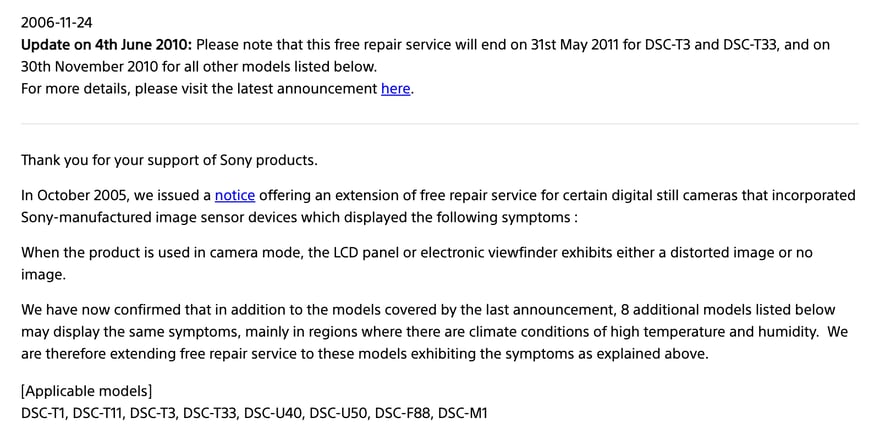
Sony’s own notice makes two things clear: these 8 models were “added” in November 2006, after a first batch in October 2005; and the free repairs had deadlines, the end of May 2011 for the T3 and T33 and the end of November 2010 for the others. Screenshot from an Internet Archive copy of Sony Asia’s notice (archived May 20, 2024, captured September 25, 2026; the original page blocks direct access; only the date, update note, notice text, and applicable models are shown, with the apology section left out), archive, original page
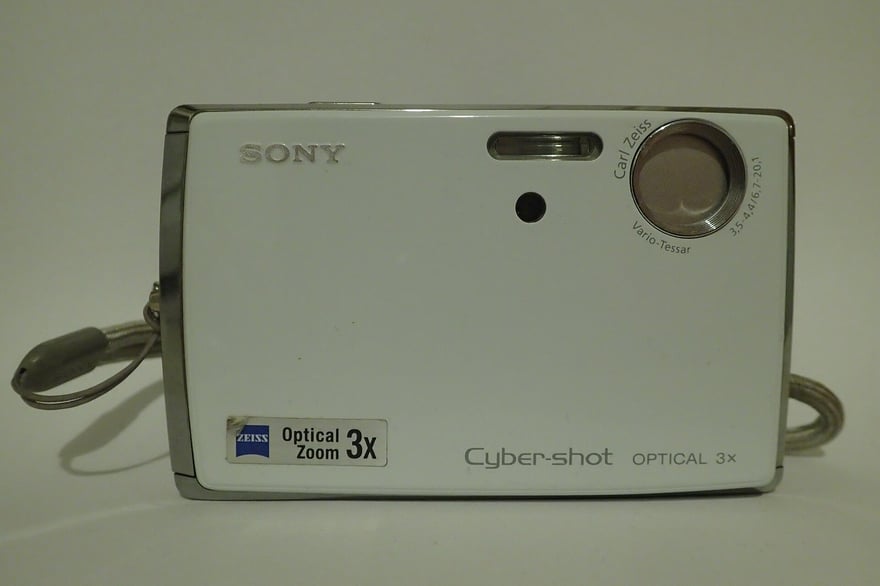
The Sony Cyber-shot DSC-T33, one of the 8 models Sony added to its extended CCD free-repair list in November 2006; free repairs for this batch (T3, T33) ended at the end of May 2011. If you see a T1, T3, T11, T33, F88, M1, U40, or U50, first ask the seller whether the CCD has been replaced, then test it with the method above. Photo: DavidIvar, CC BY-SA 4.0, original.
-
Most original batteries are discontinued; only third-party ones are left. Old digital cameras use lithium batteries specific to each model, the original makers stopped producing them long ago, and in practice you can only buy third-party batteries. Old batteries may also have aged or swollen. How to check: before buying, look up the camera’s battery model and make sure third-party batteries and chargers are available. Open the battery door and check whether the original battery is bulging; don’t charge a swollen battery again.
-
A gap in memory card formats can leave you with a camera and no card to put in it. Fujifilm and Olympus launched the xD-Picture Card in July 2002, and both switched to SD in 2009; from 2010, all new Olympus cameras used SD or CF. Fujifilm’s last camera with an xD slot was the 2009 F200EXR (which also takes SD). All early Sony Cyber-shots took only Sony’s own Memory Stick, and only from around 2010 did they accept both Memory Stick and SD; the DSC-T77 and DSC-W150, for example, take only Memory Stick Duo. xD cards today are mostly old stock. How to check: open the card slot cover to see which type it takes. Ask whether the seller includes a card, and if so, test-shoot with it on the spot. Also make sure your card reader or computer can read that type of card.
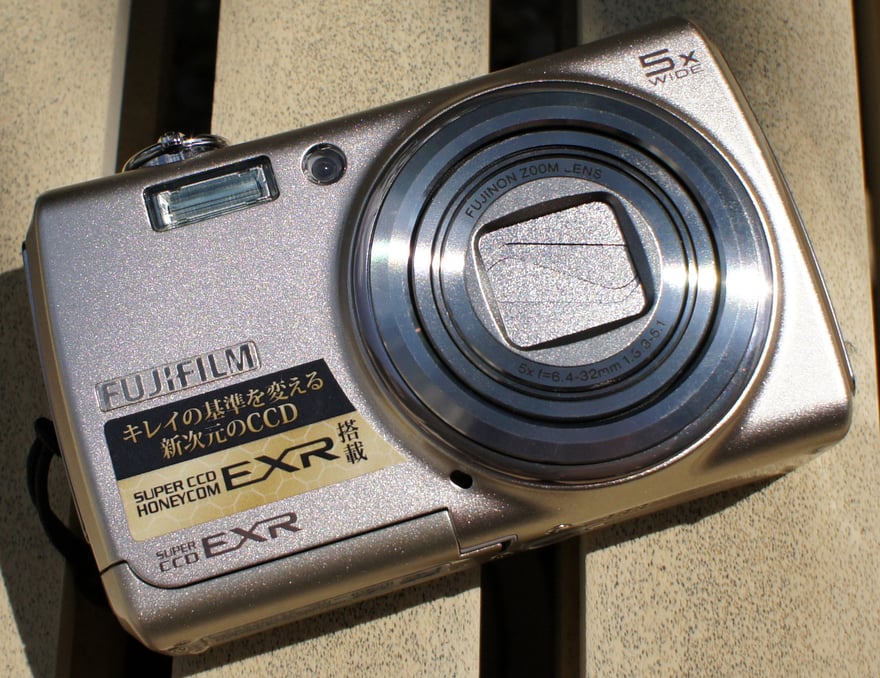
The Fujifilm FinePix F200EXR, a 2009 model and Fujifilm’s last camera with an xD slot (it also takes SD cards), uses a Super CCD EXR sensor; the factory sticker on the body sells it outright as “a new dimension of CCD.” Photo: 663highland, CC BY 2.5, original.
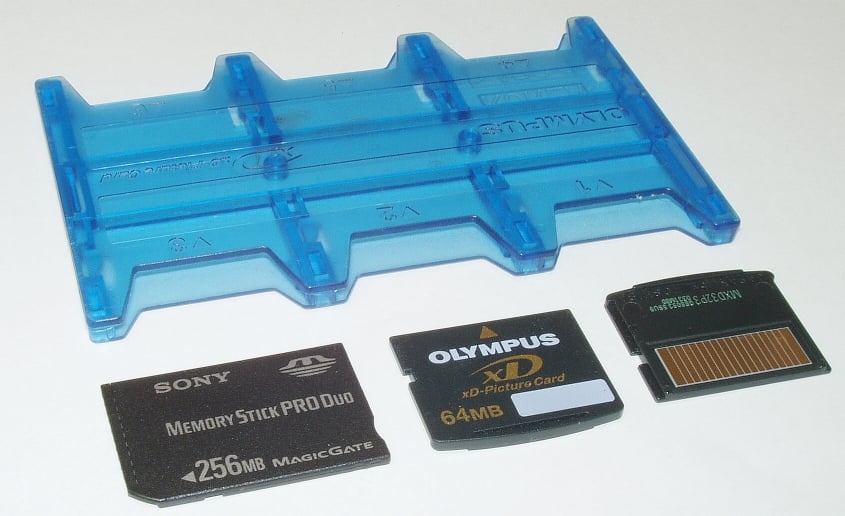
On the left is the Memory Stick PRO Duo used by Sony cameras; in the middle and on the right is the xD-Picture Card used by Fujifilm and Olympus cameras (the one on the right is flipped over). Both are smaller than today’s standard SD card, and neither fits in an SD slot. Photo: Bela, CC BY-SA 3.0, original.
-
The lens extension mechanism is the mechanical weak point of pocket cameras. A compact camera’s lens extends when you turn it on and retracts when you turn it off, and if that motor and gear assembly fails, the camera shows a lens error and won’t start. I couldn’t find any quantitative failure-rate data on this, so I can only list it as a known risk. How to check: on the spot, turn the camera on and off at least five times and zoom in and out a few times. Listen for catching or odd noises, and watch the screen for a lens error message.
-
Flash capacitors age. A big part of the “CCD look” comes from direct flash, so a broken flash takes away half the reason to buy one. A used-camera seller’s buying guide lists failed flash capacitors as a common problem, and the same guide also mentions dark shadows on the screen and aging batteries. How to check: turn the flash on and shoot five or six frames in a row. Make sure every shot fires and the recharge time isn’t getting longer, and check the screen for dark shadows or dead pixels at the same time.
-
Dashcams disguised as CCD cameras are a real scam. Xinhuanet’s 2024 report mentioned sellers in China converting dashcams into “CCD cameras.” A 2022 udn report also described someone who paid 220 yuan for a converted dashcam. Goods from China can also be bought through cross-border e-commerce. How to check: first confirm that the brand and model on the body can be found on the manufacturer’s site or DPReview. If the price is clearly below the going rate for that model, there’s no brand or model name on it, or the seller only provides pictures from the internet, don’t buy it.
There’s also a used-camera seller’s buying guide claiming that buying from private sellers has “a 50% or higher chance of getting a dud,” but it doesn’t say where that number comes from, so this article doesn’t use it.
6. How to choose a popular CCD model: specs and pitfalls of ten real CCD cameras
Online “best CCD camera” lists often mix in CMOS models. Each of the ten cameras below was confirmed to have a CCD sensor using the manufacturer’s spec page, the Canon Camera Museum, or a review site’s spec page. Some are models named in the craze; others are older cameras whose specs are worth noting. Used prices vary a lot by region and condition, so this article doesn’t list them.
| Model (year) | Sensor | Card / battery |
|---|---|---|
| Canon IXUS 130 (2010) US: PowerShot SD1400 IS |
1/2.3-inch CCD 14.1MP |
SD NB-4L |
| Canon IXUS 95 IS (2009) US: PowerShot SD1200 IS |
1/2.3-inch CCD 10MP |
SD (no SDXC) NB-6L |
| Canon PowerShot A620 (2005) | 1/1.8-inch CCD 7.1MP |
SD 4 AA batteries |
| Canon PowerShot G10 (2008) | 1/1.7-inch CCD 14.7MP |
SD NB-7L |
| Sony DSC-T77 (2008) | 1/2.3-inch CCD 10.1MP |
Memory Stick Duo NP-BD1 |
| Sony DSC-W830 (2014) | 1/2.3-inch CCD 20.1MP |
SD or Memory Stick NP-BN |
| Nikon Coolpix S3500 (2013) | 1/2.3-inch CCD 20.05MP |
SD EN-EL19 |
| Fujifilm F200EXR (2009) | 1/1.6-inch Super CCD EXR 12MP |
xD or SD NP-50 |
| Fujifilm F31fd (2006) | 1/1.7-inch Super CCD HR 6.3MP |
xD only NP-95 |
| Olympus µ 770 SW (2007) US: Stylus 770 SW |
1/2.33-inch CCD 7.1MP |
xD only LI-42B |
The most useful column here is the memory card. Seven of the ten take SD cards, the most common type today (the F200EXR takes both), so you can put in the card you already have and start shooting. The F31fd and µ 770 SW take only xD cards, and the T77 takes only Memory Stick, so you’ll need to find cards and a reader separately. None of these ten is on Sony’s 2005 or 2006 CCD defect lists (see Chapter 5, point 1 for the lists).
Key points for each model
- Canon IXUS 130: called the PowerShot SD1400 IS in the US and the IXY Digital 400F in Japan. One of the models most often named in the craze.
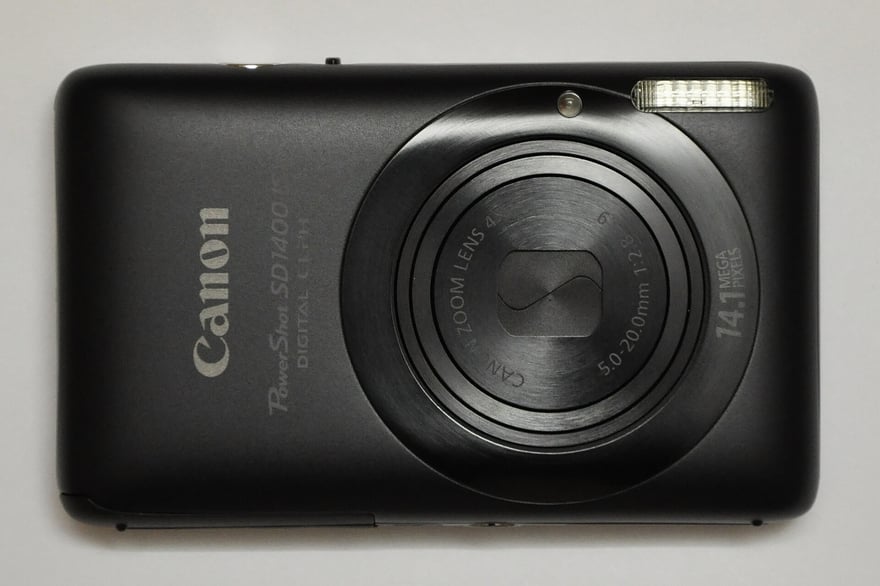
The Canon PowerShot SD1400 IS, sold as the IXUS 130 in Europe (IXY Digital 400F in Japan), is a 2010 model with a 1/2.3-inch CCD and 14.1 megapixels, and one of the models most often named in the craze. Photo taken in December 2010. Photo: Joe Ravi, CC BY-SA 3.0, original.
- Canon IXUS 95 IS: called the PowerShot SD1200 IS in the US and the IXY Digital 110 IS in Japan; the same model Chinese actress Shen Yue uses. It takes only SD and SDHC, so newer high-capacity SDXC cards won’t work; buy cards of 32GB or less.
- Canon PowerShot A620: runs on AA batteries, the only camera in the table that doesn’t need a model-specific lithium battery, which sidesteps the discontinued-battery problem entirely. The trade-off is a body thicker than a pocket camera.
- Canon PowerShot G10: a high-end model with a 1/1.7-inch sensor, larger than the 1/2.3-inch sensor in a typical pocket camera, so there’s somewhat less noise in dark scenes. The previous G9 (2007) also uses a CCD; its battery is the NB-2LH.
- Sony DSC-T77: the same model BLACKPINK’s Lisa uses. It takes only the Memory Stick Duo family, which is the biggest hurdle to buying one.
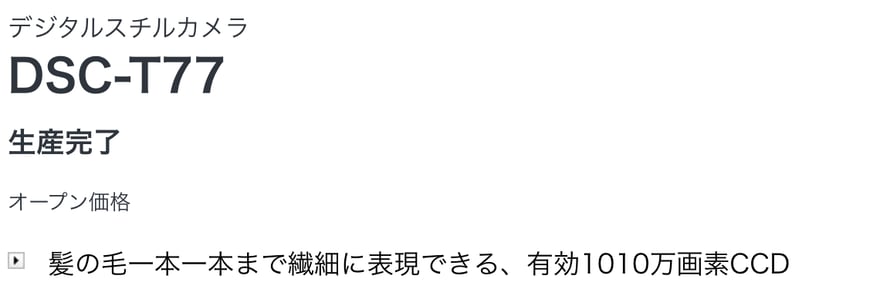


The DSC-T77, named as the camera Lisa uses, still has a product page on Sony’s Japanese website. It’s marked “生産完了” (discontinued), and the first feature listed is “有効 1010 万画素 CCD” (an effective 10.1-megapixel CCD). Screenshot from Sony Japan’s DSC-T77 product page (captured September 25, 2026; only the model name, discontinued notice, and CCD line are shown), original page
- Sony DSC-W830: released in 2014, five or six years later than most popular models, making it one of the last CCD compacts. It takes both SD and Memory Stick cards.
- Nikon Coolpix S3500: the same model BLACKPINK’s Jennie uses (as relayed by fashion media from her Instagram photos). A 2013 model that takes SD cards.
- Fujifilm F200EXR: uses Fujifilm’s own Super CCD EXR sensor at 1/1.6 inch, on the large side for a compact. Works with both xD and SD.
- Fujifilm F31fd: Fujifilm Super CCD HR, a 1/1.7-inch sensor, and the oldest camera in the table. It takes only xD cards, which today are mostly old stock.
- Olympus µ 770 SW: called the Stylus 770 SW in the US (μ770 SW in Japan), built around a waterproof, shockproof body. It takes only xD cards.
Super CCD is Fujifilm’s own CCD design. Its pixel layout differs from a standard CCD, but it’s still read out the CCD way, “lining up for the same exit.”
Looks the part, but isn’t a CCD
Being in the same series doesn’t mean having the same sensor. The Canon IXUS 220 HS (2011) came out just a year after the IXUS 130, looks very similar, and even uses the same NB-4L battery, but it has a back-illuminated CMOS sensor. The “HS” in the name stands for Canon’s HS System, a combination of a high-sensitivity CMOS sensor and image processor. When shopping used, treat any IXUS or PowerShot with “HS” in the name as CMOS, then check the spec sheet to confirm.
How to choose from this table
- For the fewest headaches: pick a model that takes SD cards and whose battery is still available from third-party makers, such as the IXUS 130, IXUS 95 IS, S3500, or W830. With the A620, you don’t even need to hunt for batteries.
- For somewhat better image quality: pick one with a 1/1.7-inch or larger sensor, like the G10, F200EXR, or F31fd, which usually do better in the dark than 1/2.3-inch models. But with the F31fd, you’ll have to solve the xD card problem first.
- For a celebrity model: the T77, S3500, and IXUS 95 IS all qualify, but the “same as the star” label shows up in the asking price, so part of what you pay is for the hype. In the used listings I checked, asking prices for old CCD cameras differed by a factor of ten or more, driven more by whether a model had been name-checked than by its specs.
- Whichever you choose, once it’s in your hands, go through the six pitfalls in Chapter 5 one by one.
7. Who should buy a used CCD camera, who should buy new, and who’s fine with a phone
People who should buy a used CCD camera
If what you want is the machine itself, the feel of an era in your hand, the overall look of direct flash, something to play with like a toy, a used CCD camera is the most direct choice, because only the cameras of that era keep the whole recipe intact.
The price is accepting that it may break, and that it often won’t be worth fixing when it does. The sensible approach is to keep your budget in the low-to-mid price range, favor sellers who offer a short-term warranty, and check it item by item against Chapter 5 once you have it. If you pay top price for a hyped, much-named model, most of what you’re paying for is the hype, not image quality.
People better off with a new compact
If you’ll carry it every day, need a warranty, and don’t want to deal with discontinued batteries and memory card gaps, a new camera is less hassle. Entry-level models like the FZ55 and IXUS 285 HS A are CMOS, but following the reasoning in Chapter 2, they can produce the same small-sensor, direct-flash, straight-out-of-camera look, and they cost less and come with a warranty.
The Canon G7 X Mark III, Fujifilm X100VI, and Ricoh GR IV are a different class: their image quality is much better, but in the US, used G7 X Mark III units have been selling for about 1.7 times the new price. If what you want is the “CCD look,” spending this kind of money isn’t great value. If what you want is a good everyday camera, this class is worth it, but wait for official restocks rather than paying the markup.
People who’ll be fine with phone filters
If all you want is that color tone on Instagram, adjusting colors or using a filter on your phone will probably do. The blind tests compiled by PetaPixel show that the color side can be matched with HSL adjustments. Direct flash and the low-resolution texture are harder to imitate, but your phone has a flash too, so try it. Use your phone for a month first to figure out whether you care about the machine or the color, then decide whether to spend money.
Conclusion
- A CCD camera is a digital camera that uses a CCD image sensor; when people say “CCD camera” today, they usually mean a compact digital camera from the 2000s.
- A CCD’s charges line up and are read out through a single exit, while each CMOS cell has its own amplifier; because CMOS is fast, uses less power, and runs cooler, it became mainstream around 2010.
- The “CCD look” more likely comes from the whole package: small sensors, direct flash, the color tuning of the time, and low-resolution JPEGs straight out of the camera. The evidence comes from tech media and blind tests; I couldn’t find any academic research.
- Many new cameras sold as “CCD cameras” are actually CMOS, including the Kodak PixPro FZ55 and Canon IXUS 285 HS A; check the sensor line on the spec sheet.
- The craze has numbers behind it: 4.04 billion views on Xiaohongshu and 8.02 billion plays on Douyin in China; in Japan, the share of buyers aged 29 and under rose from 4% in 2018 back to 17% in 2025, a return to the level of the mid-to-late 2000s (it was 21% in 2004); used CCD cameras in Japan have risen to 20,000 to 40,000 yen.
- The six most common pitfalls when buying used are the CCD defects Sony announced in 2005 and 2006, discontinued batteries, memory card gaps, the lens extension mechanism, flash capacitors, and disguised dashcams, and each one can be checked on the spot.
- Of the ten verified popular CCD models, the seven that take SD cards are the easiest to get started with; the F31fd and µ 770 SW take only xD cards, and the T77 takes only Memory Stick; Canon models with “HS” in the name are mostly CMOS.
Further reading
- What is a point-and-shoot camera: 1977 to 2026 (in Chinese): the full history of point-and-shoot cameras and CIPA shipment figures, including the 2008 peak for compact digital cameras.
- Disposable cameras, instant cameras, and point-and-shoots: what’s the difference (in Chinese): an overview of the series on three kinds of “simple cameras.”
Appendix 1: What I couldn’t find
I looked into these questions but couldn’t find reliable answers, so this article doesn’t cover them and doesn’t fill them in with estimates:
- Peer-reviewed research on color differences between CCD and CMOS.
- Quantitative data on failure rates for the lens extension mechanism, or overall failure rates, in used digital cameras.
- The original data source for China’s “CCD trading volume up 280% year over year in 2025” (seen only in a user post).
- The source of the claim that buying from private sellers has “a 50% or higher chance of getting a dud” (seen only as a seller’s claim).
- The full English text of the New York Times’ January 2023 report (paywalled); I read it through a licensed reprint and secondary citations. For the NPR feature, I only confirmed that it exists.
Appendix 2: Sources
- PetaPixel, “What is a CCD or CMOS sensor,” on how CCD and CMOS work, blind tests, and color claims: https://petapixel.com/what-is-ccd-cmos-sensor/ (2021-08-04)
- Xinhuanet, “CCD Cameras Back in the Spotlight” (reprinted by CCTV’s business channel), on Xiaohongshu, Douyin, Xianyu, Chanmofang, Huaqiangbei, and disguised dashcams: https://jingji.cctv.com/2024/12/04/ARTIk3BVOAtQpkbF8sWUrkv0241204.shtml (2024-12-04)
- Used-camera seller article, CCD vs. CMOS color comparison (seller has a sales interest): https://dutchthrift.com/blogs/blogs/ccd-colors-vs-cmos-the-science-behind-camera-sensors (checked 2026-09-25)
- CIPA historical digital camera statistics (built-in-lens shipments, 2008 peak and 2023 low): https://www.cipa.jp/stats/documents/common/cr300.pdf (checked 2026-09-25)
- CIPA 2025 annual report (2.437 million built-in-lens units shipped; Japan domestic built-in-lens vs. interchangeable-lens cameras): https://www.cipa.jp/stats/documents/e/d-2025_e.pdf (published early 2026)
- CIPA July 2026 statistics (January–July total and July alone): https://www.cipa.jp/stats/documents/e/d-202607_e.pdf (published 2026-09-01)
- CIPA August 2026 statistics (August alone and January–August total): https://www.cipa.jp/stats/documents/e/d-202608_e.pdf (checked 2026-10-27)
- CIPA characteristics of digital camera buyers in the Japanese market (age breakdown): https://www.cipa.jp/stats/documents/common/cr800.pdf (checked 2026-09-25)
- Wikipedia, “Kodak Pixpro,” on the FZ55’s sensor and JK Imaging’s license: https://en.wikipedia.org/wiki/Kodak_Pixpro (checked 2026-09-25)
- BCN 2025 ranking of compact digital camera series (reprinted by Excite): https://www.excite.co.jp/news/article/BcnRetail_588749/ (2026-01-12)
- Canon Europe, specs of the original IXUS 285 HS (Wi-Fi and NFC already included): https://www.canon-europe.com/cameras/ixus-285-hs/specifications/ (checked 2026-10-27)
- Liberty Times 3C, roundup of Y2K retro cameras and the models celebrities use: https://3c.ltn.com.tw/news/64430 (2026-01-02)
- Liberty Times 3C, used compact CCD cameras in Japan up 4 times in price: https://3c.ltn.com.tw/news/66347 (2026-06-07)
- ETtoday, prices at a CCD camera rental and sales shop in Wuhan: https://www.ettoday.net/news/20260304/3126783.htm (2026-03-04)
- United Daily News relaying Yangcheng Evening News, a used camera price increase in China: https://udn.com/news/story/7333/9343559 (2026-02-25)
- udn Tech, China’s CCD camera craze and a converted dashcam case: https://tech.udn.com/tech/story/123152/6713215 (2022-10-25)
- SMZDM user post (source unclear; this article does not use its figures): https://post.smzdm.com/p/a950z9qp/ (2026-09-13)
- The New York Times, “The Hottest Gen Z Gadget Is a 20-Year-Old Digital Camera” (Kalley Huang): https://www.nytimes.com/2023/01/07/technology/digital-cameras-olympus-canon.html (2023-01-07; paywalled, full text not read)
- DT Next reprint of the same New York Times article, 184 million views for TikTok’s #digitalcamera: https://www.dtnext.in/edit/2023/01/10/the-hottest-gen-z-gadget-a-20-year-old-digital-camera (2023-01-10)
- Primicias citing the New York Times, an eBay spokesperson on a 90% rise in Nikon Coolpix searches: https://primicias.ec/noticias/tecnologia/nostalgia-resucita-camaras-digitales (checked 2026-10-27)
- Fox News, more than 220 million views for #digitalcamera over roughly a year (measured differently from the New York Times figure): https://www.foxnews.com/tech/young-people-making-digital-cameras-cool-again (2023-02-09)
- NPR, feature on Gen Z and compact digital cameras: https://www.npr.org/2024/12/09/nx-s1-5209770/gen-z-digital-compact-cameras-millennials-trendy (2024-12-09)
- Digital Camera World, used G7 X III prices in the US: https://www.digitalcameraworld.com/cameras/compact-cameras/a-year-after-canon-increased-production-this-powershot-compact-camera-is-still-so-viral-that-used-models-are-nearly-twice-the-new-cost (2026-08-21)
- DPReview, G7 X III production resuming after a parts shortage: https://www.dpreview.com/news/1514834866/canon-powershot-g7x-iii-production-resuming-parts-shortage-back-orders/ (2025-09-16)
- Reuters (reprinted by BusinessWorld), Fujifilm X100 series demand and the imaging division’s share of profit: https://bworldonline.com/technology/2024/06/28/604906/fujifilm-once-struggled-to-sell-cameras-now-it-cant-keep-up-with-demand/ (2024-06-28)
- Imaging Resource, G7 X Mark III 2019 launch price of US$749.99: https://www.imaging-resource.com/PRODS/canon-g7x-iii/canon-g7x-iiiA.HTM (checked 2026-10-27)
- TechRadar, G7 X Mark III current US list price of US$879.99 (in a report on the 30th anniversary edition): https://www.techradar.com/cameras/compact-cameras/canons-viral-compact-camera-from-2019-just-got-an-unexpected-makeover-meet-the-g7x-mark-iii-limited-edition (checked 2026-10-27)
- Cameralabs, Canon IXUS 130 sensor specs: https://www.cameralabs.com/canon_powershot_sd1400_is_ixus_130/ (checked 2026-09-25)
- DPReview spec page, Fujifilm F200EXR (sensor, memory card): https://www.dpreview.com/products/fujifilm/compacts/fujifilm_f200exr/specifications (checked 2026-09-25)
- DPReview spec page, Sony DSC-T77: https://www.dpreview.com/products/sony/compacts/sony_dsct77/specifications (checked 2026-09-25)
- DPReview spec page, Sony DSC-W150: https://www.dpreview.com/products/sony/compacts/sony_dscw150/specifications (checked 2026-09-25)
- EDN, Sony adds 8 models to its CCD defect list in 2006: https://www.edn.com/ccd-sensor-defect-prompts-sony-camera-recall/ (2006-11-27)
- Computerworld, Sony’s 8 added models and how the 2005 batch affected other brands: https://www.computerworld.com/article/1649155/sony-finds-ccd-problem-with-some-of-its-digital-cameras.html (2006-11-24)
- DPReview, Sony’s first batch of CCD defect models in 2005 and their manufacturing period: https://www.dpreview.com/articles/1978984737/sony-ccds (2005-10-07)
- Sony Japan, notice to owners of digital still cameras (first batch announced October 3, 2005): https://www.sony.jp/support/cyber-shot/information/info/top_ccd.html (checked 2026-09-25)
- Sony Japan, notice of the end of the extended CCD warranty (the 2005 batch in Japan ran until November 30, 2009): https://www.sony.jp/support/cyber-shot/information/info/top_ccd_end.html (2009-12-01)
- Sony Asia, “Notice to Owners of Sony Digital Still Cameras” (8 added models, including the end dates updated in 2010): https://www.sony-asia.com/electronics/support/articles/00181532 (2006-11-24; the original page blocks direct access; Internet Archive copy: https://web.archive.org/web/20240520060243/https://www.sony-asia.com/electronics/support/articles/00181532 )
- Sony Asia, notice of the end of the extended CCD warranty (T3 and T33 until May 31, 2011, others until November 30, 2010): https://www.sony-asia.com/electronics/support/articles/00181987 (Internet Archive copy: https://web.archive.org/web/20191017161658/https://www.sony-asia.com/electronics/support/articles/00181987 )
- Canon Camera Museum, IXUS 130 (IXY 400F / SD1400 IS) specs: https://global.canon/en/c-museum/product/dcc588.html (checked 2026-10-27)
- Canon Camera Museum, IXUS 95 IS (IXY 110 IS / SD1200 IS) specs: https://global.canon/en/c-museum/product/dcc570.html (checked 2026-10-27)
- Canon Camera Museum, PowerShot A620 specs: https://global.canon/en/c-museum/product/dcc517.html (checked 2026-10-27)
- Canon Camera Museum, PowerShot G9 and G10 specs: https://global.canon/en/c-museum/product/dcc548.html , https://global.canon/en/c-museum/product/dcc565.html (checked 2026-10-27)
- Canon Camera Museum, IXUS 220 HS (CMOS) specs: https://global.canon/en/c-museum/product/dcc599.html (checked 2026-10-27)
- Sony Japan, DSC-T77 and DSC-W830 specs: https://www.sony.jp/cyber-shot/products/DSC-T77/spec.html , https://www.sony.jp/cyber-shot/products/DSC-W830/spec.html (checked 2026-10-27)
- Nikon Japan, Coolpix S3500 specs: https://nij.nikon.com/products/lineup/compact/s3500/spec.html (checked 2026-10-27)
- DPReview, Fujifilm F31fd announcement and specs: https://www.dpreview.com/articles/0915232969/fujif31fd (2006-09-25)
- Digital Camera Watch (Japan), Olympus μ770 SW review (specs and LI-42B battery): https://dc.watch.impress.co.jp/cda/review/2007/03/07/5743.html (2007-03-07)
- DCFever, Fujifilm F200EXR sensor size: https://www.dcfever.com/shop/product.php?pid=2109 (checked 2026-10-27)
- LINE Today, digital cameras used by BLACKPINK members (Lisa: DSC-T77; Jennie: Coolpix S3500): https://today.line.me/tw/v2/article/oqnwLqp (2023-05-19)
- Wikipedia, “XD-Picture Card,” on when xD cards were introduced and dropped: https://en.wikipedia.org/wiki/XD-Picture_Card (checked 2026-09-25)
- Wikipedia, “Cyber-shot” and “Sony Cyber-shot DSC-TX5,” on when Memory Stick and SD dual compatibility arrived: https://en.wikipedia.org/wiki/Cyber-shot , https://en.wikipedia.org/wiki/Sony_Cyber-shot_DSC-TX5 (checked 2026-09-25)
- Used-camera seller’s Y2K retro camera buying guide, roundup of common faults: https://www.changeweb.com.tw/ (2025-12-04)
Image sources
All photos in this article are openly licensed files from Wikimedia Commons, credited below according to each license; the cover image is a 16:9 crop (top and bottom) of the Canon PowerShot SD1400 IS (IXUS 130) photo. Two screenshots of official pages, used as supporting citations in the text, are listed after the photos.
- CCD sensor from a 6-megapixel digital camera (Chapter 1): Ahmed2IQ, public domain, https://commons.wikimedia.org/wiki/File:CCD_sensor.JPG
- Kodak PixPro AZ401 (Chapter 3): Greyfiveys, CC BY-SA 4.0, https://commons.wikimedia.org/wiki/File:Front_view_of_Kodak_Pixpro_AZ401_(cropped).jpg
- Canon PowerShot SD1400 IS / IXUS 130 (cover image and Chapter 6): Joe Ravi, CC BY-SA 3.0, https://commons.wikimedia.org/wiki/File:Canon_PowerShot_SD1400_IS.jpg
- Sony Cyber-shot DSC-T33 (Chapter 5): DavidIvar, CC BY-SA 4.0, https://commons.wikimedia.org/wiki/File:SONY-Cyber-shot-dsc-t33.jpg
- Memory Stick PRO Duo and xD-Picture Card (Chapter 5): Bela, CC BY-SA 3.0, https://commons.wikimedia.org/wiki/File:Memory-Cards.jpg
- Fujifilm FinePix F200EXR (Chapter 5): 663highland, CC BY 2.5, https://commons.wikimedia.org/wiki/File:Fujifilm_FinePix_F200EXR01n2550.jpg
- Screenshot: Sony Japan DSC-T77 product page (Chapter 6), https://www.sony.jp/cyber-shot/products/archive/DSC-T77/ , captured September 25, 2026, supporting citation
- Screenshot: Sony Asia’s 2006 notice of extended free CCD repairs (Chapter 5), https://www.sony-asia.com/electronics/support/articles/00181532 , captured from the Internet Archive copy https://web.archive.org/web/20240520060243/https://www.sony-asia.com/electronics/support/articles/00181532 on September 25, 2026, supporting citation
Keywords: CCD camera, best CCD cameras, CCD camera models, CCD look, what is a CCD camera, CCD vs CMOS, used CCD camera, CCD camera buying pitfalls, CCD camera prices, digital point-and-shoot, Kodak FZ55, Canon IXUS
Frequently asked questions
What is a CCD camera?
A CCD camera is a digital camera that uses a CCD image sensor. After CMOS sensors became mainstream around 2010, CCDs mostly stayed in the compact digital cameras of the 2000s. So when people talk about a “CCD camera” today, they usually mean a pocket-size digital camera made in that era that has now ended up on the used market.
Do CCD cameras really look more like film?
The pictures do look different from today’s phones, but the current evidence doesn’t support the idea that it’s all down to the chip. Blind tests compiled by the tech outlet PetaPixel show that CMOS photos can match the color impression of CCD cameras with HSL color adjustments. The more reasonable explanation is a whole package of conditions from that era: small sensors, direct flash, each maker’s color tuning at the time, and low-resolution JPEGs straight out of the camera. The evidence behind this conclusion comes from tech media and blind tests; I couldn’t find any academic research.
Is the Kodak PixPro FZ55 a CCD camera?
No. The Kodak PixPro FZ55 uses a 1/2.3-inch CMOS sensor and is made by JK Imaging in the US under a Kodak brand license. The Canon IXUS 285 HS A is also CMOS. To check whether a camera really has a CCD, look at the “Image sensor” line on the manufacturer’s spec sheet, not the product title.
Which popular models actually use a CCD?
This article lists ten models whose sensors were confirmed on manufacturer or review-site spec pages: the Canon IXUS 130, IXUS 95 IS, PowerShot A620 and PowerShot G10, the Sony DSC-T77 and DSC-W830, the Nikon Coolpix S3500, the Fujifilm F200EXR and F31fd, and the Olympus µ 770 SW. For the fewest headaches, pick one that takes SD cards and whose batteries you can still buy. Canon models with “HS” in the name are mostly CMOS, for example the IXUS 220 HS.
What should I check when buying a used CCD camera?
Check at least six things: whether the model is on the CCD defect lists Sony announced in 2005 and 2006, the battery model and whether third-party batteries are available, whether it takes xD or Memory Stick cards, whether the lens extends and retracts smoothly when you power it on and off, whether the flash recharges normally after several shots in a row, and whether the brand and model on the body actually exist, so you don’t end up with a converted dashcam.
Sources: Chinese original first published on 2026-09-25 (Taipei) and revised on 2026-10-27. Prices and market data were checked on 2026-09-25; camera specifications and corrections on 2026-10-27.
This English version is based on original Traditional Chinese content on joelin.cc. The language and explanations are localised for international readers. The Traditional Chinese original is the authoritative version — for its complete meaning, please read the original article.