
Contents (14)
The standard business card size in the United States and Canada is 3.5 × 2 inches, which is exactly 88.9 × 50.8 mm (8.89 × 5.08 cm). For printing, set up the file at 3.75 × 2.25 inches, which adds 1/8 inch of bleed on every side, and keep text inside a 3.25 × 1.75 inch safe area. At 300 DPI the finished card is 1050 × 600 pixels.
There is no US government or ISO standard behind this size. It is an industry convention: major printers such as Vistaprint, MOO and PrintingForLess all sell 3.5 × 2 inches as their standard card. Other countries settled on slightly different sizes, so a card designed in Europe or Japan will not match a US template.
Business card size in inches, mm, cm and pixels
| Unit | Horizontal | Vertical |
|---|---|---|
| Inches | 3.5 × 2 | 2 × 3.5 |
| Millimeters | 88.9 × 50.8 | 50.8 × 88.9 |
| Centimeters | 8.89 × 5.08 | 5.08 × 8.89 |
| Points | 252 × 144 | 144 × 252 |
| Pixels, 300 DPI | 1050 × 600 | 600 × 1050 |
| Pixels, 600 DPI | 2100 × 1200 | 1200 × 2100 |
The conversions are exact because an inch is defined as 25.4 mm: 3.5 × 25.4 = 88.9 mm and 2 × 25.4 = 50.8 mm. Pixels are inches × DPI, so a 3.5 inch side at 300 DPI is 1050 pixels. Points, at 72 per inch, are a common unit in layout software such as Illustrator and InDesign.
300 DPI is the usual minimum for print. Vistaprint’s file-prep guide asks for 300 DPI at the printed size and notes that an image stretched to twice its width drops to 150 pixels per inch, which prints soft. The card’s shape is 7:4 (3.5 ÷ 2 = 1.75), close to a 16:9 slide (1.78) but much wider than a 3:2 or 4:3 photo, so photos usually need cropping to fit.
Bleed and safe area: the print-ready size
| Area | Inches | mm | Pixels |
|---|---|---|---|
| With bleed | 3.75 × 2.25 | 95.25 × 57.15 | 1125 × 675 |
| Trim (final card) | 3.5 × 2 | 88.9 × 50.8 | 1050 × 600 |
| Safe area | 3.25 × 1.75 | 82.55 × 44.45 | 975 × 525 |
Pixels are at 300 DPI. Three rectangles, each 1/8 inch (0.125 in, about 3.2 mm) apart, make up a print file. The bleed is extra background that runs past the edge and is cut off; without it, a cutting blade that lands slightly off line leaves a thin white edge. The trim line is where the card is cut. The safe area is where names, phone numbers and logos belong, so nothing important is sliced off.
PrintingForLess and 4OVER4 both give these three sizes for a 3.5 × 2 inch card. Not every printer uses the same bleed: some templates use less than 1/8 inch, and some European printers ask for 3 mm per side (instantprint’s 85 × 55 mm card becomes a 91 × 61 mm file). Download the template from the printer you are ordering from before exporting. How bleed works for other print sizes is covered in What Is Bleed in Printing?
Settings that match the table above:
- Illustrator or InDesign: a new document 3.5 in wide and 2 in high, with bleed set to 0.125 in on all four sides; export a print PDF with bleed included.
- Photoshop or another pixel editor: a canvas of 1125 × 675 pixels at 300 DPI, with guides 37.5 pixels in from each edge for the trim line and 75 pixels in for the safe area.
- Online design tools: choose the 3.5 × 2 inch business card preset rather than a custom metric size, and turn on the bleed or print-margin display before placing text.
Vertical business card size
A vertical business card is the same card turned 90 degrees: 2 × 3.5 inches (50.8 × 88.9 mm), 600 × 1050 pixels at 300 DPI, and 2.25 × 3.75 inches with bleed. The paper and the cut are identical; only the layout changes. Card holders and wallet slots are usually horizontal, so a vertical card sits sideways in them.
Business card sizes by country
| Country | Size | Inches |
|---|---|---|
| United States, Canada | 88.9 × 50.8 mm | 3.5 × 2 |
| UK, Germany, most of Europe | 85 × 55 mm | about 3.35 × 2.17 |
| Japan | 91 × 55 mm | about 3.58 × 2.17 |
| Taiwan | 90 × 54 mm | about 3.54 × 2.13 |
| China | 90 × 54 mm | about 3.54 × 2.13 |
| South Korea | 90 × 50 mm | about 3.54 × 1.97 |
| Australia | 90 × 55 mm | about 3.54 × 2.17 |
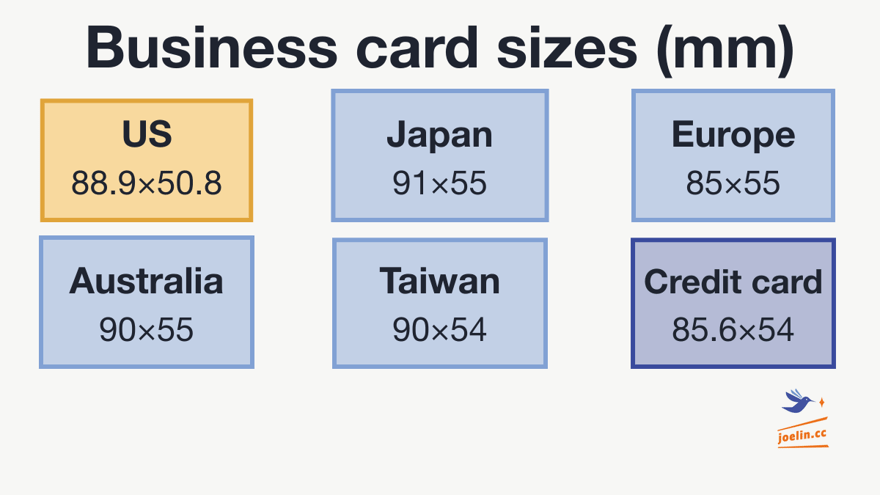
These are printing-industry conventions rather than legal standards: each is what printers or publishers in that market describe as the standard or most common card. The US card is the narrowest of the group except for Europe’s, and it is the shortest except for South Korea’s. The European card is narrower but taller than the US card, and the Japanese card is larger than the US card in both directions.
Sources for each row:
- United States and Canada: Vistaprint US, Vistaprint Canada, MOO US and PrintingForLess.
- Europe: Vistaprint UK, Vistaprint Germany and instantprint (UK).
- Japan: Raksul, a large Japanese online printer, which lists 91 × 55 mm as its regular size.
- Taiwan: CommonWealth Magazine (in Chinese), which calls 90 × 54 mm the most commonly used size.
- China: Canva China (in Chinese), which lists 90 × 54 mm as the standard horizontal card.
- South Korea: Bizhows (in Korean), which calls 90 × 50 mm the most commonly used size.
- Australia: Paperlust and Kwik Kopy. Sizes vary between Australian and New Zealand printers; Vistaprint New Zealand, for example, uses 91 × 55 mm.
All checked November 2026.
The practical problem shows up when a design crosses borders. A 3.5 × 2 inch design sent to a European printer for an 85 × 55 mm card has to be cropped about 4 mm on the width and stretched or padded about 4 mm on the height; the reverse happens with a European template printed in the US. Start the file at the size of the printer you will use, not the size of the template you happened to find.
Business card vs credit card size
| Card | mm | Inches | Standard |
|---|---|---|---|
| US business card | 88.9 × 50.8 | 3.5 × 2 | industry practice |
| Credit card (ID-1) | 85.60 × 53.98 | about 3.370 × 2.125 | ISO/IEC 7810 |
| European business card | 85 × 55 | about 3.35 × 2.17 | industry practice |
A US business card is wider and shorter than a credit card: about 3.3 mm (0.13 in) wider and 3.2 mm (0.125 in) shorter. That is why a business card slides into a wallet’s card slot but may stick out a little at the side, and why it does not fit a sleeve or case made exactly for credit cards. The credit card actually has slightly more area, about 46.2 cm² against 45.2 cm².
Credit cards, debit cards and US and EU driver’s licenses share one international standard, the ID-1 format of ISO/IEC 7810. Business cards have no such standard, which is how each country ended up with its own size. The European 85 × 55 mm card is the closest to a credit card. Full credit card dimensions are in Credit Card Size and Dimensions, and sleeve sizes for card-sized items are in Photocard Sleeve Size.
How many business cards fit on a letter-size sheet?
| Layout | Area used | Cards |
|---|---|---|
| 2 × 5, horizontal | 7 × 10 in | 10 |
| 4 × 3, vertical | 8 × 10.5 in | 12 |
Layouts are columns × rows on an 8.5 × 11 inch sheet. With no gaps between cards, 10 horizontal cards fill 7 × 10 inches of a letter-size sheet, leaving 1.5 inches across and 1 inch down for margins. Turning the cards vertical fits 12, but only with margins of 0.25 inch, which leaves little room for a home printer’s unprintable edge. Home-printed sheets also have no room for bleed between cards, so designs with a color running to the edge look cleaner from a print shop. Other paper and photo sizes are listed in the Photo and Paper Size Chart.
Frequently asked questions
What is the standard business card size in inches?
3.5 × 2 inches in the United States and Canada. A vertical card is the same card turned on its side, 2 × 3.5 inches.
What is the business card size in mm and cm?
3.5 × 2 inches is exactly 88.9 × 50.8 mm, or 8.89 × 5.08 cm. Printers in Europe usually use 85 × 55 mm instead, and printers in Japan use 91 × 55 mm.
What size is a business card with bleed?
3.75 × 2.25 inches. That is the 3.5 × 2 inch card plus 1/8 inch (0.125 in) of bleed on every side. Keep text and logos inside the 3.25 × 1.75 inch safe area.
How many pixels is a business card?
1050 × 600 pixels at 300 DPI. With 1/8 inch bleed the file is 1125 × 675 pixels, and the safe area is 975 × 525 pixels.
Is a business card the same size as a credit card?
No. A credit card is 85.60 × 53.98 mm (about 3.370 × 2.125 in). A US business card is about 3.3 mm wider and 3.2 mm shorter, so it does not fit snugly in a credit card sleeve.
Is there an official business card standard?
Not in the US. 3.5 × 2 inches is an industry convention that US printers follow. The credit card size is the one with an international standard, ISO/IEC 7810.
What is the business card size in points for Illustrator or InDesign?
252 × 144 points (72 points per inch). With bleed it is 270 × 162 points.
Sources: The 3.5 × 2 inch size is a printing-industry convention, not a government or ISO standard; it is taken from the product and file-setup pages of Vistaprint (US and Canada), MOO (US), PrintingForLess and 4OVER4. Sizes for other countries come from printers and publishers in each market: Vistaprint UK and Germany and instantprint (Europe), Raksul (Japan), CommonWealth Magazine (Taiwan), Canva China (China), Bizhows (South Korea), and Paperlust and Kwik Kopy (Australia). The credit card size is ISO/IEC 7810 ID-1. All pages checked November 2026. Pixel, point and metric figures are calculated from those sizes.
Sources: 名片尺寸是多少?9 × 5.4 公分,跟信用卡幾乎一樣高
Use Google Search a lot?
Set joelin.cc as a preferred source to see more of its articles when you search.