
This article is also available in:繁體中文 · 日本語 · Español
A credit card is 85.60 × 53.98 mm, which is 3.370 × 2.125 inches or about 8.56 × 5.4 cm. It is about 0.76 mm (0.03 in) thick.
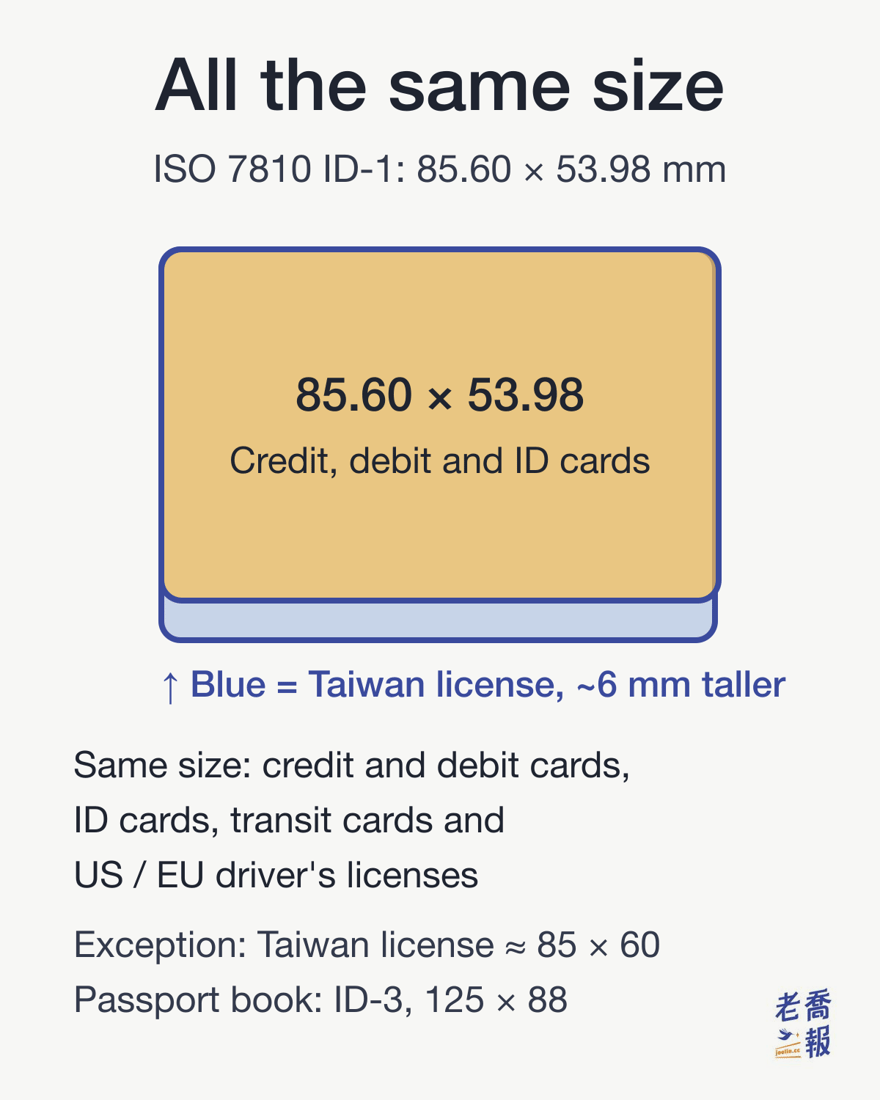
The cards in your wallet being exactly the same size is not a coincidence. Credit cards, debit cards, most national ID cards, driver’s licenses in the US and EU, and standard transit cards all follow one international standard: the ID-1 format of ISO/IEC 7810. So “how big is a debit card” or “what size is an ID card” are usually the same question, and you can answer it by measuring any credit card you have.
If what you need is the size of the photo printed on an ID card, that is a separate, country-specific rule and not covered by this standard.
Card size chart: nearly every card in your wallet is ID-1
| Card | Format | mm | inches |
|---|---|---|---|
| Credit and debit cards | ID-1 | 85.60 × 53.98 | 3.370 × 2.125 |
| US driver’s licenses and state ID cards | ID-1 | 85.60 × 53.98 | 3.370 × 2.125 |
| EU photocard driving licences and national ID cards | ID-1 | 85.60 × 53.98 | 3.370 × 2.125 |
| Standard transit and fare cards | ID-1 | 85.60 × 53.98 | 3.370 × 2.125 |
| Taiwanese driver’s license | not ID-1 | about 85 × 60 (user measurements) | about 3.35 × 2.36 |
| Passport (booklet) | ID-3 | 125 × 88 | 4.92 × 3.46 |
The first four rows are the same physical card size; only what is printed on them differs. The last two rows are exceptions: Taiwan’s driver’s license is taller than a credit card, and a passport is not a card at all but a booklet whose data page uses the ID-3 format.
You will often see the credit card size written as 3.375 × 2.125 inches (3⅜ × 2⅛). That is the same card rounded to the nearest eighth of an inch; the exact conversion of 85.60 mm is 3.370 inches.
The four card formats in ISO/IEC 7810
Banks did not set the 85.60 × 53.98 mm size themselves. ISO/IEC 7810 is the international standard for the physical size of identification cards, and it defines four formats:
| Format | mm | inches | Common use |
|---|---|---|---|
| ID-1 | 85.60 × 53.98 | 3.370 × 2.125 | credit and debit cards, ID cards, driver’s licenses, transit cards |
| ID-2 | 105 × 74 | 4.13 × 2.91 | older-style ID cards in some countries |
| ID-3 | 125 × 88 | 4.92 × 3.46 | passport data pages |
| ID-000 | 25 × 15 | 0.98 × 0.59 | SIM cards (the original full-size format) |
Almost every card you handle day to day is ID-1. The standard also sets the thickness at about 0.76 mm and the corner radius at about 3.18 mm (1/8 inch), which is why ATM slots, card readers and wallets can accept every ID-1 card. ID-3 is the size of a passport data page. ID-000 is the original full-size SIM card; the later Micro and Nano SIMs are separate specifications.
An exception: Taiwan’s driver’s license is not ID-1
Not every country’s license follows the standard. Taiwan’s driver’s license measures about 85 × 60 mm without a sleeve. It is almost exactly as wide as a credit card (85 versus 85.60 mm) but about 6 mm taller, which is why it sticks out of, or jams in, a wallet card slot.
That figure needs a caveat: Taiwan’s licensing authority has never published a size specification for the license. Its public rules cover eligibility and validity, not millimeters, so 85 × 60 mm is a consistent value from independent measurements. Supporting evidence: in 2022 a proposal on Taiwan’s public policy participation platform asked for driver’s licenses and vehicle registrations to adopt the ISO 7810 ID-1 size. The fact that someone proposed it shows the license was not that size at the time (the proposal did not reach the required number of endorsements). For an exact number, measure the card you have.
How business cards, photocards and instax film compare with a credit card
Several things feel almost the same size as a credit card in your hand, but none of them is ID-1:
| Item | mm | Compared with a credit card |
|---|---|---|
| Credit card (ID-1) | 85.60 × 53.98 | baseline |
| US business card (3.5 × 2 in) | 88.9 × 50.8 | about 3 mm wider, 3 mm shorter |
| K-pop album photocard | 85 × 55 | slightly narrower and taller, no standard |
| instax mini film | 86 × 54 | almost identical, a manufacturer’s own size |
The differences are only a few millimeters and you cannot tell them apart by hand, but they are different in kind. ID-1 is governed by an international standard, so there is exactly one number worldwide. Business cards, photocards and instant film follow industry conventions or a manufacturer’s specification, and exceptions are common. That difference matters most when you buy sleeves: a sleeve bought to credit card size may not fit a photocard that uses a non-standard size. For details, see photocard size, how to choose card sleeve sizes and instax and Polaroid photo sizes.
How to print a copy of an ID card at the right size
A copy of an ID card should be printed at actual size, 85.60 × 53.98 mm, with front and back on one sheet of Letter or A4 paper. If you print a phone photo of the card directly, the printer often scales it automatically to fit the page, and the printed card comes out larger or smaller than the real one. Choose “Actual size” or 100% scaling in the print dialog to get the original size.
What size should a card design file be?
If you are designing a membership card, loyalty card or name badge, make it ID-1 size so it fits standard card sleeves and holders.
| Resolution | Pixels |
|---|---|
| 300 DPI | 1011 × 638 px |
| 600 DPI | 2022 × 1275 px |
300 DPI is the usual print standard; go up to 600 DPI if the card has small text or a barcode. How much bleed to add and whether to draw the rounded corners on the artwork varies by card printer, so follow your printer’s artwork guidelines.
Frequently asked questions
What is the size of a credit card in cm?
8.56 × 5.4 cm. The exact size is 85.60 × 53.98 mm, about 0.76 mm thick. This is the ID-1 format of ISO/IEC 7810, and credit cards worldwide use it.
What is the size of a credit card in inches?
3.370 × 2.125 inches, often rounded to 3.375 × 2.125 inches (3⅜ × 2⅛).
Is an ID card the same size as a credit card?
Usually, yes. Most national ID cards, US state ID cards and EU ID cards use the same ID-1 size as credit cards. A passport is the main exception: its data page is ID-3, 125 × 88 mm.
Is a driver’s license the same size as a credit card?
In the US and the EU, yes: licenses are ID-1 cards. Not every country follows this. Taiwan’s license, for example, is about 85 × 60 mm, roughly 6 mm taller than a credit card, so it does not sit flush in a wallet card slot.
How thick is a credit card?
About 0.76 mm (0.03 in). ISO/IEC 7810 allows a small tolerance. Card readers and ATM slots are built for this thickness, which is why all ID-1 cards work in them.
Sources: Chinese original first published 2026-10-08; original last updated 2026-10-16. Card dimensions follow ISO/IEC 7810. The Taiwanese driver's license size is a consistent measurement reported by users, not a published official specification. Examples of cards in the US and EU were added for this English edition.
This English version is based on original Traditional Chinese content on joelin.cc. The language and explanations are localised for international readers. The Traditional Chinese original is the authoritative version — for its complete meaning, please read the original article.