
This article is also available in:繁體中文
Summary
This article explains how to choose card sleeve sizes. The core principle is that a sleeve should be slightly larger than the card, but not too large. For fandom photocards, the usual sleeve size for mainstream 55 × 85 mm album photocards is 58 × 89 mm, often labeled as 3-inch. Universal Music bonus cards use 58 × 93 mm sleeves, Japanese card-pack cards use 66 × 90 mm, 4-inch card merchandise uses 73 × 104 mm, and postcards and 4×6 photos use approximately 107 × 155 mm. Double sleeving pairs a snug 56 × 86 mm inner sleeve with a 57.5 × 87.5 mm outer sleeve; each successive layer must be at least as large as the preceding layer in both dimensions. For a single layer, simply choose 58 × 89 mm. Cards close to trading card game sizes need trading card sleeves: standard 63 × 88 mm cards use 64 × 89 mm inner sleeves, 66 × 91 mm regular sleeves, and 69 × 94 mm outer sleeves; small 59 × 86 mm cards use 60 × 87 mm, 62 × 89 mm, and 65 × 92 mm respectively. A common 3 × 4-inch rigid Toploader accommodates cards up to 63.5 × 88.9 mm and 35pt thick. Instax mini prints measure 86 × 54 mm, close to ordinary photocards, and can share their sleeves; four-frame photo booth strips need dedicated strip sleeves. In Taiwan, sleeve thickness is expressed in si, with one si equal to 0.01 mm and 20 si a common choice. Trading card collectors use pt, with one pt equal to one-thousandth of an inch and 35pt approximately 0.89 mm. Like photocards, sleeves have no specifications set by a standards body; the figures here come from manufacturer labels and measurements shared by fan communities.
Key facts
- Sleeves for ordinary album photocards measure 58 × 89 mm, fitting 55 × 85 mm cards, and are often labeled as 3-inch.
- Sleeve sizes are 58 × 93 mm for Universal Music bonus cards, 66 × 90 mm for Japanese card-pack cards, and 73 × 104 mm for 4-inch cards.
- Postcards and 4×6 photos measuring 102 × 152 mm use sleeves of approximately 107 × 155 mm.
- For double sleeving, each successive layer must be at least as large as the preceding layer in both dimensions.
- Snug inner sleeves measure 56 × 86 mm, outer sleeves 57.5 × 87.5 mm, and single-layer photocard sleeves 58 × 89 mm.
- Standard 63 × 88 mm TCG cards use 64 × 89 mm inner sleeves, 66 × 91 mm regular sleeves, and 69 × 94 mm outer sleeves.
- A 3 × 4-inch Toploader accommodates cards up to 63.5 × 88.9 mm and 35pt thick.
- Thickness: one si equals 0.01 mm, with 20 si a common choice; one pt equals one-thousandth of an inch, and 35pt is approximately 0.89 mm.
- Instax mini prints measuring 86 × 54 mm can use ordinary photocard sleeves.
- Card sleeves have no specifications set by a standards body; the figures come from manufacturer labels and community measurements.
The original Chinese article was published on September 10, 2026, and updated on October 9, 2026.
There is just one principle when choosing a card sleeve: it should be slightly larger than the card, but not too large.
Take the most common fandom photocard, measuring 55 × 85 mm. The usual sleeve size in Taiwan is 58 × 89 mm—3 mm wider and 4 mm longer. Product listings often call this a “3-inch photocard sleeve.”
The tricky part is that sleeves, like photocards, have no official standard. Dimensions vary somewhat between manufacturers, and even “photocards” come in several sizes. This article puts the common pairings into tables so you do not have to guess every time.
1. Sleeve Sizes for Fandom Photocards
| Card type | Common sleeve size (mm) | Notes |
|---|---|---|
| Ordinary photocard (album photocard) | 58 × 89 | Fits mainstream 55 × 85 mm photocards; often labeled “3-inch” |
| Universal Music bonus card | 58 × 93 | Same sleeve width as for an album photocard, but 4 mm longer |
| Japanese card-pack card | 66 × 90 | Noticeably wider than an album photocard |
| 4-inch card (merchandise such as fan banners) | 73 × 104 | A larger size of card merchandise |
| Postcard, 4×6 photo | Approximately 107 × 155 | Fits 102 × 152 mm photos and postcards |
The most important thing about this table is not any particular number; it is that there are five rows. People searching for “photocard sleeves” usually assume there is only one kind. In reality, even within Taiwan’s fandom communities, these several types are in circulation. Before buying, identify which type you have. For an ordinary photocard included with an album, 58 × 89 mm is usually a safe choice; for everything else, I recommend measuring first. Homemade 55 × 85 mm photocards also fit 58 × 89 mm sleeves. If you want to make your own, the Fan Support photocard maker can export a print-ready file directly.
2. How to Pair Inner and Outer Sleeves
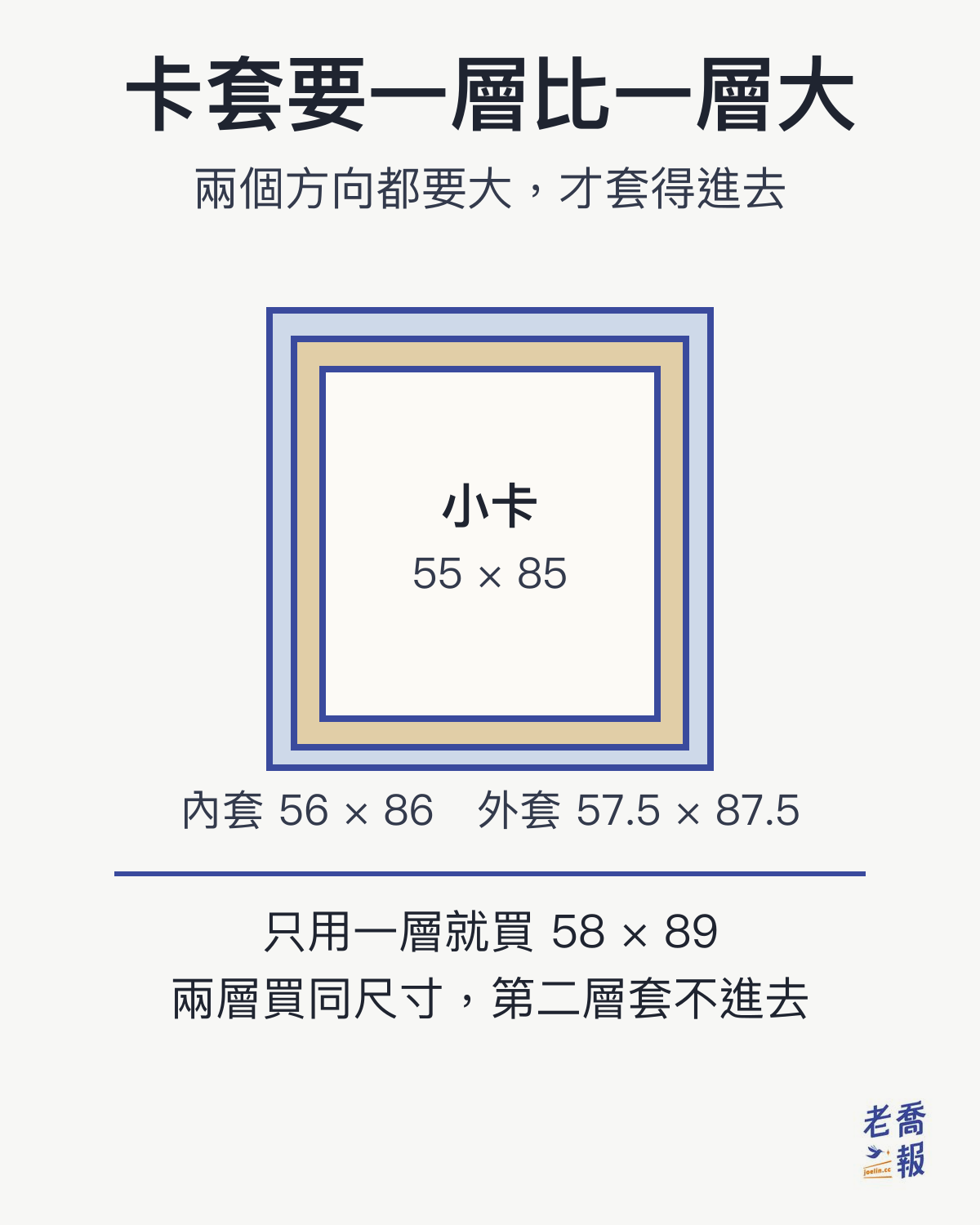
If you want double-layer protection, use two sleeves with different functions:
| Layer | Common size (mm) | Function |
|---|---|---|
| Snug inner sleeve | 56 × 86 | Fits closely against the card, keeping out dust and fingerprints |
| Outer sleeve | 57.5 × 87.5 | Goes over the card in its inner sleeve, protecting against scratches and splashes |
| Single-layer photocard sleeve | 58 × 89 | The usual choice when using only one layer |
The pairing principle takes just one sentence: each successive layer must be at least as large as the preceding layer in both dimensions. That may sound obvious, but it is the rule people break most often. Many buy two sleeves of the same size, only to find that the second layer simply will not fit.
In practice, if you plan to use only one layer, buying 58 × 89 mm sleeves is the easiest option. Only double sleeving requires pairing 56 × 86 mm with 57.5 × 87.5 mm. Buy both together, rather than making two separate purchases based on what you remember.
3. What to Do with Cards in TCG Sizes
Some photocards are not 55 × 85 mm; they are closer to the sizes used by trading card games such as Pokémon and Yu-Gi-Oh! In that case, fandom photocard sleeves will not fit, and you need trading card sleeve sizes instead:
| Card format | Inner sleeve (mm) | Regular sleeve (mm) | Outer sleeve (mm) |
|---|---|---|---|
| Standard 63 × 88 mm (Pokémon, One Piece) | 64 × 89 | 66 × 91 | 69 × 94 |
| Small 59 × 86 mm (Yu-Gi-Oh!) | 60 × 87 | 62 × 89 | 65 × 92 |
The advantage of trading card sleeves is that their specifications are well established and clearly labeled. Manufacturers indicate the relationship between inner and outer sleeves directly on the packaging. If your card measures close to 63 × 88 mm or 59 × 86 mm, buying trading card sleeves will be much easier than finding a good fit among fandom photocard sleeves.
There is also a rigid protective card holder called a Toploader. The common 3 × 4-inch version accommodates cards up to 63.5 × 88.9 mm and 35pt thick. It is a hard case rather than a sleeve, suitable for long-term storage or shipping of individual high-value cards.
4. How to Store Postcards, Photos, and Instant Prints
| Item to store | Item dimensions (mm) | Suitable protective sleeve |
|---|---|---|
| Postcard, 4×6 photo | 102 × 152 | Approximately 107 × 155 mm |
| Instax mini instant print | 86 × 54 | Can use ordinary photocard sleeves |
| Photo booth strip, Life4Cuts strip | 2×6 vertical strip format | Requires a dedicated strip sleeve |
Instax mini instant prints measure 86 × 54 mm, almost the same size as ordinary photocards, so most photocard sleeves can be used directly. That is the most useful point in this table. Postcards themselves come in more than one size, so check which type you want to store before ordering. Meanwhile, four-frame strips produced by photo booths have a completely different aspect ratio. They need dedicated strip sleeves; do not try to force them into photocard sleeves.
5. How to Read Thickness Measurements
In Taiwan, photocard sleeve thickness is usually labeled in “si” (絲). One si equals 0.01 mm. The most common choice in the community is 20 si, or 0.2 mm. A higher number means a thicker, stiffer sleeve, but it also takes up more space, which you need to account for when putting cards into a binder.
Rigid holders in the trading card community are usually labeled in pt. One pt equals one-thousandth of an inch, so the 35pt mentioned earlier is approximately 0.89 mm. You cannot read the two units interchangeably without converting them.
Another choice is whether the sleeve seals shut. Open sleeves make cards easy to remove and replace, suiting people who reorganize frequently. Sealed sleeves offer better splash protection and suit cards kept in long-term collections without being moved.
6. How to Interpret the Numbers on This Page
This needs to be clear from the outset: the sleeve dimensions in this article come from manufacturers’ product labels, printing platforms’ specifications, and measurements compiled by fan communities. None is a specification announced by a standards body. Like photocards, card sleeves are not governed by a standards body.
The only exception is the trading card system. Because the cards themselves have well-established dimensions, accessory manufacturers’ labeling is also consistent, making those specifications relatively reliable.
So the final advice remains the same: measure your card before placing an order. The cost of measuring once is far lower than buying an entire pack of the wrong sleeves.
Article keywords: card sleeve sizes, photocard sleeves, sleeve dimensions, postcard protective sleeves, inner and outer sleeves, Toploader, instant photo storage
Frequently asked questions
What size sleeve should I buy for a photocard?
For an ordinary album photocard measuring 55 × 85 mm, buy a 58 × 89 mm sleeve, often labeled as 3-inch. This is the most widely used size in Taiwan’s fandom communities.
Why won’t my card fit into the sleeve I bought?
There are two common reasons. First, your card may not be an ordinary album photocard: Universal Music bonus cards use 58 × 93 mm sleeves, while Japanese card-pack cards use 66 × 90 mm, so the sizes differ. Second, you may have bought two sleeves of the same size for double sleeving. The outer layer must be at least as large as the inner layer in both dimensions for it to fit.
What is the difference between inner and outer sleeves?
A 56 × 86 mm inner sleeve fits snugly against the card and keeps out dust and fingerprints. A 57.5 × 87.5 mm outer sleeve goes over the card in its inner sleeve and protects against scratches and splashes. If you only want one layer, buying a 58 × 89 mm sleeve is the easiest option.
Can instant photos use photocard sleeves?
Yes. Instax mini prints measure 86 × 54 mm, almost the same size as ordinary photocards, so most photocard sleeves can be used directly. However, four-frame strips from photo booths have a completely different aspect ratio and need dedicated strip sleeves.
What does 20 si mean on a sleeve?
Si is a unit of thickness. One si equals 0.01 mm, so 20 si means 0.2 mm, the most common choice in the community. A higher number means a thicker, stiffer sleeve, but it also takes up more space in a card binder.
Is a Toploader the same as a card sleeve?
No. A Toploader is a rigid card holder rather than a soft sleeve. The common 3 × 4-inch version accommodates cards up to 63.5 × 88.9 mm and 35pt thick, making it suitable for long-term storage or shipping of individual high-value cards.
This English version is based on original Traditional Chinese content on joelin.cc. The language and explanations are localised for international readers. The Traditional Chinese original is the authoritative version — for its complete meaning, please read the original article.