
This article is also available in: 繁體中文 · 日本語 · 한국어 · Bahasa Indonesia · Bahasa Melayu · ไทย · Português (Brasil) · Español · Türkçe · Tiếng Việt · Deutsch · हिन्दी
Contents (6)
To convert shoe sizes, measure your foot length in centimeters first. That physical measurement gives you a common starting point; US, UK and EU size numbers are different labeling systems.
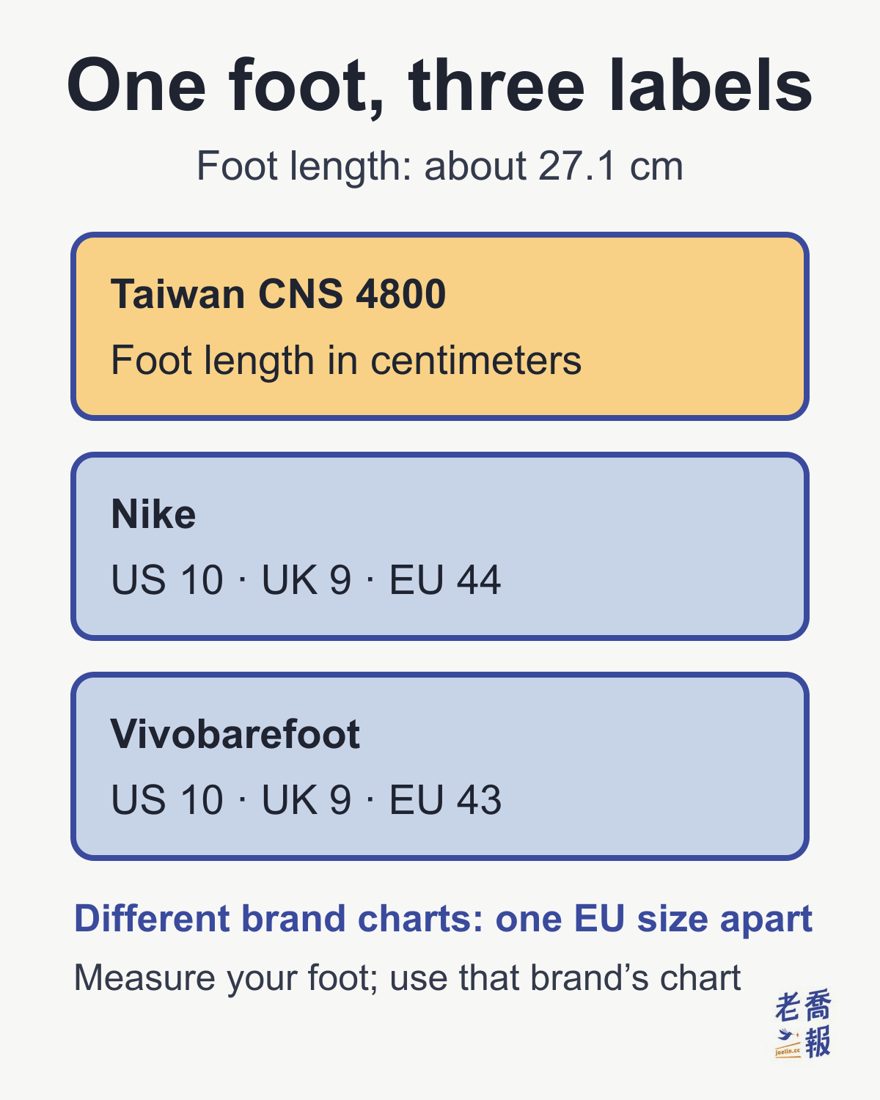
Taiwan has a national shoe-sizing standard, CNS 4800, which expresses size as foot length in centimeters plus foot girth or width. Numbers such as 25, 25.5 and 26 on footwear labeled under the Taiwanese or Japanese foot-length systems refer to centimeters of foot length. US, UK and EU sizes are older numbering systems without one universally consistent brand conversion: a foot around 27.1 cm long is EU 44 on Nike’s official chart but EU 43 on Vivobarefoot’s.
The most reliable sequence is to measure your feet, then consult the chart for the brand you intend to buy. Do not apply another brand’s conversion table directly.
Shoe size chart by foot length: Nike’s official men’s chart
| Foot cm | US men | UK | EU | Box CM |
|---|---|---|---|---|
| 24.6 | 7 | 6 | 40 | 25 |
| 25.4 | 8 | 7 | 41 | 26 |
| 25.9 | 8.5 | 7.5 | 42 | 26.5 |
| 26.2 | 9 | 8 | 42.5 | 27 |
| 26.7 | 9.5 | 8.5 | 43 | 27.5 |
| 27.1 | 10 | 9 | 44 | 28 |
| 27.5 | 10.5 | 9.5 | 44.5 | 28.5 |
| 27.9 | 11 | 10 | 45 | 29 |
| 28.4 | 11.5 | 10.5 | 45.5 | 29.5 |
| 28.7 | 12 | 11 | 46 | 30 |
This is Nike’s men’s chart as checked in October 2026. Its foot-length values were given in inches and are converted here to centimeters, rounded to 0.1 cm. For this brand, the US and UK columns differ consistently by one size. The box-label CM values are about 0.4–1.3 cm greater than foot length, so they cannot be used as the foot measurement. Another brand’s EU column can differ by half a size or a full size, for the reasons below.
Why the charts disagree: the size increments differ
| System | Basis | Listed interval | Formal standard |
|---|---|---|---|
| Taiwan CNS 4800 | Foot length | 0.5 cm | Yes |
| Japan JIS S 5037 | Foot length | 0.5 cm | Yes |
| China GB/T 43293 | Foot length | — | Yes |
| International ISO 9407 | Foot length and width | 5 mm | Yes |
| EU | Shoe last | 6.7 mm | No single settled system* |
| UK | Shoe last | 8.5 mm | No single settled system* |
| US | Shoe last | 8.5 mm | No single settled system* |
The first four rows have formal specifications based on foot dimensions. Taiwan’s CNS 4800 was established in 1979 and revised in 2023, using foot length in centimeters plus girth or width. Japan’s JIS S 5037 uses a similar notation and was in force at the time of the original research. China’s GB/T 43293-2022 took effect on May 1, 2023, and labels foot length in millimeters. The second edition of ISO 9407, Mondopoint, appeared in 2019; both foot length and width are in millimeters, usually with a 5 mm size interval.
An EU full size is 2/3 cm, known as a Paris point. A UK or US full size is 1/3 inch, about 8.5 mm; US men’s and women’s sizes are numbered separately. The table rounds those historical increments.
The top four systems assign numbers a physical meaning in foot dimensions. The bottom three began as measurements of the shoe last—the form used to make the shoe—rather than the foot itself. Brands then decide which foot length should correspond to each size. The EU increment of about 6.7 mm is smaller than the UK/US increment of about 8.5 mm, so whole EU sizes do not align neatly with the other systems. Rounding can produce a difference of a full size.
SATRA, the footwear research organization, traces the UK increment to the barleycorn: in medieval England, three barleycorns laid end to end represented an inch. The continental system is called the Paris point. Germany previously had a national length-grading standard, DIN 66074-2 from 1975, but it has been withdrawn; the issuing organization recommends ISO 9407 instead.
*There is an international conversion guide, ISO 19407:2023, covering Mondopoint, EU, UK and Chinese, Japanese, Korean and US sizes. It also notes that the underlying systems have not been formally settled and that its conversion tables are guidance. Thus two official brand charts can both be valid for their own shoes while assigning different EU numbers to the same foot.
Men’s and women’s labels can differ even at the same EU size
US men’s and women’s numbers are separate: for the same length, the women’s US number is larger. Even an EU-to-UK conversion can differ between men’s and women’s products. Vivobarefoot’s official chart illustrates this:
| EU | Men: UK / US | Women: UK / US |
|---|---|---|
| 40 | 6 / 7 | 7 / 9 |
| 41 | 7 / 8 | 8 / 10 |
| 43 | 9 / 10 | 9 / 11 |
For this brand, men’s US sizes are one number above UK sizes; women’s US sizes are two above UK sizes. EU 40 is UK 6 in the men’s chart but UK 7 in the women’s chart. Other brands differ: Nike’s official chart has a 1.5-size difference between women’s and men’s US numbers for the same length. SATRA gives UK women’s 5 = US women’s 7 and UK men’s 11 = US men’s 12 as examples.
For men’s shoes, many brands put US one size above UK, such as UK 9 = US 10. For women’s shoes the difference is often about 2–2.5 sizes, depending on the brand. If a listing says only “US 8,” first establish whether it means men’s or women’s sizing, then use that brand’s chart.
The CM or JP label on a box may not be foot length
The meaning of a box’s CM or JP column depends on the brand. Nike explicitly distinguishes the CM size printed on boxes and labels from measured foot length. Men’s US 10 has a box label of 28, while its corresponding foot length is 27.1 cm—almost 1 cm shorter.
Numbers on shoes labeled according to CNS 4800 or JIS S 5037 refer to foot length. Reusing the CM label from an old pair to buy a different brand can therefore put you half a size or a full size off before you begin. Measure your feet instead.
For EU 43 specifically, Vivobarefoot’s men’s chart gives a foot length of 27.0–27.5 cm. Nike’s men’s EU 43 corresponds to about 26.7 cm, or 10.5 inches. The same EU number is not one fixed foot length across brands.
Measuring foot length and width using CNS 4800
CNS 4800 defines foot length as the distance from the back of the heel to the tip of the longest toe while standing on a level, flat surface, feet parallel and weight distributed evenly between both feet.
- Measure standing up, with parallel feet and weight shared evenly.
- Measure to the longest toe. It may be the second toe rather than the big toe.
- Measure both feet and choose for the longer one, since shoes are bought as a pair.
Width is a separate dimension. CNS 4800 uses letters for foot girth, the circumference around the widest part of the forefoot. Its men’s system has ten grades spanning A through G; later designations indicate a wider fit. For a 26 cm men’s size, E corresponds to a 249 mm girth and 102 mm width, while EE corresponds to a 255 mm girth and 104 mm width. The 2E and 3E labels often seen on Japanese shoes abbreviate EE and EEE.
A complete Taiwanese or Japanese standard-based label can therefore look like “26EE”: foot length in centimeters followed by the width grade. A half-size step such as 26 to 26.5 is 0.5 cm. CNS 4800 also permits an all-millimeter length/width notation such as “235/95,” following the same physical-measurement approach as ISO 9407, Mondopoint.
Joe’s barefoot-shoe example: EU 43 still requires toe room
The first barefoot shoes Joe bought in Yokohama had EU 43, US 10 and UK 9 on the box. The experience is described in Joe’s first barefoot shoes (Traditional Chinese). Vivobarefoot’s official men’s chart places EU 43 at a foot length of 27.0–27.5 cm, with US and UK numbers matching that box.
But barefoot-shoe fit is different from conventional-shoe fit. The first sizing instruction supplied with those shoes called for 1–1.7 cm of space in front of the toes; less than 1 cm was considered insufficient. The official sizing page also explained that first-time wearers coming from conventional shoes may find them roomy by design.
For the same 27 cm foot, “fits” therefore does not mean exactly the same thing in conventional and barefoot shoes. A size chart supplies a starting point. More on selection and the transition is in the barefoot-shoe overview (Traditional Chinese).
Keywords: shoe size conversion, foot length in cm, US UK EU shoe sizes, shoe box CM, CNS 4800, JIS S 5037, Mondopoint, 2E and 3E shoe width
Sources: The Chinese original was published and updated on October 9, 2026. Brand-chart examples were checked in October 2026. CNS 4800 is Taiwan's standard; the chart below is Nike men's sizing, not a universal conversion chart.
This English version is based on original Traditional Chinese content on joelin.cc. The language and explanations are localised for international readers. The Traditional Chinese original is the authoritative version — for its complete meaning, please read the original article.