
Other languages (3)
繁體中文 · 日本語 · Tiếng Việt
Contents (34)
Summary
GiGO is a Japanese arcade chain operated by 株式会社GENDA GiGO Entertainment, established on April 1, 2004, with capital of ¥50 million; the operating company itself is not listed. Its parent, GENDA, is listed on the Tokyo Stock Exchange’s Growth Market under securities code 9166. GiGO originated as SEGA’s arcade chain: on November 4, 2020, SEGA announced the sale of an 85.1% stake in SEGA Entertainment, which then had 199 stores, to GENDA. The transaction closed on December 30 that year, and the store signs changed to GiGO in January 2022. In October 2020, SEGA returned to photo booth manufacturing with fiz, effectively handing over the retail channel while remaining a manufacturer. SEGA’s sale announcement gave as its reason heavy arcade losses caused by the pandemic; SEGA Entertainment, the company sold, had revenue of ¥40.6 billion and operating profit of only ¥178 million in the year to March 2020, SEGA booked a special loss of about ¥20 billion, and the price was not disclosed. What SEGA kept was machines and prizes: its AM & TOY segment had revenue of ¥78.1 billion and operating profit of ¥5.6 billion in the year to March 2026. The official website reported 427 stores in Japan, checked on September 24, 2026, with the page stating a September 1 snapshot. Separately, photobooth.joelin.cc lists 250 GiGO branches with photo booths in Japan, 857 model registrations, and coverage across 41 prefectures; 42 branches have registrations for current SEGA models, and 40 have Korean Photoism machines. The two store counts use different definitions and cannot be subtracted from each other. GENDA describes itself as an Entertainment Platform connecting IP and fans, and also operates businesses such as karaoke. GENDA’s fiscal year ends in January. Its revenue grew from ¥55.7 billion in the year to January 2024 and ¥111.8 billion in the year to January 2025 to ¥170.8 billion in the year to January 2026, and its entertainment-platform locations grew from 843 at the end of January 2024 and about 11,800 at the end of January 2025 (mainly from buying the US mini-location operator NEN) to about 14,000 in September 2026, after 62 acquisitions since its founding (as of March 2026, including planned ones). The figure of about 420 GiGO stores in Japan is the company’s own statement as reported by the media; its IR materials have no formal store-count table. Same-store sales at its Japanese arcades exceeded the previous year in every month from October 2025 to July 2026 (102%–116%), and it plans 50 new arcades in Japan in the year to January 2027, led by the large crane-game format “GiGOクレーンゲームオアシス.” GENDA has also moved upstream by buying prize makers アレスカンパニー (October 2023), フクヤ (January 2024) and トーシンパック (May 2026); its prize business plans revenue of ¥18.2 billion in the year to January 2027, the same order of magnitude as FURYU, the industry’s number two in crane-game prizes (¥19.6 billion in the year to March 2026). The venue operator has started making its own prizes. According to GENDA press releases, GiGO’s overseas operations include Taiwan, renamed after the December 2021 acquisition of SEGA AMUSEMENTS TAIWAN; Vietnam, beginning in 2024; and mini locations in the United Kingdom, beginning in 2025. No photo booth sub-brand was found at GiGO’s corporate level: it is a retail channel rather than a photo booth brand. Specialization happens at individual branches: the official social accounts for GiGO池袋2号館 describe it as a photo sticker machine specialty store and emphasize costume rentals, while GiGO渋谷 has a costume rental area on its third floor.
Key facts
- GiGO is operated by 株式会社GENDA GiGO Entertainment. Its parent, GENDA, is listed on the Tokyo Stock Exchange’s Growth Market under securities code 9166; the operating company is not separately listed.
- On November 4, 2020, SEGA announced the sale of an 85.1% stake in its arcade subsidiary SEGA Entertainment, which then had 199 stores, to GENDA. The transaction closed on December 30, and store signs changed from SEGA to GiGO in January 2022.
- SEGA returned to photo booth manufacturing with fiz in October 2020, then sold its arcades a month later, effectively handing over the retail channel while remaining a manufacturer.
- SEGA’s sale announcement (November 4, 2020) cited heavy arcade losses caused by the pandemic. SEGA Entertainment had revenue of ¥40,624 million and operating profit of ¥178 million in the year to March 2020; SEGA booked a special loss of about ¥20 billion, and the price was withheld at the buyer’s request.
- What SEGA kept on the arcade floor is AM & TOY (arcade machines and toys): revenue of ¥78.1 billion and operating profit of ¥5.6 billion in the year to March 2026.
- GiGO’s official website reports 427 stores in Japan (checked September 24, 2026, page dated September 1, 2026); GENDA tells the media about 420, and its IR materials have no formal domestic store-count table.
- GENDA’s fiscal year ends in January. Revenue: ¥55,697 million (year to January 2024), ¥111,786 million (year to January 2025), ¥170,787 million (year to January 2026).
- GENDA entertainment-platform locations: 843 (end of January 2024) → about 11,800 (end of January 2025, mainly from buying the US company NEN in November 2024) → about 14,000 (September 2026); 62 acquisitions since its founding (as of March 2026, including planned ones).
- Same-store sales at GENDA’s Japanese arcades exceeded the same month a year earlier every month from October 2025 to July 2026 (102%–116% before calendar adjustment); it plans 50 new arcades in Japan in the year to January 2027, led by the large crane-game format GiGOクレーンゲームオアシス.
- GENDA has bought prize makers upstream: アレスカンパニー (October 2023), フクヤホールディングス (January 2024) and トーシンパック (May 2026; based in Bunkyō, Tokyo, and a different company from the Hokkaido firm トーシン that runs the capsule-toy store #C-pla). Its prize business plans revenue of ¥18.2 billion in the year to January 2027.
- As of September 25, 2026, photobooth.joelin.cc lists 250 GiGO branches with photo booths in Japan, 857 model registrations, and coverage across 41 prefectures. This counts branches with photo booths, not the company’s total stores; the two counts cannot be subtracted from each other.
- Of the 250 GiGO branches, 42 have registrations for current SEGA models, and 40 have machines from the Korean brand Photoism. Most of the data comes from manufacturers’ installation maps and indicates only broad patterns.
- According to GENDA’s official press releases, GiGO’s overseas operations include Taiwan, where locations were progressively renamed after the December 2021 acquisition of SEGA AMUSEMENTS TAIWAN; Ho Chi Minh City, Vietnam, beginning in 2024; and mini locations in the United Kingdom, beginning in 2025.
- No consistently named photo booth sub-brand spanning multiple stores was found at GiGO’s corporate level. The official social accounts for GiGO池袋2号館 call it a photo sticker machine specialty store and emphasize costume rentals; GiGO渋谷 has a costume rental area on its third floor.
GiGO is a Japanese arcade chain operated by 株式会社GENDA GiGO Entertainment. Its parent, GENDA, is listed on the Tokyo Stock Exchange’s Growth Market under securities code 9166. It originated as SEGA’s arcade chain: in November 2020, SEGA sold an 85.1% stake in its arcade subsidiary SEGA Entertainment to GENDA, and store signs changed from SEGA to GiGO in January 2022.
GiGO’s official website reported 427 stores in Japan, checked on September 24, 2026, with the page stating a September 1, 2026 snapshot. Separately, the photo booth database I maintain lists 250 GiGO branches with photo booths in Japan as of September 24, 2026. Photo booths are just one of the many types of machines inside GiGO stores, so under the three-layer framework in the overview of the Japanese photo booth retail channel series, GiGO belongs to the “retail channel” layer rather than the photo booth brand layer.
This article covers four things: how the company passed from SEGA to GENDA, what kind of company GENDA is, how GENDA has grown since taking over (with the latest 2026 figures), and what role photo booths actually play within GiGO.
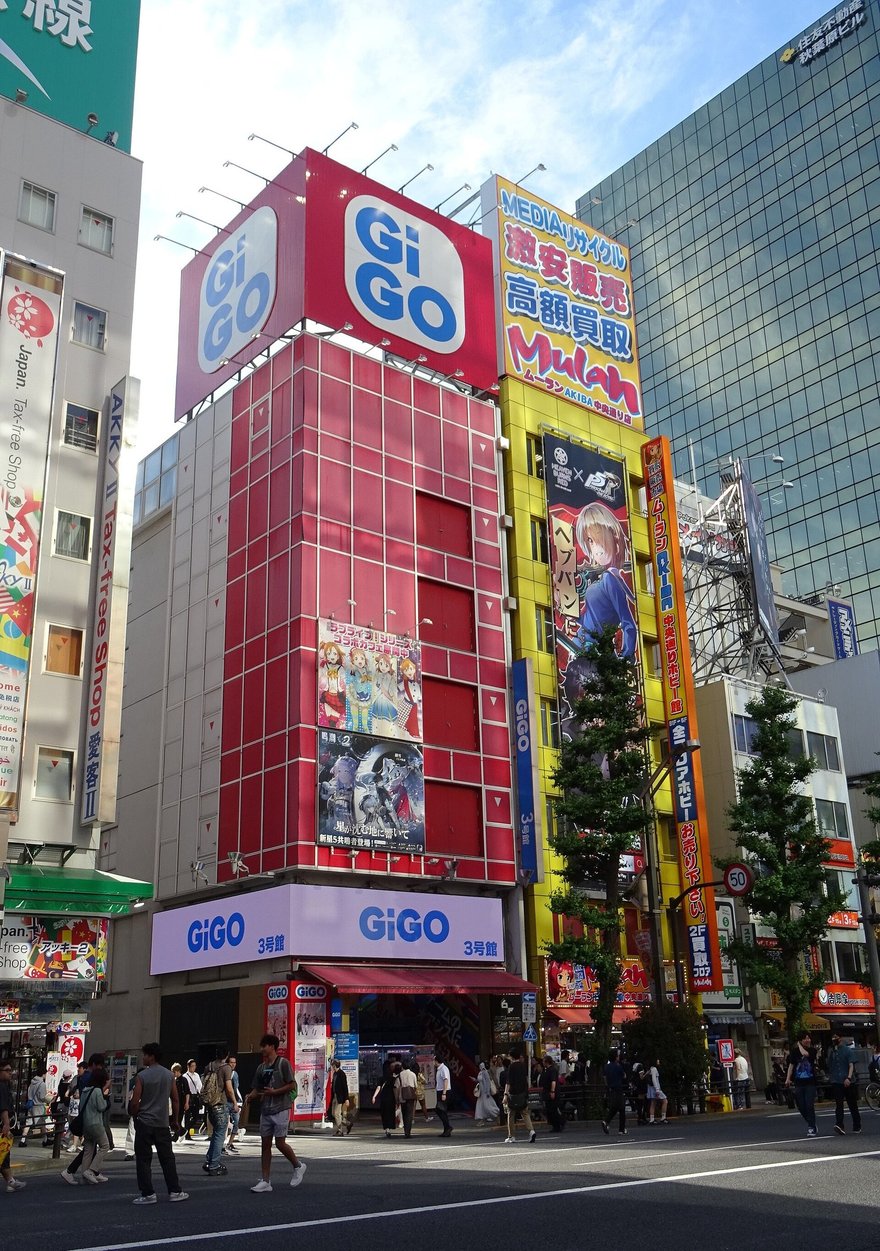

Company Profile
| Item | Details |
|---|---|
| Official name | 株式会社GENDA GiGO Entertainment |
| Established | April 1, 2004 |
| Capital | ¥50 million |
| Representative | Representative Director and President 二宮一浩 |
| Parent company | GENDA株式会社 (Tokyo Stock Exchange Growth Market, 9166) |
| Is the operating company publicly listed? | No; it is a GENDA subsidiary |
| Businesses stated on the official website | Planning and operation of amusement facilities; planning and operation of food and beverage facilities |
| Stores in Japan | 427 on the official website, checked on September 24, 2026, with the page stating a September 1, 2026 snapshot; GENDA tells the media about 420, and its IR materials have no formal table |
| Parent company revenue | GENDA ¥170.8 billion (year to January 2026, consolidated; fiscal year ends in January) |
| Overseas operations | Yes: Taiwan, Vietnam, and the United Kingdom, according to GENDA’s official press releases |
Compiled from GENDA GiGO Entertainment’s company information, checked on September 24, 2026. The listed company is the parent, GENDA; GiGO’s operating company is not separately listed, so GiGO’s business figures must be sought in GENDA’s financial reports. The company’s official website describes its businesses as “planning and operation of amusement facilities” and “planning and operation of food and beverage facilities,” without mentioning photo booths at all. We will return to this point later.
From SEGA’s Arcades to GiGO
The GiGO name is new, but the stores on the street are not. Here is the timeline:
| Date | Event |
|---|---|
| July 1995 | SEGA launches its first photo sticker machine, “プリント倶楽部” |
| Around 2000 | SEGA withdraws from the photo sticker machine business |
| October 2020 | SEGA reenters the photo booth market with “fiz” |
| November 4, 2020 | SEGA announces the sale of an 85.1% stake in its arcade subsidiary SEGA Entertainment, which then had 199 stores across Japan, to GENDA |
| December 30, 2020 | The share transfer closes |
| December 2021 | The GENDA group acquires SEGA AMUSEMENTS TAIWAN; its Taiwan locations are subsequently renamed GiGO in stages |
| January 2022 | Store signs in Japan change from SEGA to GiGO |
| July 2023 | Parent company GENDA lists on the Tokyo Stock Exchange’s Growth Market |
| 2024 | GiGO opens in Ho Chi Minh City, Vietnam |
| 2025 | GiGO mini locations open in the United Kingdom |
The full account of SEGA’s arcade sale, and the origins of the common misconception that “SEGA went under,” are covered in the main article on the photo booth industry. For GENDA’s listing date alongside those of other listed companies, see the main article on Japanese photo booth history, “Thirty Years of Japanese Photo Booths”.
The part of this table that deserves a closer look is autumn 2020. Within a little over a month, SEGA made two moves in opposite directions: it returned to photo booth manufacturing with fiz in October, then sold its arcades in November. Under the series overview’s three-layer framework, SEGA handed over the “retail channel” layer while staying in the “manufacturer” layer.
That did not sever the connection between the two layers. Of the 250 GiGO branches in my photo booth database, 42 have registrations for current SEGA models—at least one of cherrit, NICO MAKE, totolu, romakyun, or lalamee. What were once SEGA’s own arcades remain among the places where SEGA machines are installed. However, these figures are based on manufacturers’ official installation maps, whose completeness varies. They indicate a broad pattern and cannot be treated as SEGA’s market share within GiGO.
Why SEGA Sold: The Margin Was Already Thin Before the Pandemic
In its November 4, 2020 announcement, SEGA’s parent セガサミーホールディングス stated its reason plainly: the pandemic had sharply reduced arcade utilization, and the business had already posted a large loss in the first quarter of the year to March 2021. Wanting to improve the profitability of this business and bring revenue back sooner, the company considered various options and decided to sell to GENDA, which had “a strong desire to expand its arcade business” (セガサミー timely disclosure, November 4, 2020).
The same announcement included the financial record of the company being sold, and it shows the problem was not only the pandemic:
| Fiscal year (ending March) | Revenue (売上高) | Operating profit (営業利益) | Net profit (当期純利益) |
|---|---|---|---|
| Year to March 2018 | 37,664 | 1,654 | 804 |
| Year to March 2019 | 39,392 | 1,450 | 694 |
| Year to March 2020 | 40,624 | 178 | △915 |
Unit: ¥ million. Source: the same announcement; non-consolidated figures for 株式会社セガ エンタテインメント.
In the year to March 2020, before the pandemic arrived, SEGA Entertainment did ¥40.6 billion of business but kept only ¥178 million in operating profit, a margin below 0.5%, and its bottom line was already a loss. The pandemic was only the push that made SEGA decide.
A few more details of the deal are worth recording:
- The price was not disclosed at the buyer’s request; SEGA booked a special loss (restructuring costs) of about ¥20 billion.
- The buyer, GENDA, had existed for little more than two years (founded in May 2018). In the year to January 2020 its consolidated net assets were ¥704 million and total assets ¥3,185 million, and it was not yet listed. A company with about ¥3 billion in total assets took over an arcade network with ¥40 billion in annual revenue.
- GENDA was already a SEGA customer before the deal: the announcement states that it bought arcade machines and prizes from SEGA. In other words, a customer that bought machines bought the seller’s entire store network.
What SEGA Kept: The AM & TOY Segment
SEGA handed over the store-operating part and kept machines and prizes. セガサミー’s financial reports place this under “AM & TOY” (amusement machines, plus the toy subsidiary セガトイズ), which includes the UFO Catcher crane game and prizes (セガサミー supplementary financial data, year to March 2026):
| Fiscal year (ending March) | Revenue (売上高) | Operating profit (営業利益) |
|---|---|---|
| Year to March 2024 | ¥71.8 billion | ¥2.3 billion |
| Year to March 2025 | ¥76.6 billion | ¥3.8 billion |
| Year to March 2026 | ¥78.1 billion | ¥5.6 billion |
Machines and toys are disclosed together in the IR materials, with no breakdown available. Over three years, revenue grew slightly and operating profit more than doubled, coinciding with a recovery in the number of arcades across Japan: according to National Police Agency statistics cited in the same material, arcade premises rose from a low of 3,882 in 2021 to 4,184 in 2025. When venue operators are willing to buy new machines and restock prizes, those who sell machines and prizes earn along with them; the effort and volatility of running stores, SEGA has handed to the venue operators.
What Kind of Company Is GENDA?
On its official website, GENDA describes itself as an “Entertainment Platform” connecting IP and fans. Alongside GiGO, it operates businesses including the karaoke chain “カラオケBanBan” and food and beverage services (GENDA’s official website, checked on September 24, 2026).
That positioning helps explain why GiGO looks the way it does. For an entertainment platform centered on “IP and fans,” an arcade sells a stretch of time spent inside the store: character merchandise in crane-game machines, capsule toys (for who runs Japan’s capsule-toy specialist stores, see Who Runs the Most Capsule-Toy Specialist Stores in Japan?), card games, and in-store cafés are all ways for fans to encounter IP. Photo booths fit naturally into that list—they are, after all, machines that let you print out and take home a record of “who I came with today and what we did.” But they are one item on the list, not the company’s central focus.
GENDA also occupies a distinctive position compared with the other parent companies in this series. タイトー’s parent is スクウェア・エニックス, namco’s parent is バンダイナムコ, and カプコン’s arcades are directly operated divisions of the company. Those parent companies’ core businesses are making games and developing IP. GENDA, by contrast, describes itself as an entertainment platform, and GiGO is a business it acquired from SEGA.
Overseas: Taiwan, Vietnam, and the United Kingdom
According to GENDA’s official press releases, GiGO currently has three strands of operations outside Japan:
- Taiwan’s “GiGO台湾” consists of locations progressively renamed after the GENDA group acquired SEGA AMUSEMENTS TAIWAN LTD. in December 2021 (GENDA press release, November 20, 2023).
- GiGO opened in Ho Chi Minh City, Vietnam, in 2024 (GENDA press release, September 24, 2024).
- GiGO mini locations opened in the United Kingdom in 2025 (GENDA press release, May 16, 2025).
The GiGO that Taiwanese readers see in Taiwan belongs to the same group and uses the same signage as GiGO in Japan. Those locations, too, were converted from SEGA sites. This article has not individually verified the current store counts or photo booth availability in each market, so it does not provide those figures.
How Much GENDA Has Grown Since Taking Over: The 2026 Figures
Revenue Tripled in Two Years
GENDA’s fiscal year ends in January, so “the year to January 2026” means February 2025 to January 2026. Consolidated (group) figures are as follows:
| Fiscal year (ending January) | Revenue (売上高) | Operating profit (営業利益) | Source |
|---|---|---|---|
| Year to January 2024 | ¥55.7 billion | ¥5.37 billion | Earnings summary, year to January 2025, prior-year column |
| Year to January 2025 | ¥111.8 billion | ¥7.97 billion | Same as above |
| Year to January 2026 | ¥170.8 billion | ¥7.43 billion | Earnings summary, year to January 2026 |
| First half of the year to January 2027 (February–July 2026) | ¥103.7 billion | ¥2.25 billion | Interim earnings summary, year to January 2027 |
The year to January 2025 shows the originally announced figures; the following year’s earnings summary restated them to revenue of ¥111.78 billion and operating profit of ¥7.91 billion after finalizing the accounting for business combinations.
Revenue tripled in two years, yet operating profit only went from ¥5.4 billion to ¥7.4 billion, and the first half’s bottom line was still a net loss of ¥320 million. Most of the gap comes from the cost of the acquisitions themselves: in its segment reporting GENDA separately shows adjusted profit “before M&A-related expenses,” and its core entertainment-platform (エンタメ・プラットフォーム) business posted adjusted segment profit of ¥21.0 billion in the year to January 2026. At the end of July 2026 the balance sheet carried goodwill (のれん) of ¥51.0 billion and interest-bearing debt of ¥121.2 billion (Results presentation, second quarter of the year to January 2027).
From 843 Locations to About 14,000
| Point in time | Locations | Definition | Source |
|---|---|---|---|
| End of January 2024 | 843 | Entertainment-platform locations, Japan and overseas combined | Earnings summary, year to January 2025 |
| End of January 2025 | About 11,800 | Same as above | Same as above |
| September 2026 | About 14,000 | The company’s own description: “about 14,000 platforms in Japan and overseas” | Results presentation, second quarter of the year to January 2027 |
The jump from 843 to about 11,800 in one year came not from opening stores but from buying the US company National Entertainment Network (NEN) in November 2024. NEN runs “mini locations” (ミニロケ): instead of opening stores, it places a few to a few dozen crane-game machines in corners of supermarkets, cinemas and restaurants and shares revenue with the host, and it had about 8,000 locations when acquired. In September 2026, North American facilities and mini locations together numbered about 13,000, so most of the 14,000 are in North America, and most are not full arcades.
These locations accumulated through 62 acquisitions since GENDA’s founding (as of March 12, 2026, including planned ones; Full-year results presentation, year to January 2026). Not all 62 were arcades; they also include karaoke, film distribution and photo studios, and GENDA says in the same material that acquisitions outside its core areas will be limited and selective from now on.
GiGO in Japan: About 420 Stores, Rising Same-Store Sales, and a Shift to Large Crane-Game Halls
The Domestic Store Count Comes Only from the Company
How many GiGO stores there are in Japan has no formal period-end table in the IR documents. Both available figures come from the company itself: GiGO’s official website lists 427 stores (as of September 1, 2026), while GENDA GiGO told the media “about 420 stores” (including 8 bowling alleys; gamebiz report). The two differ in timing and in whether sub-brands are included; this article does not reconcile them. A precise figure would require the annual securities report.
Same-Store Sales Beat the Previous Year Every Month
GENDA publishes monthly same-store sales growth for its Japanese arcades (stores that had been open for at least a full month in the prior period and are still open, compared with the same month a year earlier):
| Month | Before calendar adjustment | After calendar adjustment |
|---|---|---|
| October 2025 | 109% | 109% |
| November 2025 | 111% | 106% |
| December 2025 | 110% | 113% |
| January 2026 | 108% | 108% |
| February 2026 | 109% | 109% |
| March 2026 | 110% | 111% |
| April 2026 | 107% | 107% |
| May 2026 | 113% | 106% |
| June 2026 | 102% | 104% |
| July 2026 | 116% | 116% |
Source: GENDA sales progress report (issued August 2026, including July). “After calendar adjustment” aligns the number of weekend and holiday days with the previous year. Monthly figures are preliminary.
For ten straight months from October 2025, the same set of stores earned more than in the same month a year earlier, from a low of 102% in June 2026 to a high of 116% in July. This period coincided with Japan’s crane-game boom, and in its first-half commentary for the year to January 2027 GENDA cited “GiGO-exclusive prizes” during peak seasons and film-driven crane-game prizes as reasons domestic results beat the budget.
A New Format: GiGOクレーンゲームオアシス
GENDA plans to open 50 new arcades in Japan in the year to January 2027, led by a large crane-game hall format, “GiGOクレーンゲームオアシス” (クレーンゲーム means crane game). In the six months from February to July 2026 it opened 4 new stores and converted 5 existing stores to this format (interim earnings summary).
The company describes the format this way: prizes lean toward everyday items such as food and household goods, and some machines use hook-and-ring setups that beginners and children can win more easily. When the GiGO in “フェスティバルウォーク蘇我” in Chiba City reopened in this format on July 10, 2026, the company said first-day visitors were ten times those of the previous year (same sales progress report). The first one in Hokkaido opened on March 28, 2026 inside “スーパーセンタートライアル上磯” in Hokuto City, which the company called the sixth in Japan.
As GiGO opens large crane-game halls, the place of photo booths inside its stores is also being rearranged. In its results material for the year to January 2026, GENDA gave an example of AI cameras analyzing customer flow: after crane-game machines were moved from the back of a test store to the entrance side, crane-game revenue came in 8% above the estimate, and on the same floor plan the photo booths (プリントシール機) and capsule-toy machines were moved as well. Crane games are now the main act; photo booths are placed to follow the foot traffic.
Moving Upstream: GENDA Starts Making Its Own Prizes
The figurines, plush toys and snacks inside crane-game machines are called “prizes” (プライズ), and venue operators used to buy them from prize makers. Comparing the four segments of the arcade floor — running venues, machines, prizes and capsule toys — the segments that sell to venues generally have thicker margins than running the venues; the whole-floor comparison is in Who Makes the Money on a Japanese Arcade Floor?. By moving upstream, GENDA aims to take that margin back. In the past three years it has bought three prize makers (GENDA company history):
- 株式会社アレスカンパニー: became a wholly owned GENDA subsidiary in October 2023.
- 株式会社フクヤホールディングス: became a wholly owned subsidiary in January 2024.
- 株式会社トーシンパック: 100% acquired in May 2026. According to GENDA’s announcement, the company is based in Bunkyō, Tokyo, was founded in 1976, and plans, manufactures and sells prizes and character goods (timely disclosure, May 11, 2026). It is a different company from 株式会社トーシン of Obihiro, Hokkaido, which runs the capsule-toy specialist store “#C-pla.”
A venue operator that makes its own prizes earns twice: it takes back the margin it used to pay prize makers, and it can make prizes that can only be won at GiGO, drawing people into its stores. In its business portfolio for the year to January 2027, GENDA lists “prize-related (フクヤ and アレス)” as a separate block, planning revenue of ¥18.2 billion and adjusted EBITDA of ¥1.4 billion (including intra-group transactions, before consolidation eliminations); its first-half commentary also notes that sales of prizes to other crane-game specialist stores are growing.
What This Means for FURYU
This is especially interesting for FURYU, which started out making photo booths. FURYU’s largest business today is not photo booths but crane-game prizes: ¥19.6 billion in crane-game prize revenue in the year to March 2026, which the company describes as second in the industry. GENDA’s prize business plans ¥18.2 billion, so the two are already of the same order of magnitude.
FURYU sells its photo booths mainly to arcade operators such as GiGO, ラウンドワン and バンダイナムコ, and it sells crane-game prizes to those same operators; GiGO is also one of the largest channels for FURYU’s photo booths (most of the 250 GiGO branches listed on this site have FURYU machines). When GiGO’s parent makes its own prizes and puts them in its own stores first, FURYU faces one of its largest customers also becoming a competitor in prizes. On the photo booth side there is no such problem for now: GENDA has not bought a photo booth manufacturer, and GiGO still installs whichever brand people want to use.
SEGA Chose Light, GENDA Chose Heavy
Put the deal of six years ago next to today’s figures, and the two companies have taken opposite paths:
- SEGA chose “light”: it only sells machines and prizes to venue operators, without carrying rent, staff or daily swings in foot traffic. The trade-off is that it earns from operators replacing machines and restocking, doing well when they do well, while the store network, members and on-site data are in someone else’s hands.
- GENDA chose “heavy”: it opens stores and places machines itself, then moves upstream into prizes, keeping as much of the floor’s money as possible. The trade-off is a heavier balance sheet — ¥51.0 billion of goodwill and ¥121.2 billion of interest-bearing debt — and risks like its North American business cutting its full-year adjusted EBITDA forecast by ¥1.5 billion as early as the first quarter of the year to January 2027: the stores you buy, you have to run.
Neither path is the right one, and this article does not comment on share prices. They simply show that the same arcade business can be cut into two halves, “running the stores” and “selling to the stores,” and the 2020 deal was the moment the cut was made.
Photo Booths’ Place Within GiGO
A Retail Channel, Not a Brand
My photo booth database divides Japan’s photo booth businesses into three layers:
- Manufacturers make machines, such as FURYU and SEGA.
- Retail channels provide places for the machines, such as arcade chains GiGO, タイトーステーション, and namco.
- Brands open specialty stores devoted exclusively to photo booths, such as girls mignon, Photoism, brooming, and eggnam.
GiGO belongs to the retail channel layer for two reasons:
- Inside GiGO branches, photo booths sit alongside crane-game machines, capsule toys, card games, and cafés. Photo booths are just one type of machine in the store.
- We found no consistently named photo booth sub-brand spanning multiple stores at GiGO’s corporate level in official materials. This differs from the paths taken by fellow retail channels タイトー, which created the photo booth brand brooming, and namco, which opened the photo booth specialty stores eggnam.
The 250 Branches Listed on This Site
The GiGO page on photobooth.joelin.cc currently lists 250 GiGO branches with photo booths in Japan, with a total of 857 model registrations across 41 prefectures, as of September 25, 2026. Each store’s address and models are listed on that page and are not repeated here.
The figure of 250 and the official website’s 427 measure different things and cannot be subtracted from each other. The 250 represents branches where this site has confirmed photo booths location by location; 427 is the total number of stores reported by the company. Because their definitions differ, the gap cannot be interpreted as “the remaining stores have no photo booths.” All we can say is that this site has currently confirmed these 250 branches. GiGO has not officially published a count of stores with photo booths.
On the machine side, 40 of the 250 branches have machines from the Korean brand Photoism; a comparison across ten retail channels appears in the overview article. Most of the rest have FURYU machines, alongside the 42 branches with SEGA models mentioned earlier. For a retail channel, this makes sense: it does not have to bet on a particular manufacturer. It can install whichever machines people want to use.
Photo Booth Specialization Happens at the Branch Level, Not the Corporate Level
GiGO has no corporate-level photo booth brand, but individual branches have made photo booths a central attraction. GiGO池袋2号館 is one example:
- The first line of its official Instagram bio reads “GiGO池袋2号館—puri specialty store,” followed by “a costume rental shop for photo booth sessions, no reservation needed.” Official posts also consistently end with “GiGO池袋2号館 is a photo sticker machine specialty store” (IG @gigo_ikebukuro2; it also has an official X account, @GiGO_ikebukuro2).
- However, the GiGO池袋2号館 store page on GiGO’s official website does not call it a “specialty store.” Under “Types of games,” it lists photo sticker machines alongside card games and capsule toys. The same page also lists the branch’s café and merchandise sales. Its name remains “GiGO池袋2号館”; it has not adopted a separate brand name.
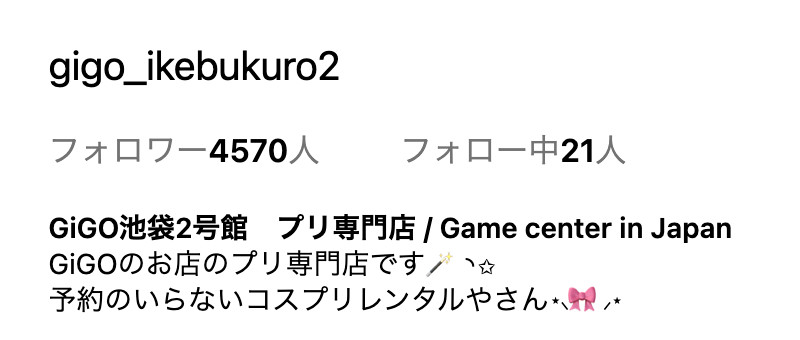
The store’s social account describes it as “a photo booth specialty store under GiGO” and “a costume rental shop, no reservation needed.” Screenshot of the official GiGO池袋2号館 Instagram bio, captured on September 25, 2026, cropped to show only the account name and the first three lines of the bio. Original page.
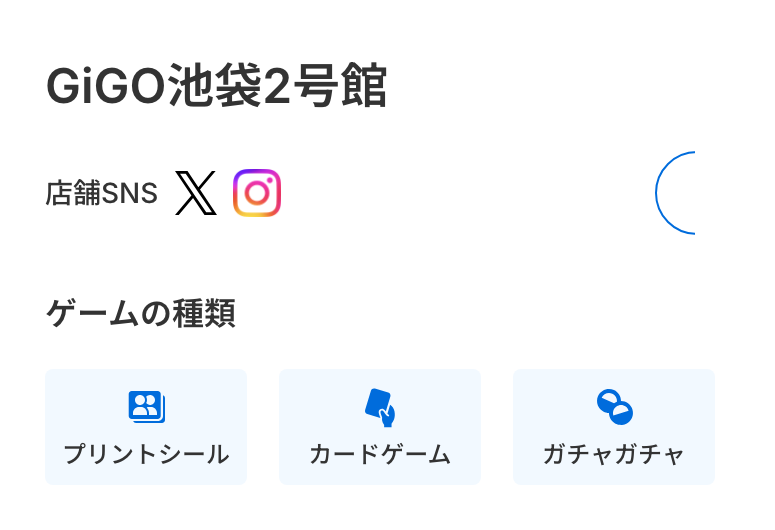
The same store as presented on GiGO’s official website: photo booths are just one of three game categories. Screenshot of the official GiGO池袋2号館 store page, captured on September 25, 2026, cropped to show only the store name and the “Types of games” field. Original page.
The same store calls itself a photo booth specialty store on social media, while the company website treats it as an ordinary branch. That gap itself illustrates how GiGO approaches photo booths: specialization is a branch-level operating choice that has not yet been brought together under a corporate brand.
Costume Rentals and Makeup Facilities
Renting clothes at a Japanese photo booth store, changing into them, and then taking pictures is called “コスプリ,” a combination of cosplay and puri. We found two GiGO branches where full costume rentals are officially confirmed:
- GiGO池袋2号館 emphasizes costume rentals. Its official social accounts say it has at least 300 costume options, with different fee categories for students and other customer groups. Fees and service hours are governed by announcements on its official social accounts; this article does not list the amounts.
- GiGO渋谷 has a costume rental area on its third floor. Its official X account promotes it with the invitation “Enjoy casual cosplay photo booth sessions” (X @GiGO_Shibuya). Prices have not been published.
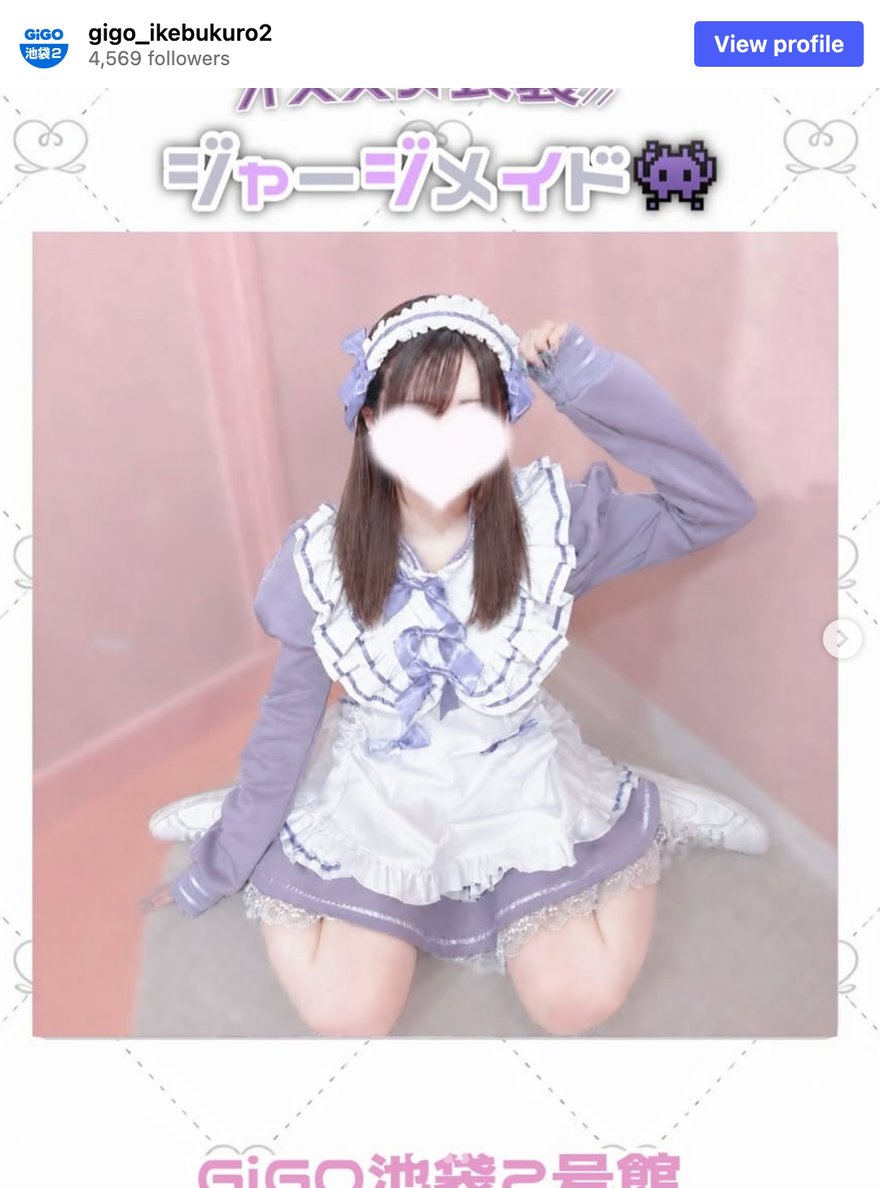
The official account for GiGO池袋2号館 regularly introduces costumes available to rent. This post features a “tracksuit maid” outfit combining a tracksuit jacket with a maid skirt, and says the branch has “many costumes available.” The heart sticker over the person’s face was already present in the official post. Screenshot from the official GiGO池袋2号館 Instagram account, August 19, 2026. Original post.
Some other GiGO branches are marked “cosplay” on manufacturers’ installation maps, but their official pages do not mention it, so they are excluded from the confirmed list. Locations across Japan where costumes can be rented for photo booth sessions, including those outside GiGO, are compiled in the Japan コスプリ location list.
Makeup counters and curling iron loans are also decided by individual branches. Among the facility tags on this site’s GiGO page, 23 branches are marked as having makeup counters, and 21 as lending hair straighteners. These tags come from manufacturers’ installation maps; they are incomplete and may not be up to date, so check the branch’s official page before using the facilities. We found no uniform explanation in official materials of changing room availability or photo booth-related offers in the GiGO membership app.
Four Takeaways from Looking at This Company
- GiGO is SEGA’s arcade chain with different shareholders and signs. SEGA handed over the retail channel while retaining machine manufacturing, and GiGO branches still have SEGA machines today.
- GiGO’s parent, GENDA, is an entertainment platform company. Photo booths do not take center stage in its business description, so GiGO has not created a corporate-level photo booth brand in the way タイトー and namco have.
- GiGO’s distinctive photo booth offerings depend on the branch. Locations such as GiGO池袋2号館 and GiGO渋谷 have made photo booths and costume rentals key attractions, but those are branch-level choices rather than standard offerings across the chain.
- Since taking over, GENDA has followed the “heavy” route: growing from 843 to about 14,000 locations and to ¥170.8 billion in revenue (year to January 2026), then buying prize makers upstream. SEGA has stayed on the “light” route of selling machines and prizes.
Related Reading
- Who Makes the Money on a Japanese Arcade Floor? Venues, Machines, Prizes and Capsule Toys in Four Segments—The parent article of this series: the floor GiGO sits on, and who earns which of its four businesses.
- More Than 40% of Japan’s Photo Booths Are in Arcades: The Three Layers of Manufacturers, Retail Channels, and Brands, and the Parent Companies of Ten Chains—The series overview, with ten retail channels and their parent companies in one table.
- Thirty Years of Japanese Photo Booths: From Print Club to FURYU’s Dominance, Then to an IP Company—The main article on Japanese photo booth history, covering manufacturers’ entries and exits and listed companies from 1995 onward.
- Japanese Photo Booth Leader FURYU’s Shift: The Number of Users Fell 40%, Yet Photo Sales Revenue Surpassed Machine Revenue—Company research at the manufacturer layer, including FURYU’s crane-game prize business.
- How Fukuoka’s ワイドレジャー Bought Tokyo’s アドアーズ—Another arcade acquisition in this series.
- A Historical Report on the Development of Taiwan’s Photo Booth and Korean-Style Photo Booth Industries—The main photo booth industry article, including the full account of SEGA’s arcade sale.
- GiGO Branches with Photo Booths in Japan—Addresses and models for 250 branches.
The figures added in October 2026 also draw on セガサミー’s timely disclosure of November 4, 2020, セガサミー’s supplementary financial data for the year to March 2026, GENDA’s earnings summaries for the years to January 2025 and January 2026, its full-year results presentation for the year to January 2026 and second-quarter presentation for the year to January 2027, its sales progress report (issued August 2026), its May 11, 2026 announcement of the トーシンパック acquisition, and GENDA’s company history (checked October 19, 2026).
Sources: GENDA GiGO Entertainment’s company information, GENDA’s official website and the GENDA press releases linked above, GiGO’s store information, the official social accounts for GiGO池袋2号館 and GiGO渋谷, and the Japan data layer of this site’s photobooth.joelin.cc database. Unless otherwise noted, all checks were conducted on September 24, 2026.
Article keywords: GiGO, GENDA, GENDA GiGO Entertainment, SEGA arcades, why SEGA sold its arcades, GENDA acquisitions, GiGOクレーンゲームオアシス, crane-game prizes, Japanese arcades, Japanese photo booths, purikura, GiGO池袋2号館, コスプリ, Japanese photo booth retail channels
Frequently asked questions
What is the relationship between GiGO and SEGA?
GiGO originated as SEGA’s arcade chain. In November 2020, SEGA sold an 85.1% stake in its arcade subsidiary SEGA Entertainment to GENDA, and store signs changed from SEGA to GiGO in January 2022. SEGA itself did not go under. What it handed over was arcade operations; it still manufactures machines, including photo booths, and GiGO branches still have SEGA machines.
Who is GiGO’s parent company? Is it publicly listed?
GiGO is operated by 株式会社GENDA GiGO Entertainment. Its parent is GENDA株式会社, listed on the Tokyo Stock Exchange’s Growth Market under securities code 9166. The operating company is not separately listed.
How many GiGO stores are there in Japan?
GiGO’s official website reported 427 stores in Japan, checked on September 24, 2026, with the page stating a September 1 snapshot. Separately, photobooth.joelin.cc lists 250 branches with photo booths, but the two figures use different definitions and cannot be subtracted to calculate how many stores lack photo booths.
Can I rent costumes for photo booth pictures at GiGO?
It depends on the branch. Full costume rentals have been officially confirmed at GiGO池袋2号館 and GiGO渋谷, which has a costume rental area on its third floor. They are not available throughout the chain. Fees and service hours vary by store; check the branch’s official social accounts or store page before visiting.
Why did SEGA sell its arcades?
SEGA’s November 4, 2020 announcement said the pandemic had sharply reduced arcade utilization and the business had already posted a large loss in the first quarter of the year to March 2021. Wanting to improve its profitability, SEGA chose to sell to GENDA, which wanted to expand its arcade business. Before the pandemic, in the year to March 2020, SEGA Entertainment had revenue of ¥40.6 billion and operating profit of only ¥178 million. SEGA booked a special loss of about ¥20 billion, and the price was not disclosed.
How big is GENDA now?
GENDA’s fiscal year ends in January. Revenue in the year to January 2026 was ¥170.8 billion, three times the ¥55.7 billion of the year to January 2024. Its entertainment-platform locations — arcades, mini locations, karaoke and others — numbered about 14,000 in Japan and overseas (September 2026), after 62 acquisitions since its founding (as of March 2026, including planned ones). The figure of about 420 GiGO stores in Japan is what the company tells the media; GiGO’s official website lists 427.
Why is GENDA buying prize makers?
A venue operator that makes its own crane-game prizes can take back the margin it used to pay prize makers, and can make prizes available only at GiGO. GENDA has bought アレスカンパニー, フクヤ and トーシンパック, and its prize business plans revenue of ¥18.2 billion in the year to January 2027, the same order of magnitude as the crane-game prizes of FURYU, the industry’s number two (¥19.6 billion in the year to March 2026).
Are GiGO in Taiwan and GiGO in Japan part of the same company?
They belong to the same group. According to GENDA’s November 20, 2023 press release, the GENDA group acquired SEGA AMUSEMENTS TAIWAN in December 2021, after which its Taiwan locations were progressively renamed GiGO台湾.
This English version is based on original Traditional Chinese content on joelin.cc. The language and explanations are localised for international readers. The Traditional Chinese original is the authoritative version — for its complete meaning, please read the original article.
Use Google Search a lot?
Set joelin.cc as a preferred source to see more of its articles when you search.