
This article is also available in: 繁體中文 · 日本語 · 한국어 · Bahasa Indonesia · Bahasa Melayu · ไทย · Português (Brasil) · Español · Türkçe · Tiếng Việt · Deutsch
Contents (17)
In one line: A is yield, 5 is meat quality, and the marbling lives in BMS
A5 is the best-known label in Japanese beef grading, and also the most misunderstood.
Most people assume A means “top quality” and 5 means “five stars”. In fact, A measures how much meat the animal will cut out. It is an economic efficiency figure for the slaughterhouse and has no direct bearing on how good the beef tastes.
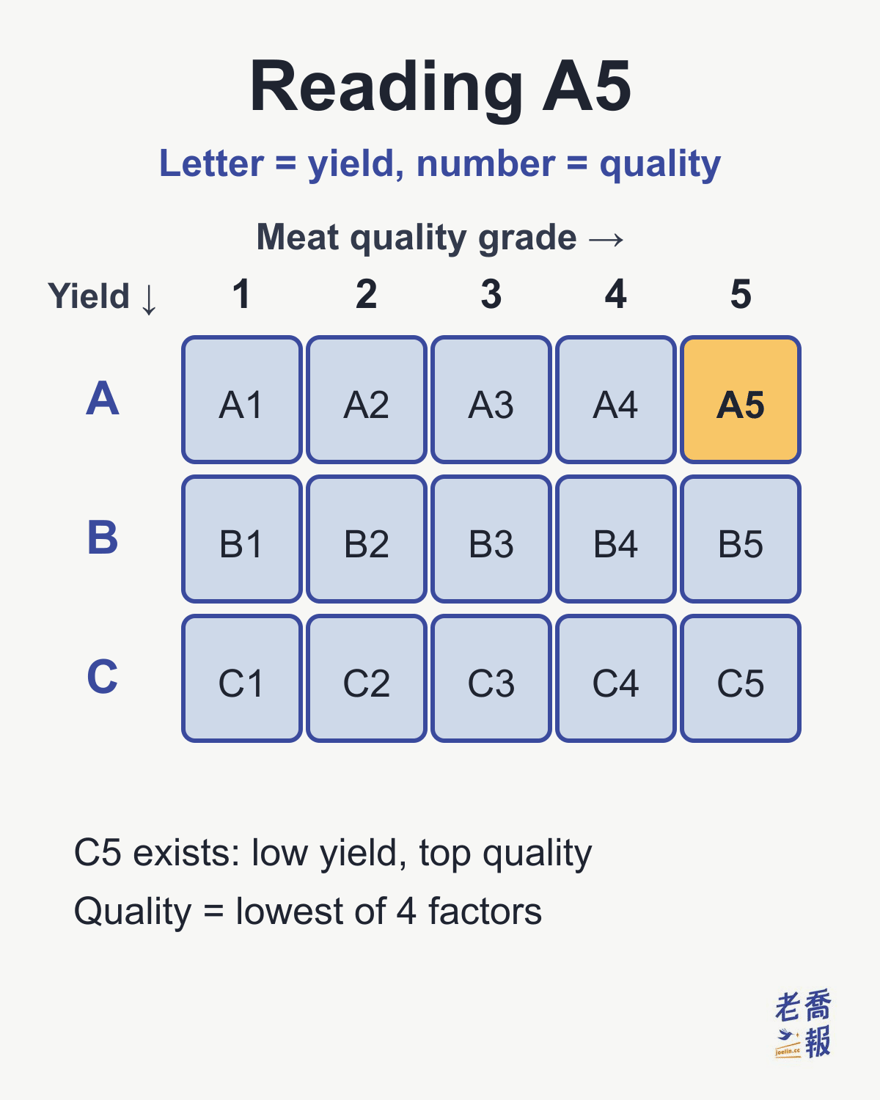
In Japan, carcasses are graded by the Japan Meat Grading Association (JMGA, 公益社団法人日本食肉格付協会). Every carcass gets two scores: a letter (yield grade A, B or C) and a number (meat quality grade 1 to 5). Together they make a 15-cell grid, from A5 down to C1.
The scale that actually describes marbling is a third measure, the one consumers hear about least: BMS, the Beef Marbling Standard, from No.1 to No.12.
This article untangles how those three layers fit together. To see how four countries’ standards each go their own way, start with who sets beef grading standards.
1. A, B and C measure how much meat the carcass will cut out
The yield grade is based on a yield standard value (歩留基準値). The calculation starts from a constant of 67.37 and adds or subtracts four measurements, each multiplied by its own coefficient: plus ribeye area (cm²) times 0.130, plus rib thickness (cm) times 0.667, minus cold carcass weight (half carcass, kg) times 0.025, and minus subcutaneous fat thickness (cm) times 0.896. For specialist beef breeds, 2.049 is added at the end.
| Measurement | Factor | Effect |
|---|---|---|
| Ribeye area (cm²) | +0.130 | Larger means higher |
| Rib thickness (cm) | +0.667 | Thicker means higher |
| Cold carcass weight (half carcass, kg) | −0.025 | Heavier means lower |
| Subcutaneous fat thickness (cm) | −0.896 | Thicker means lower |
Taken together, the four directions in this table say one thing: the formula rewards a carcass with plenty of meat, thin subcutaneous fat and no excess bulk. Ribeye area and rib thickness stand for saleable meat, while subcutaneous fat gets trimmed off and thrown away, which is why its coefficient is the heaviest negative of the four.
Once calculated, the value is checked against these thresholds:
| Yield grade | Yield standard value |
|---|---|
| A | 72 and above |
| B | 69 to under 72 |
| C | Under 69 |
Once you read the formula, it is clear what it measures: a large ribeye, a thick rib, a carcass that isn’t overweight and thin subcutaneous fat all push the score up. It describes the carcass’s shape and lean-to-fat layout, and answers the question “is the share of saleable meat high?”
That is a business question, not a question of taste. The buyer is the slaughterhouse and the cutting plant, not you at the table.
2. 1 to 5 is the meat quality grade, and the rule is “lowest of four”
The meat quality grade is set by four factors:
- Marbling (脂肪交雑).
- Meat color and brightness.
- Firmness and texture of the meat.
- Fat color, luster and quality.
The final meat quality grade equals the lowest of these four.
This rule matters far more than it looks. A piece of beef with marbling beautiful enough for an advertising shoot will get a quality grade of 3 if its fat is judged too yellow and scored at 3. The label will not say 5. Turn it around and a piece labeled 5 means all four factors are at 5. It is a guarantee of “no weak spot”, not a guarantee of “the most extreme marbling”.
3. The marbling itself is BMS No.1 to No.12
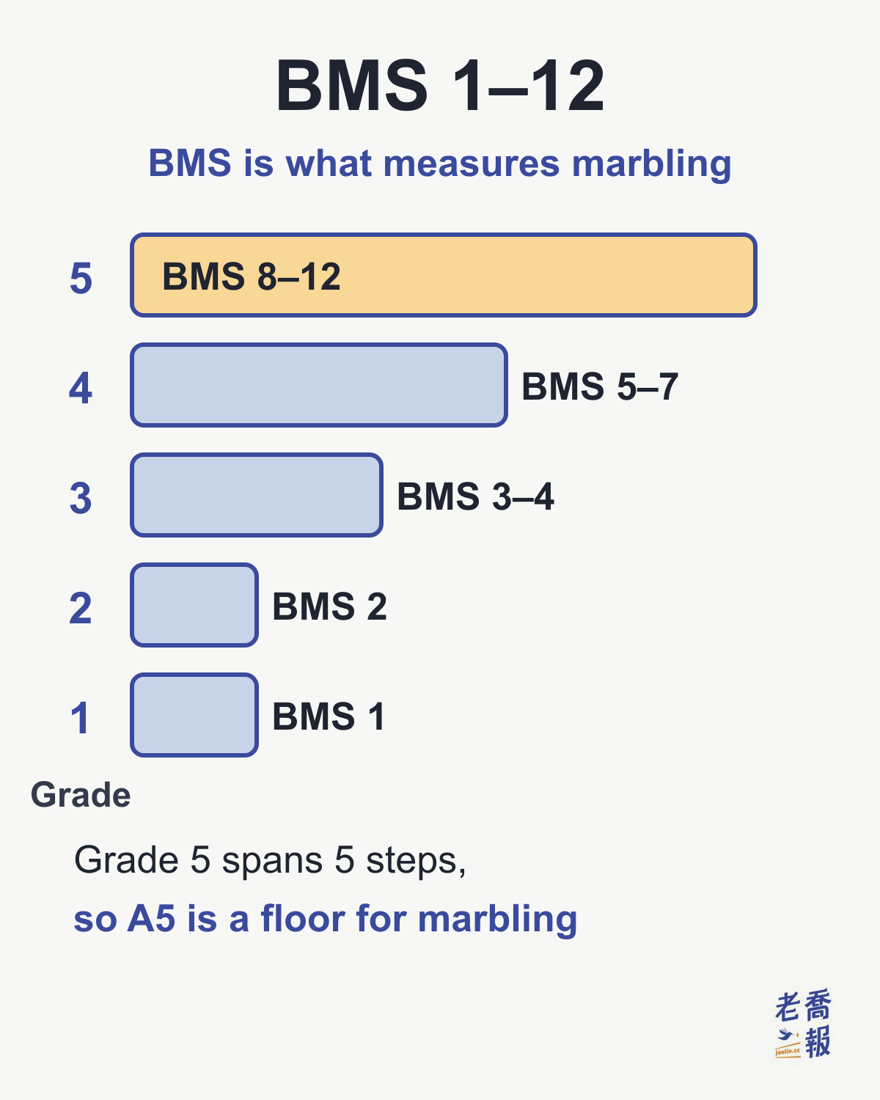
Of the four factors, marbling is scored on the BMS scale:
| Quality grade | BMS range |
|---|---|
| 5 | No.8 – No.12 |
| 4 | No.5 – No.7 |
| 3 | No.3 – No.4 |
| 2 | No.2 |
| 1 | No.1 |
This table is the core of the whole article. Look at the first row: quality grade 5 covers BMS 8, 9, 10, 11 and 12, five full steps.
The other two color factors have their own scales too: meat color uses BCS (Beef Color Standard) No.1 to No.7, and fat color uses BFS (Beef Fat Standard) No.1 to No.7. Each grade has its own acceptable range; for example, quality grade 5 accepts BFS No.1 to No.4, and grade 4 widens that to No.5.
4. Why A5 doesn’t mean the best-tasting beef
Reason 1: A5 guarantees a floor for marbling, not a ceiling
An A5 at BMS 8 and an A5 at BMS 12 sit in completely different price bands in Japan, yet both labels say A5. When you see “A5 Wagyu” on a restaurant menu, what you learn is “the marbling is at least BMS 8”, not “this is the very top piece”.
That is also why high-end channels in Japan print the BMS number. A5 without the number carries much less information than you might expect.
Reason 2: the A has nothing to do with what you taste
As covered above, A is yield. So a combination like C5 exists and makes sense: a carcass with a poor shape and low yield, but all four quality factors at the top. For the diner, C5 can beat A4 on the plate.
The reverse, A1, exists too: a very efficient carcass with almost no marbling. If you read A as quality, neither of these cells makes any sense.
Reason 3: more marbling doesn’t mean it suits your taste
No standard can make this call for you. Beef at BMS 11 or 12 has fat with a low melting point that melts in your mouth, but most people have had enough before they finish three slices. Japanese Wagyu dishes often use thin slices, sukiyaki or small teppanyaki portions because fat that dense was never suited to eating as one big steak.
A grade describes how much marbling there is, not whether it suits the meal you want today. Marketing has tied those two ideas together for a long time, but in the standard itself they have never been the same thing.
5. A5 is not the same as USDA Prime either
The popular claim that “A5 is roughly Prime” is an informal approximation. Neither the Japan Meat Grading Association nor the USDA has ever published any equivalence.
The reason sits in the formula above: Japan’s letter includes a yield condition, and USDA Prime includes a physiological maturity condition. Neither is a pure marbling axis, so they cannot be placed on one line and compared. Forcing a conversion is like plotting height and body fat percentage on the same number line.
If you really want a rough feel, the more reasonable comparison is marbling against marbling: the USDA Prime threshold starts at slightly abundant, and the marbling density in the BMS 8 to 12 range is far above it. But that is still only a sense of direction, not a conversion.
6. What to ask next time you order or buy
- Ask for the BMS number, not just the grade. A seller who can give you the number actually knows what they are selling.
- Ask about the cut. Within the same A5 animal, the gap in marbling and eating experience between the tenderloin and the top blade is much bigger than the gap between A5 and A4.
- If someone says their beef is “benchmarked to Japan’s A5 standard”, that usually means an analogy, not a certification. Follow up with one question: benchmarked to which BMS number?
These three questions are not meant to catch anyone out. They simply take the word “grade” back to what it really is: one organization, using one specific ruler, measuring one specific dimension, and getting one result. Only when you know what that ruler measures can you tell whether the number is useful to you.
Sources
- Japan Meat Grading Association, Beef Carcass Trading Standards (牛枝肉取引規格): the yield standard value formula, the A/B/C thresholds, the four quality factors and the lowest-of-four rule, the BMS-to-quality-grade table, and the BCS and BFS scales
- USDA AMS, United States Standards for Grades of Carcass Beef (the Prime marbling threshold)
Keywords: A5 Wagyu, BMS, Wagyu yield grade, meat quality grade, Japan Meat Grading Association, beef grading, Wagyu grades, marbling score
Frequently asked questions
What does the A in A5 actually mean?
A is the yield grade (歩留等級). It measures how much meat the carcass will cut out, and it comes from a formula that produces a yield standard value (歩留基準値): plug in ribeye area, rib thickness, cold carcass weight and subcutaneous fat thickness. 72 and above is A, 69 to under 72 is B, and under 69 is C. It describes the carcass’s shape and lean-to-fat layout and answers whether the share of saleable meat is high. Its audience is slaughterhouses and cutting plants, not the diner.
And the 5 in A5? Does it mean the most marbling?
5 is the meat quality grade. It is set by four factors: marbling (脂肪交雑), meat color and brightness, firmness and texture of the meat, and fat color, luster and quality. The final grade is the lowest of the four. So 5 means all four factors reached 5, with no weak spot; it does not mean the marbling is maxed out. What actually describes the amount of marbling is BMS No.1 to No.12, and quality grade 5 spans five full steps, BMS 8 to 12.
Why do two A5 cuts differ so much in price?
Because A5 only guarantees a floor for marbling. An A5 at BMS 8 and an A5 at BMS 12 are both called A5, but in Japan they sit in completely different price bands. That is why high-end channels print the BMS number: A5 without the number tells you less than you might think. The cut matters a lot too. Within the same A5 animal, the gap between the tenderloin and the top blade is bigger than the gap between A5 and A4.
Which is higher, A5 or USDA Prime?
There is no official equivalence between them; neither the Japan Meat Grading Association nor the USDA has ever published a conversion. Japan’s letter includes a yield condition and USDA Prime includes a physiological maturity condition, so neither is a pure marbling axis, and they cannot be placed on one line to compare. If you want a rough sense of direction, compare marbling with marbling: the USDA Prime threshold starts at slightly abundant, and the marbling density of BMS 8 to 12 is far above it. That is a sense of direction, not a conversion.
Is there such a thing as C5?
Yes, and it makes sense: a carcass with a poor shape and low yield, but with all four quality factors at the top. For the person eating it, C5 can beat A4 on the plate. A1 exists too: a very efficient carcass with almost no marbling. These two combinations are exactly why you cannot read A as quality. Read the letter as quality and neither combination makes sense.
Sources: Chinese original first published 2026-09-16; its information was revised 2026-10-27. The yield grade formula, grade thresholds, quality factors and the BMS, BCS and BFS scales follow the Japan Meat Grading Association's carcass trading standards; the Prime marbling threshold follows the USDA standards for grades of carcass beef.
This English version is based on original Traditional Chinese content on joelin.cc. The language and explanations are localised for international readers. The Traditional Chinese original is the authoritative version — for its complete meaning, please read the original article.