
This article is also available in:繁體中文 · Tiếng Việt
In December 2022, I walked into stores belonging to eighteen photo booth brands in six days, starting on the streets of Seomyeon in Busan.
My impression at the time was that this thing was on fire. One sign followed another. Behind the machines were exposed keyboards and mice, and the corner of a screen still showed the watermark saying Windows had not been activated. These were simply a computer and a photo printer housed inside a lightbox. The barrier to entry was low enough for anyone to copy.
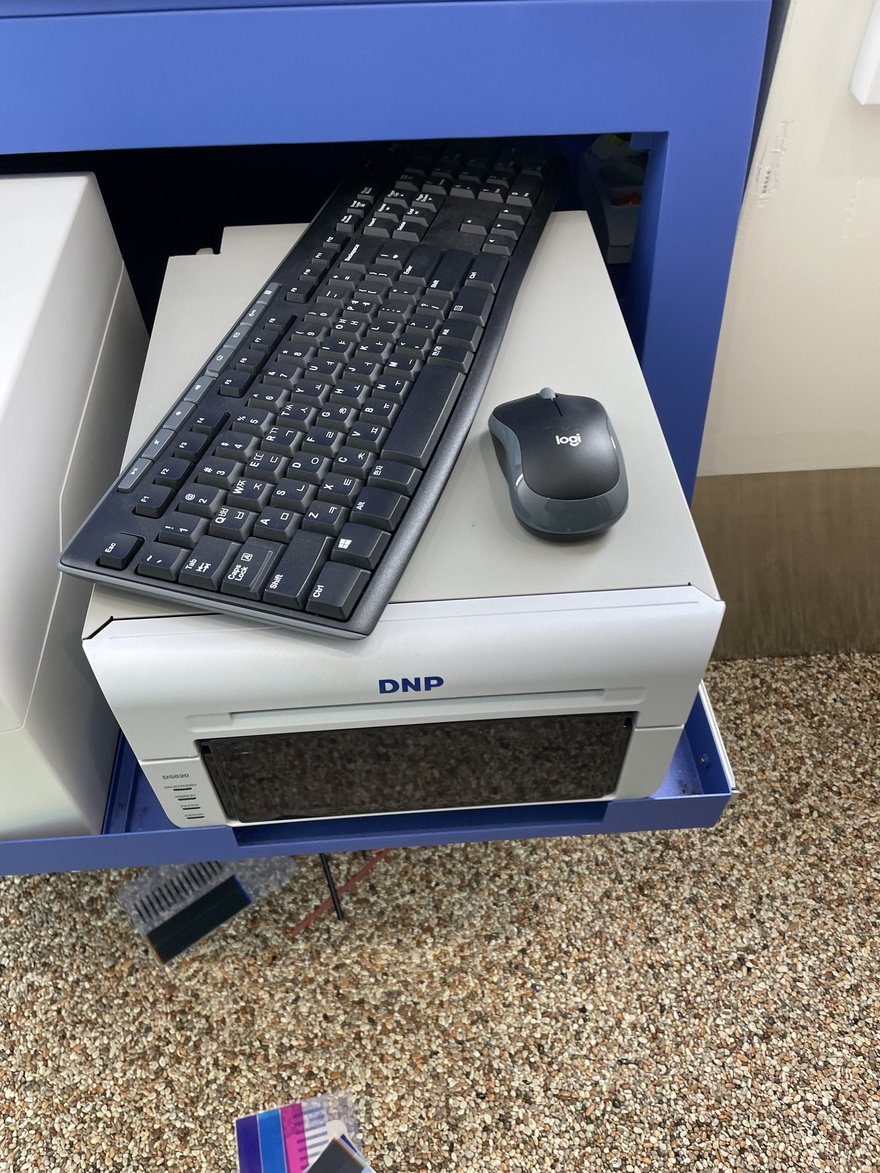
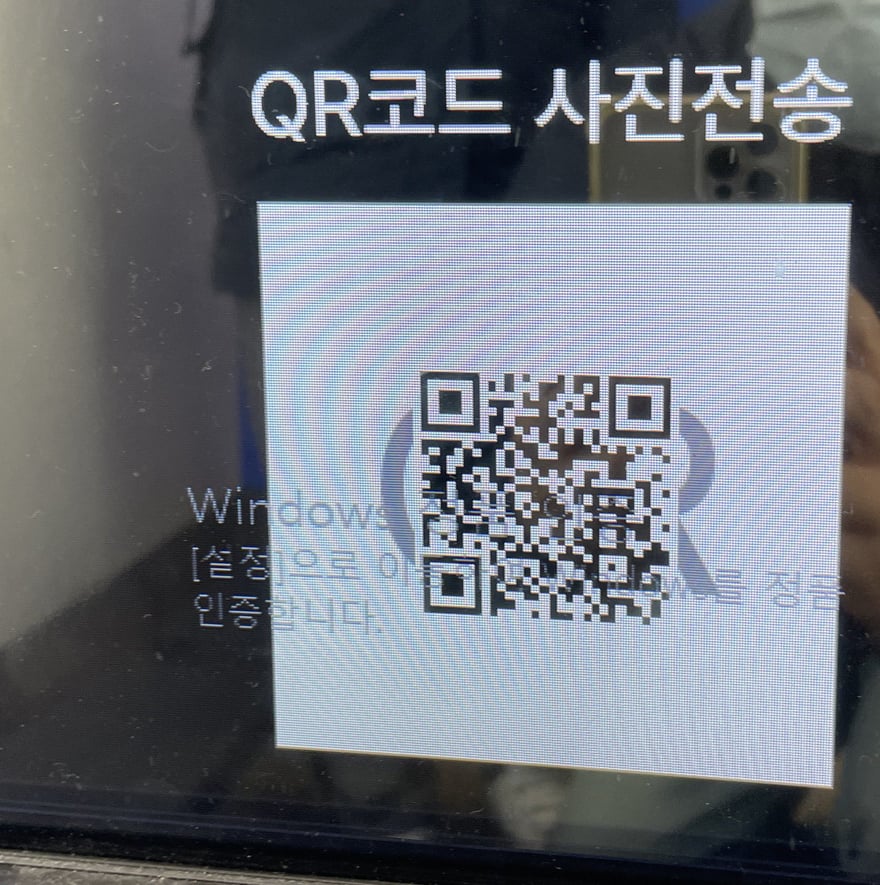
A Photo Slate machine in December 2022: its lower drawer held a keyboard, mouse, and DNP photo printer, while a Windows activation watermark showed through beneath the photo-transfer screen. Photographs by this site; see the detailed breakdown in Photo Slate Leaves the Entire Machine Backend Exposed.
After returning home, one question stayed with me: how did Koreans themselves see this business?
This article is what emerged after working through the official statistics, tax data, franchise filings, academic research, financial statements, and media coverage I could find in Korea.
It covers 1995–2026. The industry history begins with the debut of Japan’s Print Club; official tax figures cover 2020–2024; individual brands’ franchise disclosure documents cover 2022–2025; and the accounts examined run from field interviews in 2020 through financial analysis in 2026.
Every number identifies who calculated it and which year it refers to. Complete sources and a brand-name reference table appear at the end.
I revised this article in September 2026, adding the first-wave suppliers, listed companies along the industry chain, and the actual current leader, Seobuk (서북), which applied to the Korea Exchange for a preliminary listing review on September 21. I covered the Japanese side separately in Thirty Years of Japanese Photo Booths; the sections of the two articles can be read alongside each other.
A Thirty-Year Timeline
| Year | What happened |
|---|---|
| 1995 | Print Club debuted in Japan; that same year, Korean vending-machine operator Protopia imported SEGA machines. |
| January 1996 | Sales began in the gift section of Seoul’s Metro Midopa department store: sixteen stickers for KRW 3,000. Newspapers called it a “붐”—a boom. |
| 1997 | More suppliers entered, and the first domestically produced machine appeared. Approximately 2,000 machines operated nationwide; the industry estimated a market exceeding KRW 20 billion. |
| 1998 | Major companies including Samsung, LG Industrial Systems, Haitai, and Hyundai entered, with more than twenty suppliers competing. The market contracted sharply that same year under a special consumption tax and an economic downturn. |
| Around 2002 | Digital cameras became widespread, and the first wave faded. Pioneer Protopia was barred from check transactions in October of that year. |
| 2017 | Life4Cuts and Photogray’s predecessor emerged as two separate starting points in the same year, beginning the second wave. |
| 2019–2020 | PHOTOISM launched, and its parent Seobuk was established in Cheonan. |
| 2022 | Pandemic restrictions were lifted; taxable sales for this business category grew 85% in one year. |
| 2023 | Seobuk surpassed Life4Cuts by both franchised-store count and revenue. |
| February 2024 | Photogray parent APR listed on KOSPI. |
| 2024–2025 | Life4Cuts’ parent company’s equity turned negative; Seobuk recorded its first loss in 2025. |
| September 2026 | After returning to profit, Seobuk applied for a preliminary KOSDAQ listing review—the first major photo booth brand to do so. |
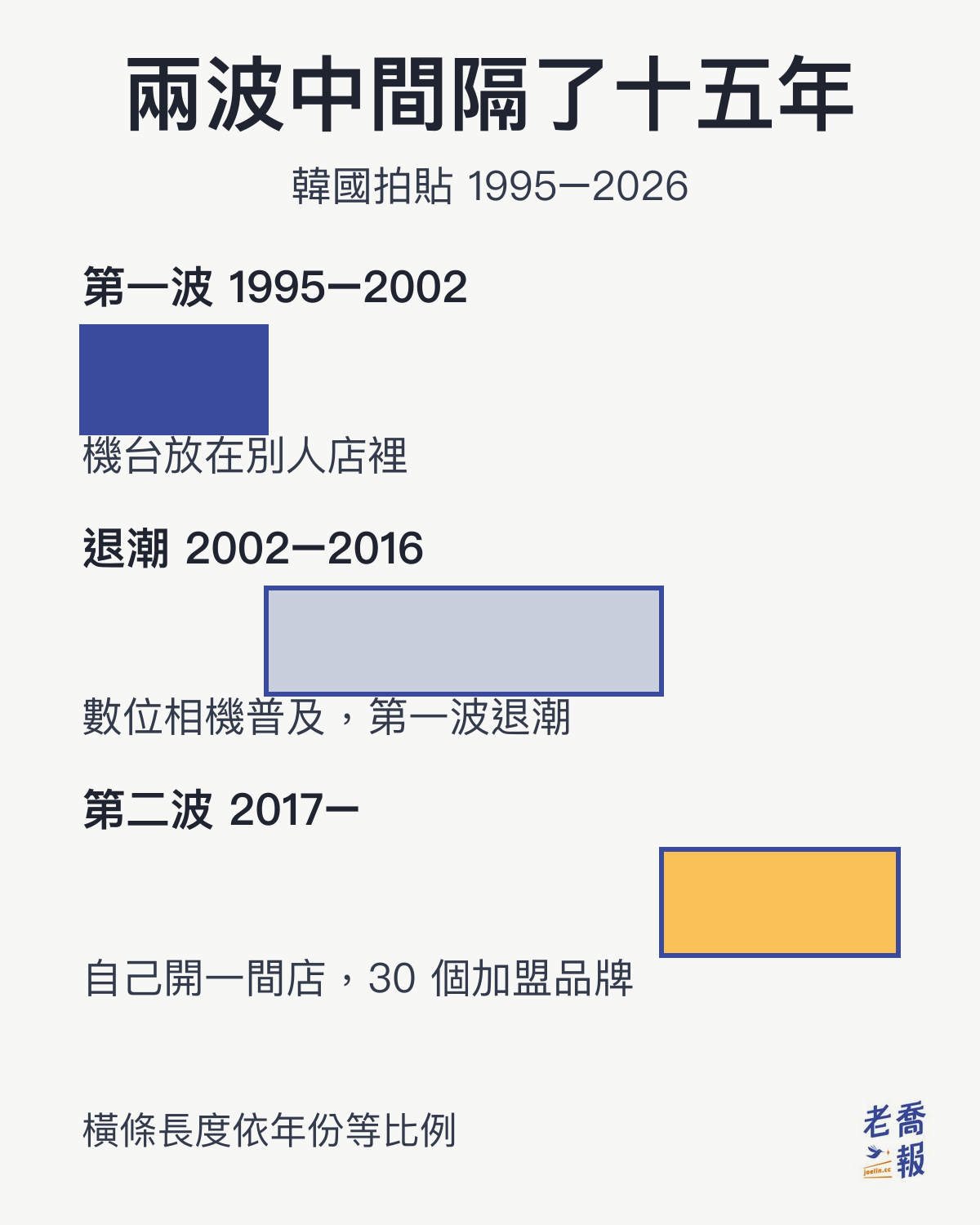
The two waves in this timeline are separated by fifteen years. The first was a vending-machine business: more than twenty suppliers flooded in and withdrew within three years. The second was a franchise-store business, beginning in 2017 and reaching the listing-review stage for the first time only in 2026.
Part One: Where This Business Came From, 1995–2019
1. The First Wave: Starting in a Department Store’s Gift Section, 1995–2002
In July 1995, Japan’s Atlus and SEGA launched Print Club, the sticker-photo machine that later became familiar to everyone. Korea followed faster than I had originally thought: that same year, a vending-machine operator called Protopia (프로토피아) imported SEGA machines into Korea. In Korean, they were called “스티커사진”—sticker photos. I covered the longer development of this business separately in A Historical Report on Taiwan’s Photo Booth and Korean-Style Photo Booth Industries.
The earliest contemporary coverage I could find dates to late January 1996. Articles in Kukmin Ilbo (국민일보) on January 31, 1996, and Naewoe Economy (내외경제) on February 1 described the same location: the gift plaza on the sixth floor of Seoul’s Metro Midopa (메트로미도파) department store. In early January, it had installed an “instant camera resembling a vending machine.” Choose a background, strike a pose, and fifty seconds later receive a sheet of sixteen stickers for KRW 3,000. There were twenty-seven animated backgrounds. The department store said eighty to one hundred people used it each day.
Neither report identified the machine’s supplier. Industry coverage in 1997 described Protopia’s Joy Photo (조이포토) as producing “sixteen stickers in just over fifty seconds,” matching the Midopa machine’s specifications. I suspect it was theirs, but no primary source directly establishes that.
The market really heated up in 1997. In October that year, Seoul Economic Daily (서울경제) cited industry sources estimating the annual market at “more than KRW 20 billion.” Two reports in 1998 looked back on approximately 2,000 machines nationwide in 1997. This is the earliest market-size figure I found in identifiable reporting, but it was the industry’s own estimate, not an official statistic.
Another frequently cited figure is that “around 2002, the industry was worth roughly KRW 20–30 billion.” The first edition of this article used it too. I am retaining it here with a qualification: the originally cited source, a university newspaper article, does not contain that number, and I found no primary-source market-size figure from around 2002. The closest figure currently available is the 1997 industry estimate of “more than KRW 20 billion” above. The KRW 20–30 billion order of magnitude is broadly consistent, but the date “around 2002” has no supporting evidence.
Its appeal at the time was very concrete. This was the film-camera era, when photo studios were the only place to have pictures developed, whereas sticker-photo machines delivered a finished product on the spot. Convenience itself was the product.
But one feature was completely different from what came later: first-wave machines were placed inside other people’s shops, in department-store gift sections, stationery shops, and 오락실—video-game arcades. Accounts even described “arcades covering their monthly rent by selling sticker photos.” At KRW 1,500–5,000 per session, they cost much more than other arcade machines.
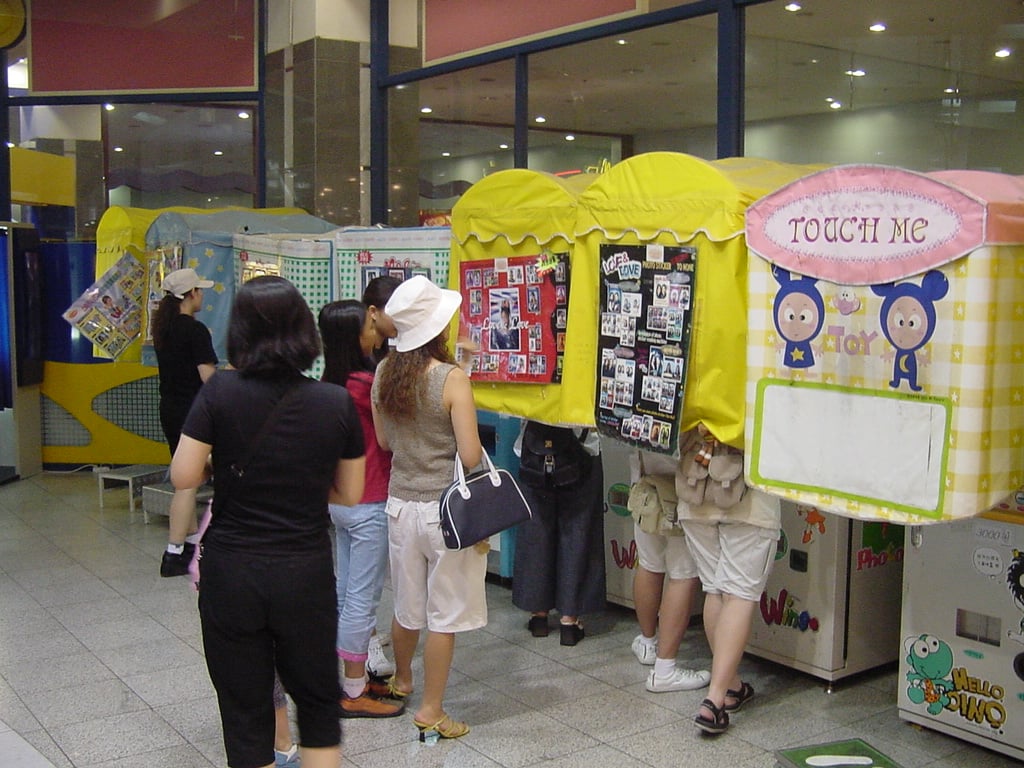
Korea in July 2001, categorized as Seoul on Wikimedia: sticker-photo machines lined up in a shopping-center corridor, with TOUCH ME printed on their canopies and samples covering their cabinets. This is how first-wave machines occupied other people’s spaces. Photograph: Alex C, CC BY 2.0, original image.
The users were teenagers and university students, who stuck the pictures onto their phones or into diaries.
Looking back on this period, SisaIN (시사IN) wrote a sentence that I think is key to understanding the whole story:
Everyone knew that sticker photos were never really for documenting and preserving things anyway. They were something to be consumed and then disappear.
Remember that sentence. Second-wave brands took the opposite approach.
1.2. First-Wave Companies: More Than Twenty Suppliers Competing for a Three-Year Market
The biggest difference between Korea’s first wave and Japan’s was that Korea did not develop its own manufacturers. Almost all the entrants were vending-machine operators. Most machines were imported from Japan or assembled under technology licenses, and core components such as printers and photo paper were entirely dependent on imports.
| Company | Entry | Brand or model |
|---|---|---|
| 프로토피아 Protopia | 1995 | 조이포토 Joy Photo, using SEGA Print Club |
| 삼원사진기계 Samwon Photo Machinery | April 1997 | 멋쟁이 Meotjaengi, imported from Japan |
| 유한씨엔티 Yuhan C&T | June 1997 | 포토플러스 Photo Plus, the first domestically produced machine |
| 현대세가엔터테인먼트 Hyundai SEGA Entertainment | 1997 | Software for taking photos with celebrities |
| LG산전 LG Industrial Systems | Early 1998 | Model name not found |
| 해태전자 Haitai Electronics | August 1998 | 깜찍이 포토 라이브 Kkamjjigi Photo Live |
| 현대정보기술 Hyundai Information Technology | August 1998 | 매직 포토 Magic Photo |
| 삼성전자 Samsung Electronics | October 1998, planned | 윙고 Wingo, contract-manufactured by a small or medium-sized company |
A few company details:
- Protopia had sold approximately 200 machines by 1997. It later signed a technology-transfer agreement with SEGA and began assembling them in Korea.
- Samwon Photo Machinery sold approximately fifty machines in just over a month after entering the market. It still appeared on the list of companies involved in the special-consumption-tax lawsuit in 1998.
- Yuhan C&T’s domestic machine cost KRW 5.4 million, approximately 60% of the price of an imported machine, and charged only KRW 1,500 per session.
- Hyundai SEGA Entertainment was a joint venture between Hyundai Electronics and SEGA, promoting photos with popular celebrities.
- Haitai Electronics’ model offered seventy-two backgrounds and cost KRW 11.8 million; Hyundai Information Technology supplied approximately one hundred machines.
- Samsung Electronics outsourced production to the smaller company 유카스코리아, Ucas Korea. I could not establish whether substantial shipments followed.
The table shows the pace of the first wave: one company in 1995, three to five in 1997, and more than twenty in 1998, with even Samsung and LG entering. Newspapers in August 1998 were still predicting 10,000 machines and a KRW 100 billion market by year-end.
Two months later, however, Electronic Times (전자신문) was already describing a market “contracting rapidly.” There were two causes: the economic downturn after the IMF financial crisis, and the government’s treatment of sticker-photo machines as expensive cameras subject to a special consumption tax. Machines cost KRW 8–12 million each; once the tax was added, sales stalled. Fourteen suppliers jointly filed an administrative lawsuit with the Busan District Court.
I could not find individual records of how the large companies subsequently withdrew. The only clearly documented case is the pioneer: Protopia switched to mobile-phone charging vending machines in 1999 and appeared on a list of companies barred from check transactions in October 2002. Reports from 1999 onward called it “새기술프로토피아,” with the same representative, so I judge it to be the same company. Reports from 1995–1997 did not identify a representative, however, preventing a completely certain match.
2. The Retreat and the Gap, 2002–2016
The first wave faded in two stages. The special consumption tax and economic downturn at the end of 1998 first stalled sales of new machines. Digital cameras came next. Two- and three-megapixel digital cameras became popular around the 2002 World Cup: no film, immediate image review, computer connectivity for uploading, and even video recording. Sticker photos lost their convenience advantage. Smartphones and selfie-filter apps later delivered the final blow.
One date is worth remembering: if you recall that “Korea already had photo booths before 2002,” you are right. They go back as far as 1995. The year 2002 marks the culmination of the first wave’s retreat, not its beginning.
For roughly the next fifteen years, this line of business almost disappeared. I could not find documentation of that period: where machines survived, whether anyone tried to revive them, or whether identifiable brands existed. There were no primary sources. This is the largest gap in the article, and I will not fill it with speculation.
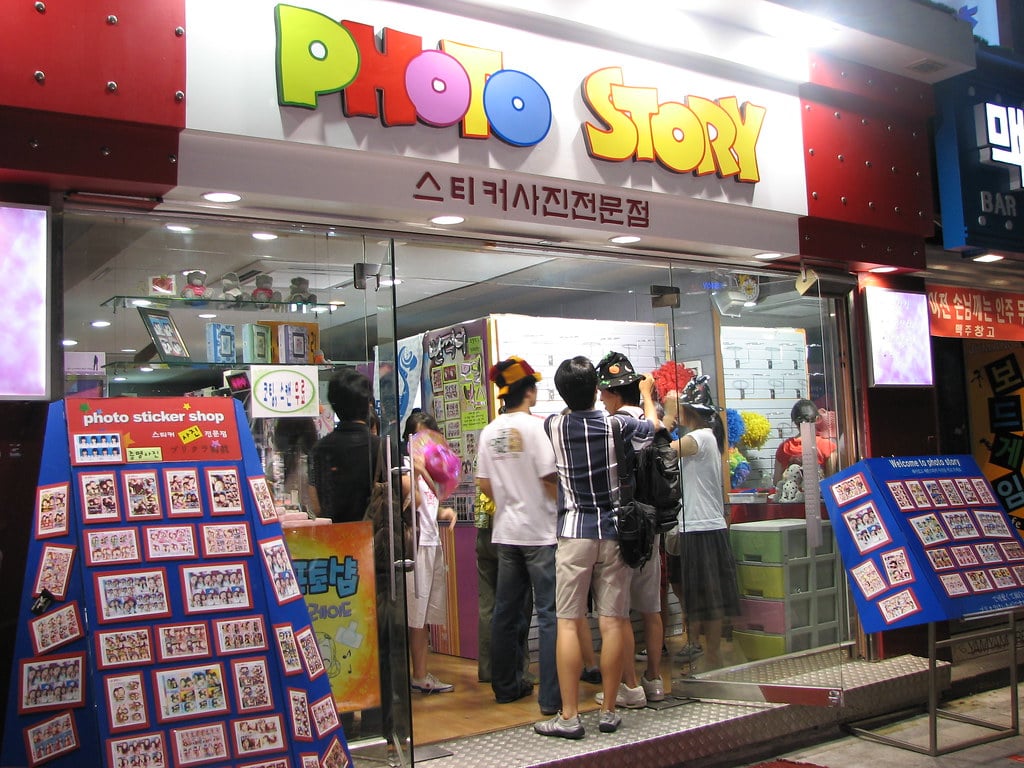
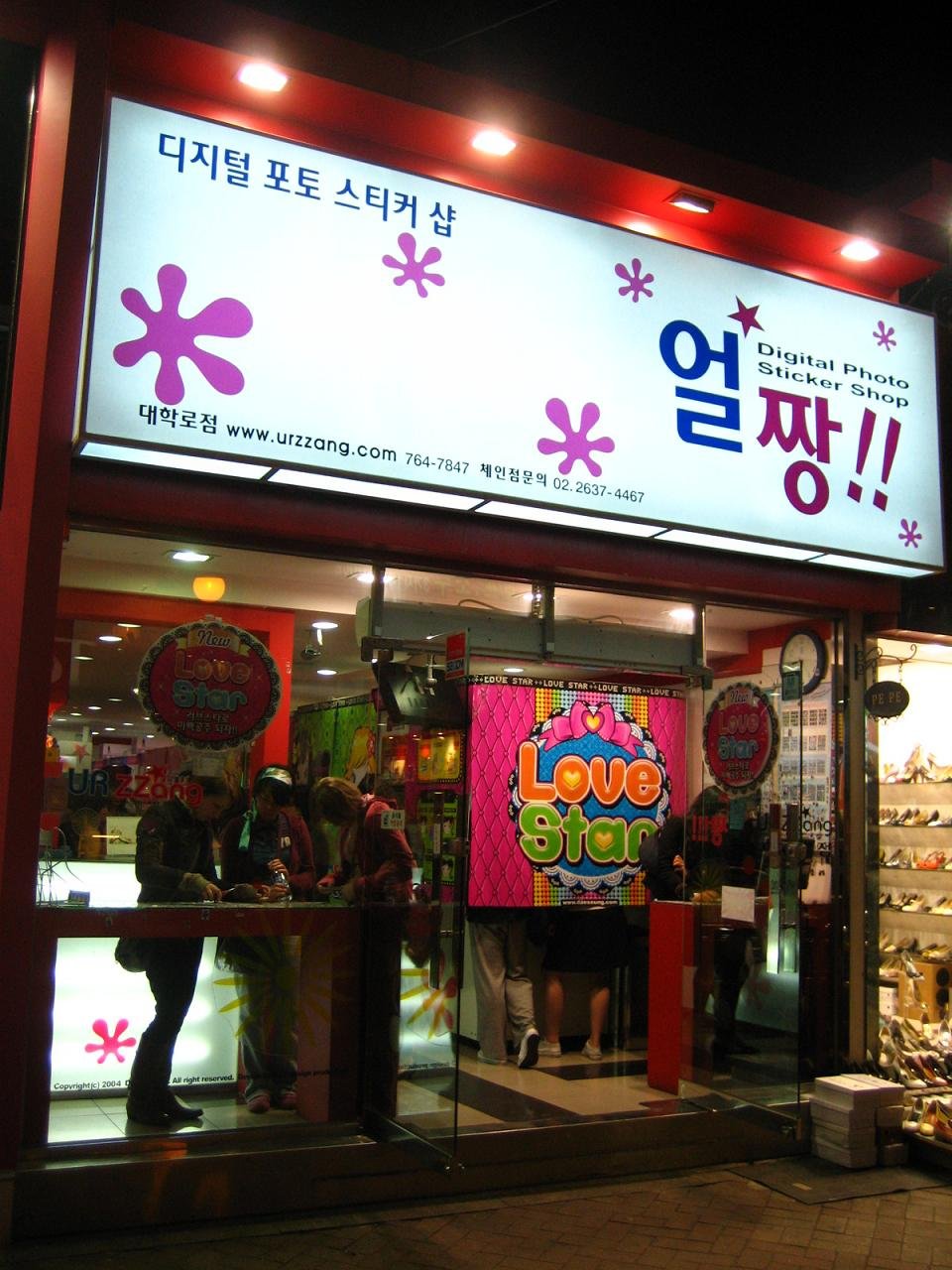
Photographs do offer one clue: the gap was not entirely devoid of shops. In August 2006, Seoul had a “PHOTO STORY 스티커사진전문점,” or sticker-photo specialty shop. In March 2008, the sign at “얼짱!! 디지털 포토 스티커 샵” in Daehakro displayed “대학로점,” meaning Daehakro branch, and a “체인점문의,” or chain-store inquiry, telephone number. Someone was still operating a chain. I could not establish how many stores they had or how long they lasted. One brand registered with the Fair Trade Commission in 2023 was called “얼짱사진샵,” Eoljjang Photo Shop; I have not verified whether it had the same operator. Photographs: top, Ian Muttoo, CC BY-SA 2.0, original image; bottom, BrianAdler, public domain, original image.
3. How the Second Wave Began: Someone Whose Name He Would Not Reveal, 2017
The usual account is that “Life4Cuts started in Daegu in 2017, founded by Lee Ho-ik.” But the primary sources tell a different story.
In an interview with Open Startup News (열린창업신문), Lee Ho-ik said:
In early 2017, there was a sticker-photo machine on Ulsan’s “젊음의 거리,” the Street of Youth. I saw a long queue of young people in front of a machine carrying the “인생네컷” brand.
Notice that wording: the machine he saw already carried the Life4Cuts brand name.
What happened next was this: he proposed to the operator at the time, “Let me become your general distributor for Seoul and Gyeonggi.” Within four months, he installed dozens of machines in places including Itaewon and Hongdae. Four months after that, he acquired the brand.
The franchise business formally began on January 17, 2018; LK Ventures was incorporated on January 22. Both dates are official Fair Trade Commission records.
So Lee Ho-ik did not create the Life4Cuts brand.
Who did? I could not find out. And this is more than a lack of documentation: reporting in the same series states that Lee remained “entirely silent” about the identity of the owner of the Ulsan machine. Someone involved deliberately kept the industry’s starting point out of public view.
There are two other inconsistencies. The interview says the brand “started on a small scale in the Gyeongnam region,” whereas most media accounts say “Daegu, April 2017.” Another report says he began the business after being inspired by an ID-photo machine in a subway station; that account coexists with the acquisition story in different reports. I cannot determine which version is correct, so I have included them all.
4. What He Actually Did: Turn a Vending Machine into a Store
If he did not create the brand, what did he do?
In a 2023 interview with Hankook Ilbo (한국일보), he put it this way:
At the time, all I saw was the brand name “Life4Cuts.” Who would have thought to put a brand on a vending machine?
Then:
I decided to turn the vending machine into a store.
That sentence marks the dividing line between the first and second waves. First-wave machines lived inside arcades as one piece of equipment in someone else’s shop. The second wave moved them into indoor spaces with decor, props, and lighting design, transforming a machine into somewhere you could spend twenty minutes.
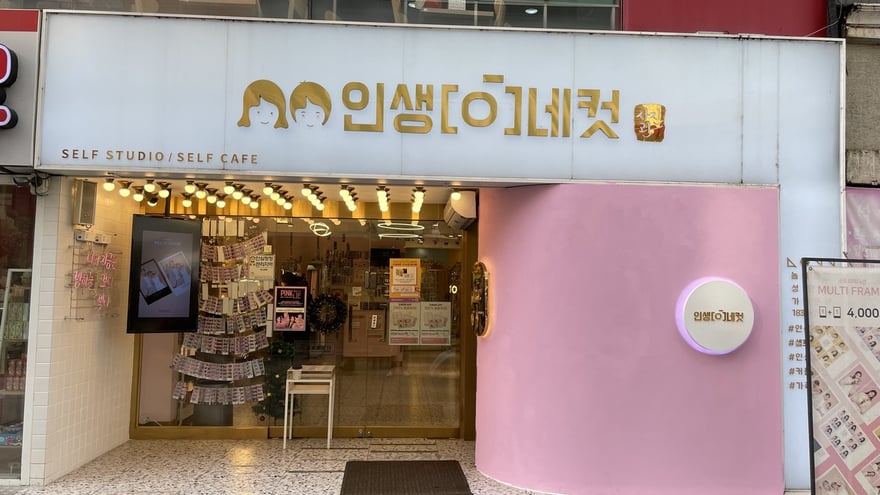
A Life4Cuts store on December 6, 2022. The sign reads SELF STUDIO and SELF CAFE, prices stand at the entrance, and samples cover an entire wall inside. This is what “turning a vending machine into a store” looks like. Photograph by this site; see the field report on Life4Cuts.
Some brands returned to the hosted-machine approach, though. Photomatic, which I visited on the same trip, did not open its own store. Instead, it placed a black-and-white photo booth inside NIKE’s Hongdae store and printed the store name on every photo. It recreated the first wave’s model of occupying someone else’s premises, with brand flagship stores replacing arcades.
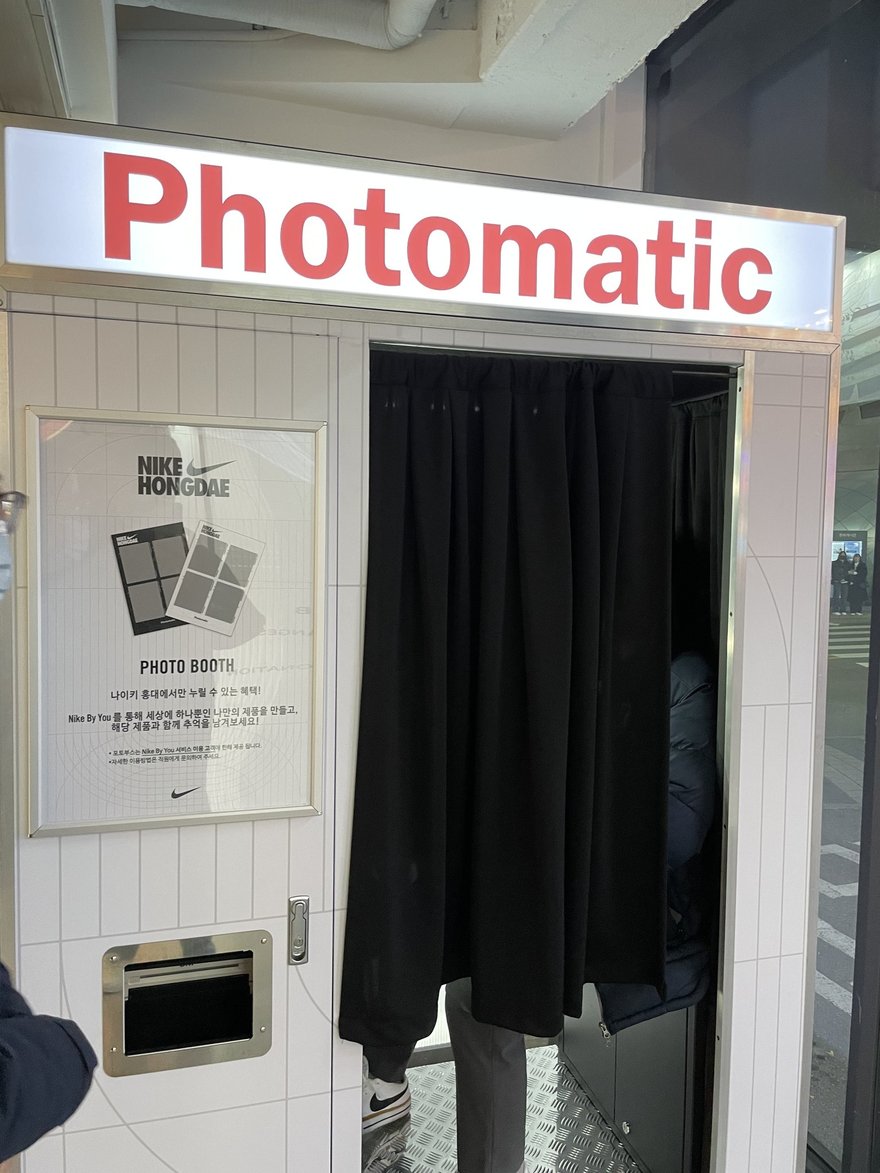
Photomatic’s booth inside NIKE’s Hongdae store on December 7, 2022. Photograph by this site.
Incidentally, Photogray’s predecessor, “포토그레이 오리진,” Photogray Origin, was also founded in 2017. Two independent starting points emerged in the same year, suggesting that 2017 was more than a coincidence involving one brand. I covered this brand’s full subsequent history in The Original, Put on Ice, Then Rebooted: A Company Study of PHOTOGRAY and Parent APR.
By 2018, Life4Cuts had approximately 200 vending machines and ten studios nationwide. I could not find figures for 2019.
As for why the revival happened specifically in 2017, I found no industry analysis independent of brand narratives. The available explanations—retro trends, Gen Z nostalgia, and Instagram’s visual culture—are all retrospective attributions.
Part Two: The Boom and the Shift, 2020–2022
5. 2020: Not Wanting to Share a Room with Strangers
The pandemic-era evidence differs from intuition, so it needs a careful explanation.
Intuitively, an unattended, contactless business should have benefited from the pandemic. Media coverage at the time did indeed frame it that way. In June 2021, Aju Business Daily (아주경제) ran a series called “The Republic of Korea Changed by COVID.” Its thirteenth installment covered “the wave of unattended businesses riding the contactless trend.” Photo booths were placed within the broader “unattended-business startup trend,” alongside unattended cafés, supermarkets, and laundries.
But a field report in Segye Ilbo (세계일보) in December 2020 is more revealing than those overviews. A consumer named Kim Cho-hui said:
I sought out an unattended self-service studio because I couldn’t take off my mask and spend a long time with a photographer.
In the same article, unattended-studio operator Seo Mi-rang said that many people had recently called to ask, “Will we be the only ones using it during that time slot, or will there be other customers?”
In other words, the demand at the end of 2020 was driven by “not wanting to share a room with strangers.”
It was a defensive need.
6. 2021: The Demand Narrative Changed
By July 2021, when Joongdo Ilbo (중도일보) interviewed young people in Daejeon, their reasons were entirely different.
Twenty-seven-year-old Lee Ga-eun said:
You can immediately check how the pictures turned out, and with no outsiders present, you can freely make expressions and strike poses.
Twenty-nine-year-old Baek Eun-ha said:
Taking pictures in a photo studio used to feel stiff and awkward… This time, I had so much fun that I didn’t even notice I was being photographed.
The rationale shifted from infection prevention to feeling at ease without a photographer present. Within a year, the same product acquired a different demand narrative: from protection to autonomy.
7. 2022: Reopening Was the Trigger
Now look at the National Tax Service figures. This business has its own code in Korea’s tax system. Its annual tax base—roughly equivalent to reported sales before tax—was:
KRW 134.4 billion in 2020, KRW 133.7 billion in 2021, KRW 247.1 billion in 2022, KRW 290.6 billion in 2023, and KRW 319.6 billion in 2024.
Look at the second number. In 2021, when the pandemic was at its worst, sales in this category actually declined slightly. The jump came in 2022: 85% growth in one year, the year restrictions were lifted.
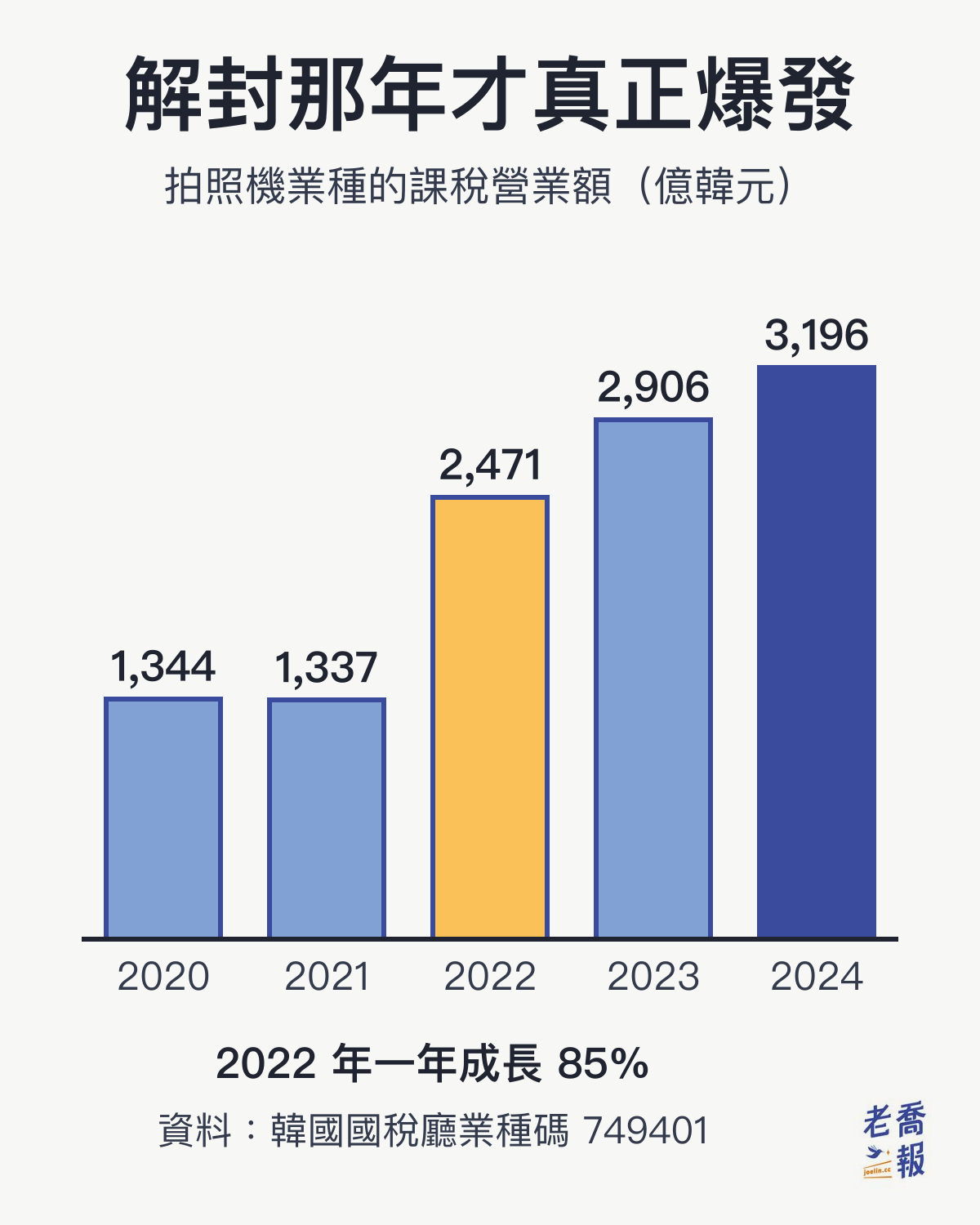
The real driver, then, was pent-up leisure spending after reopening. The unattended-business narrative peaked in 2020–2021; the revenue peak followed a year later. The narrative led reality by roughly a year.
The two sets of testimony in Sections 5 and 6 make sense in that light: defensive demand could sustain the business’s existence, but could not generate growth. Volume rose once the proposition became “this is fun in itself.”
KB Kookmin Card’s subsequent analysis points to the same timing. Unattended photo studios’ sales in 2022 grew 271% over 2021, the strongest increase among all unattended formats; coin-operated karaoke grew 115% over the same period. This was a comparison of 2022 against 2021, published retrospectively in 2023.
8. Who Was Opening Stores, and Why the Warnings Always Came Late
Young people were the main store openers. In one case, a young man recently discharged from military service opened a Photo Street near Omokgyo Station in Seoul. Equipment and interior work cost approximately KRW 100 million, or about TWD 2.29 million. More broadly, the main entrants were entrepreneurs without food-service or retail experience, attracted by the low barrier of “no specialized skills required; can operate unattended.”
Franchise recruitment pitches were consistent, with three selling points: unattended operation, savings on long-term staffing, and twenty-four-hour opening to improve sales per unit of floor space. One recruitment page put it this way:
Operators can maximize returns by reducing personnel expenses. An unattended system can operate twenty-four hours a day, allowing customers convenient access during commuting hours or on weekends, with excellent profitability.
Where were the stores opening? In districts where young people congregated, such as Hongdae and Seongsu. How dense were they? Seongsu-dong had five self-service photo studios within 130 meters; the area near Hongik University Station also had five within 130 meters. One report described more than thirty in a single commercial district.
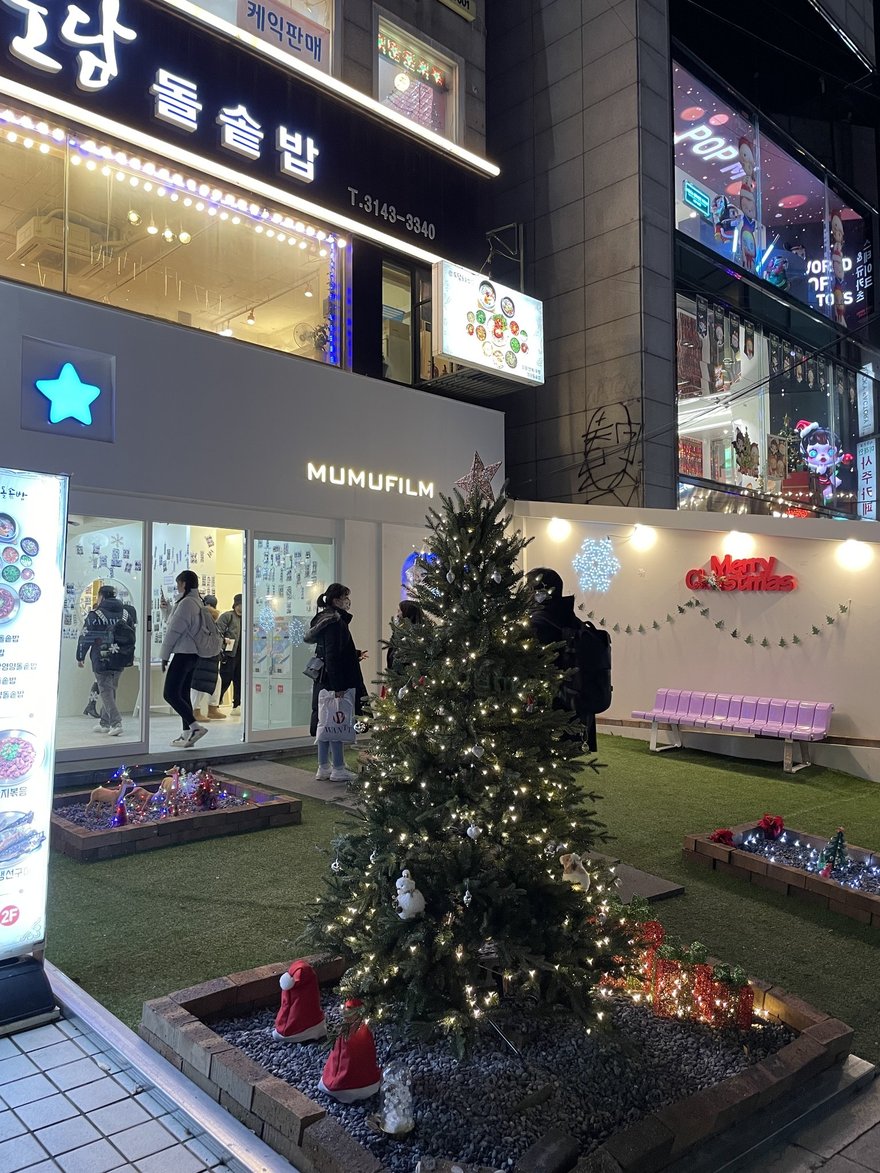
On December 7, 2022, MUMUFILM had covered its entire storefront area in turf and installed a Christmas tree, surrounded on both sides by other businesses’ signs. That year marked the peak of store openings, with shops competing for attention on the same street. Photograph by this site; see MUMUFILM.
One point deserves separate attention: the warnings appeared very late.
Media framing in 2020–2021 was almost entirely a positive growth story. Reports about “excessive franchise recruitment,” “franchise disputes,” and “surging secondhand-machine listings” became common only from late 2022 through 2024.
Compare that with National Tax Service closure registrations: 176 in 2020, 195 in 2021, 296 in 2022, 514 in 2023, and 611 in 2024.
The warnings reached the press at roughly the same time closures began accelerating. The media were acknowledging what had happened.
One case involved a twenty-nine-year-old entrepreneur who believed only the claim that “photo booths are guaranteed to make money,” even borrowing to fund equipment and interior work, and ended up with approximately KRW 100 million in debt.
The Korean industry’s own comparison was blunt: claw-machine stores, the country’s previous low-barrier unattended-business bubble in 2016–2018. They made that analogy themselves.
Part Three: What the Industry Looks Like Now, 2023–2026
9. How Many Brands Are There?
Media reports often mention approximately fifty brands and 3,000 stores nationwide. But the source is only “according to the industry,” with no identifiable institution behind it, so I do not use those figures as data.
The answer grounded in statutory filings is the set of brands that have registered franchise disclosure documents with the Fair Trade Commission. In August 2026, I searched them individually by keyword and confirmed approximately thirty after removing duplicates.
That is a lower bound, not a total. Brands missed by the keyword searches are excluded, and those operating only company-owned stores without franchising do not register.
One notable detail: all thirty brands were classified as “기타 서비스,” other services. The Fair Trade Commission’s industry classification has no photography or photo booth category.
Major brands and registration dates:
| Logo | Brand | English | Franchisor | Initial registration |
|---|---|---|---|---|
 |
포토이즘 | Photoism | 서북 Seobuk | 2020.03.19 |
| 포토마임 | Photo Mime | 이맛이지 | 2021.02.04 | |
|
포토이즘박스 | Photoism Box | 서북 Seobuk | 2021.06.18 |
 |
포토시그니처 | Photo Signature | 이미지네트웍스플러스 Image Networks Plus | 2021.10.15 |
| 미소포토부스 | Miso Photo Booth | 티엠벤처스 | 2021.11.03 | |
 |
하루필름 | Haru Film | 에이치제이제이컴퍼니 HJJ | 2021.11.05 |
 |
포토그레이 | Photogray | 에이피알 APR | 2021.11.12 |
 |
그믐달셀프스튜디오 | Old Moon Self Studio | 네이처라우드 Nature Loud | 2022.02.22 |
 |
플랜비 스튜디오 | PLAN B Studio | 리오컴퍼니 Rio | 2022.02.22 |
 |
인생네컷 | Life4Cuts | 엘케이벤쳐스 LK Ventures | 2022.03.21 |
| 포토스트리트 | Photo Street | 웜브로 | 2022.08.17 | |
 |
픽닷 | PICDOT | 에브리세컨드 Every Second | 2022.08.08 |
|
포토이즘컬러드 | Photoism Colored | 서북 Seobuk | 2022.09.22 |
 |
하마필름 | Hama Film | 루센트 Lucent | 2023.01.26 |
 |
포토오브제 | Photo Objet | 리오컴퍼니 Rio | 2024.11.26 |
(The complete thirty-brand reference table appears at the end.)
The registration dates reveal a clear curve: one in 2020, five in 2021, seven in 2022, four in 2023, five in 2024, and three in 2025. New franchise-brand registrations peaked in 2021–2022.
PICDOT (픽닷) was the store I photographed in Seomyeon, Busan, in December 2022. It had 24 HOURS and CARD & CASH etched directly onto its glass door. At the time, I knew only the brand; now I could connect it to its legally registered entity. PLAN B Studio and Photo Objet also share the same franchisor and representative.
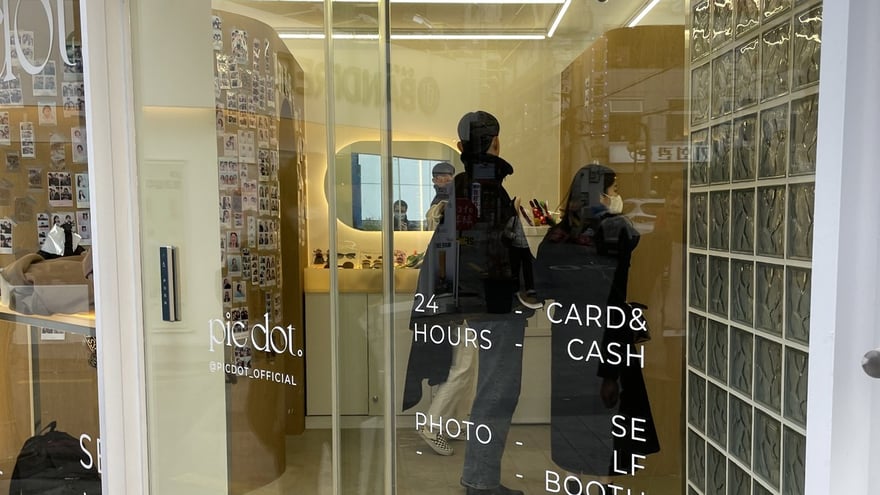
Pic dot, or PICDOT, in Seomyeon, Busan, on December 4, 2022. The glass door reads 24 HOURS and CARD & CASH. It had eight stores nationwide that year; the disclosure document two years later showed forty-eight. Photograph by this site.
9.2. How Often Are These Data Updated?
Almost all the figures in the preceding sections come from franchise disclosure documents, so their reporting cycle needs explaining first. It determines which point in time the figures can represent.
Under Korea’s Fair Transactions in Franchise Business Act, franchisors must register their regular updates within 120 days after the end of each fiscal year. Sole proprietors required to prepare financial statements receive 180 days. The registered information covers the previous fiscal year’s financial position, employee count, average annual franchise-store sales and the basis for calculating them, goods purchases and leasing details, store counts, advertising and promotional expenditure, and other items.
Most Korean companies use calendar years. Adding 120 days to a December 31 year-end gives an April 30 deadline in the following year. That explains why many of the latest versions I obtained were dated April 2026 while disclosing figures for fiscal 2025.
One point therefore needs to be clear: the latest “current state” these documents can represent is the end of 2025. Figures for 2026 will not enter the register until April 2027.
Two other features affect how the numbers should be read:
- Each version discloses only the latest reporting year. To examine trends, you have to retrieve historical versions individually; that is how the four-year per-store revenue table was assembled.
- Alongside regular annual updates, changes can be registered at any time, such as changes of address or fees. Brands’ final registration dates therefore do not all fall neatly in April.
How fresh were the data in practice? I opened the pages for all thirty brands individually:
| Latest data year | Brands | Share |
|---|---|---|
| Fiscal 2025 | 20 | 67% |
| Fiscal 2024 | 10 | 33% |
| 2023 or earlier | 0 | 0% |
| Not found | 0 | 0% |
All thirty registered brands had disclosure documents; none was missing. But freshness fell into two groups: two-thirds had updated to fiscal 2025, while one-third remained at fiscal 2024.
Four of the ten brands still reporting 2024 were sizable: Photogray, Photo Signature, PLAN B Studio, and PICDOT, with 499 stores combined. As of August 2026, none had completed its regular 2026 update registration. They may have been overdue, or their fiscal years may not follow the calendar year. I did not verify this, so I draw no conclusion. The Film and Photoflex were even older, having gone more than a year without an update.
(The full thirty-brand distribution appears in Appendix Three.)
9.3. Two Overlooked Brands
After completing this table, two brands emerged that neither previous media coverage nor my own narrative had mentioned.
PLAN B Studio: twenty stores in 2022, ninety-seven in 2023, and 122 in 2024—116 franchised and six company-operated. It grew sixfold in two years, reaching a scale comparable to Photogray’s 154 stores.
PICDOT: eight stores in 2022, twenty-four in 2023, and forty-eight in 2024. This was the store I photographed in Seomyeon, Busan, in December 2022. It had only eight stores nationwide then, and I happened to walk into one of them.
Both brands’ data stop at fiscal 2024, so their 2025 situation is unknown. Their existence nevertheless shows that the media’s longstanding “top three” framework overlooked growing mid-tier brands.
One detail discovered while checking the tables: Hama Film was previously called “하마 study cafe,” an unattended study room. Moving from one unattended format into another was the only verifiable case of such a transition I found in this entire investigation.
Two other brands, Soyou Film and Photo Outlet, had registered but had not yet opened franchising. Both franchised and company-operated store counts were zero. This represents a business that has not started, rather than a decline to zero franchises; that distinction matters when reading the table.
10. Store-Opening Costs and Per-Store Revenue
The following comes from each brand’s latest disclosure document, with registration dates between October 2025 and August 2026.
| Brand | Reference floor area | Opening costs, excluding interior work | Latest franchised / company-operated stores | Average annual franchise-store revenue |
|---|---|---|---|---|
| Photogray | 33 m² | KRW 120.83 million, about TWD 2.76 million | 107 / 47 (2024) | KRW 205.10 million, about TWD 4.69 million |
| Photoism Box | 33 m² | KRW 73.92 million, about TWD 1.69 million | 449 / 21 (2025) | KRW 166.78 million, about TWD 3.81 million |
| Photoism Colored | 33 m² | KRW 73.92 million, about TWD 1.69 million | 70 / 12 (2025) | KRW 156.21 million, about TWD 3.57 million |
| Photo Signature | 33 m² | KRW 112.77 million, about TWD 2.58 million | 174 / 1 (2024) | KRW 123.98 million, about TWD 2.83 million |
| Photoism main line | 50 m² | KRW 65.20 million, about TWD 1.49 million | 14 / 2 (2025) | KRW 87.14 million, about TWD 1.99 million |
| Old Moon | 33 m² | KRW 80.20 million, about TWD 1.83 million | 40 / 1 (2025) | KRW 67.30 million, about TWD 1.54 million |
| Life4Cuts | 33 m² | KRW 99.95 million, about TWD 2.28 million | 261 / 12 (2025) | KRW 44.66 million, about TWD 1.02 million |
| Hama Film | 33 m² | KRW 83.60 million, about TWD 1.91 million | 15 / 0 (2024) | KRW 41.92 million, about TWD 960,000 |
One detail deserves a pause: almost every reference floor area is 33 square meters, roughly ten ping, with only Photoism’s main line using 50 square meters. That makes these brands’ opening costs comparable in this instance.
Average annual revenue varies enormously. Photogray, the highest, reports KRW 205.10 million; Hama Film, the lowest, KRW 41.92 million—a nearly fivefold difference. The same ten-ping store size, the same basic machine concept.
These are sales, not profit. Opening costs also exclude interior work, which each brand charges separately at KRW 1.98–5.50 million per square meter, as well as rent, fire-safety work, and air conditioning. Any multiple obtained by dividing these two columns is not a return on investment.
11. Store-Count Trends: A Reshuffling Rather Than Universal Decline
| Brand | 2023 | 2024 | 2025 |
|---|---|---|---|
| Life4Cuts | 368 | 310 | 261 |
| Photoism Box | 369 | 423 | 449 |
| Photoism Colored | 62 | 74 | 70 |
| Photoism main line | 28 | 19 | 14 |
| Old Moon | 78 | 54 | 40 |
| Photogray | 92 | 107 | — |
| Photo Signature | 206 | 174 | — |
(All figures are year-end franchised-store counts. Different brand lines are registered independently and should not be added together.)
This table challenges the sweeping claim that “the industry is declining.”
Life4Cuts lost 107 stores in two years, a 29% decrease. Old Moon halved over the same period, and Photo Signature was also shrinking. Meanwhile, Photoism Box added eighty stores, and Photogray was growing too.
More interestingly, within the same company, Seobuk, Photoism’s main line fell from twenty-eight stores to fourteen while Photoism Box grew from 369 to 449. Even inside one headquarters, resources were concentrating on specific store formats. That headquarters’ financial statements were also troubled; see The Market Leader Lost Money Last Year: A Financial Statement Study of PHOTOISM Parent Seobuk.
From another perspective, adding the stores belonging to one company together, PHOTOISM’s three lines had 459 franchised stores in 2023, already exceeding Life4Cuts’ 368. In 2025, the comparison was 533 to 261. By store count, Life4Cuts had ceased to lead by 2023. Section 14.2 discusses that company.
Contract changes are even more direct. Life4Cuts recorded 227 contract cancellations over three years: seventy-seven in 2023, eighty-six in 2024, and sixty-four in 2025. Photo Signature recorded thirty-seven contract terminations in 2024 alone.
12. Four Years of Per-Store Revenue: The Collapse Varies by Brand
Each disclosure version reports only the latest year, but historical versions remain available. Checking them individually allows a four-year per-store revenue curve to be reconstructed. Figures are in thousands of Korean won; parentheses show the number of sample stores for that year.
| Data year | Haru Film | Life4Cuts | Photoism Box | Photogray | Photo Signature |
|---|---|---|---|---|---|
| 2022 | 433,546 (101) | 150,767 (334) | 183,333 (257) | 154,349 (74) | 218,644 (210) |
| 2023 | 225,484 (116) | 88,880 (374) | 161,110 (369) | 202,804 (94) | 141,753 (206) |
| 2024 | 140,827 (118) | 57,444 (312) | 186,056 (423) | 205,096 (107) | 123,976 (174) |
| 2025 | 99,419 (91) | 44,655 (261) | 166,779 (449) | Not published | Not published |
| Change over four years | −77% | −70% | −9% | +33% | −43% |
This table brings the preceding debate into focus.
Collapsing per-store revenue is a brand-specific phenomenon. Haru Film fell 77% over four years, Life4Cuts 70%, and Photo Signature 43%. But Photoism Box fell only 9%, while Photogray rose 33%.
In other words, market share is shifting and store-level economics are diverging. Some brands have more stores but weaker individual stores; others have more stores while per-store revenue holds up; one is growing both its store count and per-store revenue.
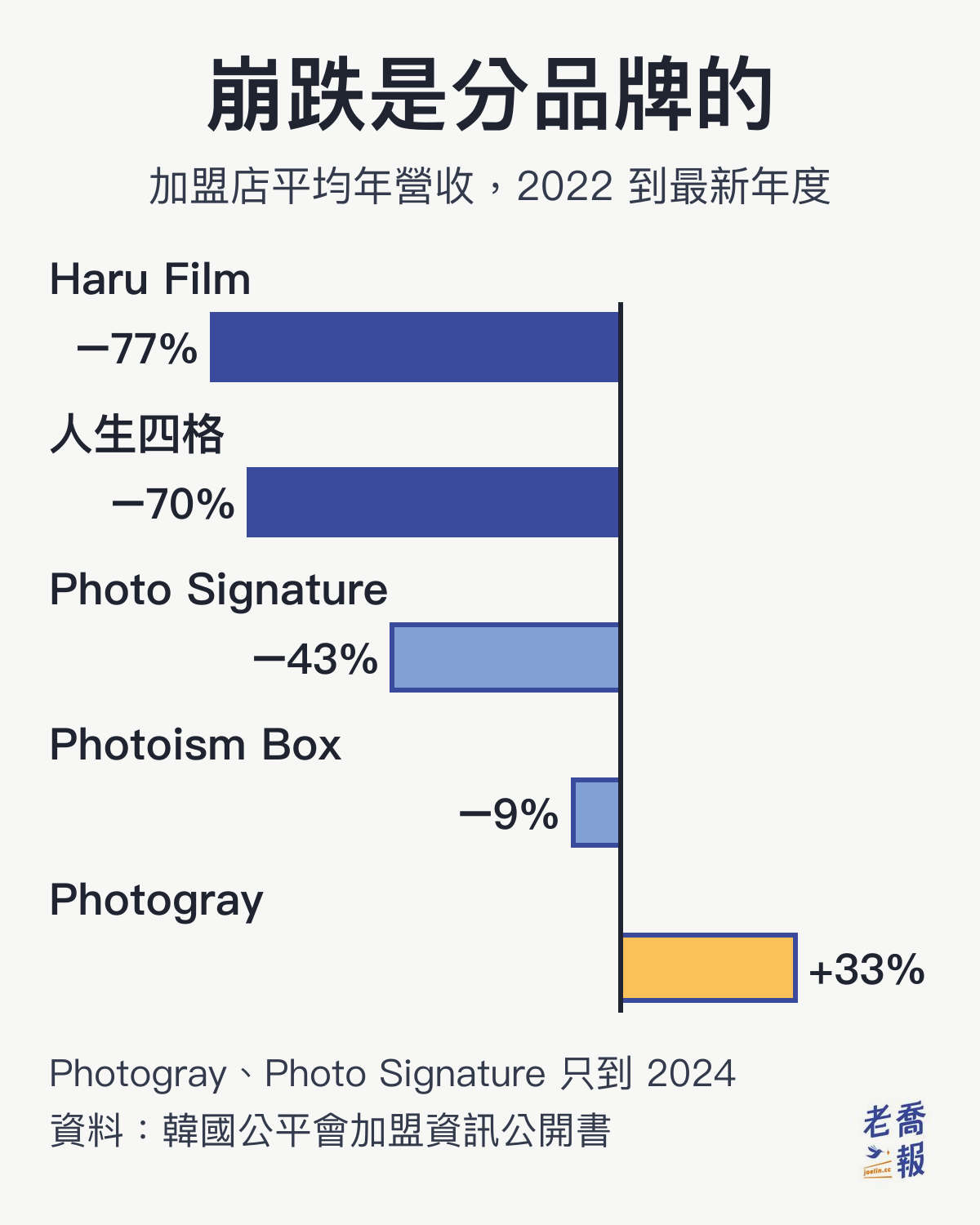
Opening costs barely changed over those four years. The numerator is falling while the denominator stays put: this is where franchise recruitment figures can most easily become misleading.
13. Haru Film’s Cliff, and That “4.1 Times”
Haru Film’s row deserves particular attention.
In 2022, its annual per-store revenue was KRW 433.54 million, approximately TWD 9.91 million, or 2.4 times Photoism Box’s figure that year. It had only 101 stores at the time. That was an exceptionally high starting point.
Its store count peaked at 133 at the end of 2024—118 franchised and fifteen company-operated—and fell to 106 at the end of 2025—ninety-one franchised and fifteen company-operated. It lost twenty-seven stores in one year. Franchise changes are even clearer: twenty new openings and two contract terminations in 2023; eight openings and four terminations in 2024; five openings and thirty-two terminations in 2025.
When I visited Busan in December 2022, Haru Film was at that high point. Locals described it as “the one doing the best business,” an impression consistent with the figures. That store had an owner’s self-inspection checklist on the wall and a collaboration campaign with a shoe shop at the entrance. It had the most developed collaboration I saw on the trip.
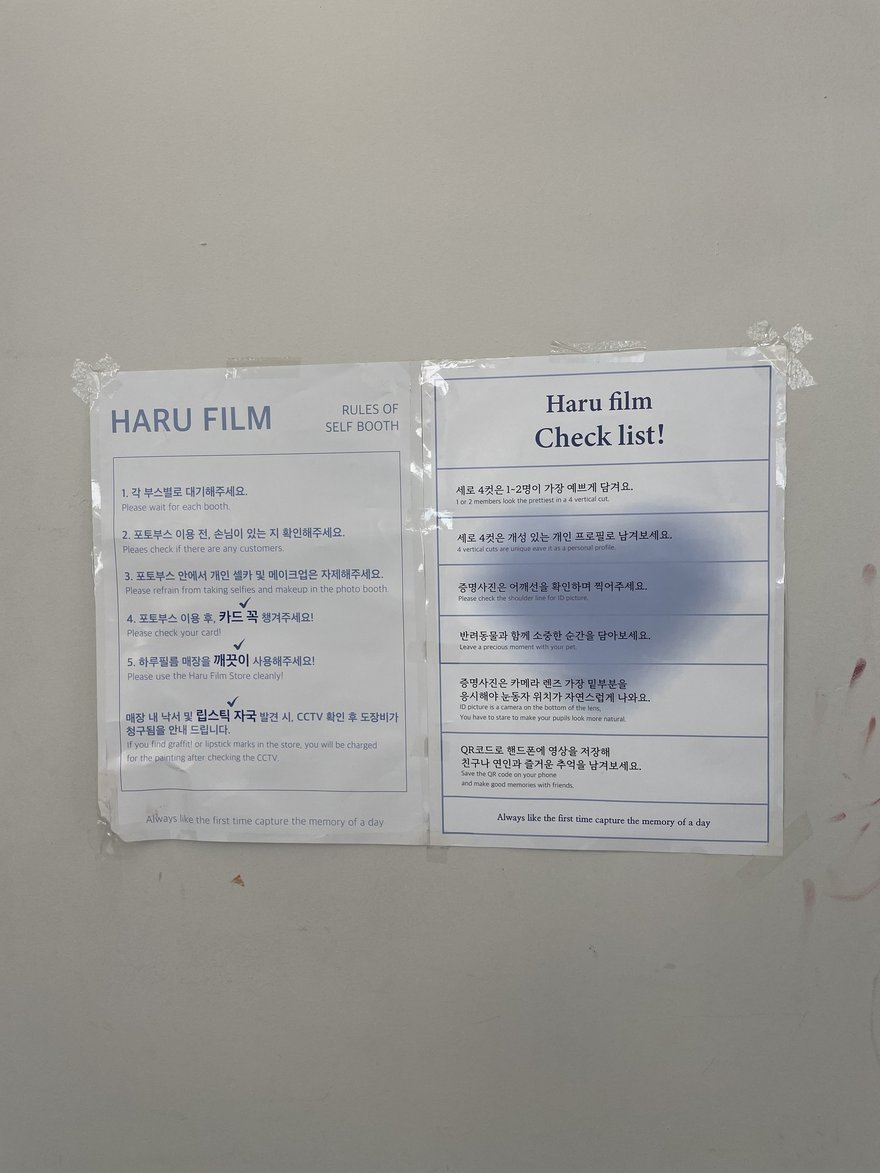
The “Check list” on a Haru Film store wall on December 6, 2022. At the time, the brand was at its high point of approximately KRW 400 million in annual per-store revenue. Photograph by this site.
That high base also explains why an October 2024 report, using fiscal 2023 data, calculated a “revenue-to-opening-cost multiple of 4.1, the highest among all brands.”
Apply the same calculation to fiscal 2025: KRW 99.42 million divided by KRW 55.55 million equals 1.8 times.
That 4.1 multiple was a snapshot from two years earlier. The 1.8 multiple is likewise not a return on investment: the numerator remains sales before tax, while the denominator remains a reference opening cost excluding rent, fire-safety work, and air conditioning. It is simply the same rough calculation applied to a newer year.
14. The Pioneer’s Finances: Revenue Halved, Equity Turned Negative
Franchise disclosure documents report the franchisor’s financial position; the Financial Supervisory Service’s electronic disclosures provide more detail. The four-year figures for Life4Cuts parent LK Ventures are below.
| Year | Revenue | Operating profit | Net profit for the year | Equity |
|---|---|---|---|---|
| 2022 | KRW 25.49 billion, about TWD 580 million | +KRW 4.50 billion | +KRW 3.62 billion | +KRW 4.28 billion |
| 2023 | KRW 22.59 billion, about TWD 520 million | +KRW 1.26 billion | +KRW 450 million | +KRW 4.71 billion |
| 2024 | KRW 19.02 billion, about TWD 430 million | −KRW 4.79 billion | −KRW 8.04 billion | −KRW 3.33 billion |
| 2025 | KRW 12.68 billion, about TWD 290 million | −KRW 5.28 billion | −KRW 7.49 billion | −KRW 10.82 billion |
Revenue halved across four years. Equity turned negative in 2024, reaching approximately negative KRW 10.8 billion in 2025. Losses had consumed the company’s entire book net worth.
Two further details are more serious. In the fiscal 2025 notes, the signing auditor raised “substantial doubt about the company’s ability to continue as a going concern”; current liabilities exceeded current assets by KRW 10.4 billion. The company had also undertaken no equity financing during those four years. Its shareholder register consistently showed only the founder, holding 100%. The consequence was that all funding came in as debt. The borrowing schedule included a lender charging 12% annual interest and personal borrowing at 18%; KRW 2 billion in privately placed corporate bonds carried the representative director’s personal joint-and-several guarantee.
The “KRW 49.4 billion revenue and KRW 9.9 billion profit” figure for 2023, once widely repeated in Chinese-language reporting, is directly contradicted by primary sources. Actual revenue was KRW 22.59 billion, operating profit KRW 1.26 billion, and net profit KRW 450 million—worse even than 2022. I covered the company’s full journey from pioneer to losses in Why Did the Original Lose? A Company Study of Life4Cuts and Parent LK Ventures.
Two further company facts: LK Ventures’ incorporation date was January 22, 2018, later than the brand’s, supporting the acquisition account rather than a founding account. Its headquarters are in Mokpo, South Jeolla Province, not Seoul. Its franchise-business workforce in 2025 comprised two managers and forty-five employees.
14.2. The Actual Leader: Seobuk, from Cheonan to a Preliminary Listing Review

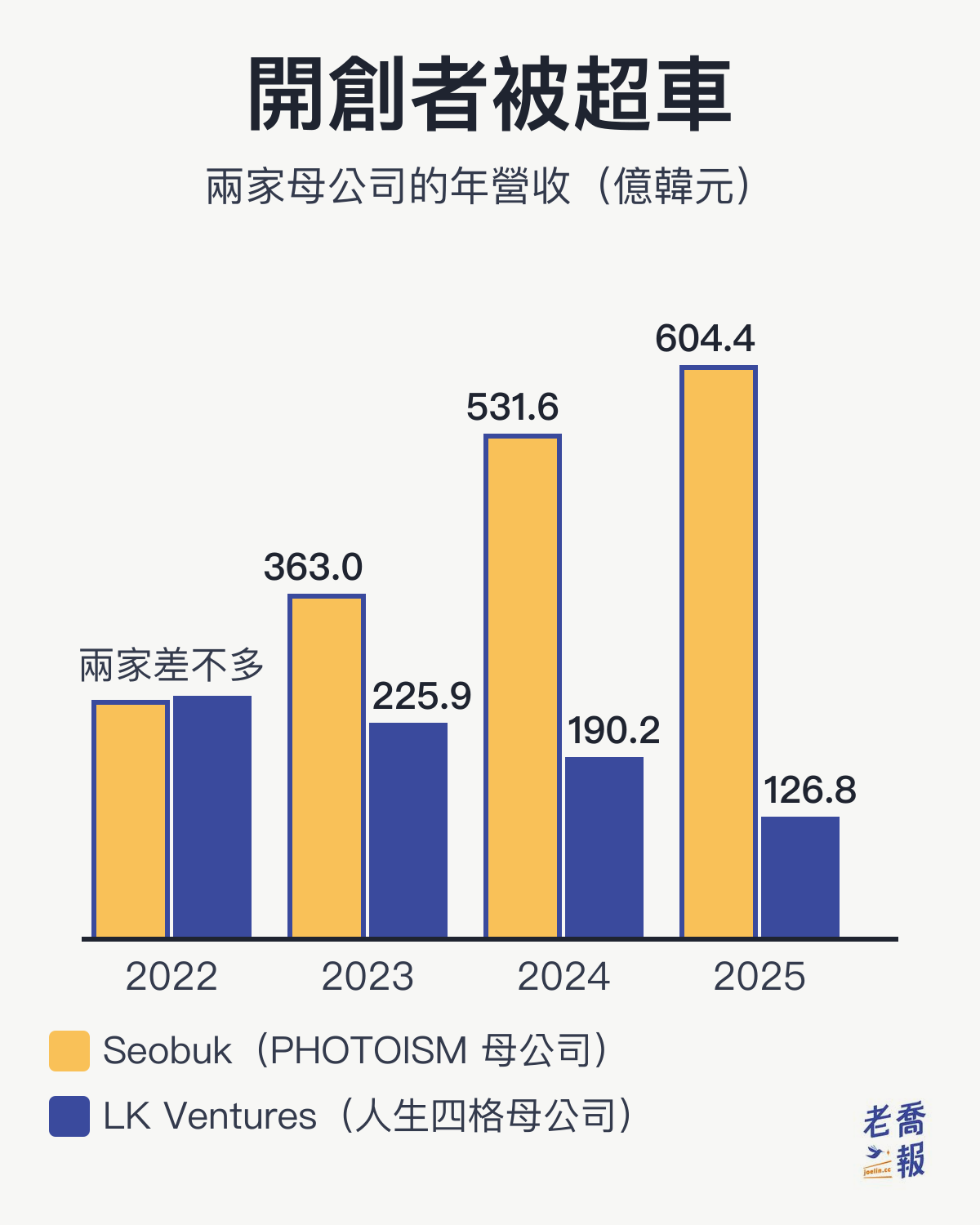
The previous section covered the pioneer; this one covers the current number one. I assess “leadership” using two measures that can be independently recalculated: company revenue from Financial Supervisory Service DART filings, and franchised-store count from Fair Trade Commission disclosure documents.
| Year | Seobuk, PHOTOISM revenue | LK Ventures, Life4Cuts revenue |
|---|---|---|
| 2020 | KRW 780 million | No public financial statements |
| 2021 | KRW 12.19 billion | No public financial statements |
| 2022 | KRW 25.00 billion or KRW 27.27 billion, under two reporting bases | KRW 25.49 billion |
| 2023 | KRW 36.30 billion | KRW 22.59 billion |
| 2024 | KRW 53.16 billion | KRW 19.02 billion |
| 2025 | KRW 60.44 billion, about TWD 1.38 billion | KRW 12.68 billion |
| First half of 2026 | KRW 35.69 billion | Not yet disclosed |
The two companies were similar in 2022. Seobuk’s revenue for that year was KRW 25.00 billion in DART’s comparative column and KRW 27.27 billion in the Fair Trade Commission disclosure—one below Life4Cuts, the other above it. I cannot determine which reporting basis is appropriate. From 2023 onward, the comparison is unambiguous: Seobuk leads by both revenue and store count. The accurate statement is therefore that Life4Cuts was the pioneer, while Seobuk had become the leader by 2023 at the latest. Figures for 2020–2022 come from disclosure documents or individual-company accounts; those from 2023 onward are consolidated.
Its seven years can be divided into five phases:
- 2019–2021 was the startup period. The Photoism STUDIO brand launched in September 2019, and the company was established in Cheonan, South Chungcheong Province, in March 2020. First-year revenue was below KRW 800 million, and book net worth was negative. After the successive launches of BOX and COLORED, revenue reached KRW 12.19 billion in 2021.
- 2022–2023 was the franchise-expansion period. A Japanese subsidiary was established in November 2022. In 2023, the combined franchised-store count of PHOTOISM’s three lines exceeded Life4Cuts’, revenue reached KRW 36.3 billion, and the company remained profitable.
- 2024 brought outside investment and a shift toward IP. It received its first external investment in September, followed at year-end by venture capital associated with SM Entertainment. IP photo frames and photocards grew to more than half of revenue. Full-year revenue was KRW 53.16 billion, with operating profit of KRW 5.66 billion.
- 2025 brought multiple simultaneous bets and the first loss. It launched four new brands in one year and established subsidiaries in the United States and Singapore. Revenue continued growing to KRW 60.44 billion, but the company posted an operating loss of KRW 6.34 billion, and its listing schedule was postponed twice.
- 2026 brought a return to profit and a listing application. First-half revenue was KRW 35.69 billion, operating profit KRW 4.11 billion, and net profit KRW 4.83 billion. Net worth recovered from KRW 4.49 billion at year-end to KRW 9.36 billion. Consolidated subsidiaries increased from six to eight, with new entities in Guangzhou and Taiwan. On September 21, it applied to the Korea Exchange for a preliminary KOSDAQ listing review.
Several figures in the Korea Exchange’s preliminary-review details, supplied by the underwriter with the application, are worth recording:
- Planned listed shares: 12,632,600, including a public offering of 2,600,000 shares, approximately one-fifth.
- Lead underwriter: NH Investment & Securities. Signing auditor: 성현회계법인, Seonghyeon Accounting Corporation.
- Employees: 164. Largest shareholder: founder 김민석, Kim Min-seok, with 70%.
- The application included fiscal 2025 financials: revenue of KRW 60.439 billion, net loss of KRW 8.764 billion, and net worth of KRW 4.485 billion.
- Registered industry: “사진장비 및 광학기기 제조업,” manufacture of photographic equipment and optical instruments. The main product was described as unattended self-service studio franchising.
The last item best explains its relationship to the industry. Seobuk registers with the exchange as a manufacturer. It is simultaneously a franchisor, a supplier of machines and photo paper, and a platform for IP content. Franchisees buy interior work, KIOSK machines, and photo paper from it when opening their stores. After opening, every printed celebrity frame generates revenue shared with the rights holder, rather than covered by an outright license purchase. In 2025, 68.8% of its revenue came from IP content, with photography services and franchising playing supporting roles. The financial details are in The Market Leader Lost Money Last Year: A Financial Statement Study of PHOTOISM Parent Seobuk.
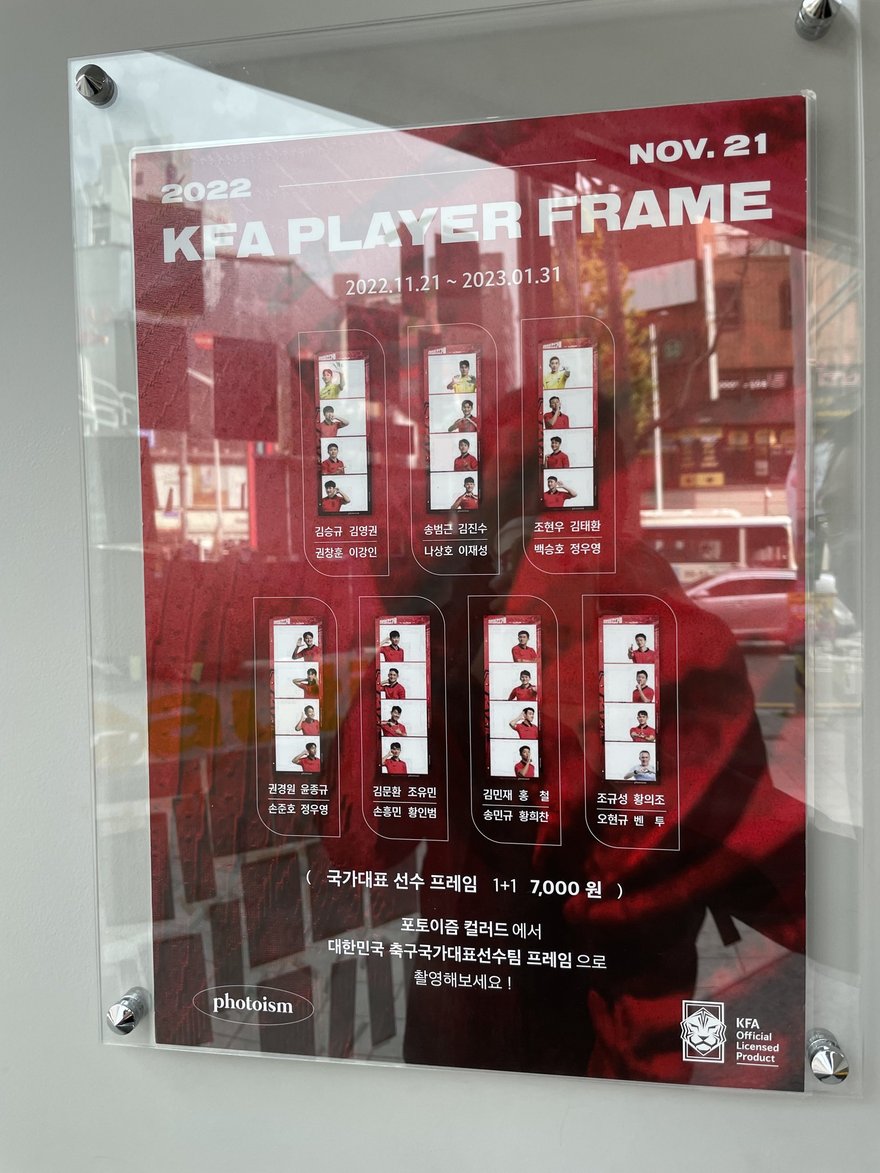
PHOTOISM COLORED in Busan on December 4, 2022. During the Qatar World Cup, officially licensed Korean national football team frames occupied the most prominent spot in the store. IP content, which later supported nearly 70% of Seobuk’s revenue, was already its signature strategy. Photograph by this site; see PHOTOISM COLORED.
The company’s own stated direction appears in its August 2026 half-year report:
- Expand the customer base from general consumers to “core fans,” and extend products beyond photography to frames, photocards, licensed merchandise, and pop-up stores.
- Use the wholly company-operated flagship PHOTOISM PLAY to launch pop-ups in coordination with rights holders’ event schedules.
- Introduce arcade-style brands WAKU WAKU and GET-YA, allowing customers to obtain IP merchandise directly in-store.
- Previously announced milestones were KRW 100 billion in revenue and overseas revenue exceeding domestic revenue. The US IP business was central to its listing story.
My assessment—an inference, not the company’s statement—is that the return to profit in the first half of 2026 suggests part of the 2025 loss was a concentrated bill for expansion. But domestic franchise revenue fell 35% in 2025, showing that the Korean store-opening engine had slowed. Almost all of the company’s next growth bets are on overseas markets and IP.
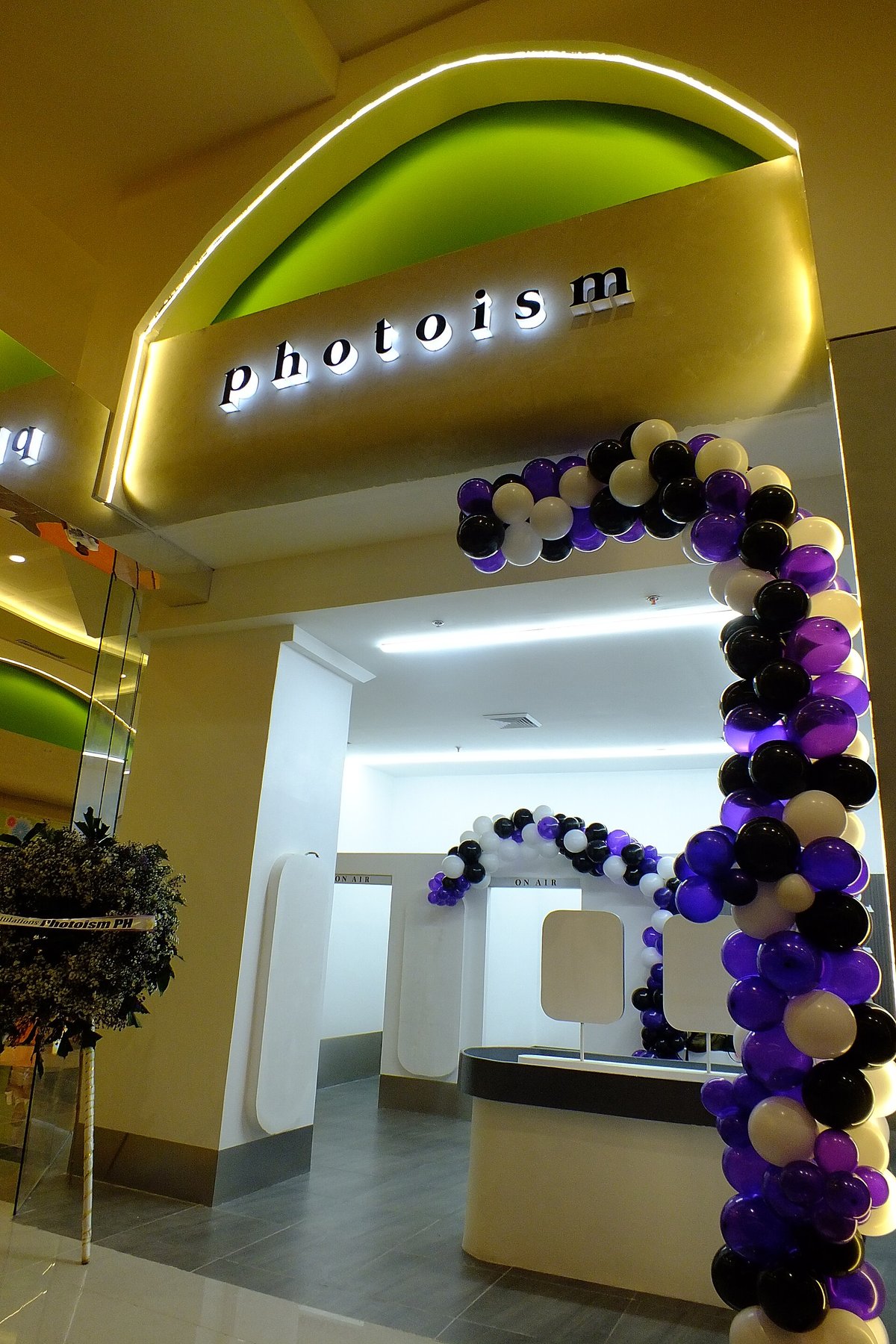
The newly opened PHOTOISM store at SM J Mall in Cebu, Philippines, in October 2024. This article has not verified whether it was company-operated, franchised, or licensed. Seobuk’s financial statements list overseas subsidiaries in Japan, the United States, Singapore, Guangzhou, and Taiwan. Photograph: Wide Awake!, CC BY 4.0, original image.
Applying does not mean being listed. The review outcome was still pending; even after approval, filings and a public offering would be required before trading began. The approximately KRW 150 billion target market capitalization reported by Korean media was an earlier company statement, not a review result. Korean media consistently described it as a contender to become “the first self-service photo studio to list.” I checked the Korea Exchange’s preliminary-review list: among the major photo booth brands’ parent companies, only Seobuk had applied. Life4Cuts’ parent began listing preparations in 2023, but there was no application record.
14.3. Listed Companies Along the Industry Chain
Korea’s industry is the reverse of Japan’s in this respect. Japan has more than ten listed companies along its photo booth industry chain—see Section 5 of Thirty Years of Japanese Photo Booths. Korea’s second wave has so far produced only one listed parent company.
| Logo | Company, securities code | Listing | Relationship to photo booths |
|---|---|---|---|
 |
에이피알 APR (278470) | 2024-02-27, KOSPI | PHOTOGRAY parent; photo booths account for about 2.8% of revenue |
|
서북 Seobuk, PHOTOISM | Unlisted; applied for preliminary KOSDAQ review on 2026-09-21 | Industry leader; itself a photo booth company |
 |
에스엠 SM Entertainment (041510) | 2000-04-27, KOSDAQ | Its venture-capital affiliate invested in Seobuk, indirectly |
 |
와이지 YG Entertainment (122870) | 2011-11-23, KOSDAQ | A YG-affiliated fund invested in Seobuk, indirectly |
 |
기업은행 IBK (024110) | 2003-12-24, KOSPI | A fund investing in Seobuk carries the IBK name; its capital contribution share was not found |
 |
삼성전자 Samsung Electronics (005930) | 1975-06-11, KOSPI | First wave: planned a machine launch in 1998 |
 |
LS ELECTRIC, then LG Industrial Systems (010120) | 1994-07-11 | First wave: entered in 1998 |
 |
SK하이닉스 SK hynix, then Hyundai Electronics (000660) | 1996-12-26, KOSPI | First wave: joint venture with SEGA |
Neither SM nor YG is a direct shareholder in Seobuk. The entities entering its shareholder register were an SM-affiliated venture-capital firm at the end of 2024 and a YG-affiliated fund in early 2025. The table lists the listed companies behind them. LS ELECTRIC’s listing date follows the Korea Exchange directory.
The unlisted companies also deserve mention, because they are the core of the second wave: Life4Cuts’ 엘케이벤쳐스, LK Ventures; Haru Film’s 에이치제이제이컴퍼니, HJJ Company; Photo Signature’s 이미지네트웍스플러스, Image Networks Plus; PLAN B Studio and PHOTO OBJET’s 리오컴퍼니, Rio Company; and PICDOT’s 에브리세컨드, Every Second. None appears in the Korea Exchange’s listed-company directory.
The key row is the second. As of September 2026, Korea had no listed company whose main business was photo booths. The only listed parent, APR, was a beauty group with photo booths as a small business line. SM, YG, and IBK were companies behind funds investing in Seobuk. For the large first-wave companies, photo booths were too small a share of revenue to disclose separately. There was therefore no stock through which to observe this industry directly in Korea. If Seobuk passes review, it will be the first.
15. The Gaps I Could Not Fill
Revenue per machine: not found. No official body or research institution has compiled it. Only surrounding details can be pieced together: new machines cost KRW 10–20 million, while secondhand prices have fallen into the KRW 1 million range. The industry convention is three to four machines in a ten-ping store, but that comes only from startup-consulting websites. Since reference floor areas are almost all 33 square meters and machine configurations should be similar, the nearly fivefold revenue gap in Section 10 is unlikely to be caused by machine count.
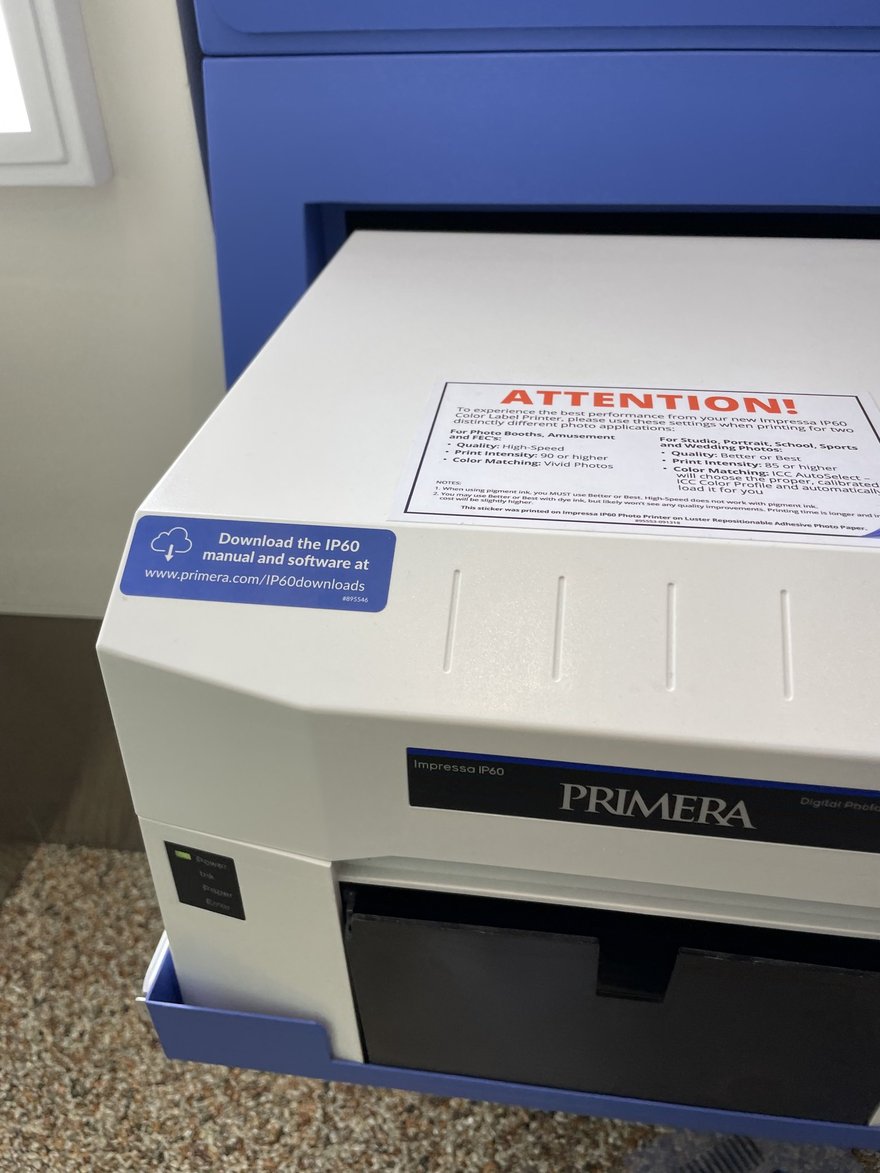
Most components inside the machines are commercially available: this one is a PRIMERA photo printer; a flash I inspected at another store was Godox. Photographs by this site; see Photo Slate and What Brand Are the Lights Inside a Photo Booth?.
Total nationwide stores: no official body has published one. Five incompatible measures are currently available: the National Tax Service’s taxable sales, which are not store counts; 708 photo studios in the National Fire Agency’s unattended-store census in March 2023; 374 unattended photo studios in Seoul’s open data; 489 Seoul stores in a Konkuk University thesis; and the media estimate of approximately 3,000 nationwide. Notice the two Seoul figures: the same city, similar periods, but a difference of 115 stores. That reflects different definitions.
There is now one additional number with a clearly defined basis. Adding the franchised and company-operated stores for each of the thirty registered brands in its latest reporting year gives 1,831: 1,260 across the twenty brands reporting fiscal 2025, and 571 across the ten reporting fiscal 2024. This has three limitations: it combines two years rather than providing a single-date snapshot; it covers only brands with registered franchise businesses, entirely excluding company-operated-only brands; and it includes company-operated stores. At least it can be traced and recalculated—something the five preceding measures do not allow.
What happened to first-wave suppliers: apart from Protopia, I found no company-by-company records of when or why they withdrew. Nor is there primary evidence identifying the supplier of the machine at Midopa department store in 1996.
One numerical attribution also needs correction. The first edition said the “industry was worth approximately KRW 20–30 billion around 2002,” citing a university newspaper. Reading the original word by word, I found no such figure: its “2~300” referred to digital cameras with “two to three million pixels.” I retained the figure in Section 1 with a note and corrected the source explanation in Appendix Two.
Franchise-association data: I checked three institutions and found none. The Korea Franchise Association only republishes Fair Trade Commission statistics. The Korea Fair Trade Mediation Agency produces industry comparison reports—it has done one for pizza—but no photo-studio edition. The Fair Trade Commission’s own franchise-sector survey did not include photo booths among its twenty-one target industries for fiscal 2025.
Part Four: How Koreans Explain It
16. The Government Investigated Machines That Did Not Give Change
In November 2023, the Korea Consumer Agency released a study. It deserves particular attention because it reveals a gap: the Korean government had indeed investigated the industry, but from a very different angle than we might expect.
The study was titled “A Survey of Self-Service Photo Studio Services.” Investigators visited thirty stores belonging to the ten brands with the most stores in the capital region and surveyed five hundred consumers who had used the services.
What did they investigate?
Cash payments received no change. All thirty stores failed to give change, with inadequate notice. Only three operators displayed the information both on the payment screen and on the machine.
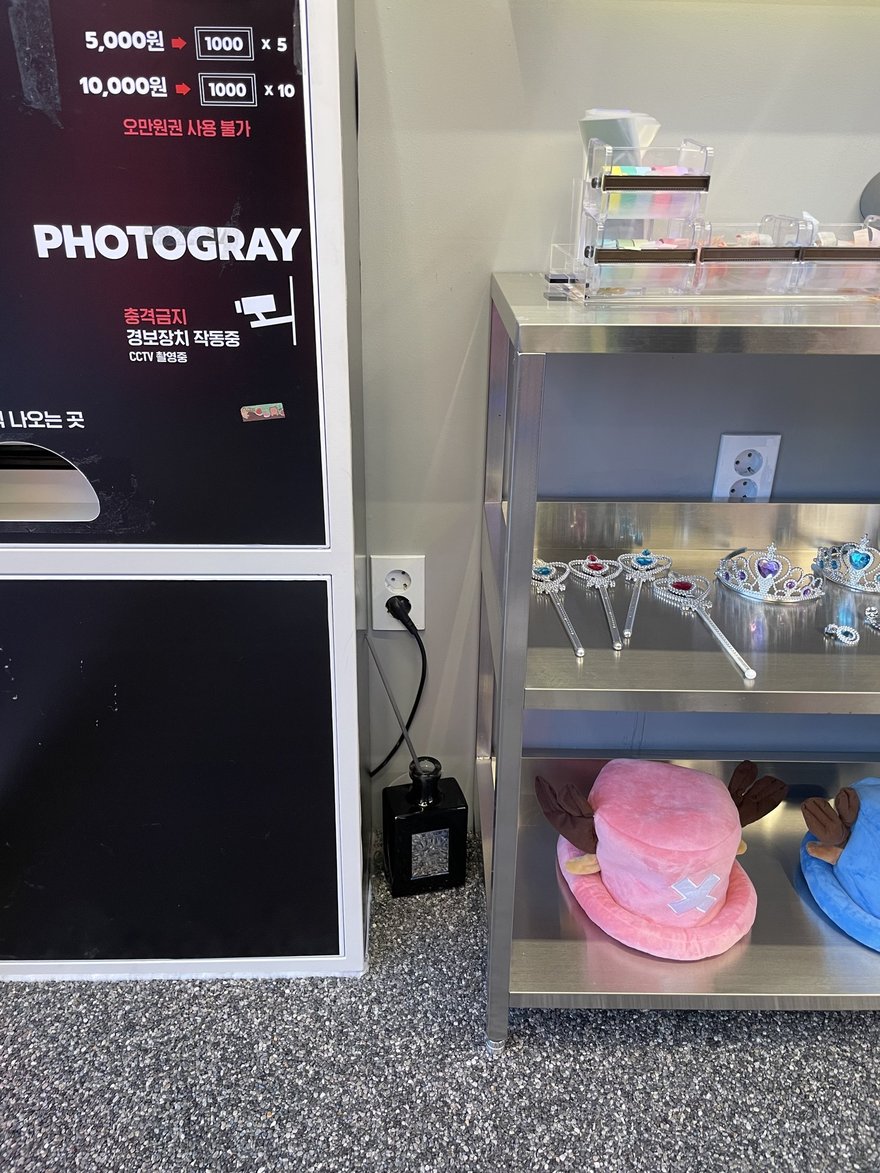
The banknote changer at Photogray RAD in Busan in December 2022: KRW 5,000 exchanged for five KRW 1,000 notes, and KRW 10,000 for ten; the red text said KRW 50,000 notes were not accepted. The same store also displayed a notice that cards were accepted, offering both card and cash payment. Photograph by this site; see Photogray RAD.
Customers were told how many photos and shooting attempts they would receive only after paying. Every inspected machine worked this way.
Print quantities had to be even. Seven of the ten operators, covering twenty-one stores, allowed only even-numbered print quantities. Three people taking photos would have to print four copies and pay an additional KRW 500–3,000, approximately TWD 11–69. Only 23% of survey respondents considered that arrangement adequate.
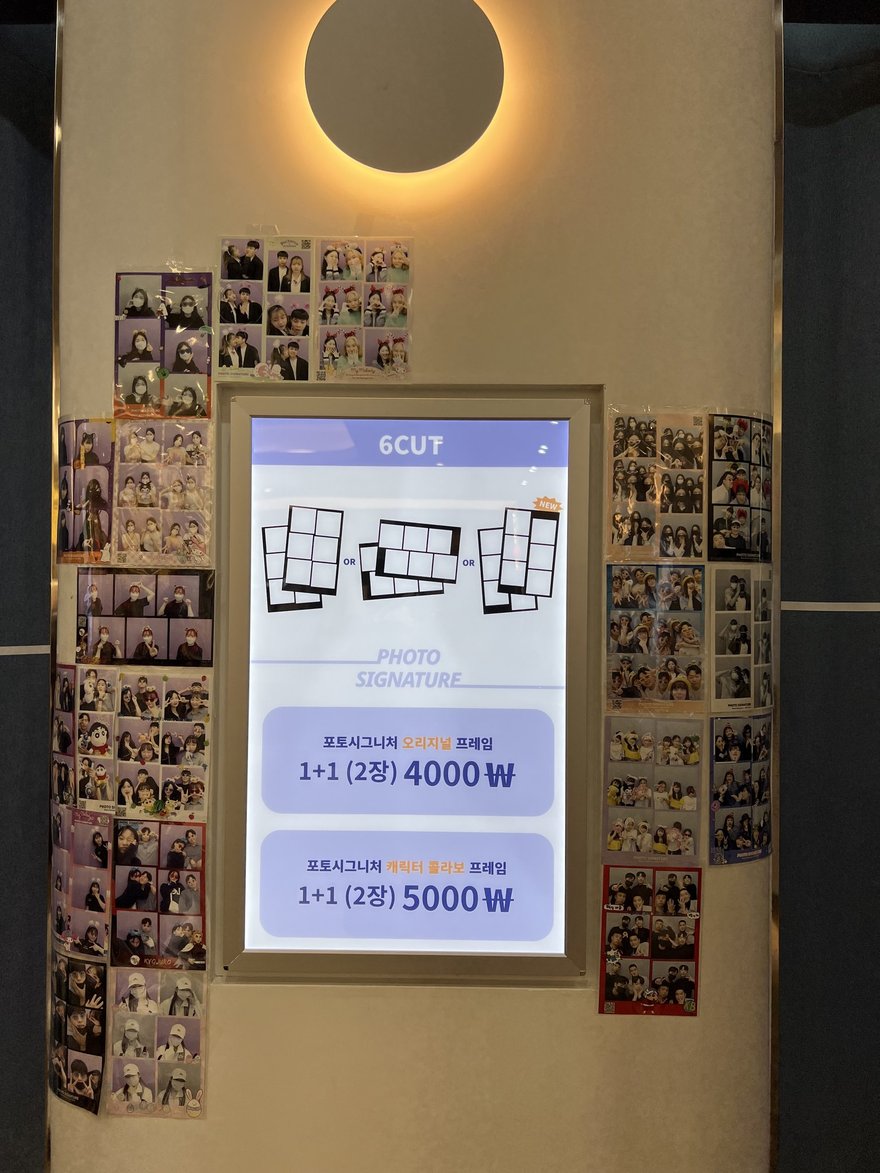
Photo Signature’s six-photo price board in December 2022: original frames, two copies for KRW 4,000; character collaboration frames, two copies for KRW 5,000. Two prints were the minimum, and collaboration frames cost KRW 1,000 more. Photograph by this site; see the store’s four price tiers in Photo Signature.
There were also personal-data issues. Five stores belonging to two operators provided photo files without consent. Four stores belonging to three operators had not deleted photographs after their announced retention periods expired.
From 2019 through the investigation, the Consumer Agency had received thirty-one related complaints. Seventeen concerned machine failures, accounting for more than half.
The entire report contained no market size, total store count, or growth rate. The government’s investigation of this industry focused on consumer disputes.
17. Scholars’ Explanations
Kim Nan-do, a professor of consumer science at Seoul National University and author of the Trend Korea (트렌드 코리아) series, said that in a highly developed society, people may instead be attracted to “the satisfaction that comes from scarcity” and “the aesthetics of imperfection.”
Lee Eun-hee, emeritus professor of consumer science at Inha University, was more specific in a March 2025 Channel PNU (채널PNU) report:
What distinguishes four-photo strips is discussing outfits and poses with friends. That process itself is a way of interacting and having fun with them.
She also noted that photographs can serve as daily records for their subjects and become a medium of communication with others when shared.
(These quotations come from retrospective reporting in 2025, rather than commentary made at the time. I also found no firm evidence that Trend Korea formally designated this phenomenon an annual keyword, so I cannot say it did.)
Gen Z interviews conducted by trend publication Careet in 2022 addressed another layer. Interviewees said they had to take pictures whenever they met friends, but the editors observed that Gen Z wanted an analog feel beyond four-photo strips alone. A twenty-three-year-old interviewee said film-camera photography had recently become mainstream among people their age.
If that assessment holds, photo booths are selling a particular aesthetic. That also explains why filters, frames, and lighting are the real points of competition between brands.
Recall the 2000s comment quoted in Section 1: sticker photos were “never really for documenting and preserving things… They were something to be consumed and then disappear.”
The first wave positioned its product as disposable. The second revived it by making it something worth keeping. The same medium, opposite positioning.


.jpg)
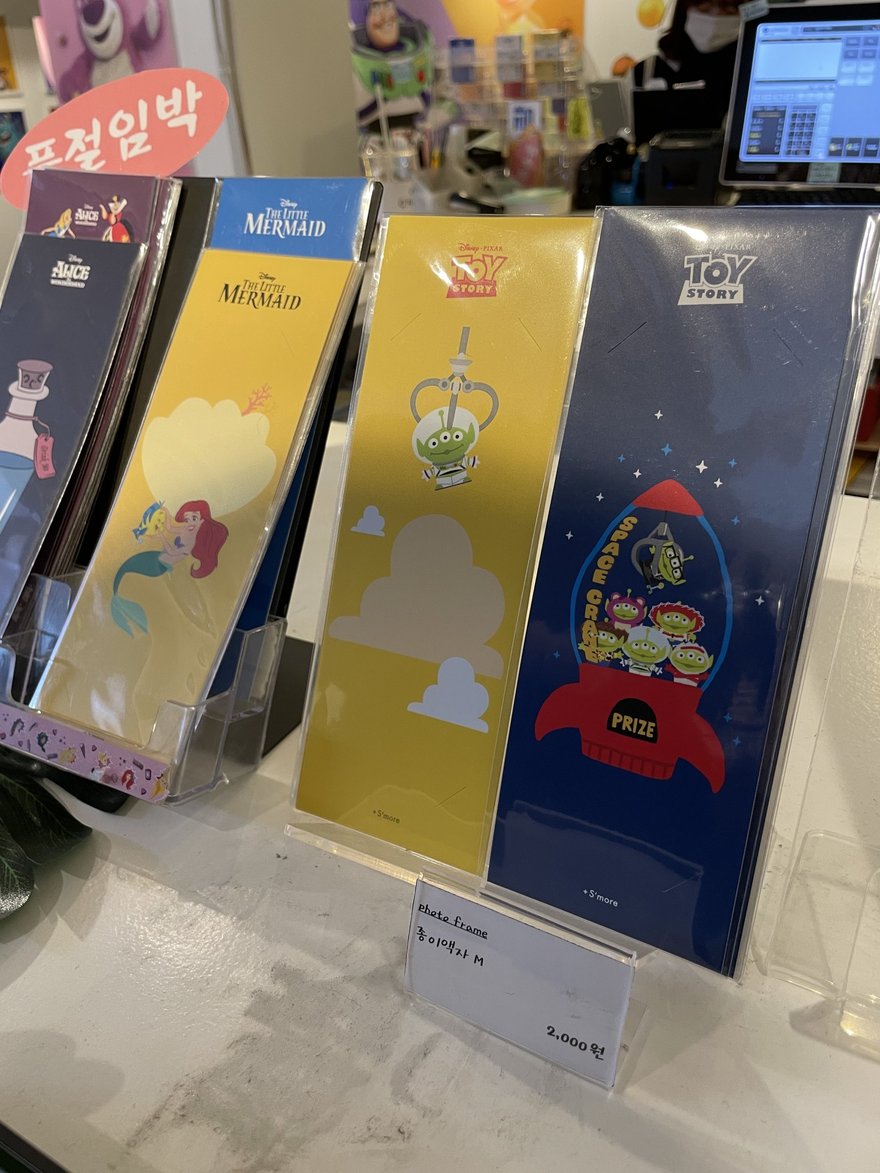
Frames sold at a Life4Cuts store in December 2022. After taking KRW 4,000 photos, you could buy a frame beside the machine to display them at home. Photograph by this site.
18. Two Narratives Coexist
Interestingly, Korean media have no consensus on whether the industry has lost its momentum.
Within the same period, you can read a Pusan National University newspaper headline saying “Still Popular in Its Eighth Year,” and a 2026 financial-media headline saying “Once-Popular Life4Cuts Has Disappeared; Following the Trend Until Even Wages Become Unaffordable.”
Both narratives can be valid, because they describe different things. The consumer culture has not faded; on the supply side, there are already too many stores.
Fair Trade Commission registration data provide a more precise answer: the question is which brands remain viable.
The brand that led the charge is also the one shrinking most sharply. Life4Cuts defined the “turn a machine into a store” model in 2017. Its revenue in 2022 was still comparable to that of later leader Seobuk, yet its parent’s equity was fully eroded by 2024, and its 2025 revenue was only 56% of the level two years earlier.
The first mover defined the category, then was overtaken by later entrants within that category.
19. Something That Did Not Happen
I investigated one more question, expecting to find examples but finding none: had this business format produced any major public scandal involving hidden-camera recording or personal data in Korea?
Small enclosed spaces combined with self-service operation intuitively suggest risk. But the specific hidden-camera cases I could find actually occurred in traditional photo studios with photographers present. I found no concrete incident reporting involving self-service photo booths themselves. Korea also had not classified them as harmful establishments under youth-protection legislation.
That is a finding in itself: concerns about this format currently rest more on intuitive associations than on documented incidents.
20. An Unexpected Comparison: Traditional Photo Studios Have Not Been Displaced
Finally, something I unexpectedly found while working through National Tax Service data.
The “Top 100 Everyday Business Categories” file included a business-code reference table. Its “photography business” statistical category corresponded to three codes: portrait and event photography, commercial photography, and photo processing. The self-service photo booth code was excluded. The two groups are mutually exclusive.
That meant I could not obtain self-service photo booth store counts from it. But it provided a clean comparison group: photography businesses with people staffing them. It could help answer whether the recent boom in self-service booths had displaced traditional photo studios.
The December 2025 figure was 21,849 businesses nationwide, up 4% from the same month a year earlier.
They had not been displaced; they were still growing.
The regional picture is clearer still. Growth was fastest on the outskirts of the capital region and in new towns: 22% in Deogyang-gu, Goyang; 11% in Namyangju; and 10% in Hwaseong. Mature commercial areas in central Seoul were shrinking: Gangnam-gu by 0.5%, Seocho-gu by 1.4%, and Gangseo-gu by 2%.
Gangnam-gu alone had 1,202 photography businesses, more than twice the count in second-place Mapo-gu.
These are two mutually exclusive populations. They can be viewed side by side, but no causal inference can be drawn. At least the plausible-sounding claim that “self-service photo booths are replacing traditional photo studios” is unsupported by official figures. They appear to be following separate paths: one serves as a social space for young people; the other provides ID photos, family portraits, and event documentation. Their customers and needs were different to begin with.
21. The Six Days I Saw for Myself Within Those Thirty Years
The preceding sections are data. Beyond those data, I made my own trip in December 2022: six days, four cities, eighteen brands, and more than twenty-five stores, exactly at the turning point described in Section 7.
At the time, I did not know which stores would survive. Looking back four years later, their paths had diverged: PHOTO LAB+ reached thirteen stores; Photogray RAD’s parent later listed on KOSPI; MUMUFILM could no longer be found four years later; and Haru Film, once locally described as “the one doing the best business,” fell over the cliff detailed in Section 13.
I wrote eighteen individual reports from those six days, arranged here by the time of on-site photography, in Korean time:
- 12/03 | Photo Signature: the brand I visited five times on the trip, with four price tiers and four studio types.
- 12/04 | Photoism COLORED: putting the national football team into photo frames during the World Cup.
- 12/04 | Mono mansion: its own name on the storefront, another brand’s campaign on the wall.
- 12/04 | Oldmoon Self Studio: that blue moon also appeared inside another brand’s store.
- 12/04 | Photogray RAD: KRW 4,000 and KRW 5,000, signs in four languages, and a banknote changer that refused KRW 50,000 notes.
- 12/04 | PHOTO LAB+: SELFIE STUDIO lettering covering an entire glass wall.
- 12/04 | What Brand Are the Lights Inside a Photo Booth?: finding Godox on-site and looking up the model on my phone.
- 12/04 | pic dot: 24 HOURS and CARD & CASH etched directly onto the glass door.
- 12/04 | Photo in the Box: a franchise inquiry hotline printed directly on the sign.
- 12/04 | PHOTO DRINK: selling an orange photo album instead of four-photo strips.
- 12/06 | 3PIC in Cheongju: twenty-four-hour operation, ID photos, and pet photography.
- 12/06 | Haru Film: an owner’s self-inspection checklist on the wall.
- 12/06 | Life4Cuts: the brand that pioneered the category, with a price board reading 1+1, two copies for KRW 4,000.
- 12/06 | Myeong Dong Film: the only store on the trip where I photographed the complete menu.
- 12/07 | insphoto: red brick, yellow frames, and a wooden prop rack at the entrance.
- 12/07 | MUMUFILM: turf and a Christmas tree outside the store.
- 12/07 | Photomatic: a black-and-white photo booth inside NIKE’s Hongdae store.
- 12/07 | Photo Slate: the store that left the entire machine backend exposed.
What was happening in Taiwan during the same period is covered in A Historical Report on Taiwan’s Photo Booth and Korean-Style Photo Booth Industries.
Comparing Korea with Japan, Taiwan, and Hong Kong
The same photo booth concept developed into four very different businesses.
| Korea | Japan | Taiwan | Hong Kong | |
|---|---|---|---|---|
| Main format | Unattended self-service photo booth stores | Machines inside game centers | Branded stores plus machines distributed through claw-machine shops | Machines integrated into shopping-mall circulation routes |
| Who owns the machines | Franchisees opening stores | Arcades, buying from manufacturers | Brand owners or distribution-channel operators | Operators placing them in malls |
| Concentration | Thirty registered brands; PHOTOISM leads | One manufacturer has 90% | Twelve brands included in the database | SNAPIO network covers thirty-eight venues; multiple brands often occupy the same mall |
| Listed companies | None primarily focused on photo booths yet; Seobuk’s application is under review | More than ten, including FURYU | — | — |
| Main article on this site | This article | Thirty Years of Japanese Photo Booths | History of Taiwan’s Photo Booth Industry | SNAPIO’s Model Without Standalone Stores |
The comparison with Japan is clearest. Both countries’ first waves began in 1995, and both attracted twenty to thirty suppliers within a few years. Japan’s first wave left behind a listed manufacturer, FURYU. Korea’s first wave was a vending-machine business, and none of its companies remained. Korea adopted a different approach in its second wave: machines belonged to store owners, producing thirty franchise brands rather than one manufacturer. By the time the first company reached listing review, the second wave was in its ninth year.
For where these Korean brands operate after expanding into Taiwan and other countries, and how to use them, the Photo Booth Information site’s Korean Photo Booth Guide organizes the information by brand.
Appendix One: Brand and Company Name Reference
Major Brands
| Logo | Korean | English / Chinese | Franchisor | Notes |
|---|---|---|---|---|
|
인생네컷 | Life4Cuts, 人生四格 | 엘케이벤쳐스 LK Ventures | Category pioneer; acquired by Lee Ho-ik in 2017 |
|
포토이즘 | Photoism | 서북 Seobuk | Main line / STUDIO |
|
포토이즘박스 | Photoism Box | 서북 Seobuk | BOX line; currently the largest |
|
포토이즘컬러드 | Photoism Colored | 서북 Seobuk | COLORED line |
|
하루필름 | Haru Film | 에이치제이제이컴퍼니 HJJ Company | One of the brands Joe visited in 2022 |
|
포토그레이 | Photogray | 에이피알 APR | Parent is a listed beauty group; predecessor founded in 2017 |
|
포토시그니처 | Photo Signature | 이미지네트웍스플러스 Image Networks Plus | |
|
그믐달셀프스튜디오 | Old Moon Self Studio; 그믐달 means a waning crescent moon | 네이처라우드 Nature Loud | |
|
하마필름 | Hama Film | 루센트 Lucent | Korean name differs from Haru Film by one syllable; do not confuse them |
|
픽닷 | PICDOT | 에브리세컨드 Every Second | Photographed by Joe in Seomyeon, Busan, in 2022 |
|
플랜비 스튜디오 | PLAN B Studio | 리오컴퍼니 Rio Company | Same franchisor as Photo Objet |
|
포토오브제 | Photo Objet | 리오컴퍼니 Rio Company | Same as above |
These twelve are the major brands repeatedly mentioned in the article. Haru Film and Hama Film differ by only one Korean syllable but belong to different companies, making them easy to confuse when citing.
Other Registered Brands
포토마임 Photo Mime | 미소포토부스 Miso Photo Booth | 포토스트리트 Photo Street | 포토플렉스 Photoflex | 포토아이브 Photo Ive | 더필름 The Film | 포토랩플러스 Photo Lab Plus | 사진관,세바 Sajingwan SEBA | 얼짱사진샵 Eoljjang Photo Shop | 포토하임 네컷 Photo Heim 4cut | 소유필름 Soyou Film | 뷰포토부스 View Photo Booth | 시안사진관 Sian Photo Studio | 포토플레이 Photo Play | 포토아울렛 Photo Outlet | 부록셀프사진관 Burok Self Photo Studio
Four other registered brands whose logos were obtained from official websites:
| Logo | Brand | Notes |
|---|---|---|
 |
포토랩플러스 Photo Lab Plus | Current official-site logo includes LIBRARY; Joe’s 2022 field report is at PHOTO LAB+ |
 |
포토스트리트 warm&cool | Current official-site logo represents the Warm & Cool line, registered separately from the main Photo Street line |
 |
포토아이브 Photo Ive | |
 |
더필름 The Film | Badge from the official site’s sharing image |
All logos come from the brands’ or companies’ own websites, with listed-company logos taken from official corporate-identity pages. They are used solely for identification and do not imply brand endorsement of this article. Where no official site could be found, or its domain had expired, the field is left blank rather than filled with a similar image: Photo Mime’s official domain had expired; Miso Photo Booth and Photo Heim had only social-media accounts; Sian Photo Studio’s website used the PHOTOCYAN logo, which could not be confirmed as the same brand line; and first-wave companies such as Protopia had disappeared. NH Investment & Securities’ website did not provide a sufficiently large logo, so it was also left blank.
Common Korean Terms
| Korean | English |
|---|---|
| 셀프사진관 / 즉석사진관 / 무인사진관 | Self-service photo studio / instant photo studio / unattended photo studio; all refer here to photo booth stores |
| 스티커사진 | Sticker photos, the first-wave term |
| 가맹점 / 직영점 | Franchised store / company-operated store |
| 정보공개서 | Franchise disclosure document, a statutory filing |
| 가맹사업 개시일 | Franchise-business commencement date |
| 계약종료 / 계약해지 / 명의변경 | Contract termination upon expiry / contract cancellation / change of registered holder |
| 평균매출액 | Average revenue: sales, not profit |
| 기준점포면적 / 창업비용 | Reference store floor area / opening costs |
| 과세표준 | Tax base, reported sales before tax |
| 폐업 | Business closure, registered formally |
| 완전자본잠식 | Complete erosion of equity, with net worth turning negative |
| 엔데믹 | Endemic: the normalized phase after restrictions were lifted |
Appendix Two: Sources
Official and Quasi-Official Sources, Grade A
- Korean National Tax Service, tax base and closure registrations for business code 749401, “동전 조작식 사진 촬영기 운영,” operation of coin-operated photographic machines, 2020–2024. Data obtained through the office of National Assembly Strategy and Finance Committee member Cha Gyu-geun; reported by Digital Times (디지털타임스) on 2026-02-17. https://www.dt.co.kr/article/12046963
- Korean National Tax Service, definitions and expense ratios for business codes 749400 / 749401. https://upjong.co.kr/business-code/upjong-749400/ / https://upjong.co.kr/business-code/upjong-749401/ (Third-party compilation; the official originals are National Tax Service notices, 국세청고시, pending re-verification.)
- Korean National Tax Service, “Business Status of the Top 100 Everyday Business Categories,” 100 대 생활업종 사업자현황, December 2025. The business-code reference table confirms “사진촬영업,” photography businesses, as 749400 / 749402 / 749403, explicitly excluding 749401. https://www.data.go.kr/data/15061118/fileData.do
- Fair Trade Commission, franchise disclosure document viewing system, 가맹사업거래 정보공개서 열람. Brand lists, store counts, opening costs, average revenue, contract changes, and financial positions in this article were checked directly on 2026-08-20. https://franchise.ftc.go.kr/mnu/00013/program/userRqst/list.do
- Fair Trade Commission, “2025 Franchise Business Statistics,” 2025 년 가맹사업 현황 통계, 2026-04-13. https://www.ftc.go.kr/www/selectBbsNttView.do?pageUnit=10&pageIndex=1&searchCnd=all&key=12&bordCd=3&searchCtgry=01%2C02&nttSn=47332
- Fair Trade Commission, “2025 Franchise Sector Survey,” 2025 년도 가맹 분야 실태조사. Twenty-one target industries; photo booths excluded. https://www.ftc.go.kr/www/selectBbsNttView.do?key=12&bordCd=3&nttSn=46272
- Korea Consumer Agency, “Survey of Self-Service Photo Studio Services,” 셀프 포토 스튜디오 서비스 관련 실태조사, 2023-11-23. https://www.kca.go.kr/smartconsumer/board/download.do?menukey=7301&fno=10040950&bid=00000146&did=1003597927
- National Fire Agency, full census of major unattended stores, 2022-12-14 to 2023-03-14; reported by Datasom (데이터솜) on 2023-08-30. https://www.datasom.co.kr/news/articleView.html?idxno=127766
- Seoul Metropolitan Government, “Status of Unattended Stores in Seoul,” 서울시 무인점포 현황, open dataset. https://data.seoul.go.kr/dataList/OA-22899/S/1/datasetView.do
- Statistics Korea KOSIS, response to public inquiry 13036, 2019-02-07, confirming that KOSIS has no market-size data of this kind. https://kosis.kr/civilComplaint/qnaDetail.do?boardIdx=13036
- Financial Supervisory Service DART, LK Ventures (엘케이벤쳐스) financial statements and notes for FY2022–FY2025. https://dart.fss.or.kr/
- KOTRA Guangzhou Trade Office, “The Hottest Trend Among China’s MZ Generation: Self-Service Photo Booths,” 중국 MZ세대 사이에서 가장 핫한 트렌드, 셀프 포토 부스, 2024-10-10. https://dream.kotra.or.kr/dream/cms/news/actionKotraBoardDetail.do?SITE_NO=2&MENU_ID=3550&bbsSn=243&pNttSn=220025&CONTENTS_NO=1
- Haru Film franchise disclosure document, registration-completed version dated 2023-12-21. https://assa-franchise.s3.amazonaws.com/franchise_199544.pdf
Academic Sources, Grade B
- Kim Ye-eun (김예은), “A Study of Factors Affecting Sales at Unattended Photo Studios in Seoul,” 서울시 무인사진관 매출액 영향 요인에 관한 연구, master’s thesis, Department of Real Estate, Graduate School of Konkuk University, February 2025. Regression analysis of actual monthly revenue from 489 Seoul stores, July 2023–June 2024. https://www.riss.kr/search/detail/DetailView.do?p_mat_type=be54d9b8bc7cdb09&control_no=7db4864683726118ffe0bdc3ef48d419
- Ham Yu-hui, Park So-hyeon, and Lee Geum-suk (함유희·박소현·이금숙), “Diversification of Consumption Patterns and Store Location: Photo Studios and Cafés in Seoul,” 소비 방식의 다변화와 점포 입지—서울시 사진관과 카페를 중심으로, Journal of the Korean Geographical Society, 58(5), 520–534, 2023. https://www.kci.go.kr/kciportal/ci/sereArticleSearch/ciSereArtiView.kci?sereArticleSearchBean.artiId=ART003014165
- Kang Min-jae and Kim Bo-yeon (강민재·김보연), “A Comparison of User Experience in Unattended Self-Service Photo Studios Based on the Honeycomb UX Model,” 허니콤 UX 모델 기반 무인 셀프 포토 스튜디오의 사용자 경험 비교, Journal of Brand Design Association of Korea, 23(5), December 2025. Survey of eighty-five people.
Financial-Institution Research, Grade B
- Kim Mun-tae (김문태), Hana Institute of Finance, “Reviewing SOHO Business Categories as the Consumption Environment Changes,” 소비 환경 변화에 따른 소호 업종 점검, 2025-06-23. Hana Card transaction data from 2019–2025. https://www.hanaif.re.kr/boardDetail.do?hmpeSeqNo=36603
- KB Kookmin Card, four-year card-spending analysis covering 2019–2022, released 2023-01-26. Unattended photo studio sales in 2022 increased 271% over 2021. https://www.handmk.com/news/articleView.html?idxno=14737 / https://news.mt.co.kr/mtview.php?no=2023012616074057394
- Shinhan Card Big Data Research Institute × Careet, “Consumption Trend Report,” 소비 트렌드 보고서, 2024-04-24. https://www.careet.net/1356 (Age figures are internally inconsistent and were not used in this article.)
Media and Industry Sources, Grades B/C
Founders and brands
- Open Startup News (열린창업신문), “After Countless Failures, He Is Writing a Life Success Story with Life4Cuts,” 수도 없이 실패했지만 ’인생네컷’으로 인생의 성공 스토리 쓰고 있다. Lee Ho-ik saw an already-branded machine in Ulsan in 2017, proposed becoming general distributor, and acquired it four months later. https://www.rgnews.co.kr/news/articleView.html?idxno=20837
- Choi Yeon-jin (최연진), Hankook Ilbo (한국일보), “‘Success Comes Like a Thief’: Lee Ho-ik, LK Ventures CEO Behind the Life4Cuts Hit,” “성공은 도둑처럼 온다” ‘인생네컷’ 대박친 이호익 엘케이벤쳐스 대표, 2023-09-27. https://www.hankookilbo.com/News/Read/A2023092510420004703
- Dailian (데일리안), Photogray rebranding and store expansion, 2022-12-01. https://www.dailian.co.kr/news/view/1179161
- Hankyung Plus (한경plus), Seobuk CEO Kim Min-seok, 2023-06-28. https://plus.hankyung.com/apps/newsinside.view?aid=202306281265d
- THE VC, Seobuk company profile. https://thevc.kr/seobuk
Contemporary consumer and operator testimony
- Segye Ilbo (세계일보), “Unattended Photo Studios, Supermarkets, Clothing Stores… ‘Come Without Worrying About COVID,’” 무인 사진관·슈퍼·옷가게… “코로나 걱정 말고 오세요”, 2020-12-14. Named consumer Kim Cho-hui (김초희) and operator Seo Mi-rang (서미랑). https://segye.com/newsView/20201214518319
- Joongdo Ilbo (중도일보), “[Trend Diary: Reading MZ] Photographing Myself, Taking the Picture Myself: Falling for Self-Service Photo Studios,” [트렌드 일기: MZ읽기] 나를 찍는다, 내가 찍는다 ’셀프 사진관’에 빠지다, 2021-07-07. Named consumers Lee Ga-eun (이가은), twenty-seven, and Baek Eun-ha (백은하), twenty-nine.
- Aju Business Daily (아주경제), “[The Republic of Korea Changed by COVID] ⑬ The Wave of Unattended Businesses Riding the Contactless Trend,” [코로나가 바꾼 대한민국] ⑬ 비대면 타고 온 무인화 바람, 2021-06-10. https://www.ajunews.com/view/20210610152821195
Industry analysis and warnings
- Kwon Sun-u (권순우), SamproTV (삼프로TV), “Once-Popular Life4Cuts Has Disappeared… Following the Trend Until Even Wages Become Unaffordable,” 핫하던 인생네컷이 안보인다…유행 따라가다 월급도 못 줄 판, 2026-01-28. Analysis by Lee Dong-yeol (이동열) of Pitch Deck (피치덱). https://v.daum.net/v/p52Oa0YCkb
- Lee Eun-seo (이은서), Consumer News (소비자가 만드는 신문), “Self-Service Photo Studio Startup Boom: Haru Film Leads in Sales Relative to Investment,” ‘창업 열풍’ 셀프사진관, 투자 대비 매출 하루필름 1위, 2024-10-17. https://www.consumernews.co.kr/news/articleView.html?idxno=716682
- Biz Hankook (비즈한국), “Self-Service Photo Studios Spring Up Everywhere… Secondhand Photo Kiosk Listings Surge,” 셀프 사진관 우후죽순 생기더니…포토 키오스크 중고 매물 급증. Claw-machine-store analogy and commercial-district density. https://www.bizhankook.com/bk/article/29706
- Kim Gi-hyeok (김기혁), Seoul Economic Daily (서울경제), “Self-Service Photo Studios Grow More Than 20%… Fierce Battle for First Place Among the Top Three,” 셀프사진관 성장세 20%↑…상위 3사 1위 싸움 치열, 2024-03-04. https://www.sedaily.com/article/13851733 (The store-count source is only “업계에 따르면,” according to the industry; not used as numerical evidence in this article.)
- Seoul Economic Daily (서울경제), “Everyone Jumped In, Then Said ‘We’re Closing,’” 너도나도 뛰어들었다가 “문 닫아요”. Commercial-district density: five stores within 130 meters. https://www.sedaily.com/article/20009681
- Lee Seung-gi (이승기), head of Howlgraphy Studio (하울그라피 스튜디오), “Profitability Analysis of Unattended Self-Service Photo Studios,” 무인 셀프 사진관의 수익율 분석, Brunch, 2025-09-25. https://brunch.co.kr/@02617af2492f44f/19
Culture and history
- Channel PNU (채널PNU), “Four-Photo Strips Keep Transforming, Still Popular in Their Eighth Year,” 변신 거듭하는 ‘네 컷 사진’, 8년째 인기 여전, 2025-03-21. Named quotations from Kim Nan-do (김난도) and Lee Eun-hee (이은희). https://channelpnu.pusan.ac.kr/news/articleView.html?idxno=37007
- Kang Ji-hye (강지혜), Careet (캐릿), Gen Z interviews, 2022-03-25. https://www.careet.net/684
- SisaIN (시사IN), “The Fate of Sticker Photos That Turned Seriousness into Play,” 심각함을 놀이로 바꾼 스티커 사진의 운명. Cultural commentary on the first wave. https://www.sisain.co.kr/news/articleView.html?idxno=33952
- Chungbuk National University Newspaper (충북대신문), retrospective account of the first wave’s arrival after 1995 and its retreat around 2002 as digital cameras spread. The original contains no market-size figure; the first edition’s incorrect attribution was corrected on 2026-09-24. https://press.cbnu.ac.kr/ktimes/m_view.php?mode=view&no=4602§ion=111
- Wikitree (위키트리), “A Must When Visiting Korea… The Origins of the Four-Photo Strips Foreigners Love,” 한국 오면 꼭 찍는다…외국인이 빠진 ’네 컷 사진’의 시작. https://www.wikitree.co.kr/articles/1151054
- Handmaker (핸드메이커), “Now a Form of Play Culture: Self-Service Four-Photo Strips,” 이제는 하나의 놀이 문화, 셀프로 찍는 ‘네컷 사진’. https://www.handmk.com/news/articleView.html?idxno=14554
- Namu Wiki entry “즉석사진관,” instant photo studios. https://namu.wiki/w/%EC%A6%89%EC%84%9D%EC%82%AC%EC%A7%84%EA%B4%80
Contemporary First-Wave Newspapers, BIGKinds Full Text, Checked 2026-09-24
- Kukmin Ilbo (국민일보), 1996-01-31, “An Age of Individuality… Sticker Photos Gain Popularity,” 개성시대… 스티커사진 인기: Metro Midopa department store’s sixth-floor gift plaza; sixteen stickers in fifty seconds for KRW 3,000.
- Naewoe Economy (내외경제), now Herald Economy (헤럴드경제), 1996-02-01, “‘How Does My Face Look?’ A Sticker-Photo Boom,” “내 얼굴 어때요” 스티커사진 붐: first introduced at Metro Midopa in early January; eighty to one hundred users daily.
- Electronic Times (전자신문), 1997-06-23, “A Boom in Sticker-Photo Vending Machines,” 스티커사진 자판기 열풍 분다: Protopia imported SEGA machines in 1995; Samwon Photo Machinery; Yuhan C&T’s domestic machine.
- Seoul Economic Daily (서울경제), 1997-10-13, “Fierce Competition to Capture the Sticker-Photo Vending-Machine Market,” 스티커사진 자판기 시장선점전 치열: industry estimate of a 1997 market “exceeding KRW 20 billion”; Protopia’s technology transfer from SEGA.
- Electronic Times (전자신문), 1997-11-22, “Sticker-Photo Vending Machines Explosively Popular Among Teenagers,” 스티커사진자판기 청소년들 폭발적 인기: Hyundai SEGA; special consumption tax.
- Gyeonggi Ilbo (경기일보), 1998-08-21, and Electronic Times (전자신문), 1998-09-21: approximately 2,000 machines in 1997; major-company entry and more than twenty suppliers in 1998.
- Electronic Times (전자신문), 1998-10-16, “Industry Disputes Special Consumption Tax on Sticker-Photo Vending Machines,” 업계, 스티커사진 자판기 특소세 “논란”: administrative lawsuit by fourteen suppliers; rapid market contraction.
- Kyunghyang Shinmun (경향신문), 1999-11-19, and Korea Economic Daily (한국경제), 2002-10-03: Protopia’s move into mobile-phone charging vending machines and suspension of check transactions.
- Korea Press Foundation BIGKinds news database. https://www.bigkinds.or.kr/
Listings and the Industry Leader, Checked 2026-09-24
- Korea Exchange KIND, list of companies undergoing preliminary review, 예비심사기업, and Seobuk details: application dated 2026-09-21; KOSDAQ; planned listing of 12,632,600 shares; public offering of 2,600,000 shares; NH Investment & Securities. https://kind.krx.co.kr/listinvstg/listinvstgcom.do?method=searchListInvstgCorpMain
- Korea Exchange KIND, listed-company directory: listing dates for APR, SM, YG, IBK Industrial Bank of Korea, Samsung Electronics, LS ELECTRIC, and SK hynix. https://kind.krx.co.kr/corpgeneral/corpList.do
- Financial Supervisory Service DART, Seobuk’s 2026 half-year report, filed 2026-08-28: first-half consolidated revenue, operating profit, net profit, and new subsidiaries in Guangzhou and Taiwan. https://dart.fss.or.kr/dsaf001/main.do?rcpNo=20260828000517
- Fair Trade Commission, Photoism (포토이즘) franchise disclosure document, version dated 2023-06-05: Seobuk financials for 2020–2022. https://franchise.ftc.go.kr/
Exchange Rate
- Anue, TWD/KRW, 2026-08-20 at 08:21: TWD 1 = KRW 43.76. https://invest.cnyes.com/forex/detail/TWDKRW/overview
Images
- Infographics: produced by this site using the figures in the article.
- Photographs: those credited to this site were taken by Joe in Korea in December 2022. The four photographs from 2001, 2006, 2008, and Cebu come from openly licensed files on Wikimedia Commons and Flickr, with photographer and license credits beneath each image.
- Brand logos: obtained from brands’ or companies’ official websites, with listed-company logos from official corporate-identity pages, on 2026-09-25; used solely for identification.
Specifically Not Found, Without Substituting Approximate Data
- When and why first-wave suppliers other than Protopia withdrew; the supplier of the machine at Metro Midopa department store in 1996; annual machine counts after 1998.
- Primary sources for the 2005–2016 gap.
- The identity of Life4Cuts’ original founder: the party involved remained silent, 함구, making this withheld information rather than merely unavailable documentation.
- Revenue per machine: no institution has compiled it.
- A single reliable definition and count of nationwide stores.
- Original research on this business format produced by franchise associations.
- Whether Trend Korea formally included the phenomenon.
Appendix Three: Disclosure Freshness for Thirty Registered Brands, Checked 2026-08-20
Source: the Fair Trade Commission’s franchise disclosure document viewing system, with each page opened and its data extracted individually. Franchised and company-operated counts are year-end figures from each brand’s latest reporting year.
| # | Brand | English | Registration number | Initial registration | Latest registration | Data year | Franchised / company-operated, total |
|---|---|---|---|---|---|---|---|
| 1 | 포토이즘박스 | Photoism Box | 20211412 | 2021.06.18 | 2026.08.03 | 2025 | 449 / 21 (470) |
| 2 | 인생네컷 | Life4Cuts | 20220217 | 2022.03.21 | 2026.04.24 | 2025 | 261 / 12 (273) |
| 3 | 포토시그니처 | Photo Signature | 20212763 | 2021.10.15 | 2025.10.10 | 2024 | 174 / 1 (175) |
| 4 | 포토그레이 | Photogray | 20214737 | 2021.11.12 | 2025.11.20 | 2024 | 107 / 47 (154) |
| 5 | 플랜비 스튜디오 | PLAN B Studio | 20220145 | 2022.02.22 | 2025.11.21 | 2024 | 116 / 6 (122) |
| 6 | 하루필름 | Haru Film | 20214241 | 2021.11.05 | 2026.04.27 | 2025 | 91 / 15 (106) |
| 7 | 포토이즘컬러드 | Photoism Colored | 20220969 | 2022.09.22 | 2026.08.03 | 2025 | 70 / 12 (82) |
| 8 | 포토랩플러스 | Photo Lab Plus | 20231404 | 2023.09.26 | 2026.05.11 | 2025 | 46 / 24 (70) |
| 9 | 픽닷 | PICDOT | 20220795 | 2022.08.08 | 2025.11.11 | 2024 | 44 / 4 (48) |
| 10 | 그믐달셀프스튜디오 | Old Moon | 20220144 | 2022.02.22 | 2026.04.21 | 2025 | 40 / 1 (41) |
| 11 | 포토아이브 | Photo Ive | 20221468 | 2022.12.29 | 2026.05.26 | 2025 | 40 / 0 (40) |
| 12 | 포토하임 네컷 | Photo Heim 4cut | 20240153 | 2024.01.26 | 2026.04.09 | 2025 | 40 / 0 (40) |
| 13 | 시안사진관 | Sian Photo Studio | 20250001 | 2024.12.31 | 2026.08.03 | 2025 | 29 / 4 (33) |
| 14 | 더필름 | The Film | 20221434 | 2022.12.23 | 2025.08.04 | 2024 | 32 / 0 (32) |
| 15 | 부록셀프사진관 | Burok Self Photo | 20251472 | 2025.12.16 | 2026.07.14 | 2025 | 17 / 7 (24) |
| 16 | 포토스트리트 warm&cool | Photo Street w&c | 20221116 | 2022.10.21 | 2026.06.15 | 2025 | 22 / 0 (22) |
| 17 | 포토스트리트 | Photo Street | 20220839 | 2022.08.17 | 2026.06.15 | 2025 | 17 / 0 (17) |
| 18 | 포토이즘 | Photoism | 20200402 | 2020.03.19 | 2026.08.03 | 2025 | 14 / 2 (16) |
| 19 | 하마필름 | Hama Film | 20230116 | 2023.01.26 | 2025.06.18 | 2024 | 15 / 0 (15) |
| 20 | 얼짱사진샵 | Eoljjang Photo Shop | 20231734 | 2023.11.24 | 2025.09.22 | 2024 | 6 / 9 (15) |
| 21 | 미소포토부스 | Miso Photo Booth | 20213976 | 2021.11.03 | 2026.04.09 | 2025 | 9 / 0 (9) |
| 22 | 포토플렉스 | Photoflex | 20221262 | 2022.11.24 | 2025.08.11 | 2024 | 7 / 0 (7) |
| 23 | 포토랩플러스엑시트 | Photo Lab Plus Exit | 20240203 | 2024.02.07 | 2026.05.11 | 2025 | 1 / 4 (5) |
| 24 | 뷰포토부스 | View Photo Booth | 20241307 | 2024.09.25 | 2026.04.30 | 2025 | 3 / 1 (4) |
| 25 | 사진관,세바 | Sajingwan SEBA | 20231490 | 2023.10.13 | 2026.06.01 | 2025 | 3 / 0 (3) |
| 26 | 포토오브제 | Photo Objet | 20241577 | 2024.11.26 | 2025.11.21 | 2024 | 2 / 1 (3) |
| 27 | 포토플레이 | Photo Play | 20250411 | 2025.04.04 | 2026.08.05 | 2025 | 0 / 3 (3) |
| 28 | 포토마임 | Photo Mime | 20210302 | 2021.02.04 | 2026.04.08 | 2025 | 2 / 0 (2) |
| 29 | 소유필름 | Soyou Film | 20240272 | 2024.02.22 | 2025.09.09 | 2024 | 0 / 0 (franchising not yet open) |
| 30 | 포토아울렛 | Photo Outlet | 20251107 | 2025.09.18 | 2026.04.23 | 2025 | 0 / 0 (franchising not yet open) |
Note: the table is sorted by latest-year store count, from largest to smallest. Three brands changed names: 해리포토 became 미소포토부스, Miso Photo Booth; 하마스터디카페 became 하마필름, Hama Film; and 포토하임 became 포토하임 네컷, Photo Heim 4cut. Different brand lines are registered independently, and figures from different reporting years cannot be directly added together for comparison.
Article overview
This article brings together research on Korea’s self-service photo booth industry (셀프사진관) from 1995 to 2026, drawing primarily on Korean official primary documents and contemporary newspapers. First wave: in 1995, vending-machine operator Protopia (프로토피아) imported SEGA Print Club machines; the earliest contemporary coverage found describes their introduction at Seoul’s Metro Midopa department store in January 1996. By 1997, approximately 2,000 machines were operating nationwide, with an industry-estimated market exceeding KRW 20 billion. In 1998, more than twenty suppliers, including LG Industrial Systems, Samsung, Haitai, and Hyundai, entered the market, which contracted sharply that same year under a special consumption tax and an economic downturn. Pioneer Protopia was barred from check transactions in October 2002, and the first wave faded as digital cameras became widespread. The second wave began in 2017: Life4Cuts founder Lee Ho-ik acquired an existing brand and established LK Ventures in 2018, turning equipment installed in other people’s shops into a standalone store format. The National Tax Service’s tax base for business code 749401 was KRW 133.7 billion in 2021, KRW 247.1 billion in 2022, and KRW 319.6 billion in 2024; the jump came in 2022, when pandemic restrictions were lifted. Thirty photo booth franchise brands were registered with the Fair Trade Commission, with a combined 1,831 franchised and company-operated stores in their respective latest reporting years. By both revenue and franchise-store count, PHOTOISM parent Seobuk (서북) had become the leader by 2023 at the latest. Its 2025 revenue reached KRW 60.44 billion, but it recorded its first loss. It returned to profit in the first half of 2026, with revenue of KRW 35.69 billion and operating profit of KRW 4.11 billion, and applied to the Korea Exchange for a preliminary KOSDAQ listing review on September 21, 2026. Pioneer Life4Cuts’ parent LK Ventures saw revenue fall from KRW 25.49 billion in 2022 to KRW 12.68 billion in 2025, with equity turning negative in 2024. The only listed parent company in this industry chain is PHOTOGRAY’s APR, listed on KOSPI in February 2024; photo booths account for only about 2.8% of its revenue.
- Korean sticker-photo booths began in 1995, when vending-machine operator Protopia imported SEGA machines. The earliest contemporary coverage found concerns Seoul’s Metro Midopa department store in January 1996.
- The first wave attracted more than twenty suppliers in 1998, including Samsung and LG Industrial Systems, but contracted sharply that same year under a special consumption tax and an economic downturn, fading around 2002.
- The second wave began in 2017. Life4Cuts pioneered the format, but by revenue and franchise-store count, PHOTOISM parent Seobuk had become the leader by 2023 at the latest.
- Seobuk returned to profit in the first half of 2026 and applied for a preliminary KOSDAQ listing review on September 21, 2026. At that point, no listed Korean company had photo booths as its main business.
- The only listed parent company in the industry chain is PHOTOGRAY’s APR, listed on KOSPI in February 2024; photo booths account for only about 2.8% of its revenue.
- The National Tax Service’s tax base rose from KRW 133.7 billion in 2021 to KRW 247.1 billion in 2022. The real boom came with the lifting of restrictions in 2022, rather than during the pandemic.
Frequently asked questions
When did photo booths first appear in Korea?
In 1995, Korean vending-machine operator Protopia (프로토피아) imported Japan’s SEGA Print Club. The earliest contemporary coverage currently found describes its introduction in the gift section of Seoul’s Metro Midopa department store in January 1996. More than twenty suppliers entered the market by 1998; the first wave faded around 2002, and the business returned in 2017 as self-service photo studios.
Which company leads Korea’s photo booth industry?
By both company revenue and franchise-store count, PHOTOISM parent Seobuk (서북) had become the leader by 2023 at the latest. Its 2025 revenue was KRW 60.44 billion, with 533 franchised stores across three brand lines. Life4Cuts pioneered the second wave in 2017, but its parent company’s 2025 revenue was KRW 12.68 billion, with 261 franchised stores.
Does Korea have any listed photo booth companies?
As of September 2026, no listed company had photo booths as its main business. The only listed parent company in the industry chain was PHOTOGRAY’s APR, which listed on KOSPI in February 2024. APR is a beauty group, however, and photo booths account for only about 2.8% of revenue. Seobuk applied for a preliminary KOSDAQ listing review on September 21, 2026; the review outcome was still pending.
Has Life4Cuts gone out of business?
No, but it is shrinking. Its franchised stores fell from 368 in 2023 to 261 in 2025. Parent LK Ventures reported 2025 revenue of KRW 12.68 billion and negative net worth of approximately KRW 10.8 billion. The auditor’s notes raised substantial doubt about its ability to continue as a going concern.
How many photo booth stores are there in Korea?
There is no official total. The thirty photo booth franchise brands registered with the Fair Trade Commission had a combined 1,831 franchised and company-operated stores in their respective latest reporting years, excluding brands that operate only company-owned stores. The frequently reported nationwide estimate of approximately 3,000 stores cannot be traced to a named source.
Sources: The original Chinese article was published on August 20, 2026, with research dated August 20 and September 24–25, 2026, and an update on October 2, 2026. Its principal geographic scope is South Korea, with comparisons to Japan, Taiwan, and Hong Kong. Original sources include the Korean National Tax Service, Fair Trade Commission, Financial Supervisory Service DART, Korea Exchange KIND, Korea Consumer Agency, academic studies, financial-institution research, contemporary newspapers, and the author's December 2022 fieldwork.
This English version is based on original Traditional Chinese content on joelin.cc. The language and explanations are localised for international readers. The Traditional Chinese original is the authoritative version — for its complete meaning, please read the original article.