
This article is also available in: 繁體中文 · 日本語
Contents (17)
Summary
Japan’s card toy market, as measured by the Japan Toy Association’s “card games and trading cards” category on a list-price basis, grew from ¥96.1 billion in FY2015 to ¥302.5 billion in FY2024 and is forecast at ¥338.4 billion in FY2025, about 3.5 times in ten years. Its share of the whole toy market rose from 12.0% to 29.0%. Even though they are all called trading cards, Japan has at least four ways of making money from them: own IP (Pokémon cards; the IP is managed by The Pokémon Company and card development is handled by Creatures Inc., so the structure suggests license fees stay inside the group); a single license (the ONE PIECE Card Game is published by Bandai, with rights held by Eiichiro Oda / Shueisha, Fuji TV, Toei Animation); one ruleset holding many IPs (Bushiroad’s Weiß Schwarz, with 160 or more titles, each paying its own license fee); and growing an original IP (Bushiroad’s Cardfight!! Vanguard, where the cards came first and the anime followed). Who takes the largest share depends on who owns the IP.
How much is disclosed varies widely. The Pokémon Company publishes only its total profit and loss in the official gazette (revenue of ¥531.4 billion and net income of ¥120.1 billion for its 28th fiscal period), with cards not broken out. Bandai Namco publishes revenue by IP (for the fiscal year ended March 2026: Gundam ¥254.3 billion, ONE PIECE ¥139.3 billion, Dragon Ball ¥138.0 billion, all including every product type), with cards not broken out. Bushiroad is one of the few companies that publishes TCG revenue (¥26.85 billion for the fiscal year ended June 2026, 46.4% of the company total). License fee rates and revenue-sharing ratios are not disclosed for any of the four models. Cards for women are a separate business: Weiß Schwarz Blau, a sister brand Bushiroad launched in 2022, ended its product line after a final set in October 2026.
Key facts
- Japan’s card toy market: ¥96.067 billion in FY2015 → ¥302.466 billion in FY2024 → a forecast ¥338.414 billion in FY2025 (+11.9%), Japan Toy Association, list-price basis.
- Cards as a share of Japan’s toy market: 12.0% in FY2015 → a forecast 29.0% in FY2025.
- The Pokémon Company, 28th fiscal period (March 2025 to February 2026): revenue of ¥531.4 billion, operating profit of ¥144.0 billion, and net income of ¥120.1 billion (financial statement notice in the official gazette, as reported by GameBusiness.jp). Card revenue is not disclosed.
- Bandai Namco revenue by IP for the fiscal year ended March 2026 (total of the group’s main companies, all product types): Mobile Suit Gundam ¥254.3 billion, ONE PIECE ¥139.3 billion, Dragon Ball ¥138.0 billion. Card revenue is not disclosed separately.
- Bushiroad TCG revenue for the fiscal year ended June 2026 was ¥26.850 billion, 46.4% of the company total; Japan ¥14.927 billion and overseas ¥11.447 billion (card product shipments only; TCG revenue also includes license fees and other related income, as noted in the materials for the first quarter of the fiscal year ending June 2027).
- Bushiroad, fiscal year ended June 2026: revenue of ¥57.823 billion and operating profit of ¥4.754 billion.
- Weiß Schwarz launched in 2008, and Bushiroad says 160 or more titles have joined it. Blau launched in 2022 and ended its product line after a final set on 2026-10-16. Rose started in April 2025, officially positioned as specializing in “bishōjo” (cute girl) titles.
- Card license fee rates and revenue-sharing ratios are not disclosed for Pokémon, ONE PIECE, or Weiß Schwarz.
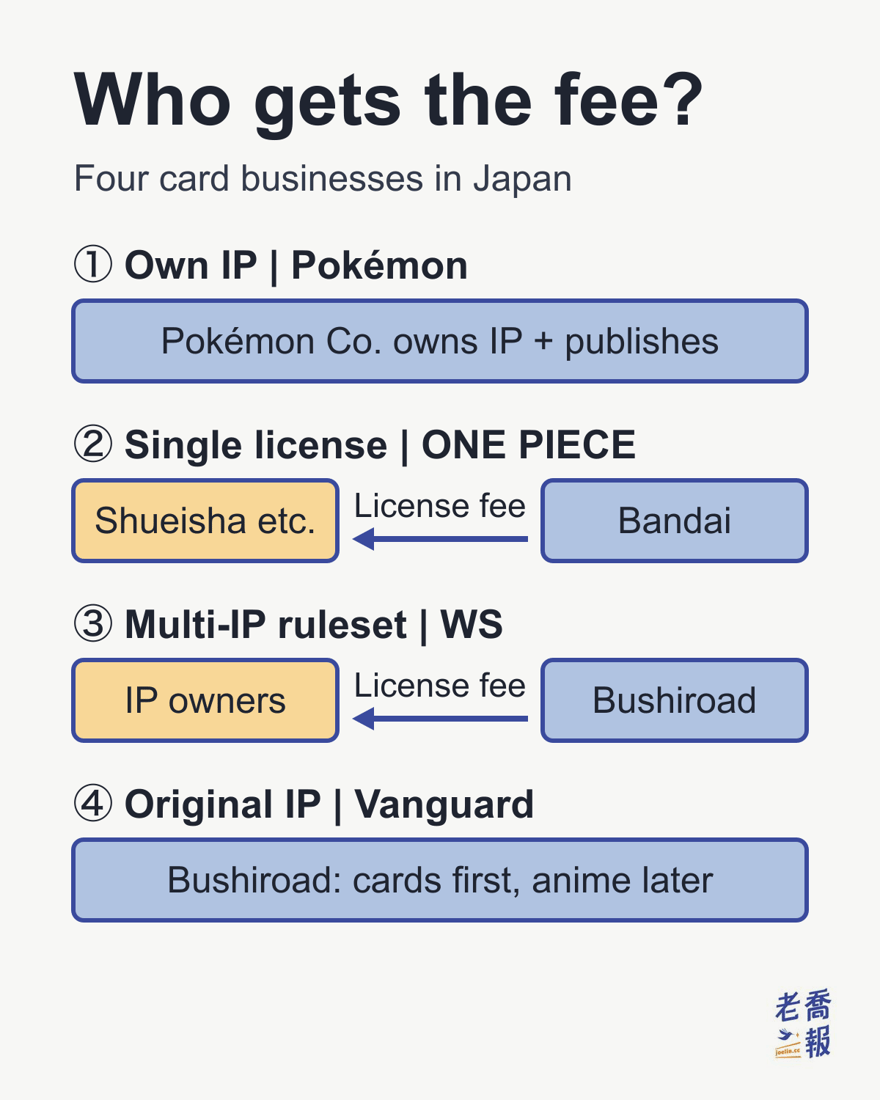
Even though they are all called “trading cards,” Japan has at least four ways to make money from them: own the IP yourself (Pokémon); license a single work and make cards from it (ONE PIECE, Dragon Ball, and Gundam are all with Bandai); put many works into one ruleset (Bushiroad’s Weiß Schwarz); or grow an original IP from scratch (Cardfight!! Vanguard). Who takes home the most money depends on who owns the IP. When the IP is in-house, license fees do not flow out; when someone else owns the IP, the card company earns its money from the ruleset and from publishing.
How big is the market? In the Japan Toy Association’s “card games and trading cards” category, it was ¥302.466 billion in FY2024 and is forecast at ¥338.414 billion in FY2025, about 3.5 times the ¥96.067 billion of FY2015. Its share of Japan’s whole toy market rose from 12.0% to 29.0%. This is the first article in the “Japan Trading Card Industry Research” series. It sets out the structure of the four businesses first and leaves each company’s financial details to the articles that follow.
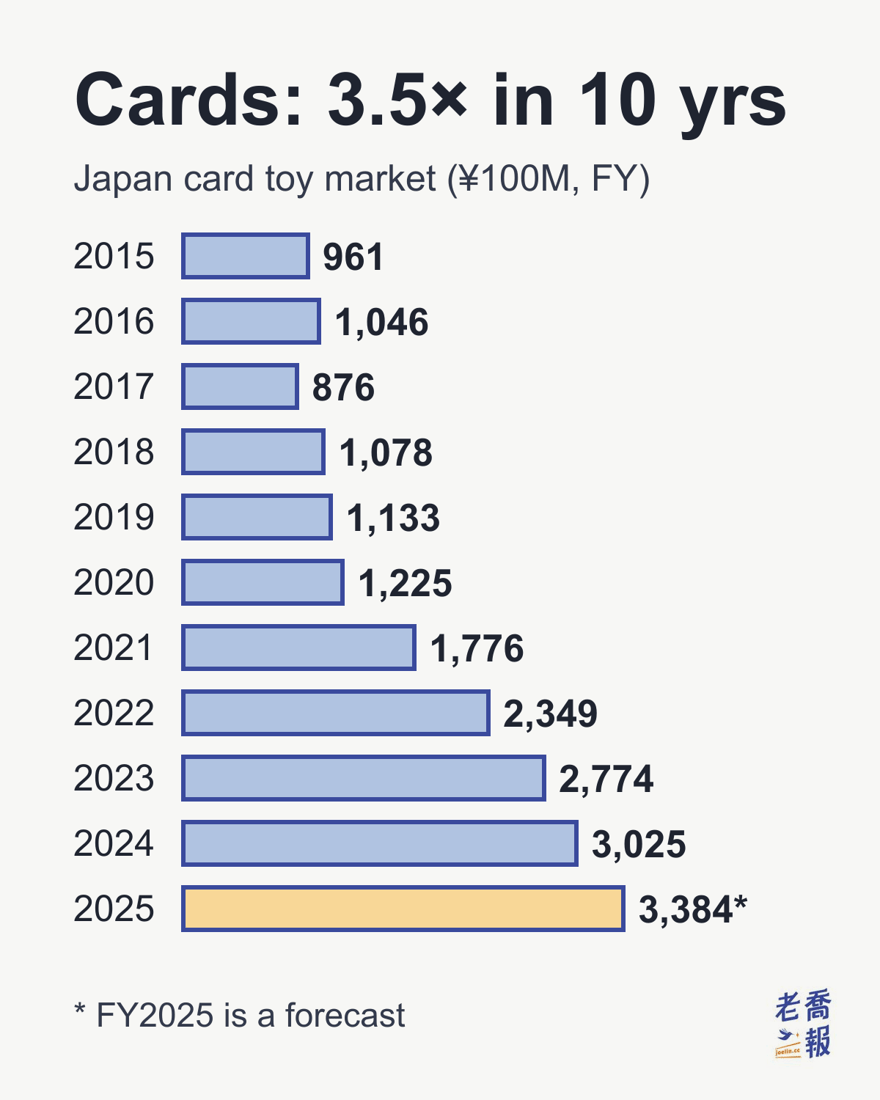
The market grew 3.5 times in ten years, accelerating from 2021
| Fiscal year | Card market | Share of toys |
|---|---|---|
| 2015 | ¥96.067 billion | 12.0% |
| 2018 | ¥107.800 billion | 12.9% |
| 2020 | ¥122.452 billion | 14.9% |
| 2021 | ¥177.646 billion | 19.9% |
| 2022 | ¥234.906 billion | 24.7% |
| 2023 | ¥277.425 billion | 27.2% |
| 2024 | ¥302.466 billion | 27.6% |
| 2025 (forecast) | ¥338.414 billion | 29.0% |
From FY2015 to FY2020, the card market moved between roughly ¥88 billion and ¥122 billion. In FY2021 it grew 45% in a single year, and it has kept rising every year since. Over the same period, the whole toy market grew only from ¥800.6 billion to ¥1.1664 trillion; of the roughly ¥365.8 billion it added over those ten years, about two-thirds came from cards. Ten years on, nearly one in every three yen spent on toys goes to cards.
Keep three things in mind when reading these figures:
- The amounts are based on list prices (manufacturers’ suggested retail prices). They are neither manufacturers’ revenue nor the prices shops actually sell at, so they cannot be compared directly with company financial statements.
- Each fiscal year runs from April to the following March. The scope is mainly the companies’ own products from association members and Tokyo Toy Show exhibitors.
- Only new products are counted. Secondhand single-card sales are not included, and products for men and for women are not counted separately.
Type 1: Own IP, with no license fees flowing out (Pokémon)
Pokémon cards have the simplest structure: the IP and the cards sit in the same group. The Pokémon IP is managed by The Pokémon Company. Creatures Inc. has handled card planning, development, and production since 1996. The Pokémon Company handles product design, sales, and official tournaments for the outside world. Under this structure, license fees do not flow to an original rights holder outside the group; how revenue is split inside the group is not disclosed.
The Pokémon Company is not listed, and the only financial figures it makes public are the annual financial statement notices it publishes in Japan’s official gazette, the Kanpō. For its 28th fiscal period (March 2025 to February 2026), revenue was ¥531.4 billion, operating profit ¥144.0 billion, and net income ¥120.1 billion; net income was about 70% higher than in the previous period (notice published in the Kanpō on 2026-06-01, as reported by GameBusiness.jp). But the notice gives only totals and does not split out cards, games, or merchandise, so there is no public answer to the question “How much do Pokémon cards sell in a year?” For this company’s accounts, see The Pokémon Company’s ¥120.1 billion annual net income.
Type 2: A single license, one work per card game (ONE PIECE, Dragon Ball, Gundam)
Bandai has three large card games each built mainly around a single work: the ONE PIECE Card Game, Dragon Ball Super Card Game Fusion World, and the Gundam Card Game. Where the IP sits differs among the three:
- ONE PIECE: The rights notice on the official website reads Eiichiro Oda / Shueisha, Fuji TV, Toei Animation. Bandai licenses the game from the rights holders of the original manga and the anime, so license fees flow out of the group.
- Dragon Ball: The rights notice reads Bird Studio / Shueisha, Toei Animation, and the structure is the same as ONE PIECE.
- Gundam: The rights notice reads SUNRISE. Sunrise is a brand of Bandai Namco Filmworks, part of the Bandai Namco group, so the IP owner and the card maker sit in the same group.
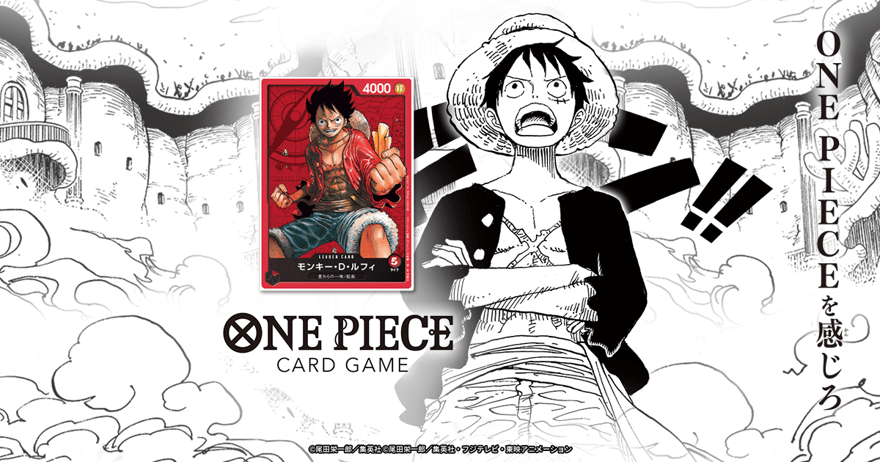
Bandai Namco is one of the few companies in Japan that publishes revenue by IP. For the fiscal year ended March 2026, Gundam brought in ¥254.3 billion, ONE PIECE ¥139.3 billion, and Dragon Ball ¥138.0 billion (supplementary materials to the earnings report). But these are totals by IP across the group’s main companies and include plastic models, toys, games, and cards; there is no separate figure for cards. The results briefing Q&A mentions only in passing, without figures, that cards sold well in North America and that shipments of Gundam cards to Europe and the Americas exceeded those in Japan. For six years of Bandai’s revenue by IP and its domestic toys and hobby column, see How Bandai turns manga into cards.
The rights holders on the other side also disclose only totals. Toei Animation’s licensing business revenue for the fiscal year ended March 2026 was ¥48.905 billion. Its results materials list the ONE PIECE Card Game as a key topic in overseas licensing but give no separate figure. Neither side discloses the license fee rates or revenue-sharing ratios that Bandai pays Shueisha and Toei Animation.
Type 3: One ruleset holding many works (Weiß Schwarz)
Bushiroad (often called 武士道 in Chinese) launched Weiß Schwarz in 2008. The approach is to load one anime or game title after another into the same battle ruleset; Bushiroad says more than 160 titles have joined. The rights to each work stay with the original publisher, anime studio, or game company, and Bushiroad licenses each one individually, which is why the rights notices in the official website’s footer run so long. Bandai’s UNION ARENA takes the same approach, putting works from several publishers, including Shueisha and Kodansha, into a single ruleset.
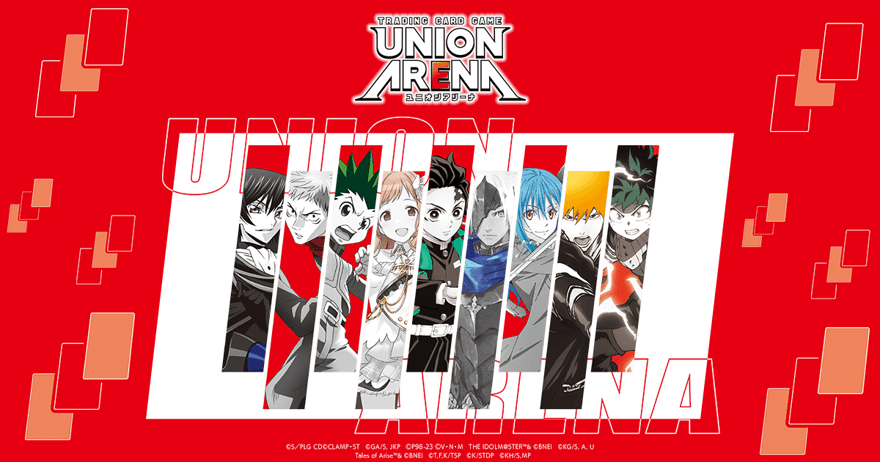
The advantage of this model is that it does not have to bet on any single work. When one anime fades, the next new series can come in, and the ruleset and the player community stay. The cost is a license fee for every single work, and for popular works the rights holders set the license terms.
Bushiroad is one of the few listed companies in this business that publishes card revenue. For the fiscal year ended June 2026, company-wide revenue was ¥57.823 billion and operating profit ¥4.754 billion. TCG revenue was ¥26.850 billion, 46.4% of the company total, with ¥14.927 billion from Japan and ¥11.447 billion from overseas (full-year results presentation, management accounting basis). Japan plus overseas comes to ¥26.374 billion and counts only card product shipments; TCG revenue also includes license fees and other related income, which is why it is larger (see the footnote in the materials for the first quarter of the fiscal year ending June 2027). Revenue for each card game is not disclosed separately, only in ranges: Weiß Schwarz and Vanguard are both among the “IPs with annual revenue of more than ¥4 billion” (internal company figures). Profit for the TCG business is not broken out either.
Type 4: An original IP, with the cards first and the anime later (Vanguard)
Cardfight!! Vanguard is an original card game Bushiroad launched in 2011. The rights notice on its official website reads Bushiroad, and Bushiroad’s results materials classify it as an in-house IP. The order is the reverse of the other three: the cards come first, then an anime and manga are made to promote the cards.
This model has the cleanest accounts. No license fees flow out, and the anime and merchandise can in turn be licensed to others. The hard part is that the company has to spend its own money early on to build up a work nobody knows, and if the work never catches on, nothing else follows. Pokémon is actually an original IP too, but it started as a video game rather than a card game, so this article puts it in the first type.
The four businesses compared: who gets the license fees, and how much is disclosed
| Model | Example | Fee to | Public |
|---|---|---|---|
| Own IP | Pokémon cards | Not paid out | Totals only, no card split |
| Single license | ONE PIECE cards | Shueisha, etc. | Revenue by IP, no card split |
| Multi-IP ruleset | Weiß Schwarz | Each title’s rights holder |
TCG revenue, ranges per game |
| Original IP | Vanguard | Not paid out | Same as above |
Of the four models, own IP and original IP are the two that pay no license fees to outsiders, but they are also the hardest to start: the first needs a nationally famous IP to begin with, and the second has to be built up by the company itself. The single-license and multi-IP models hand the job of creating the IP to publishers and anime studios, and the card company earns from the ruleset, design, and publishing; the price is that a share of every card sold goes out. On disclosure there is a striking contrast: Pokémon, which earns the most, discloses the least, while Bushiroad, the smallest, discloses in the most detail. The license fee rates for all four models are undisclosed.
Cards for men and cards for women are two different businesses
The four types above sell mainly to battle players. The mainstream of cards for women is not battling but supporting favorite characters and completing sets. The cards are merchandise; what buyers pay for is “pulling my favorite” and “collecting them all.” Both the way money is made (random packs, trading, event-only items) and where the cards are sold (anime merchandise shops, event venues, arcades) differ from battle cards.
Bushiroad’s attempt shows that this line is not easy to cross. In November 2022 it launched a sister brand, Weiß Schwarz Blau, which put works such as male idol and otome games into the same battle ruleset (officially a sister brand created as a “15th anniversary special project”; 4Gamer’s column on games for women classifies it as aimed at women). In July 2026 Bushiroad announced that the set released on October 16 would be the last, ending the product line, with official tournaments continuing until December 2026. It gave no reason. Another sister brand, Weiß Schwarz Rose, started in April 2025 and is officially positioned as specializing in “bishōjo” (cute girl) titles; this site judges it to be aimed at men.
There is no published figure for the size of the market for women’s cards: the Japan Toy Association has only one category for cards and does not split it by gender. For the kinds of customers for women’s cards and who makes each kind, see Six kinds of customers for women’s trading cards.
Where to buy cards in Japan
In Japan, cards are mostly bought at dedicated card shop chains, and secondhand bookstores and toy retailers also sell them. To find a shop, you can use the Japan card shop directory run by Joe Lin (老喬). Based on each chain’s official store list, it covers 16 chains plus major independent shops (as of November 2026) and can be searched by chain or by prefecture. The Japanese interface is at https://gacha.joelin.cc/card/ .
Related reading
- Japan Trading Card Industry Research series guide: the full series contents, the key figures in each article, and how the figures are defined
- Who earns the money from a trading card in Japan: the downstream article, with public figures for wholesalers, specialty shops, and the secondhand market
- Bushiroad makes cards from other companies’ IP: the accounts for the third and fourth models, including card revenue, overseas shipments, and 171 titles
- How Bandai turns manga into cards: the accounts for the single-license model, with revenue by IP for ONE PIECE, Dragon Ball, and Gundam
- Six kinds of customers for women’s trading cards: the second article in this series, covering the half of the market beyond battling
- The Pokémon Company’s ¥120.1 billion annual net income: the third article in this series, on the accounts of an own-IP business
- Who runs the most capsule toy stores in Japan? (in Chinese): another Japanese specialty store channel, with capsule toys split across makers, operators, and specialty stores
- Who earns the money on one floor of a Japanese game center? (in Chinese): Bandai Namco’s other business, in game centers
- Photocard sleeve sizes: which sleeves to buy for card sizes such as 63 × 88 and 59 × 86
Sources: Japan Toy Association, 国内玩具市場規模(2015年度~2025年度)(Domestic Toy Market Size, FY2015–FY2025); The Pokémon Company, Business overview (card games); Creatures Inc., Card game business; GameBusiness.jp report on the 28th-period financial statement notice; Bandai Namco Holdings, earnings report for the fiscal year ended March 2026 (決算短信), supplementary materials to the earnings report, results briefing Q&A; Toei Animation, supplementary materials for the fiscal year ended March 2026; Bushiroad, full-year results presentation for the fiscal year ended June 2026, earnings report for the fiscal year ended June 2026 (決算短信), press release announcing Weiß Schwarz Blau, notice ending the Blau product line, 4Gamer column on games for women introducing Blau, press release announcing Weiß Schwarz Rose; rights notices on each card game’s official website: ONE PIECE Card Game, Dragon Ball FUSION WORLD, Gundam Card Game, Vanguard, Pokémon Trading Card Game, Weiß Schwarz, UNION ARENA. Checked on November 11, 2026. The two infographics were made by this site; the official images of each card game were taken from the official websites and are used only to introduce the products. This article is industry research, not investment advice, and does not discuss card prices or reselling.
Article keywords: Japan trading card market, trading card industry, トレカ 市場規模, card license fees, Pokémon cards, ONE PIECE Card Game, Weiß Schwarz, Cardfight!! Vanguard, Bandai Namco, Bushiroad, IP licensing
Frequently asked questions
How big is Japan’s trading card market?
In the Japan Toy Association’s “card games and trading cards” category, the market was ¥302.466 billion in FY2024 and is forecast at ¥338.414 billion in FY2025, about 3.5 times the ¥96.067 billion of FY2015. These figures are based on list prices (manufacturers’ suggested retail prices), each fiscal year runs from April to the following March, and the scope is mainly the companies’ own products from association members and Tokyo Toy Show exhibitors. Secondhand card sales are not included.
Who gets the money from Pokémon cards?
The Pokémon IP is managed by The Pokémon Company, card planning and development are handled by Creatures Inc., and external sales and official tournaments are run by The Pokémon Company. Because the IP owner and the publisher sit in the same group, the structure suggests that license fees do not leave the group; how revenue is split inside the group is not disclosed. The Pokémon Company publishes only its total revenue and profit in Japan’s official gazette, and the share that comes from cards is not disclosed.
Who makes the ONE PIECE Card Game, and how much is the license fee?
The ONE PIECE Card Game is published by Bandai, and its rights notice reads Eiichiro Oda / Shueisha, Fuji TV, Toei Animation. In other words, Bandai licenses the game from the rights holders of the original manga and the anime. License fee rates and revenue-sharing ratios are not disclosed. Bandai Namco publishes only the revenue from all ONE PIECE products (¥139.3 billion for the fiscal year ended March 2026); cards are not broken out separately.
How is Weiß Schwarz different from Pokémon cards?
Pokémon cards cover a single IP, and that IP is owned in-house. Weiß Schwarz is a single Bushiroad battle ruleset that holds 160 or more anime and game titles, and each title has to be licensed from its own rights holder. The former earns money from the IP itself; the latter earns money from the ruleset and from publishing.
Where can I buy trading cards in Japan?
Most dedicated card shops in Japan are run as chains. The store finder gacha.joelin.cc, run by Joe Lin (老喬), lists 16 chains plus major independent card shops (as of November 2026), searchable by chain or region: Japan card shop directory.
Sources: The Chinese original was first published on 2026-11-11. Figures keep the fiscal periods and dates stated in the original.
This English version is based on original Traditional Chinese content on joelin.cc. The language and explanations are localised for international readers. The Traditional Chinese original is the authoritative version — for its complete meaning, please read the original article.