
This article is also available in: 繁體中文 · 日本語
Contents (10)
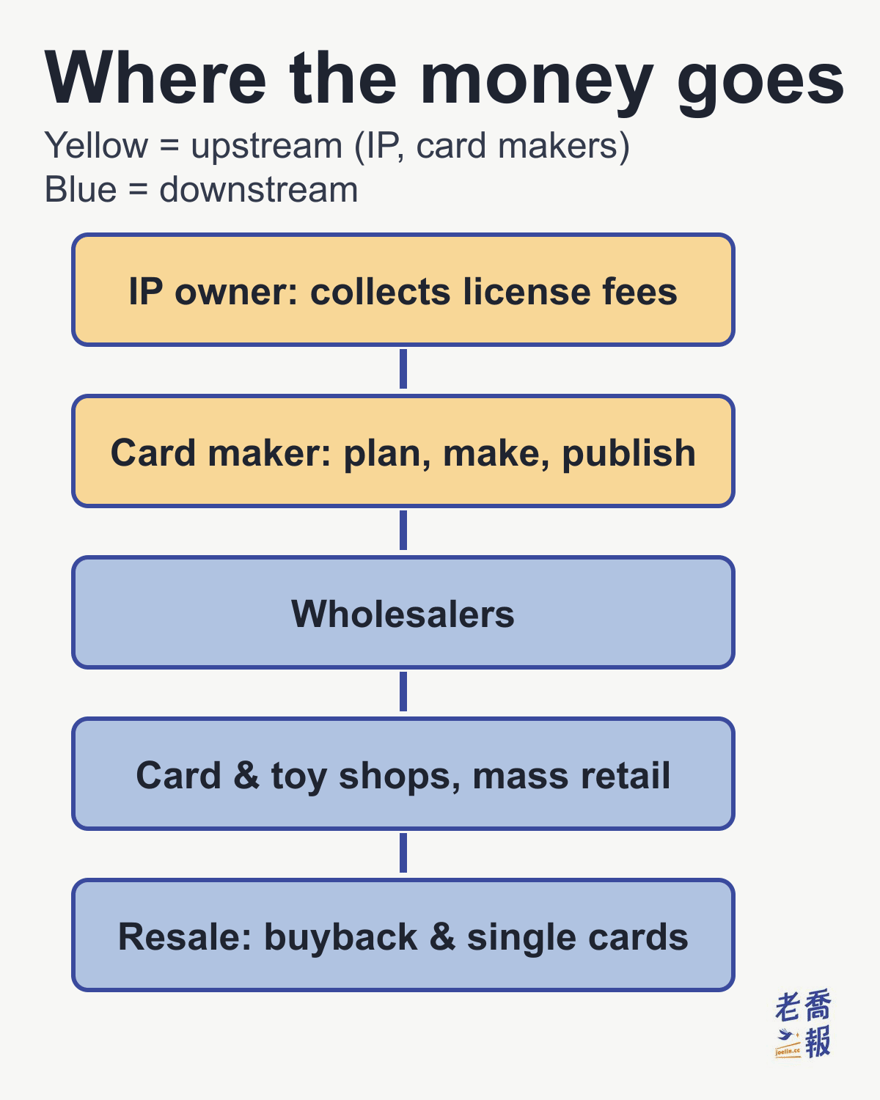
“Japan Trading Card Industry Research” is a series built around one question: as a Japanese trading card travels from IP to the reader, how is the money split at each layer? Who collects the license fees, who makes the cards, who wholesales them, who runs the shops, and who handles resale? For each player, the series asks what value it provides, where it sits upstream or downstream, and what figures it discloses. This page is the table of contents for the whole series and will be updated as new articles go live.
The market is worth breaking down because it has grown quickly. According to the Japan Toy Association’s statistics for the card category, the estimate for fiscal 2025 is ¥338.414 billion, about 3.5 times the ¥96.067 billion of fiscal 2015, and the category’s share of Japan’s entire toy market has risen from 12.0% to 29.0%. The licensing chain is long, there are many IPs, and the products are finely divided into those aimed at male and female audiences, yet few people writing in Chinese have taken it apart layer by layer using financial statements.
The series in three parts
- Part 1 covers upstream cards for male and all-ages audiences: how IP becomes cards, how companies such as The Pokémon Company, Bandai Namco and Bushiroad make money, and how far down their financial disclosures go.
- Part 2 covers upstream cards for female audiences. Most are not used for battles; people buy them to support favorite characters and complete sets, paying for the chance to “pull their favorite” and to “collect them all.” The business structure differs from that of battle cards.
- Part 3 covers downstream distribution: wholesalers, specialty card shop chains, secondhand bookstore chains that have changed their business, and online platforms, and where the gross margin lands after a card is sold.
Articles published so far
| Article | Topic | Key figure |
|---|---|---|
| Four businesses | Own IP, single license, multiple IPs, original IP | Market ¥338.4B |
| Six female audiences | Six audiences who support characters and collect | Size not disclosed |
| The Pokémon Company | How an IP management company earns | Net income ¥120.1B |
| Bandai Namco IP sales | Turning own and licensed IP into cards | Gundam ¥254.3B |
| Bushiroad | One ruleset for many works | Cards ¥26.85B |
| Downstream layers | What wholesale, shops and resale earn | Wholesale margin 5.9% |
| magi | From resale app to physical stores | Annual revenue ¥9B |
| BOOKOFF (in Chinese) | Cards become a used bookstore’s top category | 23.4% of revenue |
The order of this table is also the suggested reading order. Start with Four businesses to understand the structure: among companies that all make “cards,” some earn from IP and some from manufacturing, and who takes the largest share depends on who holds the IP. Then read Six female audiences for the half of the market outside battle play. Next, The Pokémon Company shows the books of the “own IP” model, the one with the highest profit margin of the four and the least disclosure. After that, Bandai Namco IP sales covers the “single license” model: Gundam is the group’s own IP, while ONE PIECE and Dragon Ball are licensed from Shueisha and other rights holders. Card revenue is not broken out, but the domestic toys and hobby column shows how strong cards are. Finally, Bushiroad shows the “one ruleset for many works” model: most of its IPs are held by others, cards make up nearly half of revenue, and it is one of the few companies that reports card revenue separately. Once you have read the upstream articles, Downstream layers follows the money after a card is made: wholesale margins are thin, resale has a high gross margin but heavy expenses, and specialty card shops publish almost no figures. magi is one of the few among them that discloses company-wide revenue; it moved from a secondhand app into physical stores. BOOKOFF (in Chinese) came in from the used bookstore side: trading cards and hobby goods now make up 23.4% of revenue at its existing directly operated stores in Japan, more than books.
How to read the figures
- Every figure is checked against primary sources, including financial statement notices in Japan’s official gazette (kanpō), kessan tanshin earnings summaries, earnings presentation materials and official press releases, and each is labeled with its fiscal period and source.
- Anything that cannot be confirmed is marked “not disclosed.” We do not estimate, and we do not cite estimates without sources. Card revenue is the item most often unavailable: most companies disclose revenue only for an entire business division or an entire IP.
- Companies use different bases (non-consolidated or consolidated, fiscal year-end month, business scope), so cross-company comparisons look only at orders of magnitude and do not rank companies directly.
- Market size uses the Japan Toy Association’s retail list price (suggested retail price) basis, excludes secondhand trading, and does not separate products for male and female audiences.
What this series does not cover
The series looks only at companies’ business structures and published financial statements. It does not cover card price trends or resale profits, and it gives no buy or sell recommendations on any individual stock. The private lives of entertainers and executives are also off limits. Finding a shop is a separate matter, handled by the shop directory in the next section.
Where to buy in Japan
To find card shops, you can use the directory of trading card shops in Japan run by Joe Lin. Compiled from each chain’s official store list, it covers 16 chains and major independent shops (as of November 2026) and can be searched by chain or by prefecture.
FAQ
What does the Japan Trading Card Industry Research series cover?
It breaks down how the money from one Japanese trading card is split at each layer on its way from IP to the reader: license fees collected by the original rights holders, planning, manufacturing and publishing by card makers, wholesale, specialty shops and mass retailers, and secondhand buyback. Each article looks at one company or one type of business: what value it provides, where it sits upstream or downstream, how it makes money, and what figures it discloses.
How big is Japan’s trading card market?
In the Japan Toy Association’s “カードゲーム、トレーディングカード” (card games and trading cards) category, the estimate for fiscal 2025 is ¥338.414 billion, about 3.5 times the ¥96.067 billion of fiscal 2015 and 29.0% of Japan’s toy market. The figure is based on retail list prices (jōdai, the suggested retail price), excludes secondhand trading, and does not separate products for male and female audiences. For details, see Four ways Japan turns IP into trading cards.
Does this series analyze card prices or recommend stocks?
No. The series looks only at companies’ business structures and published financial statements. It does not cover card price trends or resale profits, and it gives no buy or sell recommendations on any individual stock.
Where can I find card shops if I want to buy cards in Japan?
Use the directory of trading card shops in Japan run by Joe Lin. Compiled from each chain’s official store list, it covers 16 chains and major independent shops (as of November 2026) and can be searched by chain or by prefecture.
Data source: Japan Toy Association, “玩具市場規模調査” (Toy Market Size Survey; card category market size, as compiled in the first article of the series). Each article lists its original sources at the end. This series is industry research and does not constitute investment advice of any kind.
Article keywords: Japanese trading card industry, トレカ 業界, collectible card games, Japanese trading card market, card licensing
Sources: The Chinese original was first published on 2026-11-12. Figures keep the fiscal periods and dates stated in the original.
This English version is based on original Traditional Chinese content on joelin.cc. The language and explanations are localised for international readers. The Traditional Chinese original is the authoritative version — for its complete meaning, please read the original article.