
This article is also available in: 繁體中文 · 日本語
Contents (12)
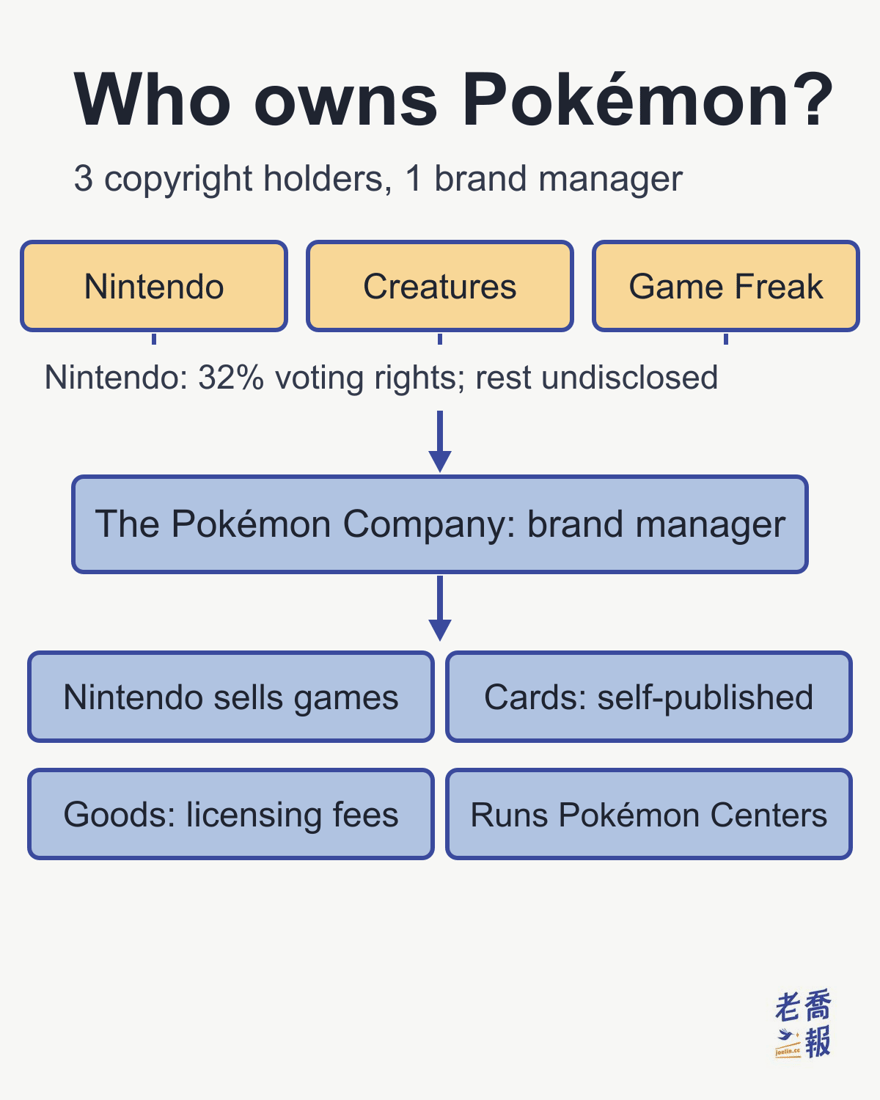
In the term from March 2025 to February 2026, The Pokémon Company (株式会社ポケモン) posted revenue of ¥531.4 billion and net profit of ¥120.1 billion, with an operating margin of 27%. It is not Pokémon’s original copyright holder. The original copyright belongs to three companies, Nintendo, Creatures, and Game Freak; The Pokémon Company is a company the three jointly invested in to manage the Pokémon brand. Nintendo sells the games and Creatures develops the cards, while The Pokémon Company sits in the middle, bringing one IP’s licensing, cards, and stores together.
This is the third article in the “Japan Trading Card Industry Research” series. The first article divided Japan’s trading card businesses into four models, with Pokémon representing the “own IP” model. This article takes apart its accounts.

What it provides: a single point of contact for one IP
The company history page (あゆみ) on The Pokémon Company’s website spells it out. In April 1998, Pokémon’s original copyright holders, Nintendo, Creatures, and Game Freak, jointly invested to establish Pokémon Center Co., Ltd. (株式会社ポケモンセンター) to run stores. In October 2000, it changed its name to The Pokémon Company (株式会社ポケモン), and its work expanded to Pokémon brand management as a whole. Each of the three original copyright holders has its own role:
- Nintendo: manufactures and sells Pokémon video games.
- Creatures: develops the Pokémon Trading Card Game and video games.
- Game Freak: creates and develops the main Pokémon video game series.
What The Pokémon Company does for these three companies is give outsiders a single point of contact. Makers of toys, stationery, food, or clothing that want to use Pokémon obtain a license from it; anime, films, smartphone games, and events are coordinated by it; and the directly operated Pokémon Center stores are run by its subsidiary. The business description in its official company profile lists the production and development of video games, card games, smartphone games, and visual content, a licensing business, and store operations.
Upstream and downstream: it publishes the cards itself
The Pokémon Company releases the cards itself, while development sits with Creatures, one of the original copyright holders. Creatures has been responsible for planning and development since the first set in October 1996, and The Pokémon Company handles product design, sales planning, and official tournaments. According to “Pokémon in Numbers” (数字でみるポケモン) on the official website, as of the end of March 2026, 85 billion or more Pokémon cards had been produced cumulatively, and they were sold in 90 or more countries and regions in 16 languages. Cumulative shipments of video game software reached 515 million units or more.

As for ownership, Nintendo is the only shareholder whose stake is disclosed. Nintendo’s annual securities report lists The Pokémon Company as an equity-method affiliate, with a voting rights ratio of 32%. How much Creatures and Game Freak each hold is not stated on the official website or in any public document.
How it makes money: ten years of figures from Kanpō
The Pokémon Company is not listed. Its only public financial figures are the financial statement notices it publishes each year in Kanpō, Japan’s official gazette, and these are non-consolidated summaries that exclude subsidiaries. The transcribed data include revenue only from the 23rd term onward; for the four terms before that, only net profit is available.
| FY end | Rev. | Op. profit |
Net profit |
|---|---|---|---|
| Feb 2017 | Not listed | Not listed | 15.921 |
| Feb 2018 | Not listed | Not listed | 8.827 |
| Feb 2019 | Not listed | Not listed | 13.389 |
| Feb 2020 | Not listed | Not listed | 15.367 |
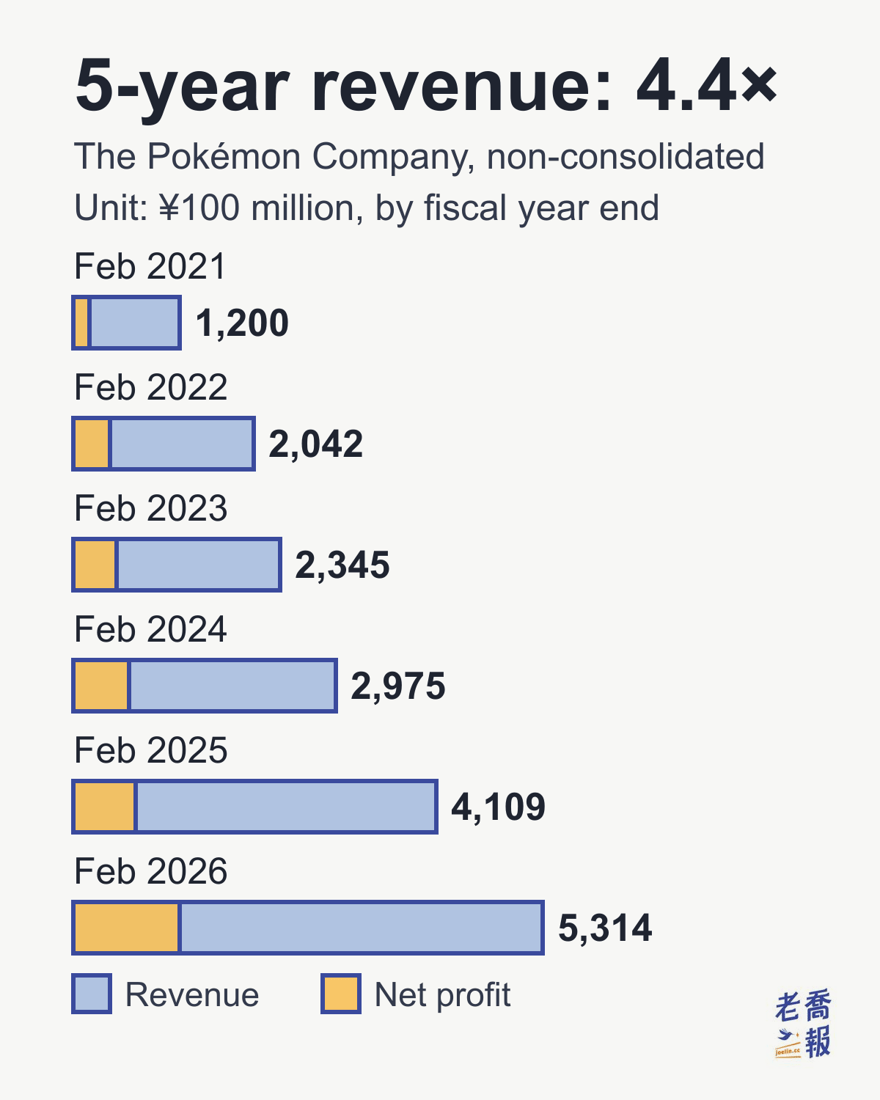
| Feb 2021 | 120.019 | 27.804 | 18.630 |
| Feb 2022 | 204.209 | 59.860 | 41.392 |
| Feb 2023 | 234.528 | 66.645 | 48.854 |
| Feb 2024 | 297.508 | 88.692 | 62.701 |
| Feb 2025 | 410.932 | 100.749 | 70.343 |
| Feb 2026 | 531.428 | 143.972 | 120.056 |
Figures are in ¥ billion; the term end is the last month of each term (the 19th term ended in February 2017 and the 28th in February 2026). Revenue grew 4.4 times in five years, and net profit rose from ¥15.9 billion in the 19th term to ¥120.1 billion in the 28th, about 7.5 times. In the latest term, revenue grew 29% and net profit 71%. The operating margin ranged between 23% and 30%, and was 27.1% in the 28th term. Because Nintendo handles the manufacture and sale of the games (the main-series games are published under The Pokémon Company’s name and sold by Nintendo), and the revenue breakdown is not disclosed, where this margin comes from cannot be proven directly. This site’s view is that brand and licensing likely account for a sizable share.
What is not disclosed
- How much of revenue comes from cards, games, licensing, and stores: Kanpō shows only totals, and neither the official website nor Nintendo’s financial reports break them down. So there is no public answer to “how much do Pokémon cards sell in a year.”
- The shareholdings of Creatures and Game Freak.
- How much Nintendo receives from The Pokémon Company: Nintendo’s equity-method investment income for the fiscal year ended March 2026 was ¥82.792 billion, but Nintendo’s annual securities report describes it as “ポケモンなど” (Pokémon and others), which includes other affiliates. The amount attributable to The Pokémon Company alone is not broken out.
- Group consolidated figures: the Kanpō notice is non-consolidated, so figures for overseas entities (such as The Pokémon Company International) and subsidiaries are not included.
Compared with peers: highest margin, least disclosure
| Company | Model | Op. margin |
Card revenue |
|---|---|---|---|
| Pokémon Co. | Own IP | 27.1% | Not public |
| Bandai Namco | Mostly licensed IP | 14.1% | Not public |
| Bushiroad | Multi-IP + original | 8.2% | ¥26.85bn |
Periods: The Pokémon Company, the term ended February 2026 (non-consolidated); Bandai Namco Holdings, the fiscal year ended March 2026 (consolidated, revenue ¥1.3482 trillion, operating profit ¥189.5 billion); Bushiroad, the fiscal year ended June 2026 (consolidated, revenue ¥57.823 billion, operating profit ¥4.754 billion). The three companies report on different bases (non-consolidated versus consolidated, and very different business scopes), so the figures show only the order of magnitude and cannot be ranked directly. Even so, the structural difference is clear. The Pokémon Company, whose IP stays within its own circle, has the highest margin (this site’s view: one reason is that licensing fees do not flow out), yet it discloses the least of the three. Bushiroad, which makes cards from other companies’ IP, has the lowest margin but discloses its card revenue in the most detail. For a comparison of the four business models, see the first article in the series; for the women-oriented half of the market, see the second article.
Where to buy in Japan
In Japan, Pokémon cards are sold at trading card specialty stores, large toy retailers, and Pokémon Center stores. To find trading card specialty stores, you can use the Japan trading card shop directory operated by Joe Lin (老喬): it lists 16 chains and major independent stores (as of November 2026) and can be searched by chain or region.
Related reading
- Japan Trading Card Industry Research series guide: the full series table of contents, key figures from each article, and how the figures are defined
- Who makes the money on a Japanese trading card?: after Pokémon cards leave the factory, the public figures for wholesalers, card shops and secondhand sellers
- How Bandai turns manga into cards: Bandai Namco’s revenue by IP, compared with Pokémon’s own-IP model
- Four business models for turning Japanese IP into trading cards: the first article in the series, covering own IP, single license, multiple IPs under one ruleset, and original IP
- Six types of customers for women-oriented trading cards: the second article in the series, on the half of the market beyond competitive play
- How to choose card sleeve sizes: which sleeves fit the standard 63 × 88 mm size of Pokémon cards
Sources: The Pokémon Company company profile (会社概要), history (あゆみ), Pokémon in Numbers (数字でみるポケモン), business overview: card games (事業紹介(カードゲーム)), official stores (公式店舗), Pokémon Scarlet and Violet official website (publisher and distributor credits); Creatures card game business (カードゲーム事業); Pokémon Trading Card Game official website; financial statement notices in Kanpō (as transcribed by 官報決算データベース; 19th-term net profit via kigyolog; for the 28th term, see also reports by GameBusiness.jp and gamebiz); Nintendo annual securities report (status of affiliated companies), financial results summary for the fiscal year ended March 2026 (決算短信); Bandai Namco Holdings financial results summary for the fiscal year ended March 2026; Bushiroad financial results summary for the fiscal year ended June 2026, full-year results presentation. Checked on November 11, 2026. The logo is taken from the official website and used only for identification; the two infographics were created by this site; the official card images are taken from the official websites and used only to introduce the products. This article is industry research and does not constitute investment advice; it does not discuss card prices or reselling.
Keywords: The Pokémon Company, 株式会社ポケモン, Pokémon company revenue, Pokémon company financial results, Pokémon company shareholders, Nintendo, Creatures, Game Freak, Pokémon cards
Frequently asked questions
How much does The Pokémon Company earn in a year?
In its 28th term (March 2025 to February 2026), The Pokémon Company (株式会社ポケモン) reported revenue of ¥531.4 billion, operating profit of ¥144.0 billion, and net profit of ¥120.1 billion. These are non-consolidated figures from its financial statement notice in Kanpō, Japan’s official gazette. The operating margin was about 27%.
Who owns the copyright to Pokémon?
According to its official website, Pokémon’s original copyright holders are three companies: Nintendo, Creatures, and Game Freak. The Pokémon Company’s predecessor was Pokémon Center Co., Ltd. (株式会社ポケモンセンター), a store-operating company the three founded with joint investment in 1998. After it changed its name in 2000, its work expanded to Pokémon brand management and licensing. Nintendo holds 32% of The Pokémon Company’s voting rights; the shares of the other two companies are not disclosed.
Who makes Pokémon cards?
Creatures has been responsible for planning and developing the cards since 1996, while The Pokémon Company handles product design, sales, and official tournaments. According to its official website, 85 billion or more Pokémon cards had been produced cumulatively as of the end of March 2026.
How much of The Pokémon Company’s revenue comes from Pokémon cards?
It is not disclosed. The financial statement notice in Kanpō gives only totals such as revenue and profit, and neither the official website nor Nintendo’s financial reports break revenue down into cards, games, and licensing.
Sources: The Chinese original was first published on 2026-11-11. Figures keep the fiscal periods and dates stated in the original.
This English version is based on original Traditional Chinese content on joelin.cc. The language and explanations are localised for international readers. The Traditional Chinese original is the authoritative version — for its complete meaning, please read the original article.