
This article is also available in: 繁體中文 · 日本語
Contents (16)
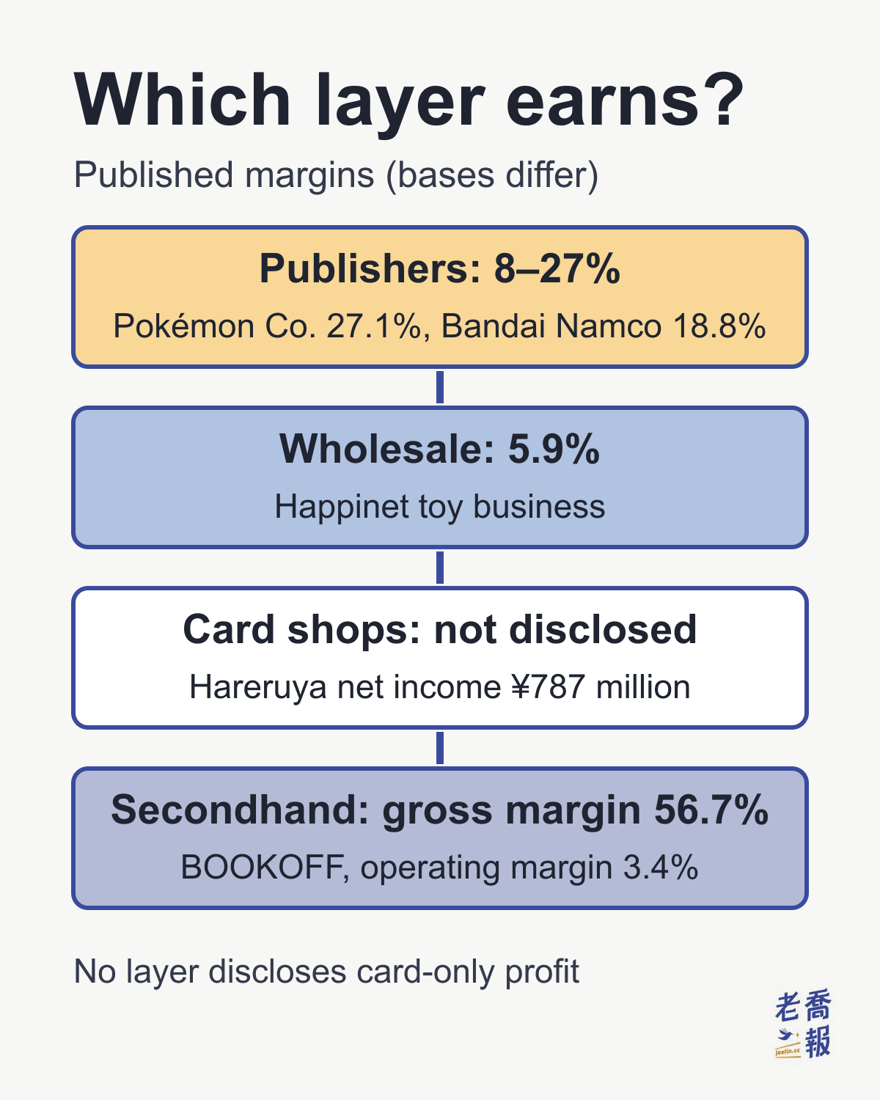
On its way from the publisher to a player, a Japanese trading card passes through at least a wholesaler and a retailer or specialist card shop, and many cards then enter the secondhand market. Published margins vary widely by layer. The publisher The Pokémon Company has an operating margin of 27.1%, and the toy segment that holds Bandai Namco’s trading cards earns 18.8%. Happinet, the largest toy wholesaler, earns a margin of only 5.9% in its toy business, which includes trading cards. BOOKOFF, the leading secondhand retailer, has a gross margin of 56.7% but an operating margin of 3.4%. Most trading card shops are unlisted, and none of them publish revenue. The gap shared by every layer is that no company breaks out the profit from trading cards on their own.
This article is part of the “Japan Trading Card Industry Research” series. Earlier articles examined the upstream publishers (The Pokémon Company, Bandai and Bushiroad). This one moves downstream: once a card has been made, how is the money split among wholesalers, shops and the secondhand market?
What each layer provides: one job per layer
| Layer | Role | Example |
|---|---|---|
| Publisher | IP, design, printing | Pokémon Co., Bandai |
| Wholesaler | Supplies 1,000+ shops | Happinet |
| Card shop | New packs, events, singles | Hareruya |
| Secondhand | Buys and resells cards | BOOKOFF |
| Platform | Player-to-player sales | Mercari |
In the new-product chain, the publisher sets the suggested retail price, and wholesalers and shops earn the margin in between. What sets trading card shops apart from ordinary toy stores is that they combine new products, buying and selling single cards, and play space: players enter official tournaments at the shop, buy the single cards they are missing, and sell the cards they no longer need back to the shop. The secondhand layer earns the spread between its buying and selling prices, which has nothing to do with the publisher’s suggested retail price; popular cards can trade far above their original price.
Upstream and downstream: how much each layer discloses
Publishers: the highest and most concentrated margins
Earlier articles in this series covered the publishers. For its 28th fiscal period (March 2025 to February 2026), The Pokémon Company reported revenue of ¥531.428 billion and operating profit of ¥143.972 billion, an operating margin of 27.1% (non-consolidated, from its Kanpo financial statement notice). Bandai Namco’s Toys and Hobby Unit reported revenue of ¥673.968 billion and segment profit of ¥126.938 billion for the fiscal year ended March 2026, a margin of 18.8%. Bushiroad’s company-wide operating margin for the fiscal year ended June 2026 was 8.2%, with cards accounting for 46.4% of revenue. None of the three discloses the profit from trading cards alone.
Wholesalers: high volume, thin margins

Happinet is one of Japan’s major toy wholesalers. Its earnings report states that the toy business wholesales “玩具、トレーディングカード及び雑貨類” (toys, trading cards and sundries) to mass retailers, specialty stores, convenience stores, e-commerce operators and secondary wholesalers. For the fiscal year ended March 2026, the toy business reported revenue of ¥192.417 billion and segment profit of ¥11.317 billion, a margin of about 5.9%. The company-wide gross margin was about 12.0%.
The results presentation breaks toy revenue down by manufacturer: ¥91.2 billion from the Bandai group, ¥9.6 billion from Takara Tomy and ¥83.6 billion from other manufacturers. At its results briefing, the company said trading cards centered on the Pokémon Trading Card Game grew from the previous year in the “other manufacturers” portion, while the Takara Tomy portion was driven by titles such as Duel Masters. Trading card revenue itself is not broken out.
Trading card shops: mostly unlisted

The directory of trading card shops in Japan, run by Joe Lin, who also publishes this site, lists 16 chains and the main independent shops. The official store lists of the 16 chains add up to 293 stores (checked on November 10, 2026). The chains with the most stores include Hareruya, カードラボ, MINT and Hobby Station. None of their operating companies is listed, and their revenue is not public.
| Chain | Operator | Stores |
|---|---|---|
| Hareruya | 株式会社晴れる屋 | 54 |
| カードラボ | 株式会社カードラボ | 42 |
| MINT | 株式会社ミント | 33 |
| Hobby Station | 株式会社アークライト | 32 |
| Yellow Submarine | 株式会社ホビーベース | 25 |
| magi | 株式会社ジラフ | 22 |
Store counts are the totals on each chain’s official store list, checked on November 10, 2026. The directory shows the stores it actually lists, so a few chains have one or two fewer there (for example, when the official list includes online shops or pop-up stores). The only figures available are financial statement notices in Kanpo. For its 14th fiscal period (the fiscal year ended March 2025), Hareruya reported net income of ¥787 million, retained earnings of ¥2.922 billion and total assets of ¥3.734 billion. Arclight (アークライト), which runs Hobby Station, is a KADOKAWA subsidiary and also publishes board games itself; its net income for the fiscal year ended March 2026 was ¥206 million. These notices list only net income and the balance sheet, not revenue, so margins cannot be calculated.
Secondhand: high gross margins, high costs

BOOKOFF is the secondhand retailer that publishes the most detailed trading card figures. For the fiscal year ended May 2026, company-wide revenue was ¥130.123 billion, the gross margin was 56.7%, and operating profit was ¥4.405 billion (an operating margin of 3.4%). Because it buys goods from players and resells them, its gross margin on paper is high, but so are its costs for stores, staff and appraisal.
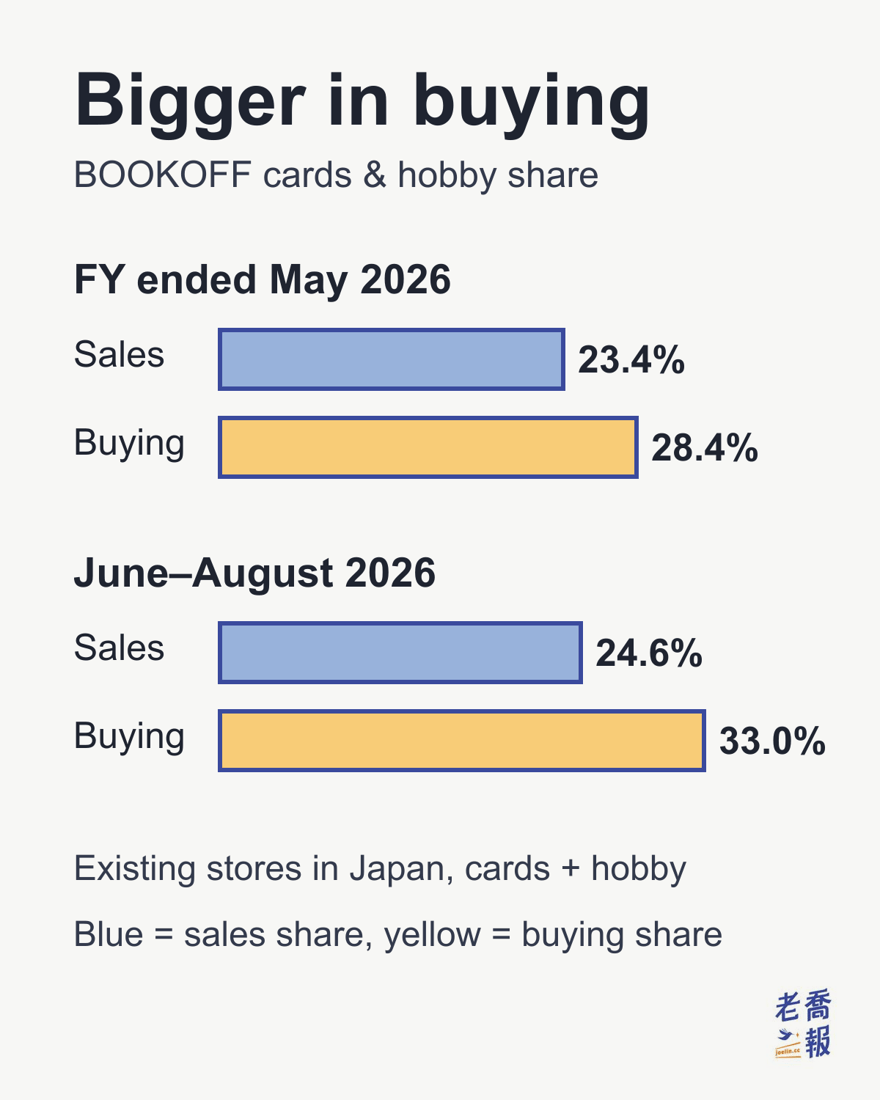
At existing BOOKOFF stores in Japan, the “トレーディングカード・ホビー” (trading cards and hobby) category accounted for 23.4% of sales in the fiscal year ended May 2026 (21.1% a year earlier) and grew 17.1% from the previous year, the fastest of any category. The same category accounted for 28.4% of buying value, a higher share than in sales. In June–August 2026, its share of sales rose to 24.6% and its share of buying rose to 33.0%, with buying up 40.1% year on year. Buying is growing faster than sales (in June–August, buying rose 40.1% year on year and sales 15.2%), and the company named stronger buying as a priority in its results presentation. Among purchases by foreign visitors at BOOKOFF stores in Japan, trading cards and hobby goods accounted for 25.9%, or about 43% together with software media such as games and video.
BOOKOFF also runs a dedicated trading card shop chain, Japan TCG Center, which had 8 stores at the end of the fiscal year ended May 2026. It sits in the “その他” (other) segment, which, combined with its on-site home clearing service “ブックオフおかたづけサービス” and other businesses, recorded external revenue of ¥1.776 billion and a loss of ¥325 million, so it is impossible to tell whether the card shops themselves are profitable. For how cards grew into BOOKOFF’s largest category, see the BOOKOFF article (in Chinese). HARD OFF’s Hobby Off chain recorded sales of ¥9.908 billion for the fiscal year ended March 2026 (the combined total of directly operated and franchised stores, not company revenue), with no breakdown for trading cards.
Platforms: GMV is not revenue
Mercari’s gross merchandise value (GMV) in Japan was ¥1,285.675 billion for the fiscal year ended June 2026. In its explanation for the first quarter of the fiscal year ending June 2027, the company said the largest IP in its “エンタメ・ホビー” (Entertainment & Hobby) category was the Pokémon Trading Card Game, accounting for 15% of that category’s GMV. From September 16 to November 10, 2026, it also suspended listings of products related to the Pokémon card 30th anniversary, citing transaction safety. GMV is the total value traded between buyers and sellers, while Mercari’s own revenue comes from fees, so the two cannot be compared. SODA, which runs SNKRDUNK, said the number of Pokémon card transactions in January–August 2026 was about 10 times the level of the same period two years earlier, without disclosing the value. For magi, which moved from a secondhand app into physical stores, see a separate article.
How each layer makes money: the figures side by side
| Company (layer) |
Margin | Cards alone |
|---|---|---|
| Pokémon Co. (publisher) |
Op. 27.1% | Not disclosed |
| Bandai Namco (publisher) |
Seg. 18.8% | Not disclosed |
| Bushiroad (publisher) |
Op. 8.2% | Rev. ¥26.85bn |
| Happinet (wholesaler) |
Seg. 5.9% | Not disclosed |
| Hareruya (card shop) |
Not disclosed | Not disclosed |
| BOOKOFF (secondhand) |
Op. 3.4% | Share 23.4% |
Margin bases: The Pokémon Company’s is a non-consolidated operating margin; Bandai Namco’s is the segment margin of its Toys and Hobby Unit, and Happinet’s that of its toy business; Bushiroad’s and BOOKOFF’s are company-wide operating margins. BOOKOFF’s 23.4% is the share of sales from “trading cards and hobby” at existing stores in Japan. Fiscal periods differ by company; see the text. “Op.” means operating margin, “Seg.” segment profit margin, and “Rev.” revenue.
What this table shows is only orders of magnitude. In the new-product chain, profit is concentrated in the publishers that hold the IP or the publishing rights, while wholesalers earn single-digit margins. The secondhand layer has the highest gross margin on paper, but after store costs its operating margin is actually the lowest. The biggest gap is in the middle: trading card shops are where players go most often, yet they publish almost no figures.
Compared with other markets: the figures cannot be added up
The trading card market tracked by the Japan Toy Association is estimated at ¥338.414 billion for fiscal 2025. That figure is based on suggested retail prices (jodai) and excludes the secondhand market. Happinet’s revenue is measured at wholesale shipment prices, BOOKOFF’s at secondhand selling prices, and Mercari’s as the value traded between players. Money measured on these four bases partly overlaps and partly sits on entirely different books, so they cannot be added together to say how much money Japanese trading cards circulate in a year. This site’s view is that, to estimate how one card’s value is shared among the layers, public data currently shows only the direction: publishers take the largest share, wholesalers the thinnest, and the secondhand market lives on spreads but carries heavy costs. Precise proportions will have to wait until card shops or wholesalers are willing to break out their figures.
Where to buy in Japan
To find trading card shops, use the directory of trading card shops in Japan run by Joe Lin, which can be searched by chain or region. Large BOOKOFF stores and Hobby Off also have trading card sections.
FAQ
Which layer makes the most money from Japanese trading cards?
On published figures, the highest margins belong to publishers that hold the IP or the publishing rights: The Pokémon Company has an operating margin of 27.1%, and Bandai Namco’s toy segment (the Toys and Hobby Unit) 18.8%. The wholesaler Happinet’s toy business earns about 5.9%, and the secondhand retailer BOOKOFF has a gross margin of 56.7% but an operating margin of 3.4%. No layer discloses the profit from trading cards on their own.
Can you find the revenue of trading card shops?
Mostly not. The companies that run chains such as Hareruya, カードラボ, MINT and Hobby Station are all unlisted, and only some publish financial statement notices in Japan’s official gazette, Kanpo. Hareruya, for example, reported net income of ¥787 million for the fiscal year ended March 2025, but these notices do not include revenue.
How big is BOOKOFF’s trading card business?
BOOKOFF only discloses the combined share of trading cards and hobby goods: 23.4% of sales and 28.4% of buying at existing stores in Japan in the fiscal year ended May 2026, with the buying share rising to 33.0% in June–August 2026. Revenue and profit from trading cards alone are not disclosed.
How many Pokémon cards sell on Mercari?
Mercari only discloses a ratio: Pokémon cards account for 15% of the gross merchandise value (GMV) of its Japanese Entertainment & Hobby category, according to its explanation for the first quarter of the fiscal year ending June 2027. Its overall Japan GMV was ¥1,285.675 billion for the fiscal year ended June 2026. The transaction value of Pokémon cards is not disclosed.
Related reading
- Japan Trading Card Industry Research: series guide—the full series contents, key figures from each article and how the figures are measured
- Four business models for turning Japanese IP into trading cards—four ways the upstream makes money
- The Pokémon Company’s ¥120.1 billion annual net income—the publisher with the highest margin
- How Bandai turns manga into cards—the numbers for Bandai Namco’s Toys and Hobby Unit
- Bushiroad makes cards from other companies’ IP—the only publisher that discloses trading card revenue
- BOOKOFF sells more trading cards than books (in Chinese)—the secondhand layer: the top category at Japan’s largest used bookstore chain
- magi: from a trading card app to physical stores—the secondhand layer: why an online platform opened stores
- Who runs the most capsule toy stores in Japan? (in Chinese)—the division of labor in another Japanese specialty store channel, capsule toys
Sources: Happinet earnings report for the fiscal year ended March 2026, Happinet results presentation for the fiscal year ended March 2026, Happinet results briefing transcript; BOOKOFF GROUP HOLDINGS results presentation for the fiscal year ended May 2026, supplementary materials for the fiscal year ended May 2026, supplementary materials for the first quarter of the fiscal year ending May 2027, annual securities report for the fiscal year ended May 2026; HARD OFF results presentation for the first quarter of the fiscal year ending March 2027; Mercari results presentation for the first quarter of the fiscal year ending June 2027, Mercari Data Sheet; SODA press release of September 17, 2026; financial statement notices in Kanpo for Hareruya and Arclight (viewed through an official gazette financial statement database: Hareruya, Arclight); publisher figures are in the other articles of the series. Checked on November 14, 2026. Logos are taken from official websites and used only for identification; the two infographics were created by this site. This article is industry research, does not constitute investment advice, and does not discuss card prices or reselling.
Keywords: Japan trading card industry value chain, trading card distribution in Japan, Happinet toy business, BOOKOFF trading cards, Hareruya financial results, Mercari Pokémon cards, trading card shops, secondhand trading cards
Sources: The Chinese original was first published on 2026-11-14. Figures keep the fiscal periods and dates stated in the original.
This English version is based on original Traditional Chinese content on joelin.cc. The language and explanations are localised for international readers. The Traditional Chinese original is the authoritative version — for its complete meaning, please read the original article.