This article is also available in: 繁體中文 · 日本語 · 한국어 · Bahasa Indonesia · Bahasa Melayu · ไทย · Português (Brasil) · Español · Türkçe · Tiếng Việt · Deutsch
Contents (18)
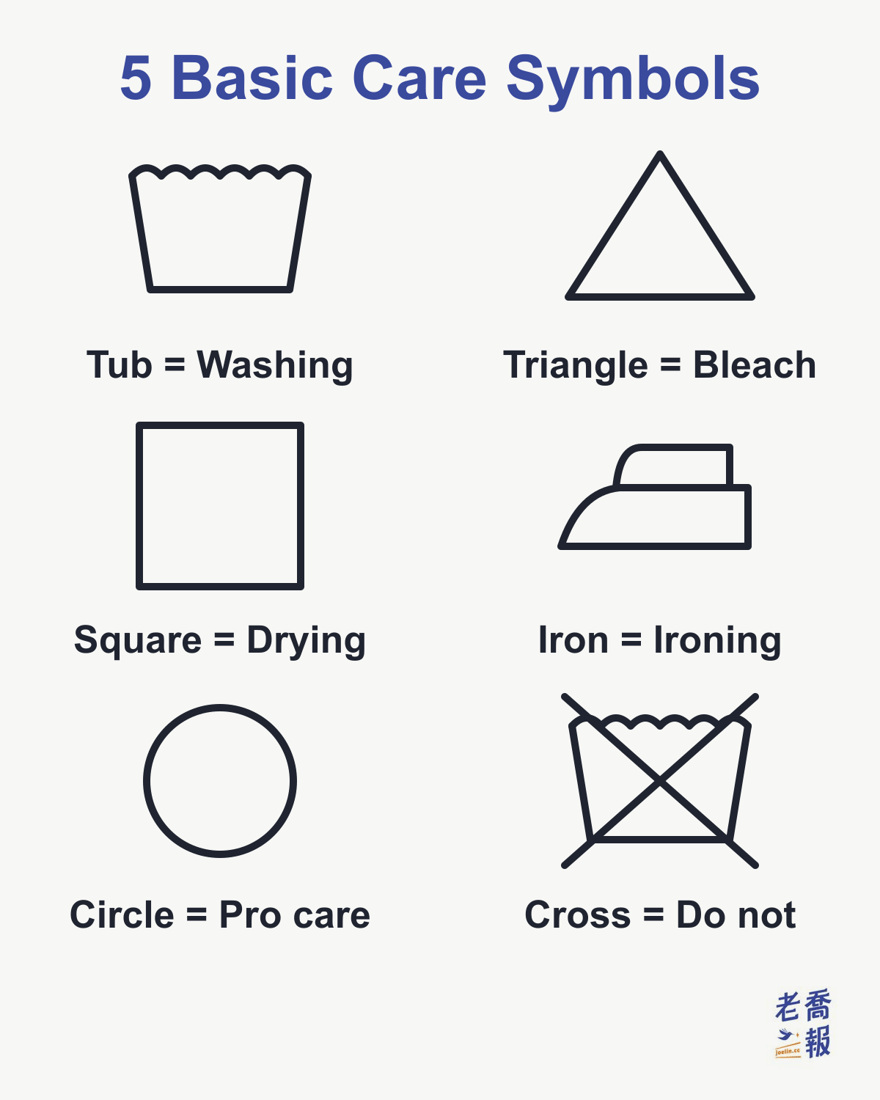
Care labels use only five basic shapes, and once you know the shapes you can read half the label: tub = washing, triangle = bleaching, square = drying, iron = ironing, circle = professional cleaning (dry or wet cleaning). Numbers or dots inside a shape give the temperature limit, bars underneath tell you how gentle to be, and a cross means do not.
These symbols come from the international standard ISO 3758 “Textiles — Care labelling code using symbols”, currently in its 4th edition, published in December 2023. Taiwan, Japan, Europe and China all build on it, so clothes bought in Taiwan, Japan or Europe carry broadly the same care labels; the US uses a separate system that looks similar but does not follow exactly the same rules. Below we first explain how to read the symbols, then how the countries differ. The symbol illustrations in this article were redrawn by this site from the care-label symbols published by Taiwan’s Ministry of Economic Affairs; the shapes and rules are the same, but always go by the label on the garment itself.
How to read a care label: shape first, then numbers, bars and crosses
flowchart TD
    A[Identify the outer shape] --> B[Check numbers or dots inside]
    B --> C[Count the bars underneath]
    C --> D{Is it crossed out?}
    D -->|Yes| E[Do not do this]
    D -->|No| F[Stay within the temperature limit]
The symbols on a care label appear in a fixed order in one row: washing, bleaching, drying, ironing, professional cleaning. Every symbol can be read with the same steps: the outer shape tells you which treatment it is, the number or dots inside give the temperature limit, the bars underneath set how gentle the treatment must be, and a cross means that treatment is not allowed. The care-symbol explanations published by Taiwan’s Ministry of Economic Affairs break it down the same way: the number is the maximum temperature, “a bar under the symbol” means a gentle process, and “an ╳ through the symbol” means do not.
The five types of care symbols at a glance
| Shape | Stands for | What may appear inside | Crossed out |
|---|---|---|---|
| Washtub | Washing | Number (water temperature), hand | Do not wash |
| Triangle | Bleaching | Two diagonal lines | Do not bleach |
| Square | Drying | Circle (tumble drying), vertical or horizontal lines (natural drying) | Do not tumble dry |
| Iron | Ironing | One to three dots | Do not iron |
| Circle | Professional cleaning | Letters P, F, W | Do not dry clean or wet clean |
The five basic shapes are the common skeleton of care labels worldwide; what differs is what is added inside them. The tub most often holds a temperature number, and a hand in the tub means hand wash only; two diagonal lines in the triangle mean only oxygen (non-chlorine) bleach; a circle in the square means tumble drying, while lines mean natural drying; the more dots in the iron, the higher the temperature; and the letters in the circle are solvent codes meant for the dry cleaner. The cross works the same way for all five: if you see a cross, that treatment is not allowed.
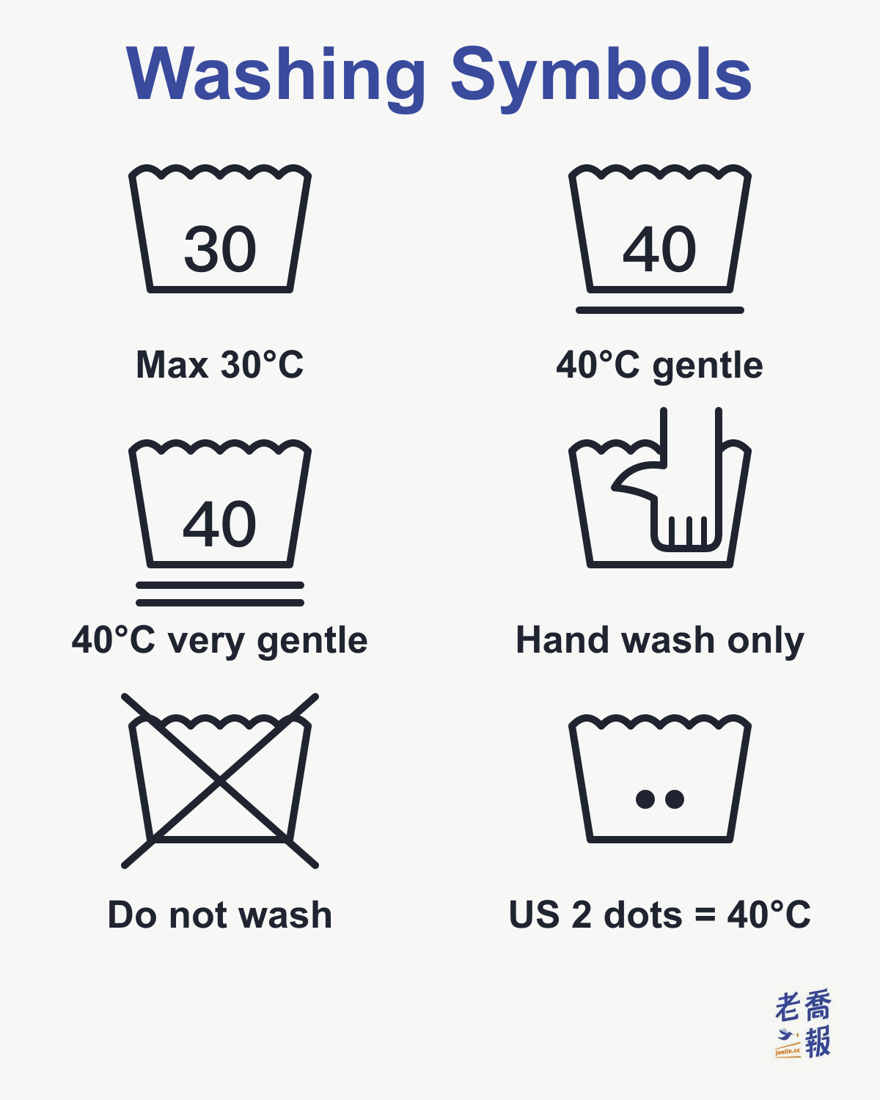
Washing: the number in the tub is the maximum water temperature, the bars set the cycle
| Number in the tub | US dots | Meaning |
|---|---|---|
| 95 | Six dots | Maximum 95°C |
| 70 | Five dots | Maximum 70°C |
| 60 | Four dots | Maximum 60°C |
| 50 | Three dots | Maximum 50°C |
| 40 | Two dots | Maximum 40°C |
| 30 | One dot | Maximum 30°C |
| A hand | A hand | Hand wash only |
| Cross | Cross | Do not wash |
The number in the tub is the upper limit in degrees Celsius; washing at any lower water temperature is fine. Under the symbols published in Taiwan, the hand-wash symbol means a maximum water temperature not exceeding 40°C; ISO 3758:2023 also adds a new “hand wash at room temperature” symbol (a hand-wash tub with one bar underneath), which Japan’s 2024 edition defines as hand washing at a liquid temperature of 30°C or below. The US ASTM D5489 does not put a number in the tub but uses dots instead, with more dots meaning hotter; according to the text of ASTM D5489 (2001 edition), one to six dots correspond in turn to 30°C (about 85°F), 40°C (105°F), 50°C (120°F), 60°C (140°F), 70°C (160°F) and 95°C (200°F).
| Under the tub | Meaning | Typical use |
|---|---|---|
| No bar | Normal cycle | Everyday clothes |
| One bar | Gentle cycle, less agitation | Wrinkle-prone or more delicate clothes |
| Two bars | Very gentle cycle, agitation kept to a minimum | Wool |
The bars tell you “how gentle the machine wash must be”: the more bars, the gentler. In the combinations published in Taiwan, 60°C and 50°C go up to one bar at most, only 40°C and 30°C have a two-bar very gentle version, and 95°C and 70°C come with the normal cycle only. The bar rule also applies to the circle (professional cleaning) symbol, where it likewise means gentle and very gentle.
Bleaching, drying and ironing: triangles, squares and the dots in the iron
Bleaching has only three versions. A plain triangle = any bleach may be used (chlorine and oxygen); a triangle with two diagonal lines inside = only oxygen/non-chlorine bleach; a crossed-out triangle = do not bleach.
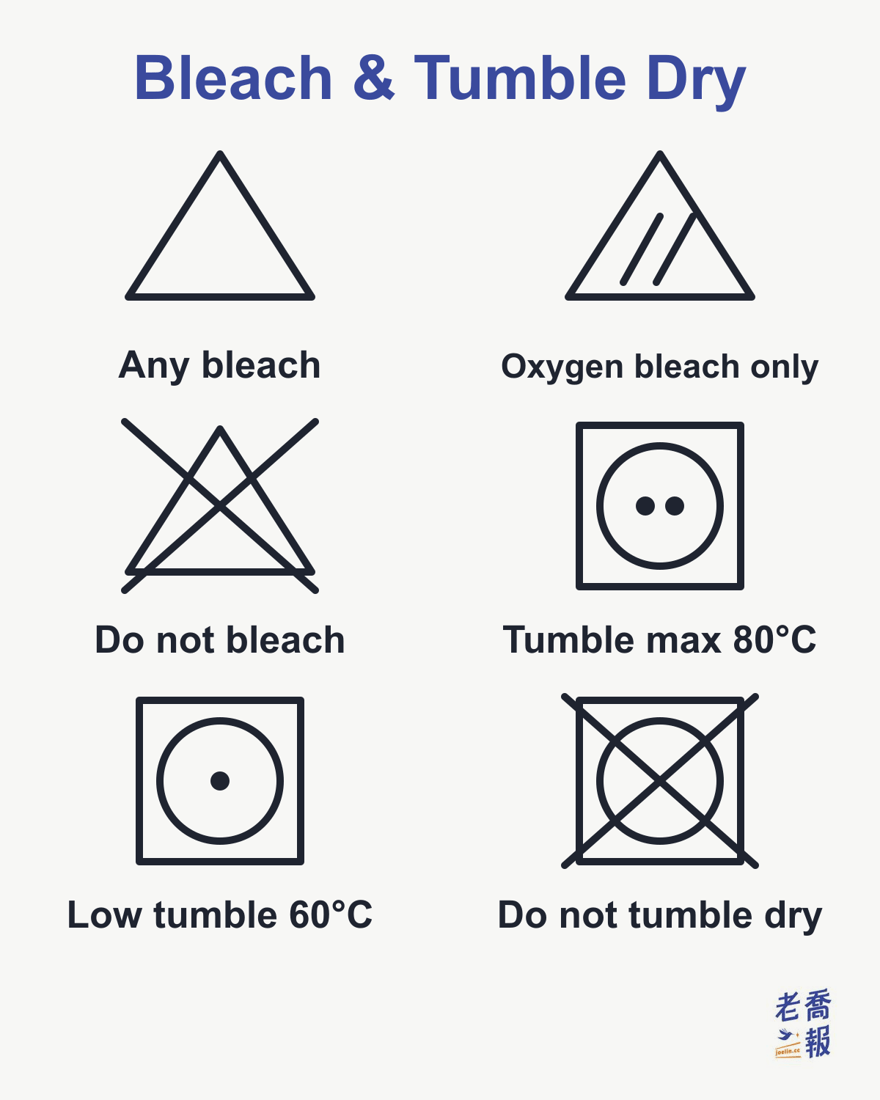
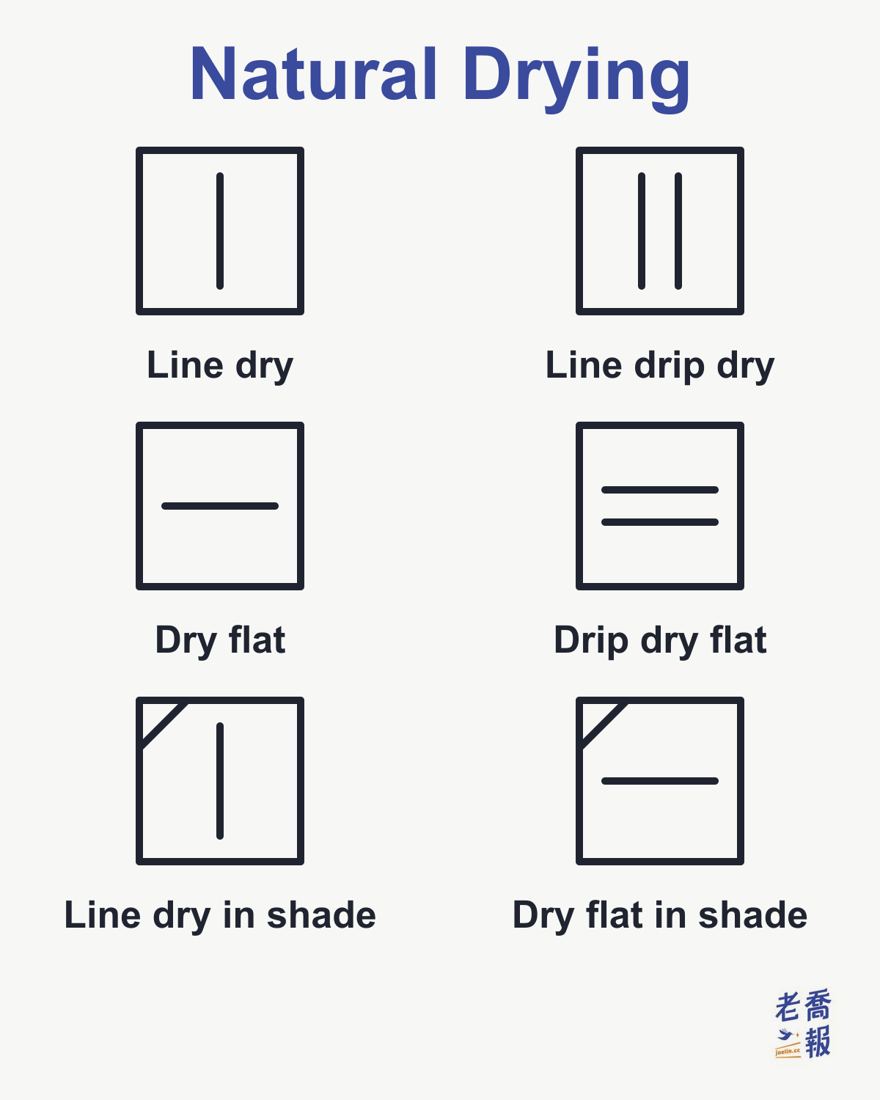
Drying splits into two branches, tumble drying and natural drying, both drawn inside a square:
- A circle in the square means tumble drying is allowed; two dots in the circle are normal temperature (maximum exhaust temperature 80°C), one dot is low temperature (maximum exhaust temperature 60°C), and a cross means do not tumble dry.
- Vertical lines in the square mean hang to dry: one vertical line is line drying, two vertical lines are drip drying, hung up wet without spinning.
- Horizontal lines in the square mean dry flat: one horizontal line is drying flat, two horizontal lines are drip drying flat, common on heavy or knitted garments.
- An extra diagonal line in the top-left corner of the square means dry in the shade, out of direct sunlight; it is often used on garments that fade easily.
| Dots in the iron | Taiwan’s published table | GINETEX, Japan 2024 edition |
|---|---|---|
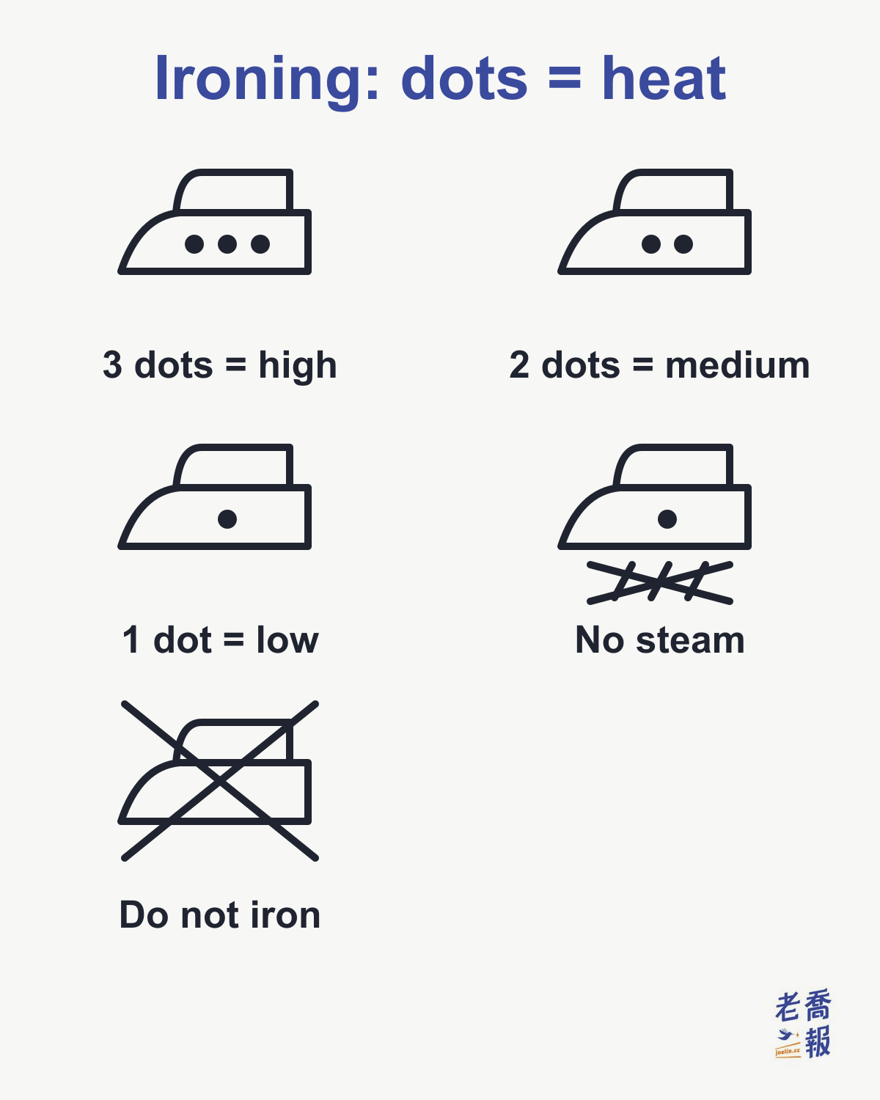
| Three dots | 200°C | 210°C |
| Two dots | 150°C | 160°C |
| One dot | 110°C, no steam | 120°C |
| One dot + crossed-out steam | Not listed | 120°C, no steam |
| Cross | Do not iron | Do not iron |
The number of dots gives the maximum soleplate temperature of the iron, and the figures in the different explanations differ by 10°C. Taiwan’s 2023 published table of care symbols gives 110, 150 and 200°C and notes that “one dot” should be used without steam; the current symbol explanations of GINETEX, the international association for textile care labelling, and the Japanese version in force from 20 August 2024 give 120, 160 and 210°C, and make “no steam” a separate new symbol (crossed-out steam under the iron), one of the symbols added in ISO 3758:2023. In practice, just pick the low, medium or high setting on your iron according to the number of dots; the difference does not affect how you read the label.
Professional cleaning: the P, F and W in the circle are for the dry cleaner
The circle stands for professional treatment by a cleaner. According to the explanations published in Taiwan, each letter in the circle has its own meaning:
- P: professional dry cleaning allowed, using tetrachloroethylene and the solvents listed under F.
- F: professional dry cleaning allowed, using hydrocarbon dry-cleaning solvents only.
- W: professional wet cleaning allowed (the cleaner treats it with water and specialized equipment; this is not your home washing machine).
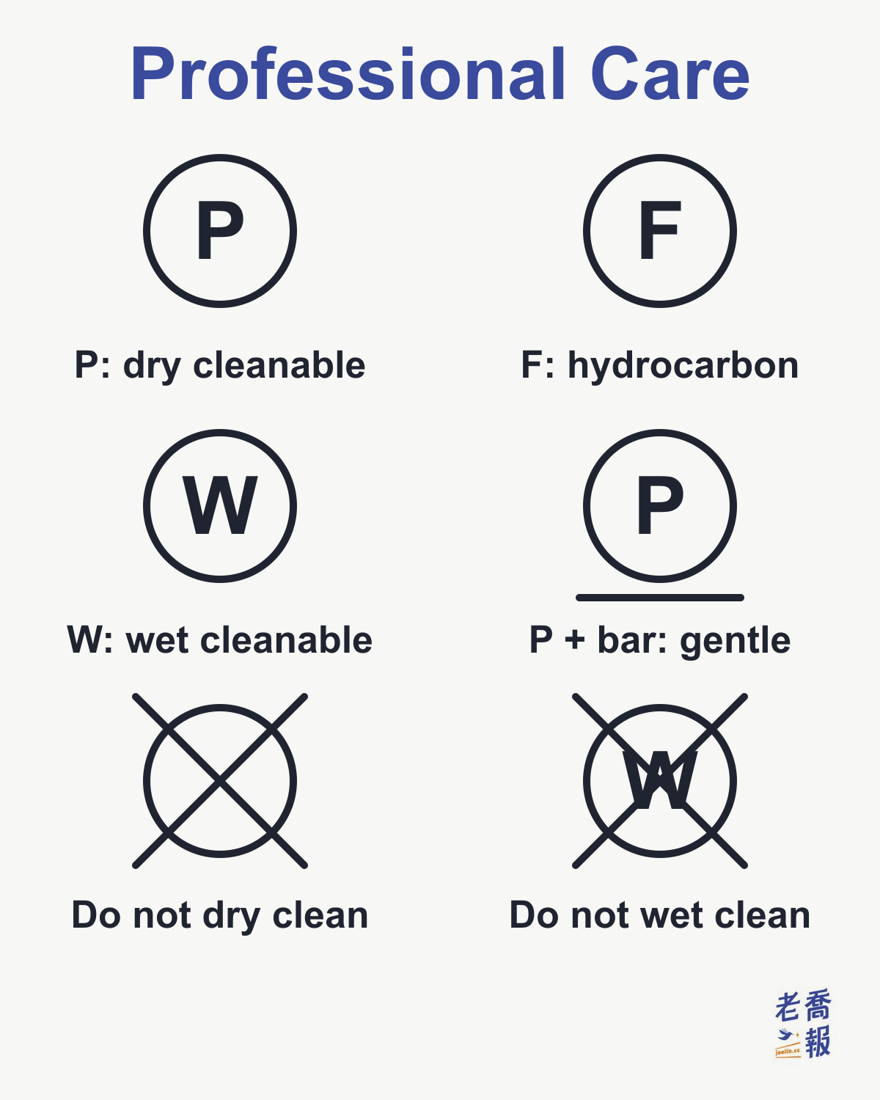
The circle can also have one bar (gentle process) or two bars (very gentle process) underneath, and a cross means do not dry clean or do not wet clean. Most people only need to remember “crossed-out circle = do not send it to the dry cleaner”; the letters are there so the cleaner can choose the solvent.
Care-label standards compared: Taiwan, Japan, Europe, the US and China
| Region | Standard or regulation | Symbols vs. ISO |
|---|---|---|
| International/Europe | ISO 3758:2023, GINETEX symbols | The baseline itself |
| Taiwan | CNS 8148, Apparel and Textile Labeling Standards | Revised with reference to ISO |
| Japan | JIS L 0001 | Aligned with ISO |
| China | GB/T 8685-2008 | Modified adoption of the 2005 ISO edition |
| US | FTC Care Labeling Rule, ASTM D5489 | Similar look, different system |
Taiwan, Japan, China and Europe all build on ISO 3758, with the same five basic shapes and the same rules for crosses and bars; the US is the only major market with a system of its own. In practice, the regions differ in who sets the rules, which ISO edition they follow, and whether text alone is allowed; each is explained below.
Taiwan: required under the Commodity Labeling Act, symbols published by the Ministry of Economic Affairs
In Taiwan, care labels on clothing are a legal requirement. Taiwan’s Apparel Labeling Standards (服飾標示基準, in force from 18 May 2023), issued under Article 12 of the Commodity Labeling Act, require apparel to state its washing and ironing instructions on a sewn-in label, or by branding, heat-transfer printing or printing on the product itself; the same rules also appear in the Textile Labeling Standards (織品標示基準; bed sheets, towels, curtains and so on). In the 2022 amendment, the care symbols were moved out of the standards’ annex and are now published separately by the Ministry of Economic Affairs. The Ministry’s published “care symbols for washing and ironing instructions under the Textile Labeling Standards” took effect on 18 May 2023; the standards require symbols for five treatments (washing, bleaching, drying, ironing and pressing, and professional textile care), supplemented with text where necessary.
On the national-standard side, Taiwan’s Bureau of Standards, Metrology and Inspection (BSMI) explains that in ROC year 103 (2014) it revised and published CNS 8148 “Textiles — Care labelling” with reference to ISO 3758, specifying five basic symbols plus a number of additional symbols, presented in a set order. If you are looking up Taiwan’s national standard for care labels, the number is CNS 8148.
Japan: switched from its own standard to the international one in 2016, then followed again in 2024
Japan used to have its own JIS L 0217, with symbols different from the international ones. The Consumer Affairs Agency’s explanation of care labelling shows that from 1 December 2016 Japan switched to JIS L 0001, aligned with the international standard, with 41 symbols in total; after ISO 3758 was revised in December 2023, Japan followed with an amendment in August 2024. The version in force from 20 August 2024 adds hand washing at a liquid temperature of 30°C and ironing without steam, bringing the total to 43 symbols, and changes the iron temperatures to 120, 160 and 210°C. The Consumer Affairs Agency keeps separate pages for three periods (up to 30 November 2016, 1 December 2016 to 19 August 2024, and from 20 August 2024); whichever version your Japanese garment carries, check the matching page.
Europe and GINETEX: the symbols are registered trademarks
Care labels on European clothing mostly use the GINETEX (International Association for Textile Care Labelling) symbols directly. GINETEX’s care-symbol page states plainly that these care symbols are protected trademarks in most countries, owned by GINETEX, and may not be produced or used without authorization; the symbols are also protected by copyright, both individually and in combination. ISO 3758:2023 also adds an Annex D explaining the differences between these registered graphical symbols and the ISO 7000 graphical symbols. In the UK, BSI publishes the standard as BS EN ISO 3758:2023 (published 30 April 2024), identical to the European EN ISO 3758.
The US: text alone is allowed, and the symbols are a different system
In the US, care labels are governed by the Federal Trade Commission (FTC) Care Labeling Rule (16 CFR Part 423). The FTC’s business guide states that as long as the label carries care instructions, symbols are optional and text alone is allowed; symbols used in place of words follow ASTM D5489-96c; and the FTC answers that using the European ISO symbols alone does not comply with the current rule. ASTM D5489 itself has been revised several times (the current version is D5489-25), but the FTC rule still recognizes the 96c version.
The same symbol does not always mean exactly the same thing in the US and in ISO, as GINETEX itself has pointed out. GINETEX’s June 2018 newsletter notes that the American symbols differ graphically from the GINETEX symbols, and sometimes in content too, mainly in three places:
- Water temperature is shown differently: the US uses dots in the washtub, ISO uses numbers.
- Natural drying uses different symbols.
- The US “do not bleach” is a solid black triangle with a cross through it.
GINETEX’s conclusion is that the two systems “look similar but are not related to each other” and cannot be matched one-to-one; clothes exported to the US can carry both sets of symbols on the same care label.
China: GB/T 8685-2008, a modified adoption of the 2005 ISO edition
China’s national standards full-text disclosure system lists the current GB/T 8685-2008 “Textiles — Care labelling code using symbols”, issued on 18 June 2008 and in force from 1 March 2009, replacing the 1988 edition. It is a recommended national standard that adopts an international standard, corresponding to a modified adoption of ISO 3758:2005. In other words, China’s current standard is two editions behind ISO: the basic shapes are the same, but it does not include the room-temperature hand-wash and no-steam ironing symbols added in the 2023 edition.
When you can’t make sense of a care label
A care label shows “the most severe treatment that will not cause irreversible damage”. That is how ISO 3758 defines its scope: the symbols tell you the upper limit the garment can take, so going gentler is always safe, while going harsher risks ruining it. So washing a “40” garment in cold water is no problem, but using a normal cycle on a label with one bar is a risk. When in doubt, choose a lower temperature, a gentler cycle or hand washing; all of these stay within what the label allows.
Keywords: laundry care symbols, care label symbols, how to read clothing care labels, washing symbols, care label meanings, ISO 3758, GINETEX, CNS 8148, JIS L 0001, ASTM D5489, GB/T 8685, iron dots temperature, tumble dry symbols
Frequently asked questions
What does 30 in the washtub symbol mean?
It means the maximum water temperature for washing is 30°C; washing at 30°C or below is fine. The number is an upper limit, not a recommended temperature. If there is also one bar under the tub, use a gentle cycle (less agitation); two bars means a very gentle cycle, common on wool garments.
What is the difference between one bar and two bars under a care symbol?
No bar = normal process; one bar = gentle (mild) process, for example less agitation; two bars = very gentle (very mild) process, with agitation kept to a minimum. The rule is the same for the washing symbol and for the professional-cleaning (circle) symbol. According to the care-symbol explanations published in Taiwan, no bar is added under the hand-wash symbol.
What does a crossed-out triangle on a care label mean?
The triangle stands for bleaching, and a cross through it means do not bleach. A plain triangle = any bleach may be used; a triangle with two diagonal lines inside = only oxygen (non-chlorine) bleach. In the US ASTM system, “do not bleach” is drawn as a solid black triangle with a cross through it; the meaning is the same.
What does a circle inside a square mean?
The square stands for drying, and a circle inside it = tumble drying is allowed. Two dots in the circle = normal temperature (maximum exhaust temperature 80°C), one dot = low temperature (60°C), and a cross = do not tumble dry. If the square contains vertical or horizontal lines instead, it means natural drying: vertical lines = hang to dry, horizontal lines = dry flat, and an extra diagonal line in the top-left corner = dry in the shade.
Can I read the care labels on clothes bought abroad?
Care labels in Taiwan, Japan, Europe and China are all based on ISO 3758 and use the same five basic shapes, so you can read most of them. The one to watch is the US: the washtub uses dots instead of a number for water temperature (more dots = hotter), natural drying is drawn differently, and American clothes often carry English text only, with no symbols.
Sources: Chinese original first published 2026-10-27. International standards and national rules are as checked at the times given for the sources cited in the text.
This English version is based on original Traditional Chinese content on joelin.cc. The language and explanations are localised for international readers. The Traditional Chinese original is the authoritative version — for its complete meaning, please read the original article.