
This article is also available in:繁體中文 · 日本語 · 한국어 · Bahasa Indonesia · Bahasa Melayu · ไทย · Português (Brasil) · Español · Türkçe · Tiếng Việt
A6 paper is 10.5 × 14.8 cm, or 4.13 × 5.83 inches.
A6 is one of the international (ISO 216) paper sizes. It measures 10.5 × 14.8 cm, which is 4.13 × 5.83 inches or 105 × 148 mm. It is a quarter of an A4 sheet and half of an A5 sheet. Compared with everyday objects, A6 is a little wider than a typical 6-inch phone screen and about 3.4 times the area of a credit card.
A6 is one of the sizes readers ask about most, yet most answers online give only the numbers in different units. They do not explain how A6 relates to A5, A4 and B6, what it is actually used for, or how much bleed to leave for printing. This article covers all of that.
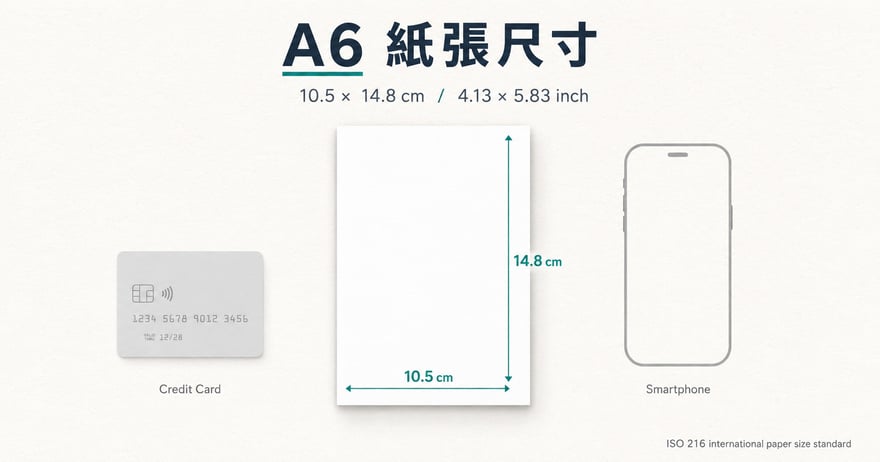
A6 size in every unit
The table below lists A6 in different units for graphic design, printing, mailing and photo output:
| Unit | A6 size |
|---|---|
| Centimeters (cm) | 10.5 × 14.8 |
| Millimeters (mm) | 105 × 148 |
| Inches (in) | 4.13 × 5.83 |
| Pixels at 300 DPI (print) | 1,240 × 1,748 |
| Pixels at 150 DPI (general output) | 620 × 874 |
| Pixels at 72 DPI (screen) | 298 × 420 |
The aspect ratio is 1 : √2 (about 1 : 1.414). Every A-series size shares this design: cut it in half and the halves keep the original proportions, the mathematical property the whole ISO 216 system (A and B series alike) is built on.
For a sense of scale:
- Compared with an iPhone 16 Pro Max (about 16.3 × 7.8 cm), A6 is about 2.7 cm wider and about 1.5 cm shorter.
- It is about 3.4 times the area of a credit card (8.56 × 5.4 cm).
- It is roughly the size of an open palm.
A6 vs 4 × 6 inches: almost the same, but not identical
In the United States, the everyday card size is 4 × 6 inches: the standard photo print, index card and postcard. A6 is very close to it.
| Size | cm | Inches | Note |
|---|---|---|---|
| A6 | 10.5 × 14.8 | 4.13 × 5.83 | ISO 216 standard |
| 4 × 6 card or photo | 10.16 × 15.24 | 4.00 × 6.00 | US photo print, index card and postcard size |
| US Letter | 21.6 × 27.9 | 8.50 × 11.00 | Comparable to A4 (8.27 × 11.69 in) |
A6 is about 3 mm wider and about 4 mm shorter than 4 × 6, and their areas are almost the same (155.4 cm² vs 154.8 cm²). An A6 print will not fill a 4 × 6 frame or sleeve exactly, and a 4 × 6 photo printed on A6 paper needs a slight crop or white edge. For mailing in the US, both fit the USPS postcard price range, which runs from 3.5 × 5 to 4.25 × 6 inches. For the full 4 × 6 specifications, see How Big Is a 4 × 6 Photo in Centimeters?, and for postcard limits by country, see the Postcard Size Guide.
How A6 compares with A5, A4 and B6
The neighboring sizes each have their own guide:
- A5 Paper Size (exactly twice A6)
- A4 Paper Size (including the differences from US Letter and the pixels needed for print)
- A4 Folded in Half (A5 after one fold, A6 after two)
- A3 Paper Size (the enlarged size for posters and charts, two A4 sheets side by side)
- A2 Size (42 × 59.4 cm)
- A1 Size (59.4 × 84.1 cm)
- A0 Paper Size (84.1 × 118.9 cm, one square meter and the origin of the A series)
- Paper and Photo Size Chart (A, B and C series, photo sizes and ID photos in one table)
Where A6 sits in the A series
A6 is A0 folded in half six times. The A series starts at A0, and each cut in half moves down one size, which is the most intuitive way to remember it:
| Size | cm | Compared with A6 |
|---|---|---|
| A4 | 21.0 × 29.7 | 4 times (A4 = 4 sheets of A6) |
| A5 | 14.8 × 21.0 | 2 times (A5 = 2 sheets of A6) |
| A6 | 10.5 × 14.8 | 1 time |
| A7 | 7.4 × 10.5 | 1/2 (A7 = half of A6) |
| A8 | 5.2 × 7.4 | 1/4 |
Fold an A4 sheet in half and you have A5; fold again for A6, and again for A7. You can check this anytime with any A4 sheet.
What size are A7 and A8?
Fold A6 once more and you get A7, 7.4 × 10.5 cm. Fold A7 and you get A8, 5.2 × 7.4 cm. The folding continues all the way to A10; the two smallest sizes are A9 (3.7 × 5.2 cm) and A10 (2.6 × 3.7 cm).
| Size | cm | mm | Equals |
|---|---|---|---|
| A7 | 7.4 × 10.5 | 74 × 105 | Half of A6 |
| A8 | 5.2 × 7.4 | 52 × 74 | Half of A7 |
| A9 | 3.7 × 5.2 | 37 × 52 | Half of A8 |
| A10 | 2.6 × 3.7 | 26 × 37 | Half of A9 |
A7 is a little larger than a playing card and is common for small notepads, tickets and small cards. A8 and smaller sizes mostly appear as labels and stickers.
A6 vs B6
The B series is a separate international standard, and each B size falls between two neighboring A sizes. B6 is 12.5 × 17.6 cm, a little larger than A6:
| Size | cm | Compared with A6 |
|---|---|---|
| A6 | 10.5 × 14.8 | — |
| B6 | 12.5 × 17.6 | 2 cm wider, 2.8 cm taller |
| A5 | 14.8 × 21.0 | 4.3 cm wider, 6.2 cm taller |
In Taiwan, where the original article was written, B6 is common for novels and planners (Japanese bunko paperbacks, by contrast, are A6), while A6 is closer to notepads, cards and mini books. If you are not sure which size a book is, measure the short side: 10.5 cm is A6, 12.5 cm is B6 and 14.8 cm is A5.
Full A-series and B-series table
| A series | cm | B series | cm |
|---|---|---|---|
| A0 | 84.1 × 118.9 | B0 | 100 × 141.4 |
| A1 | 59.4 × 84.1 | B1 | 70.7 × 100 |
| A2 | 42.0 × 59.4 | B2 | 50 × 70.7 |
| A3 | 29.7 × 42.0 | B3 | 35.3 × 50 |
| A4 | 21.0 × 29.7 | B4 | 25 × 35.3 |
| A5 | 14.8 × 21.0 | B5 | 17.6 × 25 |
| A6 | 10.5 × 14.8 | B6 | 12.5 × 17.6 |
| A7 | 7.4 × 10.5 | B7 | 8.8 × 12.5 |
A6 paper specifications in detail
Choosing a paper weight
The most common A6 paper weights and what they are used for:
| Weight | Typical use | How it feels |
|---|---|---|
| 80 g / 100 g | General printing, notepads, thin planners | Thin; can be printed on both sides but shows through a little |
| 120 g | Card bases, invitations | Medium, with some body |
| 150–180 g | Flyers, ordinary cards | Firm, does not bend easily |
| 200 g / 250 g | Mailed postcards, cards, tickets | On the thick side |
| 300 g and up | Heavy card stock, handmade items | Stiff, close to board |
The “g” in the table is grams per square meter (basis weight, often written gsm). The higher the number, the thicker the paper, and the weight of a single card follows the same number. In the US, paper is often labeled in pounds (lb) of basis weight, which is a different number from g/m² for the same sheet, so compare paper in gsm when you can.
How much does a postcard weigh? About 3 to 4 grams for A6
An A6 postcard printed on 180 to 250 g card stock weighs about 2.8 to 3.9 grams. The most common case, an A6 card on 250 g card stock, weighs about 3.9 grams.
The calculation is area × basis weight. The area of A6 is 0.105 × 0.148 = 0.01554 square meters, so:
- An A6 postcard on 180 g paper weighs about 0.01554 × 180 = 2.8 grams.
- An A6 postcard on 250 g paper weighs about 0.01554 × 250 = 3.9 grams.
- An A6 card on 300 g heavy card stock weighs about 0.01554 × 300 = 4.7 grams.
These estimates assume paper of even thickness and do not include lamination, stickers or stamps. A 4 × 6 in card (10.16 × 15.24 cm) has almost the same area as A6, so its weight falls in the same range.
Postal services regulate postcards mainly by size, and some also set rules for paper stock or thickness. If you print your own postcards on unusually heavy card stock or in an unusual size, check your postal service’s rules first; a card outside them may be charged as a letter.
Finished size vs bleed size
If you send A6 to a printer, you need to tell two sizes apart:
- Finished size: 10.5 × 14.8 cm (the size of the final product in your hand)
- Bleed size: 10.9 × 15.2 cm with 2 mm per side, or 11.1 × 15.4 cm with 3 mm per side (follow your printer’s spec; 3 mm is the most common)
This is a standard detail in printing. Printing on a home printer usually does not need bleed, but anything sent to a printer does, or the cut edges may show white. Always follow your printer’s template. For more on how bleed works, see the Print Bleed Guide.
Where to buy A6 paper
- Stationery and book stores: A6 notebooks and A6 notepads are the most common.
- Online marketplaces: A6 card stock, blank A6 postcard stock and heavy art paper in A6.
- Printers: for small runs you can specify A6; most printers have a minimum order of about 200 to 500 sheets.
Common uses for A6
A6 is the sweet spot between a pocket size and a proper sheet of paper, which is the main reason it is so widely used in design, stationery and printing:
- Postcards: A6 is accepted as a postcard size by many postal services, and in the US it fits within the USPS postcard price range. More in the Postcard Size Guide.
- Cards and greeting cards: Christmas cards, birthday cards and invitations most often come as an A6 card with an envelope.
- Planners and notepads: A6 is the largest size that slips into a coat pocket, and many pocket planners use it.
- Flyers, menus and membership cards: common for restaurant menus, event flyers and store loyalty cards.
- Tickets and stickers: a convenient size for event tickets and sticker sheets.
- Zines and small booklets: A6 is a popular portable format in independent publishing.
Frequently asked questions
What fraction of A4 is A6?
A6 is 1/4 of A4. Fold an A4 sheet in half to get A5, and fold A5 in half to get A6. In the same way, four A6 sheets together make exactly one A4 sheet.
Is A6 bigger than a phone?
Slightly. A typical 6-inch phone is about 7.6 × 16.0 cm, and A6 is 10.5 × 14.8 cm. A6 is about 2.9 cm wider and about 1.2 cm shorter, and its total area is slightly larger than a 6-inch phone screen.
Is A6 the same as 4 × 6?
No, but they are very close. A6 is 10.5 × 14.8 cm, and a 4 × 6 photo is 10.16 × 15.24 cm. A6 is about 3 mm wider and about 4 mm shorter. Both fit within the USPS postcard price range (3.5 × 5 to 4.25 × 6 in), but postcard limits differ by country, and in some countries a 4 × 6 card’s 15.24 cm long side exceeds the maximum, so check before mailing. For the full 4 × 6 specifications, see How Big Is a 4 × 6 Photo in Centimeters?.
How many pages can an A6 booklet have?
It depends on the thickness. A typical A6 zine starts at about 16 pages (four sheets folded), and handmade booklets most often run 32 to 48 pages. Folding an A4 sheet twice and cutting it gives four A6 leaves, or eight pages.
Can I mail an A6 card as a postcard?
Usually, yes. A6 (4.13 × 5.83 in) fits within the USPS postcard price range of 3.5 × 5 to 4.25 × 6 inches, and many other postal services also accept A6 as a postcard. Postage rates and limits vary by country and change over time, so check your postal service. For details, see the Postcard Size Guide.
How much does a postcard weigh?
About 2.8 to 3.9 grams for an A6 postcard on 180 to 250 g card stock. The calculation is area × basis weight: A6 is 0.01554 square meters, so 180 g paper gives 2.8 grams and 250 g paper gives 3.9 grams. A 300 g heavy card comes to about 4.7 grams.
Keywords: A6 paper size, A6 size in cm, A6 size in inches, A6 dimensions, A6 vs 4 × 6, A6 vs A5, A6 vs B6, A7 size, A6 in pixels
Sources: The original Chinese article was first published on May 7, 2026, and last updated on October 19, 2026. A-series and B-series dimensions follow the ISO 216 international standard. The Chinese original's sections on Taiwanese postal rules, postage and convenience-store printing have been replaced with general advice; the USPS postcard limits (3.5 × 5 to 4.25 × 6 in) are as checked on October 18, 2026, and postal rules can change.
This English version is based on original Traditional Chinese content on joelin.cc. The language and explanations are localised for international readers. The Traditional Chinese original is the authoritative version — for its complete meaning, please read the original article.