
This article is also available in:繁體中文 · 日本語 · 한국어 · Bahasa Indonesia · Bahasa Melayu · ไทย · Português (Brasil) · Español · Türkçe · Tiếng Việt
A5 paper is 14.8 × 21 cm, or 5.83 × 8.27 inches.
People who look up the A5 size are usually stuck on one of three questions:
- They have an A4 sheet and want to know whether folding it in half gives A5.
- They are buying a notebook or making a menu or flyer, and need to confirm how big A5 actually is.
- They see a row of codes such as A5, A6, B5 and B6, and just want to know which one is bigger.
This article answers all three. Many pages about A5 give a single set of numbers without explaining how it relates to the neighboring sizes. But what actually confuses people is never the number itself. It is whether that number counts as big or small.
1. Complete A5 dimensions
| Unit | Width | Height |
|---|---|---|
| Millimeters (mm) | 148 | 210 |
| Centimeters (cm) | 14.8 | 21.0 |
| Inches (in) | 5.83 | 8.27 |
| Pixels (300 DPI) | 1,748 | 2,480 |
| Pixels (150 DPI) | 874 | 1,240 |
The one-line version: A5 = 14.8 × 21 cm = A4 folded in half once = twice A6, and almost exactly the size of a 6 × 8 in photo print.
The area is 310.8 square centimeters, and the aspect ratio is about 1 : 1.419. Before the sides are rounded to whole millimeters, the theoretical ratio is 1 : √2, and that number turns out to matter in a moment.
2. A5 is half of A4: one sheet explains the A series
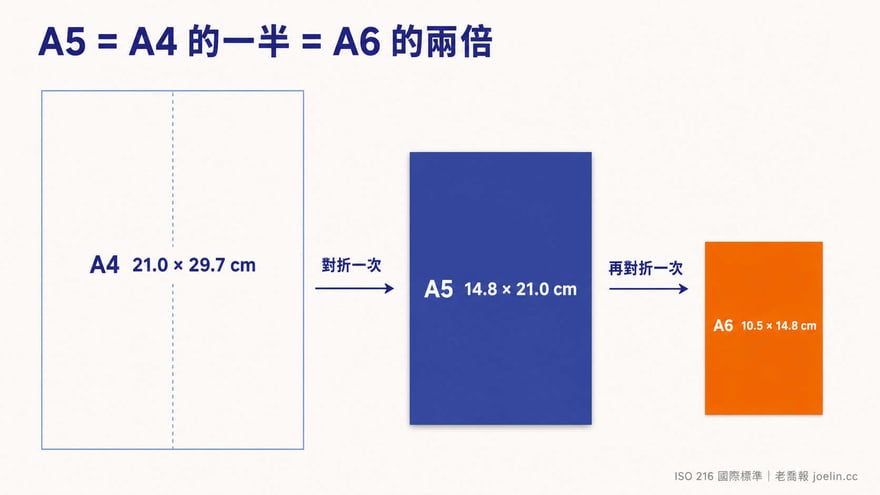
The A series has only one rule: fold a sheet in half along its long side and you get the next size.
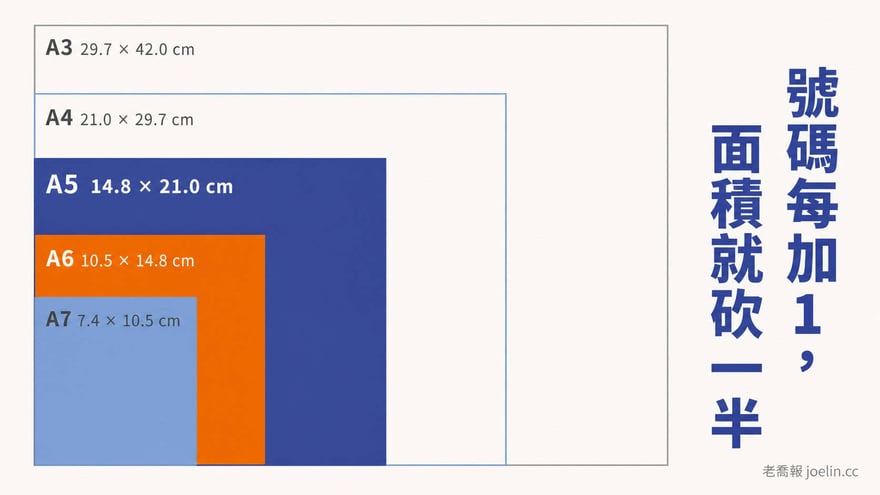
- A4 (21.0 × 29.7 cm) folded once becomes A5 (14.8 × 21.0 cm).
- A5 folded once becomes A6 (10.5 × 14.8 cm).
- A6 folded once becomes A7 (7.4 × 10.5 cm).
It works the other way too: A5 is half of A4 and a quarter of A3. A4 has its own complete guide, including the differences from US Letter and the pixels needed for printing: A4 Paper Size: 21 × 29.7 cm.
Here is a point people often ask about but rarely see explained: why does the sheet not become wider or narrower after folding?
Because the A series has a fixed aspect ratio of 1 : √2 (about 1 : 1.414). It is the only ratio that stays the same after a sheet is cut in half. That is why an A4 page reduced to A5, or an A5 page enlarged to A4, keeps its content undistorted with no extra white margins. It is the reason ISO 216 chose this ratio, and the reason most copiers have zoom buttons labeled A3 → A4 → A5.
“A4 folded in half” can mean two different things, and the answers differ. Folded once, it is A5, the subject of this article. Folded twice, it is A6. If A6 is what you are after, see A6 Paper Size: 10.5 × 14.8 cm. For both folds side by side, see A4 Folded in Half.
3. Which is bigger, A5 or A6? By how much?
A5 is bigger than A6, and by exactly twice the area.
| Item | A5 | A6 |
|---|---|---|
| Size | 14.8 × 21.0 cm | 10.5 × 14.8 cm |
| Area | 310.8 cm² | 155.4 cm² |
| Relationship | Reference size | Exactly half of A5 |
There is a detail that is easy to miss: the short side of A5 (14.8 cm) equals the long side of A6 (14.8 cm). That is not a coincidence. A6 is A5 folded in half, so two A6 sheets side by side make one A5 sheet.
In everyday terms, A6 is a postcard and A5 is a slim notebook. Put them side by side and A5 is clearly a size larger; you will not mix them up.
Which should you choose? The test is simple: does the content need to be read? A6 suits a single sentence, an image or a QR code (postcards, small cards, inserts). As soon as there are paragraphs, tables or more than three lines of text, use A5. Otherwise the type has to shrink below 8 pt, and nobody wants to read the printed result.
4. A5 vs Half Letter: the US counterpart
In the United States, the closest size to A5 is Half Letter (also called Statement), 5.5 × 8.5 inches, which is a Letter sheet folded in half, just as A5 is A4 folded in half.
| Size | cm | Inches | Area (cm²) |
|---|---|---|---|
| A5 (ISO) | 14.8 × 21.0 | 5.83 × 8.27 | 310.8 |
| Half Letter (US) | 14.0 × 21.6 | 5.5 × 8.5 | 301.6 |
The two are very close but not the same. A5 is about 8 mm wider and about 6 mm shorter than Half Letter, and about 3% larger in area. That is the same relationship as A4 and Letter, only reversed: A4 is narrower and longer than Letter, but A5 is wider and shorter than Half Letter, because folding swaps the long and short sides. In practice, an A5 planner insert will not sit exactly in a Half Letter binder, and an A5 file printed on Half Letter paper needs to be scaled to fit.
5. A4, A5 and A6: the whole family ladder
People who search “A4 A5 A6” usually want to see the whole ladder at once. Here is the complete version:
| Size | cm | mm | Area (cm²) | Compared with A5 | Everyday reference |
|---|---|---|---|---|---|
| A3 | 29.7 × 42.0 | 297 × 420 | 1,247.4 | A5 is 75% smaller | Posters, design drawings |
| A4 | 21.0 × 29.7 | 210 × 297 | 623.7 | A5 is 50% smaller | Copy paper, office documents |
| A5 | 14.8 × 21.0 | 148 × 210 | 310.8 | Reference size | Notebooks, menus |
| A6 | 10.5 × 14.8 | 105 × 148 | 155.4 | A5 is 100% larger | Postcards, small cards |
| A7 | 7.4 × 10.5 | 74 × 105 | 77.7 | A5 is 300% larger | A little larger than a business card, tickets |
The rule of thumb: every step up in number halves the area. So A5 is 1/2 of A4, 1/4 of A3 and 1/8 of A2.
6. How does A5 compare with B5 and B6? (Watch out for ISO vs JIS)
The B series is not a substitute for the A series. Its sizes sit between the A sizes: B5 is larger than A5 and smaller than A4, and B6 is larger than A6 and smaller than A5.
But here is a trap many people have fallen into: the B series has two standards, and their numbers differ.
| Size | cm | Compared with A5 |
|---|---|---|
| B5 (ISO international standard) | 17.6 × 25.0 | A5 is 29% smaller |
| B5 (JIS Japanese standard) | 18.2 × 25.7 | A5 is 34% smaller |
| A5 | 14.8 × 21.0 | Reference size |
| B6 (ISO international standard) | 12.5 × 17.6 | A5 is 41% larger |
| B6 (JIS Japanese standard) | 12.8 × 18.2 | A5 is 33% larger |
Why does this matter? Because both standards circulate in printing and stationery. A “B6 planner” from a Japanese stationery brand is usually JIS B6 (12.8 × 18.2 cm), but if you ask a printer for “B6,” they may set it up as ISO B6 (12.5 × 17.6 cm). The difference of 3 to 6 mm can cause problems when it lands in the bleed area.
The practical advice: when you talk to a printer about B sizes, always give the dimensions in millimeters, never just the code. The A series has no such problem; there is only one ISO 216 worldwide.
7. How many inches is A5? Almost the same as a 6 × 8 print
The long side of A5 is 21.0 cm, or 8.27 inches. That leads to a coincidence few people notice:
| Size | cm | Area (cm²) |
|---|---|---|
| A5 | 14.8 × 21.0 | 310.8 |
| 6 × 8 in photo | 15.2 × 20.3 | 309.7 |
The two areas differ by only 0.4%, so they are practically equal (A5 is slightly narrower and slightly taller). If you have ever had a 6 × 8 print framed, that is the size of A5, which is easier to remember than any number.
Here are the other common photo sizes for comparison:
| Compared with | cm | A5 vs that size | How it looks |
|---|---|---|---|
| 4 × 6 in | 10.2 × 15.2 | A5 is 101% larger | Twice the size, clearly two steps apart |
| 5 × 7 in | 12.7 × 17.8 | A5 is 38% larger | Noticeably a size larger |
| 6 × 8 in | 15.2 × 20.3 | Almost equal | No visible difference |
| 8 × 10 in | 20.3 × 25.4 | A5 is 40% smaller | Noticeably a size smaller |
Further reading: How Big Is a 4 × 6 Photo in Centimeters?
8. What A5 is used for (and where it does not fit)
The most common uses of A5:
- Notebooks and planners: “A5 planner” is one of the most common planner sizes. Opened flat it equals A4, giving enough writing space while still fitting in a bag.
- Books: novels, light novels and reference books often use A5 or a trim size close to it.
- Menus: a mainstream size for single-page menus, taking up little table space while keeping the type readable.
- Flyers: more substantial than A6 and cheaper than A4, so they are less likely to be thrown away immediately.
- Event booklets and handouts: A4 sheets folded and bound make an A5 booklet.
- Cards: an A4 sheet folded in half makes an A5 folded card.
Where A5 does not fit:
- Mailing as a postcard: postal services cap postcards well below A5. In the US, the postcard price applies only up to 4.25 × 6 in, and A5 (5.83 × 8.27 in) is far over that, so it is mailed as a letter at a higher rate. Limits vary by country; see the Postcard Size Guide.
- ID photos: the dimensions do not match at all; ID photos follow their own fixed photo sizes.
- Official documents and contracts: these use A4 (or Letter in North America), and A5 looks informal.
9. How many pixels do you need to print A5?
The 300 DPI print standard is 1,748 × 2,480 px, about 4.34 megapixels.
| DPI | Pixels | Typical use |
|---|---|---|
| 72 | 420 × 595 | Web display, viewing a PDF on screen |
| 150 | 874 × 1,240 | Home inkjet printers, internal handouts |
| 300 | 1,748 × 2,480 | Standard for print shops and photo labs |
| 600 | 3,496 × 4,961 | More detail than the eye can tell apart |
Is a phone photo good enough to print at A5? Yes, with plenty to spare. A5 at 300 DPI needs only about 4.34 MP, and any phone from the last ten years (starting at 12 MP) is far above that. What usually makes a print blurry is not a lack of pixels but an original that has been compressed by a messaging app. Photos sent through apps such as Messenger are re-encoded at lower quality, so always send the original file to print.
10. Where can you print A5?
| Option | How to do A5 | Advice |
|---|---|---|
| Home printer | Choose A5 in the printer driver, or lay out two A5 pages on A4 and cut | Fastest for small quantities; adjust the paper guides in the tray |
| Copy shop or print center | Ask for A5 directly | Better value than home printing from about ten copies, with a choice of paper |
| Commercial printer (large runs) | Gang-run printing, lowest unit cost | Only cheaper from about 500 copies; needs 3 mm bleed |
A layout tip: if you plan to print on A4 and cut it in half, design the A4 page with one A5 above the other, and leave at least 3 mm of bleed on all four sides. Otherwise the tolerance of the cut will eat into text near the edges. For how bleed works, see Print Bleed Guide.
11. Further reading: the paper size library
- A6 and postcard sizes: A6 Paper Size: 10.5 × 14.8 cm
- Common postcard sizes: Postcard Size Guide
- A4 folded in half, once and twice: A4 Folded in Half
- 4 × 6 photo size: How Big Is a 4 × 6 Photo in Centimeters?
- Paper, photo and ID photo sizes in one table: Paper and Photo Size Chart
12. A note on these numbers
The A-series dimensions here follow the ISO 216 international standard and are fixed. For the B series, keep the differences between the ISO and JIS standards in mind. For actual print specifications, the paper sizes a given machine supports and postage rates, check with your print shop and your postal service.
Frequently asked questions
How many centimeters is A5?
14.8 × 21.0 cm (148 × 210 mm). In inches, it is 5.83 × 8.27 in.
Which is bigger, A5 or A6?
A5, and it has exactly twice the area of A6. Two A6 sheets side by side make one A5 sheet.
Is A4 folded in half A5 or A6?
Folded once, it is A5. Folded twice, it is A6. This is the most common point of confusion.
Can I mail A5 as a postcard?
Usually not at the postcard rate. In the US, the postcard price applies only up to 4.25 × 6 in, and A5 (5.83 × 8.27 in) is far over that, so it is mailed as a letter at a higher rate. Other postal services also cap postcards well below A5, though the exact limits vary by country.
Is A5 bigger than A4?
No, A5 is half of A4. A4 folded in half once is A5.
What size is half of A5?
A6 (10.5 × 14.8 cm), which is about the size of a standard postcard.
How many inches is A5?
5.83 × 8.27 inches. Its size is almost exactly the same as a 6 × 8 in photo print, with only a 0.4% difference in area.
Is A5 the same as Half Letter?
No, but they are close. Half Letter is 5.5 × 8.5 in (14.0 × 21.6 cm). A5 is about 8 mm wider and 6 mm shorter, so A5 inserts and Half Letter binders are not an exact match.
Which is bigger, A5 or B6?
A5. A5 (14.8 × 21.0 cm) is 41% larger than ISO B6 (12.5 × 17.6 cm) and 33% larger than JIS B6 (12.8 × 18.2 cm). Remember that the B series has two standards, ISO and JIS, with different numbers.
How big is an A5 notebook when opened?
A4 (21.0 × 29.7 cm). That is why A5 planners are so popular: closed, they are easy to carry; open, the writing area equals a sheet of copy paper.
How much bleed should I leave for an A5 layout?
The printing standard is 3 mm of bleed on all four sides, with the safe area a further 3 to 5 mm inside the trim line. If you print on A4 and cut it in half yourself, do not skip the bleed, because home cutting is less precise than a print shop’s.
Keywords: A5 size, A5 paper size, A5 size in cm, A5 size in inches, A5 vs A6, A4 A5 A6 sizes, A5 vs B6, A5 vs Half Letter, A5 in pixels
Sources: The original Chinese article was first published on August 3, 2026, and last updated on October 20, 2026. A-series dimensions are fixed by the ISO 216 international standard; B sizes differ between ISO and JIS. The Half Letter comparison was added for English-language readers, and Taiwan-specific postal, document and printing examples in the Chinese original have been replaced with general ones.
This English version is based on original Traditional Chinese content on joelin.cc. The language and explanations are localised for international readers. The Traditional Chinese original is the authoritative version — for its complete meaning, please read the original article.