
This article is also available in:繁體中文 · 日本語 · 한국어 · Bahasa Indonesia · Bahasa Melayu · ไทย · Português (Brasil) · Español · Türkçe · Tiếng Việt
Fold A4 in half once and you get A5 (14.8 × 21 cm); fold it twice and you get A6, which is 10.5 × 14.8 cm.
If you use US Letter paper instead, the same idea gives different numbers: half of Letter (8.5 × 11 in) is Half Letter, 5.5 × 8.5 in (14 × 21.6 cm), and a quarter is 4.25 × 5.5 in (10.8 × 14 cm). Those are close to A5 and A6 but not the same, because Letter does not follow the A-series proportions.
A6 is a size you see every day without really noticing it: postcards, pocket notebooks, the inside pages of greeting cards, flyers, hotel key card holders, and restaurant menu cards are often A6.
So how big is A6 exactly, why does it have this shape, and how does it convert to A4, A5, and A7? Joe put together the full picture here, starting from the math behind the ISO paper system.
1. A6 dimensions in every unit
| Unit | Width | Height |
|---|---|---|
| Centimeters (cm) | 10.5 | 14.8 |
| Millimeters (mm) | 105 | 148 |
| Inches (in) | 4.13 | 5.83 |
| Pixels (300 DPI) | 1,240 | 1,748 |
| Pixels (150 DPI) | 620 | 874 |
| Pixels (72 DPI) | 298 | 420 |
| Aspect ratio | 1 : 1.414 (√2) | — |
In one line: A6 is 10.5 × 14.8 cm, A4 folded twice, and the seventh size in the ISO 216 A series counting from A0. Its area is 155.4 square centimeters, exactly half of A5.
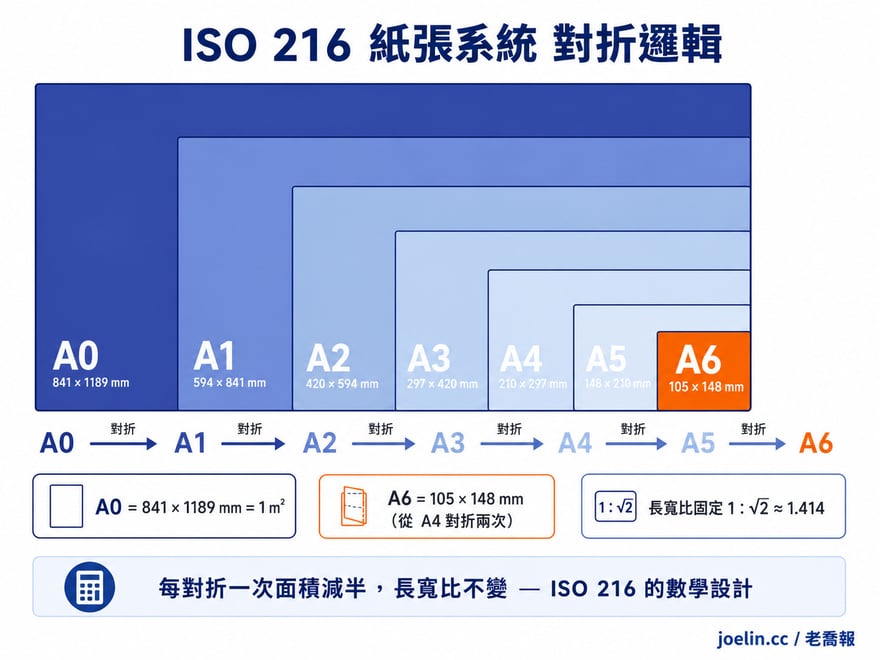
2. Where A6 comes from: the math behind ISO 216
Many people do not realize that the A-series sizes (A0 to A10) were not chosen at random. They follow a precise set of mathematical rules.
The three core rules of ISO 216
- Rule 1: A0 is one square meter. A0 has an area of exactly 1 m² (841 × 1189 mm), and it is the baseline for the whole A series.
- Rule 2: The aspect ratio is always √2 ≈ 1.414. For every A-series sheet, the long side divided by the short side equals √2.
- Rule 3: Folding in half gives the next size. Fold A0 once and you get A1, fold again for A2, then A3, and so on.
A0 (841×1189) folded in half → A1 (594×841)
A1 folded in half            → A2 (420×594)
A2 folded in half            → A3 (297×420)
A3 folded in half            → A4 (210×297)
A4 folded in half            → A5 (148×210)
A5 folded in half            → A6 (105×148)  ← the subject of this article
A6 folded in half            → A7 (74×105)
Why the √2 ratio?
This is the cleverest part of the ISO 216 design. Because the ratio is √2 ≈ 1.414, the shape stays the same after every fold.
For example:
- A4 = 210 × 297 mm (ratio 1 : 1.414)
- Fold A4 in half and you get two A5 sheets (148 × 210 mm, still 1 : 1.414)
That means a printer does not need a new layout: an A4 design can be scaled straight down to A5 or A6 without the proportions changing or the layout shifting. The system was devised in 1922 by the German engineer Walter Porstmann and became an ISO international standard in 1975.
The full ISO A series
| Size | Width × height (mm) | Centimeters | Pixels at 300 DPI | Common uses |
|---|---|---|---|---|
| A0 | 841 × 1189 | 84.1 × 118.9 cm | — | Large posters |
| A1 | 594 × 841 | 59.4 × 84.1 cm | — | Posters |
| A2 | 420 × 594 | 42.0 × 59.4 cm | — | Medium posters |
| A3 | 297 × 420 | 29.7 × 42.0 cm | 3508 × 4961 | Small posters, menus |
| A4 | 210 × 297 | 21.0 × 29.7 cm | 2480 × 3508 | Documents, standard copy paper |
| A5 | 148 × 210 | 14.8 × 21.0 cm | 1748 × 2480 | Booklets, greeting cards |
| A6 | 105 × 148 | 10.5 × 14.8 cm | 1240 × 1748 | Postcards, pocket notebooks |
| A7 | 74 × 105 | 7.4 × 10.5 cm | 874 × 1240 | Small cards, stickers |
| A8 | 52 × 74 | 5.2 × 7.4 cm | — | Business-card-like cards |
| A9 | 37 × 52 | 3.7 × 5.2 cm | — | Small labels |
| A10 | 26 × 37 | 2.6 × 3.7 cm | — | Tiny labels |
Each step down the table halves the area. The pixel counts follow the same pattern: the long side of one size in pixels equals the short side of the next size up (A5’s 2480 is A4’s 2480). Half of A4 being A5, and half of that being A6, is simply two neighboring rows of this table.
3. What A6 is used for, beyond postcards
People most often connect A6 with postcards, but notebooks and stationery are where A6 is used the most.
Notebooks and planners (A6 is the international “pocket size”)
- Hobonichi Techo Original: A6 is the standard size.
- Muji A6 notebooks: one of the most common formats in stationery stores.
- Traveler’s Notebook Passport Size: a pocket size one step smaller than A6.
- Moleskine Pocket: close to A6, but slightly smaller at 9 × 14 cm.
A6 is popular because it fits in most jacket pockets, back pockets, and small bags.
Greeting cards and invitations
- The insert of many birthday and holiday cards is A6 folded in half to A7.
- An A6 page has room for exactly one photo plus a short message.
Small flyers and mailers
- A standard size for restaurant menus and exhibition flyers.
- Cheap to print: one A4 sheet cut into four gives four A6 pieces.
Postcards
A6 is one of the most common postcard sizes. A postcard is not defined by the A series, though: each country’s postal service sets its own size limits, and a postcard can be smaller than A6. In the US, the familiar postcard size is 4 × 6 in, which is almost the same size as A6 (see the comparison below). Check your local postal rules before mailing a custom-size card.
Hotel and restaurant cards
- “Today’s special” cards on restaurant tables.
- Hotel key card sleeves.
4. How A6 compares with other sizes
Seeing the proportions side by side is clearer than reading the numbers:
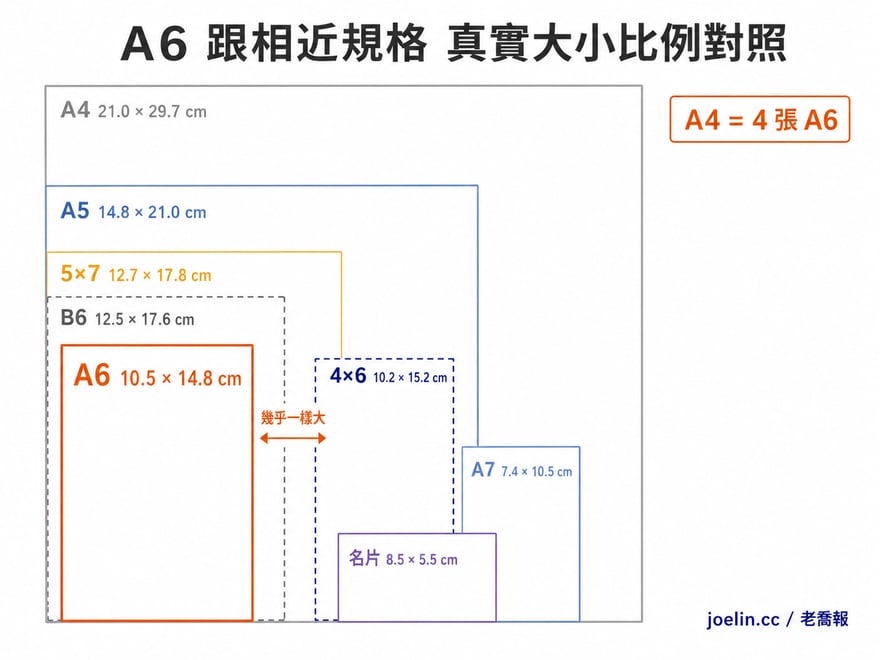
| Size | Dimensions (cm) | Compared with A6 |
|---|---|---|
| A4 | 21.0 × 29.7 | 4 times the area (four A6 sheets) |
| A5 | 14.8 × 21.0 | 2 times the area (two A6 sheets) |
| A6 | 10.5 × 14.8 | Baseline |
| A7 | 7.4 × 10.5 | Half the area |
| Quarter Letter | 10.8 × 14.0 (4.25 × 5.5 in) | Slightly wider and shorter, about 3% less area |
| 4 × 6 in | 10.16 × 15.24 | Almost identical (less than 1 cm² difference) |
| B6 | 12.5 × 17.6 | About 42% more area |
| 5 × 7 in | 12.7 × 17.78 | About 45% more area |
| Business card (as drawn in the diagram) | 8.5 × 5.5 | About one-third of the area (about 3 cards ≈ 1 A6) |
| US business card | 8.9 × 5.1 (3.5 × 2 in) | Also about one-third of the area |
| Polaroid 600 | 10.8 × 8.8 | Slightly smaller, different proportions |
The rows that matter most for everyday use are A5 and A4, which are exactly two and four A6 sheets, and 4 × 6, which is the one most often confused with A6.
The most common mix-up: A6 vs 4 × 6
A6 (10.5 × 14.8 cm) and a 4 × 6 in print (10.16 × 15.24 cm) are almost exactly the same size, less than one square centimeter apart. But their shapes differ:
- A6 = 1 : √2 (≈ 1.414)
- 4 × 6 = 1 : 1.5
That is why a 4 × 6 photo placed in an A6 frame or layout leaves a thin gap on one side or gets trimmed at the ends. For the full comparison, see How Big Is a 4×6 Photo in Centimeters?
5. How many pixels do you need to print A6? A 300 DPI chart
| DPI | Pixels | Typical use |
|---|---|---|
| 72 | 298 × 420 | On-screen display |
| 150 | 620 × 874 | Home inkjet printers |
| 300 | 1,240 × 1,748 | Standard for photo labs and print shops |
| 600 | 2,480 × 3,496 | More detail than you need |
For A6, aim for 1,240 × 1,748 px at 300 DPI. Going up to 600 DPI makes almost no visible difference.
Is a phone photo good enough to print at A6? 1,240 × 1,748 px is about 2.17 megapixels. Any phone from the iPhone 6 onward (8 MP and up) has far more than enough.
6. Where to buy or print A6
| Where | Best for |
|---|---|
| Stationery and lifestyle stores | Ready-made A6 notebooks, planners, and cards |
| Local print shops and online printers | Custom A6 printing (flyers, invitations, booklets) |
| Photo labs | Photo prints; you can ask for A6 or for 4 × 6, which is almost the same size |
| Self-service photo kiosks | 4 × 6 prints (≈ A6) |
| The postal service | Mailing A6 postcards, within your country’s postcard rules |
The pattern is simple: buy finished A6 products at a stationery store, have custom pieces made at a printer, and if you just need a photo at roughly A6 size, a 4 × 6 print does the job.
7. Related reading: size references
- 4 × 6 photos and how they compare with A6: How Big Is a 4×6 Photo in Centimeters?
- A4 size and pixels: A4 size
- A5 size: A5 size
- A6 size in detail: A6 size
- Instant photo sizes: Instax and Polaroid Photo Sizes
- Photo booth strip sizes: Life Four Cuts photo sizes
- Paper and photo sizes in one table: Paper and Photo Size Chart
Frequently asked questions
What is half of A4?
A5, which is 14.8 × 21 cm (148 × 210 mm). Fold it in half again and you get A6 (10.5 × 14.8 cm). Each fold moves one step down the A series, and the √2 aspect ratio never changes. Half of US Letter is a different size: Half Letter, 5.5 × 8.5 in.
Is A6 a postcard?
It is one of the most common postcard sizes, but the two are not exactly the same thing. Postal services set their own maximum postcard sizes, and in practice a postcard can be smaller than A6.
Is A6 the same size as 4 × 6?
Almost the same size, but a different shape. A6 is 10.5 × 14.8 cm (ratio 1 : √2) and 4 × 6 is 10.16 × 15.24 cm (ratio 1 : 1.5). Their areas differ by less than 1 cm².
Who is an A6 notebook good for?
A6 is the “pocket size,” good for commuters, students, and anyone who wants a notebook that slips into a jacket pocket. It is one size smaller than A5 and slightly larger than a phone.
Which is bigger, A6 or B6?
B6 (12.5 × 17.6 cm) has about 42% more area than A6 (10.5 × 14.8 cm). In Taiwan, B6 shows up mostly in books and pocket paperbacks, and B6-size planners also exist.
What fraction of A4 is A6?
One-quarter. Folding A4 once gives A5, and folding A5 again gives A6, so A6 = A4 ÷ 4. One sheet of A4 cuts into exactly four A6 pieces.
How many pixels do I need to print A6?
1,240 × 1,748 px at 300 DPI (about 2.17 megapixels). A phone photo is more than enough.
How heavy is A6 paper?
That depends on the paper weight, not the size. General A6 printing often uses 80–120 gsm (standard copy-paper weight), while postcard versions use 250–300 gsm card stock. Size and paper weight are separate choices, so specify both when ordering.
Keywords: half of A4 size, A4 folded in half, half A4 size in cm, A5 size, A6 size, A6 in cm, A6 in inches, A4 A5 A6 sizes, A series paper sizes, A6 pixels
Sources: Chinese original first published 2026-05-12; original last updated 2026-10-20. Notebook and planner dimensions vary by brand and edition; check each brand's listing. Postal size limits differ by country and are not covered in detail here.
This English version is based on original Traditional Chinese content on joelin.cc. The language and explanations are localised for international readers. The Traditional Chinese original is the authoritative version — for its complete meaning, please read the original article.