
This article is also available in:繁體中文 · 日本語 · 한국어 · Bahasa Indonesia · Bahasa Melayu · ไทย · Português (Brasil) · Español · Türkçe · Tiếng Việt
A0 paper is 84.1 × 118.9 cm, or about 33.11 × 46.81 inches.
A0 is the largest standard size in the A series and the origin of the whole series. Here are the answers first:
A0 size quick reference
| Unit | A0 size |
|---|---|
| Centimeters | 84.1 × 118.9 cm |
| Millimeters | 841 × 1189 mm |
| Inches | about 33.11 × 46.81 in |
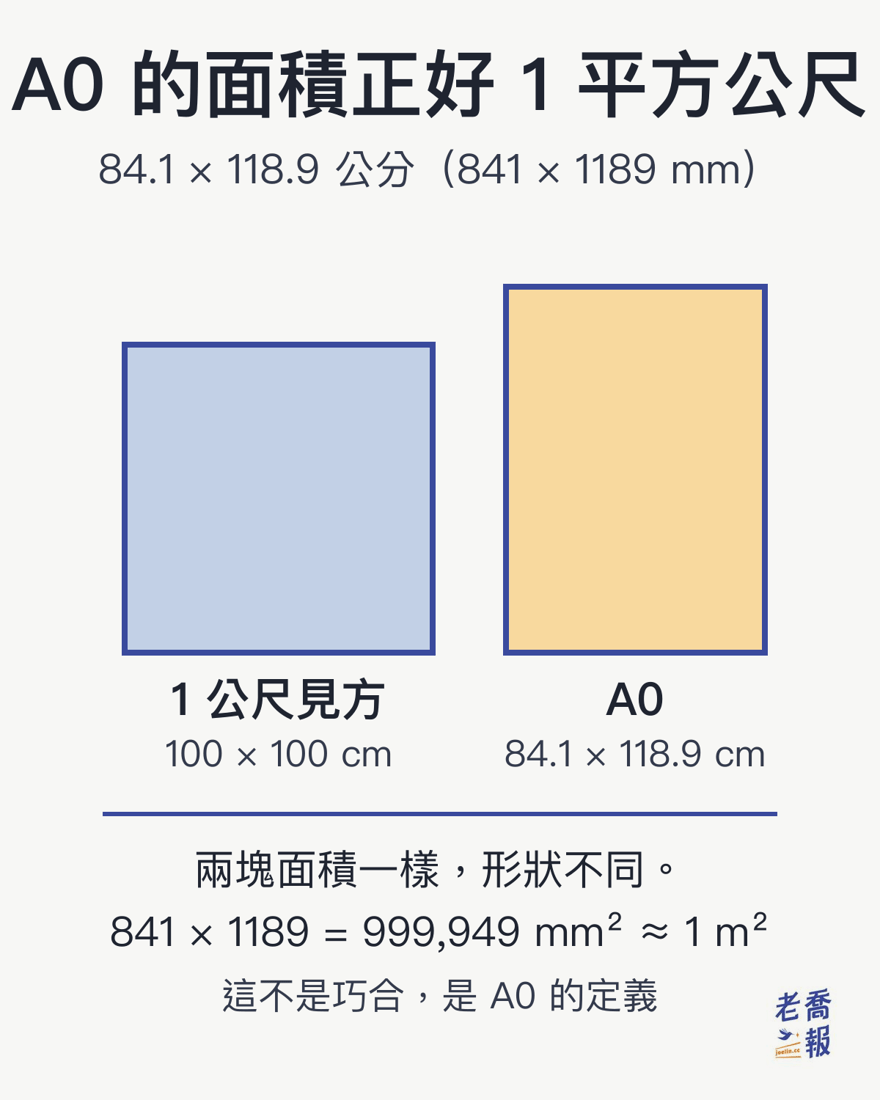
The definition is easier to remember than the numbers: the area of A0 is one square meter. 841 × 1189 = 999,949 square millimeters, which rounds to exactly 1 m². That is not a coincidence; it is how A0 is defined.
Why the odd numbers 841 × 1189?
The sides of A0 were not picked arbitrarily. They are the result of working backward from two conditions.
The first condition is that the area must equal one square meter. The second is that the aspect ratio must be 1 : √2. Satisfy both at once and the sides come out as 841 mm and 1189 mm. The ratio is 1 : √2 so that the proportions survive folding: when you fold the long side in half, the new sheet still has a 1 : √2 ratio. This property lets every layout in the A series scale proportionally without trouble. An A0 poster reduced to an A3 proof keeps its type sizes and margins in proportion, with no need to redo the layout.
The full A series: folding down from A0
| Size | cm | mm | Relationship to A0 |
|---|---|---|---|
| A0 | 84.1 × 118.9 | 841 × 1189 | Origin (area 1 m²) |
| A1 | 59.4 × 84.1 | 594 × 841 | A0 folded once |
| A2 | 42 × 59.4 | 420 × 594 | A0 folded twice |
| A3 | 29.7 × 42 | 297 × 420 | A0 folded three times |
| A4 | 21 × 29.7 | 210 × 297 | A0 folded four times |
| A5 | 14.8 × 21 | 148 × 210 | A0 folded five times |
The whole table repeats one action: folding in half. Each fold adds one to the number, halves the area and keeps the shape. The familiar A4 is simply A0 folded four times, with one sixteenth of A0’s area. Each size has its own guide: A1 Size, A2 Size, A3 Paper Size and A5 Paper Size.
A0 vs US sizes: 34 × 44 and 36 × 48 inches
The United States has no A0. The closest inch-based sizes are 34 × 44 in (ANSI E, used for engineering drawings) and 36 × 48 in (ARCH E, used for architectural drawings).
| Size | cm | Inches | Compared with A0 |
|---|---|---|---|
| A0 (ISO) | 84.1 × 118.9 | about 33.11 × 46.81 | Reference size |
| ANSI E | 86.4 × 111.8 | 34 × 44 | 2.3 cm wider, 7.1 cm shorter |
| ARCH E | 91.4 × 121.9 | 36 × 48 | 7.3 cm wider, 3 cm longer |
Neither is the same as A0. ANSI E is wider and noticeably shorter, and ARCH E is larger in both directions. Their aspect ratios are also different (about 1 : 1.29 for ANSI E and 1 : 1.33 for ARCH E, compared with A0’s 1 : 1.41), so an A0 layout scaled onto either one leaves white space at the sides. For academic posters in particular, check the size the conference asks for: US events often specify inch sizes rather than A0.
What A0 is used for
- Engineering drawings and full CAD plots: when the full drawing of a whole building or production line has to be spread out, A0 is the smallest size that shows it all at once.
- Academic poster presentations: international conference poster sessions often specify A0 in portrait orientation.
- Large signage and exhibition backdrops: the main wall of a booth or the key visual at an event entrance is often built on A0 as a basic module.
- Large maps and charts: contour maps, transit network maps, full organization charts and other detail-dense content.
- Teaching charts and anatomy charts: diagrams that a group of people need to look at together.
How many pixels do you need to print A0?
The conversion formula is: millimeters ÷ 25.4 × DPI.
| Resolution | Pixels (841 × 1189 mm) | Typical use |
|---|---|---|
| 300 DPI | 9933 × 14043 px | Exhibition visuals viewed up close, detail-dense charts |
| 150 DPI | 4967 × 7022 px | Signs viewed from a distance on a wall, academic posters |
A0 covers one square meter. At 300 DPI, a single uncompressed layer already takes several hundred megabytes, and with many layers the file reaches gigabytes. Design software struggles to open it, and sending it to a print shop becomes a long wait. The deciding factor is still viewing distance: use 300 DPI when viewers will lean in to read small text, and 150 DPI when they stand two or three meters away, where the difference is barely visible. Academic posters are a compromise case. Titles are read from a distance and body text up close, so in practice people often work somewhere between 200 and 300 DPI, or place charts separately at high resolution.
Where to print A0
Office printers and self-service copiers usually top out at A3 or 11 × 17 in, and there is no self-service option at this size. Your choices are a large-format print shop, a wide-format printer at a copy shop, or a commercial printer. Academic posters have a practical convention worth remembering: print on synthetic paper or fabric, which can be rolled into a poster tube or even folded into a suitcase, and holds up to long trips far better than ordinary poster paper. Before sending the file, ask about the bleed, the color mode and the mounting method (hanging rods, top and bottom wooden strips, or simply taping the four corners). Mistakes in these details cost much more at A0 than at small sizes.
Frequently asked questions
How many centimeters is A0?
84.1 × 118.9 cm, or 841 × 1189 mm, which is about 33.11 × 46.81 inches. It is the largest standard size in the A series.
Why is A0 such an odd number like 841 × 1189?
Because A0 is derived from two conditions: the area has to equal one square meter, and the aspect ratio has to be 1 : √2. Solving for both gives 841 × 1189 mm, an area of about 999,949 square millimeters, or one square meter.
How is A0 related to A1 and A2?
A0 folded once is A1 (59.4 × 84.1 cm), folded again is A2 (42 × 59.4 cm), and so on. Each fold adds one to the number, and because the aspect ratio is 1 : √2, the shape never distorts.
How many pixels do you need to print A0?
9933 × 14043 px at 300 DPI for print and 4967 × 7022 px at 150 DPI. A0 covers one square meter, so a 300 DPI file is very large; 150 DPI is usually enough for prints viewed from a distance on a wall.
Is A0 the same as 36 × 48 inches?
No. 36 × 48 in (ARCH E) is 91.4 × 121.9 cm, larger than A0 in both directions. 34 × 44 in (ANSI E) is wider but shorter. Check which size your printer or conference expects.
Where can I print A0?
Office printers and self-service copiers usually go up to A3 or 11 × 17 in at most, so A0 needs a large-format print shop, a wide-format printer at a copy shop, or a commercial printer. For academic posters, a common approach is to print on synthetic paper or fabric so the poster can be rolled up and carried to the venue.
Keywords: A0 paper size, A0 size in cm, A0 size in inches, A0 dimensions, A0 poster, A0 in pixels, A series paper sizes
Sources: The original Chinese article was first published on August 18, 2026, and last updated on October 19, 2026. A-series dimensions are fixed by the ISO 216 international standard; the US comparison sizes (ANSI E 34 × 44 in and ARCH E 36 × 48 in) were added for English-language readers. Taiwan-specific printing advice in the Chinese original has been replaced with general advice.
This English version is based on original Traditional Chinese content on joelin.cc. The language and explanations are localised for international readers. The Traditional Chinese original is the authoritative version — for its complete meaning, please read the original article.