
This article is also available in:繁體中文
The Chinese article was originally published on September 24, 2026, and updated on October 2, 2026. The historical dates and market data below reflect that original research snapshot.
The photo booth was invented in the West. In 1925, a Russian immigrant applied for a patent in New York, then installed the first Photomaton on Broadway, offering eight photos for 25 cents. Over the following century, photo booths in Europe and North America took a completely different path from those in Asia: they became ID-photo machines for passports, driver’s licenses, and monthly transit passes, later branching into vintage film booths and rentals for weddings and events. What Japan invented in 1995 was the branch that “prints photos as stickers and lets you doodle on them.” That branch never took root in Europe and North America.
This is the European and North American installment of the photo booth industry research series, alongside the articles on Taiwan, Japan, South Korea, and Hong Kong. It answers three questions:
- When did photo booths begin, and which companies represented each era?
- Which companies in the European and North American industry are publicly listed?
- Why did Europe and North America never develop a photo sticker culture, despite having the same basic kind of photography machine?
Today’s European and North American industry leader, ME Group, formerly Photo-Me, is publicly listed. Its financial statements and operations are covered in a separate in-depth article: ME Group, the Photo Booth Leader in Europe and North America. This article covers only its place in history.
First, a clarification about the quality of the evidence. The only original records I could obtain were patents, UK company registrations, and listed-company announcements. For details about companies and individuals from the 1920s through the 1960s, this site could find only secondary sources—Wikipedia, compiled corporate histories, and collectibles websites—which often disagree. Wherever the evidence is secondary or contradictory, the text says so. Questions I could not resolve are listed at the end.
1. Invention: From the Coin-Operated Camera of 1889 to Broadway in 1925
1889: Someone Built It, but It Never Became Widespread
More than three decades before Photomaton, someone had already built a coin-operated automatic camera. French inventor Théophile Enjalbert applied for a U.S. patent in October 1889 (US436627), which was granted in September 1890. After a coin was inserted, the machine photographed the subject on a wet iron plate, then automatically developed and fixed the image. Secondary accounts describe similar machines in Germany, but this site could not locate their original patents.
None of these early machines became widespread, for technical reasons: wet plates required chemical processing on site, the wait was long, and the machines were prone to breakdowns. They remained novelties at exhibitions and amusement parks.
1925: Josepho and Photomaton
The person who truly turned the photo booth into a business was Anatol Josepho. He was a Russian-born immigrant—sources give his birthplace as either Tomsk or Omsk—who arrived in the United States in the early 1920s.
- On March 27, 1925, Josepho filed a patent application with the U.S. Patent Office for a “Photographic apparatus.” It was granted on June 7, 1927 (US1631593), with Photomaton Inc. as the patent holder. The patent focused on a lighting and mirror arrangement that prevented unattractive shadows in close-up portraits.
- The first machine stood at 1659 Broadway in New York. A set of eight photos cost 25 cents and took approximately eight minutes to emerge. Most sources date its opening to September 1925, while others give 1926. This site could not find original newspaper reports from the time to settle the question.
- Long queues reportedly formed after the opening. A frequently cited figure is “280,000 customers in the first six months.” The number appears identically across secondary websites and may well have been copied from one to another. This site treats it only as a story passed down.
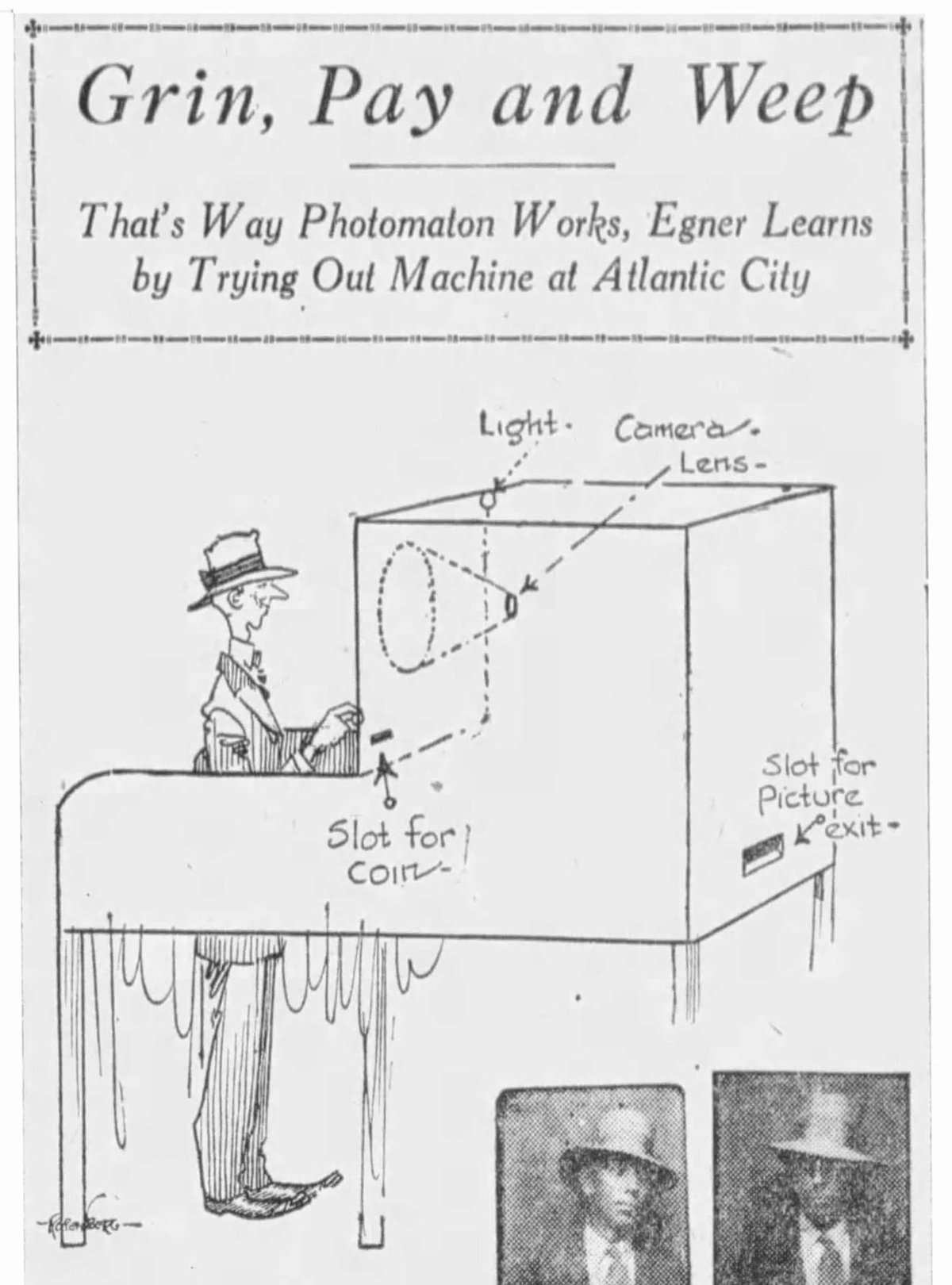
A Photomaton diagram published in the American newspaper The Cincinnati Post in July 1927, with a title roughly described as “Smile, pay, and wait”: the customer inserts a coin, sits down, and looks into the lens; the lights come on for the photograph, and a few minutes later the pictures drop out of a slot on the side. Illustration by Manuel Rosenberg. The original is held by Columbia University’s Rare Book Library and is in the public domain.
1927: One Million Dollars
One of the most frequently repeated statements in photo booth history is that Josepho sold the rights for one million dollars. Here is what this site found:
- Multiple secondary sources agree on the US$1 million price and identify the buyer as an investment group led by Henry Morgenthau Sr., the former U.S. ambassador to Turkey. Confidence in these details is moderate.
- Different sources date the transaction to either 1927 or 1928. This site cannot resolve the discrepancy.
- Some online articles claim that the investment group also included Supreme Court Justice Louis Brandeis and that Franklin D. Roosevelt served as a director. This site found those claims only in a summary of unclear origin and does not adopt them.
The more accurate formulation is therefore: around 1927, Josepho reportedly sold the photo booth rights for US$1 million to investors led by Morgenthau. The company that took over was Photomaton Inc.
2. The First Bubble: Collapse in a Financial Fraud Scandal in 1929
After the rights were sold, capital quickly drove the photo booth’s expansion.
- United States: Photomaton Inc. took over Josepho’s patent and installed machines in major cities. This site could not find a reliable figure for the number of machines at its peak.
- United Kingdom: In 1928, financier Clarence Hatry established Photomaton Parent Corporation, installed photo machines at railway stations, amusement grounds, and other locations, and issued shares.
- France: Photo machines arrived in Paris around the end of 1928. Secondary sources disagree about whether the French Photomaton company was founded in 1928 or 1936 and who founded it.
The British operation soon ran into trouble. In September 1929, a fraud scandal engulfed Hatry’s entire group. Trading in its companies, including Photomaton Parent Corporation, was suspended, and the group collapsed. Hatry himself received a 14-year prison sentence. Financial-history records provide corroboration, making this a comparatively well-supported episode in the photo booth’s 1920s history.
The first photo booth bubble in Europe and North America thus burst in 1929—just one month before the New York stock market crash. Japan’s first purikura bubble, by comparison, saw its market halve in a single year in 1998; see Thirty Years of Japanese Purikura. Both occurred within three or four years of the invention: one collapsed because of financial fraud, the other because too many manufacturers rushed in at once.
3. From Entertainment to Public Infrastructure, 1930s–1990s
When Photomaton first appeared, it was entertainment: friends and couples squeezed inside to take a strip of pictures, much like today’s Life4Cuts. Over the following decades, however, another demand gradually took over European photo booths: ID photographs.
- France: According to secondary sources, France had a system of identity cards bearing photographs from 1921, although the cards were not compulsory at the time. The requirement for portraits of a fixed size with consistent backgrounds drove people into photo booths.
- United Kingdom: According to a compiled corporate history, Britain began accepting black-and-white booth photographs for passports in 1966 and switched passport photographs to color in 1976.
- Paris: Carte Orange, the region-wide monthly transit pass introduced in 1975, required a photograph and remained in use until 2009. Station photo booths consequently became an everyday facility for commuters.
The principal U.S. company during this period was Auto-Photo Company. Its Model 11 reportedly debuted in 1955 and remained in production until the mid-1960s. Its durability means some machines still operate today. Secondary sources disagree, however, about whether the company was founded in 1926 or 1932.
Britain’s Photo-Me also emerged during this period. Its official history records that in 1954, its first customer sat inside a Photo-Me booth and received photographs a few minutes later. UK company records show that its operating subsidiary was incorporated in July 1954, while the listed entity was incorporated and listed on the London Stock Exchange in 1962. The frequently cited year “1952,” according to corporate-history sources, was the year the founder visited Britain, rather than the company’s founding year.
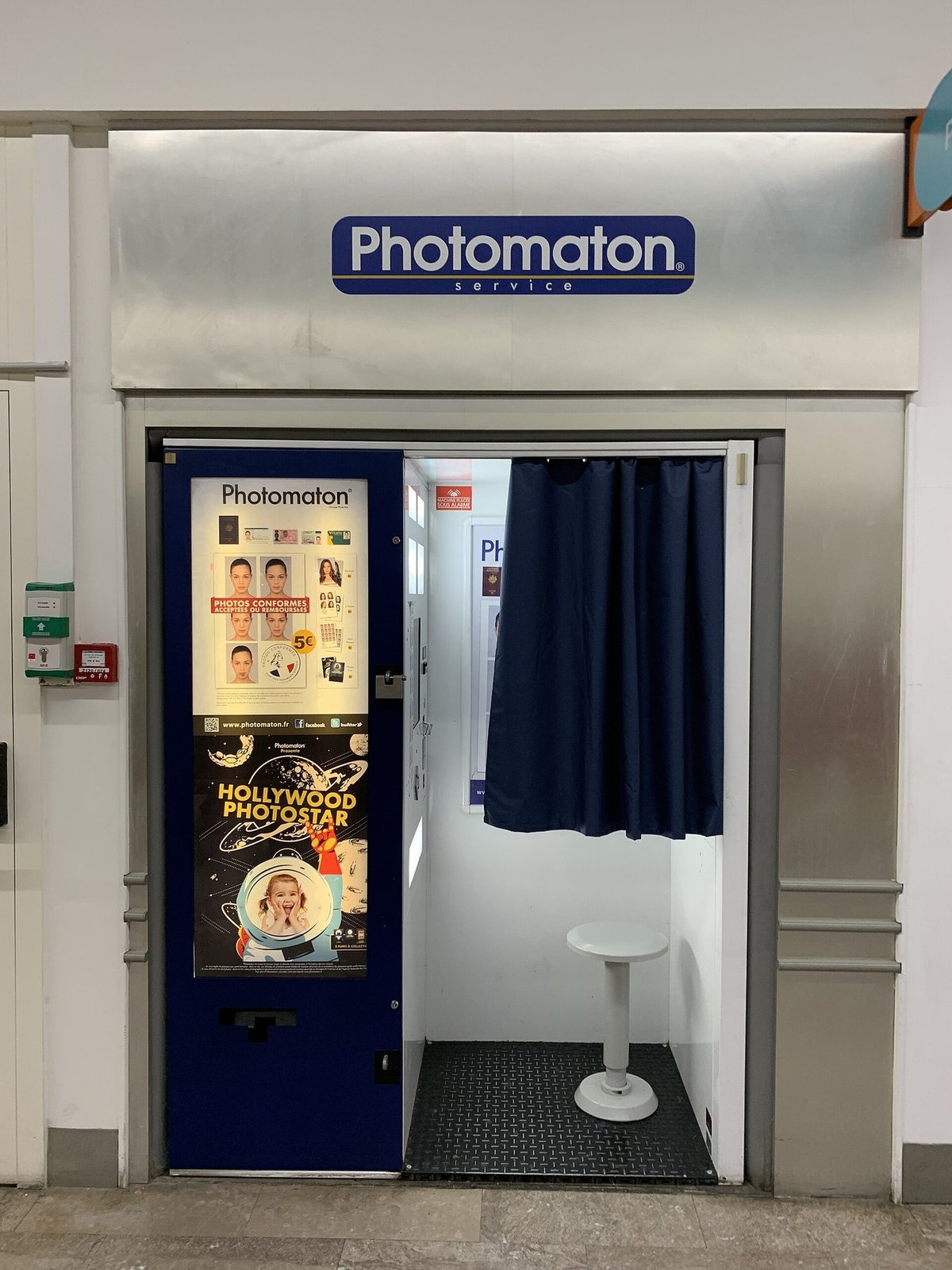
A Photomaton at the Val de Fontenay shopping center outside Paris in November 2019. Its exterior is covered with ID-photo specifications: this is what a typical European photo booth looks like today. Photograph by Chabe01, CC BY-SA 4.0. Original image.
The significance of this period is that, in Europe, photo booths went from “fun” to “necessary.” Installed near stations, supermarkets, and government offices, they served anyone who needed official-document photos, rather than a particular group of young people. That positioning continues today and shaped what followed.
The “fun” side did not disappear entirely. In the late 1920s, Surrealist artists in Paris were already using Photomaton as a creative tool. The Centre Pompidou still holds a strip of self-portraits that painter Yves Tanguy took in a Photomaton around 1929. Andy Warhol later made extensive use of photo booth pictures as well. This coexistence of “official identification and self-expression” is the central theme of Western photo booth research. The Photographers’ Gallery in London’s centenary exhibition, “Strike a Pose! 100 Years of the Photobooth,” running from October 2025 to February 2026, Näkki Goranin’s American Photobooth (2008), and Raynal Pellicer’s Photobooth: The Art of the Automatic Portrait all approach the subject from this perspective.
4. A British Company Took Over Europe’s ID-Photo Business
In 1994, Photo-Me merged with KIS, a company based in Grenoble, France, that made instant photo-processing equipment. Photo booths began moving toward digital technology. Photo-Me subsequently brought ID-photo machines across Europe into its group, with France’s Photomaton becoming its largest subsidiary. In 2022, the company changed its name to ME Group.
Today, ME Group operates 30,520 photo booths in 16 countries, as reported for fiscal 2025. Among the European and North American photo booth companies this site could identify, it has the most machines and is the only publicly listed company. It also acquired Fujifilm’s Japanese photo booth business in 2023, making the European and North American ID-photo leader one of the main operators of street-side ID-photo machines in Japan as well.
Its financial statements, four business divisions, and attempt to sell itself in 2025 are covered in a separate article: ME Group, the Photo Booth Leader in Europe and North America.
5. The Twilight of Chemical Machines and the Vintage Film Booth Revival, Since the 2000s
As digital photo booths became widespread, old booths using chemically processed photographic paper began turning into antiques. A key factor was the successive discontinuation of upstream materials:
- Polaroid discontinued instant pack film in 2008.
- Fujifilm discontinued the same type of instant film in 2016.
Chemical machines became scarcer and harder to repair, which in turn made them a nostalgic experience. From the 2000s onward, small European companies specializing in restoring old machines emerged:
- Berlin’s Photoautomat: In early summer 2004, two friends installed their first restored vintage black-and-white photo booth at Rosenthaler Platz, according to local media reports. By 2026, its official website listed 34 locations across Germany, Switzerland, Austria, the Netherlands, the United Kingdom, and elsewhere.
- Paris’s Fotoautomat: Founded in 2007, it installed its first machine at the Palais de Tokyo and currently has approximately 17 machines. The two companies have similar names, but their websites and locations are independent. This site found no evidence of any acquisition or licensing relationship.
- America’s Photomatica: It operates physical photo booth museums in San Francisco, Los Angeles, and Houston, restoring old Auto-Photo and Photo-Me machines. This site could not establish its founding year.
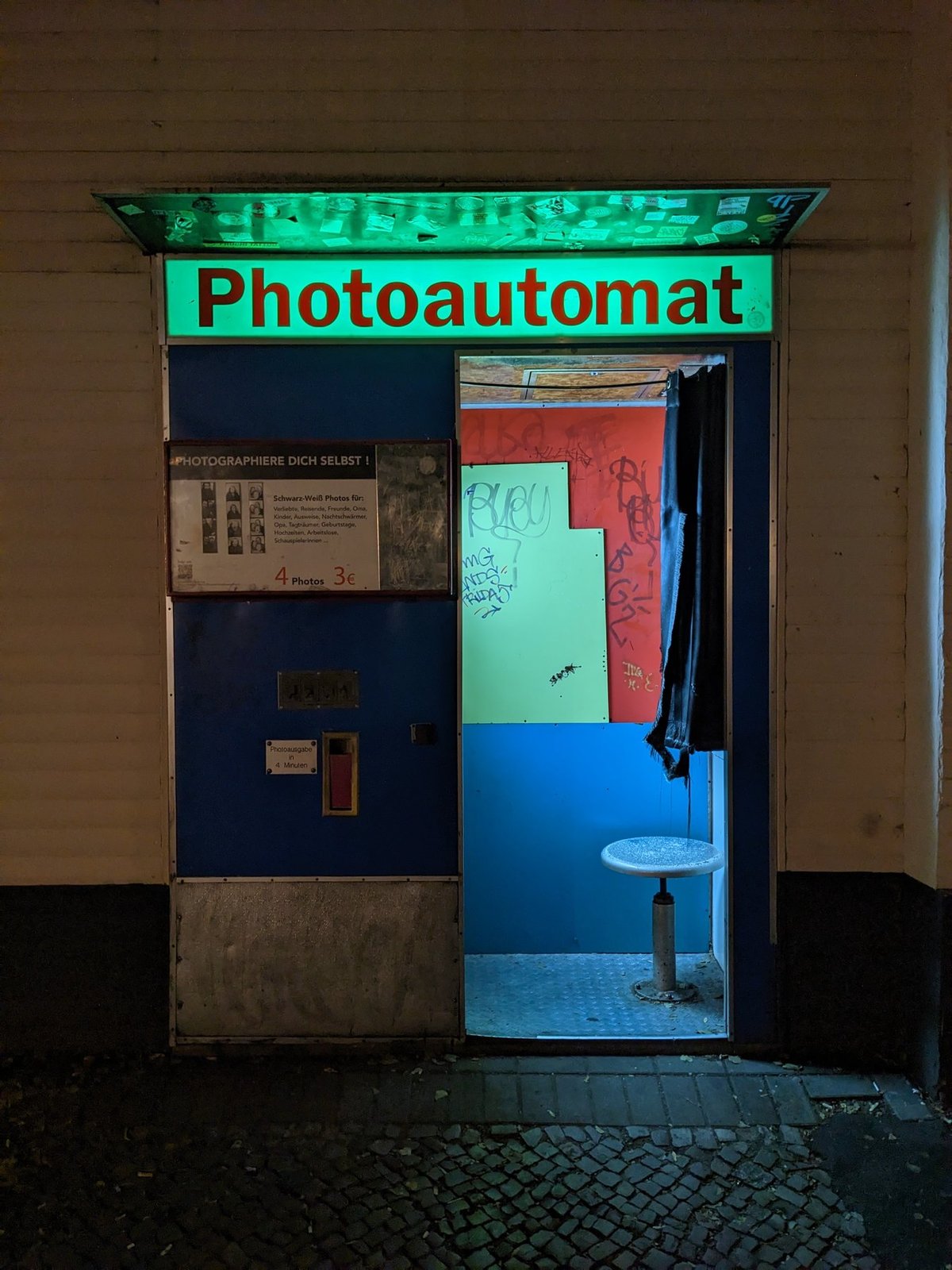
A Photoautomat at night in Berlin, August 2023. Photograph by Spinarak, CC BY-SA 4.0. Original image.
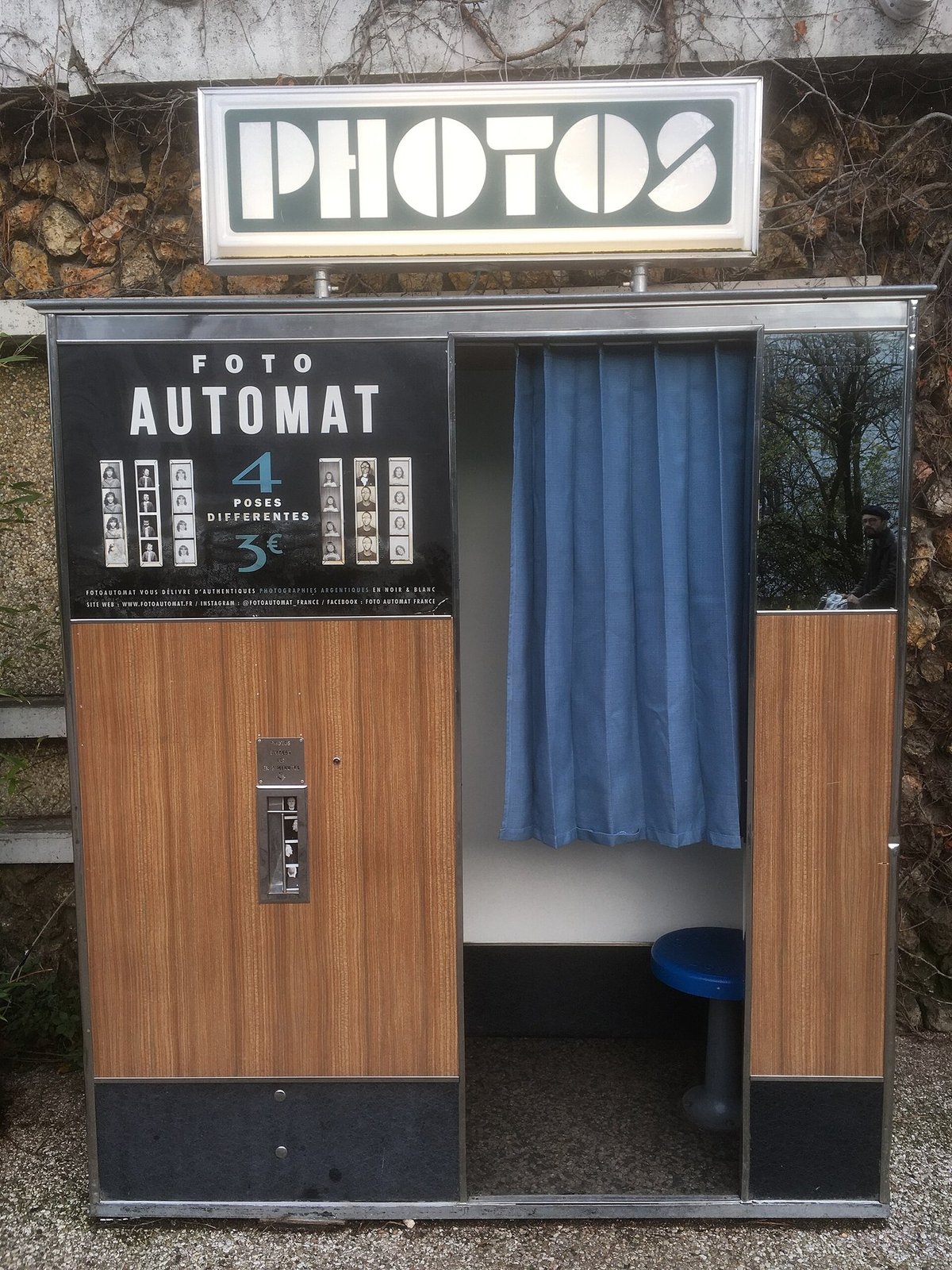


A Fotoautomat black-and-white film booth in Paris’s Parc des Buttes-Chaumont, December 2019, producing four photos per set. Photograph by Wolf Gang, CC BY-SA 2.0. Original image.
_im_Parc_des_Buttes-Chaumont,_Paris.jpg)
These film booths operate on a small scale, numbering in the dozens. Yet they are one of the few European and North American business formats that “look like” Asian photo booth shops: fixed locations, young customers, and photographs taken for fun.
6. Event Rentals: The Largest “Fun” Photo Booth Business in Europe and North America Has No Fixed Address
If you ask people in Europe and North America where the fun side of photo booths went, the answer will usually be weddings and parties.
From the 2010s onward, an entire photo booth rental industry emerged in the United States. Operators transport DSLR photo booths, animated-GIF machines, interactive mirror booths, and 360-degree video platforms to weddings, company year-end parties, and brand events, charging per event. Companies selling this equipment to entrepreneurs, such as Photobooth Supply Co, were founded around 2013. This business format also appears to have begun developing recognizable brands around those years. This site infers that timing from company founding dates; it found no industry report identifying a precise takeoff year.
For scale, market research firm IBISWorld’s summary page puts U.S. photo booth rental industry revenue at approximately US$101.4 million in 2024, with 3,322 businesses and no company holding more than 5% of the market. This site read only the summary, not the full paid report.
The number of businesses in this industry is more than 100 times the number of Korean self-service photo studio locations in the United States. But they have no fixed address: one wedding today, another party tomorrow. This is a key to understanding “why Europe and North America have no photo sticker shops,” a question we will return to in Section 8.
7. The 2020s: Korean-Style Photo Studios Arrive
In the 2020s, Korean self-service photo studios began opening stores in Europe and North America. Taking Life4Cuts (人生四格) as an example, its official location pages listed the following in September 2026:
| Region | Official location count |
|---|---|
| United States | 9 |
| Canada | 18 |
| United Kingdom | 16 |
| Other European countries | 13–14; the page loads dynamically, and two counts produced different results |
Source: Life4Cuts’ official U.S., Canadian, UK, and European location pages, checked on September 24, 2026.
The figures show that Korean-style photo studios do exist in Europe and North America and are concentrated in major cities. But they number in the dozens, far below the scale in South Korea; for Korean store counts, see Thirty Years of Korean Photo Booths. Other Korean brands, including Photoism, also have U.S. stores, but no consolidated official directory is available.
How does Western mainstream media view this development? This site searched The New York Times, The Guardian, BBC, Le Monde, Der Spiegel, Vogue, Teen Vogue, and Refinery29 using multiple sets of keywords. It found only one direct report: an April 2025 Los Angeles Times article about GENIC. That business, however, is a brand founded in Los Angeles by two entrepreneurs who grew up in South Korea. They deliberately created high-angle photo booths that were “a little cooler than the Korean version”; it is not a Korean brand itself. Almost all other reporting came from English-language media based in South Korea.
The more accurate description, then, is that Korean-style photo studios are “being introduced and locally adapted” in Europe and North America, but Western mainstream media has yet to treat them as an established cultural phenomenon.
8. Why Europe and North America Never Developed a Photo Sticker Culture
Japanese Purikura Has Almost No Presence in Europe and North America
The only documented official export of Japanese purikura machines this site could find was PURIBOOTH, a model FURYU developed for overseas markets in 2014. It was unveiled at a U.S. amusement-equipment trade show in November 2014. The first machine was installed at Dave & Buster’s in Hollywood, Los Angeles, that December, and shipments began in January 2015. This site could not find information on its subsequent development, and FURYU’s U.S. subsidiary no longer mentions it on its current official website.
The Japanese purikura machines visible in the United States today are mainly those in certain ROUND ONE locations, where they are one of many types of arcade machines. There are records of a dedicated purikura shop in New York and machines beside Japanese supermarkets, but those records end with blog posts and discussion threads from a decade ago. Their current status could not be established. This site found no comparable records for Europe.
Two Clues This Site Found
This site could not find any scholar or industry operator who had directly answered the question. It found only two clues:
- An established association with ID photos: According to an industry-history website, from the 1930s onward, the main purpose of photo booths in the United States was to produce ID photographs suitable for passports. The pattern was even more pronounced in Europe, as discussed in Section 3. Once people see a machine as something “for official documents,” it becomes difficult to reinvent it as somewhere “to have fun with friends.”
- Local adaptation is necessary: GENIC’s founders told the Los Angeles Times that the Korean model could not simply be transplanted to the United States; the branding had to be reworked. At a minimum, this suggests that the aesthetics and activities of Asian photo sticker booths are not automatically accepted in Europe and North America.
This Site’s Inference
The following are inferences, rather than findings from published research:
- The desire to “take inexpensive photos with friends and keep a souvenir” did not disappear in Europe and North America. It was served by event rentals instead. More than 3,000 U.S. photo booth rental businesses do at weddings and parties what Asian photo booth shops do—the difference is that they follow events rather than opening on the street.
- Asian photo sticker businesses grew in arcades in Japan and small street-level shops in South Korea and Taiwan. Neither type of venue is an everyday gathering place for young people in Europe and North America. There, young people gather at parties and events, and photo booths followed them.
9. A Comparison with Asia
The same machine that dispenses photographs developed into five different kinds of business across five markets.
| Europe and North America | Japan | South Korea | Taiwan | Hong Kong | |
|---|---|---|---|---|---|
| Main format | ID-photo machines plus event rentals | Purikura machines in arcades | Unstaffed self-service photo studios | Branded shops plus distribution through claw-machine shops | Machines integrated into shopping-center circulation routes |
| Why customers come | Official-document photos, a necessity; fun at events | Entertainment | Entertainment and fandom | Entertainment | Entertainment |
| Who owns the machines | Operating companies themselves for ID photos; rental businesses for events | Arcades, which buy from manufacturers | Franchisees who open the stores | Brand owners or distribution partners | Operators that place machines in shopping centers |
| Representative companies | ME Group, publicly listed | FURYU, publicly listed | Life4Cuts and Photoism | This site’s database includes 12 brands | SNAPIO |
| Dedicated articles on this site | This article and ME Group | Thirty Years of Japanese Purikura and FURYU | Thirty Years of Korean Photo Booths | The History of Taiwan’s Photo Booth Industry | SNAPIO’s Model Without Storefronts |
The differences in this table begin with “why the customer walks in.” Photo sticker booths in all four Asian markets are entertainment; the difference lies in who owns the machines. In Europe and North America, the main photo booth business serves a necessity, while event rentals have taken over the fun side without fixed locations. Europe and North America are therefore the only one of these five markets where the largest photo booth company depends on government document procedures rather than young people’s weekends.
For current photo booth and Korean self-service studio locations in these Western countries, the Photo Booth Information site organizes them into three country pages: United States, United Kingdom, and Canada.
10. What I Could Not Find
- Whether Josepho’s first machine opened in 1925 or 1926. Original newspaper reports from the time are in the U.S. Library of Congress’s newspaper database, which this site could not access.
- The exact month and year, contract terms, and investor list for the US$1 million transaction associated with 1927.
- Whether the French Photomaton company was founded in 1928 or 1936, who founded it, and when and how it became part of today’s ME Group.
- Auto-Photo Company’s founding year: 1926 or 1932.
- The number of photo booths in the United States and Europe from the 1920s through the 1960s. No reliable figures were found.
- Britain’s acceptance of photo booth pictures for passports in 1966 and switch to color in 1976. These claims were found only in a compiled corporate history; no original UK government documents were located.
- The founding year of America’s Photomatica.
- Research by Western scholars or industry operators directly addressing “why Europe and North America have no photo sticker culture.” Not a single study was found.
English Terms Used in This Article
- Photo booth: A general term for a coin-operated automatic photography machine. In Europe and North America, it usually refers to an ID-photo machine.
- Photomaton: The name of Josepho’s 1925 machine and company. Today, it is ME Group’s photo booth brand in France.
- Photo strip: A vertical strip of multiple pictures dispensed by a photo booth. It can be regarded as a predecessor of Life4Cuts.
- Photo booth rental: A service business that transports photography equipment to weddings and events.
- Life four cuts: The English rendering of 人生四格, the name of a representative Korean self-service photo studio brand.
- Purikura: The romanization of the Japanese プリクラ. In English, it specifically denotes Japanese-style photo sticker booths.
Lead image: Anatol Josepho seated beside a disassembled Photomaton machine, photographed by France’s Agence Rol in 1927. The original is held by the Bibliothèque nationale de France and is in the public domain. This site cropped it to 16:9.
_-_btv1b53177889f.jpg)
Article keywords: European and North American photo booths, photo booth history, Photomaton, Anatol Josepho, ID-photo machines, ME Group, film photo booths, photo booth rentals, Life4Cuts, photo booth industry
Article overview
This article traces the photo booth industry in Europe and North America from 1889 to 2026, alongside the series’ main articles on Taiwan, Japan, South Korea, and Hong Kong. In 1889, French inventor Théophile Enjalbert had already obtained a U.S. patent for a coin-operated automatic camera (US436627), but it never became widespread. On March 27, 1925, Russian immigrant Anatol Josepho applied for a photographic apparatus patent (US1631593, granted June 7, 1927, with Photomaton Inc. as the patent holder) and installed the first Photomaton at 1659 Broadway in New York, offering eight photos for 25 cents. Secondary sources date its opening to either 1925 or 1926. Around 1927, Josepho reportedly sold the rights for US$1 million to investors led by Henry Morgenthau Sr. In 1928, British financier Clarence Hatry established Photomaton Parent Corporation, which collapsed in September 1929 amid the Hatry group’s fraud scandal. Around World War II, photo booths in Europe gradually became ID-photo facilities serving French identity cards, British passports (a compiled corporate history dates acceptance of booth photos to 1966 and the switch to color to 1976), and Paris’s Carte Orange monthly transit pass (1975–2009). Britain’s Photo-Me began in 1954, listed in London in 1962, and merged with France’s KIS in 1994 as it moved toward digital technology. Now named ME Group, it has the most booths and is the only publicly listed company among the European and North American photo booth businesses this site could identify: 30,520 booths across 16 countries in fiscal 2025. As Polaroid discontinued instant film in 2008 and Fujifilm did so in 2016, restored vintage booths became a retro business format exemplified by Berlin’s Photoautomat (2004) and Paris’s Fotoautomat (2007). The U.S. photo booth event-rental industry generated approximately US$101.4 million in revenue in 2024 and comprised 3,322 businesses, according to an IBISWorld summary. Korean self-service photo studios entered Europe and North America in the 2020s; Life4Cuts’ official directories listed nine U.S. locations, 18 in Canada, 16 in the UK, and 13–14 elsewhere in Europe. Western mainstream media had yet to cover them as an established cultural phenomenon. The only documented official export of Japanese purikura machines this site could find was FURYU’s PURIBOOTH, developed for overseas markets in 2014.
- The photo booth was a Western invention: Anatol Josepho filed U.S. patent US1631593 on March 27, 1925; it was granted on June 7, 1927, with Photomaton Inc. as the patent holder.
- The first Photomaton stood at 1659 Broadway in New York and offered eight photos for 25 cents. Secondary sources date its opening to either 1925 or 1926.
- In 1889, French inventor Théophile Enjalbert had already obtained U.S. patent US436627 for a coin-operated automatic camera, but it never became widespread.
- Around 1927, Josepho reportedly sold the rights for US$1 million to investors led by Henry Morgenthau Sr.; sources give either 1927 or 1928 as the transaction year.
- British financier Clarence Hatry established Photomaton Parent Corporation in 1928; it collapsed in September 1929 amid the Hatry group’s fraud scandal.
- Around World War II, European photo booths gradually became ID-photo facilities. Paris’s Carte Orange monthly transit pass required a photograph from 1975 to 2009.
- Photo-Me began in Britain in 1954, listed in London in 1962, merged with France’s KIS in 1994, and changed its name to ME Group in 2022.
- ME Group operated 30,520 photo booths across 16 countries in fiscal 2025. Among European and North American photo booth companies this site could identify, it had the most machines and was the only publicly listed company.
- Polaroid discontinued instant film in 2008 and Fujifilm in 2016; chemical photo booths gradually became antiques.
- Berlin’s Photoautomat, established in 2004, and Paris’s Fotoautomat, established in 2007, developed a retro business format by restoring old black-and-white photo booths.
- The U.S. photo booth event-rental industry generated approximately US$101.4 million in revenue in 2024 and comprised 3,322 businesses; none held more than 5% of the market, according to an IBISWorld summary.
- Life4Cuts’ official September 2026 location directories listed nine locations in the United States, 18 in Canada, 16 in the UK, and 13–14 elsewhere in Europe.
- This site found only one direct Western mainstream-media report on Korean-style photo studios: an April 2025 Los Angeles Times article about GENIC, a brand founded in the United States.
- The only documented official export of Japanese purikura machines this site could find was PURIBOOTH, developed by FURYU for overseas markets in 2014.
Frequently asked questions
Who invented the world’s first photo booth?
The first commercially successful photo booth was Anatol Josepho’s Photomaton. He filed a U.S. patent application (US1631593) on March 27, 1925, and installed the first booth at 1659 Broadway in New York, offering eight photos for 25 cents. Earlier, in 1889, French inventor Théophile Enjalbert had already obtained a U.S. patent for a coin-operated automatic camera, but it never became widespread.
Was Photomaton really sold for US$1 million?
Multiple secondary sources agree that Josepho sold the rights for US$1 million to investors led by Henry Morgenthau Sr. However, sources give either 1927 or 1928 as the year, and this site could not find original documents from the time. The transaction can therefore only be described as reported.
Why are most photo booths in Europe and North America used for ID photos?
From the mid-twentieth century onward, identity cards, passports, and monthly transit passes required photographs. That demand took over the use of booths installed near stations, supermarkets, and government offices. According to corporate-history sources, Britain began accepting booth photos for passports in 1966; Paris’s Carte Orange monthly transit pass required a photograph from 1975 to 2009.
What is the largest photo booth company in Europe and North America?
Within the scope of this site’s research, it is the UK-listed ME Group, formerly Photo-Me. It operated 30,520 photo booths across 16 countries in fiscal 2025. France’s Photomaton is one of its brands, and ME Group is also the only publicly listed company in the European and North American photo booth industry this site could identify.
Are Korean-style self-photo studios popular in Europe and North America?
There are stores, but they do not yet constitute an established culture. Life4Cuts’ official September 2026 directories listed nine locations in the United States, 18 in Canada, 16 in the UK, and 13–14 elsewhere in Europe. This site found only one direct Western mainstream-media report, published by the Los Angeles Times in April 2025, and it covered a brand founded in the United States.
Why did Europe and North America not develop a photo sticker culture like Japan and South Korea?
No scholar or industry operator was found to have studied the question directly. This site found two clues: photo booths had long been established as machines for official-document photos, and Asian formats needed local adaptation to gain acceptance. This site’s inference is that the desire to take souvenir photos with friends was served by photo booth rentals at weddings and parties. The United States has more than 3,000 such businesses, but they have no fixed storefronts.
This English version is based on original Traditional Chinese content on joelin.cc. The language and explanations are localised for international readers. The Traditional Chinese original is the authoritative version — for its complete meaning, please read the original article.