
This article is also available in: 繁體中文 · 日本語 · 한국어 · Bahasa Indonesia · Bahasa Melayu · ไทย · Português (Brasil) · Español · Türkçe · Tiếng Việt · Deutsch · हिन्दी
Contents (22)
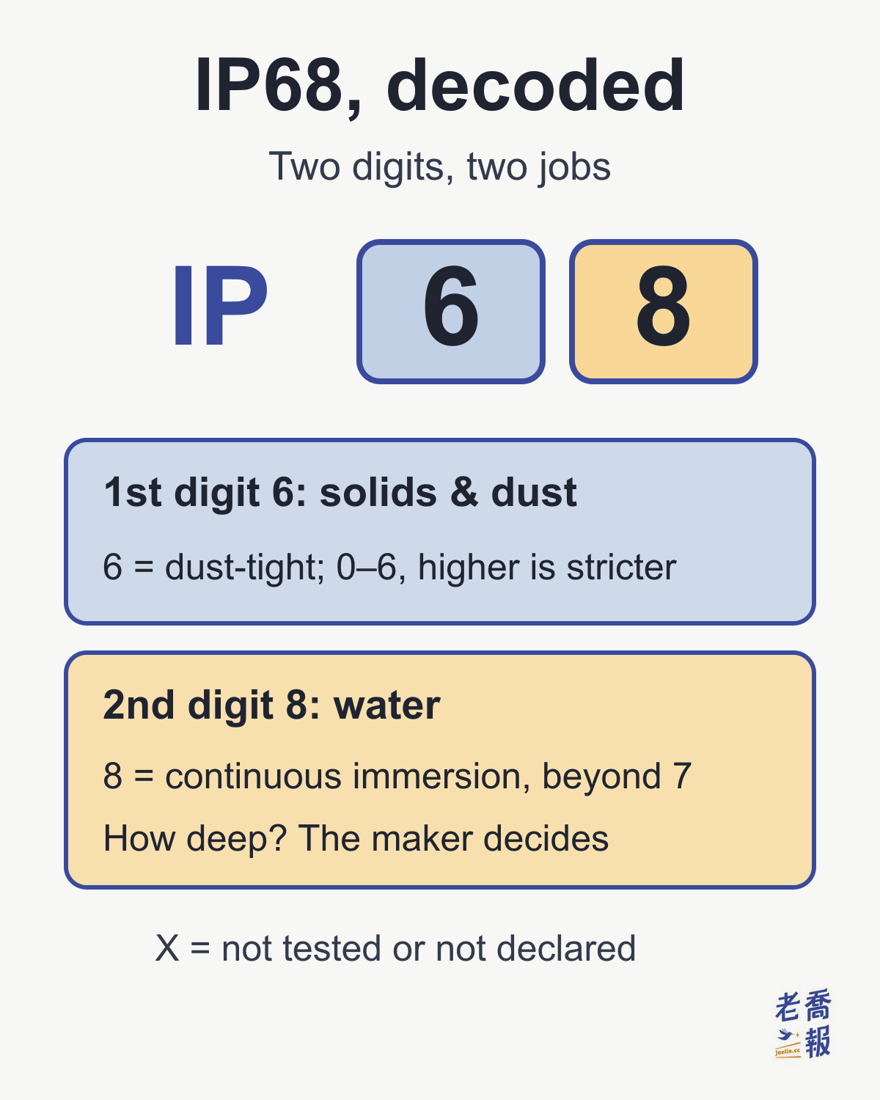
IP68 means: dust-tight (6), and able to withstand continuous immersion in water (8). But the standard does not fix “how deep”. It only requires conditions more severe than IP67’s “1 m of water for 30 minutes”, and the actual conditions are set by the manufacturer. That is why, under the same IP68 rating, some phones say 1.5 m and others say 6 m.
IP stands for Ingress Protection, and the code comes from the International Electrotechnical Commission (IEC) standard IEC 60529 “Degrees of protection provided by enclosures (IP Code)”. Each of the two digits that follow covers one thing: the first covers solids and dust, the second covers water. Wherever there is an X, that item was not tested or is not declared.
So when you see a water-resistance spec, first split it into its two digits, then look up the depth and duration the manufacturer itself states, and finally remember that the standard tests with fresh water: seawater, pools, hot water and steam are outside what the rating covers.
Which standard IP ratings come from: IEC 60529
The IEC’s official IP ratings page puts it plainly: electronic equipment degrades or fails when water or dust gets in, and an IP rating scores how well the enclosure keeps them out. The IEC also notes that marketing words such as “waterproof” or “water-resistant” are hard to interpret, whereas the IP code is a term defined by tests.
According to the IEC Webstore record for the standard, the current version is the consolidated edition IEC 60529:1989+AMD1:1999+AMD2:2013 (edition 2.2), published on 29 August 2013, and it applies to enclosures of electrical equipment with a rated voltage not exceeding 72.5 kV. The standard was prepared by IEC Technical Committee 70, and the first edition was published in 1976. The standard itself is sold, so the test conditions in this article are compiled from the IEC overview page, public explanations from the testing body TÜV and publicly available summaries of the standard; the original text of the standard prevails on the details.
The IEC page defines the range of both digits clearly: the first runs from 0 (no protection) to 6 (dust cannot get in); the second runs from 0 (no protection) to 9 (high-pressure hot water from different angles). A higher number means a more severe test was passed, but levels 7 and above on the second digit are a different kind of test, and below we explain why you cannot simply compare the numbers by size.
How to read the two digits: one chart to tell whether your device can get wet
flowchart TD
    A[Read the two digits] --> B{2nd digit is X?}
    B -->|yes| C["Untested: keep dry"]
    B -->|no| D{Is it 7 or 8?}
    D -->|no| E[Drips and jets only]
    D -->|yes| F[Brief fresh-water dunk]
    F --> G["Check maker's depth"]
    G --> H["Sea or hot water: no"]
How to read this chart: start with the second digit. An X means the manufacturer makes no water-resistance claim, so treat the device as not water-resistant. 1 to 6 are tests against dripping water, rain and water jets and do not include immersion. Only 7 or 8 are immersion tests, and for 8 you have to go back to the manufacturer’s official spec for the actual depth and duration. Even at 7 or 8, the test uses still fresh water; seawater, pool water, hot water and steam are all outside the test. A device whose second digit is 9 was tested against high-pressure hot-water cleaning, which does not mean it can be submerged either.
First digit 0–6: protection against solid objects and dust
| Digit | What it keeps out |
Example |
|---|---|---|
| 0 | No protection | — |
| 1 | Objects 50 mm and larger | Back of the hand |
| 2 | Objects 12.5 mm and larger | Finger |
| 3 | Objects 2.5 mm and larger | Tools, thick wires |
| 4 | Objects 1 mm and larger | Thin wires, small screws |
| 5 | Dust-protected | A little dust can get in but does not affect operation |
| 6 | Dust-tight | Dust cannot get in |
The first four levels of the first digit measure “how big an object cannot get in”, which also tells you whether a hand or finger can reach hazardous parts inside, so the examples for levels 1 to 4 are the back of a hand, a finger, tools and wires. Only levels 5 and 6 are about dust: 5 allows a little dust in as long as it does not interfere with safe operation; 6 means none gets in, and in the test the device is placed in a dust chamber with a vacuum drawn inside the enclosure, for up to 8 hours. For the IP6X, IP67 and IP68 ratings you see on phones and watches, the first digit is always 6.
Second digit 0–9: water test conditions
| Digit | Protects against |
Test conditions (summary) |
|---|---|---|
| 0 | No protection | — |
| 1 | Vertically dripping water | Equivalent to 1 mm of rain per minute, 10 minutes |
| 2 | Dripping water, tilted 15° | 3 mm of rain per minute, 10 minutes in total |
| 3 | Spraying water | Sprayed within 60° of vertical |
| 4 | Splashing water | Splashed from all directions |
| 5 | Water jets | 6.3 mm nozzle, 12.5 litres per minute |
| 6 | Powerful water jets | 12.5 mm nozzle, 100 litres per minute |
| 7 | Temporary immersion | 1 m of water, 30 minutes |
| 8 | Continuous immersion | More severe than 7, conditions set by the manufacturer |
| 9 | High-pressure hot water jets | 80°C hot water, high-pressure jets at close range |
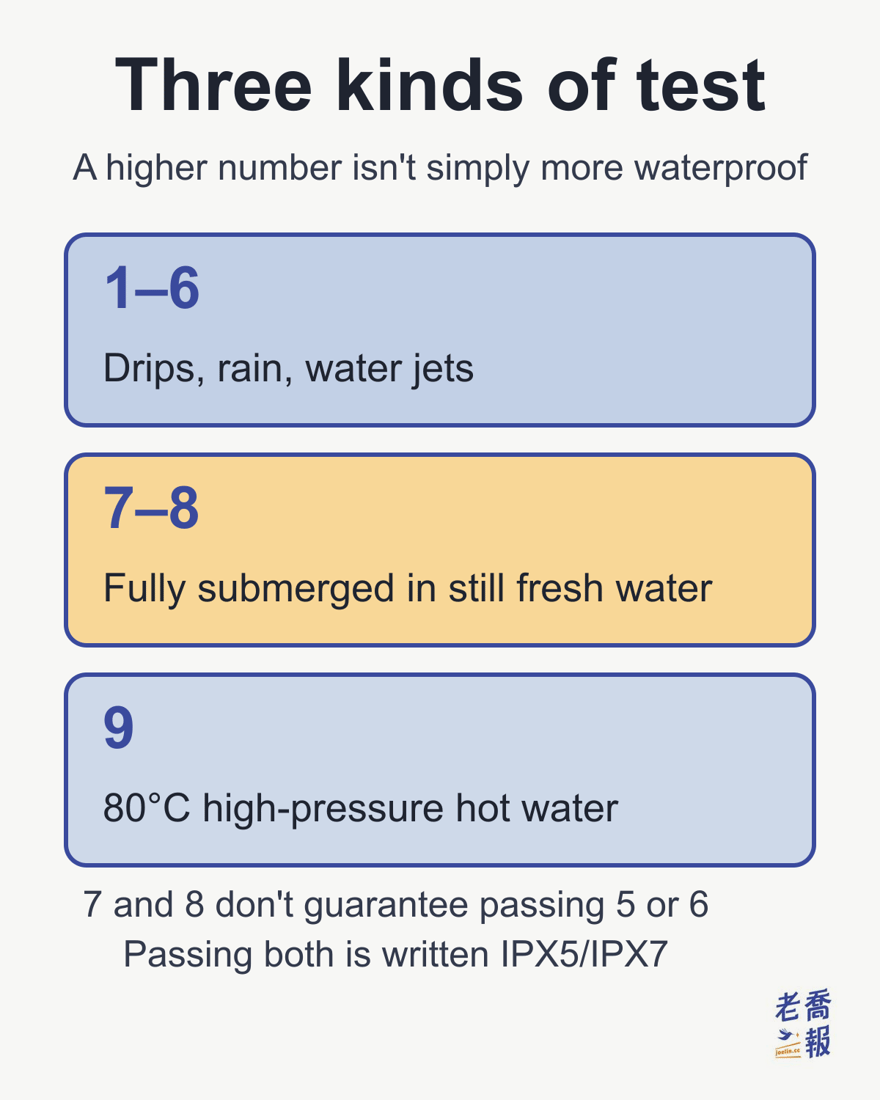
The table shows that the second digit actually covers three kinds of test: 1 to 6 are increasingly strong dripping, spraying and jetting water, like rain or being hit with a hose; 7 and 8 mean the whole device goes under water; 9 is high-pressure hot-water cleaning. The jet tests for levels 5 and 6 are both done from 3 m away for at least 3 minutes, and the water flow for level 6 is 8× that of level 5. For level 7, the 1 m refers to the lowest point of the enclosure being 1 m below the surface (for taller devices, the highest point is 15 cm below the surface, whichever is deeper). Level 9 was only added to IEC 60529 by the second amendment in 2013: the French standards body AFNOR’s summary of NF EN 60529/A2 states that this amendment adds IPX9 (high-pressure, high-temperature water jets) without changing the existing levels.
The testing body TÜV’s IP testing page describes level 8 as “must be more severe than IPX7” and gives as examples more than 1.5 m or 1 hour; level 9 is 80°C hot water at about 15 litres per minute, sprayed for 30 seconds from each of four directions.
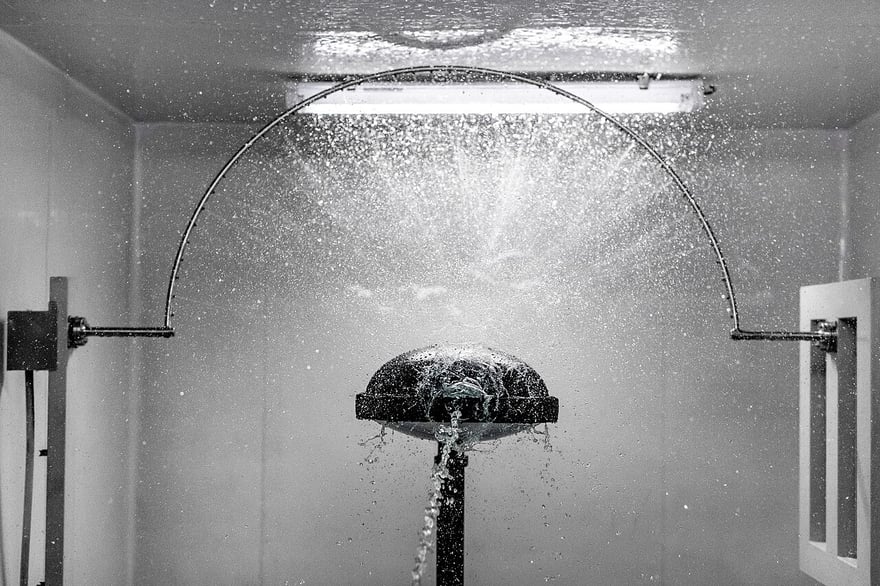
To see what an actual test looks like, take the lab photo below of a light fitting being tested for IP66 certification: a semicircular metal tube with a row of small holes swings back and forth while spraying water onto the fitting. This oscillating tube is the apparatus commonly used for levels 3 and 4. According to the testing lab DLS’s IPX3/IPX4 test explanation, for level 3 the tube swings 60 degrees to each side, like rain falling at a slant; for level 4 this widens to 180 degrees to each side, which amounts to splashing water from every direction.

How deep can IP68 go? The standard only says “more severe than IP67”
This is the most commonly misunderstood point. IP67 has fixed test conditions (1 m, 30 minutes); IP68 does not. The standard only requires it to be more severe than level 7, with depth and duration agreed between manufacturer and user. So IP68 by itself is not a depth; it means “a depth claimed by the manufacturer was passed”.
Using phone makers’ official specs as examples shows how big the gap is. Start with the iPhone that so many people carry: Apple’s iPhone splash, water and dust resistance page lists each generation’s rating under IEC 60529:
| iPhone model |
IP rating |
Official depth (30 min) |
|---|---|---|
| iPhone 12–17 series (incl. 16e, 17e, Air) | IP68 | 6 m |
| iPhone 11 Pro, 11 Pro Max | IP68 | 4 m |
| iPhone 11, XS, XS Max | IP68 | 2 m |
| iPhone 7, 8, X, XR, SE (2nd and 3rd generation) | IP67 | 1 m |
Same company, same IP68: the iPhone 11 is 2 m, the iPhone 12 onward is 6 m, a 3× difference. The earlier iPhone 7 to XR are rated IP67, and their depth is exactly the 1 m of level 7 in the standard. This page does not list models from the iPhone 6s and earlier.
Switch to another maker: Samsung’s official Galaxy phone water resistance page says the IPX8 rating was tested by submerging the device in 1.5 m of fresh water for 30 minutes, kept still, to meet the requirements of IEC 60529.
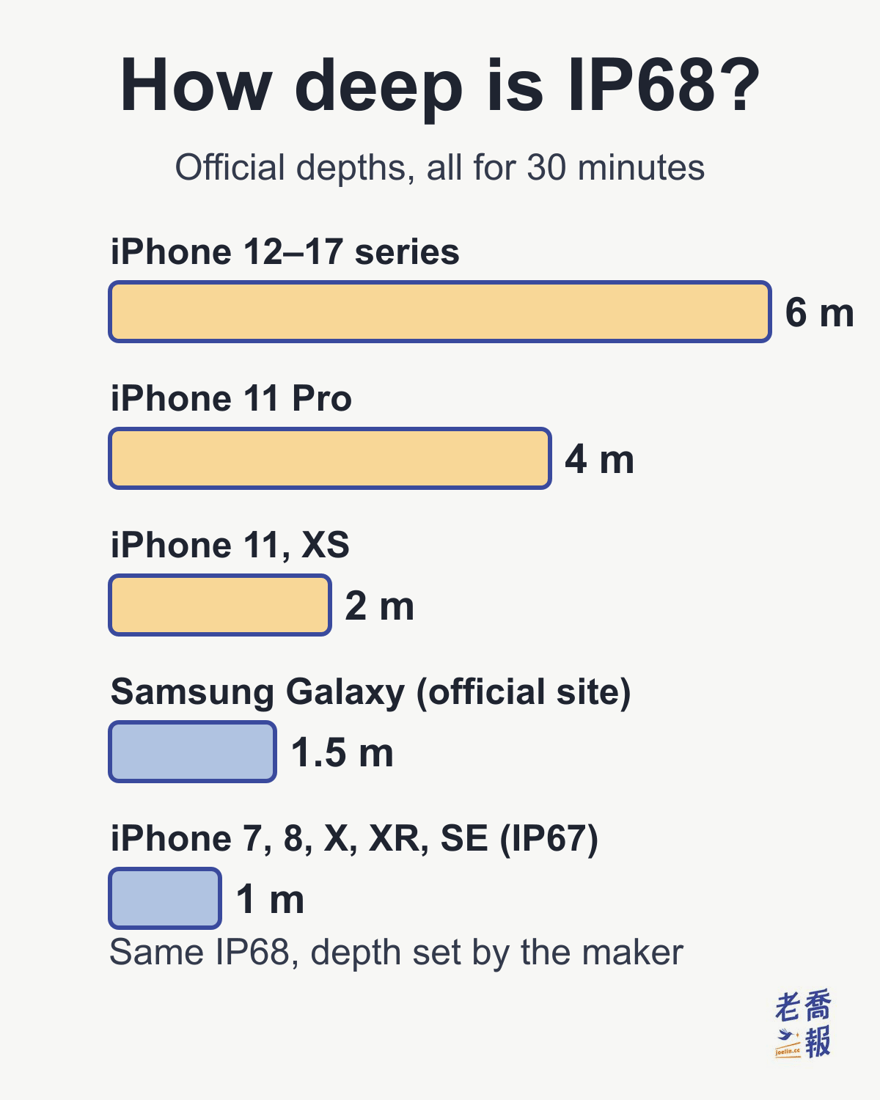
Both are “8”, yet one says 6 m and the other 1.5 m. Neither has got it wrong; the standard simply lets each manufacturer set its own conditions. To know how deep your own device can go, you can only check the official spec or manual for that model; you cannot work it out from the four characters “IP68”.
X means not tested: how to read IPX7, IPX4 and IP48
The X in an IP code is not “zero”; it means “this item was not tested or is not declared”. IPX7 means the water protection reaches level 7, but the manufacturer gives no dust test result; IPX4 only declares protection against water splashed from any direction. Earbuds, watches and older phones often use this style.
There are also cases that declare only partial protection against solids. Samsung’s official support page lists foldables such as the Galaxy Z Fold6 and Flip6 as IP48: the first digit 4 means objects 1 mm and larger are kept out, but it is not a dust level (dust protection needs 5 or higher), while the second digit 8 means continuous immersion. This shows that the two digits are tested and declared separately: good water protection does not mean good dust protection.
One more detail: levels 7 and 8 on the second digit do not guarantee passing the level 5 and 6 jet tests, because sitting in still water and being hit by a jet put different forces on the enclosure. Products that pass both are written with a slash, such as IPX5/IPX7 or IP65/IP67.
IP69K is not “more waterproof”: it comes from an automotive standard and tests high-pressure hot-water cleaning
Many people see IP69K and assume it is a step above IP68 in water resistance, but it actually tests something else. The suffix K is not an IEC 60529 code; it comes from the German automotive standard DIN 40050-9, later taken over by the international standard ISO 20653. According to the ISO website, the current version is ISO 20653:2023 (edition 3, published in August 2023, replacing the 2013 edition), titled “Road vehicles — Degrees of protection (IP code) — Protection of electrical equipment against foreign objects, water and access”.
According to the enclosure maker ROLEC’s DIN 40050-9 IP69K test explanation, the 9K test uses a fan-jet nozzle 10 to 15 cm away, with 80°C (±5°C) hot water at a pressure of 8,000 to 10,000 kPa and 14 to 16 litres per minute, spraying for 30 seconds from each of four angles (0°, 30°, 60° and 90°) while the test object rotates on a turntable. It simulates trucks and food-plant equipment being cleaned with a pressure washer.
The IPX9 added to IEC 60529 in 2013 is also an 80°C high-pressure hot-water jet, with conditions close to 9K, but the two come from different standards. Whether IP69 or IP69K, both test “does water get in when it is blasted with high-pressure hot water”, which is a different test from IP68’s “does water get in when it sits under water”; a device rated IP69 has not necessarily passed IP68. Some products pass both, and then list them together as IP68/IP69.
Water-resistant does not mean seawater-, hot-water- or pool-proof, and it ages
The immersion test behind IP ratings uses fresh water, and still water at that. That means several everyday situations are actually outside the test:
- Seawater contains salt and pool water contains chlorine. Samsung’s official support page explicitly says not to expose the phone to salt water, pool water, soapy water, perfume, sunscreen or liquids containing alcohol.
- Hot water and steam are also outside the test. Samsung warns against using the phone in places with abnormal temperatures or high humidity, such as saunas and steam rooms; Apple also lists not using an iPhone in a sauna or steam room.
- Water with pressure or speed is not part of the immersion test either. Apple gives showering, water skiing and jet skiing as examples to avoid, and says not to swim or bathe with an iPhone.
The other issue is ageing. Apple’s guidance states that splash, water and dust resistance “are not permanent conditions” and may decrease as a result of normal wear, and that liquid damage is not covered by the warranty; Samsung’s official support page likewise says the water resistance of Galaxy phones is not permanent and may weaken naturally over time or through normal wear and tear. For a device that has been dropped, opened, or had its battery or screen replaced, the original seal is even harder to vouch for.
What people usually ask: phones, watches, earbuds, outdoor sockets
My phone is rated IP68. Can I take underwater photos?
The standard only guarantees that no water gets in within the depth and duration declared by the manufacturer, in still fresh water. Pressing the screen and moving the phone underwater both change the water pressure, and the beach and the pool add a different kind of water. Apple’s guidance is even more direct: it lists “intentionally submerging iPhone in water” among the things to avoid, and Samsung does not list underwater photography as a recommended use either. The safest reading is “if it falls in by accident, you can fish it out and it still works”, not “you can take it into the water”.
What to do if your iPhone falls in water or gets a drink spilled on it
Following Apple’s official guidance: if it gets a liquid other than plain water on it (a drink, for example), first rinse the affected area with tap water, then wipe it dry with a soft, lint-free cloth. Next, unplug all cables, tap the phone gently with the connector facing down, and leave it in a dry place with some airflow; you can point a fan blowing cool air at the connector. Do not use an external heat source such as a hair dryer, and do not push cotton swabs or paper towels into the connector.
The most important number is 5 hours: wait at least 5 hours before charging with a Lightning or USB-C cable or connecting an accessory; if you want to use wireless charging, wipe the phone first and make sure it is dry. From the iPhone XS and XR onward, the phone shows an alert if there is liquid in the connector when you plug in a cable; if you see it, dry the phone as described above first. Also wait until the phone is dry before opening the SIM tray.
My watch says “water resistant 50 m”. Is that the same as IP68?
No. Most watches use a water-resistance standard specific to watches rather than the IP code. Take Apple’s Apple Watch water resistance page as an example: the original Apple Watch and Series 1 were rated IPX7 under IEC 60529; from Series 2 onward they are rated water resistant to 50 m under the watch standard ISO 22810:2010, and the Ultra models to 100 m; for dust, Series 7 and later are rated IP6X. Apple likewise stresses that this is “water resistant”, not “waterproof”: do not use it in a steam room, keep it away from soapy water, and its water resistance may diminish over time and cannot be rechecked or resealed. The “50 m” on a watch also does not mean you can dive to 50 m; what it can be used for depends on the manufacturer’s guidance.
Earbuds rated IPX4, IP54 or IP57: what’s the difference?
Take Apple’s AirPods sweat and water resistance page as an example: the first-generation AirPods Pro are IPX4, declaring only splash resistance and no dust rating; AirPods Pro 2 (USB-C charging case) are IP54, adding dust protection at level 5; AirPods Pro 3 are IP57 and can withstand 1 m of water for up to 30 minutes. Apple also states that they are sweat- and water-resistant but not waterproof, not meant for swimming or showering, and that their resistance may diminish over time. In other words, IPX4 earbuds are fine for sweaty workouts and light rain, but you cannot treat them as a device that can go in water.
What to look for in outdoor sockets and outdoor lights
The enclosures of outdoor electrical equipment are marked with the same IP code, and you read it the same way as on a phone. The standard itself does not say “outdoors must be level X”. The more practical approach is to think about what kind of water the installation spot will get, then match it to the test conditions of the second digit:
| Where it is installed |
Water it will get |
Matching second digit |
|---|---|---|
| Under eaves, occasionally splashed by rain | Splashing | 4 (splashing from all directions) |
| In the open, hit directly by slanting rain | Rain, splashing | 4 or higher |
| Hosed down (garden, car-wash area) | Water jets | 5 or 6 |
| On the ground where water may pool | Immersion | 7 or higher |
This table maps installation locations to the IEC 60529 test conditions; it is not a legally required minimum. Levels 7 and 8 test immersion for a limited time, so for a spot that will stay under water for long periods, check whether the manufacturer states it can be used that way. Also, IP ratings are tested in the condition the manufacturer specifies, such as whether the waterproof cover is closed and the mounting orientation and position, so follow the conditions of use in the manual. Installing sockets and light fittings also involves electrical safety: have it done by a qualified electrician, following local rules, rather than going by the IP number alone.
Keywords: IP68, iPhone water resistance, IP67, IPX7, IPX4, IP69K, waterproof rating, dust rating, IEC 60529, ISO 20653, IP code, phone water resistance, water-resistant watch, earbuds water resistance
Frequently asked questions
How deep and how long can an IP68 device stay underwater?
IEC 60529 does not set a fixed depth for IP68. It only requires the level 8 immersion conditions to be more severe than level 7 (1 m of water for 30 minutes); the actual depth and duration are set by the manufacturer. So you have to check the official spec for your device: for example, Apple states 6 m for 30 minutes for the iPhone 12 to 17 series and 2 m for 30 minutes for the iPhone 11, while Samsung’s official support page states 1.5 m of fresh water, kept still, for 30 minutes.
What is the difference between IP67 and IP68?
Both have 6 as the first digit, meaning dust-tight; the difference is the second digit. 7 is a fixed test of immersion in 1 m of water for 30 minutes, while 8 is continuous immersion that is more severe than 7, with conditions set by the manufacturer. IP68 only guarantees something stricter than IP67, not a particular depth: two phones both rated IP68 may say 1.5 m and 6 m respectively.
What does the X in IPX7 mean?
X means that item was not tested or the manufacturer does not declare it. IPX7 means the first digit (dust) is not declared and the second digit (water) reaches level 7. It does not mean the device has no dust protection at all, only that no test result is given, so you cannot treat it as dust-protected when you buy it.
Is IP69K more waterproof than IP68?
No. The K in IP69K comes from the automotive standards DIN 40050-9 and ISO 20653, and the test is a jet wash with 80°C hot water at 8,000 to 10,000 kPa from 10 to 15 cm away, aimed at equipment that gets cleaned with a pressure washer. It is a different kind of test from IP68 immersion: a device rated IP69 has not necessarily passed IP68, and products that pass both list both ratings.
Can I take an IP68 phone swimming, into a hot spring or into the shower?
The manufacturers advise against it. The immersion test behind IP ratings uses still fresh water. Samsung’s official support page explicitly says not to expose the phone to salt water, pool water or soapy water, and not to use it in saunas or steam rooms; Apple also says not to swim or bathe with an iPhone, to avoid high-pressure or high-velocity water and steam rooms, and that liquid damage is not covered by the warranty.
My iPhone fell in water. How long before I can charge it?
Apple’s official guidance: unplug all cables, tap the phone gently with the connector facing down, and leave it to dry in a dry place with some airflow; wait at least 5 hours before charging with a Lightning or USB-C cable or connecting an accessory. Do not use an external heat source such as a hair dryer, and do not push cotton swabs or paper towels into the connector. From the iPhone XS and XR onward, the phone shows an alert if there is liquid in the connector when you plug in a cable.
Is a water-resistant phone still water-resistant after years of use?
Not necessarily. Both Apple and Samsung state in their official guidance that water and dust resistance are not permanent conditions and may decline with normal use and wear; for a phone that has been dropped, opened or had its battery replaced, it is even harder to say. Apple also states that Apple Watch and AirPods cannot be rechecked or resealed for water resistance.
Sources: Chinese original first published 2026-10-27; standards and manufacturer specs as checked in October 2026.
This English version is based on original Traditional Chinese content on joelin.cc. The language and explanations are localised for international readers. The Traditional Chinese original is the authoritative version — for its complete meaning, please read the original article.