
This article is also available in: 繁體中文 · 日本語 · 한국어 · Bahasa Indonesia · Bahasa Melayu · ไทย · Português (Brasil) · Español · Türkçe · Tiếng Việt · Deutsch · हिन्दी
Contents (13)
From smallest to largest: A6 (10.5 × 14.8 cm) → B6 (12.8 × 18.2 cm) → A5 (14.8 × 21 cm) → B5 (18.2 × 25.7 cm), followed by A4. B6 and B5 here use JIS.
When choosing a notebook or planner, the real difficulty is often which size is larger and how much larger. A and B numbers do not form one simple numerical sequence. This guide compares them; individual size guides cover their full specifications.
The sizes at a glance
| Size | cm |
|---|---|
| A6 | 10.5 × 14.8 |
| B6 · JIS | 12.8 × 18.2 |
| A5 | 14.8 × 21 |
| B5 · JIS | 18.2 × 25.7 |
| A4 | 21 × 29.7 |
A6 is the smallest of these four notebook sizes, and B5 the largest. A4 is included as a familiar reference.
| Size | Area: A6 = 1 | Area vs previous |
|---|---|---|
| A6 | 1 | — |
| B6 · JIS | ≈ 1.5 | ≈ 1.5 × A6 |
| A5 | 2 | ≈ 1.33 × B6 |
| B5 · JIS | ≈ 3 | ≈ 1.5 × A5 |
| A4 | ≈ 4 | ≈ 1.33 × B5 |
A and B sizes alternate. Each step has about 1.3–1.5 times the area of the previous size. A5 has twice the area of A6, and A4 about four times; B6 and B5 sit between them. The listed ratios are approximate because dimensions are rounded to whole millimetres.
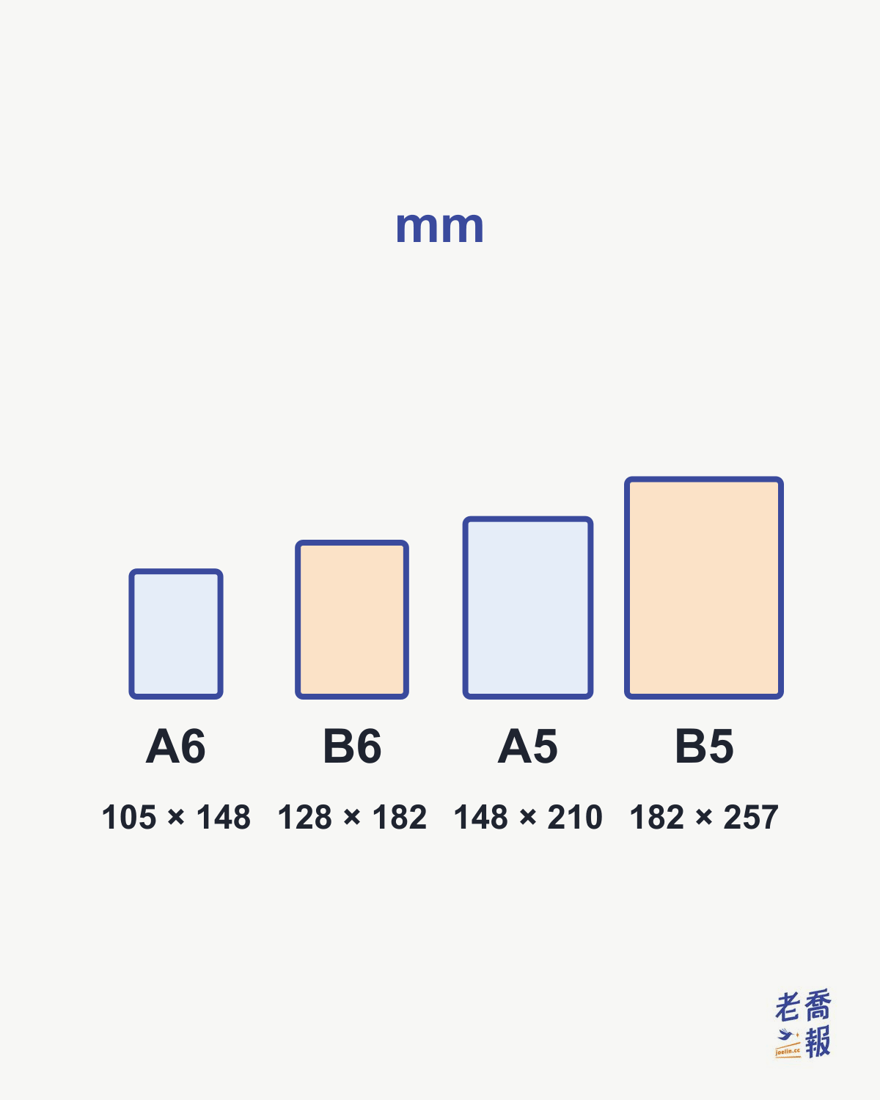
Four useful comparisons
A5 and A6: A6 is half of A5
Folding A5 in half gives A6. The long side of A6, 14.8 cm, is the short side of A5. The relationship follows the paper-size series; dimensions are rounded to whole millimetres.
A5 and B6: B6 is 2 cm narrower and 2.8 cm shorter
JIS B6 (12.8 × 18.2 cm) is smaller than A5 (14.8 × 21 cm), with about three quarters of its area. It is more compact in the hand while offering about 50% more writing space than A6.
A6 and B6: B6 is 2.3 cm wider and 3.4 cm taller
JIS B6 has about 1.5 times the area of A6. It fills the gap if A6 feels cramped but you do not want to carry A5.
A5 and B5: B5 is 3.4 cm wider and 4.7 cm taller
JIS B5 has about 1.5 times the area of A5 and is smaller than A4. It is the most common student-notebook size in Taiwan. Compared with A4 (21 × 29.7 cm), it is 2.8 cm narrower and 4 cm shorter, with about three quarters of A4’s area.
Why A and B sizes alternate
Both series use the rule that halving a sheet gives the next number, with a theoretical aspect ratio of 1:√2. Their starting points differ. In Japanese JIS, the B area is about 1.5 times the same-numbered A area, placing B6 between A6 and A5, and B5 between A5 and A4. Folding B5 in half gives B6, subject to whole-millimetre rounding.
Taiwanese notebooks and planners commonly use JIS: B6 is 12.8 × 18.2 cm and B5 is 18.2 × 25.7 cm. ISO B6 is 12.5 × 17.6 cm and ISO B5 is 17.6 × 25 cm. ISO sizes are slightly smaller. Check the actual dimensions when buying a cover or refill from another market; a matching B label alone does not guarantee a fit.
Choosing a notebook or planner
- A6: for a line or two of notes each day and easy carrying. It is the size of a Japanese bunko paperback and fits many coat pockets.
- B6: for more writing space than A6 while remaining manageable in one hand.
- A5: for a full page each day, ticket stubs or photos. In Taiwan, A5 offers the widest choice of planners among these sizes.
- B5: for class notes, diagrams and attaching handouts.
A4 is the reference size for documents and copier paper.
Related size guides: A6 · B6 · A5 · B5 · A4.
Questions
Which is larger, A5 or A6?
A5 is larger: 14.8 × 21 cm versus 10.5 × 14.8 cm. A6 corresponds to A5 folded in half, with whole-millimetre rounding.
Which is larger, B6 or A5?
A5 is larger. JIS B6 is 12.8 × 18.2 cm, 2 cm narrower and 2.8 cm shorter than A5 (14.8 × 21 cm), with about three quarters of its area.
What is the order from smallest to largest?
A6 (10.5 × 14.8 cm) → JIS B6 (12.8 × 18.2 cm) → A5 (14.8 × 21 cm) → JIS B5 (18.2 × 25.7 cm) → A4 (21 × 29.7 cm). The A and B series alternate.
How much smaller is B5 than A4?
JIS B5 is 18.2 × 25.7 cm, 2.8 cm narrower and 4 cm shorter than A4 (21 × 29.7 cm). It has about three quarters of A4’s area.
Sources: B6 and B5 use Japanese JIS dimensions, as commonly used in Taiwan. ISO alternatives are listed separately. Stationery-use examples come from the Taiwanese context of the original article.
This English version is based on original Traditional Chinese content on joelin.cc. The language and explanations are localised for international readers. The Traditional Chinese original is the authoritative version — for its complete meaning, please read the original article.