This article is also available in: 繁體中文 · 한국어 · Bahasa Indonesia · Bahasa Melayu · ไทย · Português (Brasil) · Español · Türkçe · Tiếng Việt · Deutsch · हिन्दी
Contents (11)
B5 has two official sizes: ISO B5 is 17.6 × 25 cm; JIS B5 is 18.2 × 25.7 cm. In Taiwan, notebooks and school handouts labelled B5 generally use the Japanese JIS size.
You may be checking how a notebook compares with A4 and A5, or preparing a booklet and wondering why two different B5 measurements appear. Both measurements are valid: the name alone does not identify the standard.
B5 dimensions: ISO and JIS
| Standard | cm | mm |
|---|---|---|
| ISO | 17.6 × 25 | 176 × 250 |
| JIS | 18.2 × 25.7 | 182 × 257 |
ISO B5 is used in international printing and some European stationery; JIS B5 is used in Japanese publishing and stationery and is prevalent in Taiwan’s notebook market. These market examples do not mean every notebook sold elsewhere follows JIS.
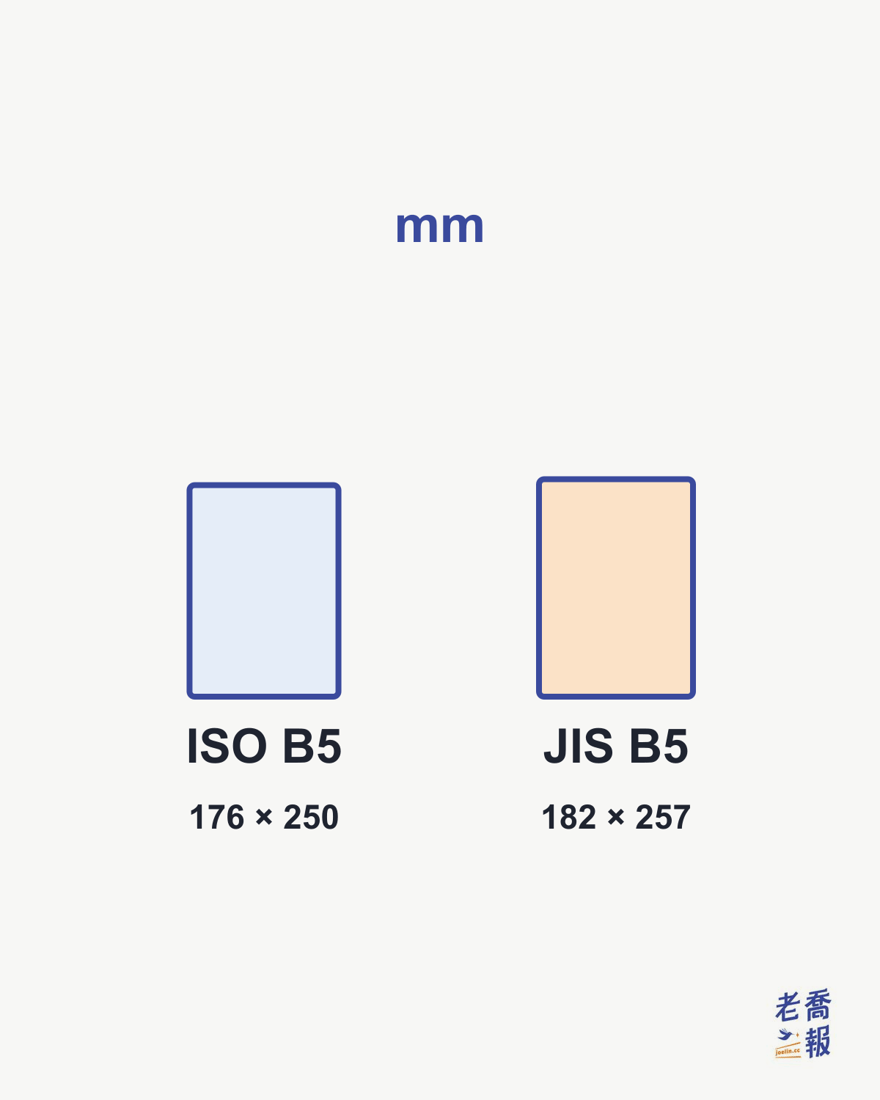
The difference starts at B0: JIS B0 has a theoretical area of 1.5 m², while ISO B0 has an area of √2 m². The Japanese B series is therefore slightly larger. A Taiwanese notebook measuring 182 × 257 mm has not been measured incorrectly: it is the JIS version.
Between A4 and A5
| Size | cm | Area vs JIS B5 |
|---|---|---|
| A4 | 21 × 29.7 | About 33% larger |
| JIS B5 | 18.2 × 25.7 | Reference |
| ISO B5 | 17.6 × 25 | About 6% smaller |
| A5 | 14.8 × 21 | About 33% smaller |
The order is A5 < ISO B5 < JIS B5 < A4. JIS B5 is about 25% smaller than A4 when A4 is the denominator; reversing the comparison makes A4 about 33% larger than JIS B5. JIS B5 is also about 50% larger than A5. These percentages compare area, not edge length.
B5 offers more writing space than A5 while taking up less room in a bag than A4. This explains its role as a notebook format in the Taiwanese context of the original article. The B series fills intermediate sizes between neighbouring A formats, as B6 does between A6 and A5.
Fold to B6; combine to B4
- Folding JIS B5 in half gives the nominal JIS B6 format, 12.8 × 18.2 cm, used for planners.
- Two JIS B5 sheets side by side correspond to JIS B4, 25.7 × 36.4 cm, used for larger exam sheets and reports in Taiwan.
- The B series, like the A series, uses the theoretical 1:√2 aspect ratio. ISO and JIS dimensions must remain within their own series.
Standard dimensions are rounded to whole millimetres, so folding is a way to understand the format family, not a precision cutting specification.
How many pixels for a B5 print?
Use: millimetres ÷ 25.4 × DPI. The following values are rounded to whole pixels.
| DPI | ISO B5, px | JIS B5, px |
|---|---|---|
| 300 | 2079 × 2953 | 2150 × 3035 |
| 150 | 1039 × 1476 | 1075 × 1518 |
At 300 DPI, ISO B5 needs 2079 × 2953 pixels and JIS B5 needs 2150 × 3035. Confirm the standard before preparing artwork. For printing or custom stationery, state 176 × 250 mm or 182 × 257 mm explicitly rather than ordering only “B5”.
Further reading: A4, A5, B6, B4 and pixels and DPI (Chinese).
Frequently asked questions
How big is B5 in centimetres?
ISO B5 is 17.6 × 25 cm; JIS B5 is 18.2 × 25.7 cm. Notebooks and school handouts in Taiwan generally use JIS.
Which B5 size do notebooks use?
In the Taiwanese notebook market described here, JIS B5 (182 × 257 mm) is prevalent because of Japanese stationery and publishing supply chains. Check the measurements when buying elsewhere.
Is B5 bigger than A4?
No. A4 is 21 × 29.7 cm and has about 33% more area than JIS B5. Conversely, JIS B5 has about 25% less area than A4.
Is B5 bigger than A5?
Yes. JIS B5 has about 50% more area than A5 (14.8 × 21 cm). A5 or B6 is more suitable when you want a smaller format.
How many pixels does B5 need at 300 DPI?
ISO B5 needs 2079 × 2953 px; JIS B5 needs 2150 × 3035 px. Confirm the exact millimetre dimensions with the printer.
What is the relationship between B5 and B6?
Folding B5 in half gives the nominal B6 format in the same standard. JIS B6 is 128 × 182 mm; two JIS B5 sheets correspond to JIS B4. Whole-millimetre rounding can cause small differences.
Sources: First published in Chinese on 17 August 2026; revised on 30 October 2026. Notebook and school-handout examples refer to Taiwan.
This English version is based on original Traditional Chinese content on joelin.cc. The language and explanations are localised for international readers. The Traditional Chinese original is the authoritative version — for its complete meaning, please read the original article.