
This article is also available in:繁體中文
If you take an ID photo in a booth on a street in Europe or North America, there is a good chance you are stepping into a machine operated by the same company: the UK-listed ME Group, formerly Photo-Me International. It has 30,520 photo booths across 16 countries, and the Photomaton booths on French streets are one of its brands. Among the European and American photo booth operators I could find for this site, it has the most machines and is the only listed company. But something is happening here that few people have noticed: its self-service laundry machines are becoming increasingly profitable. In the first half of FY2026, laundry EBITDA—earnings before machine depreciation—exceeded photo booth EBITDA for the first time. Laundry machines are expensive, however, and carry substantial depreciation. After depreciation, photo booths remain its most profitable business.
This is an in-depth listed-company study in the photo booth industry research series, following the same approach as the article on Japan’s FURYU: using only the company’s own annual reports, results announcements, and stock exchange announcements, with the year and measurement basis specified for each figure. It answers five questions:
- Where did ME Group come from, and how is it related to France’s Photomaton?
- How does it make money, and how much does each of its four businesses earn?
- What has happened to its core photo booth business over the past decade, and why does a change in government rules reduce its revenue?
- What does it do in Japan?
- Why did it try to sell itself in 2025, and why did the sale fail?
The broader history of European and American photo booths, beginning on New York’s Broadway in 1925, is covered separately in A Century of Photo Booths in Europe and America. This article focuses on this company alone.
1. Company Background: Photo-Me in 1954, a French Connection in 1994
ME Group’s predecessor, Photo-Me, opened its first UK photo booth in 1954, according to the company’s official history. It listed on the London Stock Exchange in 1962 and has now been publicly traded for more than sixty years. In August 2022, it changed its name to ME Group International and its ticker from PHTM to MEGP. In June 2023, it joined the FTSE 250, the UK’s mid-cap stock index.
Today, nearly 70% of this British company’s revenue comes from Continental Europe, and its largest subsidiary is in France. That story begins in 1994, when Photo-Me merged with KIS, an instant photo-processing equipment company based in Grenoble, France, according to the company’s official history. Corporate history sources indicate that KIS founder Serge Crasnianski became the largest shareholder as a result. He became CEO in 2009 and has remained in the role ever since. KIS is now the group’s research, development, and manufacturing center.
Its 30,520 photo booths are distributed across 16 countries, listed explicitly in the 2025 annual report: Australia, Austria, Belgium, China, Finland, France, Germany, Ireland, Japan, Luxembourg, the Netherlands, Portugal, Singapore, Spain, Switzerland, and the UK. The annual report discloses figures only for three broad regions, without individual country counts. In FY2025, photo booth vending revenue was £107.9 million in Continental Europe, £43.2 million in Asia-Pacific, primarily Japan, and £15.1 million in the UK and Ireland. On its own website, France’s Photomaton states that it has more than 10,000 photo booths in France, prints 13 million photos a year, and has 90% brand awareness. These are company claims, without third-party verification.
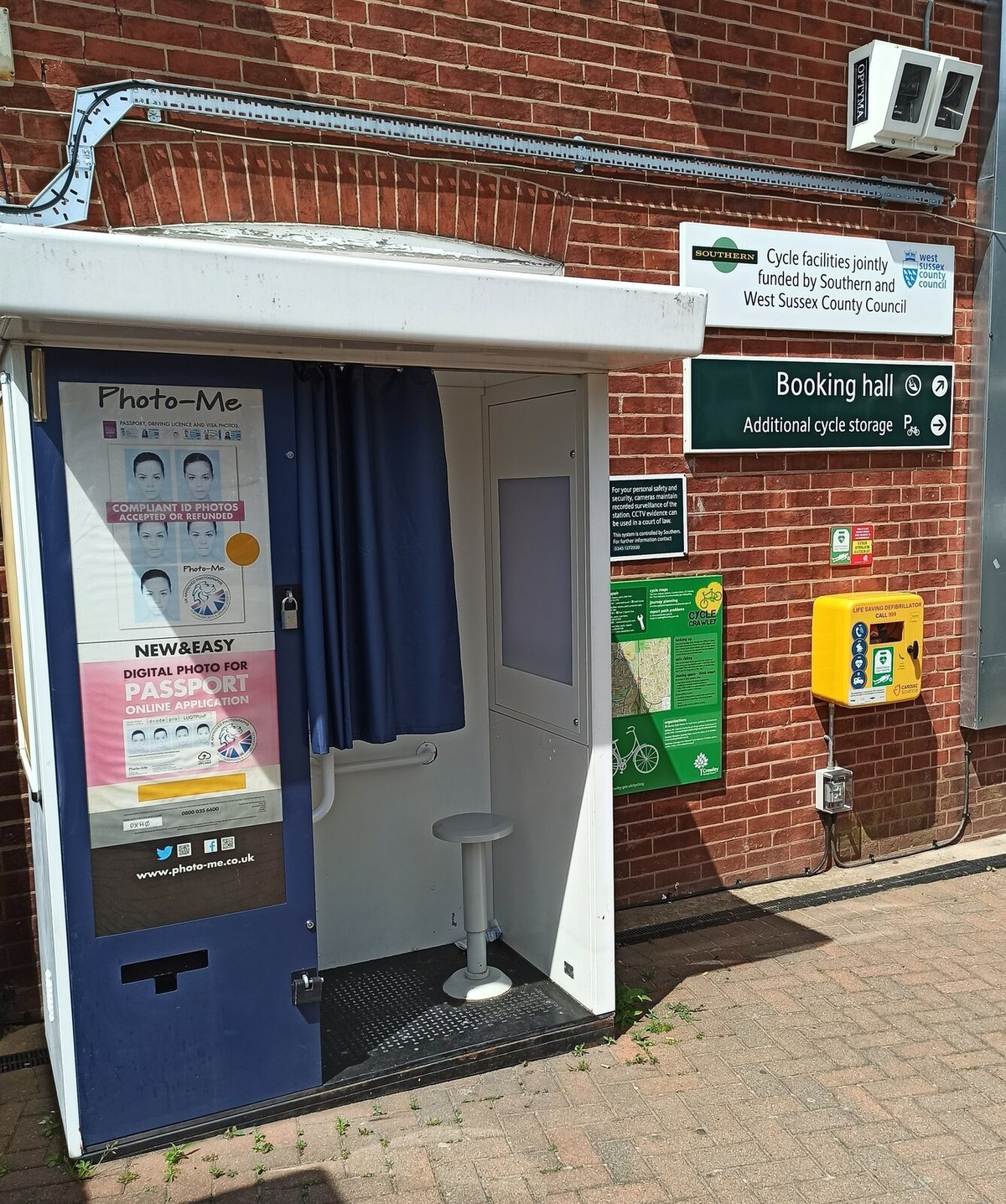
A Photo-Me ID photo booth at Three Bridges railway station in West Sussex, UK, in June 2022. A station location and a focus on passport photos are typical of ME Group’s UK operation. Photo: Thomas Nugent, CC BY-SA 2.0, original image.
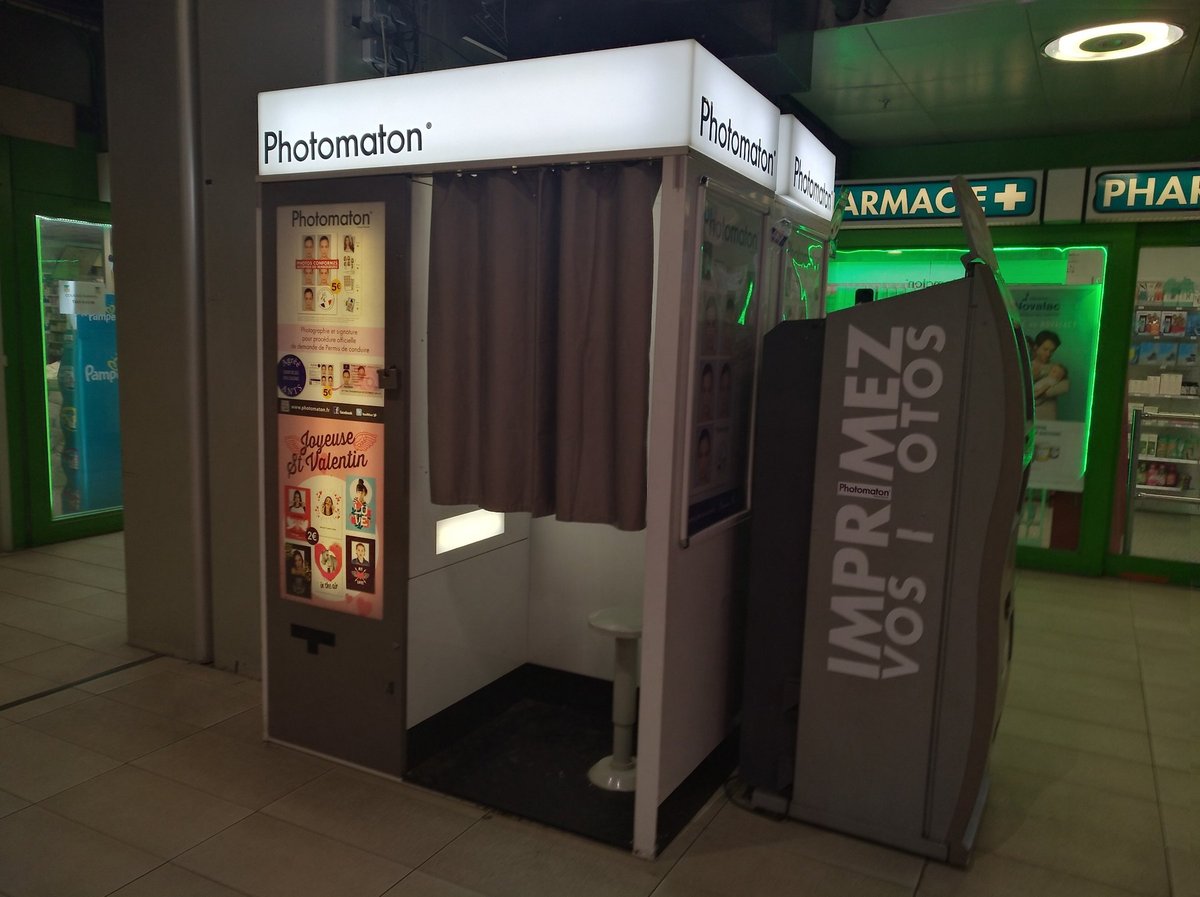
A Photomaton photo booth, left, and photo-printing machine, right, at the Perrache transport interchange in Lyon, France, in March 2019. Photo: Sebleouf, CC BY-SA 4.0, original image.
France’s Photomaton is the group’s largest subsidiary, according to the group’s March 2026 announcement appointing a chief operating officer. I could not find when or how it joined the group in the company’s documents. The frequently cited year “1998” actually corresponds to Photo-Me’s acquisition of Prontophot and Soft from Switzerland’s Fotolabo group that year, according to secondary sources. The names in that transaction were not Photomaton, so this article does not present 1998 as an established fact.
2. Photo Booths Still Earn the Most, but Laundry Is Catching Up
ME Group now has four businesses. The figures for FY2025, ended October 2025, are as follows:
| Business | Machine count | Revenue (£) | EBITDA (£) | Depreciation and amortization (£) | Operating profit (£) | Operating margin |
|---|---|---|---|---|---|---|
| Photo.ME photo booths | 30,520 | 168.6 million | 59.3 million | 10.8 million | 48.5 million | 28.8% |
| Wash.ME self-service laundry | 7,607 | 112.4 million | 55.5 million | 22.3 million | 33.2 million | 29.5% |
| Print.ME photo-printing kiosks | 4,515 | 11.1 million | 6.2 million | 3.0 million | 3.3 million | 29.4% |
| Other vending machines: juice machines, pizza machines, children’s rides, and photocopiers | 6,562 | 23.3 million | 8.0 million | 5.1 million | 2.9 million | 12.3% |
| Corporate overhead | — | — | -8.6 million | 1.1 million | -9.7 million | — |
| Group | 49,204 | 315.4 million | 120.4 million | 42.3 million | 78.1 million | 24.8% |
Source: the “by product segment” table in ME Group’s 2025 annual report. Operating margins were calculated by this site as operating profit divided by revenue.
First, it helps to distinguish these profit measures, because the story of this company changes depending on which one you use:
- EBITDA: revenue minus operating costs—site commissions, consumables, staff, and maintenance—but before machine depreciation and amortization, interest, and tax. It is closer to “how much cash the machines bring back to the company each year.”
- Operating profit: EBITDA minus depreciation and amortization. The more expensive the machines and the heavier the depreciation, the larger the gap between the two.
- Net profit: operating profit after interest and income tax, the earnings ultimately available to shareholders. ME Group’s FY2025 group net profit was £56.6 million, with a net margin of approximately 17.9%.
- Gross profit: revenue minus cost of sales. ME Group discloses this only at group level. In FY2025, group revenue was £315.4 million and cost of sales £202.4 million, giving gross profit of approximately £113.0 million and a gross margin of approximately 35.8%, calculated by this site. The annual report does not break out gross profit by business.
Thus, the statement that “about £35 remains from every £100 of revenue” refers to EBITDA, not net profit. On EBITDA, laundry’s 49.4% margin is far higher than photo booths’ 35.2%. But a laundry kiosk contains large commercial washing machines and dryers, and annual depreciation for the laundry business is £22.3 million, twice that of photo booths. Per unit, annual depreciation is approximately £2,900 for a laundry kiosk and £350 for a photo booth, calculated by this site. After depreciation, their operating margins are almost the same—29.5% versus 28.8%—and because photo booth revenue is larger, its operating profit remains £15 million higher.
In the first half of FY2026, covering November 2025 through April 2026, the crossover occurred at the EBITDA level:
- Self-service laundry EBITDA was £30.7 million, up 20.9% year on year.
- Photo booth EBITDA was £27.2 million, down 8.1% year on year.
This was the first time it had happened since ME Group began publishing EBITDA for each business. However, the interim report did not disclose depreciation or operating profit by business. Applying FY2025 depreciation levels as an estimate—approximately £11 million per half-year for laundry and £5.4 million for photo booths—photo booth operating profit in the first half would probably still have been approximately £2 million to £3 million higher than laundry’s. This is this site’s estimate, not a company figure. The more accurate statement is that laundry has overtaken photo booths in cash earnings, remains slightly behind after depreciation, and is rapidly closing that gap at its current growth rate.
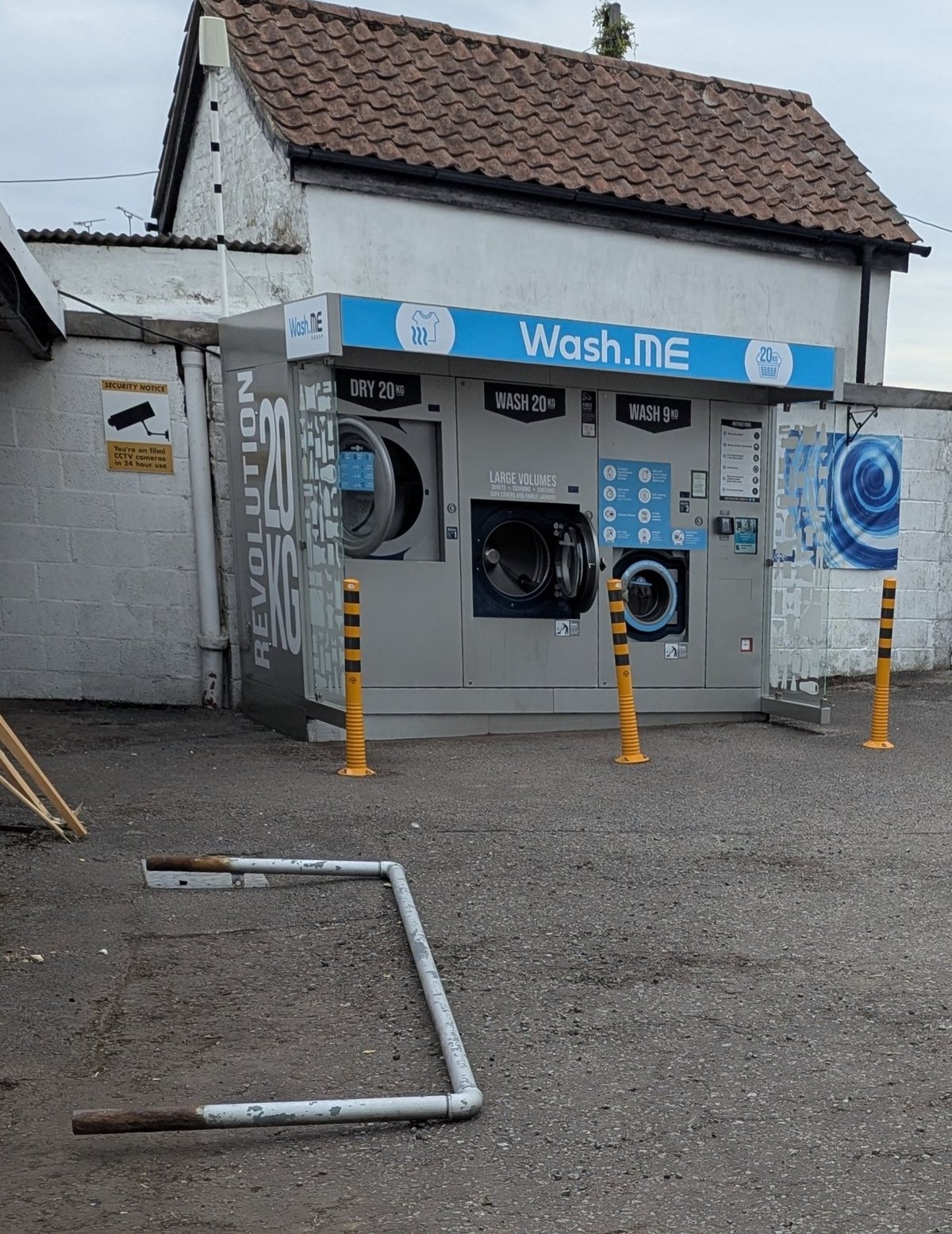
A Wash.ME self-service laundry kiosk in Raglan, Wales, UK, in July 2025. The commercial washing machines have capacities of up to 20 kg. The annual report gives examples such as duvets and horse blankets that will not fit in a domestic washing machine. A laundry kiosk costs far more to build and carries much more depreciation than a photo booth. Photo: Jaggery, CC BY-SA 2.0, original image.
Something similar has already happened in Japan. In FURYU’s purikura business, cloud membership revenue exceeded revenue from machines and consumables sold to arcades for the first time in the fiscal year ended March 2026; see the FURYU company study. Both companies still have their original businesses, but their main sources of growth have shifted to something else.
3. How It Makes Money: It Owns the Machines and Pays the Sites a Share
ME Group describes its business model in its annual report as operating most of its machines itself and paying site owners a percentage of turnover, a fixed rent, or a combination of both.
In other words, the payment for each photo session belongs to ME Group. Supermarkets, stations, government offices, and shopping centers simply rent it a corner. Its own KIS operation develops and manufactures the machines, and its own engineering network maintains them. This differs from all three other benchmark companies covered on this site:
- Japan’s FURYU is a supplier. It sells purikura machines to arcades, which collect customers’ payments. FURYU earns recurring revenue from sticker consumables and cloud memberships.
- Korea’s Seobuk, which operates Photoism, and LK Ventures, which operates Life4Cuts, are franchisors. The machines belong to the franchisees who open the stores.
- ME Group handles everything itself: machines, site contracts, payment collection, and maintenance.
The company publishes annual revenue per machine each year. These are the FY2025 figures, excluding VAT:
| Machine type | Annual revenue per unit (£) |
|---|---|
| Revolution self-service laundry kiosk | 14,329 |
| Photo.ME photo booth | 5,437 |
| Print.ME photo-printing kiosk | 2,389 |
One laundry kiosk brings in approximately as much annual revenue as 2.6 photo booths. Both rent a corner of a supermarket or car park, but placing a laundry kiosk there generates more than 150% more revenue than placing a photo booth. That is the arithmetic behind its aggressive laundry expansion in recent years. This is this site’s inference; the company’s description is that laundry and photo booths are its two core businesses.
What Is the Difference Between a Photo Booth and a Photo-Printing Kiosk?
The names sound similar, but they do two different things:
- Photo.ME photo booth: you sit inside, the machine takes your picture, and it prints the photos immediately. Its main business is ID photos for passports, identity cards, and driving licenses. The machines have built-in specifications for different countries’ ID photos, based on ICAO and ISO standards. Machines in the UK and France can also send digital photos directly to government application systems. They also take souvenir photos. From 2025, they added AI fun photos, with digital files available by scanning a QR code, and introduced themed photos in collaboration with Paris Saint-Germain football club, PSG.
- Print.ME photo-printing kiosk: it has no camera. It is a machine that lets you print photos from your phone, located in supermarkets and shopping centers, and offers photo prints, photo books, and collages. It is an ancillary ME Group business, with 4,515 machines in nine countries. Each generates £2,389 a year, less than half the revenue of a photo booth. In France, older machines are being replaced with a smaller new model, Speedlab.
How Many Sessions Does One Photo Booth Handle per Day?
The company does not publish session counts or print volumes, only annual revenue per unit. A rough estimate can be made from that figure: FY2025 revenue per booth of £5,437 is approximately €6,300. An ID photo session costs €8 in France and €10 in Germany, following the 2022 price increases. That works out to approximately 630 to 790 sessions per booth per year, or about two per day on average. This is this site’s estimate; actual figures also depend on exchange rates, prices in different countries, and the mix of souvenir photo packages. For comparison, Photomaton France’s self-reported annual volume of 13 million photos across more than 10,000 booths works out to roughly a thousand-plus photos per booth per year, the same order of magnitude as the estimate above. However, one session often produces more than one print, and that figure may also include prints from photo-printing kiosks, so it is only a reference point.
4. The Core Photo Booth Business: Flat Numbers, Falling Revenue per Unit
Start with the booth count: 27,867 in FY2021 and 27,625 in FY2022. The acquisition of Fujifilm’s Japanese photo booth business pushed it up to 30,762 in FY2023, followed by 30,613 and 30,520 in the next two years. At the end of April 2026, the count was 30,356. Excluding that one acquisition, the number of photo booths has been broadly flat.
Now look at annual revenue per booth:
| Fiscal year | Annual revenue per unit (£) |
|---|---|
| 2021 | 4,421 |
| 2022 | 5,586 |
| 2023 | 5,908 |
| 2024 | 5,644 |
| 2025 | 5,437 |
The 2021 low was caused by the pandemic. Price increases helped produce the 2023 peak: in 2022, the company raised photo session prices in France from €6 to €8 and in Germany from €8 to €10. Revenue per unit then fell for two consecutive years. The company attributed the 2025 decline to three simultaneous events: Germany’s new rules, problems at a French printing-paper supplier, and the expiry of a UK site contract.
The company is betting on “next-generation photo booths” as the solution. These can perform biometric checks and liveness detection and produce digital photos that meet newer ID requirements. The problem is that progress has repeatedly fallen behind its own targets:
- The 2022 annual report targeted 10,000 installations within three years.
- The 2023 annual report changed the target to 8,000 cumulative installations by the end of FY2025.
- The 2024 annual report changed it again to 8,000 cumulative installations by the end of FY2027.
- Actual cumulative installations were 547 in FY2023, 1,980 in FY2024, 3,079 in FY2025, and 4,362 at the end of April 2026.
5. Policy Is Both Its Accelerator and Its Brake
The biggest difference between European and American photo booths and Asian purikura or photo-strip machines is why customers step inside. Japanese high school girls take purikura, and young Koreans take four-cut photos, for fun. Europeans enter a Photomaton mainly for passports, driving licenses, identity cards, or monthly transit passes. A large part of ME Group’s business therefore depends on how governments regulate ID photos.
Examples of policies that helped it grow:
- From February 2016, France allowed photo booths to send digital ID photos and signatures directly into the driving license application system, ANTS. At the time, 7,800 machines in France had been upgraded or were about to be upgraded.
- The UK’s HM Passport Office, HMPO, introduced secure uploads for online applications. By the end of April 2018, ME Group had upgraded 2,200 photo booths into terminals capable of sending photos directly to the Passport Office.
- Japan began issuing My Number cards in 2016. The company treated this as a growth engine that year, but the same annual report also acknowledged that the government’s rollout had not gone as smoothly as expected.
Examples of policies that reduced its revenue:
- From May 2025, Germany required passport photos to be taken at government registration offices or by certified photographers. The company said this reduced German photo booth revenue by approximately £3 million in the second half of 2025. Its response was to begin upgrading German booths into biometric machines compliant with the new rules in the second half of FY2026.
- After Japan changed the way people apply for new passports, H1 FY2026 photo booth revenue in Asia-Pacific, primarily Japan, was £19 million, down 14.8% year on year. Even excluding the effect of yen depreciation, it fell 7.2%. The company’s wording attributed the decline “mainly” to “Japanese government changes to new passport applications.”
Taken together, these examples show what an ID photo booth essentially is: an outsourced terminal in a government identity-document process. When governments digitize the process and designate photo booths as an authorized entry point, the business grows. When governments bring photo-taking back into their offices or let people upload photos from their own phones, revenue falls. This is a completely different source of risk from Asian purikura and photo-strip businesses: those worry that young people will stop coming; ID photo booths worry that governments will change the rules.
“Fun” and “identification” are two recurring themes in Western photo booth research, although no one appears to have compared them with Asian purikura:
- The Photographers’ Gallery in London held the centenary exhibition “Strike a Pose! 100 Years of the Photobooth” from October 10, 2025, to February 22, 2026. It traced the story from Josepho’s 1925 invention to the ways artists such as Andy Warhol used the booth as a creative tool.
- Two frequently cited books are Näkki Goranin’s American Photobooth, published in 2008, which covers the invention, technology, and business history of American photo booths; and Raynal Pellicer’s Photobooth: The Art of the Automatic Portrait, which collects photo booth portraits and artworks from the 1920s onward.
- In academic research, Erika Goyarrola Olano’s case study “The Photobooth: Proof, Appropriation, Identity” discusses how photo booth images serve as proof of identity while also being appropriated by artists for self-expression.
These studies all concern the West’s own photo booths. I could not find any research directly addressing “why Europe and America did not develop an Asian-style purikura culture.” That question is discussed in Chapter 8 of A Century of Photo Booths in Europe and America.
6. It Is in Japan, Too
Many people do not realize that the European and American ID photo leader is also one of the main operators of Japan’s street-side ID photo booths, or 証明写真機.
On July 3, 2023, ME Group’s Japanese subsidiary, ME Group Japan, signed an agreement to acquire the Japanese photo booth businesses operated by two Fujifilm subsidiaries, for a maximum price of ¥996 million; see the original London Stock Exchange announcement. The acquisition was completed on September 30 for approximately ¥966 million, or about £5.3 million, financed by a local Japanese loan at an interest rate of 1.2%. It brought in 3,548 booths at once; see the original acquisition completion announcement. By the end of the transfer period in March 2024, the final number received was 3,611, and an additional deferred payment of ¥59,794,000 was made. In the completion announcement and its late-2023 trading update, the company said the acquisition had made it the leading operator in Japan’s photo booth market. The company gives two different accounts of how many locations it has in Japan: a Japanese-language press release from ME Group Japan states approximately 14,000 locations nationwide (June 30, 2026 press release), while the English acquisition completion announcement uses “more than 15,100 booths” for both Japan and Asia-Pacific in the same paragraph. On September 25, 2026, I compiled the entries individually from ME Group Japan’s official location search and counted 13,085 locations. ME Group Japan’s Japanese website calls this business “Photo ME 証明写真機事業,” or the Photo ME ID photo booth business. Photo ME’s history, from Japan’s 日本オート・フォート in 1963 to Photomaton EVO in 2026, along with how to use the machines, photo sizes, and i-keep digital files, is covered separately in the Photo ME brand article.
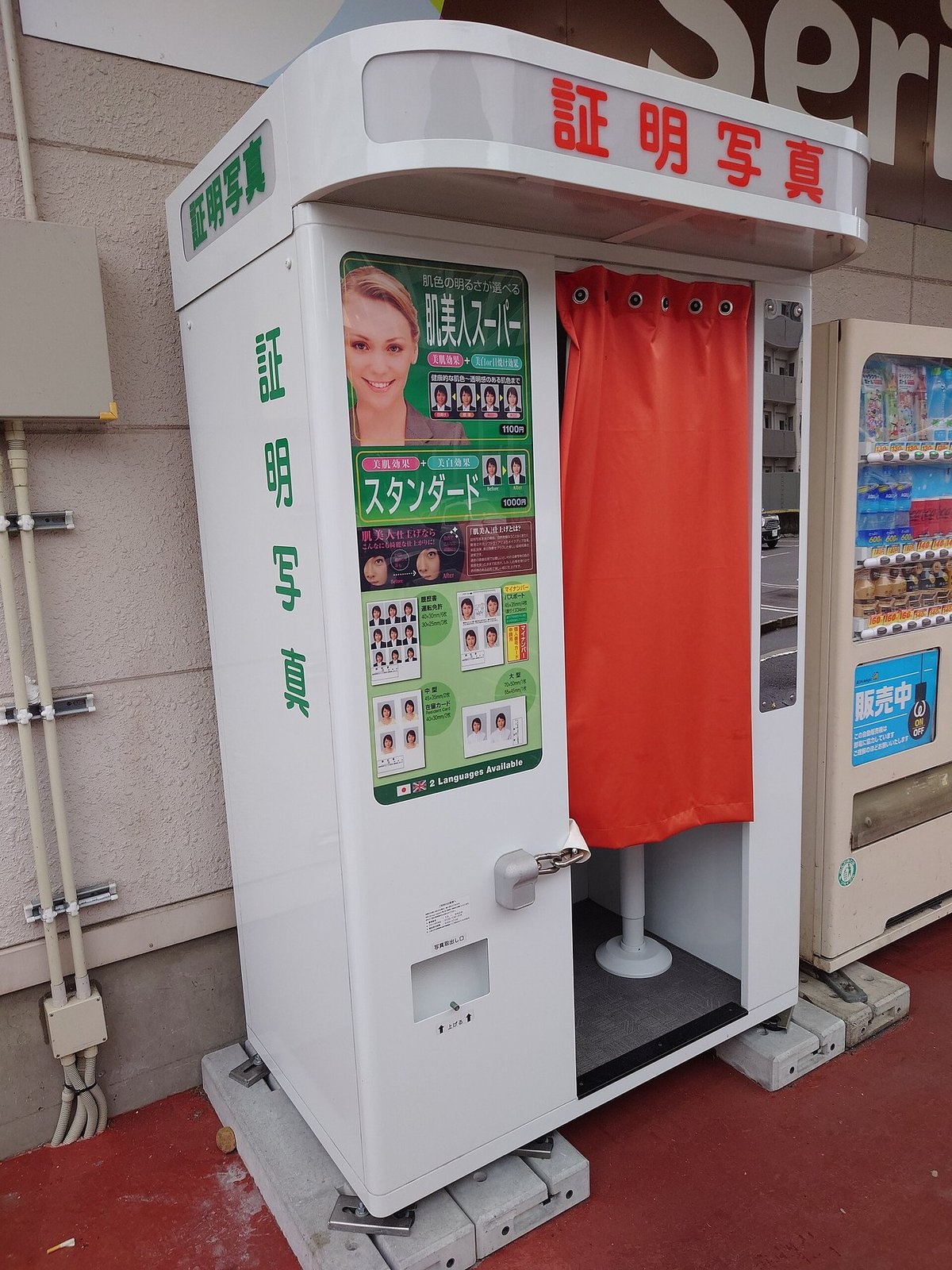

.jpg)

An ID photo booth on a street in Kita Ward, Nagoya, in February 2024. This photo illustrates what Japanese ID photo booths look like. The image description does not identify the operator, so it does not establish that this is a ME Group machine. Photo: 円周率3パーセント, CC BY-SA 4.0, original image.

The distinction matters: ME Group operates 証明写真機 in Japan—the small ID photo booths beside stations and supermarkets—not arcade プリクラ, or purikura. Almost all Japanese purikura machines are made by FURYU; see Thirty Years of Japanese Purikura. These two markets have different customers, locations, and pricing. They just happen to share the name “photo booth.” How Taiwanese visitors can use these ID photo machines in Japan, and the differences among ME Group Japan, DNP, and ID VOX, are covered in the Japan ID Photo Booth Overview.
For ID photo booth locations in the UK and Ireland, the photo booth information site has separate pages for UK ID photo booths and Ireland ID photo booths.
Japan is now the only market pulling back among ME Group’s three regions: in H1 FY2026, Asia-Pacific revenue fell 13.2% year on year and machine numbers also declined. It was the only region where both revenue and machine count fell. In addition to the new passport system, the company was removing unprofitable fresh orange juice vending machines in Japan.
7. Fourteen Years of Figures
| Fiscal year | Revenue (£ million) | EBITDA (£ million) | Profit before tax (£ million) | Notes |
|---|---|---|---|---|
| 2012 | 207.8 | 44.0 | 20.1 | Fiscal year ended in April; revenue includes discontinued operations |
| 2013 | 195.6 | 44.9 | 24.3 | |
| 2014 | 186.6 | 47.8 | 30.1 | |
| 2015 | 177.2 | 55.3 | 38.5 | Lowest revenue in the fourteen-year period |
| 2016 | 184.0 | 56.7 | 40.1 | |
| 2017 | 214.6 | 69.2 | 48.0 | |
| 2018 | 229.8 | 71.0 | 50.2 | |
| 2019 | 228.1 | 69.7 | 42.6 | |
| 2020 | 310.2 | 87.3 | 0.5 | An 18-month period; see explanation below |
| 2021 | 214.4 | 65.1 | 28.6 | First year with an October year-end |
| 2022 | 259.8 | 92.2 | 53.4 | |
| 2023 | 297.7 | 106.6 | 67.1 | Fujifilm Japan business acquired |
| 2024 | 307.9 | 114.2 | 73.4 | |
| 2025 | 315.4 | 120.4 | 78.2 | |
| H1 FY2026 | 154.3 | 57.0 | 32.7 | Half-year figures |
Sources: five-year summaries in ME Group’s annual reports and the 2026 interim report. Figures are as reported by the company.
This table can be read in three phases. From 2012 to 2019, revenue moved sideways between £177 million and £230 million. After the pandemic, laundry expansion, price increases, and the Japanese acquisition helped revenue grow from £214 million in 2021 to £315 million in 2025, while profit before tax nearly tripled. But from 2024, annual revenue growth fell to 2%–3%, and in H1 FY2026 it was just 0.3%. The growth curve is flattening.
There are three traps when reading this company’s figures:
- The 2020 row covers 18 months. In 2020, the company changed its fiscal year-end from April to October, so the statutory annual report covers May 2019 through October 2020. Before that, it had already released results for the “12 months ended April 2020,” showing profit before tax of £4.1 million. The same year has three different periods and three different profit figures; they cannot simply be joined into one continuous line.
- Business names such as “Photo.ME” and “Wash.ME” were introduced only in the 2021 rebranding. Previously, the businesses were called Identification, Laundry, and Kiosks.
- Laundry machine counts have used two different definitions over time: cumulative deployments, including machines already sold, and machines currently operating. They cannot be directly compared as a measure of growth.
8. 2025: It Tried to Sell Itself
This section follows the timeline. Every event comes from the company’s stock exchange announcements or annual reports.
- February 28, 2025: one of the major shareholders, investment fund FPCI Montefiore Investment IV, sold 26.5 million shares through a secondary placing at 200p per share, representing approximately 7% of the company’s share capital.
- June 3, 2025: two directors joined the board: the CEO’s son, Vladimir Crasneanscki, as an executive director, and Lord Barker as an independent director.
- June 18, 2025: following unusual share-price movements and media speculation, the company issued an announcement confirming that it was “reviewing various strategic options to enhance shareholder value,” including seeking potential buyers. It stated that it had not yet received any offer proposal. Under the UK Takeover Code, the company entered an “offer period” that day. Its financial advisers were Zaoui & Co and Rothschild & Co.
- December 5, 2025: the company announced the end of the offer period. In essence, it said that, after engaging with several interested parties, the board had received no offer that it considered to be in the best interests of all shareholders and had therefore terminated discussions.
- January 14, 2026: Montefiore sold a further 12.5 million shares at 132p per share, disposing of its entire remaining holding. The price was 34% lower than in its sale a year earlier.
- February 2, 2026: the CEO’s son was promoted to deputy CEO.
- February 25 and March 12, 2026: the company twice announced delays to publication of its audited 2025 financial statements, saying that accounting firm Forvis Mazars needed more time. Trading in its shares was suspended from March 2.
- February 26, 2026: shareholders approved an authorization to buy back shares, with 99.82% voting in favor, and a “Rule 9 waiver,” with 83.54% voting in favor in a vote open only to independent shareholders.
- March 23, 2026: the annual report was published and share trading resumed. A share buyback of up to £18 million began the same day.
That last waiver needs some explanation. CEO Crasnianski and his concert party together hold approximately 36.5% of the shares. When the company buys back its own shares, the number of shares outstanding falls, passively increasing his ownership percentage. Under the UK Takeover Code, anyone holding between 30% and 50% must make an offer to all shareholders if their percentage increases further. Before the buyback, the company therefore needed the other, independent shareholders to approve a waiver of that obligation.
The following is this site’s inference, based on the timeline above: the largest shareholder’s side holds more than one-third of the company and is handing leadership to the next generation; an outside financial investor has exited at successively lower prices; the company sought a buyer but could not agree on price; it then turned to buybacks to return value to shareholders, and those buybacks will further increase the largest shareholder’s ownership percentage. The company’s next phase is more likely to involve greater ownership concentration on the largest shareholder’s side than an acquisition by someone else.
9. Comparing It with FURYU and the Two Korean Companies
| ME Group (UK) | FURYU (Japan) | Seobuk (Korea, Photoism) | LK Ventures (Korea, Life4Cuts) | |
|---|---|---|---|---|
| Main business | ID photo booths and self-service laundry | Purikura machines and character merchandise | Self-service photo studio franchising and K-pop content | Self-service photo studio franchising |
| Who owns the machines? | The company, which pays sites a share of revenue | Sold to arcades | Franchisees | Franchisees |
| Why do customers come? | To obtain ID photos: a necessity | Entertainment | Entertainment and fandom | Entertainment |
| Listed? | Yes, since 1962 | Yes, since 2015 | No; applied for a preliminary KOSDAQ listing review in September 2026 | No |
| State of the core photography business | Booth count is flat, revenue per unit is falling, and laundry has overtaken it on earnings | The number of users fell 38.7% over six years; revenue from selling photos exceeds revenue from selling machines | Nearly 70% of revenue comes from IP content | Core business has posted losses for consecutive years |
Figures for FURYU and the two Korean companies come from this site’s FURYU company study and Thirty Years of Korean Photo-Strip Culture.
All four companies are discussed as part of the “photo booth/purikura” industry, but they are actually four different businesses: ME Group is an outsourced terminal in government identity-document processes; FURYU is a machine supplier transitioning into an IP company; and the two Korean companies are chain headquarters that use photography to attract young people, then monetize through franchising and content. Their only common ground is that photography itself is no longer the growth engine. Each is looking elsewhere—to laundry, IP, or content—for its next path forward.
10. What I Could Not Find
- How much the 2025 strategic review cost, and which parties the company approached: the annual report says only that related costs were excluded from the calculation of executive bonuses. It gives neither an amount nor names.
- When and how France’s Photomaton joined the group: I could not find this in company documents. The transaction behind the commonly cited “1998” date did not name Photomaton.
- Between March 2021 and February 2022, the Crasnianski side’s holding rose from 27.8% to 36.5%. I could not find the individual transactions.
- Exactly what changed in Japan’s new passport applications: the company says only “Japanese government changes to new passport applications.” This article did not separately investigate Japanese Ministry of Foreign Affairs rules and does not supply details on the company’s behalf.
- Share price and market capitalization: company documents disclose only the two placement prices, 200p and 132p. This article did not obtain additional share-price data from financial websites.
English Terms Used in This Article
- Photo.ME, Wash.ME, Print.ME, and Feed.ME: the four business names introduced in ME Group’s 2021 rebranding, covering photo booths, self-service laundry, photo-printing kiosks, and food vending machines, respectively.
- Vending revenue: money customers pay into machines by cash or card, excluding revenue from sales of machines, parts, and services.
- EBITDA: earnings before interest, tax, depreciation, and amortization, often used to compare the cash-earning capacity of different businesses.
- Offer period: a term under the UK Takeover Code for the period between a company publicly stating that it may be acquired and confirmation of whether an offer will be made. During this period, holders of 1% or more must disclose their dealings.
- Rule 9: Rule 9 of the UK Takeover Code requires an offer to all shareholders when a holding crosses 30%, or when a holding already between 30% and 50% increases further. A passive increase caused by a company share buyback can be waived with approval from independent shareholders.
- Secondary placing: an existing shareholder sells a block of shares to institutional investors. The company itself receives no proceeds.
Lead image: a row of Photomaton machines in an underground passage at Les Halles station in Paris—from left, a photo-printing kiosk, two printers, and a photo booth. Photographed by Lionel Allorge in August 2012, CC BY-SA 3.0, original image. Cropped to 16:9 by this site.

Article keywords: ME Group, Photo-Me, Photomaton, European and American photo booths, ID photo booths, self-service laundry, photo booth industry, listed-company research
Article overview
This is an in-depth study of listed photo booth operator ME Group International plc, formerly Photo-Me International, whose London Stock Exchange ticker is MEGP. All data comes from company annual reports, results announcements, and stock exchange announcements. Photo-Me opened its first UK photo booth in 1954, listed in London in 1962, and merged with France’s KIS in 1994. KIS founder Serge Crasnianski has been CEO since 2009. The company changed its name to ME Group in August 2022 and joined the FTSE 250 in June 2023. France’s Photomaton is the group’s largest subsidiary. In FY2025, ended October, group revenue was £315.4 million and profit before tax was £78.2 million. Its 30,520 photo booths across 16 countries generated £168.6 million in revenue with a 35.2% EBITDA margin; its 7,607 self-service laundry units generated £112.4 million with a 49.4% EBITDA margin. After depreciation, photo booths still produced more operating profit: £48.5 million versus laundry’s £33.2 million, because laundry depreciation of £22.3 million was twice that of photo booths. Group gross margin was approximately 35.8%, and net margin approximately 17.9%. In H1 FY2026, laundry EBITDA of £30.7 million exceeded photo booth EBITDA of £27.2 million for the first time, but the interim report did not disclose operating profit by business. Photo booths operate in 16 countries: Australia, Austria, Belgium, China, Finland, France, Germany, Ireland, Japan, Luxembourg, the Netherlands, Portugal, Singapore, Spain, Switzerland, and the UK. Annual revenue per photo booth peaked at £5,908 in FY2023 and fell to £5,437 in FY2025. Germany’s new passport photo rules reduced German revenue by approximately £3 million in the second half of 2025; changes to new passport applications in Japan contributed to a 14.8% year-on-year decline in Asia-Pacific photo booth revenue in H1 FY2026. The group acquired Fujifilm’s Japanese photo booth business in 2023, ultimately receiving 3,611 booths. On June 18, 2025, the company announced a review of strategic options, including seeking potential buyers, and entered an offer period. It ended the process on December 5 after receiving no suitable offer. Major shareholder fund Montefiore’s two share placements were priced at 200p and then 132p. In February 2026, shareholders approved a buyback and a Rule 9 waiver.
- ME Group International plc was formerly Photo-Me International plc. It changed its name on August 1, 2022, and its London Stock Exchange ticker changed from PHTM to MEGP.
- Photo-Me opened its first UK photo booth in 1954, listed on the London Stock Exchange in 1962, and joined the FTSE 250 in June 2023.
- Photo-Me merged with France’s KIS in 1994. KIS founder Serge Crasnianski has been CEO since 2009 and holds approximately 36.5% together with his concert party.
- France’s Photomaton is ME Group’s largest subsidiary.
- In FY2025, group revenue was £315.4 million, EBITDA was £120.4 million, and profit before tax was £78.2 million.
- In FY2025, 30,520 photo booths across 16 countries generated revenue of £168.6 million and EBITDA of £59.3 million, giving an EBITDA margin of 35.2%, calculated by this site.
- In FY2025, 7,607 self-service laundry units generated revenue of £112.4 million and EBITDA of £55.5 million, giving an EBITDA margin of 49.4%, calculated by this site.
- FY2025 operating profit was £48.5 million for photo booths and £33.2 million for self-service laundry. Laundry depreciation of £22.3 million was twice the £10.8 million for photo booths.
- FY2025 group gross margin was approximately 35.8% and net margin approximately 17.9%, calculated by this site from the annual report’s income statement.
- In H1 FY2026, self-service laundry EBITDA of £30.7 million exceeded photo booth EBITDA of £27.2 million for the first time. The interim report did not disclose operating profit by business.
- Photo booths operate in 16 countries: Australia, Austria, Belgium, China, Finland, France, Germany, Ireland, Japan, Luxembourg, the Netherlands, Portugal, Singapore, Spain, Switzerland, and the UK.
- FY2025 photo booth vending revenue was £107.9 million in Continental Europe, £43.2 million in Asia-Pacific, and £15.1 million in the UK and Ireland.
- France’s Photomaton states that it has more than 10,000 photo booths in France, prints 13 million photos annually, and has 90% brand awareness.
- FY2025 annual revenue per unit was £14,329 for laundry kiosks, £5,437 for photo booths, and £2,389 for photo-printing kiosks.
- Annual revenue per photo booth peaked at £5,908 in FY2023 and then declined for two consecutive years.
- Germany’s new passport photo rules, introduced in May 2025, reduced German photo booth revenue by approximately £3 million in the second half of 2025.
- In H1 FY2026, Asia-Pacific photo booth revenue was £19 million, down 14.8% year on year. The company attributed this to Japanese government changes to new passport applications.
- The group acquired Fujifilm’s Japanese photo booth business in September 2023, initially taking over 3,548 booths and ultimately receiving 3,611 by the end of March 2024.
- The next-generation photo booth target changed from 10,000 units within three years to 8,000 by the end of FY2025, then to 8,000 by the end of FY2027. Cumulative installations reached 4,362 at the end of April 2026.
- On June 18, 2025, the company announced a review of strategic options, including seeking potential buyers, and entered an offer period. It ended the process on December 5 after receiving no suitable offer.
- Major shareholder fund Montefiore’s placement price fell from 200p in February 2025 to 132p in January 2026. The second placement disposed of its entire remaining holding.
- On February 26, 2026, shareholders approved a buyback authorization and a Rule 9 waiver. A buyback of up to £18 million began on March 23.
Frequently asked questions
How are ME Group, Photo-Me, and Photomaton related?
They belong to the same group. Photo-Me International was a British company founded in 1954 and listed in London in 1962. It changed its name to ME Group International in August 2022. France’s Photomaton is its photo booth brand and the group’s largest subsidiary.
How many photo booths does ME Group have?
At the end of FY2025, in October 2025, it had 30,520 photo booths in 16 countries, representing 62% of the group’s 49,204 machines. At the end of April 2026, it had 30,356 photo booths.
Are photo booths still ME Group’s most profitable business?
It depends on the metric. After depreciation, FY2025 photo booth operating profit of £48.5 million was still higher than laundry’s £33.2 million. But on EBITDA, before depreciation, laundry’s £30.7 million exceeded photo booths’ £27.2 million for the first time in H1 FY2026. Laundry equipment is expensive and carries substantial depreciation, so the two metrics give different answers.
What is the difference between Photo.ME photo booths and Print.ME photo-printing kiosks?
In a photo booth, you sit inside, the machine takes your picture, and it prints the photos immediately. Its main business is ID photos for passports and identity cards; there were 30,520 booths in 16 countries in FY2025. A photo-printing kiosk has no camera: it prints photos from your phone. There were 4,515 kiosks in nine countries, with annual revenue per unit of £2,389, less than half that of a photo booth.
How do changes to government ID photo rules affect ME Group?
The impact is direct. When France and the UK allowed photo booths to upload digital ID photos, its business grew. Germany’s 2025 requirement for passport photos to be taken at government registration offices or by certified photographers reduced its second-half revenue by approximately £3 million. After changes to new passport applications in Japan, Asia-Pacific photo booth revenue fell 14.8% year on year in H1 FY2026.
What does ME Group do in Japan?
It operates street-side 証明写真機, or ID photo booths, rather than arcade purikura machines. It signed an agreement on July 3, 2023, and completed the acquisition of Fujifilm’s Japanese photo booth business on September 30 for approximately ¥966 million, ultimately receiving 3,611 booths. The company describes itself as the leading operator in Japan’s photo booth market.
Was ME Group acquired in 2025?
No. On June 18, 2025, the company announced that it was reviewing strategic options, including seeking potential buyers, and entered an offer period under the UK Takeover Code. On December 5, it announced that, after engaging with several interested parties, it had received no offer that the board considered to be in the best interests of all shareholders and had terminated discussions.
Sources: The Chinese original was first published on September 24, 2026 and last revised on October 2, 2026. Company statements and outlook retain that research snapshot.
This English version is based on original Traditional Chinese content on joelin.cc. The language and explanations are localised for international readers. The Traditional Chinese original is the authoritative version — for its complete meaning, please read the original article.