This article is also available in: 繁體中文 · 日本語 · 한국어 · Bahasa Indonesia · Bahasa Melayu · ไทย · Português (Brasil) · Español · Türkçe · Tiếng Việt · Deutsch · हिन्दी
Contents (23)
Short answer: this article was first written in Chinese, where six names get compared most often: lipstick (口紅), liquid lipstick (唇釉), lip gloss (唇蜜), lip colour (唇彩), and two words for lip balm (護唇膏 and 潤唇膏). Only two pairs among them genuinely differ; the rest of the confusion comes from translation and marketing. Lip tint, lip oil and two more Chinese marketing names, 唇露 and 唇泥, are covered in a section further down.
First, texture and effect:
| Name | Texture | Colour | Moisture |
|---|---|---|---|
| Lipstick | Solid, wax-heavy | High | Medium |
| Liquid lipstick | Liquid to thick | Medium to high | Medium |
| Lip gloss | Thin, clear or lightly tinted | Low | Medium |
| Lip balm | Solid, mostly oil and wax | None or very low | High |
Then wear and use:
| Name | Wear | Remove | Use |
|---|---|---|---|
| Lipstick | High | Yes | Mainly colour |
| Liquid lipstick | Medium | Yes | Colour plus shine |
| Lip gloss | Low | Advised | Over lipstick for shine |
| Lip balm | Low | No | Everyday moisture |
Two other Chinese names do not need their own rows: 潤唇膏 and 護唇膏 are the same thing, so every value is the same as lip balm, and 唇彩 is an umbrella term for lip makeup, not a single product type. On the English side, 唇釉 is what retailers would shelve as liquid lipstick, and brands’ English labels for it often say lip glaze or lip lacquer; 唇蜜 is lip gloss, and 護唇膏 is lip balm.
So only two differences really need explaining, lipstick versus liquid lipstick and liquid lipstick versus lip gloss, and even those lines are blurrier than you might expect.
Why these names are so confusing: two roots
1. English keeps colour and care apart; the blur is on the shelf labels
English draws a clear line: lipstick is makeup, lip balm is care, and the two words do not overlap. That is not true everywhere. In Chinese, the single word 唇膏 covers both: “this 唇膏 is a gorgeous shade” means lipstick, while “put on some 唇膏, the air is dry” means lip balm. A lot of the confusion in Chinese starts with that one word.
English shoppers run into a different kind of blur. Chapstick, a brand name, is often used as a generic word for any lip balm, and retailers add in-between categories that sit across the colour/care line. The usual English shelf labels map onto this article like this:
| Shelf name | Chinese | Main job |
|---|---|---|
| Lipstick | 口紅 | Colour |
| Liquid Lipstick | 唇釉 | Colour with shine |
| Lip Gloss | 唇蜜 | Shine, alone or layered |
| Lip Balms & Treatments | 護唇膏, 潤唇膏 | Moisture |
| Lip Stain, lip tint | 唇染 | Dyes the lips |
| Lip Oil | 唇油 | Shine plus moisture |
| No category | 唇露, 唇泥 | Chinese marketing names |
Lip balm works by forming a protective layer of oils, waxes or petroleum jelly on the surface of the lips. The simplest split is this: lip balm handles care, lipstick handles colour, and lip gloss handles shine. Lip oil is the one English category that deliberately straddles two of them; the UK pharmacy chain Boots describes it as a hybrid of lip gloss and lip balm.
That is also why a common Chinese question, roughly “what’s the difference between 唇膏 and lip balm?”, looks like it is asking about two versions of the same word when it is really asking about makeup versus skincare.
2. 唇釉, 唇泥 and 唇露 are marketing coinages, not product types
In Taiwan, where this article was originally written, cosmetics regulation used to have two tiers before July 2024: ordinary cosmetics, and specific-purpose cosmetics that needed inspection and registration. Since then cosmetics are no longer classified, and every product goes through product registration. Article 3 of Taiwan’s Cosmetic Hygiene and Safety Act defines cosmetics as “preparations applied to the external parts of the human body, teeth or oral mucosa to moisturise hair and skin, stimulate the sense of smell, improve body odour, beautify the appearance or cleanse the body” (our translation). Liquid lipstick, lip gloss and 唇泥 appear nowhere in it.
The industry has no standard either. Retailers sort products under labels such as Liquid Lipstick and Lip Gloss, but the names are terms brands use to describe texture and set themselves apart, and each brand defines them differently: brand A’s liquid lipstick may be thinner than brand B’s lip gloss, and brand C’s 唇泥 may be the same thing as brand D’s matte liquid lipstick.
So the right answer to “what’s the difference between liquid lipstick and lip gloss?” should start with: it depends on the brand.
Behind every texture there are only three variables
There are many names, but the formulation logic is simple. The texture of a lip product is decided almost entirely by the ratio of wax, oil and gel.
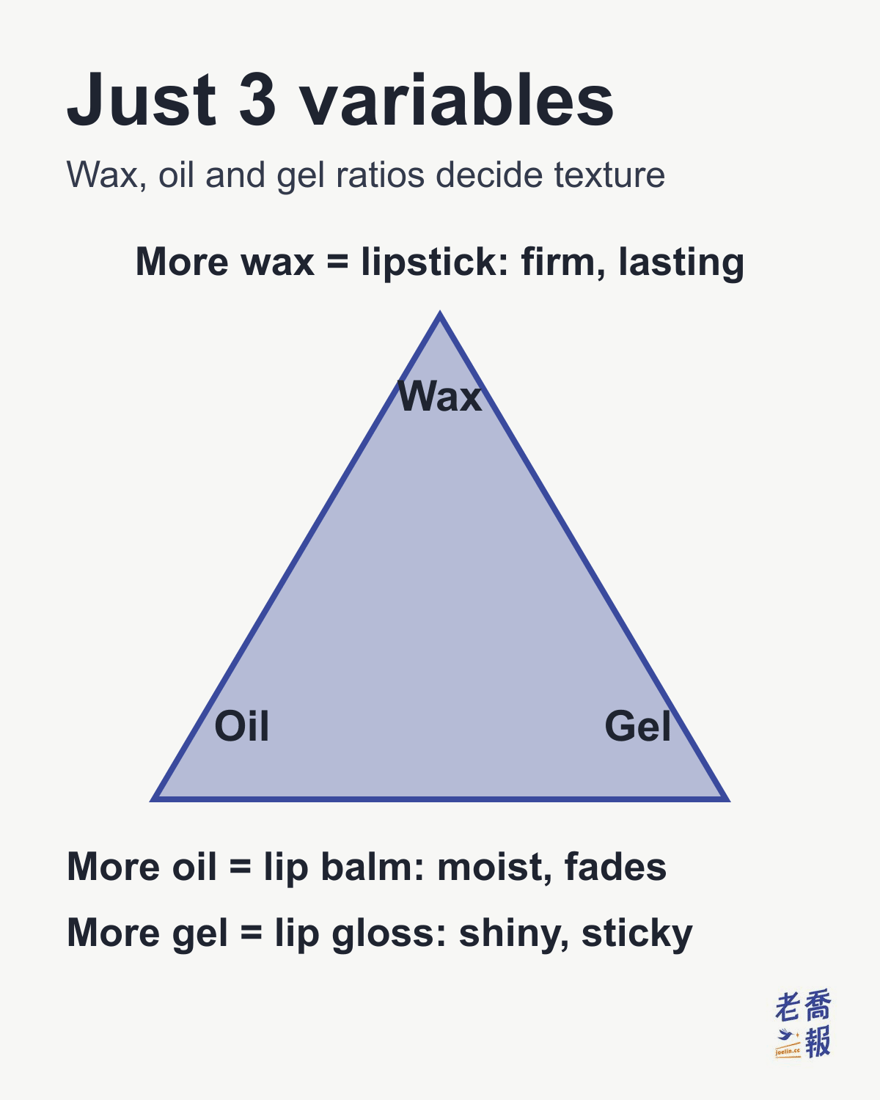
- Wax (beeswax, candelilla wax, carnauba wax and similar) holds the shape. The more wax, the firmer the product, the better it stands up as a stick, and the stronger its colour payoff and wear; the price is a drier feel and less spread.
- Oils and butters (castor oil, jojoba oil, shea butter, mineral oil, petroleum jelly) give moisture and spread. The more oil, the more comfortable and hydrating, but also the more easily it gets eaten or wiped off.
- Gels and resins (various polymers) give shine and grip. The more gel, the shinier and stickier; the tacky feel of lip gloss comes from here.
Pull these three levers and all six names can be explained: lipstick is wax-heavy, lip balm is oil-heavy, lip gloss is gel-heavy, and liquid lipstick is the liquid version with the three in middling proportions.
The differences, pair by pair
Liquid lipstick vs lipstick
The difference is the vehicle, not the product type. Lipstick is a solid held up by wax that can stand as a stick, with higher colour payoff and longer wear; liquid lipstick is liquid or thick and creamy, with more oil and gel, usually comes with an applicator, gives sheerer colour and stronger shine, and comes off more easily.
In practice: for saturated colour that lasts all day, choose lipstick; for a juicy look that is quick to apply, choose liquid lipstick. As for removal, it is worth removing both, especially high-payoff products, which contain more pigment; leftovers in the lines of your lips can make their colour look darker.
Lip gloss vs liquid lipstick
The answer here is that each brand draws its own line; there is no objective standard.
The rough tendency is that lip gloss is clear or lightly tinted, thin, and mainly adds shine, often layered over lipstick; liquid lipstick has more colour payoff, a thicker texture, and can be worn on its own. But that is a tendency, not a rule. Checking the ingredient list and swatches before you buy is more reliable than going by the name.
潤唇膏 vs 護唇膏: a Chinese-only question
There is no difference: they are two translations of the same thing. Both are lip balm in English; Taiwan usually says 護唇膏, while mainland China and Hong Kong more often say 潤唇膏.
If you see an article comparing the two with a table of differences, it is most likely a split invented to pad out content. This question does not exist.
Vaseline vs Vaseline lip balm
The base is the same. Both are mainly petrolatum, which is petroleum jelly itself; the stick lip balm version adds ingredients such as shea butter and vitamin E plus fragrance, and comes in a form you can apply directly.
One number worth knowing: petrolatum is the most occlusive ingredient currently known and can reduce transepidermal water loss by 98% or more. It is not absorbed by the skin; it simply sits on the surface and blocks water from evaporating. So if all you want is to seal in moisture, plain petroleum jelly from a tub is not inferior in terms of ingredients; what it lacks is convenience to carry and apply.
Four names not in the tables: lip tint, lip oil, 唇露 and 唇泥
Four more names often show up on the shelf. They are not in the tables above, each for a different reason.
- Lip tint uses dyes to change the colour of the lips themselves instead of laying pigment on top. Tints are mostly watery or gel-like, with sheer colour and little shine, and the colour stays for a while after you wipe off the surface layer. Korean beauty retailers treat lip tint as a major category of its own, and English also has lip stain, which means something similar.
- Lip oil is an oil-heavy liquid with the shine of lip gloss and the moisture of lip balm; the UK pharmacy chain Boots describes it as a hybrid of lip gloss and lip balm. In terms of the three variables, it is the liquid version of the oil corner.
- 唇露 (literally lip dew) is a Chinese marketing name that usually means a watery lip tint; usage varies between brands.
- 唇泥 (literally lip mud) is also a marketing name, usually for a matte, mousse-like liquid lip colour close to a matte liquid lipstick. Overseas retailers, English-language ones included, have no such category.
Of these four, only lip tint follows genuinely different formulation logic: every other product’s texture can be explained by the ratio of wax, oil and gel, while tint colours the lips with dyes. The other three all fit back into the triangle; only the name is different.
How Taiwan’s law classifies them
This section is something most comparison articles leave out, yet it shapes the marketing copy you actually see. The rules below are those of Taiwan, where this article was originally written.
Lip balm cannot claim to treat anything. Article 10, paragraph 2 of Taiwan’s Cosmetic Hygiene and Safety Act states that cosmetics must not be labelled, promoted or advertised with medical efficacy. So legal lip balm copy in Taiwan can only talk about moisturising, hydrating and beautifying, not about treating, reducing inflammation or curing. A lip balm claiming to treat cheilitis is already breaking the law by making that claim, which also makes it a simple test of whether a brand can be trusted.
Before July 2024, SPF-labelled products were on a different tier in Taiwan: they were specific-purpose cosmetics and had to go through inspection and registration with the Food and Drug Administration and obtain a permit before going on sale. According to the Taiwan FDA press release of 26 June 2024 (in Chinese), from July 2024 cosmetics are no longer classified, the term “specific-purpose cosmetics” no longer exists, and all cosmetics instead go through product registration with a product information file kept on hand. An SPF lip balm now follows the same route to market as an ordinary lip balm; the difference remains in the labelling rules: the labelled SPF must not exceed the measured value, and the highest label allowed is SPF 50+. How sunscreen labels work in different countries is covered in SPF, UVA and broad spectrum: sunscreen labels compared by country.
Text of the law: Cosmetic Hygiene and Safety Act (in Chinese)
So which one should you choose
No brand recommendations, just a quick guide:
- If your lips are simply dry and you want everyday care, use lip balm, and check the ingredient list for occlusive ingredients.
- If you want colour that lasts and shows up well in photos, use lipstick.
- If you want a juicy look, quick application and no lip liner, use liquid lipstick.
- If you are already wearing lipstick and want more shine, layer lip gloss on top.
- If you spend long hours outdoors, choose a product labelled with an SPF.
Why lips dry out so easily, and why they sometimes feel drier after you put something on, is a separate topic involving the structure of lip skin and how moisturising ingredients work; Joe will write about it separately. For where the pigments in lip makeup come from and the controversy around them, see cochineal, the raw material of natural red dye (Chinese original); for animal-derived ingredients and vegan certification, see cruelty-free, vegan and no animal testing: what’s the difference? (Chinese original).
Frequently asked questions
What is lip balm?
Lip balm (護唇膏 or 潤唇膏 in Chinese) uses oils and wax to form a protective layer on the surface of the lips and reduce water loss. Its job is moisture and care, and it is usually colourless or only very lightly tinted.
What is liquid lipstick?
Liquid lipstick is liquid lip colour with a texture between lipstick and lip gloss: usually thicker than gloss and wetter than lipstick, mostly sold with a slanted or flat applicator. Note that it is not a defined product type. Neither Taiwan’s regulations nor the industry define it (the Chinese name is 唇釉, and brands’ English labels also say lip glaze or lip lacquer); it is a brand term describing texture, so one brand’s liquid lipstick may be thicker than another brand’s lip gloss.
What’s the difference between liquid lipstick and regular lipstick?
The vehicle and the texture, not the product type. Lipstick is a solid held in shape by wax, with higher colour payoff and longer wear; liquid lipstick is liquid or creamy, with more oil and gel, so its colour is sheerer, its shine stronger, and it comes off more easily. In regulatory terms the two are the same kind of thing.
What’s the difference between lip tint and liquid lipstick?
How the colour gets onto your lips. Liquid lipstick, like lipstick, covers the lips with a pigmented cream or liquid; lip tint uses dyes to change the colour of the lips themselves. Tints are mostly watery or gel-like, with sheer colour and little shine, and the colour stays for a while after you wipe off the surface layer. Korean beauty retailers list lip tint as a major category of its own, and Chinese-speaking shoppers often just call it tint.
Is lip oil a lip balm or a lip gloss?
Somewhere in between. Lip oil is an oil-heavy liquid with the shine of lip gloss and the moisture of lip balm; the UK pharmacy chain Boots describes it as a hybrid of lip gloss and lip balm. Most lip oils are lightly tinted or colourless, and they wear about as briefly as gloss.
What are 唇泥 and 唇露 in Chinese lip products?
Both are names invented by brands, not defined product types. 唇泥 (literally lip mud) usually means a matte, mousse-like liquid lip colour, close to a matte liquid lipstick; 唇露 (literally lip dew) usually means a watery lip tint. Usage varies between brands and overseas retailers have no matching category, so the texture description and swatches are more reliable than the name.
Are 潤唇膏 and 護唇膏 different products?
No. They are two Chinese translations of the same product: both are lip balm in English. Taiwan usually says 護唇膏, while mainland China and Hong Kong more often say 潤唇膏. When you see the two compared side by side, it is usually a split made up for marketing copy, not a real difference.
What’s the difference between Vaseline and Vaseline lip balm?
The base is the same thing. Both are mainly petrolatum (petroleum jelly); the lip balm version adds ingredients such as shea butter and vitamin E plus fragrance, and comes in a stick for direct application. If all you want is an occlusive seal to keep moisture in, plain petroleum jelly from a tub is not inferior in terms of ingredients.
Can a lip balm claim to treat chapped lips?
Not in Taiwan, where this article was originally written. Article 10, paragraph 2 of Taiwan’s Cosmetic Hygiene and Safety Act states that cosmetics must not be labelled, promoted or advertised with medical efficacy. So legal lip balm copy there can only talk about moisturising, hydrating and beautifying, not about treating or curing. A lip balm claiming to treat cheilitis is breaking the law by making that claim.
In Taiwan, is SPF lip balm regulated the same way as ordinary lip balm?
Since July 2024 the route to market is the same. SPF-labelled products used to be specific-purpose cosmetics, which had to go through inspection and registration with Taiwan’s Food and Drug Administration and obtain a permit. After the transition period of the Cosmetic Hygiene and Safety Act ended at the end of June 2024, cosmetics are no longer classified, and all cosmetics instead go through product registration with a product information file kept on hand. The difference lies in labelling: the labelled SPF must not exceed the measured value, and the highest label allowed is SPF 50+.
Keywords: what is liquid lipstick, liquid lipstick vs lipstick, lip gloss vs liquid lipstick, lip tint, lip stain, lip oil, lip balm, chapstick, Vaseline lip balm, petrolatum, SPF lip balm, lip products explained, Taiwan Cosmetic Hygiene and Safety Act
Sources: Chinese original first published 2026-08-28 and updated 2026-10-27; Taiwan regulations as checked in October 2026.
This English version is based on original Traditional Chinese content on joelin.cc. The language and explanations are localised for international readers. The Traditional Chinese original is the authoritative version — for its complete meaning, please read the original article.