
This article is also available in: 繁體中文 · 日本語
Contents (16)
Summary
K-pop photocards are not sold on their own. They are random bonuses inside the album, and the money is booked in album (and digital music) revenue. The Korea Consumer Agency published a survey in March 2023 covering 50 albums (128 versions) released in 2021-2022: 96.9% included random photocards, and each version came with 7.8 extras on average, 2.9 of them random. 52.7% of respondents had bought albums to collect extras, and only 5.7% used the CD to listen to music. People who bought to draw random extras bought 4.1 copies of the same album on average, and the most was 90. In the most extreme album there were 78 photocard types with 6 random per copy, so at least 13 copies were needed to complete the set; the Agency recommended selling extras separately from albums. Weverse Shop’s product page says random extras have “equal probability” and stresses that all albums count toward Circle Chart and Hanteo sales. Korean album sales were 115.77 million copies in 2023, 93.28 million in 2024 and 86.38 million in 2025 (Korea Herald, citing Circle Chart). Album and music-source revenue in 2025: HYBE 772.96 billion won (29.17% of revenue, versus 44.56% in 2023), SM about 320.6 billion won (27.3%), JYP about 257.9 billion won (about 31.4%, calculated by this site); YG reports albums, music sources and merchandise (MD) combined. No official result of the Korea Fair Trade Commission’s 2023 tying investigation could be found; what it penalized in August 2024 was the return rights of 4 official shops (fines totaling 10.5 million won). Japanese editions also include random photocards (TWICE’s “#TWICE5” first-press edition A: 3 random cards out of 18 types), and this site found no Japanese card company in this chain.
Key points
- Korea Consumer Agency, published 2023-03: 50 albums, 128 versions in total, 96.9% with random photocards; 7.8 extras per version on average, 2.9 random; 5.7% listen to music on CD
- People who bought to draw random extras bought 4.1 copies of the same album on average, up to 90; the most extreme album had 78 photocard types, 6 random per copy, at least 13 copies needed
- Korean album sales: 115.77 million copies in 2023, 93.28 million in 2024, 86.38 million in 2025 (Korea Herald, citing Circle Chart)
- HYBE’s 음반/음원 (albums plus music sources) in 2025: 772.96 billion won, 29.17% of revenue (44.56% in 2023, 38.17% in 2024); concerts 28.83%, MD and licensing 21.53%
- SM 음반/음원 in 2025: about 320.6 billion won (27.3%); JYP about 257.9 billion won (about 31.4% by this site’s calculation from two figures in the annual report); YG’s albums, music sources and MD combined: 201.9 billion won (37.02%), pure albums not disclosed
- Weverse Shop product page: random extras have “동일한 확률” (equal probability); all albums are “100% 한터차트, 써클차트 음반 집계에 반영” (100% counted in Hanteo and Circle Chart album tallies)
- Korea Fair Trade Commission, 2024-08: fines totaling 10.5 million won on 4 official shops over return rights; no official result announced for the 2023 tying investigation
- Japanese edition of TWICE’s “#TWICE5” (2025-05-14), first-press limited edition A, ¥5,170: 3 random photocards out of 18 types, plus an event lottery serial code
K-pop photocards are not sold on their own; they are random bonuses inside the album. To get the member they like, fans buy the same album several times, and every copy counts toward album sales. In the Korea Consumer Agency’s survey published in 2023, 96.9% of 50 albums (128 versions) included random photocards, and people who bought for the extras bought 4.1 copies of the same album on average. So by annual-report classification, the money from photocards is booked under agencies’ “albums and music sources” revenue; what photocards pull is album sales and chart rankings. This site found no Japanese card company in this chain.
This is the last article in Part 2 (women’s audience) of the Japan trading card industry research series. The six kinds of women’s card customers lists K-pop photocards as one kind of customer; this article looks at how that business differs from Japanese cards. For the physical size and sleeves of photocards, see photocard sizes in millimeters and how to choose photocard sleeves.
What a photocard is: one random photo card in the album
A photocard (포토카드) is a small card printed with a member’s photo, packed in the box together with the album CD and photobook. Take a mini album released in October 2026 on Weverse Shop (the official shop run by HYBE) as an example. The product page says:
- Photocard: 1 per version, size 55 × 85 mm, “1 of 4”, meaning 1 random card out of 4 types.
- Each version costs 20,700 won including tax, and up to 15 copies can be bought.
- Note: “본 음반에 포함된 랜덤 구성품은 동일한 확률로 구성되어 있습니다” (the random extras in this album have equal probability for each type).
- Another line: “Weverse Shop에서 판매 되는 모든 음반은 100% 한터차트, 써클차트 음반 집계에 반영 됩니다” (all albums sold here count toward Hanteo and Circle Chart album sales).
The last line spells out this business: photocards make people buy more, and every extra copy counts as a sale.
How many repeat purchases random photocards cause
The Korea Consumer Agency published a survey in March 2023 that looked at 50 albums (128 versions) released in 2021-2022 and polled 500 fans:
- 96.9% of the 128 versions included random photocards; each version came with 7.8 extras on average, 2.9 of them random.
- 52.7% of respondents had bought albums to collect extras; only 5.7% actually used the CD to listen to music.
- The 194 people who had bought albums to draw random extras bought 4.1 copies of the same album on average, and the most any one person bought was 90.
The most extreme album had 78 photocard types:
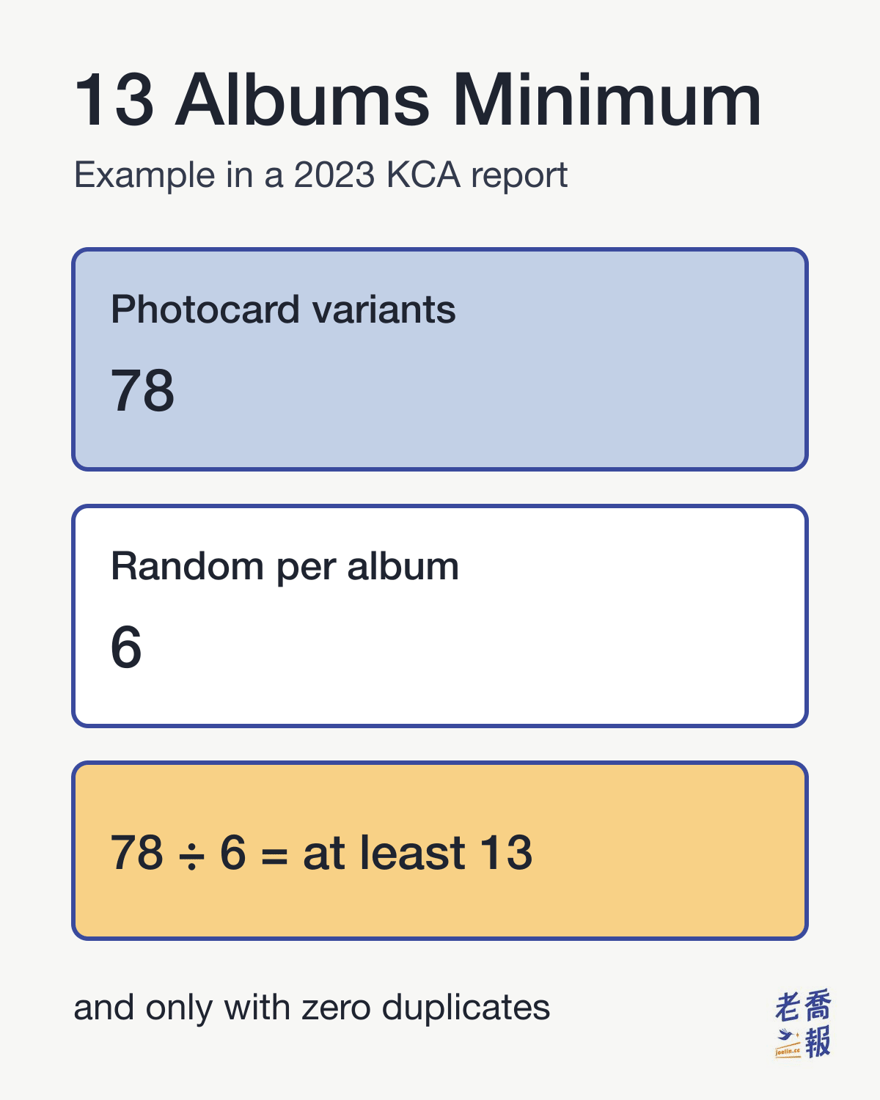
With 6 random types per copy, even perfect luck with no duplicates takes 13 copies to complete the set; in practice there will be duplicates, so you must buy more. In the same material the Agency recommended that companies sell extras separately from albums and consider the environment. This is the same logic as Japan’s oshikatsu collectible cards, where “one box is deliberately built not to complete the set”; the difference is that here every extra copy bought is a whole album.
How the money moves: agencies make, sell and count sales themselves
flowchart TD
  A[Korean agency<br>makes album and cards] --> B[Own official shop<br>Weverse Shop etc.]
  A --> C[Record distributor]
  B --> D[Fans<br>buy more to draw cards]
  C --> D
  D --> E[Every copy counted<br>Circle Chart, Hanteo]
  E --> F[Charts and news<br>feed promotion]
  D --> G[Duplicate cards<br>traded among fans]
Diagram: joelin.cc · Joe Lin
Image source: created by this site, based on HYBE’s annual report, 2024 Korea Fair Trade Commission reporting and the Weverse Shop product page.
The top of the chain is the Korean agencies. HYBE’s annual report describes one route for its albums as “당사 레이블 → 음반/원 유통사(YG플러스 등) → ㈜위버스컴퍼니 → 소비자” (own label → record distributor such as YG PLUS → Weverse Company → consumer) and another as “→ 외부 판매상(오픈마켓 등) → 소비자” (external sellers such as open marketplaces). The Fair Trade Commission’s 2024 material also says each of the big four agencies has its own official shop (HYBE’s Weverse Shop, SM’s SMTOWN & STORE, JYP’s JYP SHOP, YG’s YG SELECT), all run by agency subsidiaries. Photocards are planned and sold by the agency together with the album, and Japanese card companies appear at no layer this site found.
The numbers: how much of revenue is albums at the big four
Photocards are not priced on their own, so the only thing to look at is the line they sit in. The big four’s 2025 annual reports (Korea’s Financial Supervisory Service, DART) classify things differently, and none lists physical albums separately.
| Company | Line | 2025 | Share |
|---|---|---|---|
| HYBE | Album + music | 772.96 billion won | 29.17% |
| SM | Album + music | about 320.6 billion won | 27.3% |
| JYP | Album + music | about 257.9 billion won | about 31.4%* |
| YG | Goods and products** | about 201.9 billion won | 37.02% |
*JYP’s annual report gives no ratio; this site divided the report’s album and music revenue by total revenue. **YG’s “상ㆍ제품” (goods and products) includes digital content such as albums and music sources, plus artist MD. At all four, “albums” are combined with digital music, and YG’s is further combined with merchandise (MD), so this table only shows that albums are roughly 30% of revenue; it cannot show how much money photocards bring in.
For companies with three years in their reports the trend is visible, but the direction differs: JYP’s album and music revenue fell to about 217.2 billion won in 2024 and recovered to about 257.9 billion won in 2025, while HYBE fell two years in a row:
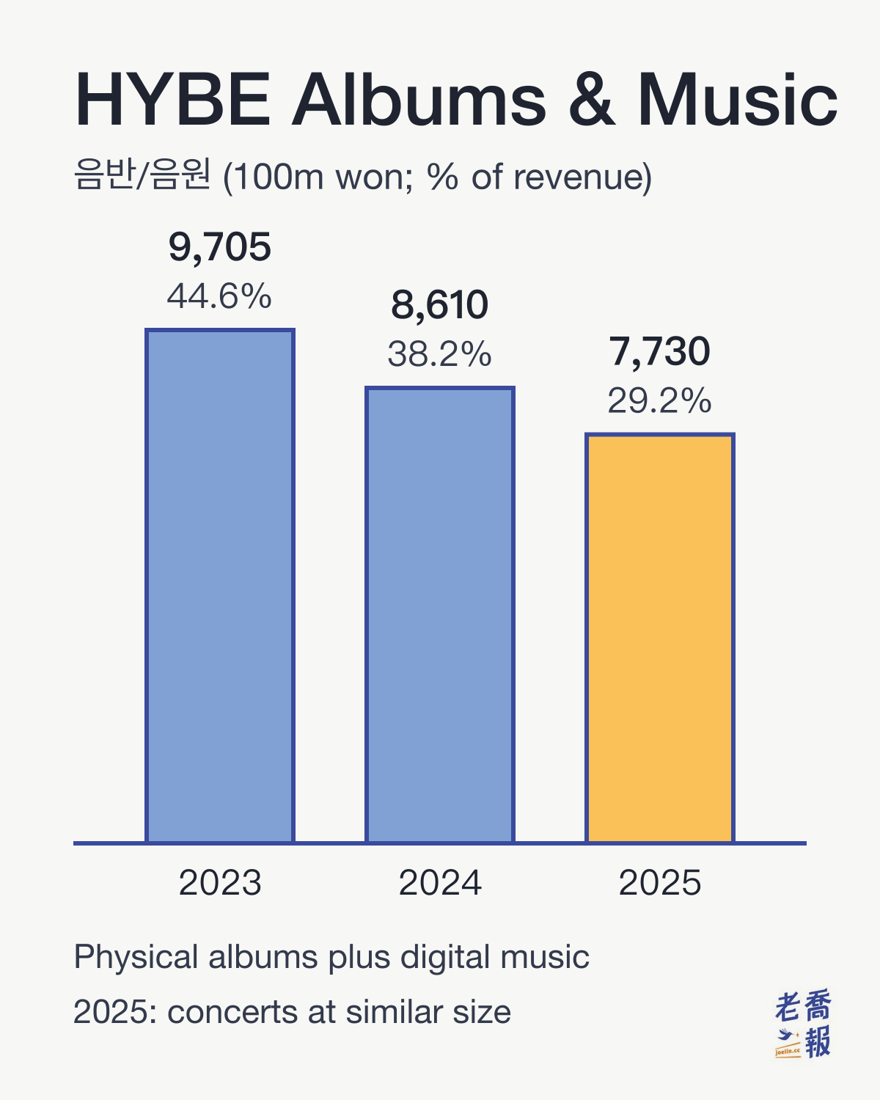
In 2025 HYBE’s concert revenue of 763.9 billion won (28.83%) is already in the same range as albums and music. The whole Korean market’s album sales are also shrinking: Korea Herald in November 2026, citing Circle Chart, gave 115.77 million copies in 2023, 93.28 million in 2024 and 86.38 million in 2025; the same report said the cumulative total of the Circle Chart top 400 in the first three quarters of 2026 was 7.6 million copies above the same period last year, and could return to 100 million copies or more. Circle Chart’s website publishes per-album sales only for the top 100, so this site could not check the market-wide totals on the official site; these three figures are media reports.
Regulation: told to sell separately, but not banned
Random photocards have been singled out a few times in Korea, and none of it has become a ban:
- The Korea Consumer Agency in March 2023 recommended that companies sell extras separately from albums; this is a recommendation, not a penalty.
- The Korea Fair Trade Commission was reported in August 2023 to be investigating whether agencies improperly tied photocards to albums (Law Times reported it as a check under Article 45 of the Fair Trade Act on tying); according to Korea Economic Daily, the Commission said at the time it could not comment on individual cases, and as of November 2026 this site could not find an official announcement of the result.
- What the Commission actually penalized in August 2024 was improper limits on returns by 4 official shops (Weverse Company, YG PLUS, SM Brand Marketing, JYP Three Sixty), with fines totaling 10.5 million won; in one example, an “event album” with an unrevealed photocard and entry to a signing-event lottery said it could only be cancelled or refunded during the application period. The penalty was about return rules, not about random photocards themselves.
Japanese editions are the same: the photocards stay with the record label
For K-pop albums released in Japan, the record label also puts the photocards in the disc package. Take TWICE’s “#TWICE5”, released in Japan on May 14, 2025 (Warner Music Japan), as an example:
- First-press limited edition A, ¥5,170: 3 random photocards out of 18 types, plus a serial code for an event lottery.
- Regular edition, ¥2,750: first pressing includes 1 random photocard out of 20 types.
Record labels’ own shops also add random cards; for example, Sony Music Shop sells Stray Kids’ imported albums with 1 random limited selfie photocard out of 8 types for each album bought (a first-come purchase bonus). On Oricon’s 2025 annual album ranking, Stray Kids’ “Hollow” was 5th, SEVENTEEN’s “HAPPY BURSTDAY” 7th and TOMORROW X TOGETHER 9th, and 11 of the top 30 were albums by Korean groups (the top 4 were all Japanese artists). Whether the Korean or the Japanese edition, it is agencies and record labels that plan and sell the photocards, and this site found no Japanese card company in it.
Compared with Japanese cards
| Japan | K-pop | |
|---|---|---|
| Sold as | Standalone packs | Album bonus |
| Made by | Card companies | Agencies |
| Booked as | Card revenue | Album revenue |
| Drives | The cards | Album sales |
Both use randomness to make people buy more; the difference is whether the card is the product itself. For Japanese cards (battle cards and oshikatsu collectible cards), the card is the product, and the money lands at the card company or merchandise maker; a K-pop photocard is an accessory to the album, the money lands in the agency’s album revenue, and what it really pushes is sales and rankings. So although K-pop photocards are the kind of card most familiar to this site’s women readers, they do not show up in the Japanese card industry’s books.
Where to buy and how to store
K-pop albums are sold at agencies’ official shops, record stores and the official shops of Japanese record labels. For photocard size and sleeves, see photocard sizes in millimeters and how to choose photocard sleeves; for the Korean used in fandom, see a roundup of fandom Korean (in Chinese). If you want to make your own fan photocards, you can use the Fan Support photocard maker that Joe Lin (老喬) runs.
FAQ
Can you buy K-pop album photocards on their own?
Officially, generally not. The photocard is a random bonus inside the album, so you only get it by buying the album, and the money is booked as album revenue. That is why fans who want a particular member’s card often buy several copies of the same album, or trade and buy from other fans.
How many albums do people buy for the photocards?
In the Korea Consumer Agency’s 2023 survey, people who bought albums to draw random extras bought 4.1 copies of the same album on average, and the most was 90. In the most extreme album there were 78 photocard types with 6 random ones in each copy, so even with no duplicates at all you would need 13 copies to complete the set.
How do photocards relate to album sales rankings?
Directly. Photocards make fans buy several copies, and every copy counts toward sales; Weverse Shop’s product page says all albums are counted in Circle Chart and Hanteo sales figures. High sales mean chart positions and news coverage. This site’s inference is that agencies therefore have an incentive to make more random photocard types; the Consumer Agency also named “fan marketing that exploits fans’ feelings” as the main cause.
Do Japanese card companies make K-pop photocards?
This site found no evidence of it. Photocards are made by Korean agencies and record labels and sold inside albums; Japanese editions are also released by Japanese record labels with random photocards inside the disc package. This site did not find Japanese card companies (Bushiroad, Bandai and others) in this chain.
Related reading
- Japan trading card industry research series guide: the full table of contents, key figures from each article and how the figures are defined
- The six kinds of women’s card customers: K-pop photocards are one of the six kinds of customers
- How oshikatsu collectible cards make money: Japan’s random collectible cards, another way of making a box that does not complete the set
- How girls’ arcade cards make money: also in Part 2, ¥100 per play and one card comes out
Sources: Korea Consumer Agency press release on the K-POP album extras survey (2023-03-07); Korea Fair Trade Commission penalty on idol merchandise shops’ return rights (2024-08); Korea Economic Daily report on the Commission’s tying investigation (2023-08), Law Times report on the Commission’s tying investigation; DART 2025 business reports HYBE, SM, JYP, YG; Weverse Shop album product page; Korea Herald (2026-11-01, citing Circle Chart); Circle Chart 2025 annual album chart; TWICE JAPAN “#TWICE5”; Sony Music Stray Kids notice; Oricon 2025 annual album ranking. Checked on November 18, 2026. The two infographics and the lead image were created by this site. This article is industry research and is not investment advice, and it does not discuss card prices or resale.
Keywords: K-pop photocards, album photocards, kpop photocard random, 포토카드 랜덤, buying duplicate albums for photocards, Weverse Shop, Circle Chart, HYBE, random photocards
Sources: The Chinese original was first published on 2026-11-18 (Taipei date). Figures and dates are as of the sources checked on 2026-11-18. The subject is South Korea and Japan; the Korea Consumer Agency survey covers albums released in 2021-2022, and the 2025 company figures come from fiscal 2025 annual reports.
This English version is based on original Traditional Chinese content on joelin.cc. The language and explanations are localised for international readers. The Traditional Chinese original is the authoritative version — for its complete meaning, please read the original article.