
This article is also available in: 繁體中文 · 日本語
Contents (16)
Summary
Japan’s idol arcade card games for elementary school girls are led by Bandai’s Aikatsu! (アイカツ!, known in Taiwan as 偶像學園) and the Pretty Series (プリティーシリーズ), developed jointly by Takara Tomy A.R.T.S and Syn Sophia (PriPara, プリパラ, is known in Taiwan as 美妙天堂). In both, ¥100 buys one play and one card; the card can be scanned back into the machine and is also collected. The machines sit in toy stores, the toy sections of mass retailers, and amusement arcades, and the anime of the same name airs on the TV Tokyo network, so the arcade game, the cards and the anime are sold together. In Bandai Namco’s financial materials, unit sales of Data Carddass (データカードダス, all of Bandai’s arcade cards) peaked at 306 million cards in FY3/2014 and were 115 million in FY3/2026. Aikatsu! group sales peaked at ¥15.9 billion in FY3/2014 and were ¥1.9 billion in FY3/2022; from FY3/2023 the reports no longer list the title. Cumulative Aikatsu! card shipments passed 110 million in March 2014 and 210 million in January 2016 (Bandai press releases). The new title アイカツ!アンコール began on October 8, 2026, with a target age of 7 to 9. Pretty Series revenue is not public: Takara Tomy’s securities report says only that the arcade business grew on the Pokémon machines and the popularity of アイプリ, and that results exceeded the previous year. Takara Tomy A.R.T.S had ¥53.606 billion in revenue for the whole company in FY3/2026, which includes capsule toys and other products. Who pays is not in public data; this site infers that it is mostly parents.
Key facts
- Aikatsu! and the Pretty Series both cost ¥100 (tax included) for one play and one card; アイカツ!アンコール also lets you buy just a card for ¥100 each.
- Bandai Data Carddass unit sales: 246 million cards in FY3/2013, 306 million in FY3/2014 (the peak), 126 million in FY3/2021, 135 million in FY3/2025, and 115 million in FY3/2026 (total for all series, not broken out by title).
- Aikatsu! group sales (Bandai Namco sales by IP): ¥15.9 billion in FY3/2014 (the peak), ¥4.6 billion in FY3/2016, and ¥1.9 billion in FY3/2022; no longer listed from FY3/2023.
- Cumulative Aikatsu! card shipments passed 110 million in March 2014 and 210 million in January 2016 (Bandai press releases).
- The Aikatsu! arcade game began on 2012-10-25; アイカツ!アンコール began operating on 2026-10-08, and Bandai gives the target age as 7 to 9.
- Pretty Series: from Pretty Rhythm (プリティーリズム, Takara Tomy) in 2010, then PriPara on 2014-07-10, ひみつのアイプリ in 2024-04 and おねがいアイプリ on 2026-04-02; original work by Takara Tomy A.R.T.S and Syn Sophia.
- Pretty Series revenue is not public; Takara Tomy A.R.T.S had ¥53.606 billion in revenue for the whole company in FY3/2026 (including capsule toys and other products).
- The anime for both series airs on the TV Tokyo network; who pays is not in public data, and this site infers it is mostly parents.
The core of Japan’s idol arcade card business for elementary school girls is a single ¥100 coin: one play of a dress-up and rhythm game, one card out of the machine, and a card that can be scanned back into the machine next time, collected, or traded. There are two main players: Bandai’s Aikatsu! (アイカツ!, known in Taiwan as 偶像學園), and the Pretty Series (プリティーシリーズ), developed jointly by Takara Tomy A.R.T.S and Syn Sophia (PriPara, プリパラ, is known in Taiwan as 美妙天堂). Shipments of all Bandai arcade cards peaked in FY3/2014 (306 million cards) and fell to 115 million in FY3/2026; Aikatsu! sales peaked at ¥15.9 billion in FY3/2014.

This article is part of the second part (women’s market) of the “Japan Trading Card Industry Research” series. Women’s trading cards: six types of buyers lists girls’ arcade cards as the first of six buyer types, and the only one of the six with company-level figures; this article stretches those figures into a series covering more than ten years.
What it sells: a ¥100 game and a card you take home
The two series play in much the same way:
- Aikatsu!: part of Bandai’s Data Carddass (the general name for Bandai’s arcade card machines), started on October 25, 2012. The newest title, アイカツ!アンコール, began operating on October 8, 2026; its official site says you start a game for ¥100 and get 1 card, and you can also buy just a card for ¥100. Bandai gives the target age as 7 to 9, and the machines are placed in the toy sections of toy stores, department stores and mass retailers, and in amusement arcades.
- Pretty Series: starting in July 2010 with Pretty Rhythm (プリティーリズム, ¥100 per play) from Takara Tomy, it continued with PriPara (July 2014), キラッとプリ☆チャン (April 2018), ワッチャプリマジ! (October 2021), ひみつのアイプリ (April 2024) and おねがいアイプリ (April 2, 2026). The current おねがいアイプリ costs ¥100 and up per play, and gives 1 card or more.
Here the card is three things at once: a save file (scan it back in and you can use that outfit), a collectible (complete a whole set), and a currency for trading (swap with classmates for the one you want). So unlike a battle card it needs no rulebook, but like a battle card it brings the player back for another coin through “which card comes next.”
Who pays is not answered directly by public data. What can be seen is this: Bandai gives the target age as 7 to 9, and the machines sit in toy sections; when Takara Tomy launched Pretty Rhythm in 2010, its press release said mothers and daughters can play together. From this, this site infers that the one putting in the ¥100 coin is mostly the parent standing next to the child.
Where it sits in the chain: arcade, cards and anime sold together
The business is not only cards. Most generations of the arcade game are paired with a TV anime (exceptions: the first-generation Pretty Rhythm arcade game in 2010, whose anime only began airing in April 2011, and アイカツ!アンコール, which is paired with a rerun of the older anime), and the anime of both series air on the TV Tokyo network. The anime introduces children to the characters, the arcade game lets them take a character’s outfit home, and toys and merchandise are sold after that.
flowchart TD
  A[Original work and planning<br>Bandai / Takara Tomy A.R.T.S<br>and Syn Sophia] --> B[TV anime<br>TV Tokyo network]
  A --> C[Arcade machine<br>¥100 per play]
  C --> D[Card<br>save, collect, trade]
  B --> E[Children get to know the characters]
  E --> C
  A --> F[Toys and licensed goods]
Diagram: joelin.cc · Joe Lin
Image source: created by this site, compiled from Bandai and Takara Tomy A.R.T.S press releases.
The rights structures of the two series differ. Aikatsu! carries the copyright notice “©BNP/BANDAI, DENTSU, TV TOKYO”, and the anime is produced by BN Pictures, part of the Bandai Namco group: the original work, anime production, machines and cards are led by the Bandai Namco group, with Dentsu and TV Tokyo also named in the copyright notice. The original work of the Pretty Series is jointly held by Takara Tomy A.R.T.S and the game developer Syn Sophia, and the anime is outsourced (アイプリ is produced by OLM and Dongwoo A&E); how the two companies split the money is not public.
The numbers: only Bandai has published them, and the more it publishes, the less there is
Shipments of all Bandai arcade cards
Each year Bandai Namco publishes Data Carddass unit sales in the supplementary materials to its earnings release. This is the total for all of Bandai’s arcade cards, not just Aikatsu!, and it is not broken out by title.
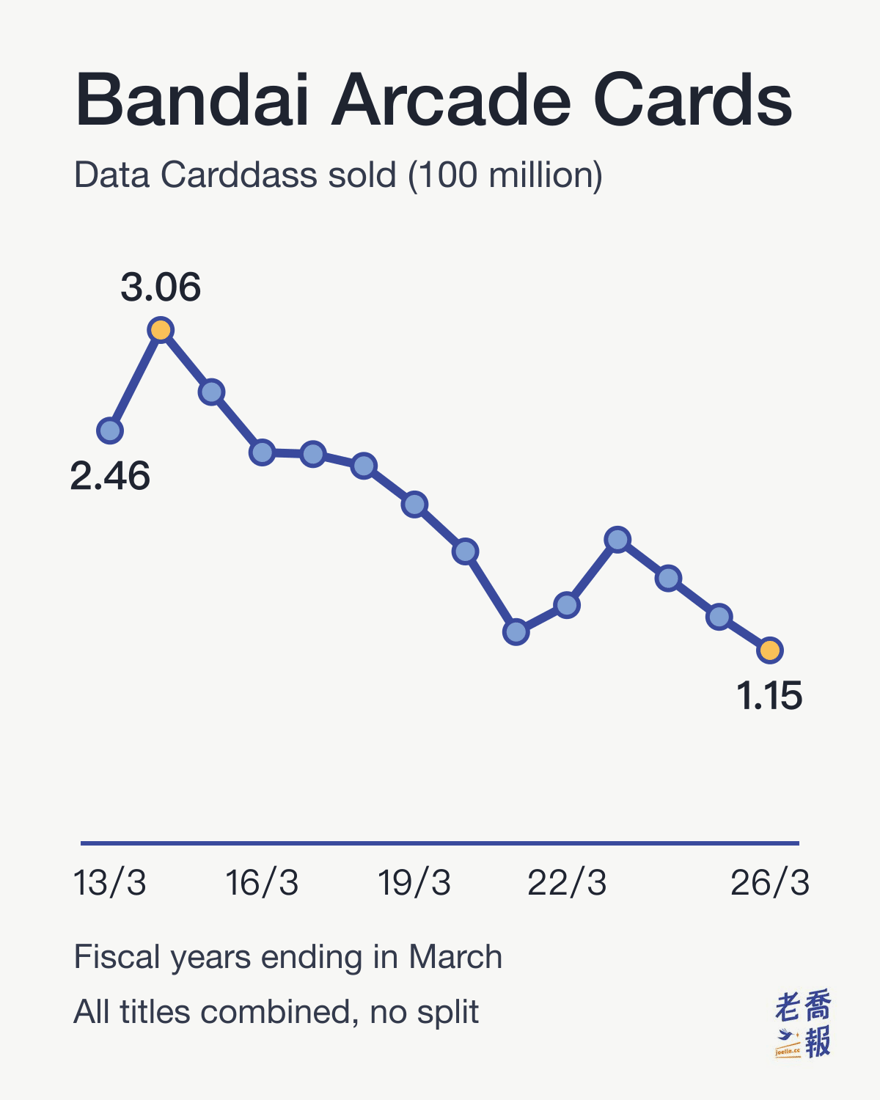
Shipments peaked in FY3/2014, exactly the year the first generation of Aikatsu! was at its hottest; they then fell steadily to 126 million cards in FY3/2021, returned to 181 million in FY3/2023, and dropped again to 115 million in FY3/2026 (the plan at the start of FY3/2026 was 125 million). Two notes on how the figure is defined: in supplements before 2023 this line was called “デジタルカード販売枚数” (digital card unit sales), and after that it was renamed “データカードダス販売枚数” (Data Carddass unit sales), with the numbers continuous across the change; and for FY3/2022, 151 million was first published, which the next year’s edition revised to 142 million, and this article uses the newer one.
Aikatsu! sales
Bandai Namco’s sales-by-IP table had an Aikatsu! row in the supplements published from 2014 to 2022, with figures covering FY3/2013 to FY3/2022. These are sales of the whole IP inside the group, including cards, toys, video and more, not just cards.
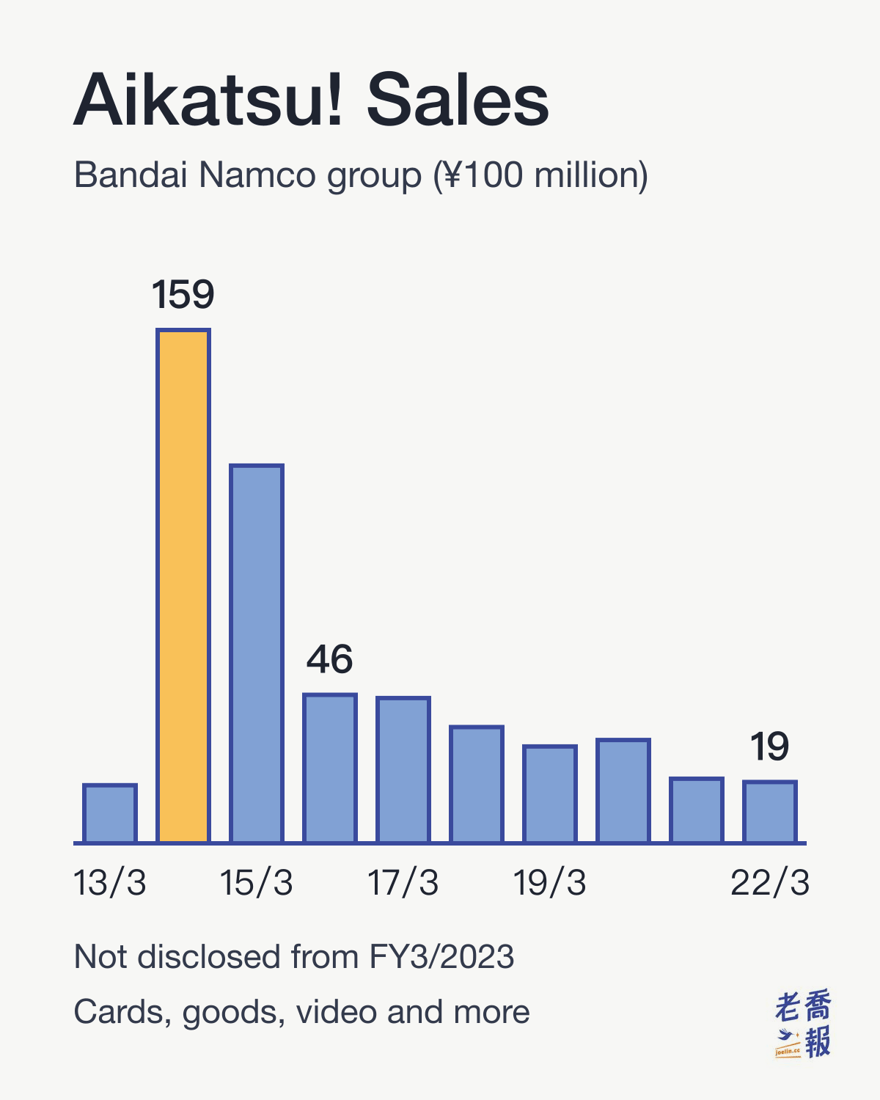
The ¥15.9 billion peak lasted only one year: ¥11.7 billion in FY3/2015, a fall to ¥4.6 billion in FY3/2016, then between ¥2.0 billion and ¥4.5 billion, and ¥1.9 billion in FY3/2022. From FY3/2023 the title disappears from the sales-by-IP table; Bandai Namco has not explained its listing threshold, but its May 2022 supplement put the FY3/2023 plan at ¥1 billion, so sales were already small when it disappeared. The message has since changed: Bandai’s press release of May 2026 says that in 2025, thanks to merchandise, sales returned to the 2014 level (“2014年の同水準まで売上を再拡大”); the sales-by-IP table for the same period still does not list Aikatsu! (the current table counts only the group’s main companies), so this statement cannot be checked against the financial reports.
For cumulative card shipments, Bandai’s press releases gave two milestones: more than 110 million in March 2014, and more than 210 million in January 2016. Bandai’s May 2026 press release also says “3.4 billion cards cumulative,” but the total of all Bandai arcade cards over fourteen years comes to about 2.74 billion, so the two do not match (Aikatsu! also has cards that do not ship through arcades, but the gap is too large); this article does not use that figure.
Pretty Series: just one sentence
Takara Tomy’s financial reports have never published Pretty Series revenue. The securities report for FY3/2026 says that the arcade business grew on the Pokémon machines plus the popularity of ひみつのアイプリ, and that results exceeded the previous year, without breaking out アイプリ; the earnings presentation introduces the newest title おねがいアイプリ and the two arcade games running side by side from April 2026, and gives no amount either. When gamebiz covered the launch event of February 26, 2026, it wrote that ひみつのアイプリ again set a series sales record in 2025, following the previous year, and that its arcade business surpassed the earlier PriPara; this is the media’s account. The one company figure visible is Takara Tomy A.R.T.S’s revenue for the whole company in FY3/2026, ¥53.606 billion, which also includes capsule toys, plush toys and other machines, so it cannot be taken as the Pretty Series figure.
The two series side by side
In the table, “Pretty” means the Pretty Series, and the start for it is Pretty Rhythm (2010.07); “Revenue” shows whether sales are public.
| Aikatsu! | Pretty | |
|---|---|---|
| Maker | Bandai | Takara Tomy A.R.T.S |
| Start | 2012.10 | 2010.07 |
| Per play | ¥100, 1 card | ¥100+, 1+ cards |
| Newest | アンコール | おねがいアイプリ |
| Revenue | Until FY3/2022 | Not public |
The business model of the two series is almost identical: ¥100 a round, one card, and an anime on the TV Tokyo network. The difference is in how much is made public: because Bandai is a listed group that discloses by IP, it left a ten-year sales curve for Aikatsu!; the Pretty Series is jointly held by Takara Tomy A.R.T.S and Syn Sophia, and its financial reports offer only adjectives. In Bandai’s figures, the peak of this business came in 2014, in the year the first generation was hottest, and through FY3/2022 no year on the IP table returned to that height.
Where to play in Japan
Machines for girls’ arcade cards are in toy stores, the toy sections of department stores and mass retailers, and amusement arcades; each series’ official site has a store locator, and the machines are not a main product at specialty card shops. For battle-card and collectible-card shops, you can use Trading card shops in Japan, operated by Joe Lin (老喬): 16 chains and major independent shops (November 2026).
FAQ
How do Aikatsu! and PriPara cards work?
At a machine in a toy store, the toy section of a mass retailer, or an amusement arcade, you put in ¥100, play one round of a rhythm and dress-up game, and the machine dispenses one card. The card shows a character and an outfit. You can scan it back into the machine next time, or collect it and trade it with friends. アイカツ!アンコール also lets you buy a single card for ¥100 without playing the game.
How much does Aikatsu! sell in a year?
Bandai Namco’s earnings supplements from 2014 to 2022 listed Aikatsu! group sales (cards, merchandise, video and more, covering FY3/2013 to FY3/2022). The peak was ¥15.9 billion in FY3/2014, and FY3/2022 was ¥1.9 billion; from FY3/2023 the reports no longer list the title. A Bandai press release in May 2026 said that sales in 2025 returned to the 2014 level thanks to merchandise, but the financial reports do not list it, so it cannot be checked. For the cards themselves, only the combined shipment count for all Bandai arcade cards is published: 115 million cards in FY3/2026, with Aikatsu! not broken out.
How much does the Pretty Series earn?
There is no public figure. Takara Tomy’s securities report says only that the arcade business grew on the Pokémon machines and the popularity of ひみつのアイプリ, and that results exceeded the previous year, without breaking out アイプリ. Takara Tomy A.R.T.S, the company behind the series, had ¥53.606 billion in revenue for the whole company in FY3/2026, and that also includes capsule toys, plush toys and other products. Media coverage of a February 2026 launch event said ひみつのアイプリ again set a series sales record in 2025, following the previous year, also without an amount.
Who pays for girls’ arcade cards?
No public data answers this directly. Bandai gives 7 to 9 as the target age of アイカツ!アンコール, and the machines are placed in toy sections; a 2010 Takara Tomy press release said mothers and daughters can play together. From this, this site infers that the payer is mostly a parent, but that is this site’s inference, not a company figure.
Related reading
- Japan Trading Card Industry Research: series guide: the full series contents, key figures from each article, and how the figures are defined
- Women’s trading cards: six types of buyers: girls’ arcade cards are the first of the six types
- Bushiroad’s sister brand Blau ends after four years: also in the second part, spinning a brand off a battle card game to reach fans of particular titles
- How Bandai turns manga into cards: how to read Bandai Namco’s sales by IP
Sources: Bandai Namco Holdings earnings supplements March 2026, March 2025, March 2023, March 2022, March 2021, March 2020, March 2019, March 2018, March 2017, March 2016, March 2015, March 2014 (each year’s earnings supplement); Bandai Aikatsu Stars! press release (2016-02-22), アイカツ!アンコール announcement press release (2026-05-01), アイカツ!アンコール launch press release (2026-10-08), アイカツ!アンコール official site FAQ, All Aikatsu! series list; Takara Tomy Pretty Rhythm press release (2010-07-15); Takara Tomy A.R.T.S PriPara press release (2020-12-06), プリ☆チャン 5th anniversary press release (2023-02-28), ワッチャプリマジ! press release (2022-01), ひみつのアイプリ press release (2024-01-26), おねがいアイプリ press release (2026-02-26), アイプリ official site, how to play; Takara Tomy securities report for FY3/2026, earnings presentation for FY3/2026; gamebiz report on the launch event (2026-02-26); Syn Sophia company profile. Checked on November 18, 2026. The two infographics and the lead image were created by this site; the logo and official images come from official websites and are used only to identify and introduce products. This article is industry research and is not investment advice.
Keywords: Aikatsu! cards, PriPara cards, アイカツ!, Pretty Series, ひみつのアイプリ, おねがいアイプリ, Data Carddass unit sales, girls’ arcade cards, Bandai, Takara Tomy A.R.T.S
Sources: The Chinese original was first published on 2026-11-18 (Taipei date). Figures keep the fiscal periods and dates stated in the original, with sources checked on 2026-11-18. The subject is Japan; the Taiwan translations of titles apply to Taiwan only.
This English version is based on original Traditional Chinese content on joelin.cc. The language and explanations are localised for international readers. The Traditional Chinese original is the authoritative version — for its complete meaning, please read the original article.