
This article is also available in: 繁體中文 · 日本語
Contents (18)
Card companies sell more than cards. They also manage three things: how many cards are on the market, what you pull from a box, and which cards are legal at tournaments. Japan’s main card companies have four tools: rarity decides whether one box can complete a set, reprints and additional production decide how much volume to release, lotteries and identity verification decide who gets to buy, and banlists and rotation decide how often the competitive environment turns over. For the October 2026 Yu-Gi-Oh! booster pack with 80 cards in total, the official page states outright that “one box won’t complete it”; from August 2026, Pokémon lets players verify their accounts with a My Number Card to join priority lotteries; from April 2026, the ONE PIECE Card Game’s Standard format uses only roughly the latest three years of cards. None of the companies publishes pull rates, production volumes, or reprint quantities.
This article is part of the Japan Trading Card Industry Research series. Earlier articles took apart the companies’ accounts; this one takes apart the everyday work of a card company. Given the same IP, how well an IP is turned into cards, the theme of the first article, depends in large part on these four tools.
What it offers: a fair environment for players, rarity for collectors
Card game customers have two kinds of needs, and card companies manage both:
- Competitive players want an environment: one strong deck must not dominate for too long, new cards must be useful, and which cards are legal at tournaments must be clearly stated.
- Collectors want rarity: the same card comes in shiny versions, special frames, and different illustrations, and pulling one feels valuable.
Both affect whether a new set sells. This site’s view: rarity and banlists look like one manages collecting and the other manages competition, but both are designs that keep players buying new sets. This is an inference; the companies’ notices do not say so.
Upstream and downstream: where the four tools sit
flowchart TD
  A["Company designs a set<br>Rarity and card count"] --> B["Production and reprints<br>How much volume"]
  B --> C["Distribution<br>Lottery, ID check, limits"]
  C --> D["Players open packs, build decks"]
  D --> E["Tournament rules<br>Banlist, rotation"]
  E --> A
Diagram: joelin.cc · Joe Lin
Diagram note: compiled by this site from the official notices of the four card games. Rarity and production are in the card company’s hands; part of the lotteries run through the company’s own channels (Pokémon Center Online, Premium Bandai); tournament rules in turn shape how the next set is designed.
Rarity: 80 cards in a set, and one box can’t complete it
For the Yu-Gi-Oh! booster pack IMMORTAL PHOENIX, released on October 31, 2026, the official product page is very detailed. The table below lists the number of cards at each rarity:
| Rarity | Types |
|---|---|
| Common | 40 |
| Rare | 18 |
| Super Rare | 10 |
| Ultra Rare | 8 |
| Ultimate Rare | 4 |
| Secret Rare ver. | 30 |
| Prismatic ver. | 24 |
A pack has 5 cards and costs ¥198 including tax (¥180 before tax), and a box has 30 packs. The first five rarities add up to 80 cards; the last two rows are higher-rarity versions made of the same cards and are not counted separately, and 4 of the Prismatic Secret Rare cards use an “Over Frame (オーバーフレーム)” (オーバーフレーム) design. The official product page states directly “1ボックスで80種類全部は揃いません” (one box will not complete all 80 types): a box has 150 cards, which cannot cover 80 types.
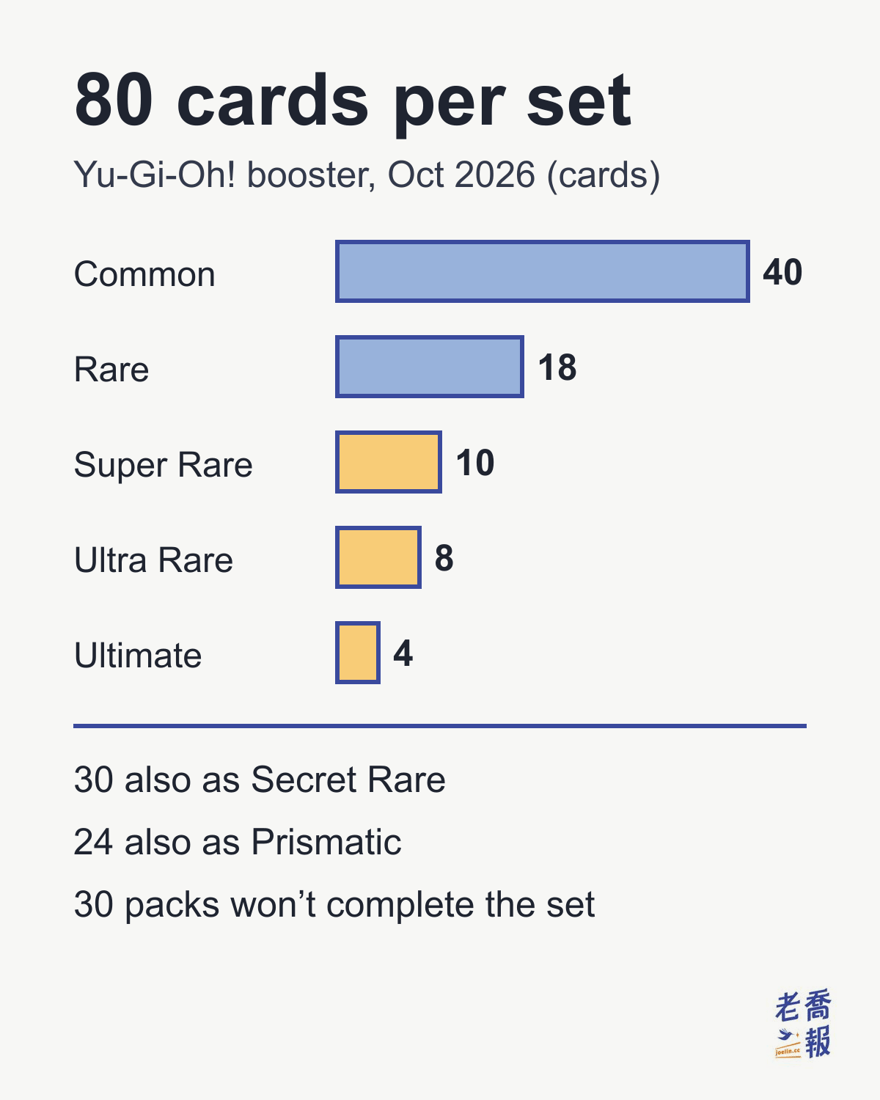
Take this set as an example: the same card is made in versions with different levels of shine. The card effect is identical, so for competitive players the plain version is enough, while collectors chase the higher-rarity version. How many cards of each rarity appear in a box (the pull rate) is not published.
Price is also set by the card company. On the Pokémon Card Game official product list, the suggested retail price of an expansion pack was mostly ¥180 from 2025 to March 2026, and ¥200 from アビスアイ in May 2026; the 30th-anniversary “30th CELEBRATION” is ¥360 per pack.
Reprints: additional production and re-inclusion
When a card sells out, the company can order additional production, or put old cards into a new product and release them again.
- Pokémon: on March 13, 2026, it announced additional production of 3 Special BOX (スペシャル BOX) products, saying it plans “to keep producing more going forward” depending on sales, and in the same notice asked people considering a purchase on secondhand platforms to “act calmly”.
- Yu-Gi-Oh!: in the “+1 Expansion Pack” bundled with the first print run of IMMORTAL PHOENIX, all 14 Ultra Rares are old cards that were re-included, and 4 of them got new illustrations.
- ONE PIECE: when some old cards are re-included, the official side updates the block icon at the bottom right according to the environment, and after the update they stay usable in Standard (see the next section).
Neither how much is produced nor how long before a card is re-included is published by any of the companies. The only production-side disclosure found so far is that Bushiroad said in its earnings presentation that it expanded production lines at its Malaysian factory for Palworld card demand.
Lotteries: who gets to buy, decided by ID verification
When a hot product is not enough to go around, a card company’s own channels switch to lotteries.
Pokémon’s approach is the strictest this site has seen. From August 3, 2026, the Pokémon Card Game player membership site “Players Club” (プレイヤーズクラブ) introduced My Number Card identity verification, and verified accounts are used for priority lotteries on some products at Pokémon Center Online and for registration at some domestic official tournaments. In the Pokémon Card Game additional lottery announced on September 29, most winning slots were reserved for verified people, each person could apply only once, and the right to buy could not be transferred; the notice also previewed another additional lottery around December for 3 products, including the 30th-anniversary “30th CELEBRATION” BOX.
The ONE PIECE Card Game’s booster packs are also sold by lottery on Bandai’s own site, Premium Bandai (プレミアムバンダイ), for example “神の支配 [OP-18]”, for which applications opened on November 6, 2026.
This site’s view: a lottery controls who can buy first-hand, but it cannot control what happens after the purchase; Pokémon’s notice positions it as a “priority” lottery, not the only way to buy every product.
Banlists and rotation: which cards are legal at tournaments
The longer a competitive card game runs, the more cards are legal and the more strong combinations exist. The four games use two different approaches.
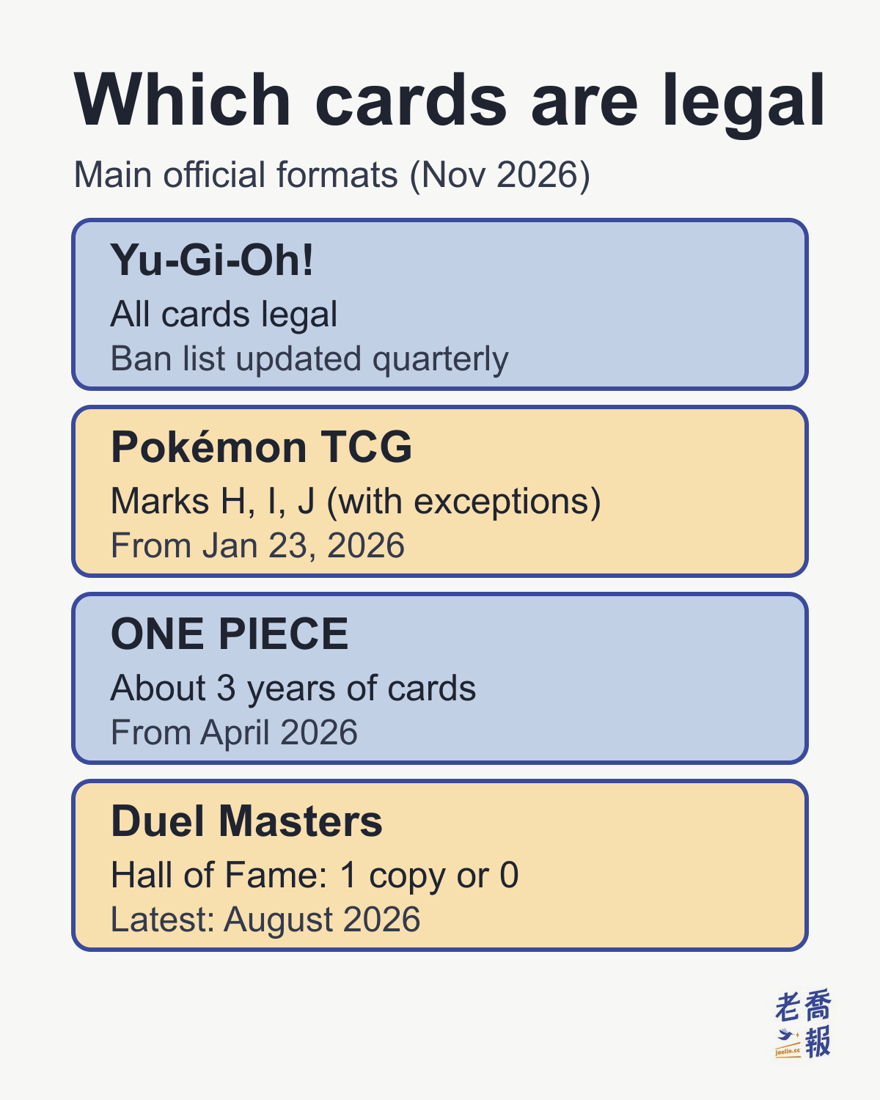
| Card | Method | Latest |
|---|---|---|
| Yu-Gi-Oh! | Ban/limit | 2026-10-01 |
| Pokémon | Mark rotation | 2026-01-23 |
| ONE PIECE | Icon rotation | 2026-04-01 |
| Duel Masters | Hall of Fame | 2026-08-10 |
Dates are the most recent application dates; ONE PIECE manages bans and limits separately, with the most recent announcement on November 17, 2026, applying from November 28. Yu-Gi-Oh! and Duel Masters do not retire old cards and only limit the number of copies; Pokémon and ONE PIECE retire old cards from the Standard format and open a separate format where old cards can be used.
Yu-Gi-Oh!: every past card is legal, and the banlist changes every quarter
The official Yu-Gi-Oh! site states that every card released in the past is legal, so it manages the game with the Forbidden & Limited List (リミットレギュレーション): Forbidden (cannot be included), Limited (1 copy), and Semi-Limited (2 copies). The updates listed on the official site run from the 2nd in September 2005 to the 70th in July 2026, with another change on October 1, 2026; since April 2014, updates have come roughly on the 1st of January, April, July, and October. The selection criteria the official side lists include keeping the game balanced, widening deck choices, and restricting cards players find hard to answer, and it states that these restrictions are “not permanent”.
Pokémon: look at the mark at the bottom left of the card
Since the “Sun & Moon” (サン&ムーン) series, Pokémon cards have carried a regulation mark (レギュレーションマーク) at the bottom left. The Standard (スタンダード) format, from January 23, 2026, in principle uses only cards marked H, I, or J (the official side separately lists a few older basic cards that can still be used). There is also the Extra (エクストラ) format, which allows cards from the “BW” series onward, and the Hall of Fame (殿堂) format, which limits strong cards using Hall of Fame points.
ONE PIECE: block icons, only about three years
The ONE PIECE Card Game introduced the block icon (ブロックアイコン) system on April 1, 2026. The number at the bottom right of a card is ① for sets 1 to 4 and ② for sets 5 to 8, advancing once a year; the Standard format uses only roughly the latest three years, so ② to ⑤ are legal from April 2026 to March 2027, and from April 2027 it changes to ③ to ⑥. The stated purpose is that by 2032 there would be ten years of cards, and the game needs to address growing complexity so that new players can join at any time. Bans and limits are managed separately, looking at the win rate of particular leader decks, tournament results, and share of participation, and are basically announced after the Japan Championship Season 1 and the world finals; the most recent was announced on November 17, 2026 and applies from November 28.
Duel Masters: Hall of Fame
Duel Masters uses the Hall of Fame regulation (殿堂レギュレーション): a card in the Hall of Fame (殿堂入り) can be included only once per deck, a card in the Premium Hall of Fame (プレミアム殿堂) cannot be included at all, and there are also “Premium Hall of Fame combos” (プレミアム殿堂コンビ) that cannot be in the same deck. The most recent one applied on August 10, 2026, and the official side states that it also takes into account cards to be released afterward.
Compared with peers: same tools, different levels of disclosure
| Tool | Public | Not public |
|---|---|---|
| Rarity | Card counts | Pull rates |
| Reprints | If added | Volumes |
| Lottery | Rules | Winners |
| Banlist | List, policy | Deck data |
All four games’ official notices state clearly what the rules are, but anything to do with quantities is not published. ONE PIECE is one of the few that writes out the basis of its ban decisions (win rate, results, share of participation), but the data itself is not published either.
This site’s view: these four tools are the card company’s own expertise, beyond the IP. Given the same hot IP, a rarity design that is too stingy drives players away, additional production that is too slow lets the secondhand market set prices in place of the official side, and a banlist that goes unchanged too long leaves tournaments with only one deck. The earlier articles showed The Pokémon Company, Bandai, Bushiroad, and Konami and Takara Tomy turning card games into stable businesses, and that rests on more than IP: it also rests on these adjustments, made every quarter and every year.
Where to buy in Japan
New sets are sold at trading card specialty shops and toy retailers in Japan, and tournaments are also held at card shops. To find a shop, you can use the list of trading card shops in Japan run by Joe Lin (老喬): 16 chains and major independent shops (November 2026), searchable by chain or area.
Frequently asked questions
Who decides the rarity of trading cards?
The company that publishes the cards decides it when designing each set. Take Yu-Gi-Oh! as an example: the official product page states how many cards exist at each rarity. In IMMORTAL PHOENIX (October 31, 2026), of 80 cards in total, 40 are Common and 4 are Ultimate Rare, and 30 of them also have a Secret Rare version. The pull rate for each rarity is not published.
How often does the Yu-Gi-Oh! banlist change?
Since April 2014, the official Forbidden & Limited List (リミットレギュレーション) has been updated roughly once a quarter, on the 1st of January, April, July, and October. July 1, 2026 was the 70th update, and it changed again on October 1. Every card released in the past is legal in Yu-Gi-Oh!, so the environment is managed with Forbidden (not allowed), Limited (1 copy), and Semi-Limited (2 copies).
What is the block icon (ブロックアイコン) in the ONE PIECE Card Game?
It is the number at the bottom right of a card: sets 1 to 4 carry ①, sets 5 to 8 carry ②, and it advances once a year. From April 1, 2026, the Standard format uses only roughly the latest three years of cards: from April 2026 to March 2027, cards ② to ⑤ are legal. Older cards can be played in the Extra format. The official stated aim is to let new players join at any time and keep card text simple.
Why does the Pokémon Card Game use My Number Card for lotteries?
From August 3, 2026, Pokémon lets accounts on its player membership site be identity-verified with a My Number Card (マイナンバーカード, Japan’s personal ID card). Verified accounts are used for priority lotteries on some products at Pokémon Center Online and for registration at some domestic official tournaments. In the additional lottery of September 29, 2026, most winning slots were reserved for verified accounts, and each person could apply only once.
Related reading
- Japan Trading Card Industry Research series guide: the full series contents, each article’s key figures, and how the figures are defined
- Four ways Japan turns IP into trading cards: the first article in the series, on who collects license fees, who makes the cards, and who sells them
- How Yu-Gi-Oh! and Duel Masters keep going: two long-running card games across paper cards, apps, and tournaments
- The Pokémon Company’s ¥120.1 billion annual net profit: how the company behind the Pokémon cards makes money
- Who makes the money on a single trading card in Japan: after a new set ships, the published figures for wholesale, specialty shops, and the secondhand market
Sources: Yu-Gi-Oh! OFFICIAL CARD GAME “IMMORTAL PHOENIX” product page, Yu-Gi-Oh! OFFICIAL CARD GAME Forbidden & Limited List (リミットレギュレーション); Pokémon Card Game regulations (レギュレーション), product information (expansion packs), March 13, 2026 additional production notice, notice on introducing Players Club identity verification, Pokémon Center Online September 29, 2026 additional lottery notice; ONE PIECE Card Game block icon system introduction (ブロックアイコン制度導入), banned and limited cards (禁止・制限カード), NEWS (OP-18 Premium Bandai lottery sale); Duel Masters Hall of Fame regulation (殿堂レギュレーション). Checked on November 18, 2026. The two infographics and the hero image were made by this site; the official key visuals come from the official sites and are used only to introduce the products. This article is industry research; it does not discuss card prices or resale and is not investment advice.
Keywords: trading card rarity, トレカ レアリティ, Forbidden & Limited List (リミットレギュレーション), banlist, Pokémon Card Game lottery, My Number Card identity verification (マイナンバーカード 本人認証), block icon system (ブロックアイコン制度), Hall of Fame regulation (殿堂レギュレーション), additional production
Sources: The Chinese original was first published on 2026-11-18 (Taipei date). Figures and dates follow the official notices checked on November 18, 2026. The ID-verified lottery described applies to Japan.
This English version is based on original Traditional Chinese content on joelin.cc. The language and explanations are localised for international readers. The Traditional Chinese original is the authoritative version — for its complete meaning, please read the original article.