
Other languages (11)
繁體中文 · 日本語 · 한국어 · Bahasa Indonesia · Bahasa Melayu · ไทย · Português (Brasil) · Español · Türkçe · Tiếng Việt · Deutsch
Contents (14)
The battery Americans and Britons call AA has the international code LR6 (alkaline) or R6 (carbon-zinc). In Japan it is 単3形, in China 5号, and in Taiwan No. 3. AAA is LR03: 単4形 in Japan, 7号 in China and No. 4 in Taiwan.
The same cell goes by completely different names from place to place, and the numbers do not even line up: what Taiwan calls No. 3 is called 5号 in China, and China’s 7号 is Taiwan’s No. 4. What really works across borders is the IEC code printed on the battery itself. The International Electrotechnical Commission’s standard for primary batteries, IEC 60086-1 (14th edition published in 2026), defines this naming system, and Japan’s and China’s national standards follow it. Once you can read the code, you will buy the right battery anywhere.
Battery names by country: AA = LR6 = 単3 = 5号 = No. 3
| US/UK | IEC | Japan | China | Taiwan |
|---|---|---|---|---|
| D | LR20/R20 | 単1 | 1号 | No. 1 |
| C | LR14/R14 | 単2 | 2号 | No. 2 |
| AA | LR6/R6 | 単3 | 5号 | No. 3 |
| AAA | LR03/R03 | 単4 | 7号 | No. 4 |
| 9V | 6LR61/6F22 | 9V形 | 9V | 9V |
The sources for this table fall into three groups. The IEC codes and the Japanese and American names come from the Battery Association of Japan’s (BAJ) battery specification page, which lists R20 = 単1 = D, R14 = 単2 = C, R6 = 単3 = AA and R03 = 単4 = AAA; in Japan the 9V battery is also called type 006P, as shown on the association’s battery types page. The UK uses the same letter names: GOV.UK’s guidance on recycling batteries refers to “AAA, AA and 9V batteries”. Taiwan’s No. 3 and No. 4 appear in the 2016 (ROC year 105) market sample test results for alkaline batteries from Taiwan’s Bureau of Standards, Metrology and Inspection, where the product-name column reads “LR6 1.5 V AA 3號” and “LR03 1.5 V AAA 4號”. China’s 5号 and 7号 appear in the Shenzhen Administration for Market Regulation’s 2021 list of primary batteries sampled for inspection, where the product names read “碳性5号电池 Size AA” (carbon-zinc No. 5 battery) and “7号 AAA LR03”. No. 1 and No. 2 use the same numbers in both Taiwan and China; this is everyday usage.
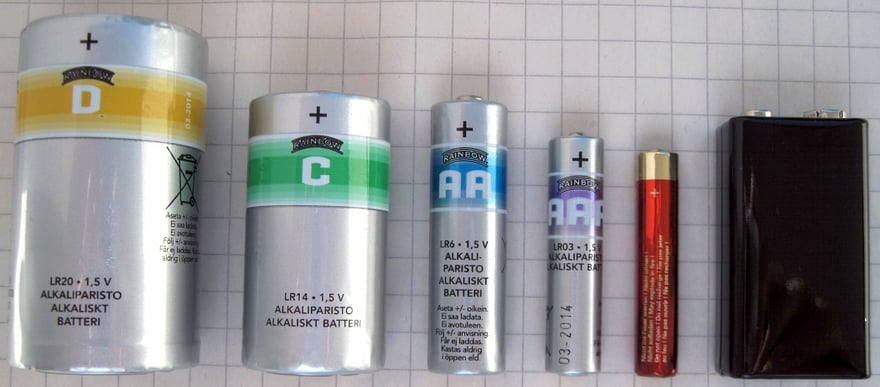

Why Taiwan’s numbers and China’s numbers part ways from No. 3 onward could not be traced to a reliable source. A 2024 report in the overseas edition of People’s Daily mentions that Chinese sizes from 1号 to 9号 all exist and that the higher the number, the smaller the cell, but it does not explain the origin either. Hong Kong simply uses the English names: the Hong Kong Consumer Council’s battery test table is titled “AA及AAA電池測試結果” (AA and AAA battery test results), and carbon-zinc batteries are called 碳性電池 there.
Dimensions and voltage: carbon-zinc and alkaline cells with the same size code are identical in size
| Name | IEC | Height × diameter max. (mm) |
Voltage |
|---|---|---|---|
| D (Taiwan No. 1) | R20 | 61.5×34.2 | 1.5V |
| C (Taiwan No. 2) | R14 | 50.0×26.2 | 1.5V |
| AA (Taiwan No. 3) | R6 | 50.5×14.5 | 1.5V |
| AAA (Taiwan No. 4) | R03 | 44.5×10.5 | 1.5V |
The dimensions come from the Battery Association of Japan’s specification page, which notes that the standard sets maximum values and actual batteries are slightly smaller; carbon-zinc and alkaline cells both have a nominal voltage of 1.5V. The key point is that the size depends only on the size code: an R6 carbon-zinc cell and an LR6 alkaline cell have the same shape and both fit an AA holder; what differs is the chemistry inside. The leading 6 in 6LR61, the IEC code of the 9V battery, means it contains six 1.5V cells connected in series; it and 6F22 (carbon-zinc) are listed in the same specification clause of IEC 60086-2. The US also has its own national battery standard series, ANSI C18, but you will not need its numbers for everyday shopping.
How to read IEC battery codes: the first letter is the chemistry
The Battery Association of Japan breaks an IEC/JIS code into four parts, in this order:
- The number of cells in series (omitted when there is only one; the 9V 6LR61 starts with 6).
- The chemistry letter (carbon-zinc batteries have no letter).
- The shape letter: R is round (cylindrical, button or coin), F is flat or rectangular.
- The size number.
So LR6 reads as “alkaline (L), round (R), size 6”, and R6, which has no chemistry letter, is carbon-zinc (called a manganese dry cell in Japan). The five most common chemistry letters are:
| Letter | Chemistry | Nominal voltage |
|---|---|---|
| None (R6) | Carbon-zinc (manganese) | 1.5V |
| L (LR6, LR44) | Alkaline | 1.5V |
| C (CR2032) | Lithium (manganese dioxide) | 3.0V |
| S (SR44) | Silver oxide | 1.55V |
| H (HR6) | Nickel-metal hydride (rechargeable) | 1.2V |
This table is compiled from the Battery Association of Japan’s specification page. The same page also lists less common letters: P (zinc-air, 1.4V, common in hearing aids), F (lithium iron disulfide, 1.5V), B (lithium carbon monofluoride, 3.0V), E (lithium thionyl chloride, 3.6V), K (nickel-cadmium rechargeable, 1.2V) and IC (lithium-ion, 3.7V). The key to reading the table is that the first letter decides the voltage, and misreading the letter causes more trouble than misreading the size: a code starting with CR means 3V and one starting with LR means 1.5V, so no matter how similar the size, they cannot be mixed. F serves both as a chemistry letter (lithium iron disulfide) and as a shape letter (rectangular), so you have to judge it by its position in the code.
Decoding CR2032: in newer codes the numbers are the size
flowchart TD
    A["CR2032"] --> B["C: lithium-MnO₂, 3V"]
    B --> C["R: round"]
    C --> D["20: 20mm diameter"]
    D --> E["32: 3.2mm thick"]
Diagram: joelin.cc · Joe Lin
In older codes such as R6, R03 and LR44, the number is only a serial number with no direct link to the size. Annex C of IEC 60086-1 splits the naming into two systems, “before October 1990” and “after October 1990” (see the table of contents of the 13th edition from 2021), and the newer codes for round cells are built directly from the dimensions: the first two digits are the diameter in millimetres, the last two the thickness in tenths of a millimetre. Read by this rule, CR2032 means lithium manganese dioxide, round, 20 mm in diameter, 3.2 mm thick, and the letter C corresponds to a nominal 3.0V. Likewise, CR2025 is 20 mm in diameter and 2.5 mm thick, and CR2016 is 1.6 mm thick; all three share the same diameter but differ in thickness.
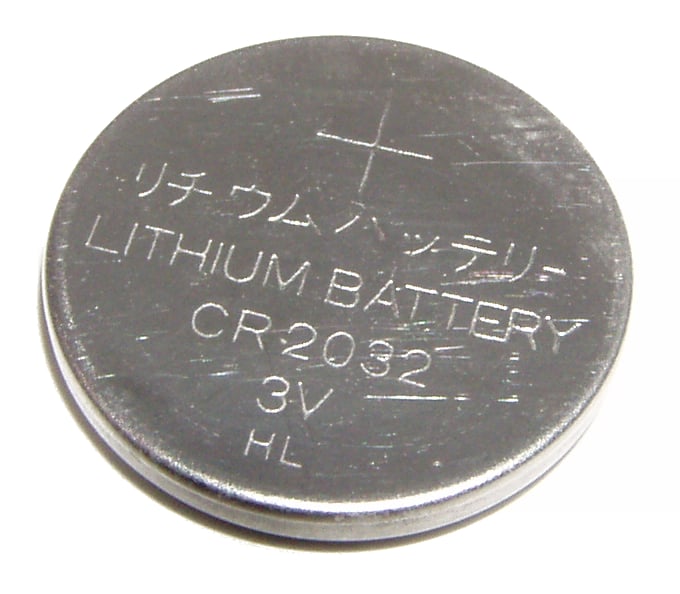

LR44, SR44, AG13: same size, different chemistry
The button cells most often confused are LR44 and SR44. Both carry the size code 44 and are the same size; IEC 60086-2 lists them in separate specification groups for alkaline and silver oxide cells. The difference is the first letter: L is alkaline with a nominal 1.5V, S is silver oxide with a nominal 1.55V. The Battery Association of Japan’s Q&A page also points out that button cells of the same size but a different type differ in internal materials and construction, and so in output and service life. When a device specifies SR44, an LR44 will not necessarily perform the same.
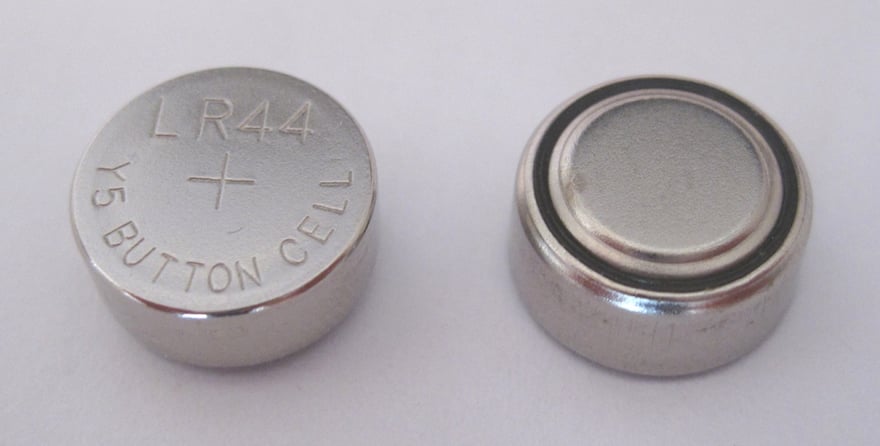

AG13, a name often seen on retail packaging, usually means an alkaline button cell in the LR44 size. But AG is not in the IEC table of chemistry letters; it is an industry convention, not a standard code. When buying, go by the LR44 or SR44 printed on the same pack.
18650 and rechargeable batteries: outside the AA/AAA naming
18650 is the industry’s customary size name for lithium-ion rechargeable cells; the numbers read as about 18 mm in diameter and about 65 mm long. It is not an IEC 60086 code for primary batteries. The international standard for secondary lithium cells is the IEC 61960 series; IEC 61960-3 covers performance testing, designation and marking of cylindrical and prismatic lithium cells, with its own naming scheme. The Battery Association of Japan’s table gives the nominal voltage of lithium-ion cells as 3.7V, more than twice that of an AA alkaline cell, and the cell is also noticeably bigger, so the two cannot be swapped.
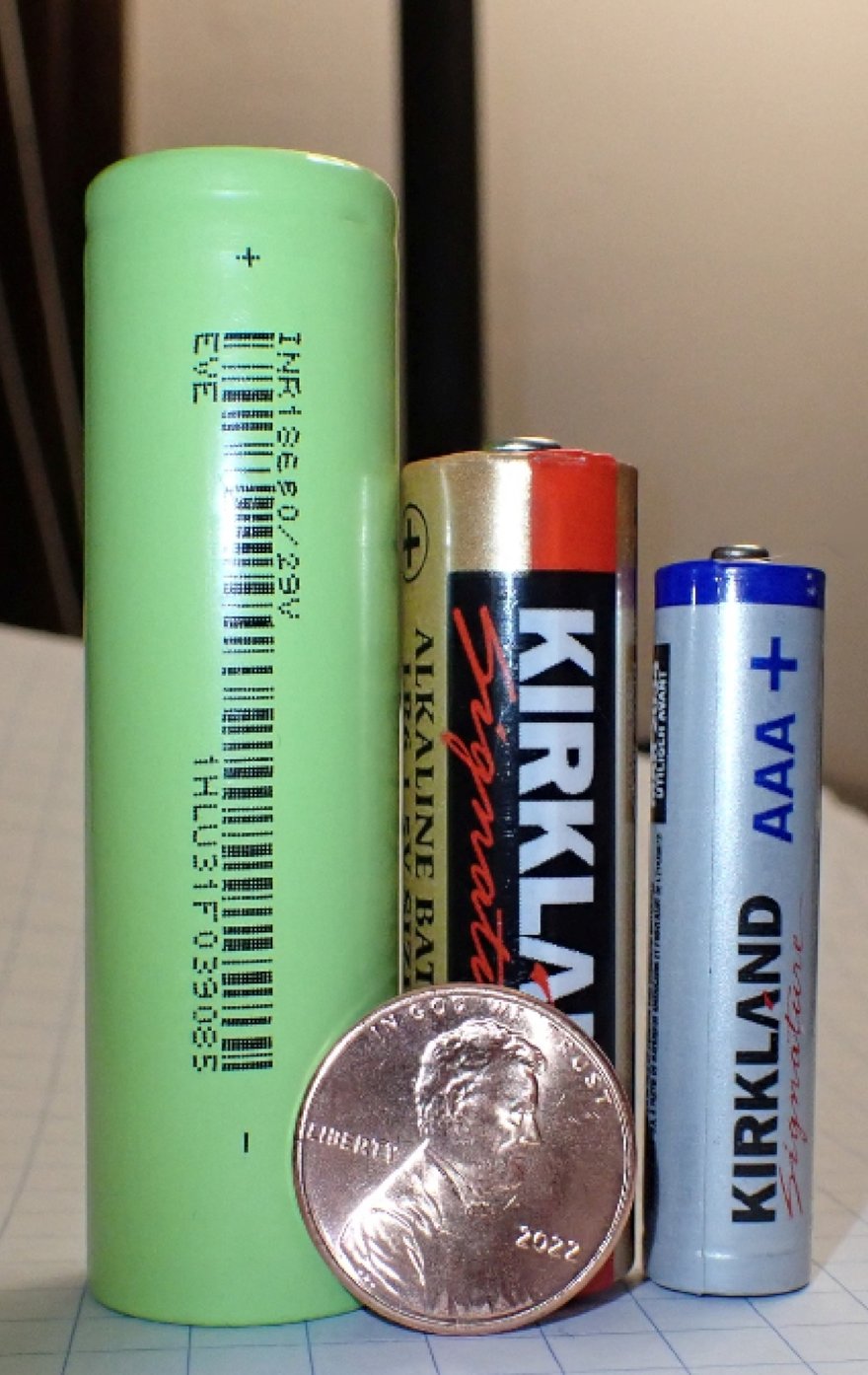

Ordinary rechargeable batteries keep the size codes of primary batteries and only change the chemistry letter. An AA-size nickel-metal hydride rechargeable is written HR6: H is nickel-metal hydride, R is round, 6 is the AA size, and the nominal voltage is 1.2V, a little lower than the 1.5V of an alkaline cell. It has the same AA shape, but whether it suits a particular device depends on that device’s manual.
Buying batteries abroad without getting the wrong ones
- In Japan, look for 単3形 when you need AA and 単4形 when you need AAA; 単 is how Japanese packaging writes the size number.
- In China, AA is 5号 and AAA is 7号; D and C are 1号 and 2号.
- In Taiwan, AA is No. 3 (3號) and AAA is No. 4 (4號).
- In the US, the UK and Hong Kong, the shelves use AA and AAA directly.
- When in doubt, check the IEC code on the battery itself: codes such as LR6, LR03 and CR2032 are written the same way everywhere.
One common item that runs on AAA batteries is the concert lightstick; for how to prepare its batteries, see Official lightsticks versus generic glow sticks.
Article keywords: AA battery, AAA battery, battery sizes by country, AA battery in Japan, 単3, 5号 battery, No. 3 battery Taiwan, LR6, LR03, CR2032, LR44, SR44, AG13, 18650, HR6, IEC 60086
Frequently asked questions
Is a ‘No. 3’ battery in Taiwan AA or AAA?
It is AA. In Taiwan, a No. 3 battery is the same cell Americans call AA, China calls 5号 and Japan calls 単3形; its IEC code is LR6 (alkaline) or R6 (carbon-zinc). The thinner, shorter No. 4 in Taiwan is AAA, IEC code LR03.
Is a 5号 battery in China the same as a No. 5 in Taiwan?
No. China’s 5号 is Taiwan’s No. 3 (AA), and China’s 7号 is Taiwan’s No. 4 (AAA). When buying batteries in China or on simplified-Chinese websites, IEC codes such as LR6 and LR03 are the safest guide, because China’s national standard series GB/T 8897 uses the IEC codes.
Can CR2032 and CR2025 be swapped?
Both are 3V lithium manganese dioxide coin cells with a 20 mm diameter. The difference is thickness: CR2032 is 3.2 mm thick, CR2025 is 2.5 mm thick. A different thickness changes how the cell makes contact and sits in the holder, so whether you can swap them depends on the model number given in the device’s manual.
What is the difference between LR44 and SR44? And which one is AG13?
LR44 and SR44 share the size code 44, so they are the same size. L means alkaline (nominal 1.5V) and S means silver oxide (nominal 1.55V). AG13 is a name often seen on retail packaging and usually refers to an alkaline button cell in the LR44 size, but AG is not a letter in the IEC standard; it is a trade convention.
What does HR6 on a rechargeable battery mean?
H stands for a nickel-metal hydride rechargeable cell (nominal 1.2V), R stands for round, and 6 is the same size as R6. So HR6 is a nickel-metal hydride rechargeable battery in the AA size (No. 3 in Taiwan). Its nominal voltage is lower than the 1.5V of an alkaline cell.
What size is an 18650 battery?
18650 is not part of the AA/AAA naming, nor is it an IEC 60086 code for primary batteries. It is the industry’s customary size name for lithium-ion rechargeable cells: the numbers mean about 18 mm in diameter and about 65 mm long. It is thicker and longer than an AA cell, has a voltage of about 3.6 to 3.7V, and cannot replace a 1.5V AA battery.
Sources: Chinese original first published on 2026-10-27 (Taipei) and revised the same day. The battery names used in each country were checked on 2026-10-27.
This English version is based on original Traditional Chinese content on joelin.cc. The language and explanations are localised for international readers. The Traditional Chinese original is the authoritative version — for its complete meaning, please read the original article.
Use Google Search a lot?
Set joelin.cc as a preferred source to see more of its articles when you search.