
This article is also available in:繁體中文 · 日本語
Summary
Ki-Re-i (キレイ) is an ID photo booth brand operated by DNPフォトイメージングジャパン, a subsidiary of 大日本印刷 (DNP). In an official 2004 press release, it was still コニカミノルタ’s “digital ID photo box.” DNP took over コニカミノルタ’s ID photo subsidiary in July 2006. The business was merged into DNPフォトルシオ in 2008 and reorganized as DNPフォトイメージングジャパン in 2014. In June 2020, DNP acquired an ID photo booth company spun off from カジタク, which had by then been renamed KJS. In 2022, it converted the acquired IDVOX booths into ID-Spot.
DNP’s own explanation for entering the ID photo booth business is that it had been making dye-sublimation thermal-transfer ribbons and photo paper since the late 1980s. Taking over Ki-Re-i brought materials, machines, and operations under one roof. It later connected the booths to systems that upload facial photographs to companies and government agencies.
As for scale, this site compiled 7,964 locations individually from the official location finder on September 25, 2026: 6,856 Ki-Re-i locations, including 448 older carina models, and 1,108 ID-Spot locations. DNP’s 2022 announcement gave a planned total of 9,400 booths, including about 2,000 ID-Spot booths.
According to the official comparison table, ID-Spot has neither the 肌美 nor 男前 mode and cannot produce reprints, but it allows unlimited retakes. Ki-Re-i lets users choose one photograph from a maximum of four shots. Withスマホ digital files require an app and must be downloaded within seven days; their resolution is 1024×768 pixels. The booths offer seven languages, including Chinese, although the official information does not specify Traditional or Simplified Chinese. They support nine QR payment methods, do not accept credit cards, and can submit My Number Card applications directly.
There is no official nationwide price list. The FAQ says prices vary by location. The only prices publicly listed on the official website are 1,600 yen for the 最上級セット top-tier package, a general range of 900–1,600 yen, and 800 yen for profile photographs in a July 2024 announcement. Taiwan passport photos use the same dimensions as Japan’s “パスポート” option, 4.5×3.5 cm, but Taiwan’s representative office in Japan requires a pure white background and prohibits beauty modes.
Key facts
- Ki-Re-i is an ID photo booth brand operated by DNPフォトイメージングジャパン, a wholly owned subsidiary of 大日本印刷 (DNP).
- In コニカミノルタ’s November 2, 2004 press release, Ki-Re-i was the group’s “digital ID photo box,” producing prints in about 27 seconds.
- On July 1, 2006, DNP took over コニカミノルタ’s ID photo subsidiary and renamed it DNPアイディーイメージング.
- A 2026 DNP announcement described that year as Ki-Re-i’s 25th brand anniversary, implying a launch around 2001. The original launch announcement was not found, so this is an inference.
- On June 30, 2020, DNP acquired all shares in Kフォトイメージ, an ID photo booth company spun off from KJS, formerly カジタク.
- In October 2022, DNP announced that it would convert about 2,000 acquired IDVOX booths into ID-Spot, bringing the group to a planned total of 9,400 booths upon completion.
- This site individually compiled 7,964 locations from DNP’s official location finder on September 25, 2026: 6,856 Ki-Re-i locations, including 448 older carina models, and 1,108 ID-Spot locations.
- According to the official comparison table, ID-Spot has neither 肌美 nor 男前 mode and does not offer reprints, but allows unlimited retakes. Ki-Re-i lets users choose one photograph from a maximum of four.
- Withスマホ digital files are downloaded through an app as 1024×768-pixel JPEGs. The server retains them for only seven days.
- Ki-Re-i’s official FAQ says photography fees vary by location. Published prices include 1,600 yen for the 最上級セット top-tier package and a general range of 900–1,600 yen, as checked on September 25, 2026.
- Ki-Re-i supports nine QR payment methods, and some booths accept transit IC cards. It accepts neither credit cards nor 5,000- or 10,000-yen banknotes.
- Taiwan passport photos have the same 4.5×3.5 cm dimensions as Ki-Re-i’s “パスポート” option, but the Taipei Economic and Cultural Representative Office in Japan requires a pure white background and prohibits selfie beauty modes or retouching.
The original Chinese article was published on September 25, 2026. The research and market information below reflect that historical snapshot.
The white ID photo booth marked “Ki-Re-i” that you see at Japanese stations or outside convenience stores belongs to 大日本印刷 (DNP). It was originally a コニカミノルタ product, which DNP took over in 2006. In 2020, DNP also acquired another operator’s IDVOX booths, later converting them into a second brand, “ID-Spot.” Based on this site’s individual compilation from the official location finder on September 25, 2026, the two brands had a combined 7,964 locations in Japan.
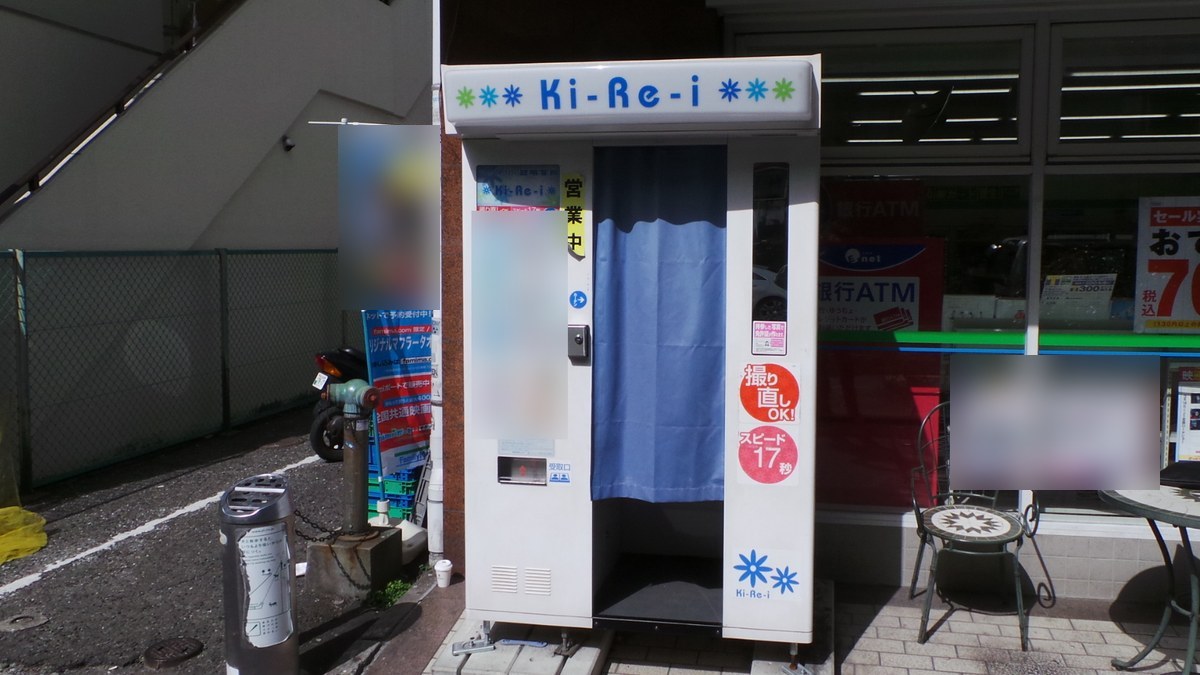
A Ki-Re-i outside a convenience store in Japan in February 2015, with stickers reading “撮り直しOK!” (“Retakes OK!”) and “スピード17秒” (“17-second speed”). This is its appearance before the logo changed in 2025. Photograph: 運転太郎, CC BY 3.0, original image. This site cropped it to 16:9 and blurred portraits on the booth and surrounding posters.
This article answers four questions:
- Why would a printing company operate street-side ID photo booths?
- How did Ki-Re-i move from コニカミノルタ to DNP, and how did ID-Spot emerge?
- What are the actual differences between Ki-Re-i and ID-Spot, using only those listed in official tables?
- For Taiwanese people taking photographs in Japan, how do sizes, prices, payment, and digital files work, and what matters when taking Taiwan passport photos?
To find a nearby booth, use photobooth.joelin.cc’s Japan ID photo booth map. This article does not repeat the location listings. For an overview of Japan’s three ID photo booth operators and the situations in which Taiwanese people may need them, see the overview of ID photo booths in Japan.
Why 大日本印刷 operates ID photo booths: it was already selling the photo paper
DNP is a major Japanese printing company. Its connection to ID photo booths begins with what photographs are printed on. According to DNP’s official announcements, it began developing dye-sublimation thermal-transfer materials for photo printing—ribbons and photo paper—in the late 1980s, supplying them to printer manufacturers on an OEM basis. In 2005, it began making PrintRush self-service photo printing kiosks (DNP press release, February 17, 2021; コニカミノルタ press release, July 10, 2006, Wayback snapshot).
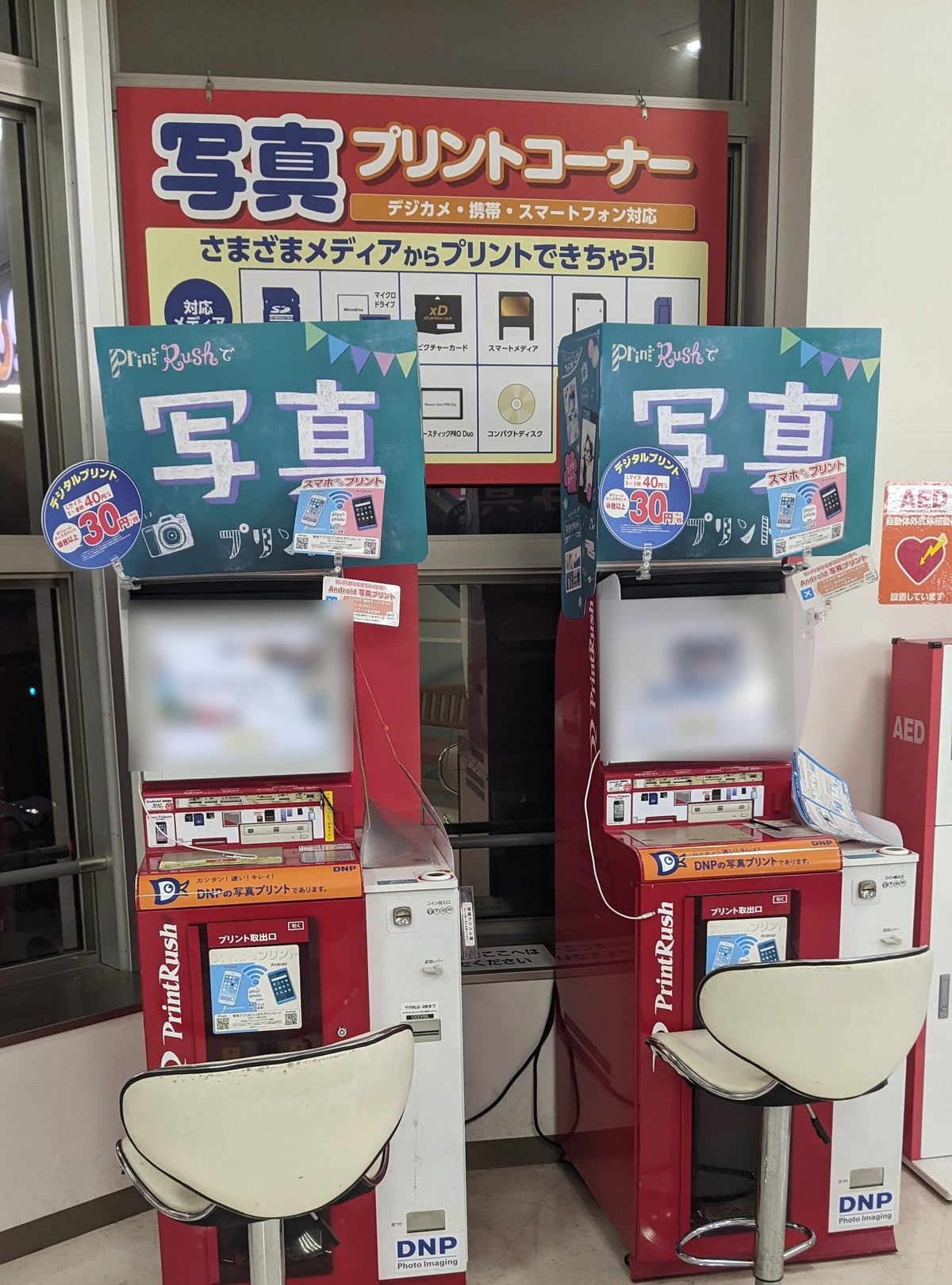
DNP self-service photo printing kiosks marked PrintRush in an electronics store in Kyobashi, Osaka, in February 2023. DNP expanded from photo paper and ribbons into these self-service printers, then took over ID photo booths. Photograph: Mr.ちゅらさん, CC BY-SA 4.0, original image. This site cropped the image and blurred the screens.
ID photo booths use this same dye-sublimation printing process to produce photographs on the spot. After DNP took over Ki-Re-i in 2006, one company handled the materials, machines, and operations. That same year, DNP also bought コニカミノルタ’s color photo paper factory in Odawara, later converting it to produce dye-sublimation thermal-transfer photo paper, according to the same 2006 コニカミノルタ announcement.
From 2014 onward, DNP gave the booths a second role: uploading the facial photographs they took directly over the internet. According to DNP, it developed a system in 2014 to send photographs taken at Ki-Re-i booths to corporate servers for employee and membership cards. In 2015, it put that capability to use for My Number Card applications (DNP, February 17, 2021). In 2022, it positioned ID photo booths as street-side “online device booths” (DNP, October 24, 2022).
DNP’s broader history, how it makes money, and its connections to semiconductors, display panels, batteries, and bookstores are covered separately in the in-depth company study of 大日本印刷 (DNP).
The account above is the company’s own explanation. As for revenue, DNP announced a target in 2020 of approximately 10 billion yen in ID photo-related service revenue for fiscal 2024. In 2022, it shifted that target to approximately 10 billion yen for fiscal 2025. No public figures were found showing whether it achieved the target: DNP’s integrated report places ID photos under “photo imaging-related” business without disclosing them separately (DNP Integrated Report 2025).
Ki-Re-i’s history: from コニカミノルタ to DNP
Ki-Re-i was not a brand created by DNP. The following timeline covers what official sources can confirm.
| Date | What happened | Source |
|---|---|---|
| Around 2001, inferred | DNP’s 2026 announcement says Ki-Re-i “marks its 25th brand anniversary this year,” implying a launch around 2001. The original launch press release was not found. | DNP announcement on PR TIMES, June 2, 2026 |
| November 2004 | Ki-Re-i was コニカミノルタ’s “digital ID photo box,” operated by コニカミノルタアイデーイメージング. Its selling points included proprietary dye-sublimation printing, studio lighting, prints in about 27 seconds, and retakes. | コニカミノルタ press release, November 2, 2004, Wayback snapshot |
| January 2006 | コニカミノルタ decided to exit the camera and photo businesses. | コニカミノルタ announcement, July 10, 2006 |
| July 2006 | DNP took over コニカミノルタ’s ID photo subsidiary and renamed it DNPアイディーイメージング. | Same source as above; DNPフォトイメージングジャパン company history |
| October 2008 | Three subsidiaries covering self-service photo printing, ID photography, and photographic product sales merged to form DNPフォトルシオ. | Company history |
| October 2014 | The business was integrated with a photo book company and reorganized into today’s DNPフォトイメージングジャパン. | Company history |
| June 2020 | DNP acquired all shares in Kフォトイメージ, a new company spun off from KJS, known as カジタク until March 2020, to take over its ID photo booth business. | DNP, June 30, 2020 |
| April 2021 | Kフォトイメージ was absorbed through a merger. | Company history |
| October 2022 | DNP announced the conversion of approximately 2,000 acquired IDVOX booths into ID-Spot, with rollout scheduled from November 2022 through September 2023. | DNP, October 24, 2022 |
| June 2025 | DNP introduced a new Ki-Re-i model: legroom increased by about 8 cm, lighting changed from flash to LED, remote maintenance became possible, and the brand logo and exterior used for at least 20 years were replaced. | DNP, June 2, 2025 |
The main point of this table is that the Ki-Re-i name predates DNP’s ownership. It was already operating in コニカミノルタ’s 2004 press release and moved to DNP only in 2006, along with the entire ID photo subsidiary. The “25th brand anniversary” is DNP’s own statement from 2026, which implies a launch around 2001. Without a launch announcement from that year, however, it remains an inference.
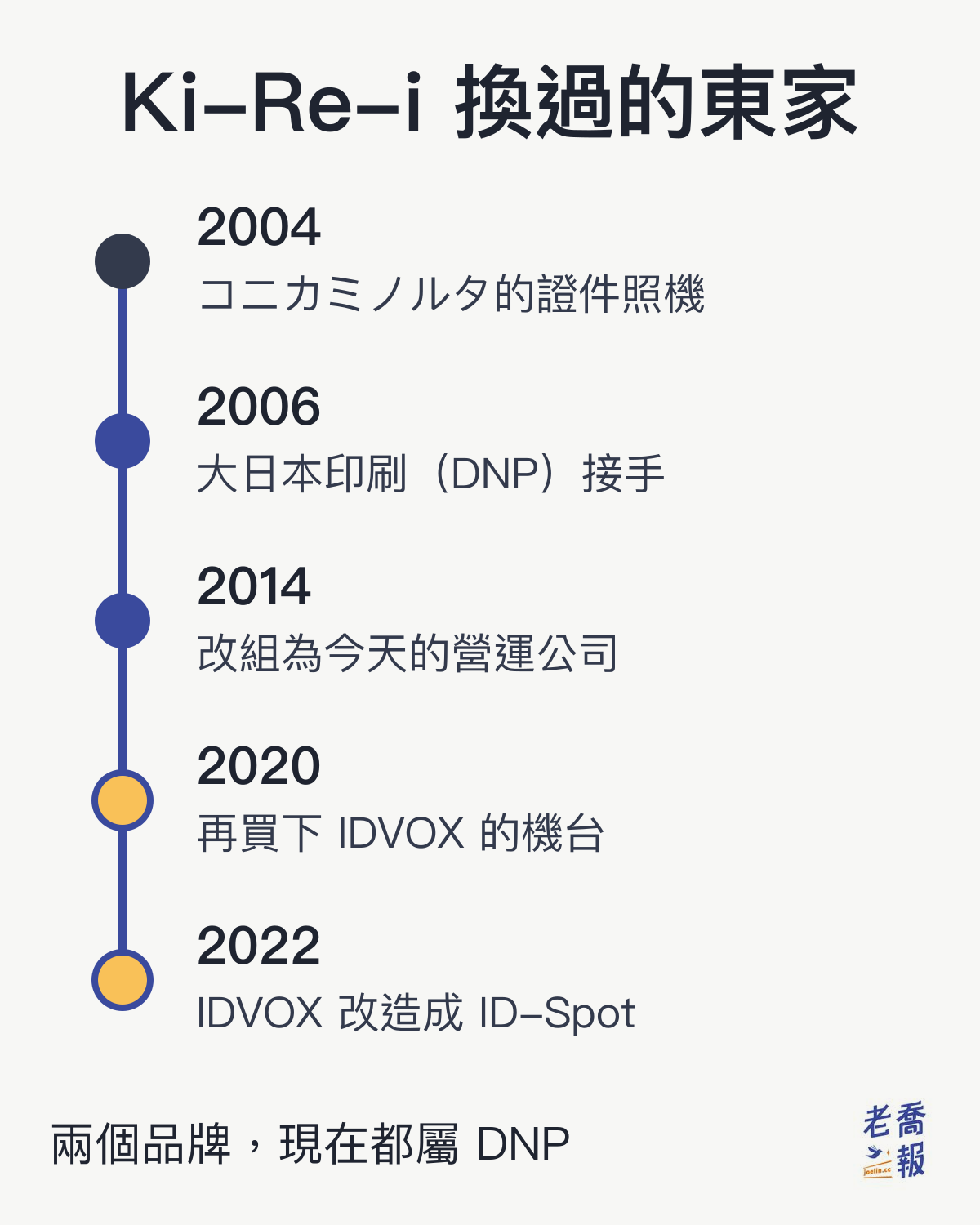
The company operating Ki-Re-i today is DNPフォトイメージングジャパン, a wholly owned DNP subsidiary with capital of 100 million yen and 166 employees as of April 1, 2026. Its headquarters shares DNP’s address (company profile). Official sources give two different establishment dates: the company profile says October 2008, while the history page says a new company was established in October 2014. A more accurate description is that its predecessor was established in 2008 and reorganized under the current name in 2014.
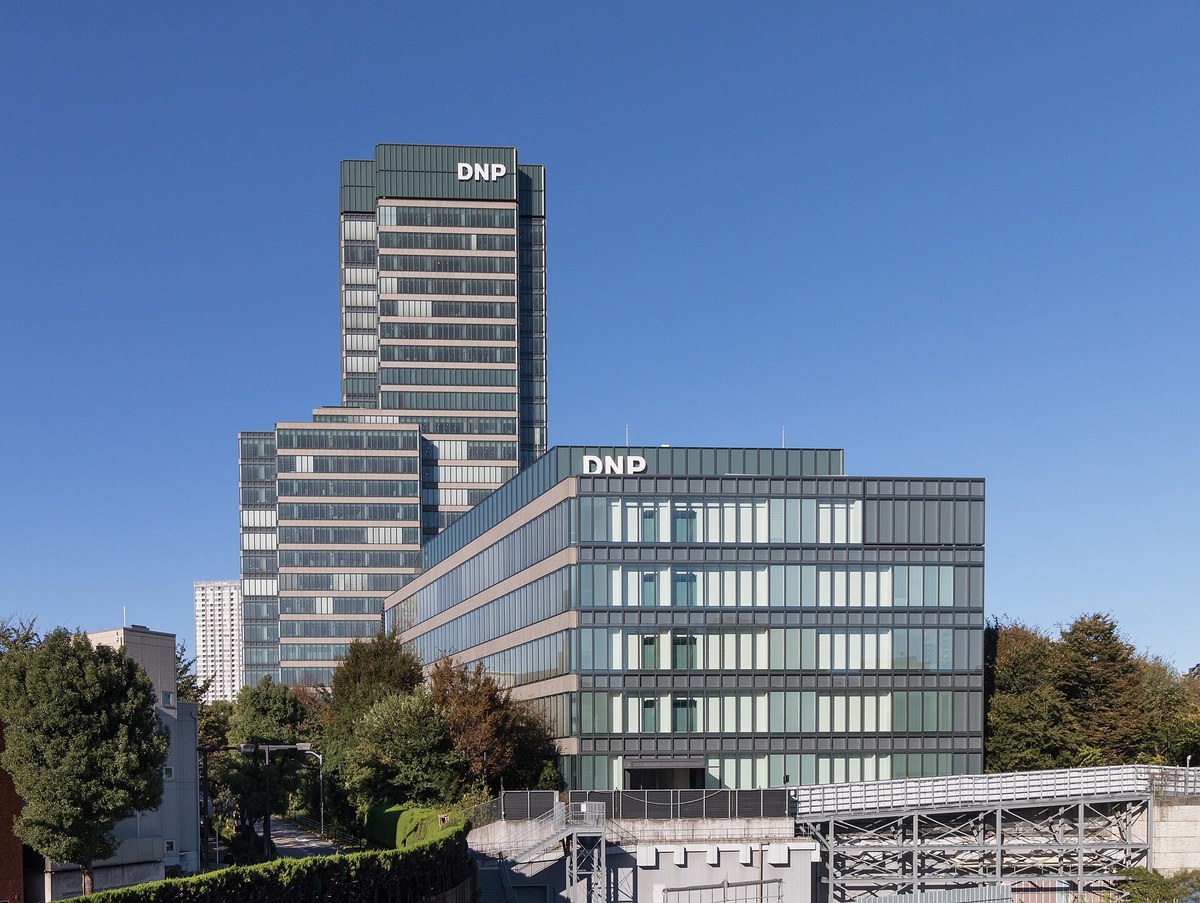
The area around DNP’s headquarters in Ichigaya, Shinjuku, Tokyo, in November 2024. The tall building in the background is the DNP Ichigaya Kagacho Building, which houses the headquarters; the building in front is the DNP Ichigaya Takajomachi Building. DNPフォトイメージングジャパン, the Ki-Re-i operator, has its registered headquarters at the same address. Photograph: Kakidai, CC BY-SA 4.0, original image. This site reduced the image size.
How ID-Spot came about, and why it is different from today’s ID VOX
What DNP bought in 2020 was the ID photo booth business of カジタク, later renamed KJS, a subsidiary of イオンディライト. Those booths were branded “IDVOX” at the time. DNP’s acquisition announcement in 2020 said the transaction increased the group’s ID photo booth fleet from approximately 7,000 to approximately 10,000. In 2022, it converted those IDVOX booths into ID-Spot.
Be aware that the booths carrying “ID VOX” signs on Japanese streets today belong to a separate network operated by 扶桑プレシジョン, rather than DNP. No official information was found explaining the relationship between this network and カジタク’s former IDVOX business. The history and use of today’s ID VOX are covered separately in Who operates ID VOX?.
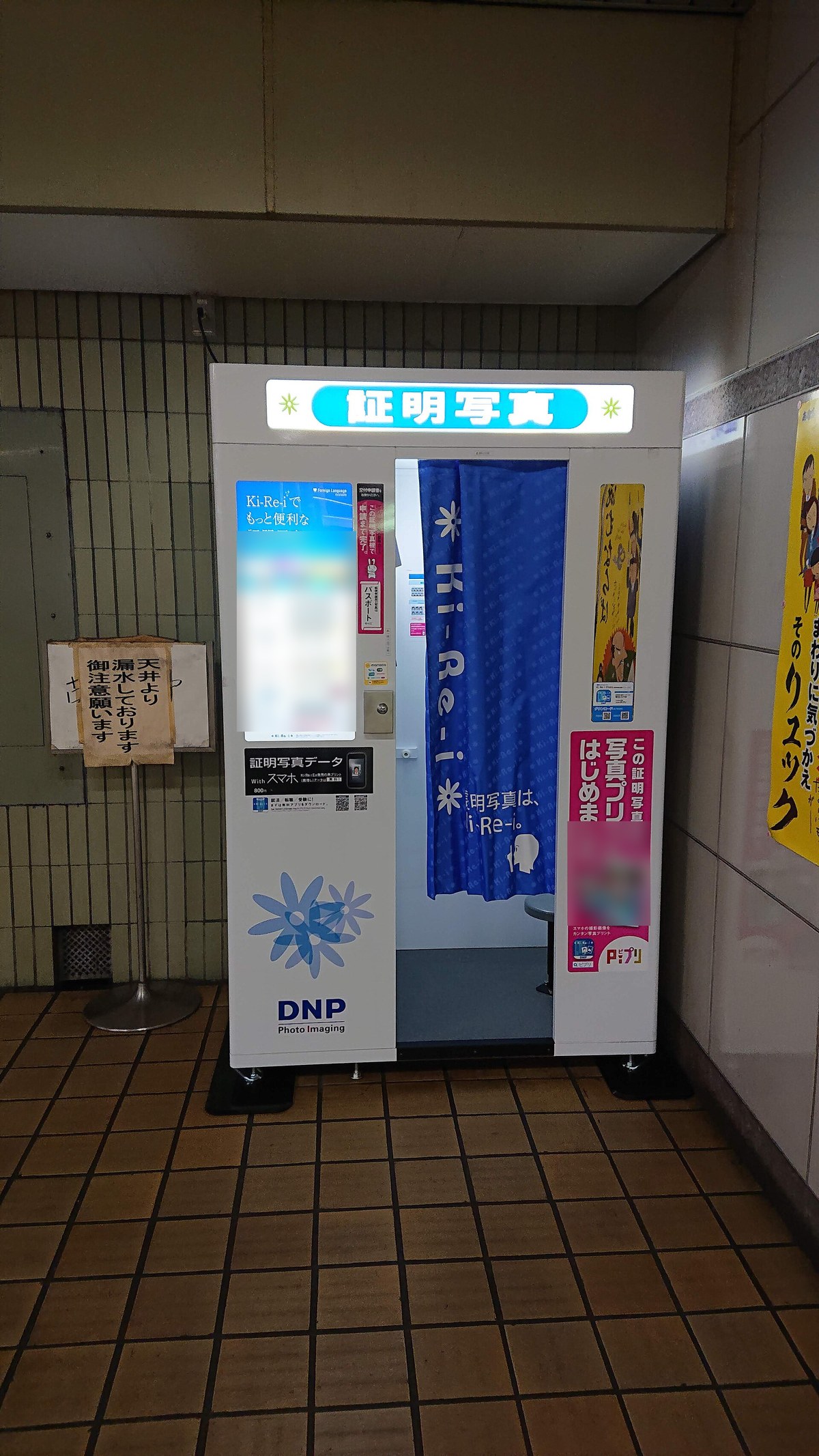
A Ki-Re-i inside Kanayama Station on the Nagoya Municipal Subway in April 2019. The left side of the booth carries instructions for “ID photo data on your smartphone.” The poster on the right says “Photo printing is now available at this ID photo booth,” referring to Piプリ, which prints smartphone photographs at postcard size. Photograph: 円周率3パーセント, CC BY-SA 4.0, original image. This site blurred portraits on the booth’s posters.
How many booths are there in Japan? Two figures with different scopes
| Figure | Breakdown | Measurement and date | Source |
|---|---|---|---|
| 7,964 locations | 6,856 Ki-Re-i locations, including 448 older carina models, plus 1,108 ID-Spot locations | Individually compiled by this site from DNP’s official location finder on September 25, 2026; the unit is installation locations | DNPフォトイメージングジャパン location finder |
| 9,400 booths | Approximately 7,400 Ki-Re-i plus approximately 2,000 ID-Spot; 8,500 would have internet connectivity for My Number Card applications | Announced by DNP in October 2022; the planned total upon completion of conversions in September 2023 | DNP, October 24, 2022 |
| Approximately 7,300 booths | Ki-Re-i only | DNP official page, as of April 2023 | DNP Ki-Re-i page for site hosts |
The two sets of figures should be viewed side by side, rather than directly subtracted. This site counted individual locations listed in the official finder, while DNP announced a planned number of machines for a particular point in time. Both the units and dates differ. DNP has not announced another total since 2023, so there is no newer official figure available for comparison.
The 7,964 locations compiled by this site cover all 47 prefectures. Feature markers in the same official dataset indicate that 6,642 locations support direct My Number Card applications: 5,879 Ki-Re-i, 439 carina, and 324 ID-Spot. Digital files are available at 6,597 locations: 5,831 Ki-Re-i, 442 carina, and 324 ID-Spot. Check the “オプション” (“Options”) field in the official finder for each booth’s features; they are not identical across all machines.
How Ki-Re-i and ID-Spot differ: the official comparison table
The table below includes only differences documented in DNP’s 2022 press release comparison table, the official location finder’s service descriptions, and the ID-Spot page (DNP, October 24, 2022; service differences in the location finder; official ID-Spot page).
| Feature | Ki-Re-i | ID-Spot |
|---|---|---|
| Origin | Taken over from コニカミノルタ in 2006 | Converted from IDVOX booths acquired in 2020 |
| Regular mode, without retouching | Available | Available |
| 肌美 and 男前 modes | Available | Not available |
| Skin enhancement and background replacement, エクセレントモード | Available | Available: skin texture enhancement, brightness adjustment, and nine background colors |
| Retakes | Choose one from up to four shots: two initial shots plus two retakes; some locations offer only two shots | Unlimited retakes; choose from the latest four shots |
| Digital file download, Withスマホ | Available | Available |
| Reprints | Available | Not available |
| My Number Card applications at the booth and QR payments | Available | Available |
The two brands share the same basic functions. Their differences center on three points: ID-Spot lacks the 肌美 and 男前 retouching modes and cannot produce reprints using a reprint code, but it places no limit on retakes. For the other functions, availability at the brand level does not mean every booth supports them. Check each machine’s feature fields in the official finder.
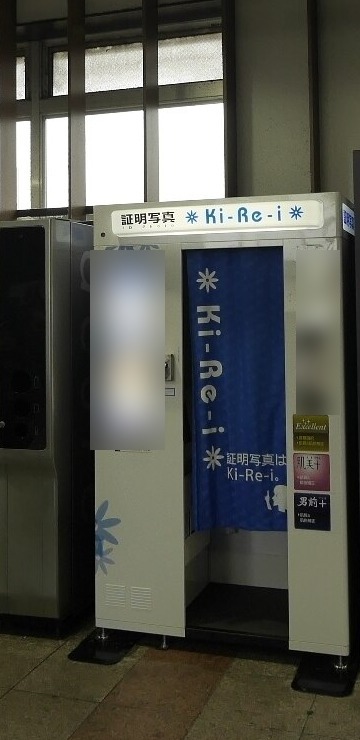
A Ki-Re-i inside a station in May 2015. The three labels to the right of the curtain, from top to bottom, are “Excellent” (エクセレントモード), “肌美+,” and “男前+.” The latter two are the modes listed in the comparison table as unavailable on ID-Spot. Photograph: 運転太郎, CC BY 3.0, original image. This site cropped the image and blurred portraits on the booth’s posters and a person’s reflection in the mirror.
Other Ki-Re-i features described in official sources include:
- Ki-Re-i’s screen and voice guidance support seven languages: Japanese, English, Korean, Chinese, Portuguese, Spanish, and Russian. The official information does not specify whether Chinese is Traditional or Simplified. No information was found confirming whether ID-Spot supports multiple languages (DNP Ki-Re-i page for site hosts).
- In Ki-Re-i’s エクセレントモード, photographs are always taken against a blue background, which is replaced afterward. Blue clothing, ties, accessories, or dyed hair may therefore become “transparent” (official Ki-Re-i EX page).
- Ki-Re-i has an accessible model, EF-1, whose seat can be slid aside with one hand to allow a wheelchair to enter. The official page says these booths have been installed at employment service offices, passport centers, municipal offices, and other locations, according to the same page for site hosts.
- DNP also offers a “facial photo collection service” for companies and schools. Human resources departments issue dedicated QR codes, and photographs are automatically uploaded to the cloud after employees or students take them at Ki-Re-i booths. The official page says the service had been adopted by “approximately 260 companies or more” as of October 2025 (DNP facial photo collection service page).
How to take ID photos at Ki-Re-i: the steps
The following process is pieced together from the official FAQ and other pages (official Ki-Re-i FAQ):
- First, find a booth with the features you need. エクセレントモード, Withスマホ digital files, My Number Card applications, QR payments, transit IC cards, and profile photographs vary by machine.
- Choose a menu on the touchscreen, such as レギュラー (regular), エクセレントモード, Withスマホ, マイナンバー (My Number), プロフィール写真 (profile photographs), or 再プリント (reprints).
- Choose the size, then insert cash or scan a QR code to pay.
- Take your photographs. The booth takes two shots in succession; pressing “撮り直し” (“Retake”) takes another two, allowing you to choose one from up to four. The whole process takes about three to five minutes, with voice guidance throughout.
- If you selected エクセレントモード, adjust your face’s position after shooting, then choose the background color and degree of skin enhancement.
- Collect the photographs. They are printed on glossy photo paper, with 1 mm markings beside each frame to help with cutting. The receipt is printed directly along the edge of the sheet and complies with Japan’s qualified invoice system.
The official FAQ’s photography tips are to close the curtain fully to block outside light, avoid placing bags on the flash unit near your feet, adjust the seat height so your eyes align with the camera, consider removing glasses because reflections may cause passport or My Number Card photographs to be rejected, and keep bangs from covering your eyes. The FAQ says ID photographs generally need to be used within three to six months of being taken, but the receiving organization’s requirements take precedence.
Operating hours depend on the location. Booths in stations and shopping centers follow the venue’s opening hours, while those at 24-hour stores can be used late at night. Photographs left behind after shooting cannot be reissued. If you used Withスマホ, you can arrange reprints through the app.
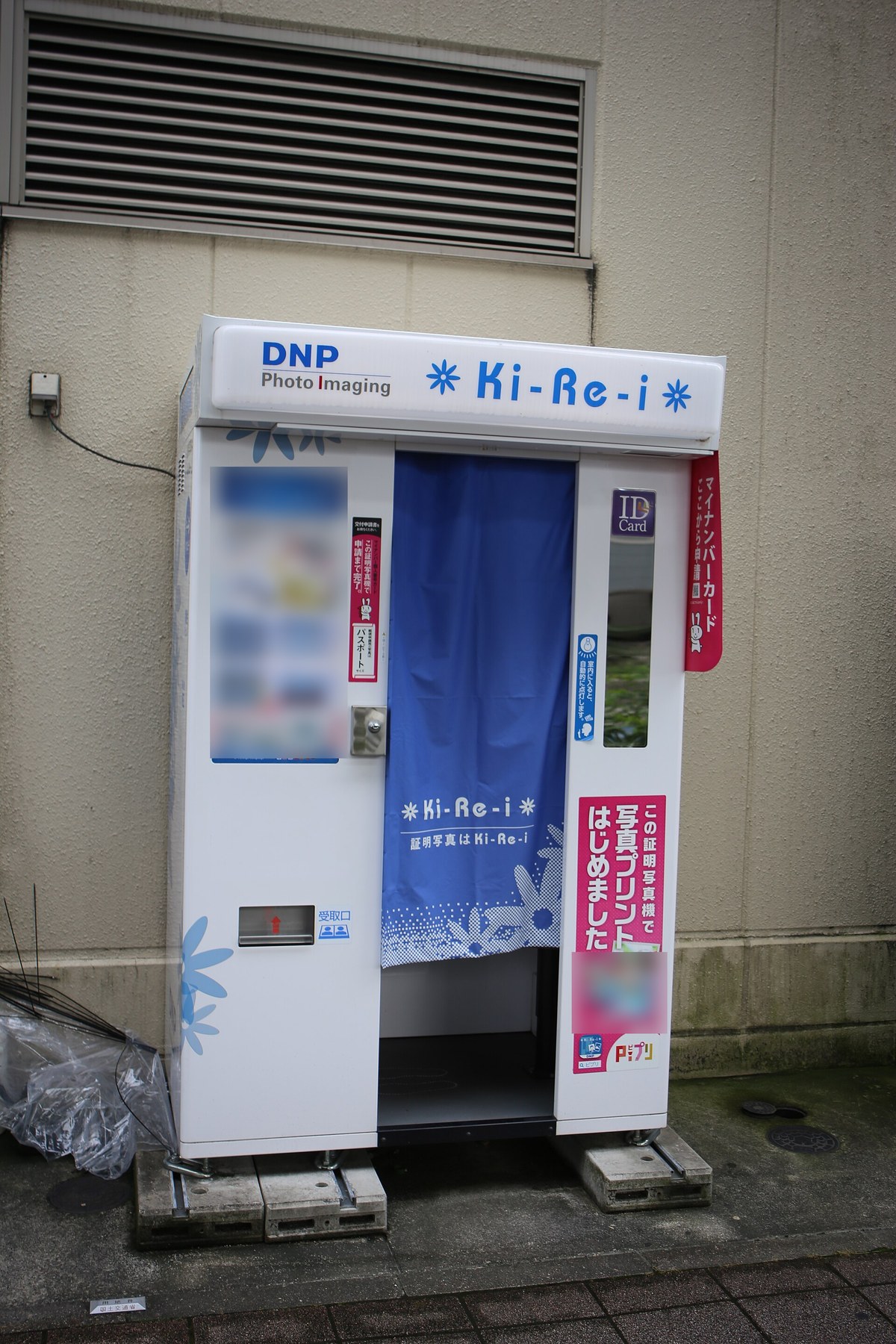
A roadside Ki-Re-i in Kita Ward, Nagoya, in July 2020. The top displays both DNP Photo Imaging and Ki-Re-i. The flag on the right indicates support for My Number Card applications at the booth. Photograph: 円周率3パーセント, CC BY-SA 4.0, original image. This site blurred portraits on the booth’s posters.
Choosing a size: follow the responsible authority’s specifications
Ki-Re-i’s official FAQ lists four sizes, with some differences between machine models (Ki-Re-i size reference chart, marked as information from May 2023):
| Menu name | What appears on one sheet |
|---|---|
| 履歴書/その他 — Résumé / Other | Eight 4.0×3.0 cm frames |
| 免許証/中型 — Driver’s License / Medium | Top row: two 5.5×5.0 cm frames; bottom row: four 3.0×2.5 cm frames |
| パスポート/マイナンバー/その他 — Passport / My Number / Other | Six 4.5×3.5 cm frames |
| 大型 — Large | Two 7.0×5.0 cm frames |
Of these four menus, Taiwanese people in Japan are most likely to use “パスポート” (4.5×3.5 cm) and “履歴書” (4.0×3.0 cm). DNP’s own pages contain several inconsistencies that need to be noted. A list in the FAQ gives the passport size as 4.0×3.0 cm, although the questions and answers and sample photo sheet on the same page give 4.5×3.5 cm. The size chart places residence cards under 4.0×3.0 cm, but the sample sheet labels the bottom three frames of the passport sheet for residence cards. “国外運転免許,” or international driving permits, appears under two different sizes in the same chart. The use-case table below therefore follows specifications published by the relevant Japanese or Taiwanese authority, then matches them to Ki-Re-i menus.
| Use | Authority’s specification | Corresponding Ki-Re-i menu |
|---|---|---|
| Taiwan passport renewal or replacement after loss, applied for through the representative office in Japan | 4.5×3.5 cm; 3.2–3.6 cm from the top of the head to the chin; pure white background (Taipei Economic and Cultural Representative Office in Japan) | パスポート |
| Residence card | 4×3 cm; 25±3 mm from the top of the head to the chin; plain background (Immigration Services Agency of Japan) | 履歴書/その他, 4.0×3.0 cm |
| Converting a Taiwan driver’s license to a Japanese license, 外免切替 | 3×2.4 cm; plain background; approximately 3 mm of space above the head (Tokyo Metropolitan Police Department) | Bottom row of 免許証/中型, trimmed to 3.0×2.4 cm |
| Résumé for part-time work or job applications | Ministry of Health, Labour and Welfare template: 36–40 mm high and 24–30 mm wide (Ministry of Health, Labour and Welfare sample résumé form) | 履歴書/その他 |
| Applying for an international driving permit with a Japanese driver’s license | 4.5×3.5 cm, according to the same Tokyo Metropolitan Police Department page | パスポート |
Use this table by checking the authority’s specification first, then choosing a menu with matching dimensions. Matching the overall size does not necessarily mean the head proportions will match. For example, residence card photographs require 25±3 mm from the top of the head to the chin, but the official information does not say whether Ki-Re-i’s résumé menu produces that proportion. It is best to measure the photograph yourself afterward. The Immigration Services Agency also announced that new residence cards would be introduced on June 14, 2026, with photographs required for children aged one to under 16 as well (Immigration Services Agency announcement). Families living in Japan with children will need photographs for them too.
Short-term visitors drive in Japan using their Taiwan driver’s license together with a Japanese translation. No photograph is needed, so an ID photo booth is unnecessary for that purpose.
Three things to remember when taking Taiwan passport photos
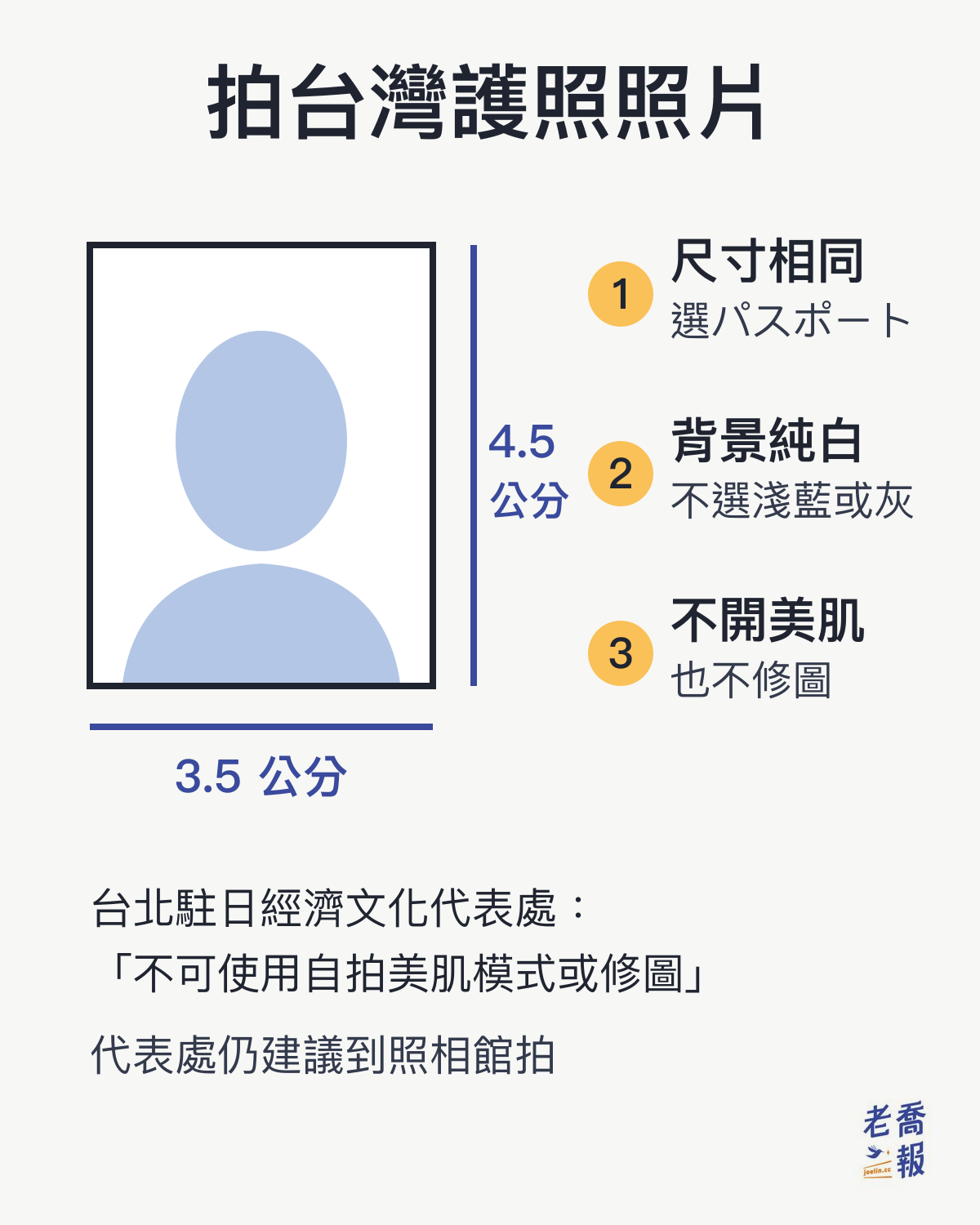
When renewing or replacing a Taiwan passport in Japan, the applicable photo specifications are those of the Taipei Economic and Cultural Representative Office in Japan. When using a Japanese Ki-Re-i booth, remember these three points:
- The dimensions match. Ki-Re-i’s “パスポート” menu produces 4.5×3.5 cm photographs, the same size required for Taiwan passports. Taiwan’s requirement of 3.2–3.6 cm from the top of the head to the chin also matches Japan’s Ministry of Foreign Affairs requirement of 34±2 mm.
- Choose a pure white background. The representative office explicitly requires a “pure white background.” Japan’s Ministry of Foreign Affairs recommends white but also accepts light blue, so a Japanese booth’s background options are not necessarily white. Ki-Re-i’s エクセレントモード offers up to nine background colors at the booth, but the official pages do not explain whether pure white is among them. Check that the background is pure white on the screen before printing.
- Do not enable beauty or skin-enhancement features. The representative office explicitly says that “selfie beauty modes or retouching must not be used.” Ki-Re-i’s 肌美 mode and the skin-enhancement function in エクセレントモード fall into that category, so do not select them for Taiwan passport photographs.
.jpg)


.jpg)

The same representative office page also says that “photo screening is strict, many applicants have their submissions rejected, and taking photographs at a photo studio is recommended” (Taipei Economic and Cultural Representative Office in Japan passport renewal page, checked September 25, 2026). A booth is an option, but the official recommendation is to use a studio. That distinction is recorded here as stated.
The online passport app feature discussed below allows only gray or blue backgrounds. It is intended for online Japanese passport applications and does not apply to Taiwan passports.
Prices: no official nationwide price list
Ki-Re-i’s official FAQ states that photography fees vary by location and that users should check the booth’s posted prices or menu screen (Ki-Re-i FAQ, “Prices and Payment”). The following are the only prices explicitly published on the official website, as checked on September 25, 2026. All include tax.
| Package | Price | Details | Source |
|---|---|---|---|
| Ki-Re-i 最上級セット, top-tier package | 1,600 yen | Prints, digital files, skin enhancement, and background replacement; available only at eligible booths | official top-tier package page |
| General price range | “Usually 900–1,600 yen” | The range used in an official article describing Withスマホ; varies depending on whether skin enhancement and printing are included | official article, September 1, 2023 |
| プロフィール写真, profile photographs | 800 yen per download | Price in the July 2024 announcement, which also says prices may vary by location; these photographs cannot be used as ID photos | DNP, July 17, 2024 |
Beyond these three figures, the official website does not publish individual prices for regular mode (レギュラー), エクセレントモード on its own, the various Withスマホ menu options, or any ID-Spot menu options. At the booth, follow the prices on the screen and machine. A single price found online is not an official nationwide rate.
Payment: cash and QR payments, but no credit cards
According to the official FAQ (Ki-Re-i FAQ), payment works as follows:
- Cash payments accept 1,000-yen banknotes and 500-, 100-, 50-, and 10-yen coins. The booths do not accept 5,000- or 10,000-yen banknotes. Change is returned in coins.
- Compatible booths support nine QR payment methods: PayPay, メルペイ, 楽天ペイ, au PAY, d払い, J-Coin Pay, Smart Code, FamiPay, and AEON Pay (DNP announcement, February 13, 2023).
- Some booths accept transit IC cards such as Suica and PASMO.
- Credit cards are not accepted.
Once cash has been inserted, you cannot cancel and obtain an immediate refund at the booth. For refunds caused by machine malfunctions, the official instructions say to call Ki-Re-i customer service at 0120-412-685, from 9:00 to 17:30. If you have only 5,000- or 10,000-yen banknotes and will not use QR payment, exchange them for 1,000-yen notes or coins first.
Getting digital files: Withスマホ and the app
To obtain digital files, select “Withスマホ” when taking your photographs (official Withスマホ page):
- Install the free “Ki-Re-i Photo” app, available for both iOS and Android.
- At the booth, select “Withスマホ,” then either “写真+データ” (“Photos + Data”) or “データのみ” (“Data Only”), and take your photographs.
- A QR code and an eight-digit download password will be printed on the photographs or collection slip. In the app, tap “証明写真(Withスマホ)” (“ID Photos [Withスマホ]”) → “写真ダウンロード” (“Download Photos”), scan the code, and enter the password.
- Download the files within seven days of taking the photographs. After that, they are deleted from the server and cannot be recovered.
The downloaded file is a 1024×768-pixel JPEG. For photographs taken on or after December 10, 2018, the app allows cropping for different uses and custom dimensions. For photographs taken in エクセレントモード, it also allows background changes, with 15 colors available. To order reprints, upload the file from the app to receive an eight-digit reprint code, then visit any Withスマホ-compatible Ki-Re-i within 24 hours. ID-Spot does not offer reprints. Deleting a file from the app removes it, and files cannot be transferred when you change phones.
As for cost, the 1,600-yen top-tier package includes digital files. The official website does not list prices for the other Withスマホ menu options.
Online Japanese passport applications, for Japanese nationals and residents in Japan
Since March 2025, even first-time Japanese passport applications can be submitted online. Ki-Re-i’s official process is to take photographs using Withスマホ, download them into the app, select “パスポート” (“Passport”) as the intended use, adjust the face’s position, choose a background color, save the image to the phone’s photo library, and then upload it through Mynaportal (Ki-Re-i online passport guide). DNP’s December 2023 announcement says the app automatically adjusts the image to the required pixel dimensions and file size, with gray or blue backgrounds available (DNP, December 20, 2023).
This feature is for Japanese passports. Taiwan passport applications in Japan are submitted to Taiwan’s representative office and require printed photographs with a pure white background. This process cannot be used for them.
Applying for a My Number Card directly at the booth
People registered as residents in Japan who have received a My Number Card application form, including Taiwanese people with medium- or long-term residence, can scan the form’s QR code at a compatible booth, follow the instructions to take their photograph, and submit the application immediately without mailing it. The booth prints an “application confirmation slip,” and a collection notice arrives at home approximately two months later (Ki-Re-i My Number page).
People who have integrated their driver’s license into their My Number Card should note the following: DNP’s notice says that, from September 1, 2025, only online applications allow driver’s license information to be carried over to a renewed card. Direct applications at booths and mailed applications do not transfer it. The official recommendation is to download the photograph using Withスマホ and apply online instead (DNP notice PDF).
FAQ
Which company owns Japan’s Ki-Re-i ID photo booths?
Ki-Re-i is a brand of 大日本印刷 (DNP), operated by its wholly owned subsidiary DNPフォトイメージングジャパン. It was originally コニカミノルタ’s ID photo booth brand. In July 2006, DNP took over コニカミノルタ’s ID photo subsidiary, acquiring the brand with it.
How much does one Ki-Re-i ID photo session cost?
There is no official nationwide price list. The FAQ says photography fees vary by location, so check the booth’s displayed prices. The official website publishes only three figures: 1,600 yen for the 最上級セット top-tier package, which includes prints, digital files, skin enhancement, and background replacement; a general price range of “900–1,600 yen”; and 800 yen for profile photographs in a July 2024 announcement, which also notes possible differences by location. These details were checked on September 25, 2026.
What is the difference between Ki-Re-i and ID-Spot?
Both are DNP ID photo booth brands. According to DNP’s 2022 comparison table, ID-Spot lacks 肌美 and 男前 modes and does not offer reprints, but it allows unlimited retakes and lets users choose from the latest four shots. Ki-Re-i allows up to four shots per session, from which users choose one, and offers reprints. ID-Spot was created by converting the IDVOX booths DNP acquired in 2020.
Can I use Ki-Re-i in Japan to take Taiwan passport photos?
The dimensions match: Ki-Re-i’s “パスポート” menu produces 4.5×3.5 cm photographs, the same size required for Taiwan passports. However, the Taipei Economic and Cultural Representative Office in Japan requires a pure white background and prohibits selfie beauty modes or retouching. The official Ki-Re-i pages do not explain whether pure white is among the background options, so check the screen after taking the photograph. The representative office also says screening is strict and recommends using a photo studio.
Can I get digital files of ID photos taken at Ki-Re-i?
Yes. When taking your photographs, select “Withスマホ,” then “写真+データ” (“Photos + Data”) or “データのみ” (“Data Only”). A QR code and an eight-digit download password are printed on the photographs. Download them using the free “Ki-Re-i Photo” app. The files are 1024×768-pixel JPEGs, and the server retains them for only seven days.
Does Ki-Re-i accept credit cards?
No. The official FAQ says credit cards are not accepted. You can pay with cash: 1,000-yen banknotes and 500-, 100-, 50-, or 10-yen coins. It does not accept 5,000- or 10,000-yen banknotes. Compatible booths support nine QR payment methods, including PayPay, and some accept transit IC cards such as Suica and PASMO.
Further reading
- Japan ID photo booth map — Nationwide locations compiled by photobooth.joelin.cc, searchable by prefecture.
- Overview of ID photo booths in Japan — The overview for this series: three operators and situations in which Taiwanese people in Japan may need ID photographs.
- Who operates ID VOX? — The ID VOX booths operated by 扶桑プレシジョン form a separate network from the IDVOX business DNP acquired.
- The Photo ME brand — The history of ME Group Japan, another ID photo booth operator on Japanese streets, along with i-keep digital files and the official size chart.
- ME Group, a leading photo booth operator in Europe and North America — An in-depth study of the parent company of ME Group Japan (Photo ME), another Japanese street-side ID photo booth operator, including its 2023 acquisition of 富士軟片’s Japanese photo booth business.
- Taiwan’s 水啦 ID photo booths and 富多美 ID photo booths — Self-service ID photo booth brands in Taiwan.
- Thirty years of Japanese purikura machines — ID photo booths (証明写真機) and arcade sticker photo machines (プリクラ) are two different kinds of machines. This article covers the history of Japanese purikura.
Sources: DNP press releases (June 30, 2020, February 17, 2021, October 24, 2022, December 20, 2023, July 17, 2024, June 2, 2025); the DNPフォトイメージングジャパン official website (company history, FAQ, location finder); コニカミノルタ’s 2004 and 2006 press releases via Wayback snapshots; DNP announcements on PR TIMES; and photo specification pages from the Taipei Economic and Cultural Representative Office in Japan, the Immigration Services Agency of Japan, the Tokyo Metropolitan Police Department, and the Ministry of Health, Labour and Welfare. All were checked on September 25, 2026. Location counts were individually compiled by this site from DNP’s official location finder on September 25, 2026.
Image sources
All photographs in this article come from openly licensed Wikimedia Commons files. Photographers and licenses are also credited beneath each image. The four Ki-Re-i photographs all show the appearance before the logo changed in 2025. Changes made by this site, including cropping and blurring portraits, are noted in the captions. Adapted images retain the original licenses.
- Lead image and opening: Ki-Re-i outside a convenience store in February 2015, photographed by 運転太郎, CC BY 3.0. This site cropped it to 16:9 and blurred portraits. Original image: https://commons.wikimedia.org/wiki/File:%E8%A8%BC%E6%98%8E%E5%86%99%E7%9C%9F_-_panoramio_(5).jpg
- “Ki-Re-i’s history” section: Ki-Re-i at Kanayama Station on the Nagoya Municipal Subway in April 2019, photographed by 円周率3パーセント, CC BY-SA 4.0. This site blurred portraits. Original image: https://commons.wikimedia.org/wiki/File:Kanayama_Station_20190420-01.jpg
- “How to take ID photos at Ki-Re-i” section: Ki-Re-i in Kita Ward, Nagoya, in July 2020, photographed by 円周率3パーセント, CC BY-SA 4.0. This site blurred portraits. Original image: https://commons.wikimedia.org/wiki/File:Kita_20200728-03.jpg
- “Why 大日本印刷 operates ID photo booths” section: DNP PrintRush photo printing kiosks in Kyobashi, Osaka, in February 2023, photographed by Mr.ちゅらさん, CC BY-SA 4.0. This site cropped the image and blurred the screens. Original image: https://commons.wikimedia.org/wiki/File:DNP_Photo_Printer_Station.jpg
- “Ki-Re-i’s history” section: DNP headquarters in Ichigaya, Tokyo, in November 2024, photographed by Kakidai, CC BY-SA 4.0. This site reduced the image size. Original image: https://commons.wikimedia.org/wiki/File:Headquarters_building_of_Dai_Nippon_Printing_Co.jpg
- “How Ki-Re-i and ID-Spot differ” section: Ki-Re-i inside a station in May 2015, with 肌美+ and 男前+ labels, photographed by 運転太郎, CC BY 3.0. This site cropped the image and blurred portraits. Original image: https://commons.wikimedia.org/wiki/File:%E8%A8%BC%E6%98%8E%E5%86%99%E7%9C%9F_-_panoramio_(2).jpg
- The “Ki-Re-i’s ownership changes” timeline and “Taking Taiwan passport photos” infographic were created by this site.
Article keywords: ID photo booths in Japan, Ki-Re-i, キレイ, 証明写真機, 大日本印刷, DNP, ID-Spot, DNPフォトイメージングジャパン, コニカミノルタ, Japanese ID photo prices, taking passport photos in Japan, residence card photos, Withスマホ
Sources: The Chinese original was first published on 2026-09-25 and last updated on 2026-09-25. Data and observations retain the historical dates and markets stated in the article.
This English version is based on original Traditional Chinese content on joelin.cc. The language and explanations are localised for international readers. The Traditional Chinese original is the authoritative version — for its complete meaning, please read the original article.