
This article is also available in:繁體中文 · 日本語 · Tiếng Việt
Summary
タイトー (TAITO) is a Japanese chain of general-purpose arcades; photo sticker booths are just one type of machine in its venues. brooming is the separate brand name it gives to the photo booth areas at selected branches, officially described as a “photo booth corner where you can shine and look cute.” タイトー was established in 1953 as 太東貿易 and became a wholly owned subsidiary of スクウェア・エニックス in 2006, when it was delisted.
Its parent company’s November 2025 materials report 175 TAITO arcades in Japan and overseas, including company-operated and franchised locations. The 122 branches with photo booths listed on photobooth.joelin.cc use a different counting scope, so the two figures cannot be subtracted. スクウェア・エニックス’s Amusement segment recorded revenue of ¥72.1 billion and operating profit of ¥8.8 billion for the fiscal year ended March 2026, with a 12.3% operating margin. Growth came from existing venues and prize sales; photo booth revenue was not disclosed separately.
The official brooming brand page lists 20 locations, verified on September 25, 2026, including three that use brooming as the name of the entire store. Its branch-by-branch service listings identify 19 locations with makeup stations, 18 with hair irons, and 13 with costume rentals. It also publishes the photo booth models operating at each location: 225 model listings across 20 locations, covering 22 models—19 from FURYU and three from SEGA. About half the listings are for models released within the preceding year. The number of individual machines is not disclosed.
The comparison with FURYU’s own girls mignon stores reveals two different approaches. The manufacturer starts with its machines and opens stores as showrooms. Its revenue received per session at company-operated stores is about twice that of its arcade channel, yet more than 90% of sessions take place in arcades, and its company-operated store count is falling. タイトー starts with existing foot traffic, adding services and a name to one corner of a venue. This costs less and can be tested branch by branch, with successful locations potentially adopting the brand across the entire store.
Key facts
- タイトー was established as 太東貿易株式会社 in 1953, listed on the Tokyo Stock Exchange’s Second Section in 1993, moved to the First Section in 2003, and became a wholly owned subsidiary of スクウェア・エニックス and was delisted in 2006.
- スクウェア・エニックス’s November 6, 2025 progress report on its medium-term management plan lists 175 TAITO arcades in Japan and overseas, combining company-operated and franchised locations. タイトー’s official store search page does not state a total.
- スクウェア・エニックス’s Amusement segment recorded revenue of ¥72.1 billion, operating profit of ¥8.8 billion, and a 12.3% margin for the fiscal year ended March 2026. The previous year’s figures were ¥71.2 billion, ¥7.8 billion, and 11.0%.
- The official explanation for the segment’s revenue and profit growth cites increased revenue at existing venues and higher prize sales, alongside declining machine sales. Photo booth revenue was not disclosed separately.
- The official brooming brand page lists 20 locations, verified on September 25, 2026. Three—アスナル金山, 浜松メイワン, and イオン富士宮—use brooming as their store name.
- Of the 20 official brooming locations, 19 list makeup stations, 18 list hair irons, and 13 list costume rentals.
- brooming publishes the photo booth models operating at each location: 225 model listings across 20 locations, covering 22 models, with six to 14 models per location. FURYU accounts for 19 models and 203 listings; SEGA accounts for three models and 22 listings. Individual machine counts are not disclosed.
- Of the 225 model listings across brooming’s 20 locations, 110 are for models released in September 2025 or later. FURYU’s わたウサ2, which began arriving from September 12, 2026, was already listed at 19 locations by September 25.
- FURYU receives ¥504 per session at its company-operated stores versus ¥239 through its arcade channel. However, more than 90% of sessions in the fiscal year ended March 2026 took place in arcades, while its company-operated store count fell from 39 in the fiscal year ended March 2025 to 32 in June 2026. See this site’s FURYU company study.
The original Chinese article was published on September 25, 2026. The research dates and market figures below reflect that historical snapshot.
タイトー (TAITO) is a general-purpose arcade chain, and photo sticker booths are just one of the many types of machines in its stores. brooming is the separate brand name it gives to the photo booth areas at selected branches; its official description calls it a “プリコーナー,” or photo booth corner. The official brand page lists 20 locations, verified on September 25, 2026. Of these, 17 still use タイトーステーション as their store name, with brooming occupying one area inside, while the other three have adopted brooming signage for the entire store.
- タイトー operates the タイトーステーション arcade chain and is wholly owned by スクウェア・エニックス・ホールディングス.
- brooming is タイトー’s own brand for dedicated photo booth areas, with a separate official brand page and individual store Instagram accounts.
Why would an arcade chain create a separate photo booth brand? The publicly available official information points to things beyond the machines: makeup stations, hair irons, costume rentals, a continually updated list of new models, and a name that can be promoted independently. This article first examines how タイトー makes money, then looks at brooming’s approach and machines, and finally compares it with manufacturer FURYU’s strategy of opening its own stores. It is part of a series on Japan’s photo booth distribution channels. For an overview of all ten chains, see the series overview.
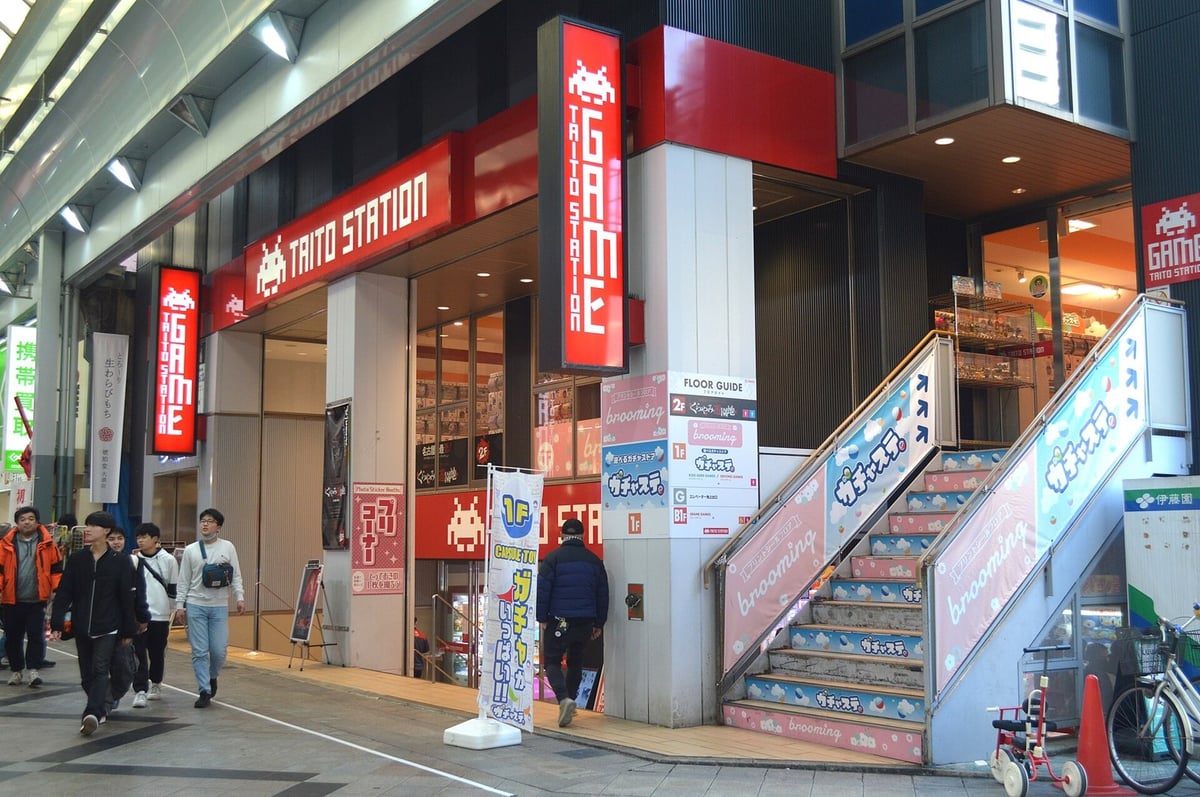
タイトーステーション大須店 in Nagoya in January 2025, one of brooming’s 20 locations. The staircase on the right leads to the floor housing brooming, with pink brooming banners and blue capsule toy area banners on either side. Photo: Asturio Cantabrio, CC BY-SA 4.0, original image.
Who is タイトー? Established in 1953, part of スクウェア・エニックス since 2006
タイトー’s official history begins with a trading company:
| Year | Event, according to タイトー’s official history |
|---|---|
| 1953 | Established in Tokyo’s Minato ward as “太東貿易株式会社,” dealing in imported miscellaneous goods, vodka production and sales, and small vending machines |
| 1954 | Began renting jukeboxes |
| 1993 | Listed on the Tokyo Stock Exchange’s Second Section |
| 2003 | Moved to the Tokyo Stock Exchange’s First Section |
| 2005 | スクウェア・エニックス acquired a stake, bringing the company into its group |
| 2006 | Became a wholly owned subsidiary of スクウェア・エニックス and was delisted; transferred its commercial karaoke business to エクシング in the same year |
The key points are in the last two rows. タイトー was once an independently listed company, but ceased to have a separate stock listing in 2006. Today it is wholly owned by スクウェア・エニックス・ホールディングス, and its photo booth areas are part of this subsidiary’s arcade business. According to its official company profile, タイトー had 846 employees and revenue of ¥72.94 billion, both reported as of March 31, 2026. Its activities include arcade operation and franchising; the development, manufacture, sale, and leasing of amusement machines; and online crane games.
Where the money comes from: revenue and profit in the Amusement segment
タイトー no longer publishes its own financial results. Its figures are included in its parent company スクウェア・エニックス’s “Amusement” segment. This segment does two things: operates arcades and sells machines and prizes to arcades.
| Fiscal year ended | Revenue | Operating profit | Operating margin |
|---|---|---|---|
| March 2024 | 61.5 | 7.5 | 12.2% |
| March 2025 | 71.2 | 7.8 | 11.0% |
| March 2026 | 72.1 | 8.8 | 12.3% |
Amounts in the table are in billions of yen. The March 2024 operating margin is calculated here from the first two financial columns; the margins for the other two years are official figures. The table shows that タイトー’s arcade business is stable and gradually improving: revenue grew from ¥61.5 billion to ¥72.1 billion over two years, and the margin returned to above 12% in the fiscal year ended March 2026. The official explanation for the latest year says that although machine sales fell year over year, revenue at existing venues and sales of prizes to amusement facilities increased—in other words, machines brought in less money, but existing stores and crane game prizes performed better. Within the group, this segment accounted for about one-quarter of スクウェア・エニックス’s ¥297.6 billion in revenue for the fiscal year ended March 2026.
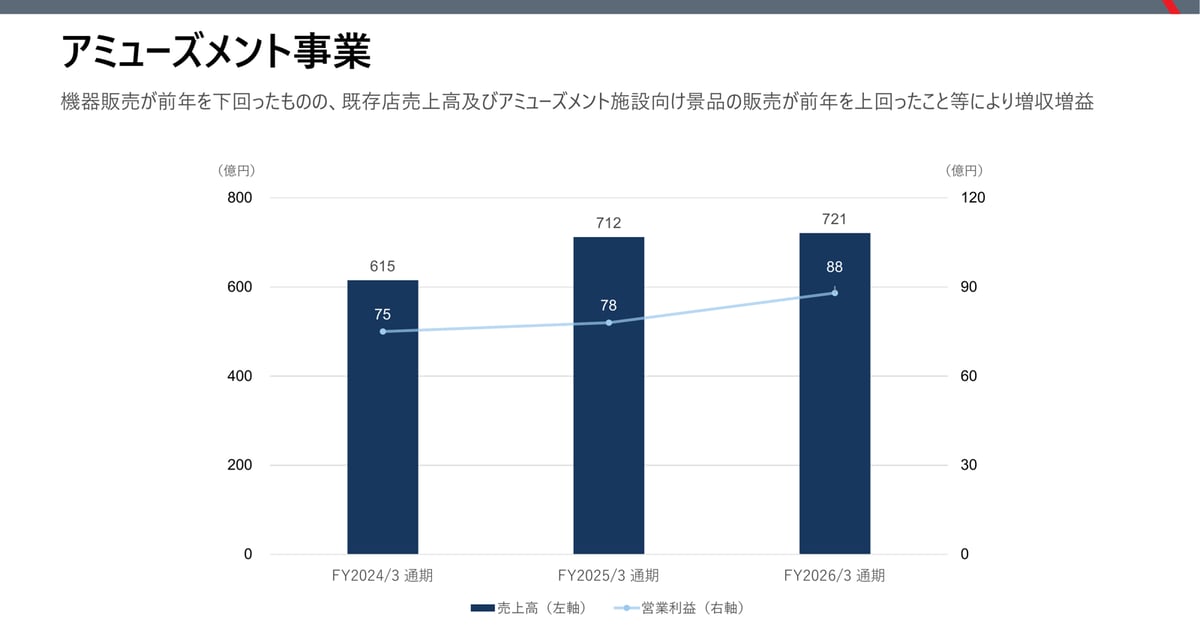
Page 14 of スクウェア・エニックス’s earnings presentation for the fiscal year ended March 2026. Source: スクウェア・エニックス・ホールディングス earnings presentation, published May 14, 2026.
For several frequently requested figures, here is what could and could not be found in official disclosures:
- Store count: タイトー’s official store search page provides no total, checked September 24, 2026. Its parent company’s November 6, 2025 progress report on its medium-term management plan states that TAITO has 175 amusement facilities in Japan and overseas, with a note that this combines company-operated and franchised locations, checked September 25, 2026.
- Photo booth revenue: not found. The earnings materials disclose only the entire Amusement segment, without breaking out the shares attributable to photo booths, crane games, or other categories.
- Number of photo booth machines: not found. brooming’s official machine lists identify models, but do not disclose a machine-count field; see the next section.
Two other figures must also be kept separate: the ¥72.94 billion in revenue in タイトー’s company profile refers to the company itself, while the Amusement segment’s ¥72.1 billion refers to a group segment. Their scopes differ.
タイトーステーション: photo booths are one type of machine inside the store
タイトー’s arcades mainly use the name タイトーステーション, with other names including タイトーFステーション and ハロータイトー. Their stores contain crane games, medal games, and other machines; photo booths are one category among them.
The タイトーステーション brand page on photobooth.joelin.cc lists 122 Japanese branches with photo booths and 712 model listings across 36 prefectures. This count includes only branches that this site has confirmed have photo booths. It uses a different scope from the parent company’s 175-store figure above: one counts all stores in Japan and overseas, while the other counts Japanese branches where this site found photo booths on manufacturers’ installation maps. The figures cannot be subtracted. Among these 122 branches, 115 have FURYU machines, 64 have SEGA machines, and two have machines from South Korea’s Photoism, as of September 25, 2026.
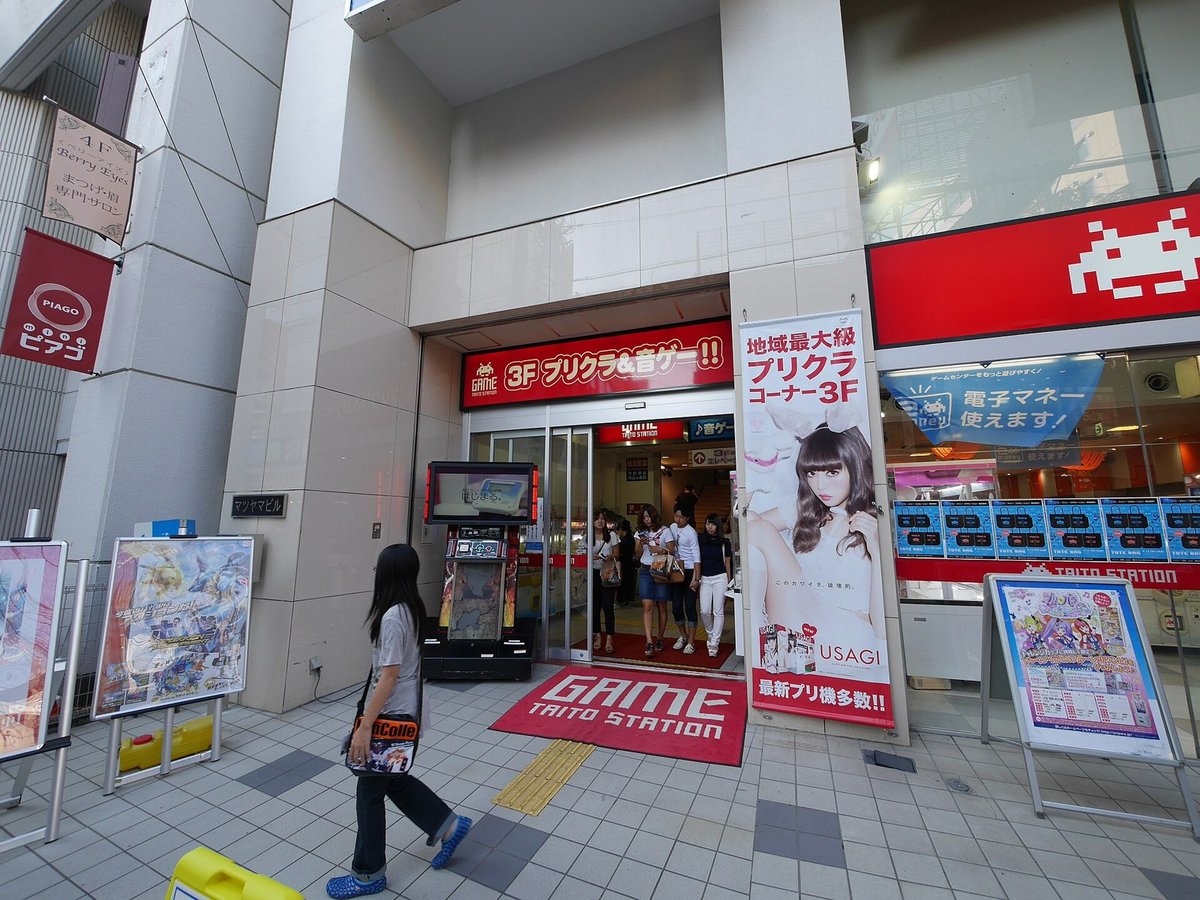
タイトーステーション町田店 in September 2015; it is now also one of brooming’s 20 locations. Even then, its entrance sign advertised “One of the area’s largest photo booth corners, 3F.” The brooming name did not yet exist, but the photo booth area was already a major part of the store’s public promotion. Photo: 運転太郎, CC BY 3.0, original image.
What is brooming? A “photo booth corner” inside the store
brooming is a blended word. The official explanation combines blooming—flowers in full bloom and beauty—with room—a space or room—meaning, in effect, “a room where people can bloom.” Its official tagline is “Look your cutest! Shine as yourself!” The brand page’s title calls it “A photo booth corner where you can shine and look cute.”
It is neither a new company nor a new chain of stores. Rather, タイトー has given a shared name and presentation to existing photo booth areas at selected branches. Its current configuration is as follows, based on the official brooming brand page, checked September 25, 2026:
- The official brand page lists 20 locations, from Hokkaido to Kyushu. This site’s brooming brand page lists these 20 venues and 193 model listings across 12 prefectures.
- Of the 20 locations, 17 still use タイトーステーション as their store name, with brooming serving as the dedicated photo booth area inside.
- Three locations—アスナル金山店, 浜松メイワン店, and イオン富士宮店—use “brooming” as their store name and display brooming signage for the entire store. All three names or official addresses point to shopping centers or station buildings: アスナル金山, 浜松駅ビル メイワン, and イオン.
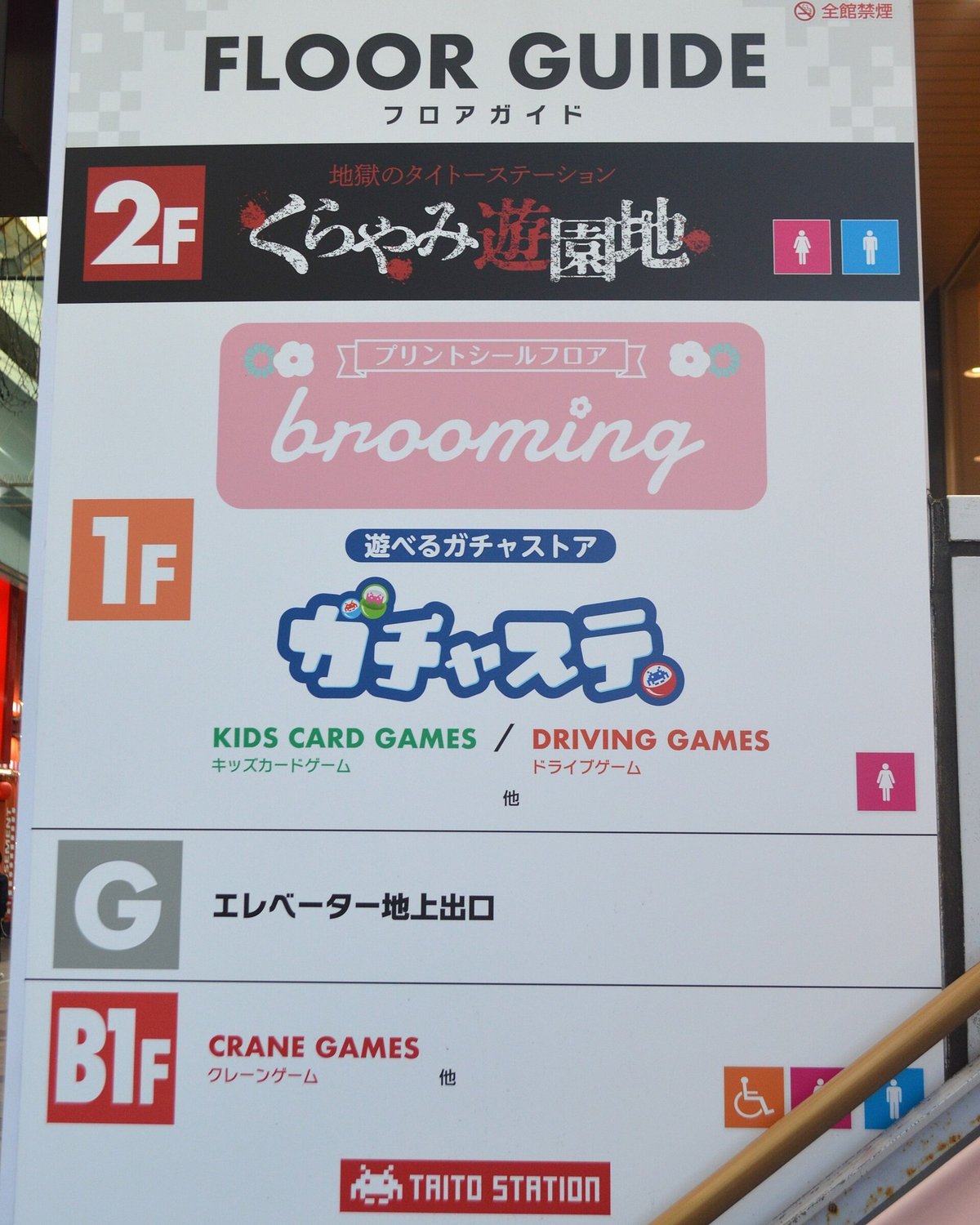
The floor directory at the same Osu store. brooming is labeled here as the “photo sticker floor,” alongside the capsule toy area and crane games in the same building—an example of a store within a store. Photo: Asturio Cantabrio, CC BY-SA 4.0, original image.
The official website’s update history also shows that this is an actively managed brand, rather than a one-time name for an interior design scheme:
- July 2025: the official brooming website was redesigned.
- October 2025: the website began publishing a “photo booths currently operating” list for each store, identifying the models installed at each branch.
- April 2026: a new brooming area opened at タイトーステーション イオンモール高の原店. A photo session event was held at the same store in June.
Services beyond the machines: makeup stations, hair irons, and costume rentals
The official brooming brand page identifies the services available at each store. Counting the indicators across all 20 locations, checked September 25, 2026, gives the following:
| Service | Locations listing it, out of 20 |
|---|---|
| Makeup stations (ドレッサー) | 19 |
| Hair irons (ヘアアイロン) | 18 |
| Costume rentals (コスプレ衣装) | 13 |
| Changing rooms | Listed separately in the costume rental descriptions for 新宿東口店 and 海老名ビナウォーク店; can be used independently |
The table shows that brooming’s main emphasis is on preparing for a photo session, rather than on the machines themselves. Almost every location has makeup stations and hair irons, and more than half offer costumes to change into before taking photos. Costume rental hours and fees vary by store. This article does not list those figures; check the individual store descriptions on the official brand page before visiting.
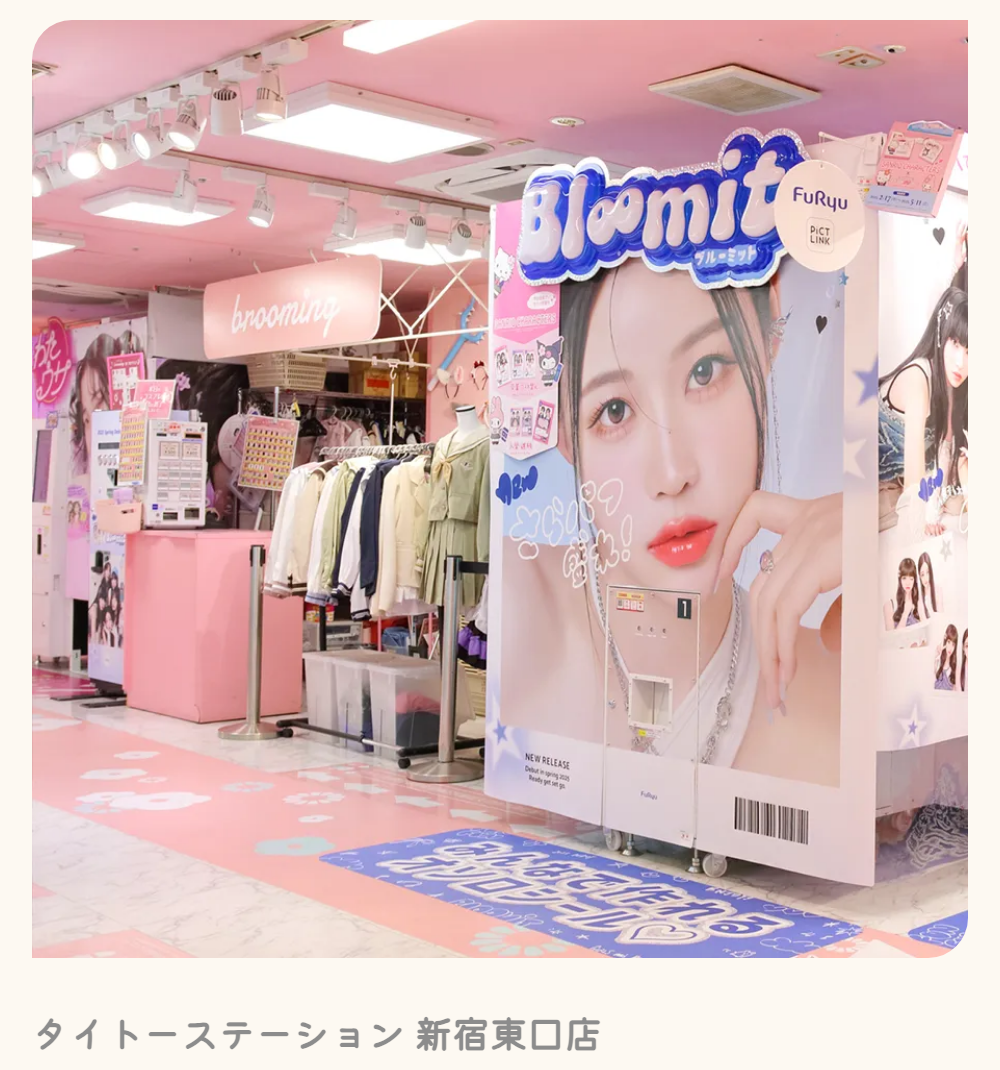
The 新宿東口店 location on brooming’s official website. One photo shows three things at once: the brooming sign on the ceiling, makeup stations and rental costumes on the left, and photo booths on the right. The website lists three services for this store: makeup stations, hair irons, and costume rentals. Screenshot taken September 25, 2026. Source: official brooming website.
One detail deserves attention: none of the three stores with brooming signage for the entire location lists costume rentals on the official page. 浜松メイワン店 does not even list makeup stations or hair irons. All 13 locations listing all three services—makeup stations, hair irons, and costume rentals—are branches with タイトーステーション signage, such as 新宿東口, 札幌狸小路4丁目, and 横浜西口五番街. In other words, displaying the brooming name on the storefront and offering a comprehensive set of services are two separate matters.
Costume rentals: this was the only branch-by-branch list we found in official materials for ten chains
In Japanese photo booth stores, renting costumes and changing before taking photos is called “コスプリ,” a combination of cosplay and purikura. When we compiled official materials for ten Japanese arcade chains, brooming’s was the only public list we found that made it possible to check, branch by branch, which locations offered the service and which did not. For most other chains, the information had to be pieced together from individual branches’ social media posts or press releases.
Outside brooming, the official store pages for タイトーステーション’s 船橋店 and 広島紙屋町店 also mention costume rentals. Adding these two locations means official materials confirm at least 15 タイトー branches offering costume rentals. Venues around Japan where customers can borrow costumes for photos are compiled in the Japan コスプリ venue list.
Which machines are at the 20 locations? The official list’s 225 model listings
The brooming website’s “photo booths currently operating” section is a machine list for each store. The information comes from タイトー’s own machine database, with a copyright notice identifying the manufacturer and a release date for each model. Retrieving and counting the entries for all 20 locations, checked September 25, 2026, gives the following:
- The 20 locations have 225 model listings covering 22 distinct models, with six to 14 models per store and an average of about 11.
- Of the 22 models, 19 are from FURYU and three from SEGA. Of the 225 listings, FURYU accounts for 203 and SEGA for 22.
- Individual machine counts: not found. The lists identify models, but do not disclose how many machines of each model are installed.
| Model | Manufacturer | Release | Number of stores |
|---|---|---|---|
| わたウサ2 | FURYU | 2026.09 | 19 |
| CENTI:U | FURYU | 2026.03 | 19 |
| Bloomit | FURYU | 2025.03 | 19 |
| FLASH | FURYU | 2026.07 | 18 |
| IDOLY | FURYU | 2025.02 | 17 |
| VERUA | FURYU | 2024.12 | 16 |
| Cherrit | SEGA | 2026.08 | 15 |
| PURICO | FURYU | 2026.06 | 14 |
“Release” is the release month shown in the official list. “Number of stores” counts how many of the 20 locations list that model. IDOLY’s full name is IDOLY Comeback Stage. The most revealing part of this table is the relationship between release dates and branch counts. The official release information for わたウサ2 states that shipments would begin rolling out on September 12, 2026; less than two weeks later, it was already listed at 19 of the 20 locations. Of the 225 listings, 110 are for models released in September 2025 or later—about half. brooming branches adopt new machines quickly, and “we have the latest machines here” is itself part of their message to customers.
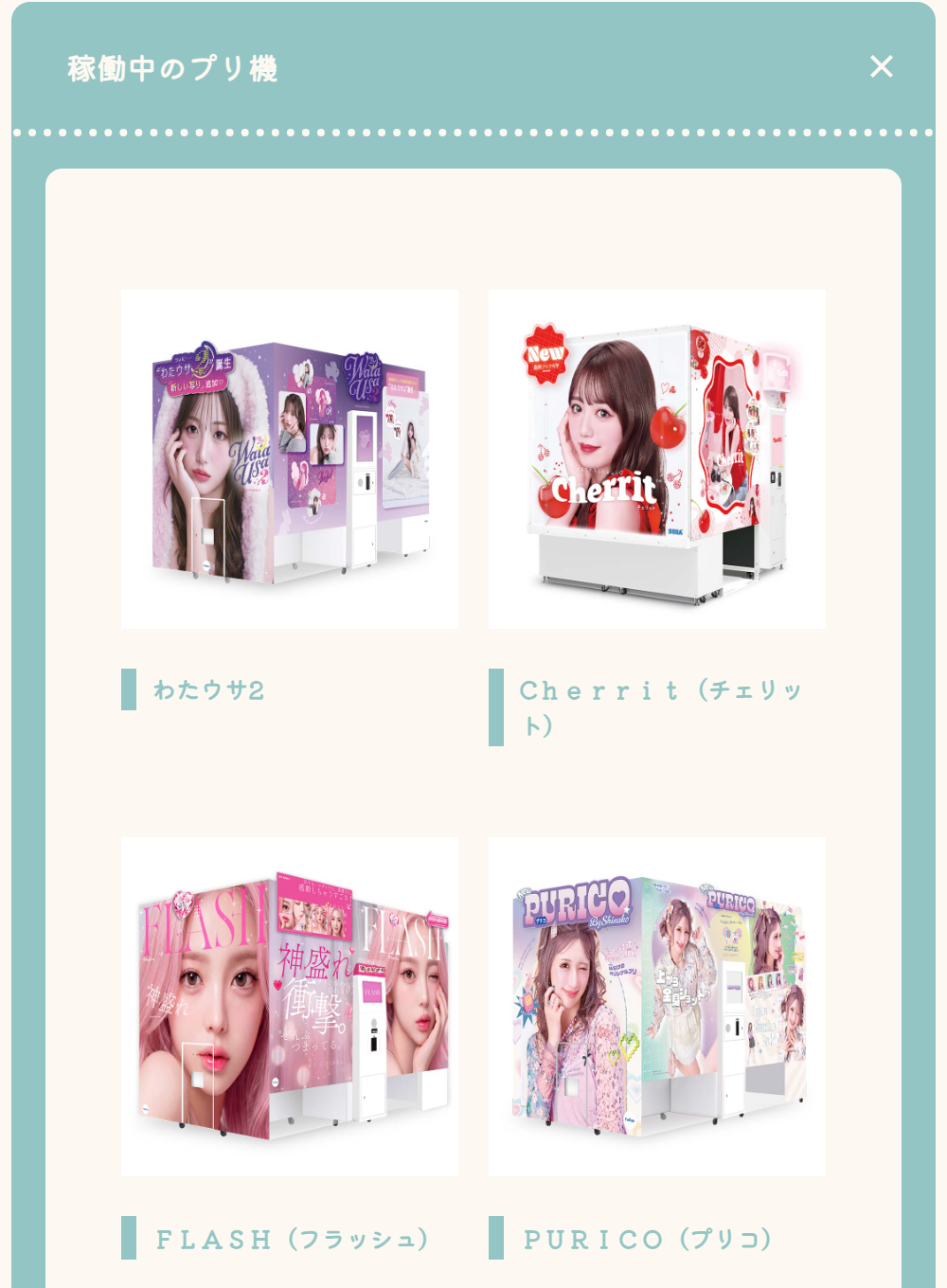
The official website’s “photo booths currently operating” list for 新宿東口店, with the newest models appearing first. Screenshot taken September 25, 2026. Source: official brooming website.
Cross-checking against this site’s photobooth.joelin.cc data, drawn from manufacturers’ installation maps, gives a consistent picture: all 20 brooming venues have FURYU machines, 18 have SEGA machines, and 19 are marked on manufacturers’ installation maps as locations with the “latest models.” Across タイトーステーション’s full set of 122 branches, 61 have that designation. The pattern of prioritizing brooming for new machines is visible.
There is another contrast: the three stores displaying brooming signage for the entire location have seven, ten, and nine models on their official lists, all below the average for the 20 stores. 浜松メイワン店’s list includes neither わたウサ2 nor CENTI:U.
Manufacturers open stores; arcade operators give spaces a name: two different business calculations
Japan’s dedicated photo booth stores emerge in two ways. One is for a manufacturer such as FURYU to open its own stores, including girls mignon. The other is for an arcade operator such as タイトー to give its in-store photo booth areas a name, such as brooming. Both may look like “branded photo booth stores,” but the business logic behind them is almost the opposite.
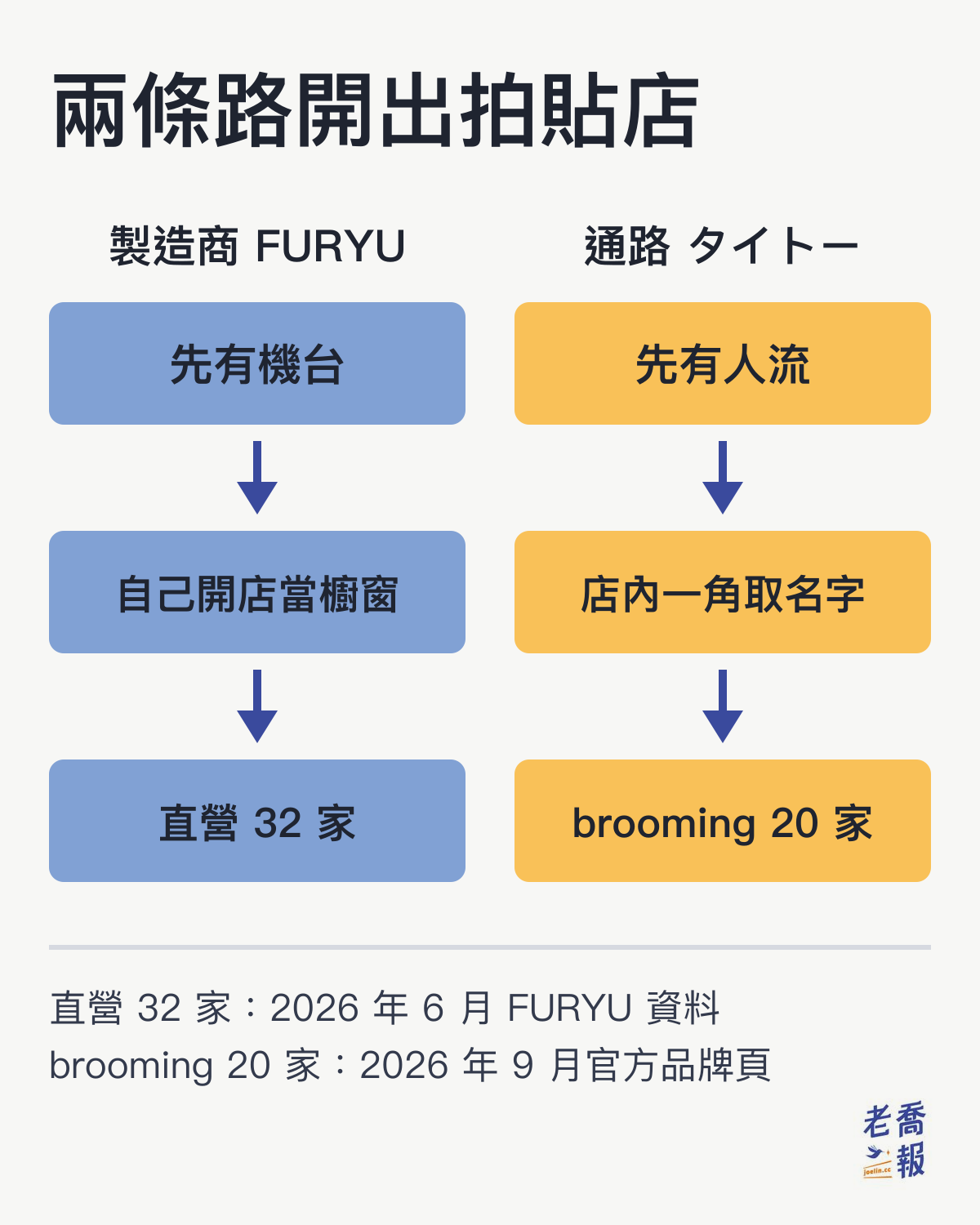
| Comparison | FURYU’s company-operated stores | brooming |
|---|---|---|
| Starting point | Its own machines | Existing foot traffic |
| Premises | Separately leased and fitted out | One corner of a branch |
| Machines | Only its own | Selects new models from two manufacturers |
| Scale | 39 → 32 stores | 20 locations |
| Core of the brand | Machines and memberships | The place itself |
The company-operated store counts were 39 for the fiscal year ended March 2025, 34 for the fiscal year ended March 2026, and 32 in June 2026. Of brooming’s 20 locations, three carry the brand across the entire store. “Machines and memberships” refers to FURYU’s machine brands and Pictlink photo memberships: wherever customers take photos in an arcade, those relationships belong to FURYU. “The place itself” means that brooming develops the space, with each store having its own Instagram account. The company-operated store counts in this table and the FURYU figures below all come from FURYU’s financial disclosures compiled in this site’s FURYU company study, covering the fiscal year ended March 2026, with the latest store count from June 2026. The following four points are this article’s analysis.
A manufacturer’s own stores earn more per session, but are difficult to scale
In arcades, FURYU is a supplier, earning money from consumables and photo download memberships. When it opens its own stores, it becomes the store operator and books the full proceeds. FURYU’s figures make this clear: revenue received per photo session is ¥504 at company-operated stores, versus only ¥239 through the arcade channel—roughly a twofold difference. Yet in the same year, more than 90% of sessions took place in arcades: 25.56 million arcade sessions versus 2.3 million at company-operated stores. Meanwhile, the company-operated store count fell from 39 to 32. For a manufacturer, its own stores are more like showrooms for new machines and the brand. Relying on them to drive revenue does not work once rent and staffing costs are taken into account.
An arcade operator adds a brand on top of rent it already pays
タイトー’s branches are already located near stations and inside shopping centers. The rent, foot traffic, and operating hours are already in place. brooming’s additional investment consists of makeup stations, hair irons, clothing racks, pink interiors, and a name—things that can be added and tested one branch at a time. Branches where the concept works can then adopt the signage for the entire store, as in Kanayama, Hamamatsu, and Fujinomiya. If it does not work, removing the name leaves the original arcade business intact. Viewed alongside the Amusement segment’s reference to “revenue growth at existing venues,” making one area of an existing branch more attractive to visitors is precisely the kind of low-cost growth available to this business.
The machine brands belong to someone else, so the operator builds a “place brand”
Customers recognize machine names such as Bloomit and CENTI:U, and those belong to FURYU. More importantly, the membership service used to save photos to a phone after a session—Pictlink—also belongs to FURYU. Wherever customers take photos in an arcade, the photo membership relationship stays with the manufacturer. For an arcade operator, the main relationship it can develop in this part of the business is “where to take photos.”
brooming turns that “where” into a brand: pink spaces, individual store Instagram accounts, photo session events, and a publicly available machine list for each location that is updated whenever a new model arrives. In effect, it converts a manufacturer’s product launch into a reason to visit its own store.
Buying from two manufacturers gives the arcade operator bargaining power
FURYU dominates brooming’s lists, but SEGA’s Cherrit, released in August 2026, was already listed at 15 locations. For an arcade operator, offering new models from two manufacturers both distinguishes its lineup from stores carrying a single brand and reduces its dependence on one supplier’s release schedule. By contrast, FURYU’s company-operated stores carry only its own machines, an inherent limitation of manufacturer-operated stores.
Together, these four points lead to a distinction: FURYU opens stores to get more people to see its machines; タイトー develops brooming to get more people to choose its stores. Both are called “branded photo booth stores,” but one sells machines and the other sells a place.
Why create a separate photo booth brand? The customers are different
There is one more straightforward reason: photo booth customers and crane game customers are not the same group. Arcades as a whole serve a broad customer base, and タイトー’s official website has no single declaration of its target audience. brooming’s copy, by contrast, revolves around “cute” and “being yourself,” addressing people who come to take photos and get ready beforehand.
.jpg)
.jpg)
.jpg)
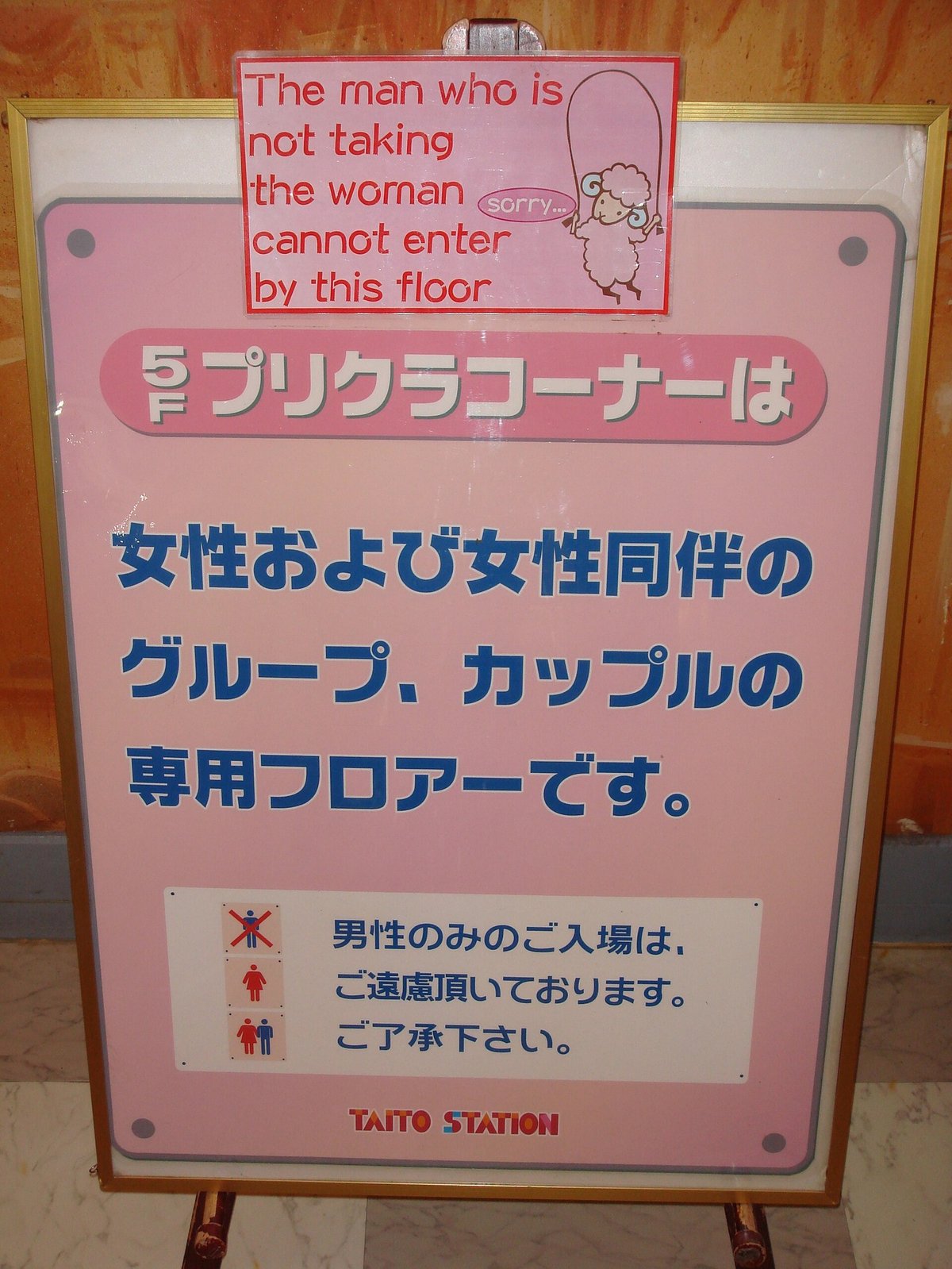
A photo booth floor notice at an unspecified タイトーステーション branch in 2006: the floor was reserved for women, groups accompanied by women, and couples, with men visiting alone asked to refrain from entering. Photo booth areas have long been spaces with different rules inside arcades. brooming formally gives a name to this “space for a different group of customers.” Photo: Olivier Lejade, CC BY-SA 2.0, original image.
.jpg)
The origins of restrictions on men entering Japanese photo booth areas alone are covered in Thirty Years of Japanese Photo Booths.
Where brooming fits in the three-layer classification
This series divides Japan’s photo booth industry into three layers: manufacturers make machines, such as FURYU and SEGA; distribution channels install machines, such as arcade chains; and brands open stores or dedicated areas focused solely on photo booths, such as girls mignon, Photoism, brooming, and eggnam. Shopping center locations have a different structural arrangement and are covered separately.
タイトー occupies two layers at once: タイトーステーション is a distribution channel, while brooming is a brand. photobooth.joelin.cc follows the same classification. The タイトーステーション page is treated as a distribution channel and excluded from the brand count; brooming has its own brand profile.
Within the overview article’s four-level classification of “photo booth brands emerging from distribution channels,” brooming already has a standalone brand page, branch-by-branch service and machine lists, and branches that have adopted its signage across the entire store. Other brands emerging from distribution channels include バンダイナムコ’s eggnam, カプコン’s プリマート, and イオンファンタジー’s PURI SPOT PALO, each to a different degree. For the full history of how Japanese photo booths evolved from 1995 to today’s situation of “concentrated machine suppliers, with distribution channels competing on service,” see Thirty Years of Japanese Photo Booths.
Related reading
- More Than 40% of Japan’s Photo Booths Are in Arcades: The Three Layers of Manufacturers, Distribution Channels, and Brands, and the Parent Companies of Ten Chains—the series overview, with ten arcade chains and their parent companies in one table.
- Thirty Years of Japanese Photo Booths: From Print Club to FURYU’s Dominance—a history of Japan’s photo booth industry.
- The Transformation of FURYU, Japan’s Leading Photo Booth Manufacturer—financial results at the manufacturer level, including revenue received per session at company-operated stores and through arcades.
- A Historical Report on the Development of Taiwan’s Photo Booth and Korean-Style Photo Booth Industries—the main article on the photo booth industry and an index of materials for the broader topic.
- brooming locations in Japan and タイトーステーション branches with photo booths—the photobooth.joelin.cc database.
Sources: タイトー’s official brooming brand page, including each store’s list of operating photo booth models; タイトー company profile; タイトー company history; タイトー store search; the official store page for タイトーステーション広島紙屋町店; スクウェア・エニックス・ホールディングス financial results summary for the fiscal year ended March 2026; its earnings presentation for the same period; its medium-term management plan progress report of November 6, 2025; and this site’s Japanese data layer on photobooth.joelin.cc.
The official brooming brand page, タイトー’s company profile and history, and スクウェア・エニックス’s investor relations materials were checked on September 25, 2026; the other sources were checked on September 24, 2026. Venue photographs come from Wikimedia Commons, with the photographer and license identified individually. The lead photograph is of タイトーステーション アリオ八尾店 in August 2019, one of brooming’s 20 locations: photo by Tokumeigakarinoaoshima, CC BY-SA 4.0, original image. The TAITO and brooming brand graphics come from their official websites and are used solely for identification; they do not imply a partnership.

Article keywords: brooming, タイトー, タイトーステーション, TAITO, スクウェア・エニックス, Amusement segment, Japanese photo booths, purikura, arcades, dedicated photo booth areas, girls mignon, コスプリ, costume rentals for photo booths in Japan.
FAQ
What is brooming?
brooming is the brand name タイトー (TAITO) gives to the photo booth areas at selected arcade branches. It officially describes them as “photo booth corners where you can shine and look cute.” The official brand page lists 20 locations, checked September 25, 2026. Most are inside タイトーステーション stores, while three—アスナル金山, 浜松メイワン, and イオン富士宮—use brooming as their store name.
Which company owns タイトー, and how much does it earn?
タイトー is a wholly owned subsidiary of スクウェア・エニックス・ホールディングス and was delisted in 2006. The Amusement segment to which it belongs recorded revenue of ¥72.1 billion and operating profit of ¥8.8 billion for the fiscal year ended March 2026, accounting for about one-quarter of group revenue. Photo booth revenue is not disclosed separately.
How many タイトーステーション locations are there in Japan?
タイトー’s official store search page does not state a total. Its parent company スクウェア・エニックス’s November 2025 materials report 175 TAITO arcades in Japan and overseas, combining company-operated and franchised locations. photobooth.joelin.cc lists 122 Japanese branches confirmed to have photo booths. The scopes differ, so the two figures cannot be subtracted.
Which photo booth models does brooming have, and how many machines are there?
brooming officially publishes the photo booth models operating at each store, checked September 25, 2026. Across 20 locations, there are 22 models and 225 model listings: 19 FURYU models and three SEGA models. The most common are わたウサ2, CENTI:U, and Bloomit, each listed at 19 locations. The official lists disclose models only, not the number of individual machines.
Can I borrow costumes and change before taking photos at brooming?
At some branches, yes. Of the 20 locations on the official brooming brand page, 13 list costume rentals, checked September 25, 2026. Hours and fees vary by store, so consult the individual store descriptions on the official brand page. None of the three stores that use brooming as the name of the entire location lists costume rentals on the official page.
This English version is based on original Traditional Chinese content on joelin.cc. The language and explanations are localised for international readers. The Traditional Chinese original is the authoritative version — for its complete meaning, please read the original article.