
This article is also available in:繁體中文 · 日本語
Original Chinese publication date: September 25, 2026. The research and market figures below retain the original article’s historical snapshot.
Summary
The ID photo booths found on Japanese streets, known as 証明写真機, belong to three operators: ME Group Japan’s Photo ME; Ki-Re-i and ID-Spot, operated by DNPフォトイメージングジャパン under 大日本印刷; and ID VOX, operated by Kyoto-based 扶桑プレシジョン. On September 25, 2026, this site compiled individual entries from all three operators’ official location finders: 13,085 Photo ME locations, 7,964 DNP locations—6,856 Ki-Re-i and 1,108 ID-Spot—and 1,320 ID VOX locations, for a total of 22,369 installation locations. The companies’ own figures are approximately 14,000 locations nationwide, a planned total of 9,400 machines announced in 2022, and approximately 1,100 machines in 2023, respectively. These figures use different definitions and cannot be subtracted from one another.
Between 2020 and 2023, カジタク, プラザクリエイト and companies in the 富士フイルム group sold their ID photo booth businesses to DNP or ME Group Japan. Taiwanese people in Japan may need these booths for Taiwanese passport renewal or replacement after loss, residence cards, exchanging a Taiwanese driver’s license for a Japanese one, and résumés. Taiwanese passport photos measure 4.5 × 3.5 cm, matching the Japanese booths’ パスポート option at 45 × 35 mm. However, Taiwan’s representative office in Japan requires a pure white background, prohibits skin-enhancement modes and retouching, and recommends having the photos taken at a photography studio.
The three operators differ in several ways. Photo ME does not publish official prices; the panels of two machines photographed in 2024 and 2026 listed スタンダード at ¥1,000 and 肌美人スーパー at ¥1,100. All three modes on its official website include skin-enhancement effects. DNP publishes a general price range of ¥900–¥1,600 and offers a regular mode without retouching. ID VOX’s official FAQ says its regular plan usually costs ¥900 or ¥1,000. For digital files, Photo ME’s i-keep requires no app and stores photos for six months; DNP’s Withスマホ requires an app and downloading within seven days; and ID VOX uses a Japanese-language app and stores photos for six months.
Since March 24, 2025, first-time Japanese passport applications have also been available entirely online. Ministry of Foreign Affairs statistics show that counter applications requiring printed photos fell by 32.6% in 2025 compared with 2024. ID photo booth operators are consequently promoting digital files that can be uploaded with online applications.
Key facts
- On September 25, 2026, this site compiled 22,369 Japanese ID photo booth installation locations from the three operators’ official location finders: 13,085 for ME Group Japan’s Photo ME; 7,964 for DNP, comprising 6,856 Ki-Re-i and 1,108 ID-Spot locations; and 1,320 for 扶桑プレシジョン’s ID VOX.
- The companies’ own figures differ: ME Group Japan’s press releases state approximately 14,000 locations nationwide; DNP announced a planned group total of 9,400 machines in October 2022, including 2,000 ID-Spot machines; and 扶桑プレシジョン’s June 2023 press release stated approximately 1,100 machines.
- カジタク sold to DNP in June 2020; プラザクリエイト announced a transfer to 日本オート・フォート in November 2020; and companies in the 富士フイルム group sold to ME Group Japan in September 2023, with a final total of 3,611 machines. These operators successively exited Japan’s ID photo booth market.
- Taiwanese passport photos measure 4.5 × 3.5 cm, with 3.2–3.6 cm from the top of the head to the chin. This matches Japan’s Ministry of Foreign Affairs specifications of 45 × 35 mm and 34 ± 2 mm from the top of the head to the chin.
- The Taipei Economic and Cultural Representative Office in Japan’s passport renewal page requires a pure white background, prohibits selfie skin-enhancement modes and retouching, and recommends a photography studio. Japan’s Ministry of Foreign Affairs recommends white but also accepts light blue backgrounds.
- All three Photo ME modes listed on its official website—スタンダード, 肌美人スーパー and 肌美人プレミアム—include skin-enhancement effects. DNP’s Ki-Re-i and ID-Spot offer a regular mode without retouching. ID VOX offers a choice between regular and skin-enhancement modes.
- Photo ME does not publish official prices. Two machines of the same model, photographed in Nagoya’s Kita Ward in February 2024 and Aioi, Hyogo Prefecture, in September 2026, both displayed スタンダード at ¥1,000 and 肌美人スーパー at ¥1,100. DNP says prices vary by location and generally range from ¥900 to ¥1,600. ID VOX’s official FAQ says its regular plan usually costs ¥900 or ¥1,000.
- Digital files: Photo ME’s i-keep requires no app, stores photos for six months, and provides files at 1500 × 1125 pixels. DNP’s Withスマホ requires an app, downloading within seven days of taking the photos, and provides files at 1024 × 768 pixels. ID VOX uses the Japanese-language IDPhotoDL2 app and stores photos for six months.
- Ministry of Foreign Affairs statistics show that domestic Japanese passport counter applications requiring printed photos fell from 3,432,129 in 2024 to 2,314,588 in 2025, a decline of 32.6%. Total applications fell by only 2.9%. Since March 24, 2025, first-time applications have also been available online nationwide.
- Smaller operators such as 三吉工業, 北菱プリントテクノロジー and 東京富士カラー do not publish location lists. The 北菱 booths installed at セイコーマート offer only gray, green, yellow-green and aqua backgrounds.
Outside supermarkets, in station passageways and beside convenience stores in Japan, you will often see a small booth with a sign reading 証明写真. This is an ID photo booth, or 証明写真機 in Japanese. Put in your money, sit down and take your photos; a few minutes later, you have printed ID photos. These machines belong to three companies: ME Group Japan, with Photo ME; 大日本印刷 (DNP), with Ki-Re-i and ID-Spot; and Kyoto-based 扶桑プレシジョン, with ID VOX. On September 25, 2026, this site compiled individual entries from their official location finders, totaling 22,369 locations.
Taiwanese people living in or traveling through Japan mainly need these booths in four situations: renewing an expired Taiwanese passport or replacing a lost one through Taiwan’s representative office in Japan; applying for a residence card; exchanging a Taiwanese driver’s license for a Japanese one; and preparing a résumé for part-time work or study. For Taiwanese passport photos, remember three things: choose パスポート at 45 × 35 mm, select a pure white background, and leave skin enhancement off.
First, make one distinction clear: ID photo booths are different from purikura machines. The arcade machines that let you draw on your photos and print them as stickers are プリクラ, or purikura. Their market, manufacturers and prices are a separate subject. Their history is covered in Thirty Years of Purikura in Japan. This article covers only 証明写真機 used for identification photos.
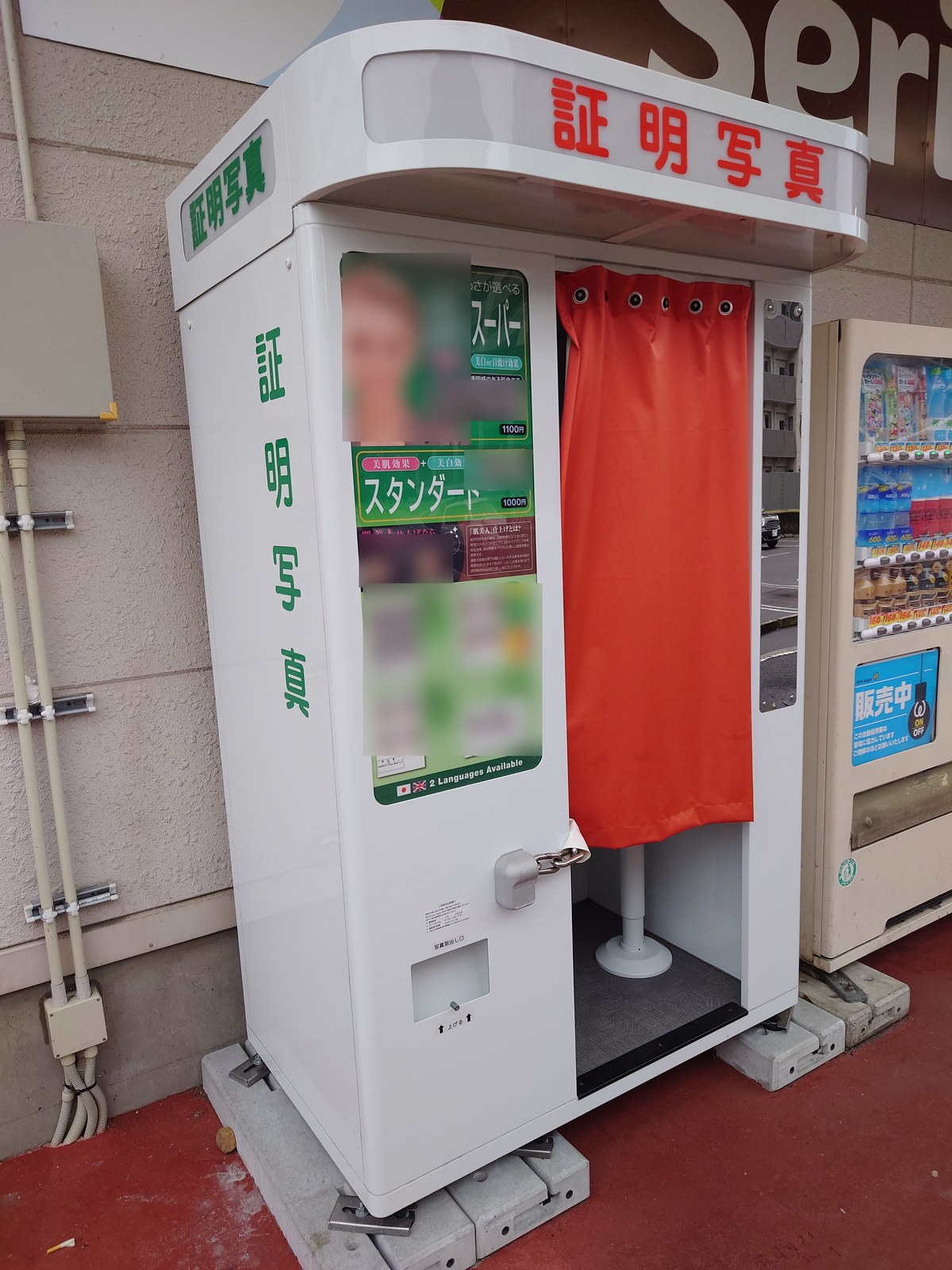
A Photo ME ID photo booth on a street in Nagoya’s Kita Ward in February 2024, with an ME Group Japan customer-service sticker on its exterior. The panel prices—¥1,100 for 肌美人スーパー and ¥1,000 for スタンダード—were the prices displayed on this particular machine at that time, rather than nationwide prices. This site blurred the advertising portraits and sample photos on the panel. Photo: 円周率3パーセント, CC BY-SA 4.0, original image.
1. When Taiwanese people need an ID photo booth: an overview
| Situation | Who may need it | Official photo specifications | Size to choose on a Japanese booth | Most common pitfall |
|---|---|---|---|---|
| Renewing a Taiwanese passport or replacing a lost one through Taiwan’s representative office in Japan | Taiwanese residents in Japan and travelers who have lost their passports | 4.5 × 3.5 cm; 3.2–3.6 cm from the top of the head to the chin; pure white background; taken within six months; two photos | パスポート, 45 × 35 mm | Choosing a light blue or gray background, or enabling skin enhancement |
| Entry certificate for returning to Taiwan urgently after losing a passport | Travelers | Two color photos with a white background; the page does not specify dimensions | Use passport specifications, as recommended by this site | Same as above |
| Residence card for study, a working holiday or employment | Taiwanese residents in Japan | 4 × 3 cm; 2.5 ± 0.3 cm from the top of the head to the chin; plain background; taken within six months | 40 × 30 mm | Since June 14, 2026, children aged one to under 16 also need a photo |
| Driving in Japan with a Taiwanese driver’s license and a Japanese translation | Travelers renting or driving a car | No photo required | — | — |
| Exchanging a Taiwanese driver’s license for a Japanese one, known as 外免切替 | Residents in Japan who want to drive | 3 × 2.4 cm; plain background; taken within six months | 30 × 24 mm, or trim a larger photo | Leave approximately 3 mm of space above the head |
| Résumé for part-time work or job applications | Working holiday participants, international students and job seekers | Ministry of Health, Labour and Welfare template: 36–40 mm high and 24–30 mm wide | 履歴書, 40 × 30 mm | — |
| Replacing a photo for the JLPT taken in Japan | International students | 4 × 3 cm; taken within six months | 40 × 30 mm | — |
| U.S. ESTA | Taiwanese people traveling to the United States | No printed photo required; the online process has switched to a selfie | No booth needed | — |
Specification sources: for Taiwanese passports, see the representative office’s passport renewal page and the Bureau of Consular Affairs photo specifications; for lost passports, see the replacement page and entry certificate page; for residence cards, see the Immigration Services Agency; for Japanese driver’s licenses, see the Tokyo Metropolitan Police Department’s photo requirements; for résumés, see the Ministry of Health, Labour and Welfare’s sample résumé format; and for the JLPT, see Japan Educational Exchanges and Services. All were checked on September 25, 2026.
Taken together, losing a passport is almost the only situation in which a short-term visitor would actually need an ID photo booth. Driving with a Taiwanese license and a Japanese translation, or applying for U.S. ESTA, requires no photo. The people who need booths more regularly are residents in Japan: for residence cards, Japanese driver’s licenses, résumés and renewing an expiring passport.
2. Three things to remember when taking Taiwanese passport photos
Size: choose Japan’s パスポート option
Taiwanese passport photos are 4.5 cm high and 3.5 cm wide, with 3.2–3.6 cm from the top of the head to the chin. Japan’s Ministry of Foreign Affairs specifies 45 mm high and 35 mm wide, with 34 ± 2 mm from the top of the head to the chin—that is, 32–36 mm. See the Ministry of Foreign Affairs passport application photo specifications. The photo dimensions and head proportions are identical, so photos taken using a Japanese booth’s パスポート option meet Taiwanese passport size requirements.
Background: always choose pure white
The representative office’s passport renewal page specifies a “pure white background.” Japan’s Ministry of Foreign Affairs recommends white but also accepts light blue, so the backgrounds available under a Japanese booth’s パスポート option may include colors other than white. Modes that allow background changes—Photo ME’s 肌美人プレミアム, Ki-Re-i’s エクセレントモード and ID VOX’s background compositing—offer several colors. Before printing, confirm on the screen that you have selected white.
Some machines do not offer white at all. The 北菱プリントテクノロジー booths installed at セイコーマート stores in Hokkaido offer only gray, green, yellow-green and aqua backgrounds. See the 北菱 official website. Photos from these booths do not meet the pure white background requirement for Taiwanese passports.
Skin enhancement: leave it off
The representative office’s passport renewal page explicitly says that selfie skin-enhancement modes and retouching must not be used. It also states that photos failing to meet the specifications will not be accepted, that screening is strict and many applicants have had their submissions rejected, and that applicants are advised to use a photography studio. See the original page, checked on September 25, 2026.
Most Japanese ID photo booths offer skin enhancement, but each operator designs its modes differently:
- All three print modes listed on Photo ME’s official website—スタンダード, 肌美人スーパー and 肌美人プレミアム—include skin-enhancement effects. Even the basic スタンダード mode lists skin enhancement and whitening. No explanation of a mode without retouching was found on the official website. See the ME Group Japan official website.
- DNP’s feature comparison table published in 2022 shows that both Ki-Re-i and ID-Spot have a regular mode without retouching. Skin retouching is an optional feature available through modes such as エクセレントモード. See the DNP press release dated October 24, 2022.
- ID VOX lets users choose between regular and skin-enhancement modes when taking photos. See the ID VOX official website.
Whether a Taiwanese passport photo taken in a Japanese ID photo booth is accepted therefore depends on its background and retouching. The representative office’s own recommendation remains to have the photos taken at a photography studio.
3. Who owns that booth on the street? Three operators and their counts
| Operator | Brand | Parent company | Locations compiled by this site from official location finders on September 25, 2026 | Company’s own figure |
|---|---|---|---|---|
| ME Group Japan | Photo ME; new model: Photomaton EVO | UK-based ME Group International | 13,085 locations | Company descriptions in press releases state approximately 14,000 locations nationwide; this wording has been used since November 2023 and remained unchanged on June 30, 2026 |
| DNPフォトイメージングジャパン | Ki-Re-i, ID-Spot | 大日本印刷 (DNP) | 7,964 locations: 6,856 Ki-Re-i and 1,108 ID-Spot | A group total of 9,400 machines announced in October 2022: 7,400 Ki-Re-i and 2,000 ID-Spot; this was the planned total for completion in September 2023 |
| 扶桑プレシジョン | ID VOX | —; an independent company in Kyoto | 1,320 locations | Approximately 1,100 machines in a June 2023 press release |
Sources for the companies’ own figures: ME Group Japan’s June 30, 2026 press release, DNP’s October 24, 2022 press release, and 扶桑プレシジョン’s June 6, 2023 press release.
This site’s figures count installation locations retrieved individually from the three official location finders on September 25, 2026, with each identical name-and-address combination counted once. The three operators total 22,369 locations. Some company figures refer to locations and others to machines, and their dates also differ. The two sets of figures are presented side by side for reference and cannot be subtracted from one another. No industry association publishes a nationwide total for Japan.
ME Group Japan: Photo ME
ME Group Japan was established in 1963 under the name 日本オート・フォート and adopted its current name in November 2022. Its official website describes it as the pioneer that first introduced ID photo booths to Japan. See the ME Group Japan official website; this is the company’s own description. Its parent is London-listed ME Group International, the group behind Europe’s Photomaton booths. The parent company’s business and finances are covered in An In-Depth Look at ME Group, the Leading Photo Booth Operator in Europe and North America. In May 2026, Japan’s first Photomaton EVO, a new model with an exterior designed by Philippe Starck, was installed in Shinjuku, Tokyo. EVO accepts only cashless payments. Photo ME’s history, how to use its booths, its official size chart and i-keep digital files are covered separately in the Photo ME brand guide.
DNP: Ki-Re-i and ID-Spot
Ki-Re-i (キレイ) was originally a digital ID photo booth brand from コニカミノルタ. 大日本印刷 took over コニカミノルタ’s ID photo business in July 2006, and the brand continues today. ID-Spot was created by upgrading the “IDVOX” machines DNP purchased from カジタク (KJS) in 2020. The upgraded machines began rolling out in November 2022. See the DNP press release dated October 24, 2022. The origins of Ki-Re-i and ID-Spot, their official comparison table, prices and Withスマホ digital files are covered separately in the Ki-Re-i / ID-Spot brand guide.
扶桑プレシジョン: ID VOX
扶桑プレシジョン is a software company established in Kyoto in 1995, with ¥15 million in capital and 15 employees as of July 2026. See its company profile. ID VOX shares its name with the “IDVOX” machines acquired by DNP: the id-vox.jp domain has been registered in the name of 扶桑’s representative since 2014, and the app from the カジタク era also used 扶桑’s package name. The machines sold to DNP in 2020 were the fleet operated by カジタク. Today’s ID VOX is a separate network operated by 扶桑 under its own name.
ID VOX booths are frequently installed at ミニストップ and スギ薬局. This site’s count of store names in the official list found 552 ミニストップ locations and 300 スギ薬局 locations out of 1,320 total. The history of 扶桑プレシジョン and ID VOX, location counts for each of its six features, and how to retrieve digital files through the app are covered separately in the ID VOX brand guide.
Three operators that have exited the market
Japan’s ID photo booth market once had more than these three operators. Between 2020 and 2023, three others sold their machines to ME or DNP:
- カジタク (KJS): In June 2020, it spun its ID photo booth business into a new company and sold all the shares to DNP. See the DNP press release dated June 30, 2020. These machines were later upgraded into ID-Spot booths.
- プラザクリエイト: In November 2020, it announced that its ID photo booth business, comprising 1,600 machines, would be spun into the subsidiary フォトプラザ and transferred to 日本オート・フォート. The subsidiary was merged into the buyer in March 2021. See the プラザクリエイト announcement.
- Companies in the 富士フイルム group: Their ID photo booth business was sold to ME Group Japan on September 30, 2023. There were 3,548 machines at closing and a final total of 3,611 after the transfer period ended. See ME Group’s acquisition completion announcement.
Finding a booth: this site’s Japan ID photo booth map
Each operator has its own official location finder, but it shows only that operator’s machines. This site puts all 22,369 locations on a single map so you can find the nearest booth and filter by brand. Prefecture pages also let you filter by whether digital files are available and whether you can apply directly for a My Number Card: Nationwide Japan ID Photo Booth Map. Examples of prefecture pages include Tokyo, with 2,302 locations across the three operators; Osaka, with 1,604; and Aichi, with 1,442.
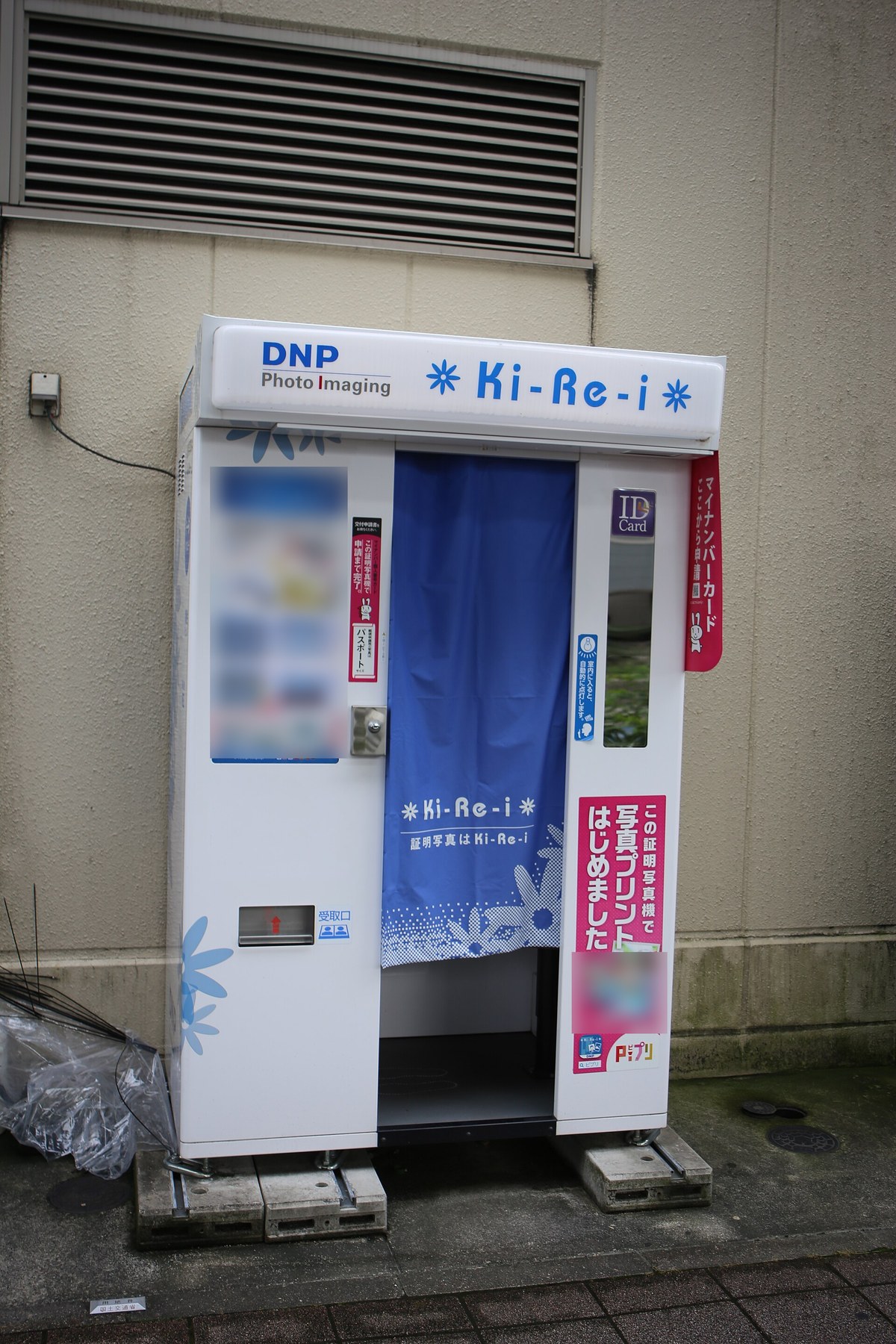
A DNP Ki-Re-i ID photo booth in Nagoya’s Kita Ward in July 2020, showing its appearance before DNP introduced its new brand logo in 2025. The red hanging sign on the right says that users can apply directly for a My Number Card (マイナンバーカード) at this machine. This site blurred the sample portraits on the panel. Photo: 円周率3パーセント, CC BY-SA 4.0, original image.
4. How the three operators differ: facts available from official sources
| Item | Photo ME (ME Group Japan) | Ki-Re-i / ID-Spot (DNP) | ID VOX (扶桑プレシジョン) |
|---|---|---|---|
| Prices from official sources | No official prices published. Two machines of the same model, photographed in Nagoya’s Kita Ward in February 2024 and Aioi, Hyogo Prefecture, in September 2026, both displayed スタンダード at ¥1,000 and 肌美人スーパー at ¥1,100 | Official sources say prices vary by installation location and generally range from ¥900 to ¥1,600. The highest-tier package—prints, digital files, skin retouching and background changes—costs ¥1,600 | Official FAQ: prices vary by location and plan; the regular plan usually costs ¥900 or ¥1,000 |
| Mode without retouching | All three modes on the official website include skin-enhancement effects; no mode without retouching was found | Both Ki-Re-i and ID-Spot offer a regular mode | Choice of regular or skin-enhancement mode |
| Direct My Number Card application at the machine | Available; listed among supported operators by J-LIS. This site’s compilation found 7,166 locations marked as supporting it | Available; listed by J-LIS. This site’s compilation found 6,642 locations marked as supporting it | 500 locations are marked マイナンバーWEB申請, meaning online My Number Card application. 扶桑 is not on J-LIS’s published operator list, and the official website does not explain the application mechanism |
| How to obtain digital files | i-keep: no app required; download by entering the 管理コード, or management code, printed on the photos. Stored for six months; original file size: 1500 × 1125 pixels | Withスマホ: install the free Ki-Re-i Photo app, scan the QR code and enter an eight-digit password. Download within seven days of taking the photos; 1024 × 768 pixels | IDPhotoDL2 app, available only in Japanese; enter the ten-digit access code printed on the photos. Stored for six months |
| Locations offering digital files in this site’s compilation | 7,889 locations | 6,597 locations | 1,316 locations |
| Payment | Official specifications for the current main model, ND71, list cash: ¥10–¥500 coins and ¥1,000 notes. No information was found confirming QR or transit e-money support. The new EVO model accepts only cashless payments | Cash; ¥5,000 and ¥10,000 notes are not accepted. Some machines support nine QR payment services and transit e-money such as Suica. Credit cards are not accepted | Cash; supported QR payment services are PayPay, d払い, 楽天ペイ, メルペイ, WeChat Pay and Alipay |
| Languages on the machine | The official website says the latest machines support six languages but does not identify them. The older machine in the photo has a panel marked “2 Languages Available” | Seven: Japanese, English, Korean, Chinese, Portuguese, Spanish and Russian. Official sources do not specify whether Chinese is Traditional or Simplified | Not stated on the official website; no information found |
| Retakes | No information found | Ki-Re-i: choose one from up to four shots. ID-Spot: unlimited retakes | Unlimited retakes |
Sources, checked on September 25, 2026: for Photo ME, see the consumer service page and machine specifications page. Panel prices come from two Wikimedia Commons photos: Nagoya in 2024 and Aioi in 2026. For Ki-Re-i, see the FAQ, Withスマホ page, article on price ranges and site-owner page for language support. For ID VOX, see its official website and FAQ. For operators supporting My Number Card applications, see J-LIS.
The location counts in the table were calculated by this site using the feature fields in each operator’s official finder. However, the three operators define those fields differently: for example, digital-file availability corresponds to i-keep, Withスマホ and アプリ対応, or app support, respectively. The counts can be used to examine proportions within one operator’s network, but not to compare operators. All three share one characteristic: even machines of the same brand may have different features. Each operator advises checking that the particular machine has the features you need before heading out.
5. Japan’s 2025 passport changes: why digital files became a priority
This section concerns Japanese people applying for Japanese passports. Taiwanese people applying for Taiwanese passports still need to submit two printed photos to Taiwan’s representative office in Japan. However, the changes explain why Japanese ID photo booth operators have been promoting digital files over the past two years.
Japan opened online passport applications through マイナポータル on March 27, 2023. Applicants could take a selfie with the smartphone app or upload a JPG, but first-time applications, or 新規, were initially available online in only some prefectures. Since March 24, 2025, first-time applications in all 47 prefectures have been available entirely online, with no printed photo required. Counter applicants still need to submit one printed photo. Passport fees were then substantially reduced on July 1, 2026: the online fee for a ten-year passport fell from ¥15,900 to ¥8,900, while the counter application fee fell from ¥16,300 to ¥9,300.
Domestic application counts from the Ministry of Foreign Affairs passport statistics:
| Year | Counter applications requiring printed photos | Online applications | Total | Online share |
|---|---|---|---|---|
| 2024 | 3,432,129 | 296,714 | 3,728,843 | 8.0% |
| 2025 | 2,314,588 | 1,305,636 | 3,620,224 | 36.1% |
Source: application breakdowns in the 2024 and 2025 editions of the Ministry of Foreign Affairs passport statistics. This site calculated the online shares. The ministry’s announcement of the 2025 passport statistics also states that the online application share after March 24, 2025, was approximately 44%.
Total applications fell by only 2.9% over the year, but counter applications requiring printed photos fell by roughly one-third: 32.6%, or approximately 1.12 million applications. Almost all of the decline was among first-time applicants. In its results announcement for the first half of 2026, ME Group attributed a 14.8% year-on-year decline in Asia-Pacific photo booth revenue to Japan’s changed process for new passport applications. See ME Group’s 2026 interim results announcement.
Online applications also accept photo files taken at photography studios or ID photo booths. マイナポータル accepts JPG uploads of up to 600 KB; larger files are automatically compressed. This is the use case promoted by Photo ME’s i-keep and DNP’s Withスマホ: take photos at a booth, obtain a digital file and upload it from home. DNP’s app can also automatically format the photo for an online passport application. Taiwanese residents in Japan who have a My Number can use the same digital-file feature to apply online for a My Number Card.
6. How to use a booth: getting it right in one visit
The three operators’ screens differ, but the steps are broadly similar:
- Check the machine before heading out. Digital files, direct My Number Card applications and QR payments are not available on every machine.
- Sit down, draw the curtain and select the purpose or size on the touchscreen. For a Taiwanese passport, choose パスポート.
- Select the mode. For a Taiwanese passport, choose a regular mode without retouching. If background options are available, confirm that the background is white.
- Pay and take the photos. Ki-Re-i takes two shots initially and allows two more retakes. ID-Spot and ID VOX allow unlimited retakes.
- Collect the photos from the slot marked 写真取出し口 or 受取口. If you selected digital files, the photos will have a download code printed on them. Follow the relevant operator’s download process.
How the sizes correspond across the three operators, according to their official size charts:
| Purpose | Official specifications | Photo ME | Ki-Re-i | ID VOX |
|---|---|---|---|---|
| Taiwanese passport, Japanese passport, My Number Card | 45 × 35 mm | パスポート・マイナンバー, 45 × 35 mm; four photos | パスポート, 45 × 35 mm; three photos in the top row for passports | 45 × 35 mm |
| Residence card, résumé | 40 × 30 mm | 履歴書・運転免許, 40 × 30 mm; six photos | 履歴書, 40 × 30 mm; eight photos | 40 × 30 mm |
| Japanese driver’s license | 30 × 24 mm | The official size chart does not list 30 × 24 mm | Trim the 30 × 25 mm photos in the bottom row of the 免許証/中型 option | 30 × 24 mm |
Sources: ME Group Japan’s ID photo size list, Ki-Re-i’s quick size reference, and the ID VOX official website, checked on September 25, 2026. All three note that available sizes vary by machine model.
All three offer the sizes needed for passports and residence cards. For the 30 × 24 mm Japanese driver’s license photo, Ki-Re-i users need to trim a larger photo themselves, while Photo ME’s official size chart does not list that size. The Tokyo Metropolitan Police Department also states that the Fuchu, Samezu and Koto driver’s license testing centers have ID photo booths whose photos can be used directly.
7. Other small operators: no public location lists
Beyond the three major operators, Japan has several smaller ID photo booth businesses. None provides a public installation-location finder, so they are not included in this site’s 22,369 locations:
- 三吉工業 (プロ写真館): A precision metalworking company in Yokohama that began making ID photo booths in 1999. It appears on J-LIS’s published list of operators supporting My Number Card applications. Its FAQ lists ¥500 per photo, with no date given, and notes that some photos cannot be used for foreign passports, visas and similar applications. See the 三吉工業 FAQ.
- 北菱プリントテクノロジー: A photo-processing company in Sapporo belonging to the セイコーマート group. Its official website states approximately 1,200 machines nationwide as of November 2021, with on-screen and voice guidance in eight languages, including Chinese. Digital downloads are unavailable. Machines installed at セイコーマート cost ¥1,000 and accept cash only. See the 北菱 official website and セイコーマート.
- 東京富士カラー: A photo-processing and photography studio operator that also recruits sites for ID photo booth installations. Its official website does not state a machine count. See 東京富士カラー.
8. Each operator in one sentence
- Photo ME (ME Group Japan): Operating ID photo booths in Japan since 1963, with UK-based ME Group as its parent; i-keep digital files require no app and are stored for six months. For the full introduction, see the Photo ME brand guide.
- Ki-Re-i / ID-Spot (DNP): The ID photo booth business 大日本印刷 took over from コニカミノルタ offers a regular mode without retouching, digital files that must be downloaded through an app within seven days, and seven languages on the machines. For the full introduction, see the Ki-Re-i / ID-Spot brand guide.
- ID VOX (扶桑プレシジョン): A third network operated by a 15-person Kyoto company, with many booths at ミニストップ and スギ薬局; QR payments include Alipay and WeChat Pay, while the digital-file app is available only in Japanese. For the full introduction, see the ID VOX brand guide.
Taiwan’s ID photo booths form a separate market. Its brands and machines are covered in the articles on 水啦 ID photo booths and 富多美 ID photo booths.
Cover image: A DNP Ki-Re-i ID photo booth in Nagoya’s Kita Ward, photographed by 円周率3パーセント in July 2020, CC BY-SA 4.0, original image. This site blurred the portraits and cropped the image to 16:9. Both modified images above retain the original images’ CC BY-SA 4.0 license.
Article keywords: Japanese ID photo booths, 証明写真機, Photo ME, Ki-Re-i, ID-Spot, ID VOX, Taiwanese passport photos, residence card photos, Japanese driver’s license photos, My Number.
FAQ
Are Japanese ID photo booths the same as purikura machines?
No. ID photo booths, or 証明写真機, are self-service machines for passport, résumé and identification photos, usually installed beside supermarkets, stations and convenience stores. Purikura machines, or プリクラ, are entertainment machines in arcades that let you draw on your photos and print them as stickers. The manufacturers, markets and prices are different.
Can a Japanese ID photo booth take photos for a Taiwanese passport?
The dimensions are suitable: the パスポート option on Japanese machines is 45 × 35 mm, matching Taiwan’s 4.5 × 3.5 cm passport photos. However, the Taipei Economic and Cultural Representative Office in Japan requires a pure white background and prohibits skin-enhancement modes and retouching. Before taking the photos, confirm that the background is white and avoid any mode that includes skin enhancement. The representative office itself recommends using a photography studio.
How much does a session at a Japanese ID photo booth cost?
None of the three operators has a uniform nationwide price. DNP officially says prices vary by installation location and generally range from ¥900 to ¥1,600. ID VOX’s official FAQ says the regular plan usually costs ¥900 or ¥1,000. Photo ME does not publish official prices, but the panels of two machines photographed in 2024 and 2026 listed スタンダード at ¥1,000 and 肌美人スーパー at ¥1,100. Check the actual machine’s panel for its price.
Can I obtain digital files from a Japanese ID photo booth?
Some machines offer them. Photo ME’s i-keep requires no app: enter the 管理コード, or management code, printed on the photos to download the files, which are stored for six months. DNP’s Withスマホ requires the Ki-Re-i Photo app and downloading within seven days of taking the photos. ID VOX uses the Japanese-language IDPhotoDL2 app and stores files for six months. Not every machine has this feature, so check before heading out.
How many ID photo booths are there in Japan?
There is no official nationwide total. On September 25, 2026, this site compiled 22,369 installation locations from the three operators’ official location finders. Smaller operators such as 三吉工業, 北菱プリントテクノロジー and 東京富士カラー do not publish location lists and are not included in that figure.
Which size should I choose for a residence card photo?
The Immigration Services Agency requires a photo 4 cm high and 3 cm wide, with 2.5 ± 0.3 cm from the top of the head to the chin, a plain background, and taken within six months. On a Japanese booth, choose 40 × 30 mm, labeled 履歴書 or 在留カード. Since June 14, 2026, residence cards for children aged one to under 16 also require a photo.
Sources: The Chinese original was first published on 2026-09-25 and last updated on 2026-09-25. Data and observations retain the historical dates and markets stated in the article.
This English version is based on original Traditional Chinese content on joelin.cc. The language and explanations are localised for international readers. The Traditional Chinese original is the authoritative version — for its complete meaning, please read the original article.