
This article is also available in:繁體中文 · 日本語 · Tiếng Việt
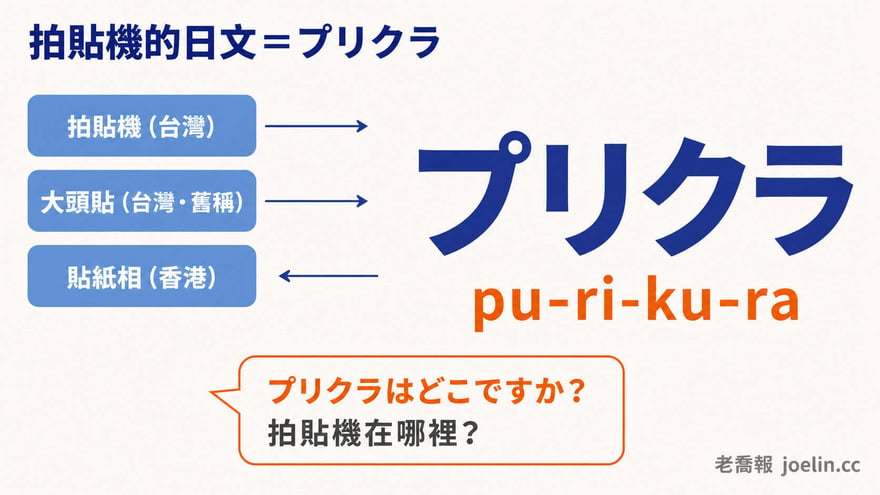
For Japan’s traditional photo-sticker booths, the everyday Japanese word is プリクラ (purikura), an abbreviation of the early brand name プリント倶楽部, Print Club. It became a common expression for the machines and their sticker photographs.
For locations, prices and the on-site process, see the Japan purikura guide. The language examples below retain the source’s January 2026 article and August update.
The main words
| What you mean | Japanese | Pronunciation or explanation |
|---|---|---|
| Purikura machine or photo-sticker experience | プリクラ | purikura |
| The machine itself | プリクラ機 | purikura-ki; 機 is read ki |
| Purikura area | プリクラコーナー | purikura kōnā |
| A location with machines | プリクラ設置店 | purikura setchiten |
Using the Taiwanese Chinese word 拍貼機 with a Japanese shop attendant may not communicate what you mean; プリクラ is the recognizable term for the Japanese format.
Related vocabulary
| Japanese | Pronunciation | Meaning here |
|---|---|---|
| プリクラ | purikura | The sticker photos as well as the experience. |
| 写真 | shashin | Photograph. |
| 盛れる | moreru | Looking more flattering or enhanced in a photo, in casual speech. |
| シール | shīru | Sticker, the output format. |
| 落書き | rakugaki | Doodling or writing on the photos. |
| デコる | dekoru | Decorating. |
| 二人で撮る | futari de toru | Taking photos as a pair. |
| 一緒に撮ろう | issho ni torō | Let’s take photos together. |
These words reflect the full Japanese experience, including enhancement, writing and decoration, rather than simply taking an unedited photograph.
Phrases to use on site
- プリクラはどこですか? — purikura wa doko desu ka? — Where are the purikura machines?
- この店にプリクラありますか? — kono mise ni purikura arimasu ka? — Does this shop have purikura?
- プリクラコーナーは何階ですか? — purikura kōnā wa nankai desu ka? — Which floor is the purikura area on?
A sign reading プリクラコーナー is likely to mark the area you are looking for.
Where to look
Common settings are ゲームセンター, often shortened to ゲーセン (game arcades), and ショッピングモール (shopping malls), as well as shopping districts popular with young people such as Shibuya, Harajuku, Shinjuku and Shinsaibashi.
Look for プリクラ and プリクラコーナー. Some signs say PHOTO, but that label does not necessarily mean purikura.
Search formulas
- Place name + プリクラ: 渋谷 プリクラ, 新宿 プリクラ or 原宿 プリクラ.
- プリクラ + ゲーセン: for machines inside game arcades.
- プリクラ + 設置店: for shops where machines are installed.
- 盛れる プリクラ 機種: for discussions of machine models with flattering enhancement effects.
What are the Chinese terms?
In Taiwan the broader expressions are 拍貼機 or 韓式拍貼, and the photographs are 拍貼. Older speakers also say 大頭貼. In Hong Kong, 貼紙相 is common. 人生四格 describes the four-frame vertical format popular in Taiwan; the source notes that the Chinese characters are also recognizable in Japanese discussions.
Japan’s purikura experience commonly includes shooting, beauty adjustment, doodling and printing stickers, as explained below.
The purikura process
The usual experience combines shooting, beauty adjustment, 落書き and printing stickers. That explains why 盛れる, 落書き and デコる are closely associated with it.
Frequently asked questions
Is 大頭貼 another Japanese word?
No. The Taiwanese term’s original machines came from Japan’s Print Club, introduced in 1995; the Japanese term is still プリクラ. Young people may shorten the resulting stickers to プリ (puri), and image files are called プリ画像. A literal translation such as 顔写真 can instead be understood as an identification portrait.
How do I ask for a machine?
Use プリクラはどこですか? To ask whether a shop has one, use この店にプリクラありますか?
Where are they usually found?
Game arcades, malls and youth-oriented shopping districts. Look for the プリクラ or プリクラコーナー sign.
Further reading
Sources: Chinese original first published 2026-01-19; original last updated 2026-08-28. Historical research dates and geographical scope are retained.
This English version is based on original Traditional Chinese content on joelin.cc. The language and explanations are localised for international readers. The Traditional Chinese original is the authoritative version — for its complete meaning, please read the original article.