
This article is also available in:繁體中文 · 日本語 · 한국어 · Tiếng Việt
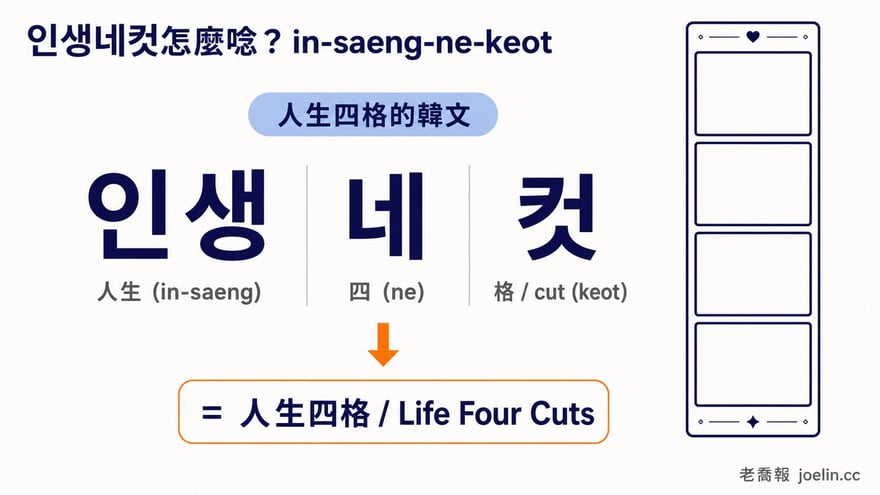
The Korean name behind the Chinese 人生四格 is 인생네컷, pronounced in-saeng-ne-keot. It combines 인생 (life), 네 (four), and 컷 (cut or frame). The official English brand name is Life Four Cuts, often styled Life4Cuts.
See photo dimensions for the print format and Japanese vocabulary for purikura. This article preserves the Chinese source’s August 2026 terminology account.
Pronunciation and meaning
- 인생: in-saeng, life, the Korean reading of the characters 人生.
- 네: ne, four.
- 컷: keot, borrowed from cut, a frame or shot.
In popular Korean usage, 인생 can suggest the best of one’s life, as in 인생샷, a particularly good photograph, or 인생맛집, a favourite restaurant described as a lifetime best. The name’s feeling is therefore about preserving life’s best moments in four frames, not just four separate pictures.
인생네컷 began as a brand name. The brand became popular around 2017, and people later used its name for the broader four-frame experience, rather like using a prominent brand name as a generic term. In Taiwan, 人生四格 similarly came to mean a Korean-style vertical four-frame photo strip even when another brand produced it.
For neutral expressions, use 네컷사진 (ne-keot-sa-jin, four-cut photos), 포토부스 (po-to-bu-seu, photo booth) or 셀프사진관 (self-photo studio). These identify the photo, machine or shop without naming Life Four Cuts.
English expressions
The brand’s official English name is Life Four Cuts; overseas branches frequently use Life4Cuts. To explain the generic format to an English-speaking friend, Korean photo booth or four-cut photo is clearer. The printed strip is a photo strip, while self-photo studio is also used for the shop format.
The August 2026 source says Life Four Cuts had expanded to more than ten countries, including the UK, US, Australia and Canada. That statement belongs to the source’s date, not a new live shop count. Brand revenue, expansion and listing plans are discussed in the Life4Cut company study.
Three layers behind the name
- A Korean brand, 인생네컷, which became prominent around 2017 and used the vertical four-frame strip as a recognizable format.
- A phrase suggesting life’s best moments captured in four cuts.
- A generic Taiwanese expression for Korean-style four-frame prints, commonly 2 × 6 inches; Hong Kong media also use 人生四格 and 四格相.
It can therefore refer to a particular brand, a layout, or the culture of keeping memories with friends. Use the context to tell which meaning is intended.
Useful Korean phrases
- 이 근처에 포토부스 있어요? — i geun-cheo-e po-to-bu-seu i-sseo-yo? — Is there a photo booth nearby?
- 인생네컷 어디에 있어요? — in-saeng-ne-keot eo-di-e i-sseo-yo? — Where is Life Four Cuts?
- 같이 네컷사진 찍을래요? — ga-chi ne-keot-sa-jin jji-geul-lae-yo? — Would you like to take four-cut photos together?
The source describes most Korean shops in this format as unattended and self-service, with screen selection and cash or card machines, so fluent Korean is not required for the shooting process. These phrases mainly help with directions and inviting someone to join.
Searching in Korea
Use a place name plus 네컷, for example 홍대 네컷 (Hongdae), 성수 네컷 (Seongsu) or 강남 네컷 (Gangnam). A place name plus 포토부스 also works, such as 명동 포토부스 (Myeongdong).
Signs include 인생네컷 (Life Four Cuts), 포토이즘 (Photoism), 하루필름 (Haru Film), and 포토그레이 (Photogray). These are brands, not interchangeable neutral category labels. The source describes their higher street density in Korea, including several shops on one street in Hongdae or Seongsu, with some also entering Taiwan.
Chinese, Korean, English and Japanese comparison
| Chinese | Korean and pronunciation | English | Japanese in the source |
|---|---|---|---|
| 人生四格 | 인생네컷, in-saeng-ne-keot | Life Four Cuts | 人生四格, the same characters |
| 四格照片 | 네컷사진, ne-keot-sa-jin | Four-cut photo | 4カット写真 |
| 拍貼機 | 포토부스, po-to-bu-seu | Photo booth | プリクラ |
| 相片條 | No Korean equivalent supplied in the source table | Photo strip | No Japanese equivalent supplied in the source table |
| 自助照相館 | 셀프사진관, sel-peu-sa-jin-gwan | Self-photo studio | セルフ写真館 |
The Japanese プリクラ row is a rough cross-language reference, not a claim that Japanese purikura and Korean booths are the same culture. Japanese machines emphasize enhancement and doodling; Korean-style booths in this comparison emphasize a natural-camera look. See the Japanese guide.
Frequently asked questions
Is Life Four Cuts a brand or a generic phrase?
Originally a brand. Its popularity led to generic usage, especially the Chinese 人生四格 for Korean-style four-frame strips. For a neutral Korean category, 네컷사진 or 셀프사진관 is more precise.
What does 인생 add to the meaning?
It can mean the best of one’s life in this colloquial construction, so the phrase evokes keeping life’s best moments in four frames.
What is the usual print size?
The source describes a vertical 2 × 6 inch four-frame format, with two strips printed from the same layout. See the 2 × 6 and 4 × 6 comparison.
Do I need Korean?
The self-service screen process is relatively intuitive. A phrase such as 인생네컷 어디에 있어요? is useful for finding a shop. Actual pronunciation is best learned from Korean audio rather than romanization alone; brand information and overseas expansion should follow official announcements.
Further reading
Sources: Chinese original first published 2026-08-04; original last updated 2026-08-04. Historical research dates and geographical scope are retained.
This English version is based on original Traditional Chinese content on joelin.cc. The language and explanations are localised for international readers. The Traditional Chinese original is the authoritative version — for its complete meaning, please read the original article.