
This article is also available in:繁體中文 · 日本語 · 한국어
Two common sizes for handheld fan banners in Taiwan are 30 × 10 cm and 45 × 15 cm. For a custom banner, the Chinese guide suggests a practical starting range of 45–50 cm wide and 15–20 cm high. These are design references, not a worldwide standard.
Make a photocard. Fan Support is operated by Joe Lin. Edit first, then log in to id.joelin.cc for free to download a PNG. The tool does not manufacture or ship physical goods. Your original photo is processed in your browser; the finished image is saved to your account when you download and is kept for 14 days.
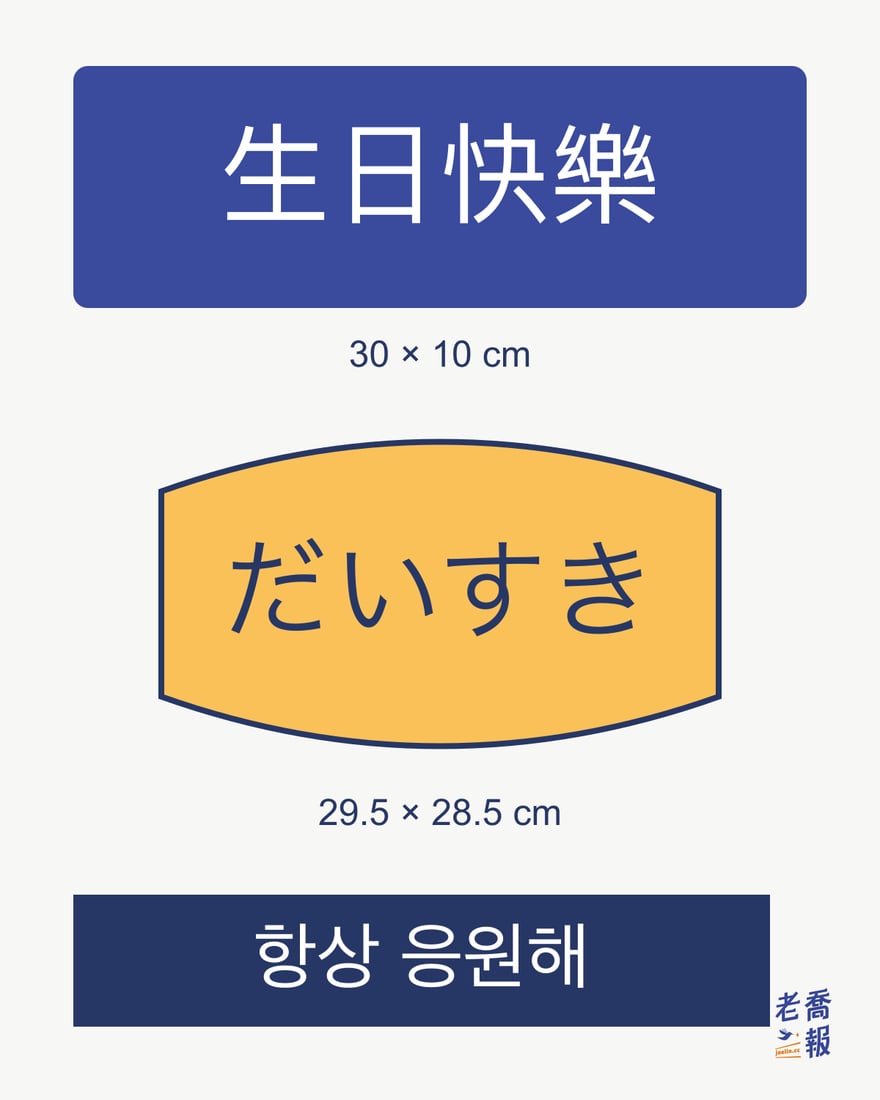
The long, narrow shape serves a purpose: it can reduce the obstruction of the audience behind you, and large lettering across a strip can be easier to recognise from the stage. How high you hold it still matters; a small banner can also block someone else’s view.
Choosing a banner size
| Format | Centimetres | Millimetres | Typical use |
|---|---|---|---|
| Common small size | 30 × 10 | 300 × 100 | Compact, held with one hand, easier to keep within event limits |
| Common large size | 45 × 15 | 450 × 150 | Held with both hands, lettering more visible at a distance |
| Suggested custom range | 45–50 × 15–20 | 450–500 × 150–200 | Adjust for the viewing distance, subject to event rules |
Check the specific event’s announcement first, then consider the distance. The Taiwan guide discusses events that use A3 as a reference: A3 is 29.7 × 42 cm, or approximately 1,247 cm², while a 45 × 15 cm banner covers 675 cm². The banner is about half that area, but area alone does not establish permission. An organiser may restrict the longest edge, material, height when held up, or all unofficial items. A 45 × 15 cm banner has a 45 cm long edge, longer than the 42 cm edge of A3, so it does not fit inside an A3 rectangle. For ways to check the actual rules, see the concert light-sign guide (in Chinese).
Comparing five materials
Changing the material can change the result considerably, even when the artwork stays the same. The names below follow the Taiwan printing context; ask your printer for an actual sample and specifications.
| Material | Characteristics | Suitable situations |
|---|---|---|
| Coated paper | Good image reproduction and usually the lowest cost among these options | A practical starting point for most indoor events |
| Pearlescent paper | A pearl-like reflective surface | Pale and pastel-coloured designs |
| Glitter-finish paper, called 滿天星 in Taiwan | Small reflective particles on the surface | A sparkling appearance when light catches it, including in dim venues |
| Nonwoven fabric | Foldable and resistant to tearing; weather resistance depends on the product | Outdoor or rainy events if the supplied material is suitable; confirm printing on one or both sides |
| PVC | Stiff and suitable for custom shapes | Shaped banners; usually the most expensive option in this comparison |
The main differences are the surface finish and ink absorption. Coated paper has an even coating that reproduces print dots accurately, making it a useful choice for photographic artwork. Pearlescent and glitter finishes add a reflective layer. That can stand out in a venue, but reflections can obscure details in dark areas, so these finishes are less suitable for predominantly dark designs.
Before using nonwoven fabric outdoors, ask whether the fabric, ink and finishing can withstand water and sunlight. A nonwoven fabric is not automatically waterproof. Its fibrous surface can soften small text and fine lines depending on the printing method, so enlarge the lettering and ask for a sample print.
A rigid handheld sign made from foam board with an adhesive PVC layer is a different construction. Its added weight and bulk can create admission problems even if the artwork has the same dimensions as a flexible banner.
Preparing a printing file
Colour, bleed and the safe area need attention, along with resolution:
- Prepare CMYK artwork if that is what your printer requires. Bright fluorescent RGB colours on a screen cannot be reproduced in ordinary CMYK printing, especially fluorescent pink and green. Avoid relying on those colours, or discuss spot-colour printing with the supplier.
- The source guide allows 2 mm of bleed on every edge. A small cutting shift is noticeable along a long banner, and insufficient bleed can leave white edges. Use the printer’s template if it specifies a different amount.
- Keep lettering and important artwork at least 3 mm inside the trim line. Text placed close to the edge is especially easy to cut off.
- Use 300 DPI as the source guide’s target resolution. A 45 × 15 cm finished size is approximately 5,315 × 1,772 pixels at 300 DPI. That is the finished-size calculation; a canvas including bleed must be larger.
A PNG downloaded from a web design tool is an image file. It is not automatically a CMYK production file, a print order or confirmation that a printer accepts its dimensions. Check the colour handling, finished size, bleed and required file format before sending it to print.
When a small batch becomes a print-shop order
Making one or two banners and producing a whole batch involve different costs. In the Taiwan examples behind this guide, online output services or convenience-store large-format printing can make sense for roughly one to ten copies, without a separate setup fee. Material choices may be limited, often to paper such as coated stock. Check that the chosen service actually offers the size you need.
For several dozen copies, a specialist merchandise printer may offer more materials and a lower unit price. Setup charges and the cost of changing artwork can matter more. About thirty copies is the source guide’s rough comparison point, not a fixed minimum order or a global price rule. Compare actual quotations.
The fan merchandise design app guide explains tools that can be used to prepare artwork and their limitations.
How banners fit alongside other fan merchandise
A flexible banner does not light up, takes little space and can be rolled up, so it can be a practical option when illuminated signs are prohibited. That does not make it automatically permitted or the only item allowed: the event’s rules still take priority.
For the uses and specifications of other items, see common types of fan merchandise. If you want a photocard rather than a banner, start with the photocard size guide.
A separate tool for photocards and wallpaper
If your design is a photocard or phone wallpaper, rather than a banner, you can open the English Fan Support image maker. Fan Support is operated by Joe Lin, who also operates this publication. Its English interface offers image-making options; the text-based fan-goods mode discussed in the Chinese, Japanese and Korean editions is not currently available in English.
The tool produces downloadable PNG files. Downloading requires signing in through id.joelin.cc. It does not manufacture or ship physical cards or banners. For a full-size banner, use a design tool and a printer template that support your intended size; do not assume a photocard canvas can be enlarged without losing quality.
Keywords: fan banner size, handheld slogan banner, Taiwan fan merchandise, banner material, banner printing, coated paper, nonwoven fabric
Sources: The sizes, material names and small-batch printing examples describe the Taiwan context of the Chinese article, first published on September 10, 2026. They are not universal concert rules or printer specifications.
This English version is based on original Traditional Chinese content on joelin.cc. The language and explanations are localised for international readers. The Traditional Chinese original is the authoritative version — for its complete meaning, please read the original article.