
This article is also available in:繁體中文 · 日本語 · Tiếng Việt
Summary
This article investigates Hong Kong photo booth brand SNAPIO and reveals fundamental differences between the photo booth business in Hong Kong and in Taiwan and Korea. SNAPIO, whose brand began in 2019 and whose company was established in June 2020, has the broadest location coverage of any photo booth brand in Hong Kong. Yet its small team of 11–50 people achieved that scale by “not opening stores”: 38 machines are almost all embedded in the public circulation routes of leading shopping malls. In 2023, a founder said its “turnover reached seven figures in Hong Kong dollars.” Hong Kong’s rental structure determines the model: the unit economics of a storefront self-service studio occupying ten-odd to twenty ping do not work there. SNAPIO’s solution is to become a device that attracts visitors to malls, with mall operators actively bringing it in. When this site first investigated its Taiwan operation in May 2023, it recorded six locations. In 2026, the official location page listed four, all still awaiting confirmation. The earliest post on its official Taiwan Instagram account dates to June 2021, and a founder also said in an interview that it entered Taiwan in 2021, focusing on the corporate market.
Key facts
- The SNAPIO brand was founded in 2019; its operating company, 香港相機有限公司, was registered in June 2020. Media reports identify the founder as either 胡浩然 or 范丞羲.
- Four official location counts do not agree, including “over 40 locations,” “over 30 locations,” and “43 locations.” My entry-by-entry count found 38 venues in Hong Kong and 46 location entries overall.
- Mall-based machines have a completely different cost structure from street-level or upstairs stores: no rent, no store staff to maintain, and almost no cost of failure. They rely on existing mall traffic, while the brand has less control.
- This site recorded six Taiwan locations in May 2023; the official list had four in 2026. Only the Taichung 勤美 location appears in both. The four officially listed locations and the possible closure flag for 微風信義 still need confirmation.
In the previous two articles, I went through the financial statements of two Korean photo booth companies: PHOTOGRAY and its parent APR, and PHOTOISM and its parent 서북. This time, I am taking a different direction: away from Korea and toward Hong Kong.
The subject is SNAPIO, the photo booth brand with the broadest location coverage in the Hong Kong market.
First, a note on terminology, since most readers of the original article are in Taiwan. What Taiwan calls a “拍貼機,” Hong Kong most often calls “貼紙相,” literally “sticker photos,” referring to the resulting photo; the machine itself is called a “貼紙相機.” Hong Kong also uses “自拍亭,” or self-service photo booth, and “四格相,” or four-frame photos. All four terms refer to the same kind of product. When quoting Hong Kong sources below, I follow their terminology.
I originally thought this would be a story about “a Hong Kong version of a Korean-style photo booth chain.” After researching it, I found that it was something else entirely. Compared with Korea and Taiwan, this is fundamentally a different business.
The mainstream model in Korea and Taiwan is to open stores: rent a space of ten-odd to twenty ping, build several themed studio sets, provide props, mirrors, and a makeup area, and have customers spend twenty minutes inside. SNAPIO does almost none of that. It places a machine along a mall’s circulation route.
This is not a stylistic difference. Hong Kong’s real estate structure forced the model into existence. Below, I examine the company, the business model, and the unresolved Taiwan operation in three parts.
(All figures below carry their verification dates. Hong Kong dollar amounts remain in their original HK$ values, without currency conversion.)
1. Establishing the company’s identity: two different years that must not be conflated
Almost all Chinese-language content about SNAPIO online consists of a small entry in a “photo booth roundup.” So the first task was to identify the legal entity.

The company behind the brand is 香港相機有限公司 (HONG KONG CAMERA LIMITED):
| Item | Details |
|---|---|
| Company registration number (CR) | 2952591 |
| Business registration number (BR) | 71973703 |
| Incorporation date | June 17, 2020 |
| Company type | Private company limited by shares |
| Status | Live; no name changes since incorporation |
| Office address | Units 2501–2502, 25/F, 南洋廣場, 57 Hung To Road, Kwun Tong, Kowloon, Hong Kong |
| Team size | 11–50 people, according to the brand’s official LinkedIn page |
The information above was verified on August 8, 2026.
One detail is particularly easy to get wrong: the brand’s founding year and the company’s incorporation year are different.
- The brand story on its official website explicitly says, “SNAPIO was founded in 2019,” and its official LinkedIn page also lists 2019 under “Founded.”
- But the legal entity was not registered until June 2020. The Hong Kong Brand Development Council’s brand directory also lists “2020” as its establishment year.
The correct wording is therefore: “The brand launched in 2019, and the operating company was incorporated in 2020.” I have seen plenty of content merge these two dates into one. Once copied, this kind of error keeps circulating.
The founders: two names, both recorded
I could not reach a definitive answer on this point, but it is worth recording because it illustrates why a named media source does not mean the information has already been reconciled:
- A November 25, 2023 interview in 東周刊 explicitly describes “Snapio self-service photo booths, founded in 2019 by Hongkonger 胡浩然.” Elsewhere, it calls him a “Snapio co-founder.”
- A December 23, 2025 industry report in 大公報 explicitly identifies “SNAPIO self-service photo booth founder 范丞羲.”
Both are identifiable media outlets, and both directly quote interviewees. The reports do not necessarily contradict each other: the two people may be co-founders, or one may be the founder and the other a later person in charge. Until I obtain the company’s list of directors, I am recording both names, without choosing one or merging them.
There is also a structural limitation to this research: company information is harder to obtain in Hong Kong than in Taiwan. Taiwan’s public business registration records directly display directors, supervisors, and their capital contributions. Searches through Hong Kong’s Companies Registry require a login and payment; free mirror sites provide only the name, registration number, registration date, and status. That is why this article cannot identify the directors, shareholders, or share capital. It reflects a difference in the systems, rather than insufficient research.
The only publicly available financial figure
The company is unlisted and publishes no financial statements. The only figure I could find comes from the November 2023 東周刊 interview, in which a founder said, “Snapio’s turnover over the past year reached seven figures,” in Hong Kong dollars. That statement refers to the year from late 2022 to late 2023. It has not been updated since.
In other words, this is a small company with disproportionately extensive location coverage. That is the central point of the next section.
2. Four conflicting official location counts, and one number I counted myself
Trying to establish how many locations it actually has leads to an interesting situation: the official sources offer four counts that do not agree.
These were the official figures I found on the same day, August 8, 2026:
| Source—all official or officially authorized | Exact numerical claim | Geographic scope |
|---|---|---|
| Heading on the official location page | “Now present in over 40 locations, including 2 concept stores” | Hong Kong, Macau, and Taiwan |
| Brand story on the official homepage | “Now present in over 30 locations” | Hong Kong, Macau, and Taiwan |
| Hong Kong Brand Development Council brand directory, submitted by the brand | “3 concept stores and 43 locations across Hong Kong, Macau, and Taiwan” | Hong Kong, Macau, and Taiwan |
| 大公報, December 23, 2025, interviewing a founder | “Self-service photo booths are currently installed at over 40 locations across Hong Kong, including 3 concept stores” | Hong Kong only |
I used the same approach as in the previous two articles: no midpoint, no “approximately.” I counted the entries myself.
Here is the entry-by-entry count from the official location page on August 8, 2026:
| Region | Number of entries |
|---|---|
| Hong Kong Island | 9 |
| Kowloon | 18 |
| New Territories and outlying islands | 11 |
| Hong Kong subtotal | 38 |
| Macau | 4 |
| Taiwan | 4 |
| Total | 46 |
Two counting traps need to be explained.
① An “entry” is not the same as a “machine.” A single entry on the website may correspond to several machines. The brand’s own membership system splits the Peak Tower location into left and right machines, while the official location page gives it only one entry. The 大公報 report also explicitly says that “some areas may have as many as 3 to 4 self-service photo booths.” The actual machine count therefore exceeds 46, but I could not establish the precise number.
② The brand itself has no consistent definition of a “concept store.” The website says two; the directory and 大公報 say three. Yet five locations on the location page carry bracketed descriptions: Mong Kok T.O.P [themed concept store], 屯門市廣場 [bathroom-themed unmanned store], 荃灣廣場 [bedroom-themed unmanned store], 朗豪坊 [supermarket-themed room], and Kai Tak Airside [pet-themed room]. Since the brand has not defined the term, I will neither define it on its behalf nor count them.
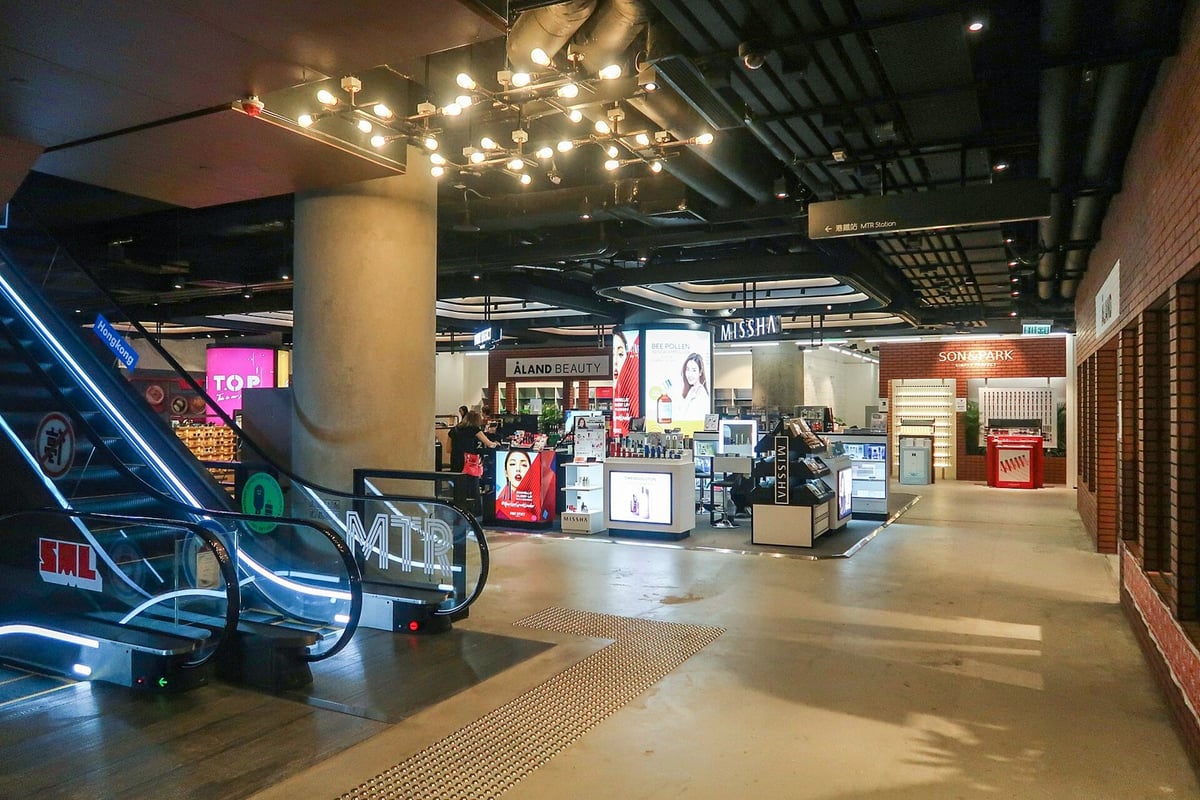
The MTR level of Mong Kok’s T.O.P This is Our Place, where SNAPIO later opened its themed concept store. This photograph was taken in 2018, before the concept store arrived. Photograph: Wpcpey, CC BY-SA 4.0. Source: Wikimedia Commons.
I have also compiled individual Hong Kong locations on my own site, verified on July 30, 2026. You can see their distribution on photobooth.joelin.cc’s Hong Kong location page.
3. Why Hong Kong has “machines,” while Taiwan and Korea have “stores”
This is the part of the story I find most worth writing about.
First, look at where the locations are
Lay out the 38 Hong Kong locations, and almost all are on the public circulation routes of leading shopping malls: 時代廣場, 希慎廣場, 皇室堡, and 利舞臺 in Causeway Bay; K11 MUSEA, with two locations, K11 Art Mall, The ONE, iSQUARE, and LCX in Tsim Sha Tsui; 又一城, with two locations, in Kowloon Tong; apm in Kwun Tong; 朗豪坊 in Mong Kok; 荷里活廣場 in Diamond Hill; plus the retail buildings at Kai Tak Sports Park, AIRSIDE, 青衣城, 屯門市廣場, 荃灣廣場, 大埔超級城, 新都城 in Tseung Kwan O, and the GODIVA Café on the departures level of Hong Kong International Airport’s Terminal 1.
This is a pattern of equipment placement, rather than store site selection. A storefront brand would not simultaneously appear at the Peak Tower, in hotel lobbies, and on an airport departures level.
Why the storefront route does not work in Hong Kong
Even in a downturn, Hong Kong retail rents remain among the highest in the world. And the market in 2026 is polarized. Savills’ first-quarter 2026 retail report showed that prime street-shop rents rose 2.7% quarter on quarter, while major mall rents rose only 0.4%. It forecast that weaker suburban and non-core retail locations could fall by up to another 5% over the full year (report). Colliers’ report for the same quarter forecast that prime high-street rents could rise by up to 5% over the full year (press release). Looking back a year, 戴德梁行’s 2025 review reported that prime high-street rents in Causeway Bay fell 7.3% year on year in 2025. One reason was that “incoming brands were becoming more mass-market, while landlords were taking a more pragmatic approach to negotiations” (press release).
In plain language, in Hong Kong you either afford a prime location or end up in a non-core area with little foot traffic. There is very little middle ground. A self-service photography studio occupying ten-odd to twenty ping, charging a few dozen Hong Kong dollars per transaction, with customer turnover constrained by the time it takes to shoot, falls precisely into that narrow middle ground.
The Korean model of “tiered store-opening costs plus a high-margin franchise package” cannot be replicated in Hong Kong. Hongkongers’ interest in taking photos is not the issue; the unit economics of a storefront do not work under Hong Kong’s rental structure.
Its solution: become a mall’s traffic-generating device instead of a tenant
In the 2023 東周刊 interview, a founder explained this more clearly than any analysis could:
“During the pandemic, many malls were crying out for help and had to try every possible way to attract visitors. Self-service photo booths take up little space and can bring people together. They look attractive, and their appearance can also be redesigned to suit promotional campaigns, so many malls were very willing to work with us.”
In the same interview, he said that during that year the company added “an average of one more self-service photo booth to the market each month.”
The commercial relationship runs in the opposite direction. When opening a store, a tenant competes with others to secure a good location from a landlord. In SNAPIO’s case, the mall itself needs to attract visitors and brings the brand in. The former pays rent to buy access to foot traffic; the latter supplies a reason for people to visit.
That explains how a company of 11–50 people can achieve this level of location coverage. Each new location does not require another store lease, another team of staff, and another fit-out.
An often-overlooked backdrop: Hong Kong’s sticker photos never disappeared, but shrank to just one or two locations
Timing also mattered. Japanese sticker photo machines arrived in Hong Kong in the late 1990s. 青春無限’s Mong Kok branch in the basement of 瓊華中心, which opened in 1998, was a representative business. At the market’s peak, a single mall basement could hold more than twenty machines.
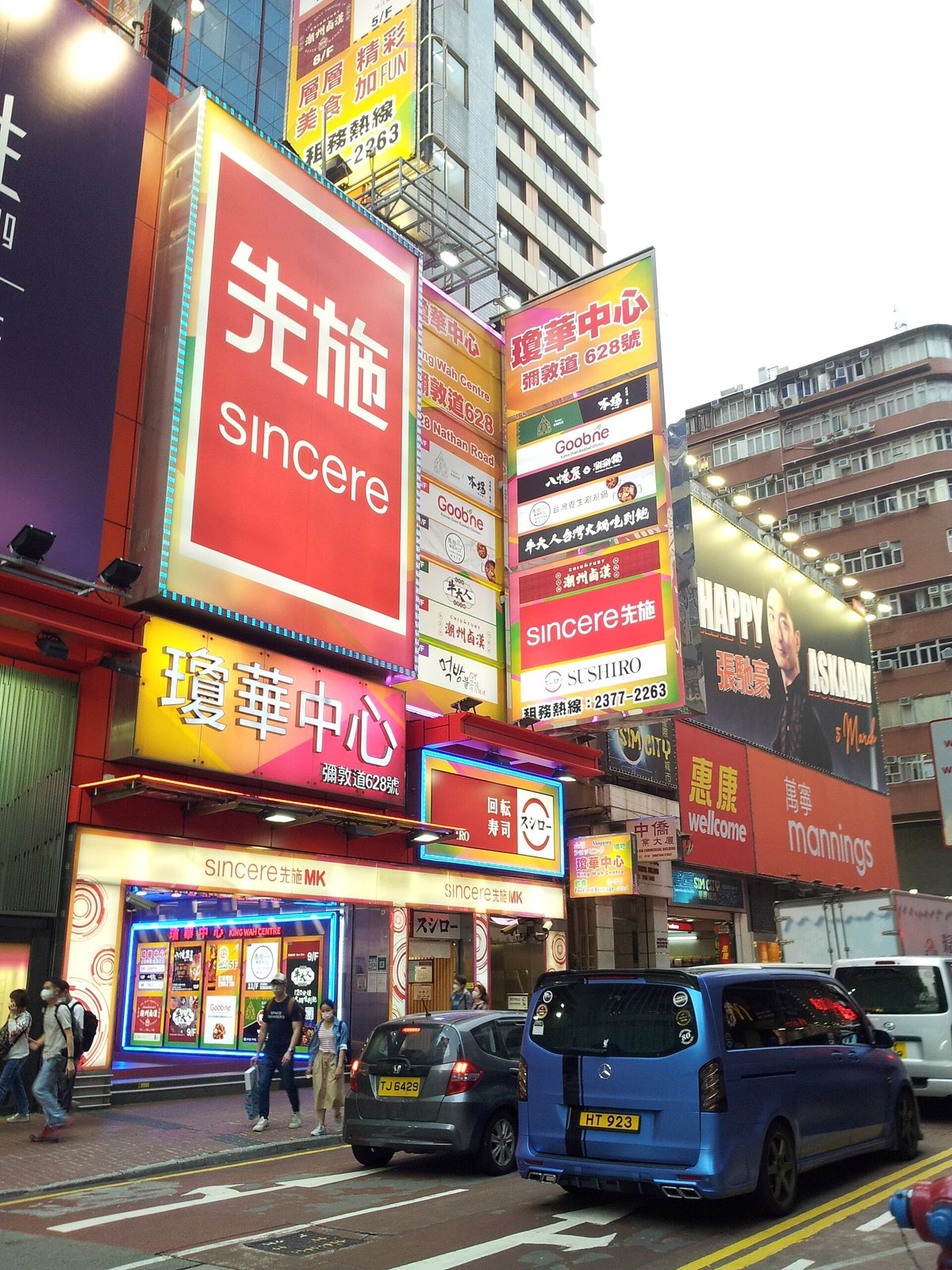
瓊華中心 on Nathan Road in Mong Kok, where 青春無限’s Mong Kok branch once occupied the basement. Photograph: HilldeFirst, 2022, CC BY-SA 4.0. Source: Wikimedia Commons.
Here is how more than twenty years of Hong Kong’s sticker photo history unfolded:
| Period | What happened in Hong Kong |
|---|---|
| Late 1990s | Japanese sticker photo machines were introduced to Hong Kong |
| 1998 | 青春無限 opened in the basement of 瓊華中心 in Mong Kok |
| Approximately 1998–2006 | The golden age: machines occupied mall basements in Mong Kok, Causeway Bay, Sha Tin, and Tuen Mun, with more than twenty machines in a single basement; 青春無限 had as many as 8 branches |
| After 2006 | Visitor numbers fell noticeably; Hong Kong media largely attributed the decline to the growing popularity of smartphone selfies |
| 2017 | Only two locations remained across Hong Kong: 瓊華中心 in Mong Kok and a location in Tsuen Wan |
| February 2019 | 青春無限’s Mong Kok branch closed, leaving only its Tsuen Wan branch |
| Around November 2019 | SNAPIO launched, placing its first Korean-style four-frame machine in K11 Art Mall in Tsim Sha Tsui |
| 2022–2024 | 青春無限 in Tsuen Wan continued introducing new Japanese machines; Japanese sticker photos were also still available at NAMCO arcades |
| 2023–2024 | A wave of local Korean-style self-service photo studios opened, while Korean brands including Photoism entered Hong Kong |
| August 2026 | SNAPIO had 38 venues in Hong Kong, according to this site’s entry-by-entry count |
The point of this table is the intersection of two trajectories: Japanese sticker photos gradually declined from 2006 onward, but never reached zero; Korean-style four-frame photos entered in 2019 through an entirely different kind of venue. The dates in the table come from Hong Kong media reports, with sources listed at the end of the article.
In February 2019, 青春無限’s Mong Kok branch closed, leaving only its Tsuen Wan branch (TOPick, February 19, 2019). The reporter writing the 2023 東周刊 interview said that after the Mong Kok branch closed, “Japanese sticker photo machines had almost disappeared from the Hong Kong market.” “Almost” should be read literally: Japanese sticker photo machines were still available at the Tsuen Wan branch and NAMCO arcades in 2024.
SNAPIO also launched in 2019, putting its first machine in K11 Art Mall in Tsim Sha Tsui (經濟一週, February 21, 2025).
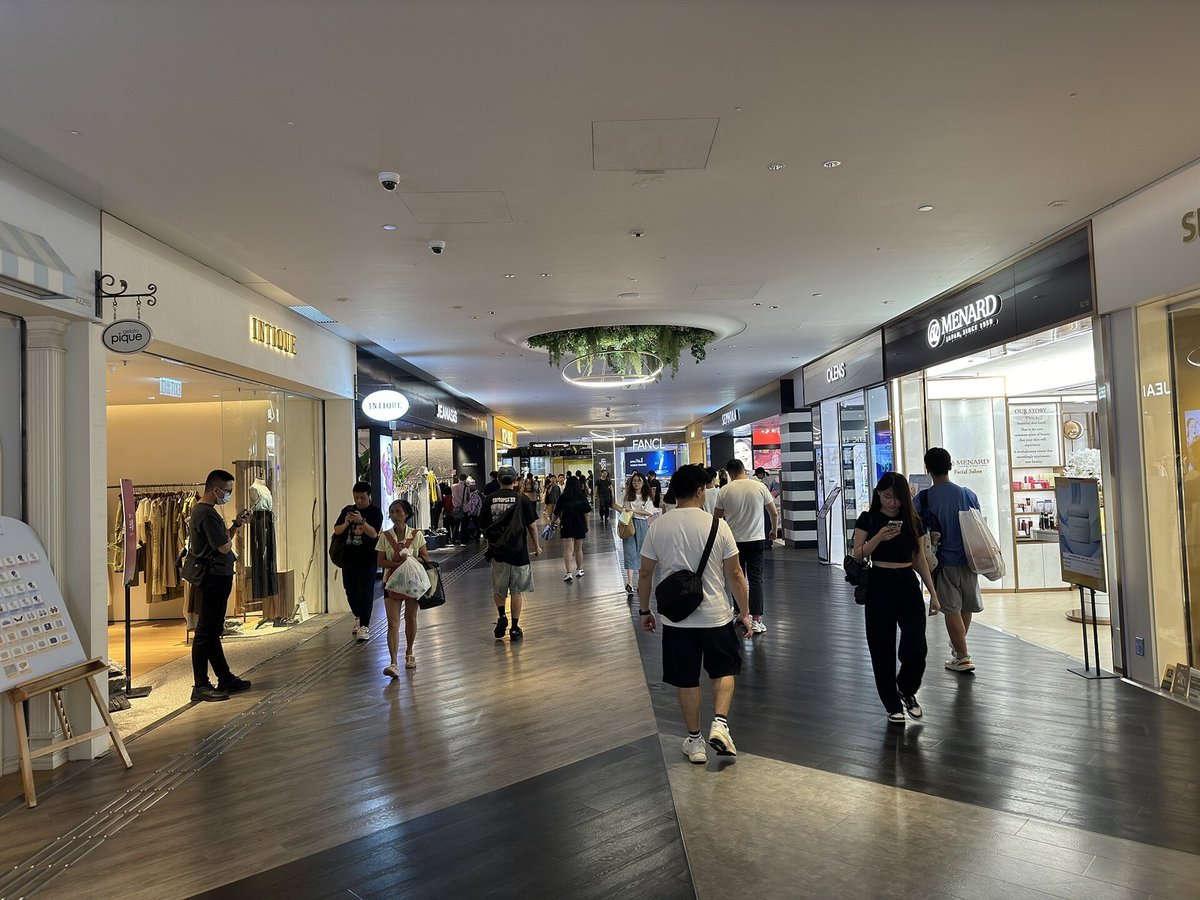
K11 Art Mall in Tsim Sha Tsui, the mall where SNAPIO placed its first machine in 2019. Photograph: LN9267, 2024, CC BY-SA 4.0. Source: Wikimedia Commons.
The two generations occupied entirely different spaces. Japanese sticker photos grew in Mong Kok’s mall basements and arcades. Korean-style four-frame photos entered the public circulation routes of leading malls from the outset.
In Taiwan, Korean-style photo booths grew out of an existing sticker photo culture. In Hong Kong, the old generation shrank to just one or two locations, while the new generation started afresh in different venues. That is a fundamental difference in how the two markets began, and explains why “the first to introduce” carries particular weight in Hong Kong. That phrase, however, is the brand’s own claim. I quote it without endorsing it; see the notes at the end.
4. Its franchise package sells “an asset that earns money on its own,” rather than “a store to open”
SNAPIO’s website has a separate franchise page. Reading through its pitch, I found that it was a fundamentally different kind of document from Korean brands’ franchise recruitment pages.
The official franchise page’s wording, verified on August 8, 2026:
- “Join the franchise at an extremely low cost, with highly flexible contract options. Start with low risk, test quickly, and scale up.”
- “Operations require no staff; the system is fully automated, substantially reducing costs and personnel expenses. Earn reliable passive income.”
- “SNAPIO has achieved the ideal model of ‘unmanned operation’… Only a small initial franchise fee is needed, after which you can enjoy the machine’s continuous automated earnings.”
- “The machine body, hardware, software, and all components are designed and produced by our own Hong Kong team, with comprehensive technical support and maintenance.”
Compared with Korean brands’ franchise packages, three structural differences are clear:
| Dimension | Korean brands’ franchise packages | SNAPIO’s franchise package |
|---|---|---|
| What is being sold | A store: floor area, number of themed studio sets, fit-out tier | An asset that earns money on its own; the keywords are “asset,” “passive income,” and “unmanned operation” |
| Cost disclosure | Publicly available tiered store-opening cost tables with detailed amounts | No amounts disclosed anywhere; only “extremely low cost” and “a small franchise fee” |
| Earnings narrative | Gross margin figures are provided | Only “extremely high profit margins,” with no figures |
The issue is two different forms of asset, rather than which is better. Store-based franchising sells a business to run; machine-based franchising sells passive income. The target franchisees, capital thresholds, and required operating capabilities are all different.
⚠️ The official website discloses no franchise fee amounts, so this article contains no SNAPIO franchise prices. Photography prices, however, have been officially announced: one set costs HK$60, two sets HK$100, and three sets HK$140 (official Instagram, September 2026). I have seen content convert Hong Kong selling prices into supposed Taiwan prices. Those conversions have no source; do not trust them.
The company’s revenue also goes beyond payments made at machines. Its website has three separate B2B entry points: event rentals, with five of its eight machine models labeled “available for event rental, including transport, loading, and unloading”; brand collaborations; and wedding rentals under the separate Snapio WEDDING line, which first exhibited at a wedding fair in November 2023. In its brand directory submission, the company reported “over 40 officially licensed IP brand partnerships and 160+ cumulative collaboration projects” in 2024. Its collaboration list includes Sanrio, Disney, POP MART, Barbie, and Chiikawa, as well as corporate clients such as 匯豐 and Chanel.
A founder described this in the 大公報 interview:
“Self-service photo booths have to keep introducing new ideas and changing to attract customers, so we will not stick with a single IP.”
He described the company’s essence as a “cultural network catalyst”: using photography as the central activity to build its partners’ brand value. In plain language, the machine is the hardware; what it is really selling is photo frame content that changes every month. On this point, its competitive logic does match that of Korean brands: the contest is over which frames are available this month, rather than the machine.
What this looks like in practice: four official posts
“Cultural network catalyst” sounds abstract on its own. These four posts from SNAPIO’s official Instagram account illustrate four different kinds of collaboration.
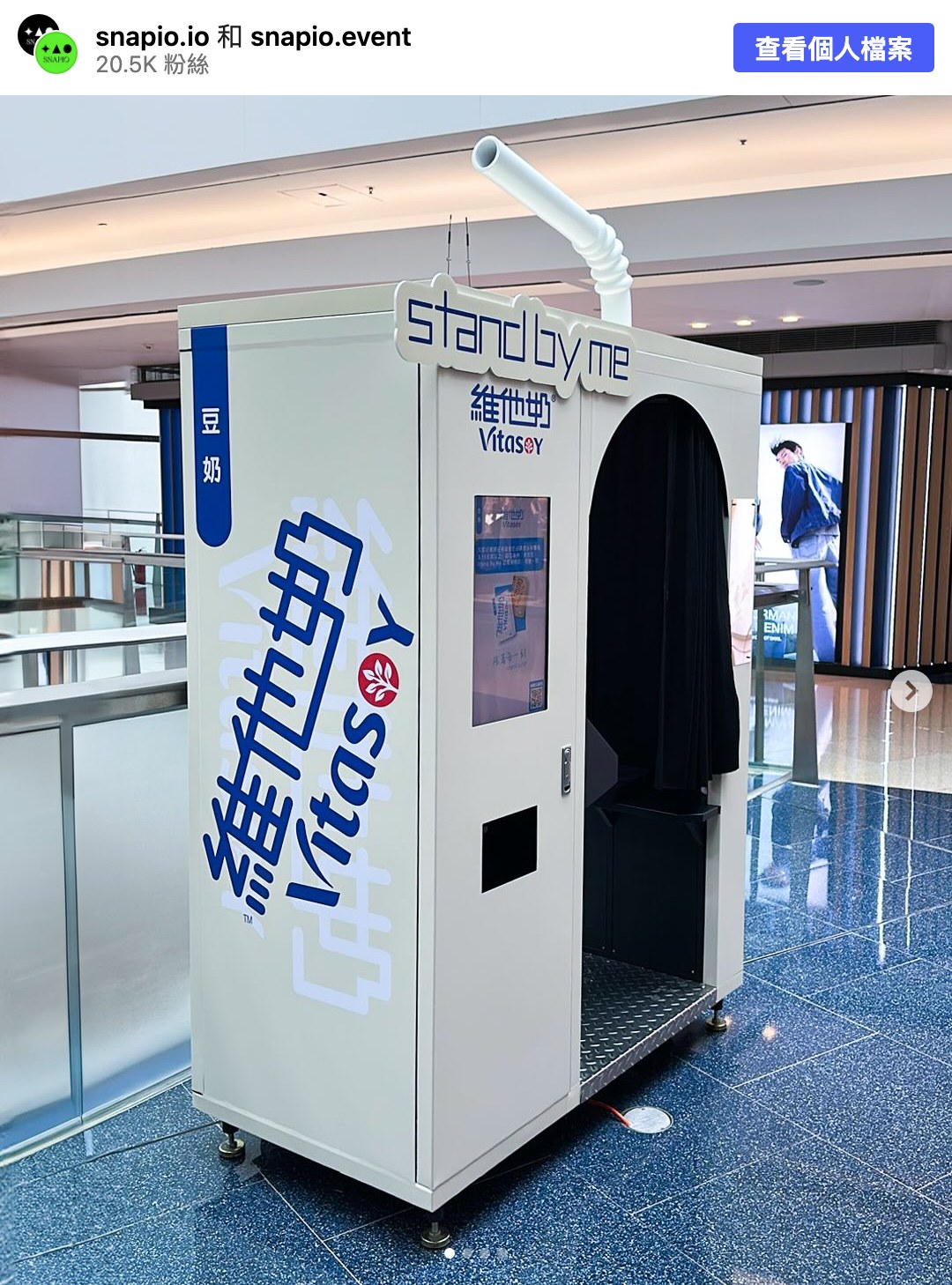
First, the entire machine becomes a brand’s event prop. In April 2026, the 維他奶 Stand By Me memory photo station wrapped the whole machine in 維他奶 branding and toured 又一城 and 奧海城 for three days each. Customers who bought at least HK$15 of 維他奶 products that day could present their receipt for one free photo session. Paid sessions were not offered at the event. The brand paid for the photos; consumers paid nothing. Screenshot from SNAPIO’s official Instagram, April 2026 (original post).
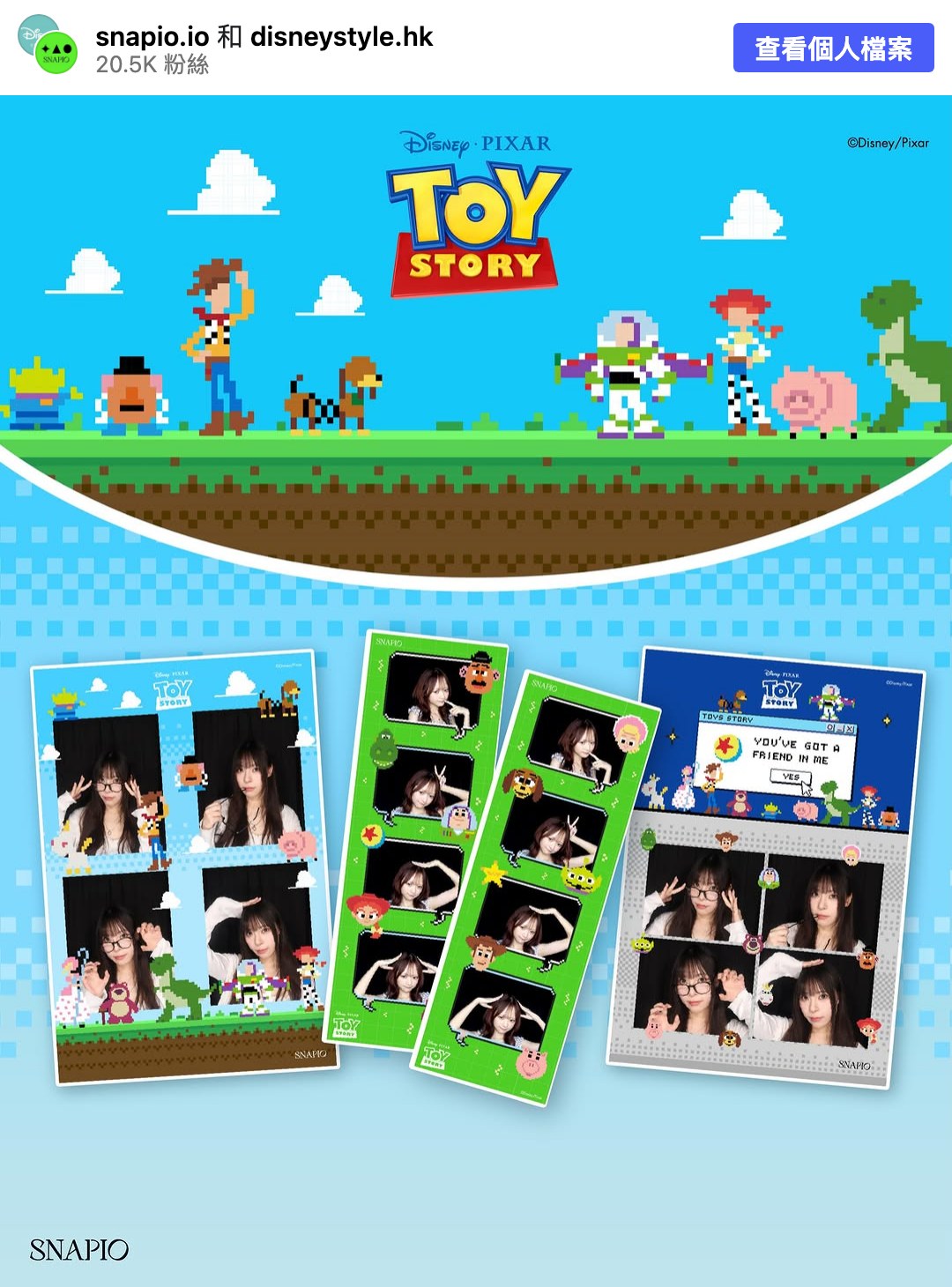
Second, officially licensed IP frames. The Toy Story Pixel Art frames released in September 2026 were labeled “officially licensed” in the post, which was jointly published with Disney Hong Kong’s official account. They launched simultaneously on designated machines in Hong Kong and Macau. Screenshot from SNAPIO’s official Instagram, September 2026 (original post).
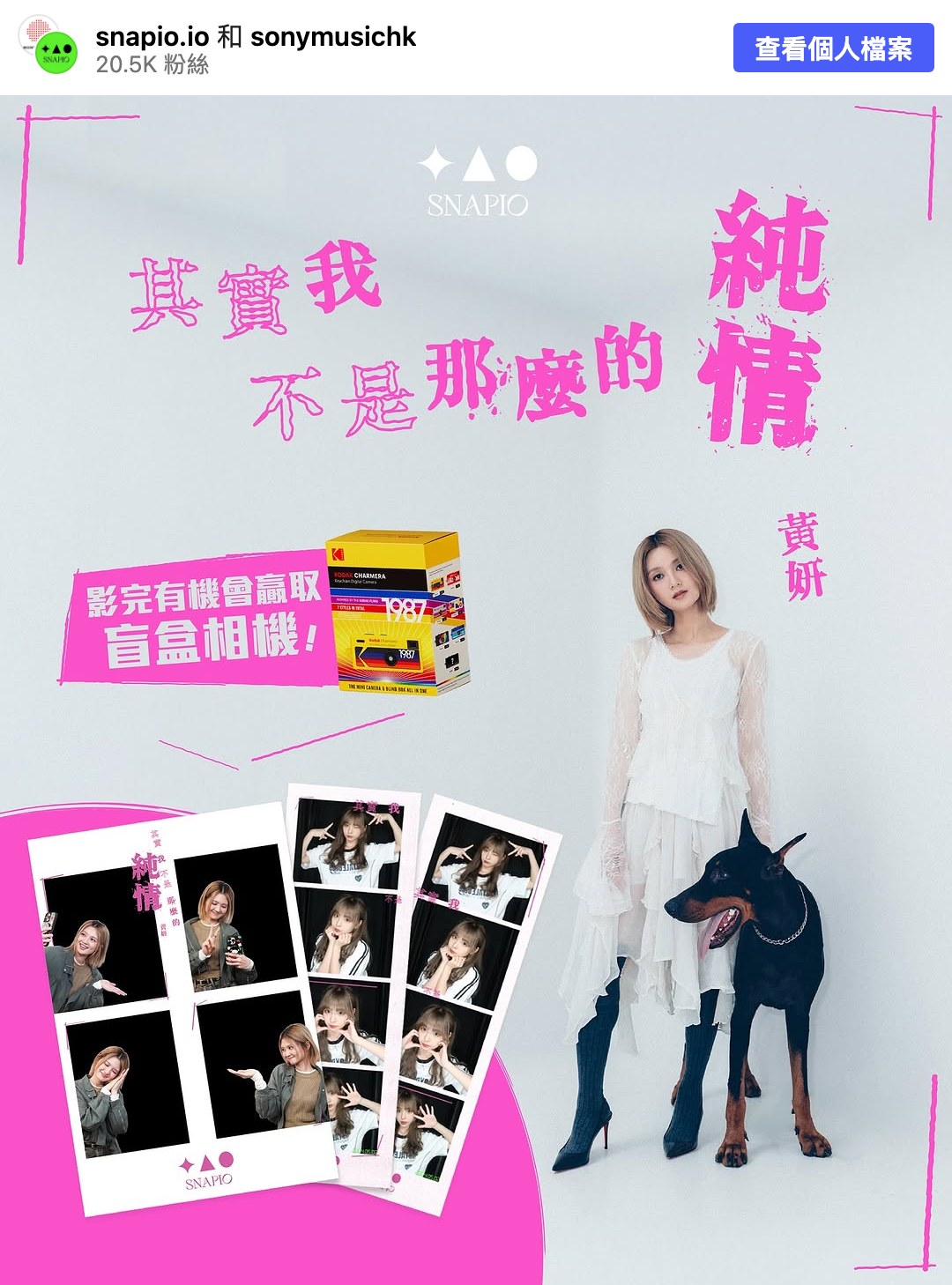
Third, record companies use the machines as promotional placements. In October 2025, a limited-edition frame was released for singer 黃妍’s new song 《其實我 不是那麼的純情》, meaning “Actually, I’m Not That Innocent,” in a post jointly published with 香港索尼音樂. After taking photos, customers could scan a QR code on the machine to enter a prize draw. The regular price of HK$60 per set still applied. This is the kind of partnership meant by “record companies” in the 大公報 report. Screenshot from SNAPIO’s official Instagram, October 2025 (original post).
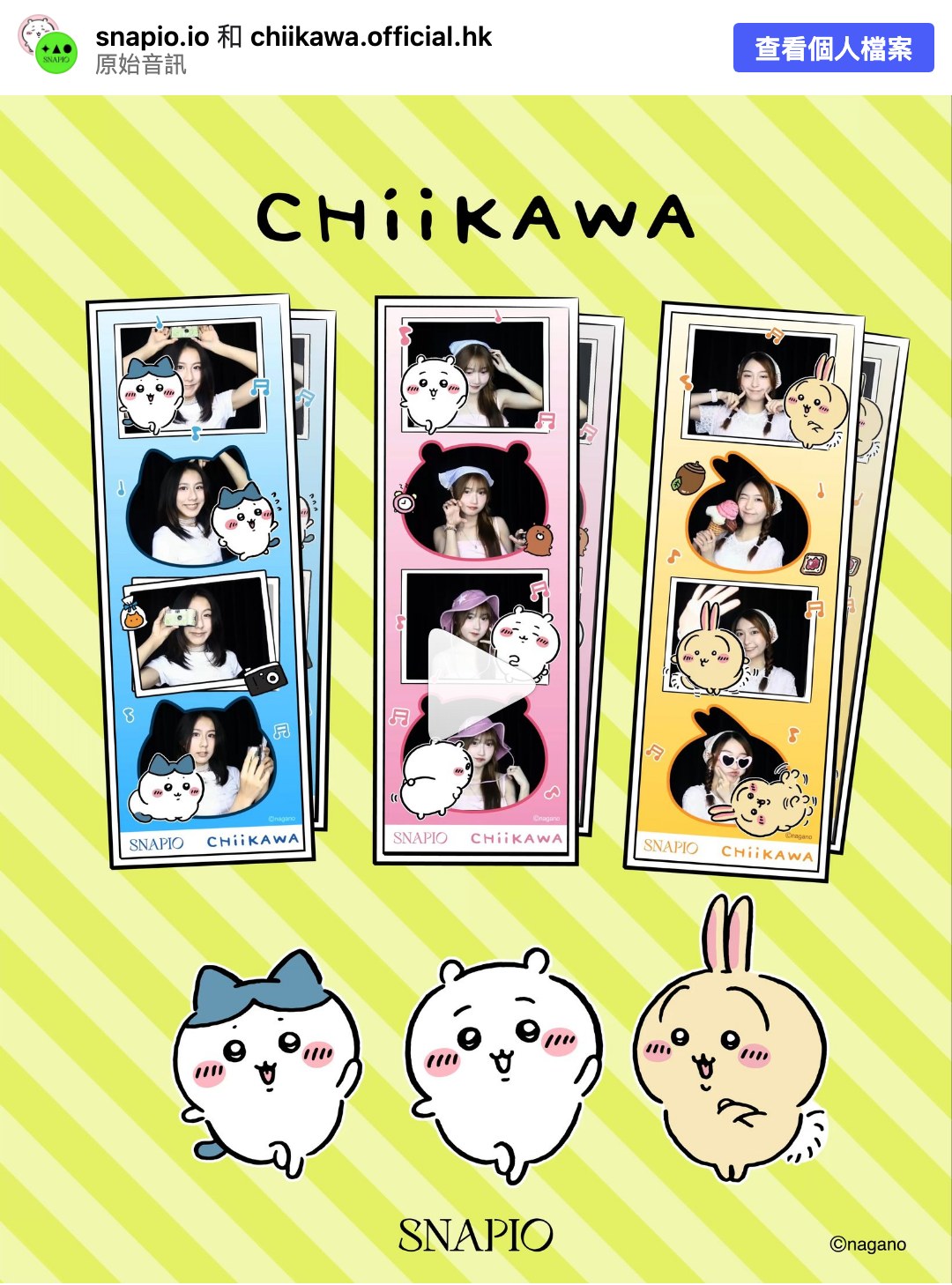


Fourth, the frame itself becomes a new product. The June 2026 CHIIKAWA release added three “animated frames” alongside the static versions. They launched simultaneously across the full Hong Kong and Macau network and were likewise labeled officially licensed. This was one of the account’s highest-engagement recent posts, with 1,799 likes; most ordinary posts received tens to hundreds. Screenshot from SNAPIO’s official Instagram, June 2026 (original post).
Viewed together, the four examples leave the machine itself almost unchanged. What changes is the frame, the machine’s exterior, and who pays. This is what its “cultural network catalyst” description looks like in practice.
The four screenshots above are reproduced for commentary. Copyright belongs to SNAPIO and the respective partners.
5. The Taiwan operation: I cannot establish a conclusion, so I will not draw one
When it comes to Taiwan, I need to be honest.
SNAPIO’s official location page lists four Taiwan locations: 台北鑽石新光, 4F; 新北重新家樂福, 1F; 台中勤美誠品, B2F; and 台中誠品 480, 4F.
Establishing a baseline: six Taiwan locations in May 2023
When I first researched this brand in May 2023, I recorded six Taiwan locations: 板橋遠百, 微風信義, 台中勤美, 中港新光三越, 台南南隅天下飯店, and 新光三越桃園站前店, B1F. In that investigation, all I could write under the three headings of corporate background, franchise plans, and machine source was “not found” or “unclear.” The company registration table in this article’s first section fills those three gaps from that earlier research.
Putting the two lists side by side reveals the shape of its Taiwan operation:
| Verification date | Taiwan locations | Count |
|---|---|---|
| May 2023, this site’s first investigation | 板橋遠百, 微風信義, 台中勤美, 中港新光三越, 台南南隅天下飯店, 新光三越桃園站前店 B1F | 6 |
| August 2026, the brand’s official location page | 台北鑽石新光 4F, 新北重新家樂福 1F, 台中勤美誠品 B2F, 台中誠品 480 4F | 4 |
Only one location, 台中勤美, matches across both lists. The clue discussed below—that 微風信義 had been flagged as possibly closed—also comes from the 2023 list. It was once there and was subsequently removed from the official website.
All four current locations have been marked “awaiting confirmation” on my site for some time. That is because the evidence on both sides has weight.
Evidence suggesting they may no longer be operating:
- Every post on the brand’s official Threads account from May through July 2026 concerned Hong Kong locations. Not one mentioned Taiwan.
- As of August 8, 2026, 誠品’s official partner-brand page still listed only its Causeway Bay store in Hong Kong under locations. Neither of the two Taiwan 誠品 locations appeared.
- The brand’s Hong Kong membership system divides locations into Hong Kong Island, Kowloon, the New Territories, and Macau, with no Taiwan section. Taiwan does have a separate membership site, however, so a separate system would also make sense. I count this as a negative signal, but not a decisive one.
- During an earlier verification, the only business listing I could find anywhere in Taiwan, for 微風信義, had already been flagged as possibly closed. That location had also been removed from the official website.
Evidence suggesting they are still there:
- The official location page still lists all four, and that list is actively maintained: 微風信義 has been removed, while Hong Kong’s 又一城 has been labeled “temporarily out of service.” A list that removes withdrawn locations and labels their status cannot simply be dismissed as outdated.
- Taiwan has its own official Linktree, created in September 2024. As of this article’s research, it still listed the same four locations, along with “fan-support frame applications” and “photo booth rental inquiries.”
- The Taiwan membership site, member.snapio.tw, was still live as of this article’s research.
My conclusion is therefore that there is no conclusion: I am declaring neither that the operation has closed nor that it remains in business. The four entries on my site retain their “awaiting confirmation” status.
I know that makes for an unsatisfying answer. But one of the easiest mistakes in photo booth content is to recommend locations from a two-year-old list as though they were current, sending readers on a wasted trip. I would rather mark a location “awaiting confirmation” than mislead someone into going.
Correcting an assumption I had taken as fact
I originally thought SNAPIO had entered Taiwan in 2019. After checking, I found that 2019 was the year the brand was founded in Hong Kong, rather than the year it entered Taiwan.
The Taiwan operation began in 2021. The earliest post on the brand’s official Taiwan Instagram account, @snapio.tw, is dated June 2, 2021. In a February 2025 interview, a founder also said, “We entered the Taiwan market in 2021,” explaining that the Taiwan operation focused on the corporate market (經濟一週, February 21, 2025). The Taiwan-specific Linktree was not created until September 2024.
⇒ The correct account is: SNAPIO entered Taiwan in 2021, focusing on corporate events, rather than following its Hong Kong approach of placing machines throughout mall circulation routes. The six locations this site recorded in May 2023 show what its presence looked like two years after entering Taiwan.
Versions of this article before September 23, 2026 said that “the earliest separate official trace of the Taiwan operation dates to the second half of 2024.” I had missed the official Taiwan Instagram account. That statement has been corrected.
One point remains unchanged, however. The November 2023 東周刊 interview, more than 2,000 Chinese characters long, discussed Hong Kong throughout and did not mention Taiwan once. In the December 2025 大公報 report, the founder also described its scale as “over 40 locations across Hong Kong.” Taiwan has consistently played a supporting role in its public narrative.
6. Three concluding points
- SNAPIO is a local Hong Kong company that turned self-service photo booths into devices that attract visitors to malls. Its moat lies in locations along the circulation routes of leading malls, together with photo frame content that changes every month, rather than in the machines.
- Hong Kong’s photo booths skip storefronts because of the rental structure, rather than differences in taste. The “storefront plus store-opening franchise” model used in Korea and Taiwan does not work under Hong Kong’s unit economics. SNAPIO instead makes malls the demand side of the relationship, prompting them to bring machines in.
- This also explains why its entry into Taiwan has been difficult. Taiwan is a market where storefront experiences compete. A single machine placed along a department store’s circulation route offers an inherently weaker experience, and its content engine—monthly frame changes tied to specific locations—did not make the journey across the sea. This point is my inference, rather than a finding from a source.
For individual locations, SNAPIO’s brand profile contains the Taiwan and Hong Kong listings and their verification statuses. The Hong Kong location page lets you view six Hong Kong brands together. I discuss why Hong Kong’s machines are almost all in malls, and why three brands may appear in the same mall, in the venue-structure analysis Why Hong Kong’s self-service photo booths are concentrated in malls. For comparison with Korea, see the Korean photo booth guide and the two preceding company studies: PHOTOGRAY and APR, and PHOTOISM and 서북. The development of Taiwan’s market is covered in the parent article, A history of Taiwan’s photo booth and Korean-style photo booth industries, while the previous year’s market changes are covered in the 2025 annual review of Taiwan’s photo booth industry.
A few notes on quotations and sourcing:
- The claim “Hong Kong’s first Korean-style self-service photography/four-frame photo brand” comes from the brand story on its official website and 誠品’s official partner-brand page. It is a claim made by the brand and its partner, rather than a fact I have independently verified. I quote it here, but do not turn it into a definitive statement such as “SNAPIO was Hong Kong’s first.”
- Whenever multiple location counts disagree, I quote the official wording and give the verification date. I do not take a midpoint or use “approximately.”
- Prices that the brand has not publicly disclosed, including franchise fees, are omitted throughout. Photography prices are quoted only at their officially announced original Hong Kong dollar amounts; I do not infer Taiwan prices from Hong Kong prices.
- All verification dates in this article are August 8, 2026, unless otherwise stated.
Sources: SNAPIO’s official website and social accounts; the Hong Kong Brand Development Council’s brand directory; Hong Kong company registration records; 東周刊, November 25, 2023; 經濟一週, February 21, 2025; 大公報, December 23, 2025; TOPick, February 19, 2019; HK01, September 21, 2017; Yahoo News, October 29, 2018; HK01, February 4, 2022; 戴德梁行’s 2025 Hong Kong property market review; Colliers’ first-quarter 2026 Hong Kong market report; Savills’ first-quarter 2026 Hong Kong retail report; and this site’s Hong Kong and Taiwan data layers at photobooth.joelin.cc.
This English version is based on original Traditional Chinese content on joelin.cc. The language and explanations are localised for international readers. The Traditional Chinese original is the authoritative version — for its complete meaning, please read the original article.