
This article is also available in: 繁體中文 · Español
Contents (11)
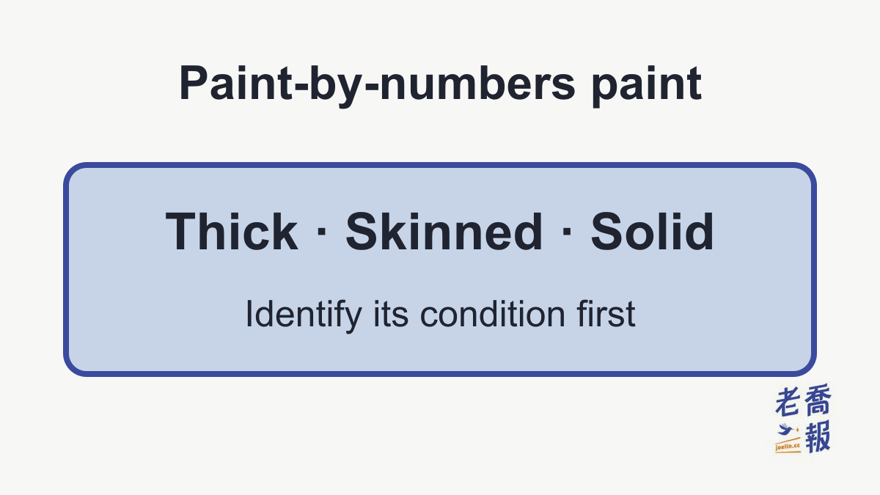
Do not immediately add water when your paint-by-numbers paint dries out. First use a clean tool to check whether it is thick but still stirrable, has a dry skin over wet paint, or has hardened throughout. Only the first condition is suitable for a small adjustment to the paint itself. Once the paint has formed hard lumps, asking the original seller for a replacement color is usually more reliable.
For the wider question of when to add water and how to use varnish, see the paint-by-numbers technique guide.
Start with a three-level check
Level 1: thick, but you can still stir it
A clean stirring stick can still move the paint, but the brush drags and the paint is difficult to spread. There is still usable wet paint in the pot. Start with the instructions for that particular kit.
ArtLife’s beginner guide says that overly thick paint can be mixed with 1–2 drops of clean water. Its FAQ on the same page also recommends stirring in 1–2 drops to restore usability. This is the Taiwanese seller’s advice for its own materials, not evidence that every brand uses the same formula.
Level 2: a dry skin, with wet paint underneath
Separate the surface film and hard flakes first. Do not stir them back into the wet paint. Test a small amount at the edge of the canvas: does it spread evenly, does it leave particles when dry, and can it cover the printed outlines?
If the test still leaves obvious particles or repeated coats cannot cover the numbers, stop diluting it. More liquid changes only the portion that is still wet. It cannot return hardened film fragments to their original state.
Level 3: the entire pot has hardened
If the paint is a solid lump that does not move when pressed or stirred, treat it as unable to return to its original painting consistency. Manto’s troubleshooting guide likewise distinguishes slightly thickened paint from hardened lumps: it suggests a little water for the former and says the latter cannot be restored.
Keep the artwork, design number, color numbers and purchase details, then ask the original seller about replacements. Do not substitute the same number from another kit: those numbers identify colors within a particular design, not a universal color code shared by brands.
Four common fixes and their limits
| Method | When it might apply | What it can do | Main cost or limit |
|---|---|---|---|
| Add a little water as the manufacturer directs | Paint is thick but still stirrable | Adjust flow | Too much water thins coverage and can make printed lines harder to hide |
| Use an acrylic retarder | Paint has not hardened and the manufacturer confirms compatibility | Extend working time afterward | Follow the product’s compatibility and mixing ratio; it cannot restore hardened lumps |
| Place clean plastic wrap close to the pot opening, then close the lid tightly | Paint is still wet and you want to reduce further moisture loss | Reduce air exchange | Preventive only; it cannot reverse an existing dry film |
| Warm the pot indirectly in water | A remedy often suggested online | May temporarily make the still-wet portion easier to stir | There is no universal temperature or duration across brands; heat cannot restore hardened resin, so this is not a standard fix |
The useful distinction is between adjusting wet paint and reversing dried paint. The first may work; there is no reliable way to reverse the second.
Why water sometimes helps—and sometimes makes painting harder
Paint-by-numbers kits commonly use water-based acrylic paint. In its acrylic shelf-life guidance, GOLDEN explains that acrylic dries as water evaporates. A tight seal and clean container opening help keep the paint usable.
Before too much water has been lost, a small amount can change the flow. After a film has formed, water merely surrounds the lump; it does not turn it back into the original paint. Dilution also leaves less pigment in a single coat, so pale or highly saturated colors that already cover poorly may need additional layers.
The sources do contain conflicting experiences. A Dcard user’s account strongly advises against adding water because it affects color saturation, and recommends blotting the brush after washing it. That experience can coexist with a seller’s advice to add a few drops. The decision depends on your formula, how far it has dried and a small test—not on treating either source as a rule for every product.
Dried poster color is a different problem from dried acrylic
Dried poster color can usually be reactivated. The poster-color formula discussed here uses water-soluble gum arabic as its binder. Turner’s poster-color instructions say to add a little warm or clean water to dried paint, leave it for a while, then stir thoroughly.
Use this sequence for that type of paint:
- Add a small amount of warm or clean water to the dried paint. Start with less rather than more.
- Leave it to soak, then mix thoroughly with a clean stirring stick.
- Test it on paper. Turner warns that too little water can make the paint difficult to spread and prone to cracking when dry; too much can weaken adhesion and produce uneven coverage.
- If mold is present, Turner’s instructions recommend removing the affected paint with a spoon, including some paint below the visible mold.
This differs from the acrylic commonly supplied with paint-by-numbers kits. Acrylic forms a water-insoluble film when dry, which is why a fully hardened pot cannot be restored with water. Turner’s FAQ also states that its water-resistant acrylic gouache cannot be restored once it has cured. Taiwan art-materials retailer Style Art lists gum arabic, glycerin, calcium carbonate, pigment and preservative among poster-color ingredients: inexpensive and highly saturated, but more prone to fading and suited to posters and practice.
Check the label before applying a remedy. Poster color or traditional, water-soluble gouache can be soaked with a little water as appropriate to the product. Acrylic—including acrylic gouache—belongs under the three-level check above.
When to stop trying to rescue the paint
Stop adding liquid and ask about replacement colors if any of these conditions applies:
- The entire pot is hard and a stirring tool cannot move it.
- There are many hard flakes below the surface, and a test leaves obvious particles.
- The paint spreads but still cannot cover the printed outlines evenly after drying.
- You have to keep adding liquid to make it flow, while the color becomes increasingly thin.
Judge the result on the canvas, not whether you can temporarily stir the paint into a paste. Restored flow is not useful if the paint no longer covers the design.
Why tiny kit pots dry out so easily
Storage guidance for professional acrylic paint cannot simply be applied to small kit pots. GOLDEN says its acrylics have no fixed expiration date, can last for years when stored well, and should be kept at 60–75°F. Liquitex’s storage guidance gives its own products a shelf life of 5–7 years at room temperature when tightly sealed and protected from contamination by water or dirty tools.
Those statements concern each brand’s professional paint in its original packaging. Paint-by-numbers kits divide small quantities among plastic pots with relatively large openings. Dried paint on the rim or a lid that is not fully snapped shut makes moisture loss easier. A professional paint’s stated storage life therefore does not establish how long every kit will last.
A storage routine that reduces drying
- Open only the color you are currently using; keep the others closed.
- Snap the lid shut immediately after taking paint. Do not leave the entire strip open for a long session.
- Wipe paint from the rim and lid before finishing, and check that the closure seals completely.
- Blot excess water after washing the brush so dirty water and other colors do not enter the pot.
- Keep the paint out of direct sunlight and away from heat sources. Do not leave it in a hot car or on a sunny windowsill.
- For a break in the project, place clean plastic wrap close to the pot opening before closing the lid to reduce air exchange.
Every step aims to reduce evaporation and contamination. Liquitex likewise emphasizes tight lids, clean container openings and preventing contamination from tap water or dirty tools.
Check replacement-color terms before buying
Kit color numbers belong to the individual design. In its after-sales information, Manto explains that designs, numbering and paint allocations differ between suppliers, so matching a number across brands does not match the color. The page also gives that brand’s replacement terms. These are the seller’s own statements; check the product page and customer-service reply that apply when you buy.
Before ordering, find out whether replacement paint can be requested by design and color number, the application deadline, quantity limits and the proof of purchase required. When a color runs out or dries up, those terms are more useful than buying another box with apparently similar colors.
This article is part of the coloring-industry research series (Traditional Chinese), comparing paint-by-numbers kits, adult coloring books, printable coloring sheets and coloring for older adults through user needs, market participants, prices and product characteristics.
Keywords: dried paint-by-numbers paint, hardened acrylic paint, lumpy kit paint, dried poster color, adding water to acrylic paint, paint storage, replacement paint colors
Sources: The Chinese original was first published on September 4, 2026, and updated on September 30, 2026. Instructions from Taiwanese kit sellers apply to their own materials; they are not universal rules for acrylic paint.
This English version is based on original Traditional Chinese content on joelin.cc. The language and explanations are localised for international readers. The Traditional Chinese original is the authoritative version — for its complete meaning, please read the original article.