
This article is also available in:繁體中文 · 日本語 · 한국어
If you first need to choose between attending, making fan merchandise and organizing an event, return to the Fan Culture and Practical Activities Map (Chinese).
When organizing a birthday project for an idol for the first time, the usual obstacle is not money. It is the order of operations: what comes first, which steps cannot be skipped, and which mistakes will derail everything that follows. These points are rarely explained together.
The complete process has seven steps:
- Schedule the project: work backward from the birthday and first confirm available advertising and venue dates.
- Raise funds: publish the budget and rules before collecting money.
- Design and permissions: check whether the materials may be used and prepare them for approval.
- Produce fan merchandise: estimate quantities from the distribution setting, then ask about printing thresholds.
- Choose media and venues: use advertising, a birthday-cafe event or fan-designed photo booth frames, separately or in combination.
- Run the event: assign roles, prepare supplies and set distribution rules.
- Report the results: provide evidence of publication or display and settle the accounts.
The sections below explain the practical points that affect decisions at each step.
Step 1: Schedule the Project, Not the Birthday
The idol’s birthday is fixed. Your event date is not. The workable date is the intersection of three constraints:
- Advertising or venue availability. Outdoor advertising slots and popular birthday-event cafes are booked on a first-come basis; dates around a popular idol’s birthday are especially crowded.
- Printing lead time for fan merchandise. Production has a physical minimum lead time that cannot be shortened indefinitely by paying more.
- Approval time for advertising artwork. Providers generally require advance review, and several rounds of revisions are normal.
First obtain those three figures, then work backward to a start date. Do not begin by deciding to “start one month ahead.” Another easily missed point is that several groups often organize projects for the same idol’s birthday. Compare schedules on social media before launching, to avoid events in the same area on the same day; that helps everyone’s attendance. To check an idol’s birthday and events running around that date, use the Fan Birthday Calendar.
Step 2: Fundraising—Explain the Rules Before Taking Money
The biggest fundraising problem is often not the amount collected, but rules added only after collection begins. Before accepting pledges, announce:
- Budget items and the target amount, specifying the advertising placements or products the money will pay for.
- What happens if the target is met or missed: a smaller placement, postponement or refunds.
- Refund rules and the deadline.
- Payment methods and the person responsible for reconciling payments.
Use payment tools that leave records, rather than an account book only the organizer can see. A common Taiwanese fan practice is to announce the project on social media, allow voluntary pledges for a defined period, and confirm the advertising order only after reaching the target. If the target is missed, switch to a placement with a lower threshold or defer to the next project. The full explanation and how budgets for different placements fit together are in Common Ways to Run Fan Projects.
Korean fandom calls the person initiating and executing the project a 총대, the lead organizer. Public income-and-expense records are a longstanding norm. This is not merely a formality: it is what gives people a reason to fund your next project.
Step 3: Design and Permissions—A Mistake Here Can Invalidate Everything Afterward
Whether an image may be used involves two separate layers:
- Copyright: rights in the photograph itself, generally held by the photographer or commissioning party. For fan photos taken by a fansite photographer, the rights belong to that photographer; for images released by an official source, the guide identifies the official source as the rights holder.
- Image or likeness rights: the photographed person’s rights over their own image. The artist holds these rights, with their agency generally managing them.
The rights holders may differ. Permission for one layer does not establish permission for both. Agencies usually have additional rules for merchandise and commercial exposure: some expressly allow nonprofit fan projects, while others prohibit printing items for sale. I discuss this separately in Can Official Images Be Used for Fan Projects? (Chinese).
For practical production, remember that almost all advertising placements require artwork approval. Image dimensions, bleed, font sizes and whether an agency’s logo may appear differ by provider. Obtain the specifications before designing; that saves much more work than revising a finished design. Software choices for different merchandise types are covered in Design Apps for Fan Merchandise.
Step 4: Produce Fan Merchandise—Estimate Quantities from the Distribution Setting
First decide what to hand out, then how many to make, and only then ask about unit prices. Common Types of Fan Merchandise provides a complete list and their relative production difficulty. Three factors materially affect the budget:
- Minimum order quantities. Printers generally set thresholds; below them, unit prices rise sharply, or the printer may decline the order.
- Quantity estimates. Work backward from the distribution setting: expected attendance, how many items each person may collect, and stock for contingencies and keepsakes.
- Hidden costs. Packaging, labor for dividing items into sets, shipping and postage to distant fans often add up to more than the organizer expected.
A safer approach is to express the quantity estimate as a range, ask the printer about unit-price differences between quantity bands, and then decide. Do not choose a number and order before understanding those differences.
Photocards are among the items whose design files you can make entirely yourself. With the Fan Support Photocard Maker (Chinese), upload a photograph and add a support message, then download a 55 × 85 mm print file with bleed to take to a printer or convenience-store printing service.
Step 5: Choose Media and Venues
The media Taiwanese fans commonly use fall broadly into three categories:
| Type | Common placements | Characteristics |
|---|---|---|
| Outdoor advertising | Bus exteriors, metro lightboxes, large outdoor LED screens | Reaches ordinary passersby; pricing and available dates are set by the advertising provider |
| Venue partnerships | Birthday-event cafes and cupsleeve events | Provides a physical gathering space where fans meet, take photographs and post check-ins |
| Fan-designed photo booth frames | Fan-submitted frames offered by photo booth venues | Relatively low entry threshold; the finished photograph is itself a keepsake |
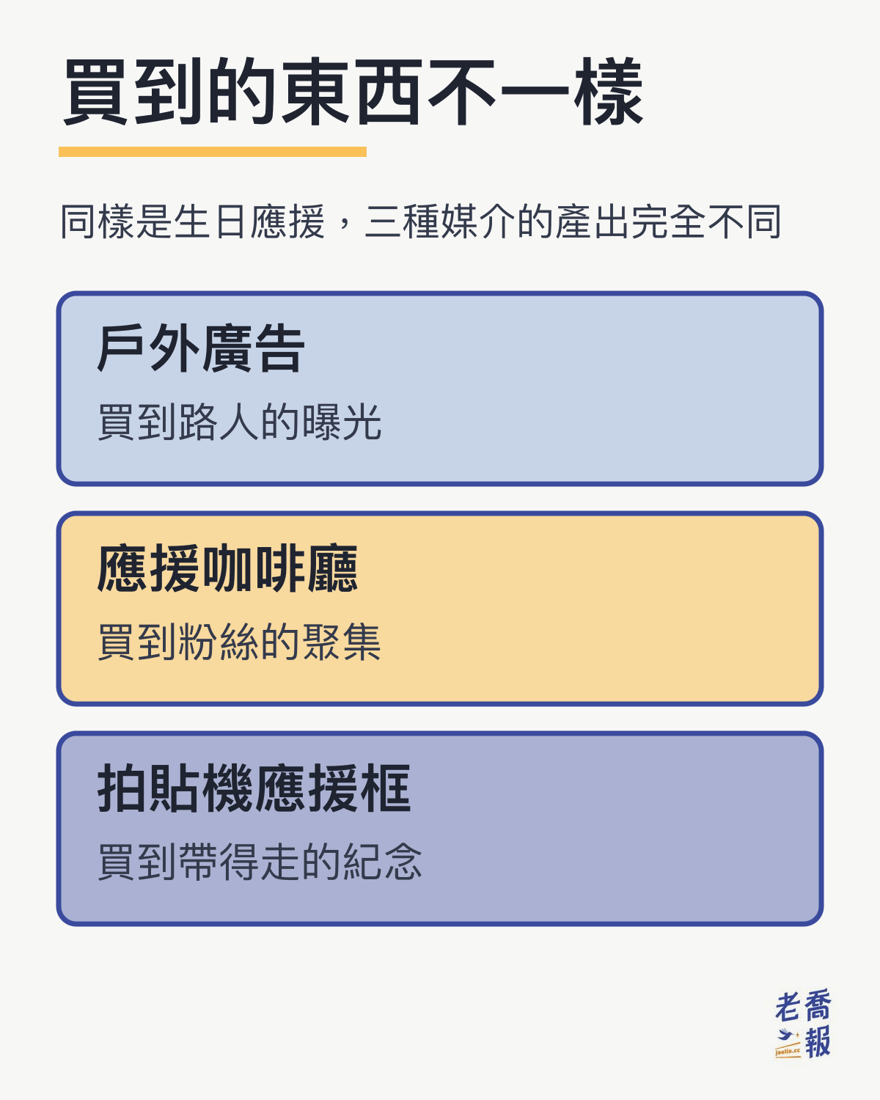
The difference is not simply price. Each helps achieve something different. Outdoor advertising buys public exposure, mostly to people who do not know the idol. A venue partnership buys an in-person gathering of fans, producing photographs and relationships. Photo booth frames sit between these: fans encounter them by entering a venue, but take the finished photographs home and upload them. For a first project with limited funds, a placement with a clearly defined threshold is easier to plan. The price table in Common Ways to Run Fan Projects distinguishes published price information from placements that require individual quotations. Current photo booth projects can be found in the Fan Event Listings.
Step 6: Run the Event
Several things happen simultaneously on site. Write the rules in advance instead of relying on last-minute judgment:
- Distribution rules: display how many sets each person can collect, whether a purchase is required, and the conditions for extra giveaway items.
- Responsibilities: assign people to distribution, queue management, documentary photographs and payment reconciliation.
- Supplies: change, resealable bags, spare stationery and cleaning materials will not magically be supplied by someone else.
- Closing: remove decorations, dispose of rubbish and confirm with the venue what must be restored.
Take documentary photographs during the event. Images reconstructed afterward are much less convincing than on-site records, and those records are the inputs for the next step.
Step 7: Report the Results—This Determines Whether There Will Be a Next Time
The event ending does not mean the project is closed. Report three things to the fans who funded it:
- Confirmation of display: photographs or video of the advertising actually running, or of the venue setup, showing that money went toward the announced purpose.
- Final accounts: actual expenses compared with the published budget, explaining any differences.
- Remaining funds: state whether unused money will be refunded, retained for another project or donated, then announce the final outcome.
The original guide describes these three reporting practices as not legally mandated, but essential to an organizer’s credibility. Fan fundraising relies on trust throughout. If one project is not accounted for clearly, the next may attract no funding. Conversely, clean final accounts can give even a small project greater drawing power next time.
Four Common Beginner Mistakes
- Choosing a date before asking about availability, then finding no slots and refusing to reschedule, forcing the project into an impossible timetable.
- Adding rules after taking money. A mid-project change of purpose invites questions, even if the motives are entirely reasonable.
- Treating official images as freely usable, only to fail artwork review and have to redesign everything.
- Budgeting only for the placement, forgetting design fees, packaging, shipping and security deposits.
These are problems of sequence rather than ability. Following the seven steps in order prevents most of them.
For a broader understanding of the culture, start with Fan Support Culture: an Overview. For what fansite photographers and fansite accounts do, see What Is a Fansite Photographer? (Chinese).
Frequently Asked Questions
How Early Should Preparation Begin?
There is no universal answer. Three things determine lead time: placement availability, printing production time and artwork-review rounds. Outdoor advertising and popular cafes need early bookings; printing takes time; and advertising providers normally require artwork review with possible revisions. Get those three figures first and work backward from the birthday, rather than choosing a fixed number of months.
What Makes Fundraising Less Likely to Go Wrong?
Explain before collecting. Publish the budget, target, outcomes if the target is met or missed, and refund rules before opening pledges. Use payment methods that leave records, and do not change the purpose midway. Ordering only after reaching the target, or reducing the placement or postponing if it is missed, is common practice in both Taiwanese and Korean fandoms.
Can Official Images Be Used Directly on Merchandise or Advertising?
Do not assume so. Copyright in the photograph and the subject’s image rights are separate, and their holders may differ. Agencies generally have additional merchandise and commercial-use rules. Advertising providers may also ask for the source of the artwork during review. I discuss this in the separate article linked above.
What Budget Should a First-Time Organizer Set?
Prices vary greatly. Only some placements have published prices; others require individual quotations. Start with one placement whose entry threshold is clear, then decide whether to expand based on fundraising. Do not choose an overall total first and try to construct a project to fit it. The common-methods guide lists published prices and items requiring quotations.
Must Income and Expenses Be Published Afterward?
The original guide states that disclosure is not legally compulsory, but is the basis of organizer credibility and future fundraising. Common practice is to publish confirmation photographs, actual expense details and the disposition of remaining money after the event. Korean fandom calls the organizer a 총대; public accounts are a longstanding practice, broadly similar to Taiwan’s.
Can One Person Organize It, or Is a Team Essential?
One person can organize a project, but should preferably not be alone on the event day. Design, provider communication and bookkeeping can be handled individually. Handing out giveaways, managing queues and taking documentary photographs happen at the same time. In practice, many organizers recruit two or three helpers and post written distribution rules on site to reduce ad hoc decisions.
Article keywords: birthday fan projects, organizing birthday fan support, project workflow, fundraising, fan merchandise, fansite photographers, fan advertising, birthday cafes, photo booth fan projects, image rights, official images, results reporting, 총대
Sources: The Chinese original was published on August 28, 2026, and last updated on October 9, 2026. This translation preserves that guide’s practices, dimensions and rights qualifications; it does not refresh prices, event schedules or legal requirements. Follow the linked resources and ask each provider about current terms.
This English version is based on original Traditional Chinese content on joelin.cc. The language and explanations are localised for international readers. The Traditional Chinese original is the authoritative version — for its complete meaning, please read the original article.