
This article is also available in:繁體中文 · 日本語 · Tiếng Việt
Summary
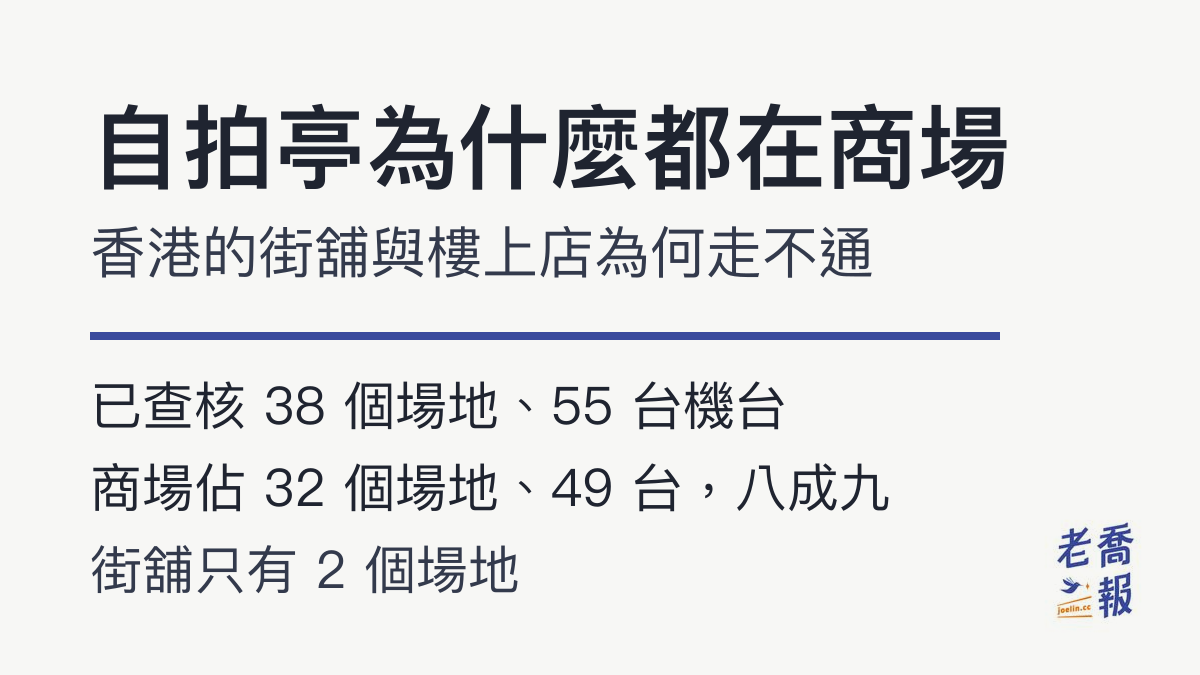
This article analyzes the venue structure of Hong Kong’s photo booths and explains what Taiwanese readers can easily misinterpret. As of August 3, 2026, the Hong Kong dataset contained 6 brands, 38 venues and 55 machines. Malls dominated, with 49 machines across 32 venues; streetfront shops, piers, hotels and the airport accounted for just one or two venues in each category. SNAPIO’s 32 venues and 38 machines represent 32 existing destinations with visitor traffic, rather than 32 stores. The fundamental difference is that Taiwanese readers tend to choose a brand before finding its address, while the Hong Kong data is organized around choosing a mall first and then considering the brands inside. Multiple brands coexist at Ginza Plaza, The ONE, T.O.P and other venues, showing that malls accommodate photo booths as a category rather than as premises exclusive to one brand. FLASH’s two streetfront shops are exceptions, carrying the full burden of shop rent and fit-out. Travelers should adjust their search process: choose an area they will visit, check the mall name and floor, then confirm the status through official sources.
Key facts
- The Hong Kong dataset covers 38 checked venues and 55 machines: malls account for 32 venues and 49 machines (89%), streetfront shops for 2 venues, and transport or tourism destinations for the remaining 4 venues.
- Multiple brands share venues such as Ginza Plaza (3 brands) and The ONE (3 brands); the mall is their common host, and choosing a brand comes second.
- Venue types shape operating differences: mall machines do not carry standalone shop rent but have less room for brand recognition; streetfront shops carry rent, fit-out and opening-hour responsibilities; upstairs shops depend on social media to bring in customers.
- Four DITTO machines remain unconfirmed; SNAPIO’s 32 venues and 38 machines describe its machine placement network, rather than a store count.
There is something about Hong Kong’s photo booths that Taiwanese readers can easily misinterpret.
When you look for Korean-style photo booths in Taipei, Ximending, Zhongshan or Fengjia, you probably think first of “going to a particular shop”: its name, street address, props, sets and friends lining up inside. In Hong Kong, the search often works in reverse: first find a mall you plan to visit, then look for a machine on a particular floor, by an escalator, beside a cinema or at a particular retail unit.
This is more than a difference in terminology. It reflects two different venue-based business models: one treats a photo booth as a lightweight attraction inside a mall; the other treats photo strips as an experience that requires a shop of its own.
As of August 3, 2026, I had compiled 6 brands, 38 venues and 55 machines using brands’ official location pages, official Instagram accounts and Hong Kong location records that retain sources for each entry. It is a small dataset, but it is already enough to answer a question more interesting than “Which brand is more popular?”: whose visitor traffic do Hong Kong’s photo booths depend on?
First, define what we are counting: 38 venues do not mean 38 shops, and 55 machines do not mean 55 brand locations
Start with this article’s data snapshot. A “venue” means the actual host location, such as a mall, pier or hotel. A “machine” means the equipment at that venue that people can use to take photos. A single venue can hold two machines from the same brand or accommodate three brands at once, so these two counts must never be conflated.
| Brand | Venues | Machines | Data status and main sources |
|---|---|---|---|
| SNAPIO | 32 | 38 | Active; official location page |
| Life4Cuts (人生四格) | 5 | 5 | Active; official Instagram |
| Photoism | 4 | 4 | Active; primarily official Instagram, with a Google Business Profile used to cross-check 1 location |
| FLASH | 3 | 3 | Active; individual shop addresses on official Instagram |
| DITTO | 2 | 4 | Unconfirmed; locations remain listed in official Instagram Highlights, but lack independent on-site verification or confirmation through an official reply |
| Fotojuju | 1 | 1 | Active; address and opening information on official Instagram |
| Total | 38 distinct venues | 55 machines | 6 brands; venues shared by brands are counted only once in the venue total |
Two points are particularly important.
First, SNAPIO’s “32 venues / 38 machines” does not mean 32 shops. Its network allows multiple machines at a single venue. Central Market, K11 MUSEA, T.O.P This is Our Place and Festival Walk, for example, all have multiple machines within the same venue.
Second, the 55 machines include DITTO’s 4 machines. As of the snapshot date, the only location evidence for these four was in official Instagram Highlights; there was no second source sufficient to confirm that they were operating on site. The discussion below therefore retains them as examples of venues “listed in the dataset,” but does not describe DITTO as confirmed to be operating, much less determine the brand’s place of origin or where its machines were manufactured.
Hong Kong does not follow a “one shop, one brand” model: look at the venue first, then the brand
Breaking the 38 venues down by host type makes the picture clear: 32 venues and 49 machines are inside malls. The remainder consists of 2 streetfront shops, 1 pier, 2 hotels and 1 airport venue.
| Host type | Venues | Machines | What the dataset shows |
|---|---|---|---|
| Malls | 32 | 49 | The core venue type; all six brands appear in mall settings |
| Streetfront shops | 2 | 2 | Both locations are FLASH shops, with identifiable street addresses and street-facing premises |
| Pier, hotels and airport | 4 | 4 | All are SNAPIO locations; these follow tourist or destination routes rather than forming a “photo-booth shopping district” |
| Total | 38 | 55 | DITTO’s 4 machines remain unconfirmed |
These figures are not market shares. They do not establish that SNAPIO has 69% of Hong Kong’s market. The reason is simple: SNAPIO has a comprehensive official location page, while most other brands have only scattered locations that can be confirmed through Instagram. Their data completeness differs. The 38 venues and 55 machines describe only the structure of public locations checked by this site; they cannot be extrapolated into a census of all Hong Kong locations or into brand market shares.
Even without discussing market share, however, the venue structure is revealing. The Hong Kong dataset contains 7 venues with 2 to 3 brands present at the same time: World Trade Centre, T.O.P, Ginza Plaza (新之城), The ONE, K11 Art Mall, Festival Walk and apm. Ginza Plaza and The ONE each have three brands. T.O.P and Festival Walk even combine multiple machines from one brand with machines from other brands.
In other words, the first question in Hong Kong is not “Who owns this shop?” but “How many kinds of photo-taking options can this venue accommodate?” Here, the mall is more than a backdrop: it is the locations’ common host. Brands can share the same building and even draw on visitor traffic on nearby floors.
This also explains why the organizing anchor for Hong Kong location pages should be the “venue” rather than the “shop.” On a Taiwanese map, treating an entire department store as a particular brand’s location can obscure the actual storefront. In Hong Kong, however, a mall is itself the destination that hosts multiple photo booths. Ignoring it makes the way the business is assembled harder to see.
Mapping SNAPIO’s network: it shows Hong Kong itinerary stops, rather than a “shop count”
This article does not revisit SNAPIO’s company, franchising or Taiwan operations. Those are covered in the published SNAPIO company study. Here, SNAPIO serves as a particularly clear measuring stick: its 32 venues and 38 machines show how Hong Kong’s photo-booth network attaches itself to different kinds of existing destinations.
| SNAPIO venue type | Venues | Machines | How to read the map |
|---|---|---|---|
| Malls | 28 | 34 | Everyday shopping routes in Causeway Bay, Mong Kok, Tsim Sha Tsui, Kowloon Tong, Kwun Tong, Kai Tak and the New Territories |
| Tourist / transport destinations | 4 | 4 | Central Pier No. 8, two hotels and the airport; joining an existing journey rather than opening a new shop |
| Total | 32 | 38 | One venue can accommodate two machines, so venue and machine counts differ |
This table conveys something more important than “How many machines does it have?”: every non-mall exception in the dataset—the pier, hotels and airport—belongs to SNAPIO. The brand therefore covers more than shopping centers. It also places photo booths where travelers will already arrive, wait or spend time. The Peak, piers and the airport are not traditional “photo-booth streets,” but they are typical stops on a Hong Kong itinerary.
A traveler sees a machine. Viewed through the venue structure, that machine is part of a network assembled from malls, attractions, hotels and transport hubs. A short brand profile will not tell you this: location counts need to be read alongside the identities of their hosts. To check individual venues, consult SNAPIO’s Hong Kong venue data directly, and do not mistake this article’s 32 venues for 32 shops.
Multiple brands at one venue show that malls do not choose just one “photo-booth champion”
In Taiwan, consumers often link the shop name, brand and venue together: to use Photoism, Life4Cuts or another Korean-style photo booth, they usually search for the brand and then go to a shop. Hong Kong’s shared-venue data reminds us that this chain can be broken apart.
At Ginza Plaza, for example, Photoism, Life4Cuts and Fotojuju share the venue. The ONE has SNAPIO, Photoism and Life4Cuts at the same time, while World Trade Centre has Photoism and Life4Cuts. These combinations do not mean that their rents, sales or partnership terms are identical, nor do they establish that every machine is operated directly by the mall. Public information is insufficient to make those judgments.
They do establish at least one point: a mall can treat photo booths as a category, rather than as premises exclusive to a single brand. The mall may care about different styles, camera heights and perspectives, frame designs, or simply giving people more reasons to spend time on a particular floor. Within that same pool of visitor traffic, brands compete to be noticed, tried and shared.
In Hong Kong, Life4Cuts and Photoism do not dominate through the large store networks they have in their home market of South Korea. Instead, they enter this shared setting through a small number of venues. Their 5 or 4 machines in Hong Kong therefore cannot be read directly as indicators of their overall scale in other markets. This article examines the distribution logic that puts venues before brands, rather than the relative strength of the brands.
FLASH’s two streetfront shops: another way to turn a “machine” into a “shop”
The dataset does not suggest that Hong Kong lacks shop-format self-photo studios. FLASH is a useful counterexample: of its 3 checked machines, two are in streetfront shops on Yiu Wa Street and Haven Street in Causeway Bay, and the third is in K11 Art Mall. The first two locations have clear street addresses and ground-level shop premises, unlike individual machines placed along a mall’s public circulation routes.
The difference is not about which is more upscale or better at business. It is about taking on different responsibilities.
| Venue approach | What customers look for first | What the operator must take on | What it gains in return |
|---|---|---|---|
| Mall machine | A mall and floor along the customer’s itinerary | Coordination with the host over placement and operating periods, plus equipment maintenance; less room to establish brand recognition | Existing visitor traffic, an easy reason to stop, and quick trial sessions |
| Streetfront self-photo studio | Brand name and street address | Shop rent, fit-out, opening hours and the rate at which street traffic naturally enters the shop | A complete branded space, with scope for multiple shooting perspectives and in-store experiences |
| Upstairs shop / shop in a commercial building | Social media, directions from friends and a precise address | The difficulty of finding the premises and the need to bring in customers independently, without relying on a ground-floor display window | More control over sales per unit of floor area and a relatively complete in-store experience |
The final row calls for particular caution. Earlier surveys of Hong Kong self-photo studios did identify small and medium-sized malls and commercial buildings around Mong Kok. However, the checked public location table for this study, as of August 3, 2026, did not establish “upstairs shops” as a separately countable venue category. They can therefore be discussed as a possible venue route for small Hong Kong self-photo studios, but the data does not justify writing that “most Hong Kong photo booths are in upstairs shops.” Current public information supports mall dominance, not that broader claim.
This is an important discipline when examining Hong Kong’s market: streetfront shops, malls and commercial buildings may all be in urban areas, but they acquire visitor traffic in entirely different ways. Calling them all “shops” erases the differences in rent, customer acquisition and the effort consumers must make to find them.
Compared with Taiwan, the first difference is in “how the map is drawn”
“Hong Kong’s rents are high, so nobody opens shops” is too hasty an answer. Rent is certainly part of the context for venue selection, but this set of public locations directly demonstrates something more specific: in Hong Kong, the map needs to start with malls and destinations; existing Taiwanese data usually starts with branded shops.
| Question | Common reading of Hong Kong’s checked locations | Common reading of Taiwan’s “one shop, one brand” model |
|---|---|---|
| What does the user enter first? | A mall, area, floor or itinerary stop | A brand name, shop name or address |
| What anchors the data? | The venue; one mall can contain multiple brands and machines | The shop; one shop usually corresponds to one brand |
| How does competition within a venue work? | Brands coexist in the same mall, on different floors or in different units | Each brand uses its own storefront as a complete customer touchpoint |
| How do travelers plan a visit? | Look along the malls or attractions they already plan to visit | Add a specific street address to the itinerary for the brand they want to try |
This comparison does not claim that Taiwan has no machines in department stores or that Hong Kong has no shop-format self-photo studios. It says only that the basic unit most readily visible in public location data differs between the two markets. In Hong Kong, that unit is more often “What is inside this mall?” In Taiwan, it is more often “Which shop is this brand in?”
In plain language, Taiwanese readers are accustomed to choosing a brand first and then finding an address. This Hong Kong dataset more often points to choosing a destination first and then choosing a brand inside it. This is a difference in consumers’ search paths and the structure of venue data, rather than a judgment about which is more upscale.
Practical advice for travelers: when looking for a photo booth in Hong Kong, plan around a “mall” before pursuing a particular shop
If your aim is simply to take a four-frame photo strip during your trip, the most practical approach in Hong Kong is these five steps, rather than memorizing brand names:
- Choose an area you already plan to visit that day. Causeway Bay, Mong Kok, Tsim Sha Tsui, Central and Kai Tak all have multiple checked venues. Avoid forcing a trip across districts just for one machine.
- Check the mall name, floor and nearby landmarks. Within the same mall, the relevant distinction may be B2, the 3rd floor or the 9th floor. “At The ONE” does not mean you will see it as soon as you walk in.
- When several brands share a venue, decide whether you care more about the frame design or the way the photos are taken. Venues such as Ginza Plaza, The ONE and T.O.P may offer more than one option. The mall is the destination; the brand is the second decision.
- Check the official status before setting out. Event machines, collaboration frames and service suspensions can change. DITTO’s 4 machines, in particular, remain unconfirmed in the dataset; do not make them your only fallback option.
- If you cannot find a location, search using terms commonly used in Hong Kong. “自拍亭” (selfie booth), “貼紙相” (photo stickers) and “四格相” (four-frame photos) usually lead closer to local information than Taiwan’s usual term, “拍貼機.” You can also consult photobooth.joelin.cc’s Hong Kong locations page directly, then return to each brand’s official account to confirm.
For trips with children, older family members or a tight schedule, the most dependable approach is to treat a photo booth in a mall you already plan to visit as an optional 15-minute activity. That is easier than searching floor by floor through a Mong Kok commercial building for a shop with an unclear address. Streetfront and upstairs shops may offer a more fully developed style, but they also require more effort to find and carry a greater cost if the visit proves unsuccessful.
The real point: Hong Kong’s photo booths are a mall distribution channel before they are a four-frame photo strip
Among the checked public locations as of August 3, 2026, 32 venues and 49 machines were in malls. SNAPIO’s 32 venues and 38 machines make this mall network especially clear. The coexistence of Life4Cuts and Photoism within the same set of venues shows that malls can accommodate photo booths as a category. FLASH’s two streetfront shops remind us that some operators still choose to wrap the equipment in a complete storefront experience.
Hong Kong therefore does not “lack photo-booth shops,” and Taiwan does not “lack department-store machines.” The real difference is which venue relationship emerges most prominently in the data: Hong Kong embeds equipment in existing visitor traffic, while Taiwan more often has brands build shops that are destinations in their own right.
This makes the concentration of photo booths in malls more than a small discovery on a tourist map. It is a reminder to anyone studying the photo-booth market: before asking which brand has the most locations, ask whose customer traffic it draws on, what kind of rent it pays, and why consumers stop at that particular place.
Further reading
- To find Hong Kong photo booths, four-frame photo options and floor information directly, consult the Hong Kong locations map. Before setting out, still check the brands’ official accounts for event machines and service suspensions.
- For SNAPIO’s company, official store-count definitions and business model, read the SNAPIO company study. This article addresses only venue structure and does not repeat that company investigation.
- This site’s May 2023 investigation of SNAPIO’s industry context has been incorporated into the Taiwan section of the SNAPIO company study, where the six Taiwanese locations from that time are retained as a baseline. That is a historical snapshot and cannot substantiate the 2026 location status discussed here.
- To understand how shop-format self-photo studios have developed in another market, see the guide to Korean photo booths.
Data scope and disclosure of interests
This article observes the structure of public locations as of August 3, 2026. It is not a census of Hong Kong’s entire photo-booth market, nor a study of any brand’s revenue, market share, franchising or rent. SNAPIO’s ratio of 38 out of 55 machines on this site represents only its share of machines in the checked dataset. Other brands’ public location information is more fragmented, so the ratio cannot be extrapolated to the entire market.
The article’s author / maintenance team is affiliated with Snapshot 妞拍貼 and with photo-booth data maintenance work. Accordingly, this article does not recommend or rank any brand, nor endorse any brand’s recruitment of business partners. Descriptions of brands sharing venues, venues and machines are limited to public information and the recorded data status. DITTO remains “unconfirmed”; its operating status and brand origin are not presented as established facts.
Sources and verification method
- SNAPIO official location page:
https://www.snapio.io/zh/whereissnapio(Hong Kong locations; checked entry by entry when the data snapshot was compiled). - SNAPIO’s official website and official social media accounts.
- Life4Cuts Hong Kong official Instagram:
https://www.instagram.com/life4cuts.hk/ - Photoism Hong Kong official Instagram:
https://www.instagram.com/photoism_hongkong/ - FLASH official Instagram:
https://www.instagram.com/flashhk_/ - DITTO official Instagram:
https://www.instagram.com/ditto.snap_/(locations appear only in Story Highlights, so they remain unconfirmed). - Fotojuju official Instagram:
https://www.instagram.com/fotojujuhk/ - SNAPIO’s entry in the Hong Kong brand directory:
https://id.hkbrand.org/tc/directory/detail/265/SNAPIO - This site’s checked Hong Kong dataset and source records for each location. Venues and machines are counted separately, and a venue shared by multiple brands is counted as one venue.
This English version is based on original Traditional Chinese content on joelin.cc. The language and explanations are localised for international readers. The Traditional Chinese original is the authoritative version — for its complete meaning, please read the original article.