
This article is also available in:繁體中文 · 日本語
When printing photos—commonly called 「晒相」 in Hong Kong—what matters is “how much this order costs in total, including shipping,” rather than the price per print. An online service may charge NT$3 per photo, but you must meet its minimum order and add shipping. A convenience store kiosk may charge NT$8 per photo, yet let you print just one and take it away immediately. Simply subtracting those two unit prices tells you little. Use this page in three steps: first, find which providers offer your desired size in the first table; then use the total-cost calculations to see which is cheapest for your quantity; finally, use the scenarios section to decide whether you can wait.
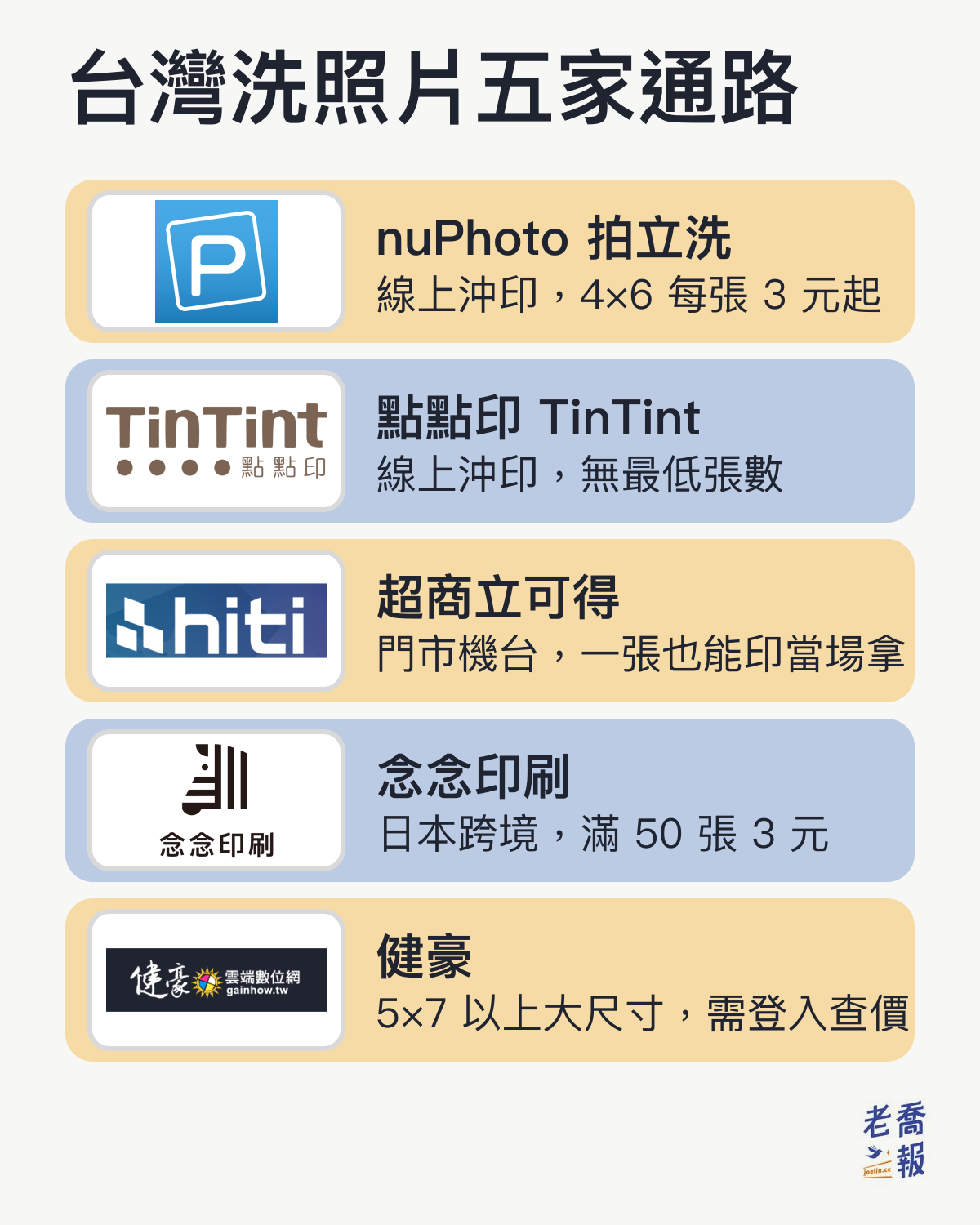
Image sources: the official websites or App Store pages of nuPhoto (拍立洗), TinTint (點點印), HiTi Likoda (相片立可得), Shimauma Print (念念印刷), and Gain-How’s cloud printing site (健豪雲端數位網). The logos are used only to identify the providers compared in this article. I have no partnership with any of them.
Which providers print which sizes? A comparison of five services
Photo printing services that consumers in Taiwan can order from directly fall into roughly three categories: online printing delivered to your home, convenience store kiosks that print on the spot, and factories in Japan that ship to Taiwan. The table below puts the five providers’ public unit prices side by side for each size. “Unavailable” means the service has no product in that size. “Not found” means the information could not be found on public pages, rather than that the service is unavailable.
| Size | nuPhoto (拍立洗) | TinTint (點點印) | Convenience store Likoda kiosks | Shimauma Print (Japan) | Gain-How (健豪) |
|---|---|---|---|---|---|
| 4×6 (six-inch photo) | NT$3 photo processing / NT$5 inkjet | NT$8 | NT$8 (1–5 prints) / NT$7 (6–10 prints) / NT$6 (11 or more) | NT$4 (fewer than 50 prints) / NT$3 (50 or more) | Not found |
| 5×7 (seven-inch photo) | Unavailable | Unavailable | Unavailable | NT$12 (fewer than 50 prints) / NT$11 (50 or more) | Available; price not found |
| 3.5×5 (Japan’s L size) | Unavailable | Unavailable | Unavailable | Original photo paper: NT$3 (fewer than 50 prints) / NT$2 (50 or more); premium Fujifilm photo paper: NT$4 / NT$3 | Not found |
| 6×8 (eight-inch photo) | Unavailable | NT$20 | NT$25 (1–5 prints) / NT$20 (6 or more) | Unavailable | Available; price not found |
| 8×10 (ten-inch photo) | Unavailable | Unavailable | Unavailable | Unavailable | Available; price not found |
| 3×4 small cards | NT$3 (NT$2 for 50 or more) | Unavailable | Unavailable | Unavailable | Not found |
| 2×3 instant-photo style | NT$3 (NT$2 for 50 or more) | Unavailable | Unavailable | Unavailable | Not found |
| Square | Unavailable | NT$8 (4×4) | Unavailable | 3.5×3.5: original photo paper NT$3 / NT$2; premium Fujifilm photo paper NT$4 / NT$3 | Not found |
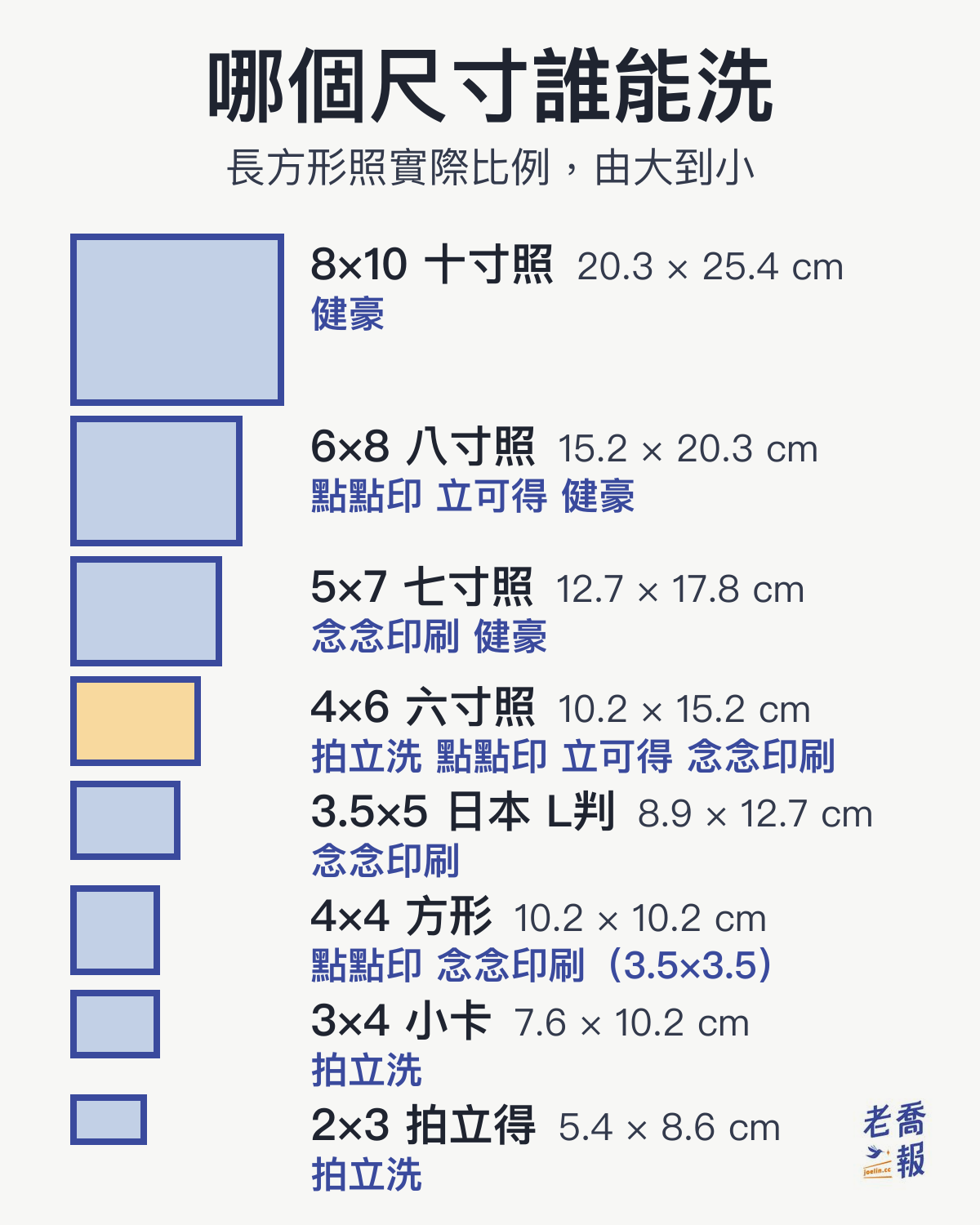
Read this table by finding the row for your desired size, then counting how many cells are not marked “Unavailable.” The additional 3.5×5 row is Japan’s default photo printing size, known as L size. Taiwan’s photo printing industry used to call it 3×5; today, only Shimauma Print offers it in Taiwan among these options. For the full specifications, see What size is a 3×5 photo?. Half of a 4×6 print is a 3×4 small card; a quarter is a 2×3 instant-photo-style print. A 3.5×5 print is not cut from a 4×6. The 4×6 row has both the widest availability and the largest price spread: all four providers with public prices offer it, so the total-cost calculations later in the article use only 4×6. By contrast, 5×7 is a gap in Taiwan’s online photo printing options. Neither nuPhoto nor TinTint offers it, and convenience store kiosks offer regular photo prints only up to 6×8. For seven-inch photos, you need Japan’s Shimauma Print, Gain-How’s photo processing system, or a professional photo lab. Only TinTint and convenience store Likoda kiosks offer 6×8, with prices jumping to NT$20 or more per print. These online services do not accept enlargements of 8×10 or larger. The 2×3 instant-photo-style prints and 3×4 small cards are exclusive to nuPhoto, with the price dropping to NT$2 each for orders of 50 or more. Square photos come in two sizes: TinTint’s are 4×4, while Shimauma Print’s are 3.5×3.5. Their side lengths differ, so the same layout cannot be reused interchangeably.
What photo sizes can you print at 7-Eleven, FamilyMart, and Hi-Life?
Convenience stores offer only two photo sizes for printing on the spot: 4×6 and 6×8.
| Convenience store | Kiosk | Available photo sizes |
|---|---|---|
| FamilyMart, Hi-Life | Likoda (dye-sublimation photo prints) | 4×6, 6×8 |
| 7-Eleven | ibon (laser toner printing on dedicated 4×6 paper) | 4×6 |
The answer to “What photo size can 7-Eleven print?” is therefore 4×6 (10.2 × 15.2 cm). For 6×8, you need a Likoda kiosk at FamilyMart or Hi-Life. Convenience stores cannot print 3×5, 5×7, or 8×10; those sizes require an online photo printing service. For the dimensions in centimeters, see the photo size comparison chart. The next two sections explain differences in production processes and pricing.
What printing technologies do the five providers use?
They may all be described as “photo printing,” but what happens inside the machines differs. The table below summarizes processes described publicly by the providers or inferable from their equipment models. “Unconfirmed” means the official website does not specify the process and this article has not verified it using the actual equipment.
| Service | Printing technology | Basis |
|---|---|---|
| nuPhoto (拍立洗) | Describes its “photo processing” option as using the same process as traditional photo labs; also offers an “inkjet” option | Official FAQ |
| TinTint (點點印) | Unconfirmed; the official website describes only glossy and matte photo paper options | Official product page |
| Convenience store Likoda kiosks | Dye sublimation (thermal dye transfer); the kiosks use photo printers from HiTi (誠研) | HiTi product page |
| Shimauma Print (念念印刷) | Silver-halide processing, using photo paper made in Japan | Official explanation |
| Gain-How (健豪) | Unconfirmed; the official website mentions only a wide color gamut and high-gloss photo paper | Official photo processing page |
| 7-Eleven ibon (outside the main comparison) | Laser toner printing on dedicated 4×6 paper, rather than a photographic process | User’s hands-on comparison |
The main point in this table is that the convenience store options differ: Likoda kiosks at FamilyMart and Hi-Life use dye sublimation, while 7-Eleven’s ibon uses laser toner. The four processes differ in where their colorants come from:
- Silver-halide processing is the traditional photo lab method. Light exposes the image onto photo paper, which then passes through chemicals to develop the colors. The colorants form within the paper, producing continuous tones. The equipment and chemicals have high fixed costs, making this process suitable for centralized printing in large volumes.
- Dye sublimation uses heat to transfer dye from a ribbon onto photo paper. Yellow, magenta, and cyan are applied in separate layers, followed by a clear protective coating. Prints emerge dry and resist fingerprints and water. The machines require almost no maintenance and can be installed in stores, which is why convenience store kiosks and photo sticker booths almost all use this process. They use six-inch-wide rolls of photo paper, which also explains why 6×8 is exactly equivalent to two 4×6 prints. See the full explanation in the section on the origins of 4×6 in the size guide.
- Inkjet printing sprays ink droplets onto photo paper, mixing colors through tiny dots. It is used by home photo printers and some dry photo labs. When a provider offers both photo processing and inkjet printing, the inkjet option is usually more expensive.
- Laser toner printing shares its technology with office printers, attaching toner to the paper’s surface. For 4×6 prints, ibon uses dedicated 209 lb heavy paper. The results look like photos, but users’ hands-on comparisons indicate that durability and color saturation fall short of the other three processes.
How should you choose in practice? For photos you want to keep in an album long term, both silver-halide processing and dye sublimation are photographic processes, so either is suitable. For urgent prints you can collect immediately, Likoda kiosks at FamilyMart and Hi-Life produce dye-sublimation photos. ibon is suitable for postcards and temporary uses; avoid using it for photos you want to preserve. This comparison is based on the providers’ public explanations; this article has not tested all five providers’ finished prints side by side. If you want to look further inside the machines—why ribbons and photo paper come as matched sets, how printhead costs are calculated, and which output technology makes sense at different production volumes—my photobooth information site compares six technologies in one table: Why photobooths use dye sublimation.
Minimum orders, shipping, and turnaround: check this table before ordering
A low price per print does not necessarily mean you pay less in the end. Minimum orders, shipping charges, and free-shipping thresholds determine the total. The table below compares the five providers’ ordering conditions. Turnaround covers only the period the provider itself promises, excluding the time you spend choosing and uploading photos.
| Service | Minimum order | Shipping | Free-shipping threshold | Turnaround | How to order |
|---|---|---|---|---|---|
| nuPhoto (拍立洗) | 12 prints of each size and style | NT$50 | Orders of NT$698 or more | Photo processing: 1–4 business days, excluding holidays, plus delivery | App or website |
| TinTint (點點印) | None (the 4×3 bulk option starts at 20 prints) | Registered mail: NT$60 | Not found | Ships in 4 days, plus postal delivery | Website |
| Convenience store Likoda kiosks | 1 print | None | Not applicable | Printed and collected on the spot | In-store kiosk; upload photos via USB, Bluetooth, or LINE |
| Shimauma Print (念念印刷) | None, but lower unit prices apply only to orders of 50 or more | International mail: NT$60; international courier: NT$120, reduced to NT$60 for 200 or more prints | Not found | International mail: approximately 14–21 days, without tracking; international courier: approximately 7–10 days, with tracking and EZ WAY real-name verification required; production and dispatch time are additional | App or website |
Gain-How is excluded from this table and the next total-cost table. Its unit prices, minimum order, and shipping charges are all in a quotation system that requires login, and none could be found for this article. It remains in the size table only to show which sizes it offers. The easiest detail to overlook here is nuPhoto’s 12-print minimum: it applies separately to “each size and style.” Ordering both 4×6 photo processing and 4×6 inkjet prints therefore means meeting two separate 12-print minimums. TinTint has no minimum order, but its NT$60 registered-mail charge is a fixed cost, so fewer prints mean more shipping cost allocated to each one. Convenience store Likoda kiosks have neither shipping charges nor a minimum-order threshold; the trade-offs are the highest unit price and just two sizes, 4×6 and 6×8. Shimauma Print’s two shipping methods differ in delivery time and whether a tracking number is provided. At 200 prints, courier shipping drops to NT$60, the same as international mail, so there is no reason to choose the slower method at or above that quantity. Gain-How’s photo processing prices are visible only after logging into its online quotation system. Because they cannot be found on public pages, the entries are marked “Not found” rather than filled with estimates.
Total costs for 4×6 prints, including shipping: 12, 50, and 200 prints
Multiply the unit price by the number of prints and add shipping to find what you will actually pay for this order. The table below uses each provider’s public prices, with no promotions applied and no overseas transaction fees for cross-border card payments included. Shimauma Print is calculated throughout using international mail and premium Fujifilm photo paper.
| Service | 12 prints, including shipping | 50 prints, including shipping | 200 prints, including shipping |
|---|---|---|---|
| nuPhoto (photo processing) | NT$86 | NT$200 | NT$650 |
| TinTint | NT$156 | NT$460 | NT$1,660 |
| Convenience store Likoda kiosks | NT$72 | NT$300 | NT$1,200 |
| Shimauma Print (international mail) | NT$108 | NT$210 | NT$660 |
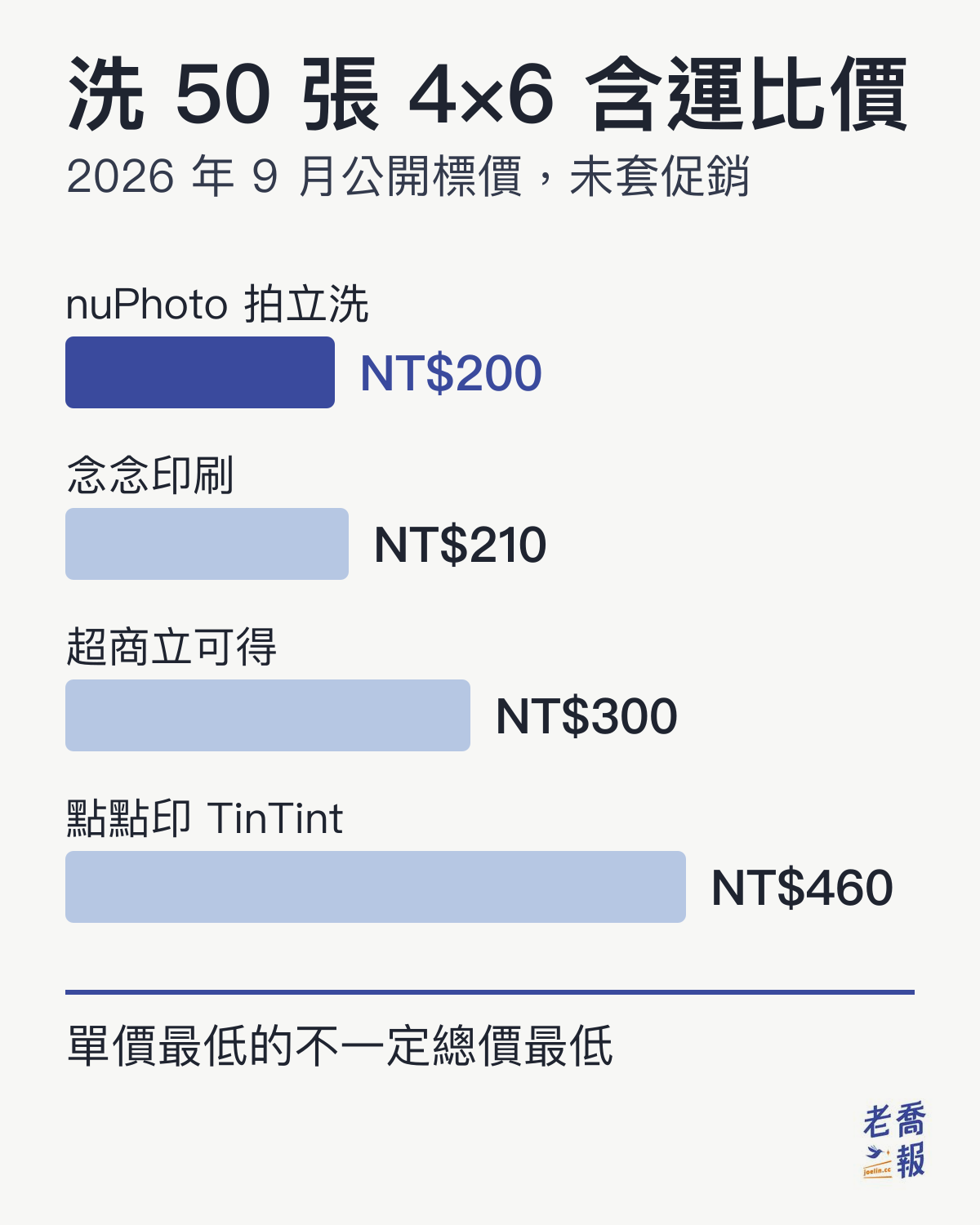
The answer changes across these three quantities, which is exactly why unit price alone is not enough. At 12 prints, convenience store Likoda kiosks are cheapest at NT$72 including shipping, because there is no shipping charge to spread across the prints. Although nuPhoto charges only NT$3 per print, adding NT$50 shipping brings the cost to NT$7.2 each. At 50 prints, the ranking reverses: nuPhoto costs NT$200 including shipping, or NT$4 each, with Shimauma Print close behind at NT$210. Convenience store Likoda kiosks, at NT$300, are now the more expensive option. At 200 prints, nuPhoto at NT$650 and Shimauma Print at NT$660 are nearly tied, both around NT$3.3 per print. The convenience store kiosks’ NT$1,200 total is almost twice as much. TinTint is the most expensive at all three quantities, but it offers two products unavailable from other providers: 6×8 and square 4×4 prints.
How to choose in three scenarios
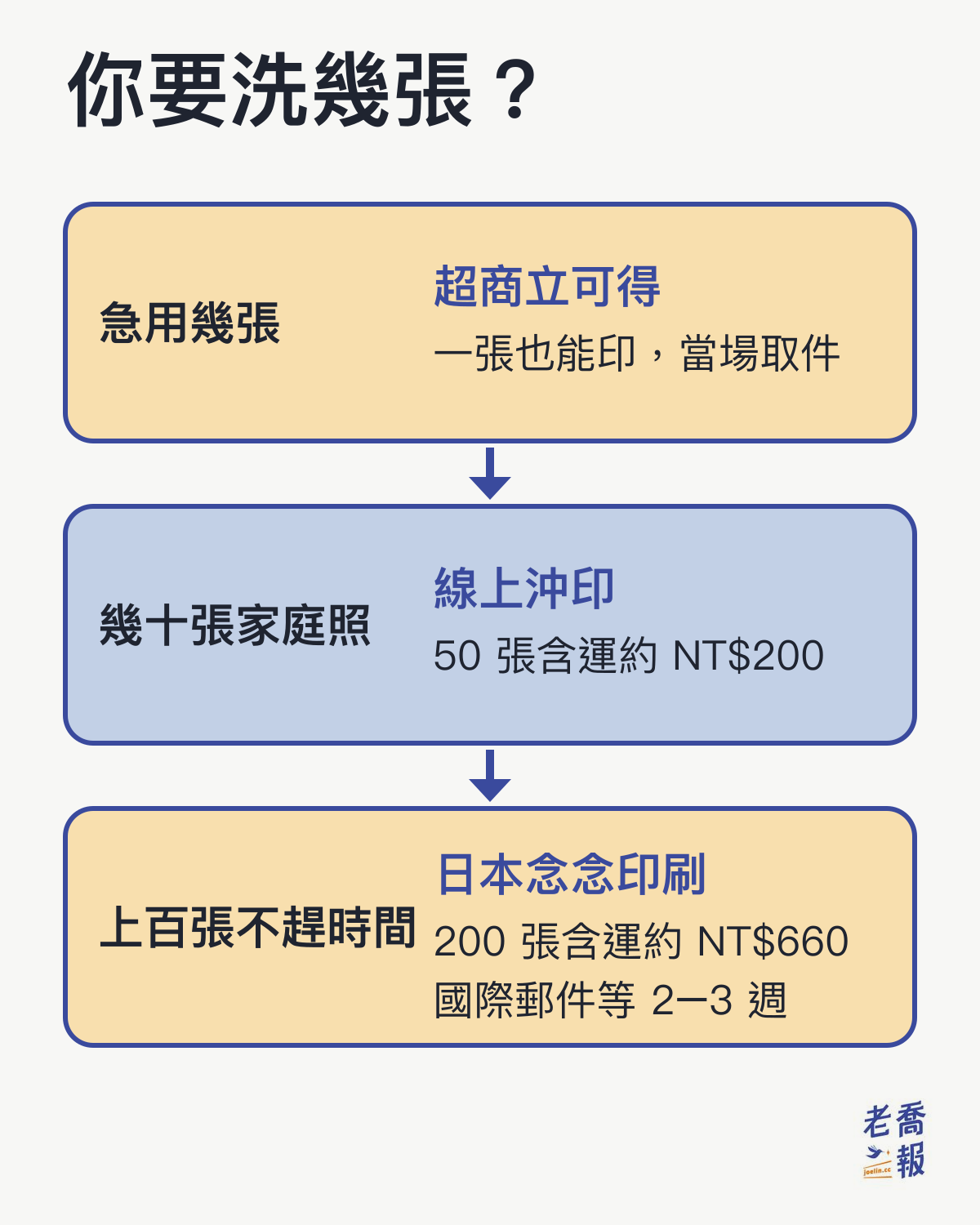
- If you urgently need a few photos, choose a convenience store Likoda kiosk. You can print just one and take it away immediately. At NT$72 including shipping for 12 prints, it has the lowest total in the table, with no delivery wait or need to assemble a minimum order.
- If you want to print dozens of family photos at once, choose online printing. At 50 prints, nuPhoto costs NT$200 including shipping, or NT$4 each—just two-thirds of the convenience store cost. The trade-off is waiting 1–4 business days plus delivery time.
- If you can wait and are organizing a large batch of photos, consider Shimauma Print’s cross-border service from Japan. At 200 prints, the total is NT$660 including shipping, or approximately NT$3.3 each. However, international mail takes 14–21 days and has no tracking number, so avoid it when time is tight.
Three checks before ordering
- Check the cropping preview before submitting. When printing a phone photo with a 4:3 aspect ratio as a 4×6, you must choose between filling the print and leaving white borders. Filling the print crops away approximately 10% of the image. See the full explanation in the section on cropping phone photos in the 4×6 size guide.
- Meet the minimum quantity before checking out. Online printing minimums are calculated separately for each size and style. If your desired quantity falls below the threshold, a convenience store kiosk may be better value.
- Distinguish photo processing from inkjet printing. A provider may offer both processes at different prices. nuPhoto’s NT$3 photo processing and NT$5 inkjet options for 4×6 are an example of this distinction. Confirm which one you have selected before ordering.
Price-check date and factual cautions
The prices above are the public prices listed on the providers’ official websites or in stores on September 15, 2026. They may change; use the official website’s prices on the day you order. Fields marked “Not found” mean that the figure could not be found on public pages. They do not mean the service is unavailable or that the price is zero. Promotions, member prices, and holiday campaigns are excluded from these calculations. The actual amount due is the total shown in your shopping cart.
Further reading: photo sizes and printing
- Full specifications for 3.5×5 and the origins of Japan’s L size: What size is a 3×5 photo? 8.9 × 12.7 cm
- Full specifications for 4×6 and cropping phone photos: How many centimeters is 4×6? A complete guide to photo sizes
- Full specifications for 5×7 and choosing a frame: What size is 5×7? 12.7 × 17.8 cm
- Full specifications for 6×8: What size is 6×8? 15.2 × 20.3 cm, the eight-inch photo size
- Full specifications for 8×10 and certificate frames: What size is 8×10? 20.32 × 25.4 cm
- Check whether you have enough pixels before printing: How many pixels does a 4×6 photo need to avoid looking blurry?
- Actual dimensions of different instant-photo formats: Instant photo size guide
- How to distinguish nine sizing systems: Sizes and specifications encyclopedia: main page
- How to use convenience store Likoda kiosks and where to find them: Likoda self-service kiosks available across major retail chains
- 7-Eleven ibon’s printing specifications and operation: ibon postcard size / 7-Eleven postcard size
Article keywords: photo printing, recommended photo printing services, online photo printing, convenience store photo printing, Likoda, nuPhoto, TinTint, Shimauma Print, 4×6 photo printing prices, photo printing shipping charges
Article overview
This article compares five photo printing services that consumers in Taiwan can order from directly: nuPhoto (拍立洗), TinTint (點點印), convenience store Likoda (立可得) kiosks, Japan’s Shimauma Print (念念印刷), and Gain-How (健豪). The main criterion is the total cost including shipping, rather than the price per print. The size matrix shows that 4×6 is the most widely available; 5×7 is a gap in Taiwan’s online printing options, with only Shimauma Print and Gain-How offering it; 6×8 is offered only by TinTint and convenience store Likoda kiosks; and these online services do not accept enlargements of 8×10 or larger. For 4×6 prints including shipping, convenience store Likoda kiosks are cheapest at NT$72 for 12 prints, nuPhoto is cheapest at NT$200 for 50 prints, and nuPhoto at NT$650 and Shimauma Print at NT$660 are nearly tied for 200 prints. Prices are the public prices listed on the providers’ official websites or in stores on September 15, 2026.
- Compare the total cost including shipping, rather than the price per print: online services have minimum orders and shipping charges, while convenience store kiosks can print a single photo for immediate collection.
- Total costs for 4×6 prints including shipping, based on public prices on September 15, 2026: convenience store Likoda kiosks are cheapest for 12 prints at NT$72; nuPhoto is cheapest for 50 prints at NT$200; and nuPhoto at NT$650 and Shimauma Print at NT$660 are nearly tied for 200 prints.
- 5×7 is a gap in Taiwan’s online photo printing options: neither nuPhoto nor TinTint offers it, and convenience store Likoda kiosks offer regular photo prints in only 4×6 and 6×8.
- nuPhoto requires at least 12 prints of each size and style. Shipping costs NT$50 and is free for orders of NT$698 or more.
- Shimauma Print ships from its factory in Japan to Taiwan. International mail costs NT$60, takes approximately 14–21 days, and has no tracking. International courier shipping costs NT$120, reduced to NT$60 for orders of 200 prints or more.
- Gain-How offers 5×7, 6×8, and 8×10 photo prints, but prices are visible only after logging into its online quotation system; this article marks them as not found.
- The production processes differ: Likoda kiosks use dye sublimation; Shimauma Print uses silver-halide processing; nuPhoto describes its photo processing option as using the same process as traditional photo labs; and 7-Eleven ibon uses laser toner printing. TinTint and Gain-How do not disclose their processes.
Frequently asked questions
Where is the cheapest place to print photos?
It depends on how many prints you need. For 4×6 prints calculated using public prices on September 15, 2026, convenience store Likoda kiosks are cheapest for 12 prints at NT$72 including shipping; nuPhoto is cheapest for 50 prints at NT$200 including shipping; and nuPhoto at NT$650 and Japan’s Shimauma Print at NT$660 are nearly tied for 200 prints. The lowest price per print does not necessarily mean the lowest total, because online printing adds shipping charges and may require a minimum order.
How much does a photo print cost at a convenience store?
For regular 4×6 photo prints at convenience store Likoda kiosks, the price is NT$8 each for 1–5 prints, NT$7 each for 6–10 prints, and NT$6 each for 11 or more. For 6×8 prints, it is NT$25 each for 1–5 prints and NT$20 each for 6 or more. There is no shipping charge or minimum order: you can print just one photo and collect it immediately.
Do online photo printing services require a minimum number of prints?
Requirements vary. nuPhoto requires 12 prints of each size and style, so ordering both photo processing and inkjet prints means meeting two separate 12-print minimums. TinTint has no minimum order, but registered-mail shipping is a fixed NT$60 cost. Japan’s Shimauma Print has no minimum, although its lower unit prices apply only to orders of 50 prints or more.
Where can I get 5×7 prints?
These Taiwanese online photo printing services do not offer 5×7, and convenience store Likoda kiosks offer regular photo prints in only 4×6 and 6×8. For seven-inch photos, you can use Japan’s Shimauma Print, which offers premium Fujifilm photo paper at NT$12 each for fewer than 50 prints or NT$11 each for 50 or more, use Gain-How’s photo processing system, or go directly to a professional photo lab.
Are convenience store photo prints the same as prints from a photo lab?
The production processes differ. Likoda kiosks at FamilyMart and Hi-Life use dye sublimation, transferring dye onto photo paper with heat and then applying a protective layer; this is a photographic printing process. 7-Eleven’s ibon uses laser toner printing on dedicated 4×6 paper, rather than a photographic process, and is suitable for postcards and temporary uses. Among online services, Shimauma Print uses silver-halide processing, nuPhoto describes its photo processing option as using the same process as traditional photo labs, and TinTint and Gain-How do not disclose their processes.
Is it economical to have photos printed in Japan and shipped to Taiwan?
Only when you are ordering many prints and are not in a hurry. Shimauma Print charges NT$3 per 4×6 print for orders of 50 or more. An order of 200 prints costs NT$660 including international mail, or about NT$3.3 each, similar to online printing in Taiwan. However, international mail takes 14–21 days and has no tracking number. International courier shipping takes 7–10 days but requires EZ WAY real-name verification. Avoid it for urgent orders.
This English version is based on original Traditional Chinese content on joelin.cc. The language and explanations are localised for international readers. The Traditional Chinese original is the authoritative version — for its complete meaning, please read the original article.