
This article is also available in:繁體中文
The original Chinese article was published on August 3, 2026, and last updated on October 9, 2026.
A 2-inch photo measures 3.5 × 4.5 cm (35 × 45 mm). A digital file at 300 DPI is approximately 413 × 531 px.
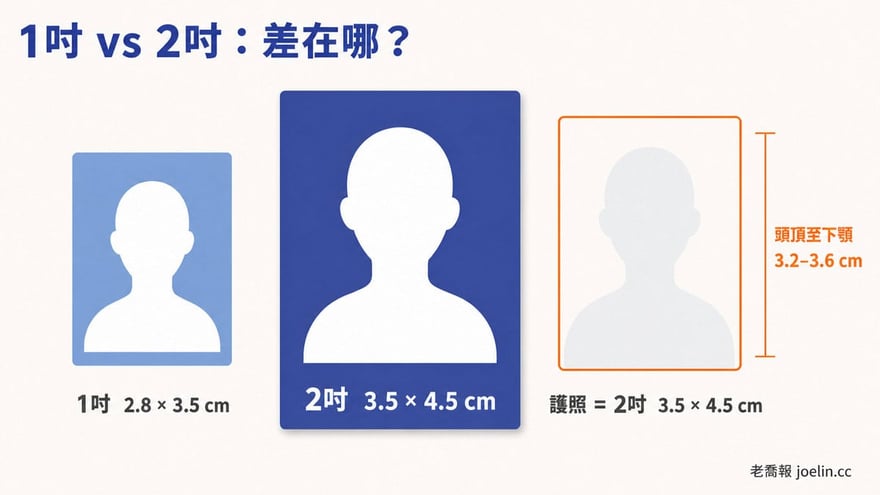
A 1-inch photo measures 2.8 × 3.5 cm, while a 2-inch photo measures 3.5 × 4.5 cm. The two are not interchangeable.
In Taiwan, this is usually what photography studios mean by a “2-inch ID portrait” (2吋大頭照). In Hong Kong, studios call ID photos “證件相.”
Common uses include:
- National ID cards
- Passports
- National Health Insurance cards
Let me clear up the most common source of confusion first: “2-inch” is a conventional label used by Taiwanese photography studios. It does not mean converting two inches directly into 5.08 cm. The 2 × 2-inch photo required for a U.S. visa is a 5 × 5 cm square, a different format.
This article explains how many centimeters a 2-inch photo measures, its physical and pixel dimensions, and which documents require 1-inch or 2-inch photos.
It covers photo specifications, rather than the dimensions of the national ID card or driver’s license itself.
If you want to know how big the cards are—national ID cards, National Health Insurance cards, and EasyCards all use the same 8.56 × 5.4 cm format—see What Size Is a Credit Card? Comparing the Cards Themselves.
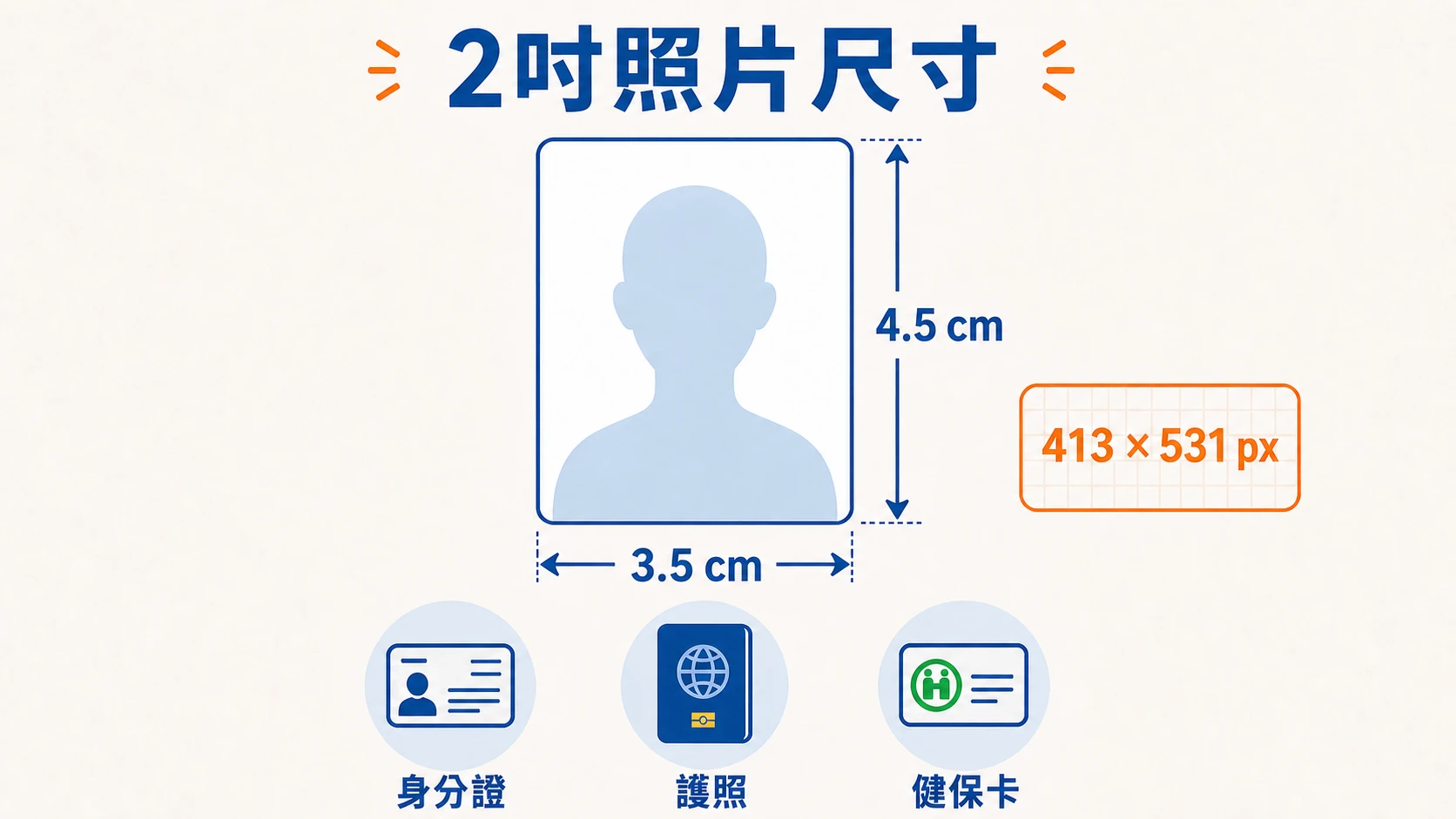
1. How Big Is a 2-Inch Photo? 3.5 × 4.5 cm
| Format | Centimeters (cm) | Millimeters (mm) | Pixels (300 DPI) | Main uses |
|---|---|---|---|---|
| 1-inch | 2.8 × 3.5 | 28 × 35 | 331 × 413 | Driver’s licenses, medical examination forms, some certification exams |
| 2-inch ID portrait | 3.5 × 4.5 | 35 × 45 | 413 × 531 | National ID cards, passports, National Health Insurance cards, Mainland Travel Permits for Taiwan Residents, national examinations |
| 2-inch half-body portrait | 4.2 × 4.7 | 42 × 47 | 496 × 555 | Résumés, student ID cards, international driving permits, some visas on arrival |
A 2-inch photo measures 3.5 × 4.5 cm (35 × 45 mm), or approximately 413 × 531 px at 300 DPI. This is usually the format meant by “2-inch ID portrait” in everyday Taiwanese usage; a 1-inch photo measures 2.8 × 3.5 cm. Writing “two-inch photo” as “兩吋照片” in Chinese refers to exactly the same thing: its dimensions are still 3.5 × 4.5 cm. The only difference is whether the number is written as a Chinese character or an Arabic numeral.
One particularly easy mistake to make: the “inch” in an ID photo’s name is not a literal inch. Converted into inches, a 1-inch photo actually measures approximately 1.1 × 1.38 in. It is a photography-industry convention, not a mathematical conversion. There is no need to question your sanity when you measure it with a ruler.
Which Is Larger, a 1-Inch or a 2-Inch Photo? The 2-Inch Photo Is Larger
A 2-inch photo is larger than a 1-inch photo. A 1-inch photo measures 2.8 × 3.5 cm, while a 2-inch photo measures 3.5 × 4.5 cm. The 2-inch photo is 0.7 cm wider and 1 cm taller, with approximately 1.6 times the area. In everyday Taiwanese speech, “一寸” and “兩寸” refer to these two ID photo formats.
| Item | 1-inch | 2-inch |
|---|---|---|
| Dimensions | 2.8 × 3.5 cm | 3.5 × 4.5 cm |
| Area | Approximately 9.8 cm² | Approximately 15.75 cm² |
| Pixels (300 DPI) | 331 × 413 px | 413 × 531 px |
| Main uses | Driver’s licenses | National ID cards, passports, National Health Insurance cards |
The difference between 1-inch and 2-inch photos extends beyond size: their uses are clearly defined. The Ministry of Transportation and Communications’ Highway Bureau requires 1-inch photos for driver’s licenses. The Ministry of the Interior requires national ID card photos to measure 4.5 cm vertically and 3.5 cm horizontally, while the Ministry of Foreign Affairs’ Bureau of Consular Affairs requires 4.5 × 3.5 cm passport photos. Both are the format called 2-inch in Taiwan (checked in September 2026). Some registration forms and certification exams also specify 1-inch photos; follow the instructions issued by the relevant organization. The two formats are not interchangeable, so check which one is required before submitting.
2. National ID Card and Passport Photo Sizes: Which Format Does Each Document Require?
National ID card and passport photos both measure 3.5 × 4.5 cm, the format called 2-inch in Taiwan. National Health Insurance cards and Mainland Travel Permits for Taiwan Residents use the same dimensions. Driver’s license photos, however, use the 1-inch format, measuring 2.8 × 3.5 cm, and cannot be used interchangeably with photos for the other documents.
| Document | Format | Special requirements |
|---|---|---|
| National ID card | 2-inch (3.5 × 4.5 cm) | Taken within the past 2 years; white background; 3.2–3.6 cm from the top of the head to the chin |
| Passport | 2-inch (3.5 × 4.5 cm) | Taken within the past 6 months; white background; 3.2–3.6 cm from the top of the head to the chin (the face occupies approximately 70–80% of the photo) |
| National Health Insurance card | 2-inch (3.5 × 4.5 cm) | Front-facing, no hat, clearly visible facial features, no compositing or alteration |
| Driver’s license | 1-inch (2.8 × 3.5 cm) | Taken within the past 2 years; glossy print with a plain background; front-facing half-body portrait (full 1-inch specifications) |
| Mainland Travel Permit for Taiwan Residents | 2-inch (3.5 × 4.5 cm) | White background |
| U.S. visa | 5 × 5 cm (2 × 2 in) | Primarily a digital file; square; different from Taiwan’s 2-inch format |
Two practical points:
- National ID cards, passports, and National Health Insurance cards can use the same set of photos: all require 3.5 × 4.5 cm photos with a white background. Having them taken and printed together offers the best value.
- Driver’s licenses are the exception: they require 1-inch photos, which are not interchangeable with photos for the other documents. A 2-inch photo submitted at a motor vehicles office will be rejected. Full specifications, pixel dimensions, and the number of photos per print layout are covered in How Many Centimeters Is a 1-Inch Photo?.
Once you know which size you need, find a nearby place to take it: the Taiwan ID Photo Booth Map compiles the official locations of three operators—水啦, 富多美, and 立可得—from their September 2026 official lists. You can search by county or city, or by venue type, including PX Mart, FamilyMart, household registration offices, and MRT stations.
⚠️ Specifications checked on August 14, 2026. Before submitting, follow the latest announcements from the responsible authority: Ministry of the Interior, Department of Household Registration: National ID Card Photo Specifications, Ministry of Foreign Affairs, Bureau of Consular Affairs: E-Passport Photo Specifications, Ministry of Transportation and Communications, Highway Bureau: Driving Test Requirements, and National Health Insurance Administration: Health Insurance Card Photo Specifications.
3. Incorrect Head Proportions Are the Main Reason Photos Get Rejected
Most people assume that an ID photo is rejected because its overall dimensions are wrong. In practice, an incorrectly sized head is a more common reason.
For passports and national ID cards, the required distance from the top of the head to the chin is 3.2–3.6 cm. In other words, the face should fill roughly 70–80% of the photo’s height. Two common failures when taking your own photo are:
- Face too small: the frame includes a half-body view and extends below the shoulders → head height is less than 3.2 cm → rejection.
- Face too large: the frame contains only the face and crops off the top of the head → incomplete outline → rejection.
Other firm requirements include a white background without shadows, a front-facing pose, no hat, no tinted glasses, no retouching or compositing, and a natural expression.
4. Can You Use a 2-Inch Photo Taken in Taiwan for Documents Abroad?
In most cases, yes, but two countries require a separate photo.
| Country or region | Format | Same dimensions as Taiwan’s 2-inch photo? |
|---|---|---|
| Taiwan (national ID cards, passports, National Health Insurance cards) | 3.5 × 4.5 cm | — |
| Japan (passports, My Number cards) | 3.5 × 4.5 cm | Exactly the same |
| South Korea (passports, national ID cards, driver’s licenses) | 3.5 × 4.5 cm | Exactly the same |
| Schengen visas (used across multiple European countries) | 3.5 × 4.5 cm | Exactly the same |
| China (passports) | 3.3 × 4.8 cm | Different: 2 mm narrower and 3 mm taller |
| United States (passports, U.S. visas) | 5 × 5 cm (2 × 2 inches) | Different: square, an entirely different format |
First, a common misconception: the 3.5 × 4.5 cm dimensions were not prescribed by an international organization. The International Civil Aviation Organization’s (ICAO) Doc 9303 governs facial geometry and requirements such as the distance from the top of the head to the chin occupying 70–80% of the image height, a plain background, and a natural expression. It does not prescribe the printed photo’s dimensions in centimeters. Each country sets its own physical dimensions; most simply happen to have chosen 3.5 × 4.5 cm.
Interestingly, even the head-height requirements line up. Taiwan requires 3.2–3.6 cm from the top of the head to the chin; Schengen visa requirements specify 32–36 mm; Japanese passport requirements specify 34 mm, plus or minus 2 mm. All three describe the same range. So if you take a compliant 2-inch photo in Taiwan, you can usually use the same set for documents in Japan, South Korea, or the Schengen area.
Remember the two exceptions. Chinese passport photos measure 3.3 × 4.8 cm. They differ from Taiwan’s 3.5 × 4.5 cm format by only a few millimeters and look very similar, but submitting the Taiwanese format will lead to rejection and require a new photo. The U.S. format differs the most: both passports and U.S. visas require a square 5 × 5 cm photo, an entirely different format from a rectangular Taiwanese 2-inch photo.
One final reminder: correct dimensions do not guarantee acceptance. Countries have different rules on how recently the photo must have been taken, background color, whether glasses are allowed, and whether retouching is permitted, and those rules can change. This table helps you determine whether you need a new photo; before submitting, always follow the latest announcement from the destination country’s responsible authority.
Japanese Résumé Photos, Japanese Driver’s Licenses, and China’s “Two-Inch” Format
Applying for a job or exchanging a driver’s license in Japan involves another set of dimensions. Japanese résumé (履歴書) photos measure 3 × 4 cm (width × height), while Japanese driver’s license photos measure 2.4 × 3 cm. Both differ from Taiwan’s 2-inch format and require separate photos. Japanese passport photos, however, use the same 3.5 × 4.5 cm dimensions as Taiwan’s 2-inch photos.
In mainland China’s photography industry, “二寸,” or “two-inch,” usually means 3.5 × 4.9 cm. It has the same width as Taiwan’s 2-inch format (3.5 × 4.5 cm), but is 0.4 cm taller. Chinese passport and visa photos instead follow the official 3.3 × 4.8 cm specifications. The same “two-inch” name can refer to different dimensions, so check the centimeters specified by the recipient before submitting.
5. How Many Pixels Do You Need to Take Your Own ID Photo?
ID photos are small, so their pixel requirements are actually very low:
| Format | Requirements at 300 DPI | Requirements at 600 DPI |
|---|---|---|
| 1-inch | 331 × 413 px | 661 × 827 px |
| 2-inch | 413 × 531 px | 827 × 1,063 px |
Any smartphone from the past ten years far exceeds these requirements. ID photo failures come down to lighting and background, rather than insufficient pixels. Three practical tips for taking your own photo:
- Take it beside a window during the day, facing the light source. Avoid overhead light that casts shadows in the eye sockets and under the chin.
- Use an actual white wall as the background. Stand one step away from it so your shadow does not fall directly on the wall.
- Transfer the original file. Sending it to yourself through LINE compresses it; for printing, use AirDrop, cloud storage, or a direct cable connection.
For the full explanation of pixel and DPI calculations, see How Many Pixels Does a 4 × 6 Photo Need to Stay Sharp? The 300 DPI Standard.
6. A Money-Saving Layout: One 4 × 6 Print Can Produce a Year’s Supply of ID Photos
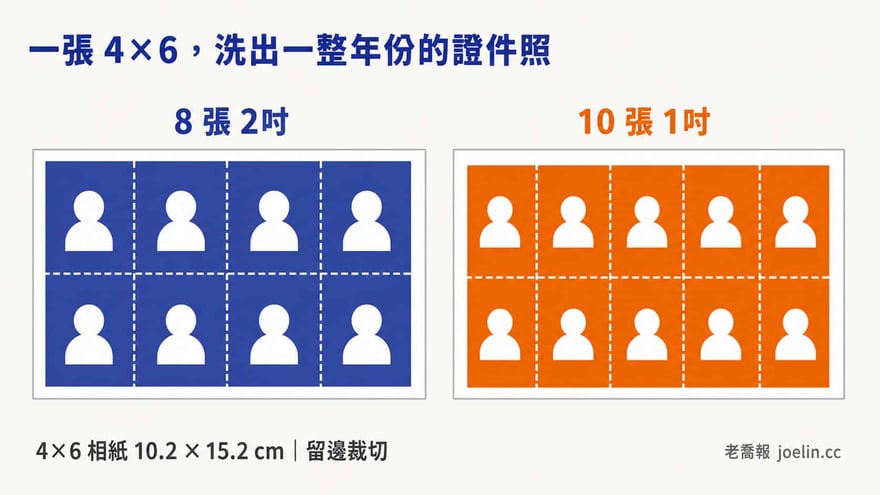
Printing ID photos individually is expensive, but arranging them on a sheet priced as a 4 × 6 photo can bring the cost down to one-tenth:
- One 4 × 6 print (10.2 × 15.2 cm) can accommodate approximately eight 2-inch photos or ten 1-inch photos, depending on the margins.
- Convenience-store photo printers often offer an “ID photo layout” option. Alternatively, use a free tool—a photography-studio layout webpage or a mobile app—to arrange the photos on a 4 × 6 canvas before printing.
- Leave cutting guides between the photos so you do not cut into the neighboring image.
For the complete specifications of a 4 × 6 print, see How Many Centimeters Is 4 × 6? A Complete Guide to the 10.16 × 15.24 cm Photo Format.
7. Frequently Asked Questions About ID Photos
How Many Centimeters Is a 2-Inch Photo? What Are Its Dimensions?
In Taiwan, a standard 2-inch ID portrait measures 3.5 × 4.5 cm (35 × 45 mm). A digital file at 300 DPI is approximately 413 × 531 px. It is not the square 5 × 5 cm photo described as 2 × 2 inches.
How Many Centimeters Is a 1-Inch Photo?
2.8 × 3.5 cm. For the complete 1-inch specifications, pixel dimensions, and number of photos per print layout, see How Many Centimeters Is a 1-Inch Photo?.
Which Is Larger, a 1-Inch or a 2-Inch Photo? What Is the Difference?
A 2-inch photo is larger. A 1-inch photo measures 2.8 × 3.5 cm, while a 2-inch photo measures 3.5 × 4.5 cm and has approximately 1.6 times the area. Their uses also differ: driver’s licenses require 1-inch photos, while national ID cards, passports, and National Health Insurance cards use 2-inch photos. The two formats are not interchangeable.
Can I Use My National ID Card Photo to Apply for a Passport?
The dimensions are the same: both require a 3.5 × 4.5 cm photo with a white background. However, passport photos must have been taken within the past six months, compared with the past two years for national ID cards. The same photo can be used only if it meets the passport’s more recent time limit and all other requirements.
Can I Use a 2-Inch Photo for a Driver’s License?
No. Driver’s licenses require 1-inch photos (2.8 × 3.5 cm), which are not interchangeable with photos for other documents. A 2-inch photo submitted at a motor vehicles office will be rejected.
Can I Take My Own ID Photo?
Yes. There is no official requirement to visit a photography studio. The challenge is meeting the specifications: a white background without shadows, a front-facing pose with no hat, a head height of 3.2–3.6 cm from the top of the head to the chin, and no retouching or compositing.
Passport applications require extra care. At the beginning of its E-Passport Photo Specifications, the Bureau of Consular Affairs specifically warns that smartphone selfies can be mirrored, reversing the left and right sides of the face. Wide-angle lenses may also distort facial features, ears, or face shape. If the photo does not comply, you will be asked to retake and resubmit it, delaying your passport collection date. For passport applications, therefore, consider having passport-specific photos taken at a studio first (checked in October 2026).
You can also take your own photos for other documents, but check the relevant authority’s photo requirements before submitting them.
Can a Graduation-Gown Photo Be Used as an ID Photo?
It is generally not recommended for most documents because the mortarboard, stole, or clothing may obscure the head, shoulders, or facial outline. Follow the photo specifications of the authority handling your application.
Are U.S. Visa Photos the Same as Taiwan’s 2-Inch Photos?
No. U.S. visa photos are square, measuring 5 × 5 cm (2 × 2 inches), and are primarily submitted as digital uploads. Visa photo requirements differ by country; check the destination country’s latest rules before submitting.
What File Format Should I Use for a Digital ID Photo?
JPEG is the most widely accepted format, but online application systems have their own file-format, file-size, and pixel-dimension limits. Confirm the system’s latest specifications before uploading.
8. Further Reading: A Guide to Specifications
- Nearby self-service ID photo booths: Taiwan ID Photo Booth Map
- 4 × 6 photo-print specifications: How Many Centimeters Is 4 × 6? A Complete Guide to the 10.16 × 15.24 cm Photo Format
- Pixel / DPI calculations: How Many Pixels Does a 4 × 6 Photo Need to Stay Sharp? The 300 DPI Standard
- Graduation attire in ID photos: The Complete Guide to ID Photos in Graduation Attire: Which Documents Do Not Allow It?
- A5 paper specifications: What Size Is A5? 14.8 × 21 cm
- A6 / postcard specifications: What Size Is A6? 10.5 × 14.8 cm
Notes and Cautions
This is Joe’s overview of ID photo specifications. Photo requirements for each document are governed by the latest announcements from the responsible authority: the Bureau of Consular Affairs for passports, the Ministry of the Interior’s Department of Household Registration for national ID cards, regional motor vehicles offices for driver’s licenses, and the National Health Insurance Administration for health insurance cards. Check again before submitting.
Article overview
In Taiwan, a standard 2-inch ID portrait measures 3.5 × 4.5 cm, or approximately 413 × 531 pixels at 300 DPI. It is commonly used for national ID cards, passports, and National Health Insurance cards. A 1-inch photo measures 2.8 × 3.5 cm and is mainly used for driver’s licenses; its full specifications are covered in a separate article. The key distinction is that ‘inch’ is a conventional photography-studio label, not a literal measurement in inches. National ID cards, passports, and health insurance cards can use the same set of photos, all measuring 3.5 × 4.5 cm with a white background, but driver’s licenses require 1-inch photos. Incorrect head proportions are a leading reason for rejection: the distance from the top of the head to the chin must be 3.2–3.6 cm. One 4 × 6 print can accommodate eight 2-inch photos or ten 1-inch photos. A 2-inch photo is larger than a 1-inch photo, with approximately 1.6 times the area.
- 2-inch photo dimensions: 3.5 × 4.5 cm.
- 1-inch photo dimensions: 2.8 × 3.5 cm.
- Pixel dimensions at 300 DPI: 413 × 531 px.
- Required head height: 3.2–3.6 cm.
- One 4 × 6 print accommodates eight 2-inch photos or ten 1-inch photos.
- A 2-inch photo is larger than a 1-inch photo: 3.5 × 4.5 cm versus 2.8 × 3.5 cm, with approximately 1.6 times the area.
- Taiwan’s 2-inch format, 3.5 × 4.5 cm, has exactly the same dimensions as photos for Japan, South Korea, and Schengen visas. Chinese passport photos at 3.3 × 4.8 cm and square U.S. photos at 5 × 5 cm are two exceptions.
Frequently asked questions
What size are national ID card photos? What about passport photos?
National ID card and passport photos both measure 3.5 × 4.5 cm, the format called 2-inch in Taiwan. They require a white background and a distance of 3.2–3.6 cm from the top of the head to the chin. The difference is recency: national ID photos must have been taken within the past two years, while passport photos must have been taken within the past six months. National Health Insurance cards and Mainland Travel Permits for Taiwan Residents use the same dimensions.
How many centimeters is a 1-inch photo?
2.8 × 3.5 cm. For the complete 1-inch specifications, pixel dimensions, and number of photos per print layout, see the dedicated article on 1-inch photo dimensions.
Can I take my own ID photo?
Yes. There is no official requirement to visit a photography studio. The challenge is meeting the specifications: a white background without shadows, a front-facing pose with no hat, a head height of 3.2–3.6 cm from the top of the head to the chin, and no retouching or compositing. However, the Bureau of Consular Affairs specifically warns that smartphone selfies can be mirrored, reversing the left and right sides of the face, and wide-angle lenses may distort facial features, ears, or face shape. Noncompliant photos require resubmission and retaking, delaying passport collection, so applicants should consider having passport-specific photos taken at a studio first. E-passport photo specifications: https://www.boca.gov.tw/cp-25-4123-c2932-1.html (checked in October 2026). You can also take your own photos for other documents, but check the relevant authority’s photo requirements before submitting them.
This English version is based on original Traditional Chinese content on joelin.cc. The language and explanations are localised for international readers. The Traditional Chinese original is the authoritative version — for its complete meaning, please read the original article.