---
title: What Is 大日本印刷 (DNP)? 150 Years of Printing Technology Across Seven Industries, from Photo Booth Paper and Semiconductor Masks to Bookstores
url: https://joelin.cc/en/p/9847
source: https://joelin.cc/en/p/9847
lang: en
pubDate: '2026-10-12'
date_modified: '2026-10-12'
description: Founded in 1876, 大日本印刷 (DNP) spans photo paper, chip masks, OLED materials, batteries and bookstores. Official reports explain its profits and ties to TOPPAN and Citizen.
author: joe
ai_role: ai_only
translation_of: /p/9847
about:
- name: 大日本印刷
sameAs:
- https://www.wikidata.org/wiki/Q1157511
mentions:
- name: TOPPAN
sameAs:
- https://www.wikidata.org/wiki/Q986752
- name: 丸善CHIホールディングス
sameAs:
- https://www.wikidata.org/wiki/Q11368062
- name: Rapidus
sameAs:
- https://www.wikidata.org/wiki/Q115165470
---
# What Is 大日本印刷 (DNP)? 150 Years of Printing Technology Across Seven Industries, from Photo Booth Paper and Semiconductor Masks to Bookstores
## Summary
大日本印刷 (DNP, Tokyo Stock Exchange: 7912) is a Japanese printing company that grew out of 秀英舎, founded in Ginza in 1876. It merged with 日清印刷 in 1935, went public in 1949, and marked its 150th anniversary on October 9, 2026. In the fiscal year ended March 2026, revenue was ¥1.5126 trillion and operating profit was ¥101 billion. Over ten years, revenue increased by only about 7%, while operating profit grew to roughly 3.2 times its earlier level. Of its three segments, Electronics accounted for about 17% of revenue and 40% of segment profit, with a profit margin of 20.1%.
DNP applies its printing technology—placing precise patterns and coatings on thin sheets—to seven industries: dye-sublimation photo printing materials; semiconductor photomasks; OLED deposition masks and optical films; lithium-ion battery pouches; bookstores; IC cards and identity documents; and packaging and beverages. In photo printing materials, it claims the world's largest market share, with about 400,000 printers operating worldwide and annual photo paper shipments equivalent to approximately 5 billion prints. It took over コニカミノルタ's photo business in 2006 and Sony's photo printer business in 2011, operates Ki-Re-i ID photo booths, and announced the sticker-capable DP-RX2 printer in September 2026. In semiconductor photomasks, it claims a leading share of the merchant market, participates as a subcontractor in Rapidus's 2 nm mask development and has invested in Rapidus, works with Canon and 鎧俠 on nanoimprint lithography, and owns 49.9% of the PDMC joint venture in Hsinchu. It owns 54.92% of 丸善CHI. Its 2026 tender offer for AUSTRIACARD attracted tenders representing 96.55% of shares.
TOPPAN reported revenue of ¥1.805 trillion and operating profit of ¥67.1 billion for the fiscal year ended March 2026. Following the listing of its photomask subsidiary, its ownership fell to 46.6%, and the subsidiary was no longer consolidated. Citizen's photo printer business is operated by シチズン・システムズ, which entered the market in 2007; シチズン時計 and DNP hold shares in each other. Beginning in 2023, DNP set targets of 10% ROE and a price-to-book ratio above 1.0. Its price-to-book ratio rose from 0.9 to 1.1. Its new medium-term plan targets operating profit of ¥130 billion in fiscal 2028.
### Key facts
- 大日本印刷 (DNP, Tokyo Stock Exchange: 7912) traces its origins to 秀英舎, founded in Ginza, Tokyo, on October 9, 1876. Its 150th anniversary fell on October 9, 2026.
- In February 1935, 秀英舎 and 日清印刷 merged to form 大日本印刷. The company listed on the Tokyo Stock Exchange in May 1949.
- For the fiscal year ended March 2026, DNP reported consolidated revenue of ¥1.5126 trillion, operating profit of ¥101 billion, and 36,360 consolidated employees.
- Over ten years, from the fiscal year ended March 2017 to the fiscal year ended March 2026, DNP's revenue increased by about 7%, and operating profit grew to approximately 3.2 times its earlier level, according to this site's calculations using the official data series.
- DNP's Electronics segment accounted for about 17% of the three segments' combined revenue and about 40% of their combined profit, with a profit margin of 20.1%, according to this site's calculations using the securities report.
- DNP claims the world's largest market share, described as “世界トップシェア,” in four products: dye-sublimation photo printing materials, OLED deposition masks, lithium-ion battery pouches, and anti-reflection and anti-glare films. It does not publish the percentages.
- DNP's official wording for semiconductor photomasks is “外販用フォトマスクでトップレベルのシェア”: a leading share of photomasks sold to external customers, rather than the world's largest share.
- Approximately 400,000 DNP printers operate worldwide, and annual photo paper shipments are equivalent to about 5 billion 4 × 6-inch prints, according to DNP IR Day 2026.
- DNP took over コニカミノルタ's photo business in 2006 and Sony's digital photo printer business in 2011, and acquired Colorvision and Sharingbox in 2020.
- In September 2026, DNP announced the DP-RX2 photo printer, which can print on sticker photo paper. Overseas sales were scheduled to begin in January 2027, with a target of 100,000 cumulative units sold by fiscal 2029.
- DNP is the largest shareholder of 丸善CHIホールディングス, with a 54.92% stake according to the shareholder register.
- DNP launched a tender offer for Austria's AUSTRIACARD in 2026, attracting tenders for approximately 96.55% of shares. As of August 25, 2026, Austrian foreign investment approval was still pending.
- DNP's new medium-term management plan targets operating profit of ¥130 billion and ROE of 9.0% in fiscal 2028, with a progressive dividend policy setting a floor of ¥40 per share.
- TOPPAN reported revenue of ¥1.805 trillion and operating profit of ¥67.1 billion for the fiscal year ended March 2026. Its revenue was about 20% larger than DNP's, while its operating profit was approximately two-thirds of DNP's.
- Following the October 2025 listing of TOPPAN's photomask subsidiary テクセンドフォトマスク, TOPPAN held 46.6% and no longer consolidated the company.
- Citizen's photo printers are operated by シチズン・システムズ, which entered the market with the CX series in 2007. シチズン時計 holds 223,000 DNP shares, and DNP also holds shares in シチズン.
- DNP owns 49.9% of Photronics DNP Mask Corporation, its photomask joint venture with Photronics in Hsinchu.
大日本印刷 (DNP) is a printing company founded in Ginza, Tokyo, in 1876, with its 150th anniversary falling on October 9, 2026. Today, it generates about ¥1.51 trillion in annual revenue, but books and magazines are no longer its main source of profit. Its products include photo paper and ribbons used in sticker photo booths and ID photo booths, masks used to manufacture smartphone OLED panels, semiconductor photomasks, and pouch films for electric vehicle batteries. What connects these products is the same underlying printing technology: producing precise patterns or coatings on thin sheets.
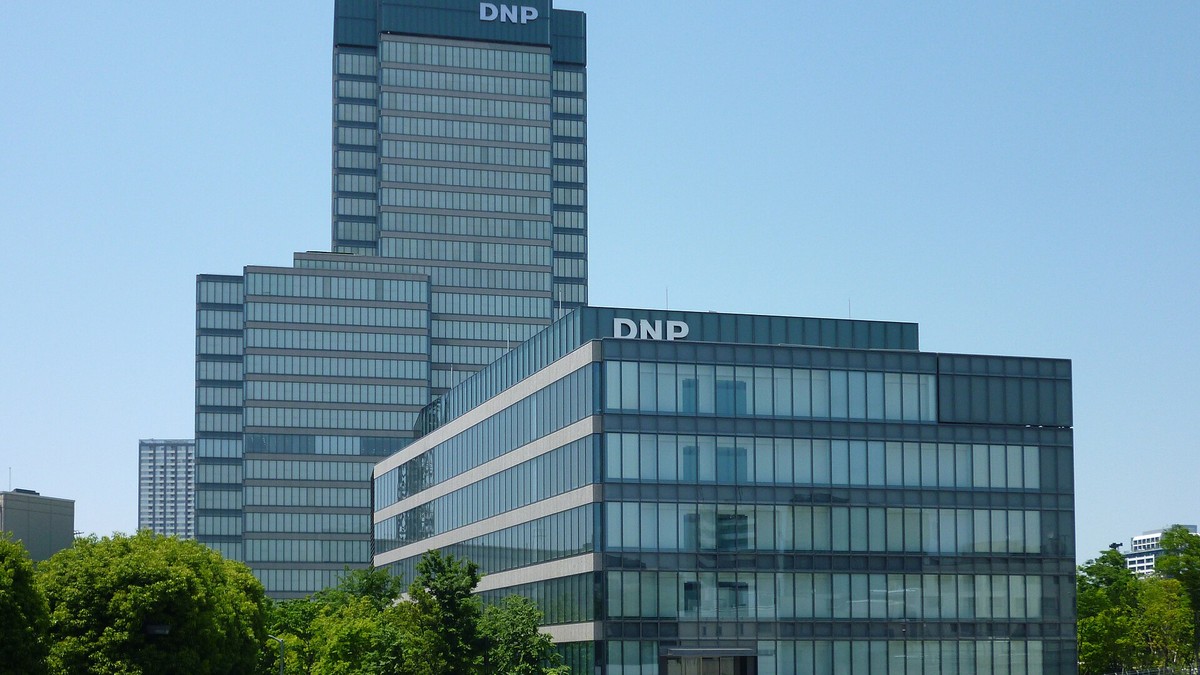
DNP's headquarters in Ichigaya, Shinjuku, Tokyo, in May 2018. The building in front is the DNP Ichigaya Takajomachi Building; the tower behind it is the Ichigaya Kagacho Building, where the headquarters is located. Photo: EXECUTOR, [CC0 public domain](https://creativecommons.org/publicdomain/zero/1.0/), [original image](https://commons.wikimedia.org/wiki/File:The_headquarters_of_DNP.jpg). Cropped to 16:9 by this site.
While researching sticker photo booths, ID photos, photo printing, and Japan's semiconductor industry, I often end up encountering the same name: DNP. This article takes a detailed look at the company, using figures drawn entirely from DNP's securities reports, integrated reports, medium-term management plans, and press releases. It answers five questions:
- How did DNP grow from a printing plant into the company it is today?
- What does it make money from now, and how much profit does each of its three segments generate?
- Why does it appear in seemingly unrelated industries such as sticker photo booths, semiconductors, smartphone screens, batteries, and bookstores?
- How does it differ from TOPPAN, Japan's other major printing company, and what is its relationship with Citizen, which also makes photo printers?
- What are its connections to Taiwan?
## Who is DNP? 150 years, from letterpress printing to photomasks
DNP's predecessor was 秀英舎, a letterpress printing company founded in Ginza, Tokyo, on October 9, 1876. In 1886, it established its first factory in Ichigaya Kagacho, then part of Ushigome Ward. After the Great Kanto Earthquake destroyed its Ginza head office by fire in 1923, the headquarters moved to Ichigaya, where it remains today (DNP's official history). In February 1935, 秀英舎 merged with 日清印刷 and changed its name to 大日本印刷. It listed on the Tokyo Stock Exchange in May 1949. The official history devotes only one line to the 1935 merger; I could find no details about why it happened or the merger ratio.

市谷の杜 本と活字館 in October 2025. Known as the “clock tower,” this building was originally a symbol of DNP's Ichigaya factory and was completed in 1926. DNP restored it to its original appearance and opened it as a cultural facility dedicated to letterpress printing in November 2020. Its official introduction describes letterpress printing as the origin of all of 大日本印刷's businesses (市谷の杜 本と活字館). Photo: Vetalapancavimsatika, [CC BY-SA 4.0](https://creativecommons.org/licenses/by-sa/4.0/), [original image](https://commons.wikimedia.org/wiki/File:%E5%B8%82%E8%B0%B7%E3%81%AE%E6%9D%9C_%E6%9C%AC%E3%81%A8%E6%B4%BB%E5%AD%97%E9%A4%A8_202510.jpg). Resized by this site.
After the war, DNP began applying printing technology to materials other than paper. Its official history identifies several turning points:
| Year | What DNP began doing | What it developed into |
|---|---|---|
| 1950 | Began printing paperboard boxes at its Kyoto factory | Packaging materials |
| 1958 | Successfully prototyped shadow masks for color televisions | Electronic components |
| 1959 | Printed packaging bags for チキンラーメン | Food packaging |
| 1961 | Began manufacturing photomasks | Semiconductor photomasks |
| 1973 | Established mass production of plastic cards with magnetic stripes | Cards |
| 1983 | Developed a rewritable IC card, described officially as the prototype for IC cards | IC cards |
| 1985 | Began producing dye-sublimation thermal recording materials; developed LCD color filter technology in the same year | Photo printing materials and displays |
| 1999 | Commercialized lithium-ion battery pouches | Battery materials |
| 2001 | Began developing deposition masks, or metal masks, for manufacturing organic EL panels | OLED panel materials |
| 2006 | Took over コニカミノルタ's ID photo business | Ki-Re-i ID photo booths |
| 2008–2010 | 丸善, 図書館流通センター, and ジュンク堂書店 became subsidiaries in succession | Bookstores and libraries |
The table shows how DNP expanded: each time, it used the same underlying technologies to make something new. Shadow masks and photomasks involve etching precise holes and circuit patterns into metal or glass; dye-sublimation photo materials and battery pouch films involve applying precise coatings to thin films. In its 2026 integrated report, DNP describes itself as combining four technologies—information processing, microfabrication, precision coating, and post-processing—to create products with the world's largest market shares (DNP Integrated Report 2026).
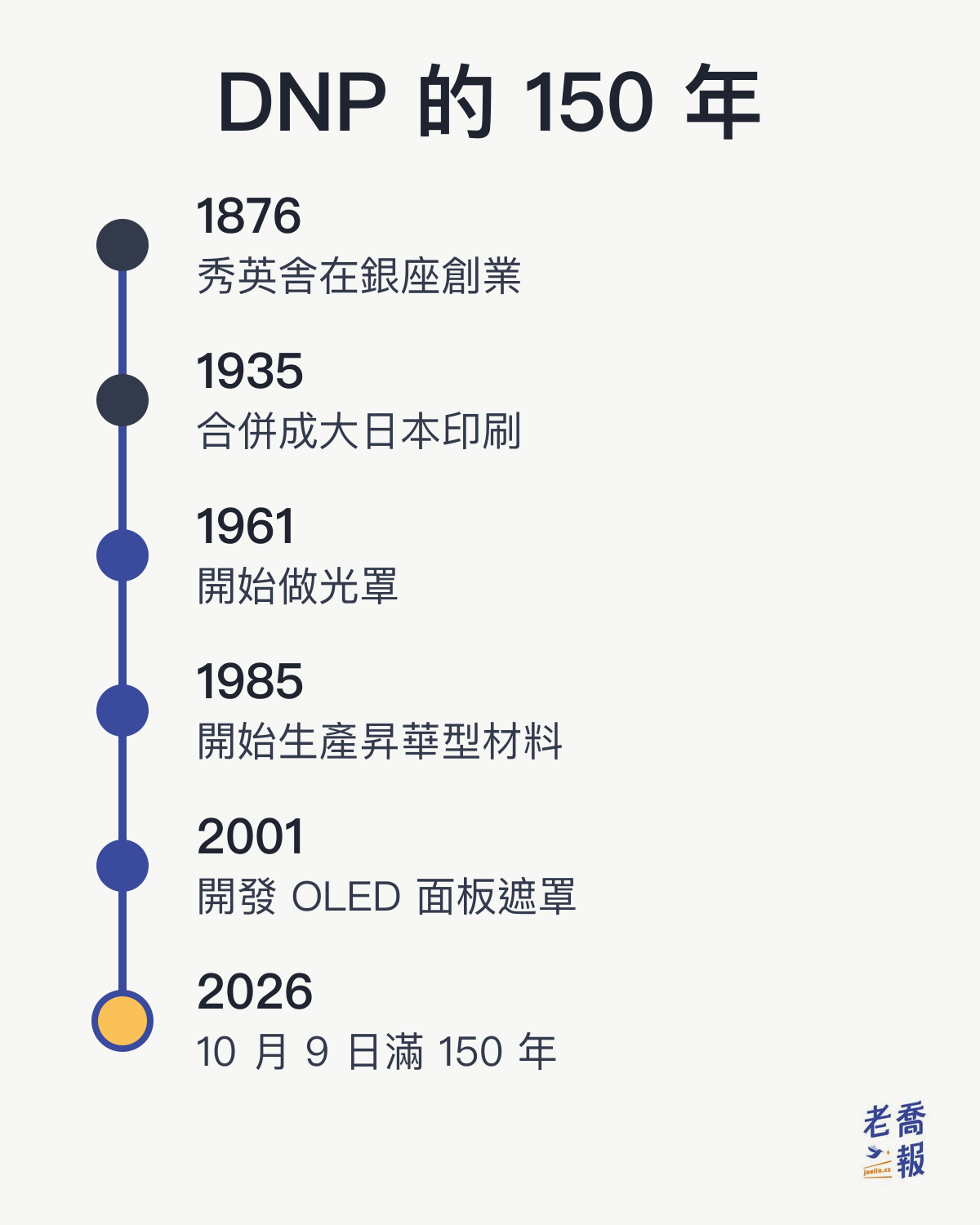
To mark its 150th anniversary, DNP scheduled a special exhibition at DNP プラザ in Ichigaya, Tokyo, from September 29, 2026, through January 23, 2027, with free admission (DNP press release, September 24, 2026).
## How it makes money: revenue rose just 7% over ten years, while operating profit grew to 3.2 times its earlier level
First, consider its scale. DNP's consolidated figures for the fiscal year ended March 2026, covering April 2025 through March 2026, were as follows (132nd-period securities report):
- Revenue: ¥1.5126 trillion.
- Operating profit: ¥101 billion.
- Net income attributable to the parent company: ¥104 billion.
- Consolidated employees: 36,360.
Now consider the ten-year trend. The data series in DNP's data book shows revenue of ¥1.4102 trillion and operating profit of ¥31.4 billion for the fiscal year ended March 2017. By the fiscal year ended March 2026, revenue had increased by only about 7%, while operating profit was roughly 3.2 times its earlier level. These are this site's calculations using the official data series (DNP Data Book 2026).
To understand why revenue barely grew while profit more than tripled, we need to look at the three segments, using the classification introduced in April 2024. Their activities are:
- Smart Communication: publishing and commercial printing, IC cards, payments and authentication, business process outsourcing (BPO), dye-sublimation photo materials and printers, ID photo booths, bookstores, and libraries.
- Life & Healthcare: packaging for food and everyday goods, battery pouches, building materials, pharmaceutical contract manufacturing, and beverages.
- Electronics: display optical films, OLED deposition masks, semiconductor photomasks, and lead frames.
| Segment | Revenue, fiscal year ended March 2026 | Segment profit | Profit margin |
|---|---|---|---|
| Smart Communication | ¥750.4 billion | ¥40 billion | 5.3% |
| Life & Healthcare | ¥512.3 billion | ¥37.3 billion | 7.3% |
| Electronics | ¥251.8 billion | ¥50.7 billion | 20.1% |
The key point is that Electronics accounts for only about 17% of the three segments' combined revenue, but about 40% of their combined profit. These shares are this site's calculations using the securities report; segment revenue includes intersegment transactions, and the profit margins were also calculated by this site. Familiar products such as ID photos, photo paper, and bookstores fall within Smart Communication, the segment with the largest revenue and lowest margin. The products sustaining profits are the photomasks, panel masks, and optical films that most people never see.
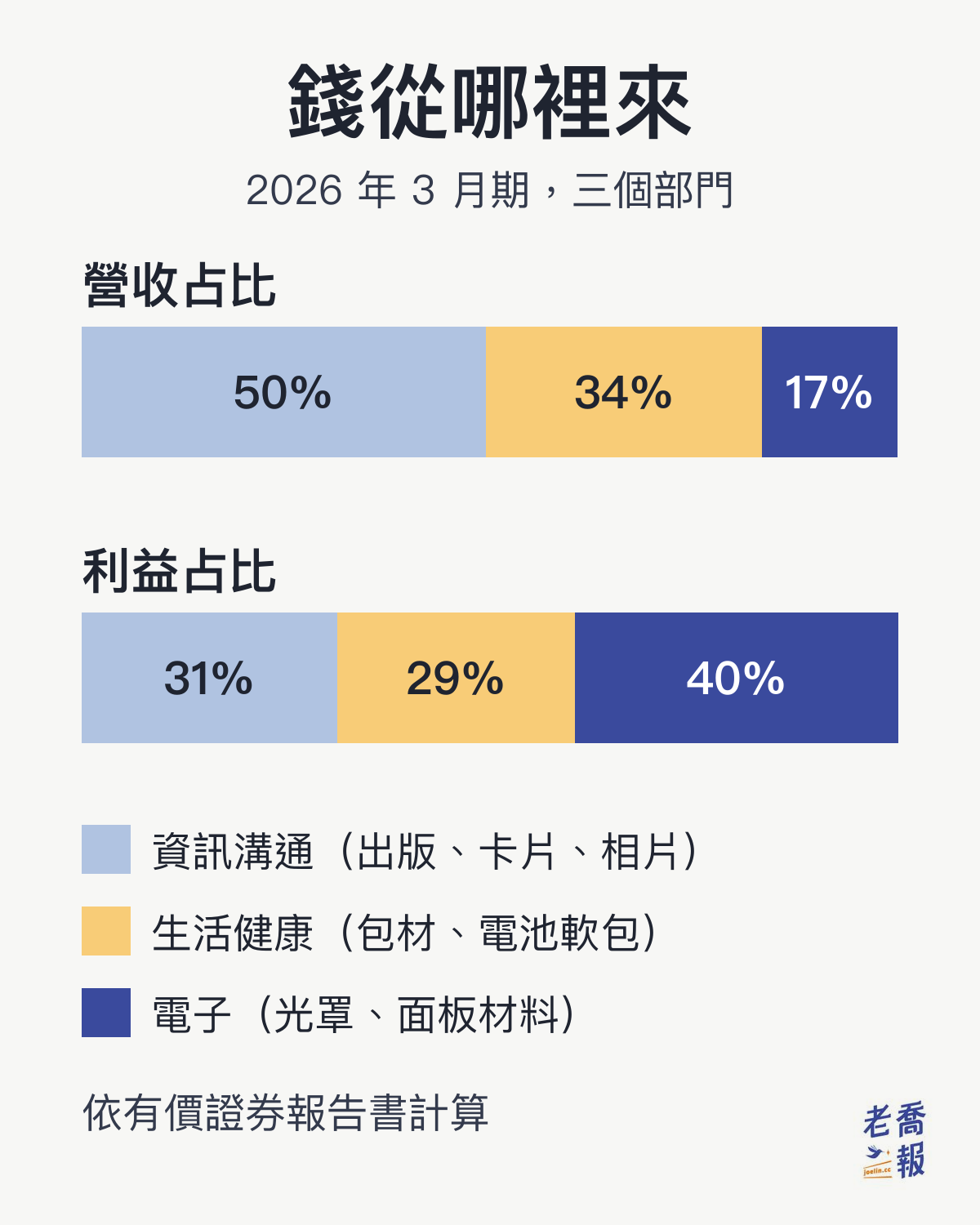
Electronics does not grow every year, either. Its operating profit fell 11.6% year over year in the fiscal year ended March 2026. The securities report attributes the decline to exchange rates and increased fixed costs from investment in photomask equipment and development.
DNP also uses a separate classification of “focus businesses,” selecting six priorities across the three segments and setting revenue targets for fiscal 2028 (Integrated Report 2026):
| Focus business | Fiscal 2022 | Fiscal 2025 | Fiscal 2028 target |
|---|---|---|---|
| Information Security, including IC cards and BPO | ¥172 billion | ¥187 billion | ¥271 billion |
| Digital Interface, including optical films and OLED masks | ¥138 billion | ¥185 billion | ¥214 billion |
| Photo Imaging, including dye-sublimation photo materials | ¥59 billion | ¥83 billion | ¥92 billion |
| High-performance Industrial Materials, including battery pouches | ¥62 billion | ¥68 billion | ¥101 billion |
| Semiconductor-related businesses, including front-end processes such as photomasks | ¥66 billion | ¥67 billion | ¥110 billion |
| Mobility & Living | ¥13 billion | ¥16 billion | ¥20 billion |
The six focus businesses generated combined revenue of about ¥606 billion in fiscal 2025, approximately 40% of company-wide revenue. DNP's combined target for fiscal 2028 is ¥808 billion. The highest growth targets are in semiconductors, with a compound annual growth rate of about 18% from fiscal 2025 to fiscal 2028, and High-performance Industrial Materials, which includes battery pouches, at about 14%.
## Where you may have encountered DNP: seven industries
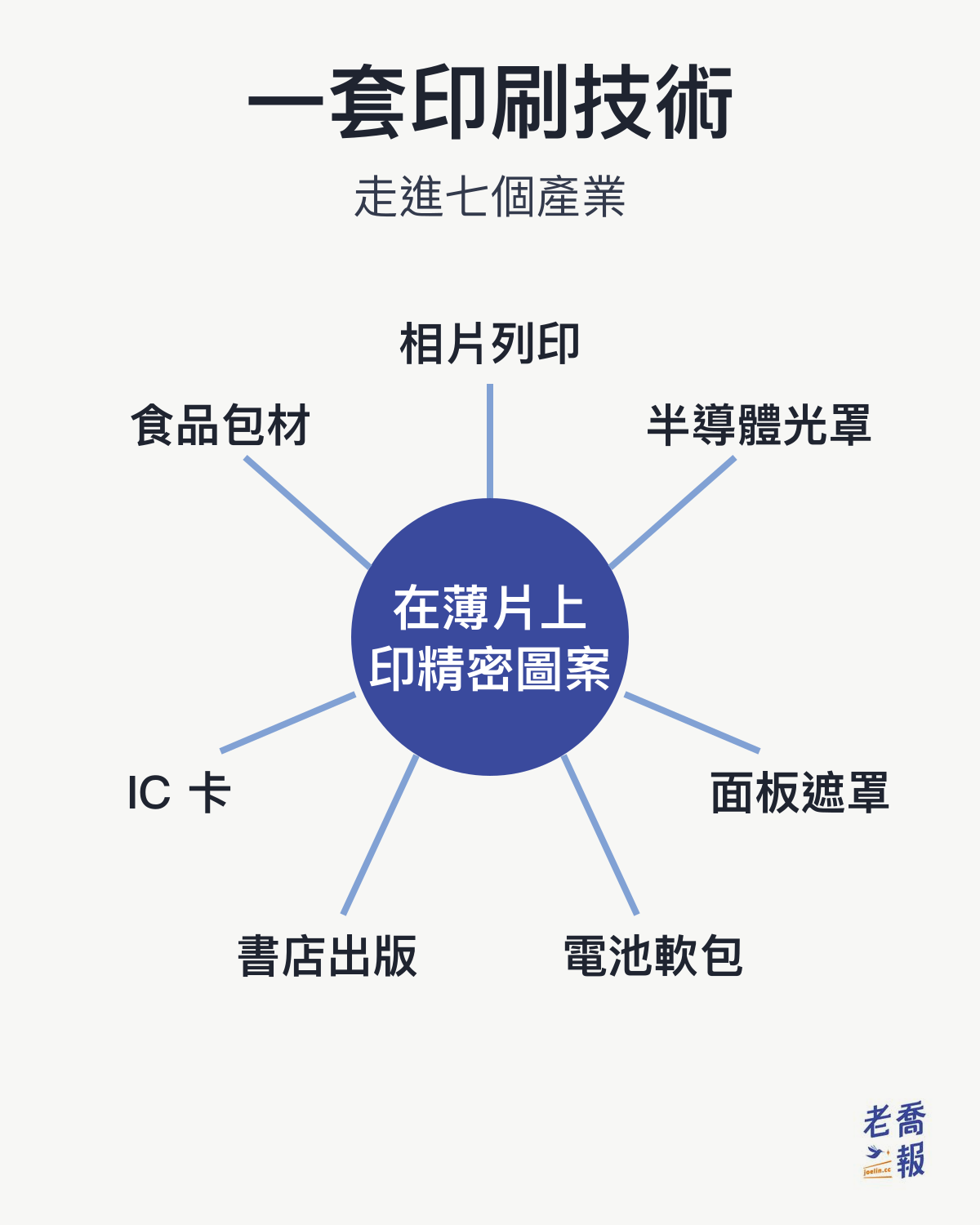
First, a word about “world number one.” In its integrated reports and on its website, DNP claims the world's largest market share—the original wording is “世界トップシェア”—in four products: dye-sublimation thermal transfer recording materials for photography, deposition masks for manufacturing organic EL panels, lithium-ion battery pouches, and anti-reflection and anti-glare films for display surfaces (DNP's “Products and Services with Leading Market Shares”). These are DNP's own claims. Its official materials provide neither market-share percentages nor the identity of the organization that conducted the research. For semiconductor photomasks, DNP uses more cautious wording: “外販用フォトマスクでトップレベルのシェア,” meaning a leading share of the market for photomasks sold to external customers, rather than the world's largest share. Its claim for IC cards concerns the largest share in Japan's domestic market.
### Photos, sticker photo booths, and ID photos: DNP's business closest to everyday consumers
The printers producing photos inside sticker photo booths, ID photo booths, and event photo booths are usually dye-sublimation printers. They use heat to transfer dye from a ribbon onto photo paper. DNP began producing these materials in 1985. Its official statement is that it “maintains the world's largest market share in photo printing using thermal transfer technology.” DNP's IR Day 2026 presentation states that approximately 400,000 DNP printers operate worldwide and annual photo paper shipments are equivalent to about 5 billion 4 × 6-inch prints (DNP IR Day 2026).
DNP expanded in this field through a series of acquisitions. Its integrated report lists three: taking over the コニカミノルタ group's photo business in 2006, taking over Sony's digital photo printer business in 2011, and acquiring the United States' Colorvision International and Belgium's Sharingbox in 2020 (DNP Integrated Report 2025). The コニカミノルタ transaction brought it Ki-Re-i, the ID photo booths seen on Japanese streets today; see this site's [article on Japan's Ki-Re-i ID photo booths](/p/9843). The Sony transaction also connects to Japan's sticker photo booth history: Japan's first sticker photo booth, プリント倶楽部, used a Sony printer in 1995; see [Thirty Years of Japanese Sticker Photo Booths](/p/9821). Sony's photo printer business then transferred to DNP in 2011.
DNP also appears in South Korean photo booth shops. In December 2022, at a self-service photo shop called Photo Slate in Seoul, I photographed two printers through the booth's glass. Their nameplates read PRIMERA and DNP; see [Inside a Photo Slate Booth](/p/9627) and [Thirty Years of Korean Photo Booths](/p/9638). This shows that a core component of Korean-style photo booths is a commercially available photo printer. However, most individual brands do not disclose which manufacturer's printers they use. I could find no official explanation identifying the printer suppliers for Japan's FURYU or South Korea's 人生四格.
DNP continues to introduce new machines. On September 16, 2026, it announced the DP-RX2 dye-sublimation photo printer, with overseas sales scheduled to begin in stages from January 2027. The new feature is the ability to print on sticker photo paper. The press release explicitly describes its purpose as producing “プリントシール風,” or sticker photo booth-style photos, event souvenir photos, and photos for fans of celebrities and performers. It can print up to 290 4 × 6-inch photos per hour. DNP targets cumulative sales of 100,000 units by fiscal 2029 and 240,000 units by fiscal 2033 (DNP press release, September 16, 2026).
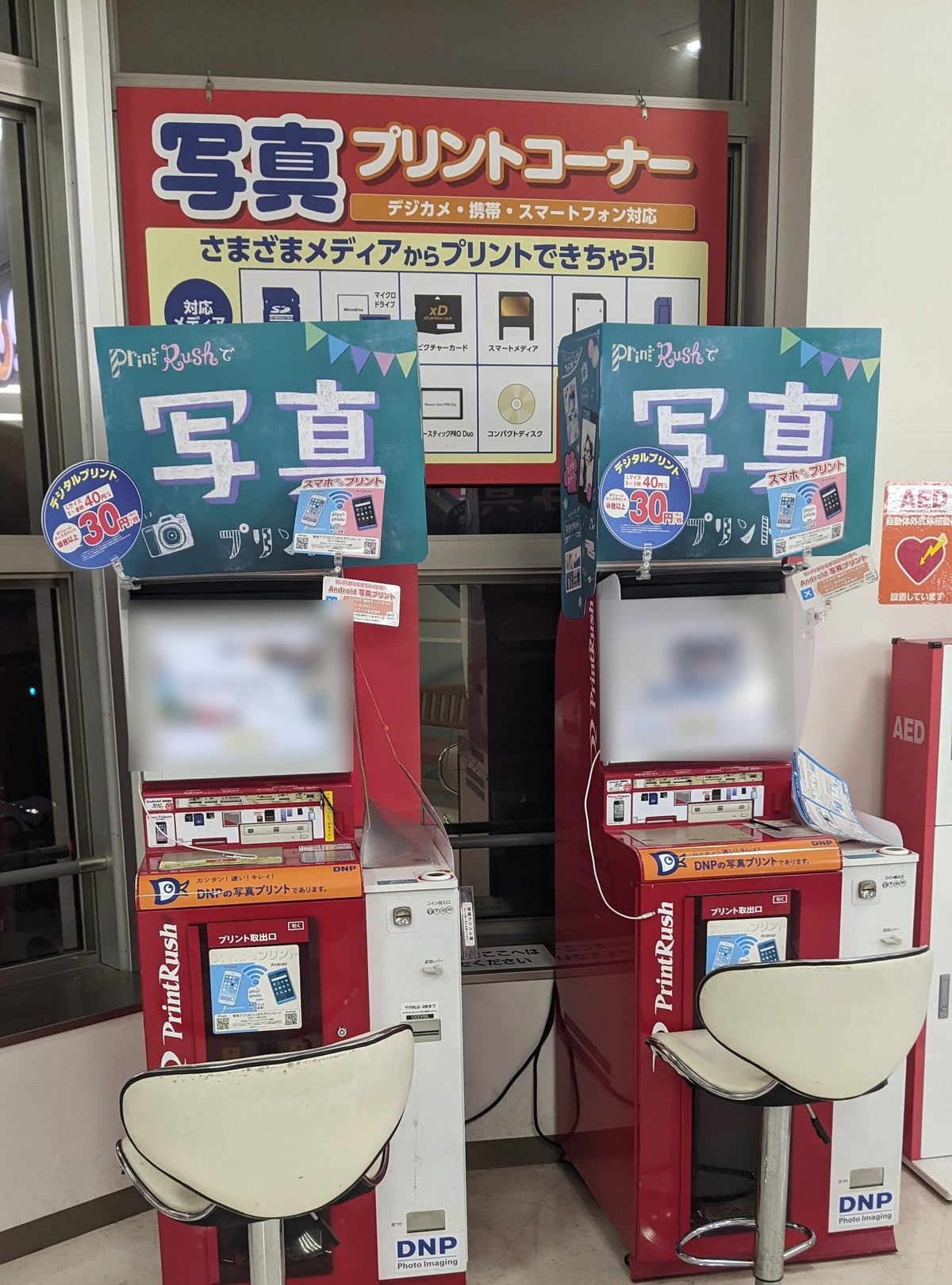
DNP PrintRush self-service photo printing kiosks in an electronics retailer in Kyobashi, Osaka, in February 2023. From photo paper, ribbons, and printers to in-store printing kiosks and ID photo booths, DNP has a presence at every level of the photo printing business. Photo: Mr.ちゅらさん, [CC BY-SA 4.0](https://creativecommons.org/licenses/by-sa/4.0/), [original image](https://commons.wikimedia.org/wiki/File:DNP_Photo_Printer_Station.jpg). Cropped by this site, with the screens blurred.
In Taiwan, DNP's photo printers are distributed by 宗橋企業. The distributor's website claims more than 2,000 installed units in Taiwan and lists applications including self-service sticker photo booths and ID photos (宗橋企業). This is the distributor's claim; DNP itself has not published a Taiwan installation count. The 立可得 photo kiosks in Taiwanese convenience stores are a separate operation, using printers made by Taiwan's HiTi 誠研; see [A Complete Guide to Photo Printing Channels in Taiwan](/p/9786).
### Another Japanese photo printer manufacturer: Citizen
The watch company Citizen (シチズン) also makes dye-sublimation photo printers in Japan. Its photo printers are operated by シチズン・システムズ, a wholly owned subsidiary of シチズン時計. It entered this market with the CX series in 2007 (シチズン・システムズ history), roughly 20 years after DNP began producing dye-sublimation materials in 1985. Its Japanese website currently lists six models. Officially listed uses include ID photos, souvenir photos for events and tourist attractions, self-service printing kiosks, and photography studios. The application fields on its product pages also include “写真シール,” or photo stickers (Citizen's official photo printer website).
The two companies emphasize different things in their public statements. DNP's claim to the world's largest market share concerns “recording materials”—consumables such as ribbons and photo paper—alongside its own printers and ID photo booths. Citizen's official materials focus on the printers themselves. It makes no market-share claim for photo printers, and its parent company's financial reports do not disclose photo printer revenue separately.
There is one relationship between them that can be established from official documents. シチズン時計's securities report lists a holding of 223,000 shares in 大日本印刷. It says the purpose is to facilitate business in its “Device Business,” the segment that includes photo printers, and notes that DNP also holds shares in シチズン (シチズン時計's 141st-period securities report). Neither company's official documents identify who manufactures the ribbons and photo paper used in Citizen printers, so this article does not speculate.
Two other major Japanese companies have participated in the same market. 三菱電機 has discontinued all of its photo printers, with the final models discontinued in 2021 and repair support continuing through March 2029 (三菱電機's list of discontinued models). 富士フイルム's official website still lists the dye-sublimation ASK-400 (富士フイルム photo printers). Sony transferred its business to DNP in 2011.
Citizen's six models, their officially stated applications, its revenue disclosure scope, and its Taiwan presence are covered separately in this site's [article on Citizen (シチズン) photo printers](/p/9854).
### Semiconductors: photomasks, nanoimprint lithography, and Rapidus
A photomask is the master pattern used to expose circuit designs onto a wafer during semiconductor manufacturing. DNP began making photomasks in 1961 and began producing hard photomasks for semiconductors in 1967. In the market for photomasks sold to external customers, DNP claims a leading market share.
Three aspects of DNP's involvement in Japan's next-generation chips can be confirmed:
- In March 2024, DNP joined the NEDO “Post-5G” research and development program involving Rapidus as a subcontractor, developing EUV photomask processes for the 2 nm generation (DNP, March 27, 2024). Its IR Day 2026 presentation states that the commissioned work was completed as planned in March 2026, with full-scale production of EUV photomasks scheduled for 2027.
- In February 2026, DNP participated in Rapidus's capital increase. The investment amount was not disclosed (DNP, February 27, 2026).
- DNP works with Canon and 鎧俠 on nanoimprint lithography. Canon supplies the equipment, 鎧俠 handles semiconductor processes, and DNP makes the imprint templates (DNP news). For more on 鎧俠, see this site's [What Is 鎧俠?](/p/100135).
In its medium-term plan for fiscal 2026 through fiscal 2028, DNP raised planned photomask investment from ¥30 billion to ¥70 billion, according to IR Day 2026. It also has a photomask factory in Taiwan: Photronics DNP Mask Corporation, a joint venture with the United States' Photronics in Hsinchu Science Park. DNP holds 49.9%, according to its securities report. Photronics's 2014 announcement states that the joint venture serves Taiwan's semiconductor manufacturers (Photronics's 2014 announcement). Neither company has disclosed the specific customers.
### Smartphone and television screens: OLED panel masks and optical films
OLED panel manufacturing involves depositing light-emitting materials onto a substrate in tiny, precise locations through vapor deposition. The thin metal sheet that sits in front during deposition and determines each pixel's position is the deposition mask. The industry often calls it an FMM; DNP's official wording is “metal masks for manufacturing organic EL displays.” DNP began development in 2001 and says it has participated since the early days of OLED. It now claims the world's largest market share, with smartphones as the main application. In May 2024, it opened a production line at its Kurosaki factory in Fukuoka for Generation 8 large substrates (DNP's 2024 press release). DNP has never named the panel manufacturers that are its customers.
Another product is optical film applied to screen surfaces. DNP claims the world's largest market share in anti-reflection and anti-glare films. This “world number one” claim is limited to those two types of film.
### Batteries: pouches for electric vehicle and smartphone batteries
Lithium-ion batteries come in three casing formats: cylindrical, prismatic, and pouch. The aluminum-plastic composite film around a pouch cell is what DNP calls a battery pouch. DNP commercialized it in 1999 and claims the world's largest market share in battery pouches for vehicles and high-end IT products. In February 2025, it also acquired レゾナック・パッケージング, now DNP 高機能マテリアル彦根, adding applications for energy storage batteries, according to its Integrated Report 2025. A chart in DNP's integrated report lists many pouch battery factories, but it is a market map; DNP does not say they are all its customers.
### Bookstores and publishing: 丸善, ジュンク堂, and 図書館流通センター
DNP's original business was printing books, and it later came to own bookstores as well. It is the largest shareholder of the listed company 丸善CHIホールディングス. According to 丸善CHI's shareholder register, DNP holds 54.92% (丸善CHI shareholder information). DNP's securities report gives its voting-rights share as 55.0%; the two figures use different measures. 丸善CHI's subsidiaries include the bookstore company 丸善ジュンク堂書店, 図書館流通センター (TRC), which operates and supports libraries, and 丸善出版.
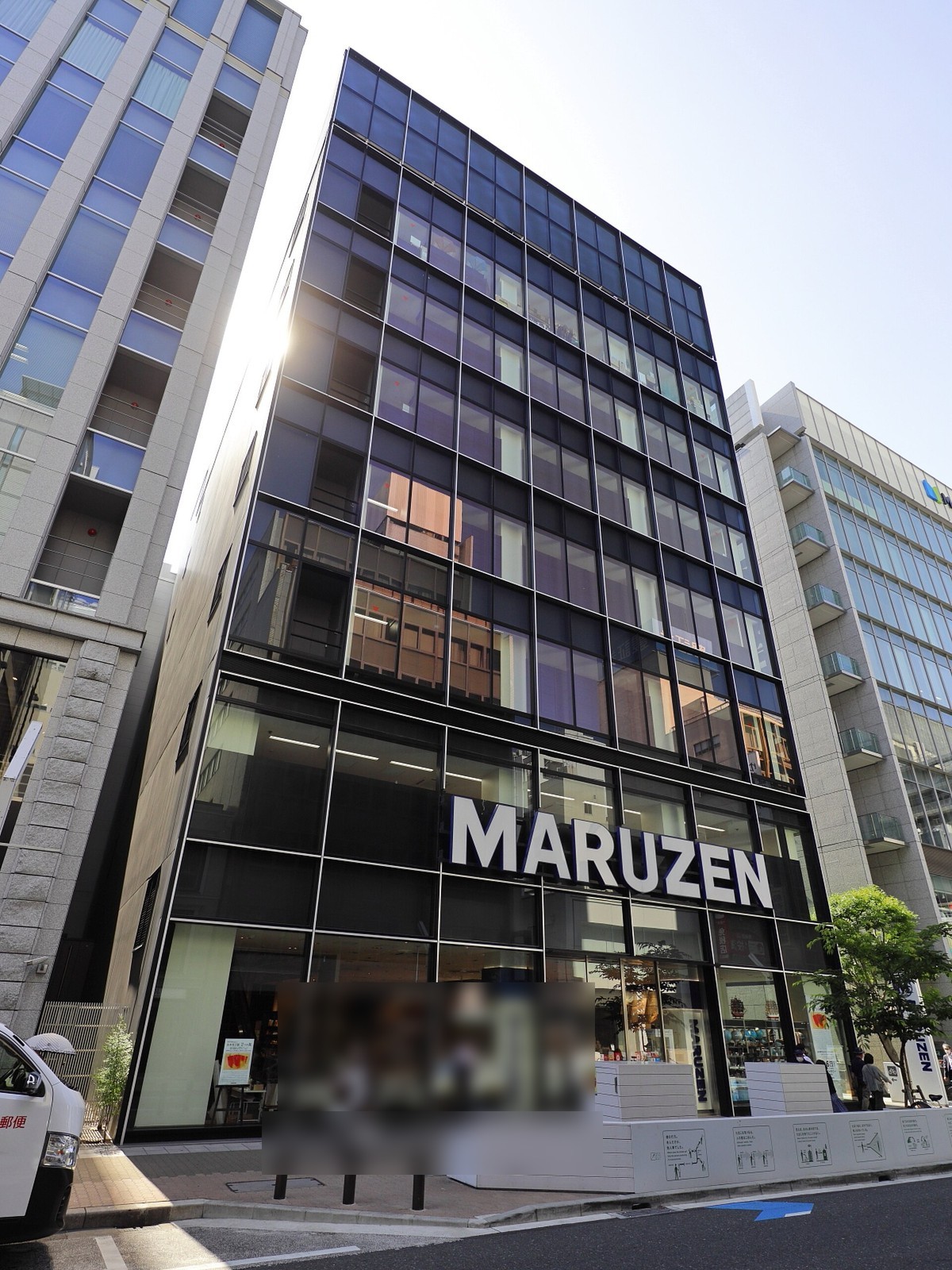
The 丸善 Nagoya flagship store in June 2022. 丸善 is one of the bookstore brands under 丸善CHI, in which DNP holds a majority stake. Photo: Tomio344456, [CC BY-SA 4.0](https://creativecommons.org/licenses/by-sa/4.0/), [original image](https://commons.wikimedia.org/wiki/File:MARUZEN_Nagoya_Head_Office,_Sakae_Naka_Ward_Nagoya_2022.jpg). Resized by this site, with pedestrians blurred.
Publication printing itself is a business DNP is scaling back. Its IR Day 2026 presentation identifies publication printing and commercial printing as targets for “structural reform.” The same presentation identifies content businesses based on Japanese anime, manga, and game intellectual property as areas with growth potential.
### Identity documents, cards, and payments: from IC cards to Austria's AUSTRIACARD
DNP developed a prototype rewritable IC card in 1983 and now claims the largest share of Japan's domestic IC card market. It is also one of four operators listed by the Japanese government as allowing people to apply directly for a My Number Card through an ID photo booth: it operates Ki-Re-i ID photo booths (My Number Card official information website).
In 2026, it pursued a major acquisition in this business. On May 13, DNP announced a tender offer for Austria's listed AUSTRIACARD HOLDINGS, which is listed in Vienna and Athens and produces payment cards, government identity documents, and security printing. The offer price was €10 per share, with an equity value of approximately ¥67.7 billion. The offer period ended on August 21, with approximately 96.55% of shares tendered, exceeding the 75% threshold (DNP announcement, August 26, 2026). As of August 25, DNP was still awaiting Austrian foreign investment approval; the acquisition would become effective only after that approval. When I checked DNP's news list on September 25, 2026, there was still no announcement that the acquisition had been completed. Separately, in 2025, DNP made Rubicon, which operates under the Laxton brand and focuses on government identity document businesses in Africa, a subsidiary.
### Packaging and beverages: from チキンラーメン bags to PET bottle production lines
DNP began printing packaging bags for チキンラーメン in 1959, and packaging remains one of its major businesses. It claims Japan's largest domestic market share in aseptic PET bottle filling systems. According to the company, about half of Japan's PET-bottled beverages are produced using these systems (DNP's “Products and Services with Leading Market Shares”). DNP even owns a beverage company: 北海道コカ・コーラボトリング, in which it holds 57.0% of voting rights, according to the securities report.
## DNP and TOPPAN: comparing two printing companies
DNP is often compared with its industry peer TOPPAN. Before October 2023, the company was called 凸版印刷; after adopting a holding-company structure, it became TOPPANホールディングス. Their histories are remarkably similar. TOPPAN was founded in 1900, 24 years after DNP, yet both listed on the Tokyo Stock Exchange in May 1949, both began making photomasks in 1961, and both developed IC cards in 1983 (TOPPAN's history and securities report; for DNP, see the official history cited above). The table below compares their consolidated figures for the fiscal year ended March 2026:
| Item | DNP | TOPPAN |
|---|---|---|
| Founded | 1876, as 秀英舎 | 1900, as 凸版印刷合資会社 |
| Revenue | ¥1.5126 trillion | ¥1.805 trillion |
| Operating profit | ¥101 billion | ¥67.1 billion |
| Operating margin | 6.7% | 3.7% |
| Consolidated employees | 36,360 | 54,371 |
| Ten-year change, fiscal year ended March 2017 → fiscal year ended March 2026 | Revenue +7%; operating profit approximately 3.2 times its earlier level | Revenue +26%; operating profit approximately 1.3 times its earlier level |
| Reportable segments | Three, including Electronics | Three, including Electronics |
| Products for which it claims the world's largest market share | Dye-sublimation photo materials, OLED deposition masks, battery pouches, and anti-reflection and anti-glare films | GL BARRIER transparent vapor-deposited barrier film |
TOPPAN's figures come from its securities report and earnings summary (TOPPAN's 180th-period securities report, earnings summary for the fiscal year ended March 2017). Profit margins and ten-year changes were calculated by this site. Both companies' “world's largest market share” statements are their own claims. TOPPAN's original wording describes a “transparent vapor-deposited barrier film with the world's number-one market share” (TOPPAN GL BARRIER product page).
The table shows that TOPPAN has about 20% more revenue and 50% more employees than DNP, but only around two-thirds of DNP's operating profit. Over ten years, TOPPAN has pursued revenue expansion—it also acquired the United States' SONOCO flexible packaging and thermoformed container businesses in April 2025—while DNP has raised its profit margin with little change in revenue.
Photomasks are where the companies' paths diverge most sharply. In 2022, TOPPAN spun its photomask business into a subsidiary and brought in the investment fund インテグラル. That company was later renamed テクセンドフォトマスク and listed on the Tokyo Stock Exchange on October 16, 2025. TOPPAN's ownership fell to 46.6%, and the company was no longer consolidated into TOPPAN's financial statements, according to TOPPAN's 180th-period securities report. DNP, by contrast, retained its photomask business and increased planned photomask investment for fiscal 2026 through fiscal 2028 from ¥30 billion to ¥70 billion. Consequently, the two companies' Electronics segment figures for the fiscal year ended March 2026 cannot be compared directly: TOPPAN's segment included only the first half-year of the photomask business.
## Shareholders and management: after the price-to-book ratio fell below 1
In February 2023, DNP set out targets in its management policy: ROE of 10% and a price-to-book ratio (PBR) above 1.0 as soon as possible (DNP, February 9, 2023). It then established a share repurchase plan of about ¥300 billion over the following three years and sold approximately ¥220 billion in strategic shareholdings, or cross-shareholdings. According to DNP's May 2026 medium-term plan presentation, operating profit and ROE exceeded the plan in each year from fiscal 2023 through fiscal 2025. Its PBR rose from 0.9 at the end of March 2023 to 1.1 at the end of March 2026 (DNP medium-term management plan presentation).
During the same period, the US activist investor Elliott appeared on DNP's shareholder register. Only two points can be confirmed from official documents:
- The major shareholder tables in DNP's securities reports show that ELLIOTT INTERNATIONAL LP held 6,477,000 shares, or 2.48%, at the end of March 2023. At the end of March 2024, it held the same number of shares, representing 2.70%. It no longer appeared among the top ten shareholders at the end of September 2024.
- In the Q&A for its November 2024 earnings briefing, DNP said its measures were being implemented according to its own plans, rather than in response to activist investor demands. It said Elliott had welcomed the medium-term plan when it was announced and confirmed that Elliott's holdings had fallen to almost nothing on the shareholder register (DNP's 2024 earnings briefing Q&A).
Official documents do not confirm the ownership percentages and investment amounts attributed to Elliott in media reports, so this article does not use them.
The new medium-term management plan announced in May 2026, covering fiscal 2026 through fiscal 2028, sets the following targets: operating profit of ¥130 billion in fiscal 2028, exceeding the historical peak of ¥120.6 billion in fiscal 2005; ROE of 9.0%; and operating profit of at least ¥150 billion and ROE of 10% in fiscal 2031. For shareholder returns, DNP adopted a progressive dividend policy with a floor of ¥40 per share and no reductions, along with at least ¥80 billion in total share repurchases across fiscal 2026 and fiscal 2027.
## DNP and Taiwan
Official documents establish three connections between DNP and Taiwan:
- DNP has a wholly owned subsidiary in Taipei, DNP Taiwan, whose activities include selling electronic component materials, according to the securities report.
- DNP owns 49.9% of Photronics DNP Mask Corporation, the photomask joint venture in Hsinchu Science Park. DNP's IR Day 2026 presentation says its partnership with Photronics serves the Taiwanese and Chinese markets and has lasted more than ten years.
- DNP's photo printers are distributed in Taiwan by 宗橋企業.
DNP discloses revenue only at the “Asia” level: ¥258.3 billion for the fiscal year ended March 2026, including China, South Korea, Taiwan, Indonesia, and other markets. It does not officially disclose Taiwan-specific revenue or customer names.
## Why all these industries connect to DNP
Returning to the opening question: why does a printing company appear in sticker photo booths, chips, smartphone screens, batteries, and bookstores at the same time? The answer lies in DNP's own description of its 150-year history: letterpress printing is the origin of all its businesses. Printing is fundamentally about placing a pattern precisely on a thin sheet. DNP has taken that ability from paper to photo paper, glass, thin metal sheets, and aluminum-plastic film. Each new sheet material has opened up another industry.
This also explains its current profit structure. The familiar printing and photo businesses generate the most revenue but have the lowest margins; the photomasks and panel materials that ordinary consumers never see generate the least revenue but have the highest margins. For readers in Taiwan, the next time you collect a photo from a photo booth, take an ID photo in Japan, or replace your phone with one that has an OLED screen, the process may well involve the same 150-year-old Japanese printing company.
Related reading:
- [How to Use Japan's Ki-Re-i ID Photo Booths](/p/9843)—the story and operation of DNP's ID photo booth brand
- [An Overview of ID Photo Booths in Japan](/p/9846)—how Photo ME, Ki-Re-i, and ID VOX differ
- [Japan ID Photo Booth Map](https://photobooth.joelin.cc/japan/idphoto/)—locations of Ki-Re-i and other ID photo booths, organized by prefecture on the photo booth information site
- [Thirty Years of Japanese Sticker Photo Booths](/p/9821) and [FURYU's Transformation](/p/1918)—the history of Japan's sticker photo booth industry and its leading company
- [Thirty Years of Korean Photo Booths](/p/9638) and [A Report on the History of Taiwan's Photo Booth Industry](/p/5848)
- [ME Group, a Leading Photo Booth Operator in Europe and North America](/p/9822)—the parent company of Photo ME, another ID photo booth operator in Japan
- [What Is 鎧俠?](/p/100135)—the memory company working with DNP on nanoimprint lithography
- [Japan's Top 50 Companies by Market Capitalization](/p/100100)
- [An Introduction to Dye-sublimation Photo Booth Technology](https://photobooth.joelin.cc/guide/dye-sublimation-photobooth/) (photobooth.joelin.cc)
Sources: DNP's 132nd-period securities report, dated June 23, 2026; DNP Group Integrated Reports 2026 and 2025; DNP Data Book 2026; the fiscal 2025 earnings overview and fiscal 2026–2028 medium-term management plan presentation, dated May 13, 2026; the DNP Group IR Day 2026 presentation, dated July 13, 2026; DNP's official history and press releases; 丸善CHIホールディングス shareholder information; Photronics's 2014 announcement; Japan's official My Number Card information website; 宗橋企業's official website; TOPPANホールディングス's 180th-period securities report and history; シチズン時計's 141st-period securities report and シチズン・システムズ's official website; and the official websites of 三菱電機 and 富士フイルム. All were checked on September 25, 2026. Claims of “world-leading market share” and “domestic-leading market share” are the respective companies' own statements; their official materials do not publish market-share percentages or the underlying research.
The original Chinese article was published on September 25, 2026, and updated on October 2, 2026, to add the related-reading link to the Japan ID photo booth page on the photo booth information site. The research dates and market data above reflect the original snapshot.
## Image sources
The photographs come from openly licensed files on Wikimedia Commons. Photographers and licenses are also credited beneath each image. The three infographics were created by this site.
- Cover image: DNP's headquarters in Ichigaya, Tokyo, in May 2018, photographed by EXECUTOR, CC0. Cropped to 16:9 by this site. Original image: https://commons.wikimedia.org/wiki/File:The_headquarters_of_DNP.jpg
- “Who is DNP?” section: 市谷の杜 本と活字館 in October 2025, photographed by Vetalapancavimsatika, CC BY-SA 4.0. Original image: https://commons.wikimedia.org/wiki/File:%E5%B8%82%E8%B0%B7%E3%81%AE%E6%9D%9C_%E6%9C%AC%E3%81%A8%E6%B4%BB%E5%AD%97%E9%A4%A8_202510.jpg
- “Photos, sticker photo booths, and ID photos” section: DNP PrintRush photo printing kiosks in Kyobashi, Osaka, in February 2023, photographed by Mr.ちゅらさん, CC BY-SA 4.0. Cropped by this site, with the screens blurred. Original image: https://commons.wikimedia.org/wiki/File:DNP_Photo_Printer_Station.jpg
- “Bookstores and publishing” section: the 丸善 Nagoya flagship store in June 2022, photographed by Tomio344456, CC BY-SA 4.0. Pedestrians blurred by this site. Original image: https://commons.wikimedia.org/wiki/File:MARUZEN_Nagoya_Head_Office,_Sakae_Naka_Ward_Nagoya_2022.jpg
For CC BY-SA photographs modified by this site, the adaptations remain under the original license.
Article keywords: 大日本印刷, DNP, 7912, what is 大日本印刷, DNP's 150th anniversary, dye-sublimation thermal transfer, dye-sublimation photo paper, photomasks, organic EL metal masks, battery pouches, 丸善ジュンク堂, TOPPAN, Citizen photo printers, Ki-Re-i
## FAQ
### What kind of company is 大日本印刷 (DNP)?
DNP is a Japanese printing company founded in Ginza, Tokyo, in 1876. Its predecessor was 秀英舎, which merged and changed its name to 大日本印刷 in 1935. Its 150th anniversary fell on October 9, 2026. Today, beyond publishing and commercial printing, it produces photo printing materials, semiconductor photomasks, OLED panel masks, battery pouches, IC cards, and packaging materials. Revenue for the fiscal year ended March 2026 was approximately ¥1.51 trillion.
### Does DNP make the photo paper used in sticker photo booths and ID photo booths?
DNP claims the world's largest market share in dye-sublimation thermal transfer materials for photography, meaning ribbons and photo paper. Approximately 400,000 DNP printers operate worldwide, and Japan's Ki-Re-i ID photo booths also belong to DNP. However, most individual photo booth brands do not disclose which manufacturer's printers and photo paper they use. This site could find no official explanation for Japan's FURYU or South Korea's 人生四格.
### How do DNP and TOPPAN differ?
Both are major Japanese printing companies. Both went public in 1949 and began making photomasks in 1961. For the fiscal year ended March 2026, TOPPAN reported revenue of ¥1.805 trillion, about 20% more than DNP, and operating profit of ¥67.1 billion, approximately two-thirds of DNP's ¥101 billion. TOPPAN listed its photomask subsidiary separately in 2025, reducing its stake to 46.6%, while DNP continued increasing its photomask investment.
### What is the relationship between DNP and Citizen?
Both make dye-sublimation photo printers. Citizen's photo printer business is operated by シチズン・システムズ, which entered the market in 2007. DNP emphasizes consumables such as ribbons and photo paper, alongside its own printers. シチズン時計 holds 223,000 DNP shares, and DNP also holds shares in シチズン. Neither company's official materials identify who makes the photo paper for Citizen printers.
### What are DNP's connections to Taiwan?
DNP has a wholly owned subsidiary in Taipei, DNP Taiwan, and a photomask joint venture with the United States' Photronics in Hsinchu Science Park, in which DNP holds 49.9%. Its photo printers are distributed in Taiwan by 宗橋企業. DNP does not disclose Taiwan-specific revenue or customer names.
### What is DNP's main source of profit today?
For the fiscal year ended March 2026, Electronics—photomasks, OLED masks, and optical films—accounted for only about 17% of the three segments' combined revenue but about 40% of their combined profit, with a margin of 20.1%. The segment containing publishing, IC cards, and photo printing generated the most revenue, with a profit margin of 5.3%.
Sources: The Chinese original was first published on 2026-09-25 and last updated on 2026-10-02. Data and observations retain the historical dates and markets stated in the article.