---
title: 'China''s New Beef Grading Standard Takes Effect December 2026: Lean Type S1–S4, Fat Type F1–F4, and Why It Didn''t Copy the Marbling Axis'
url: https://joelin.cc/en/p/9800
source: https://joelin.cc/en/p/9800
lang: en
pubDate: '2026-10-28'
date_modified: '2026-10-28'
description: GB/T 29392-2026 (out May 25, in force Dec 1, 2026) splits beef into lean type S1–S4 and fat type F1–F4. Studies cite 80% or more of China's cattle as Simmental crosses; one marbling axis would fail most local beef.
schema_type: BlogPosting
author: joe
entity_ids:
author: https://me.joelin.cc/#joe
ai_role: ai_only
translation_assistant: caddy
ai_credit: 'AI-assisted translation and editing: Caddy (AI)'
faq:
- q: Does China actually have an official beef grading standard?
a: 'Yes, and it is not new. GB/T 29392 was first published in 2012 (then titled 普通肉牛上腦、眼肉、外脊、里脊等級劃分, a grading standard for chuck roll, ribeye, striploin and tenderloin from common beef cattle). It was revised in 2022 and renamed 畜禽肉質量分級 牛肉 (Quality grading of livestock and poultry meat: Beef), which is the version currently in force; the 2026 version was published on May 25, 2026 and takes effect on December 1. All three versions are GB/T recommended national standards with no legal force, and consumers barely see the grades today. The accurate statement is not that there is no standard, but that there is one that has not yet reached the shelf.'
- q: How are lean type S1–S4 and fat type F1–F4 told apart?
a: First, look at whether the cross-section of the longissimus dorsi (the ribeye muscle) has intramuscular fat visible to the naked eye. Beef without it is lean type on the S axis; beef with it is fat type on the F axis; beef that meets neither is classed as out-of-grade. Lean type is graded by cross-checking sex, physiological maturity, meat color and fat color, while fat type uses marbling as its main axis combined with the other three. The new version also lets producers choose which axis to use, based on the principle of maximizing value.
- q: Why doesn't China follow the US and Japan in making marbling the main axis?
a: Because its industry is structured differently. China's beef cattle were developed from draft-type local yellow cattle, and the research literature often cites that Simmental crossbreds make up 80% or more of the beef cattle industry. Local yellow cattle tolerate rough forage and have fine, tender meat, but they grow slowly and yield few high-value cuts. Copy a ruler with marbling as its only scale, and the bulk of locally supplied beef would sit permanently in the lower bands, a standard that fails its own country's product from the start. The two-track design amounts to admitting that lean beef can have grades too.
- q: If a recommended standard has no legal force, is it any use?
a: That depends on whether it gets adopted. The new version requires packaging to show the grade, stores to display the grade mark prominently, and online sellers to show it on the product detail page, but legally these are only things that should be done. Once supermarket chains, restaurant groups or e-commerce platforms write it into their purchasing specifications, suppliers have to comply, and at that point it turns from a recommendation into a ticket of entry. US grading is still a voluntary, fee-based service today, yet almost all fed cattle are graded, because without a grade they cannot capture the premium.
translation_of: /p/9800
---
# China's New Beef Grading Standard Takes Effect December 2026: Lean Type S1–S4, Fat Type F1–F4, and Why It Didn't Copy the Marbling Axis
## In one line: China's new national standard splits beef into two grading axes instead of copying marbling
GB/T 29392-2026, 畜禽肉質量分級 牛肉 (Quality grading of livestock and poultry meat: Beef), was published on May 25, 2026 and takes effect on December 1, 2026.
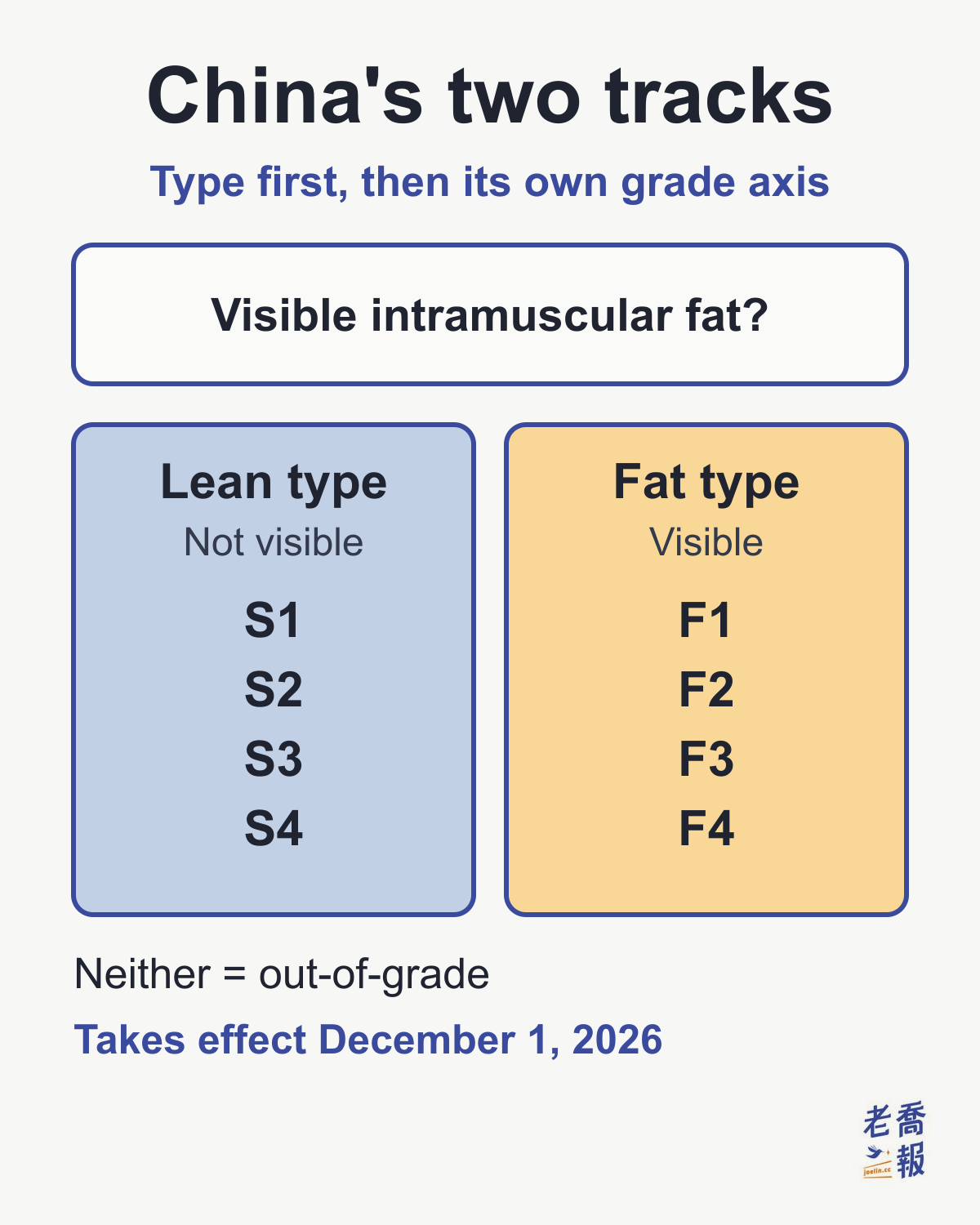
What deserves attention is not that it is yet another revision, but its design: beef is first sorted into two types, and each type has its own grading axis.
- Lean type (瘦肉型), where the cross-section of the longissimus dorsi shows no intramuscular fat visible to the naked eye: S1, S2, S3, S4.
- Fat type (脂肪型), where visible intramuscular fat is present: F1, F2, F3, F4.
- Beef that meets neither is classed as out-of-grade (等外級).
The mainstream rulers in the US, Japan and Australia all use marbling as their core scale. This Chinese version did not follow. This article covers why it didn't, and what it takes for a recommended standard to actually reach the shelf.
This is the China installment of [who sets beef grading standards](/en/p/9796).
## 1. Getting the versions straight: China has had a national standard for years
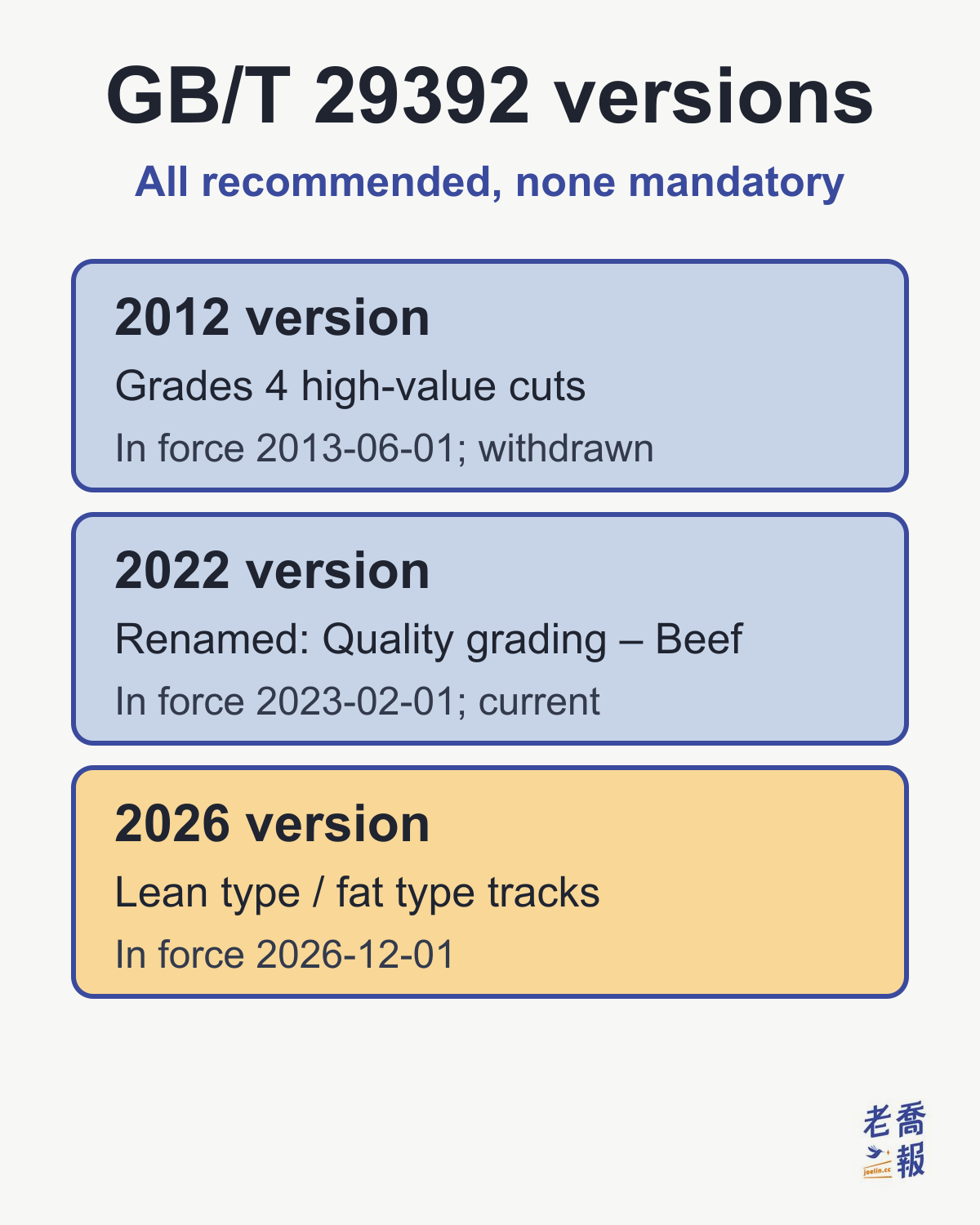
The line "China has no official beef grading" has circulated in Chinese-language content for a long time, but it is out of date.
| Version | Published
→ in force | Status |
| --- | --- | --- |
| GB/T 29392
-2012 | 2012-12-31 →
2013-06-01 | Withdrawn |
| GB/T 29392
-2022 | 2022-07-11 →
2023-02-01 | Current |
| GB/T 29392
-2026 | 2026-05-25 →
2026-12-01 | Upcoming |
The 2012 version was then titled 普通肉牛上腦、眼肉、外脊、里脊等級劃分 (grading of chuck roll, ribeye, striploin and tenderloin from common beef cattle) and covered only those four high-value cuts. The 2022 version was renamed 畜禽肉質量分級 牛肉, and the 2026 version keeps that name. All three are GB/T, meaning recommended national standards with no legal force. The responsible body is the national technical committee for slaughtering and processing standardization, and the supervising authority is the Ministry of Agriculture and Rural Affairs.
So the accurate statement is: China has official grading, but it is not mandatory, and consumers barely see it today. That is a different thing from "no standard", and section 5 explains why the distinction matters.
## 2. Four technical indicators, and one very specific assessment condition
The new version uses four indicators:
| Indicator | Scale | Notes |
| --- | --- | --- |
| Physiological maturity | Grades 1 to 5 | Judged by vertebral ossification or incisor changes; corresponds to 24 months or younger up to 72 months or older |
| Meat color | Grades 1 to 8 (light to dark) | Grades 4 and 5 are best |
| Fat color | Grades 1 to 8 (light to dark) | Grades 1 and 2 are best |
| Marbling | Grades 1 to 5 (low to high) | Read on the longissimus dorsi cross-section at the 6th–7th or 12th–13th rib; if the two differ, the 12th–13th rib governs |
Two things in this table are worth pausing on:
- For meat color, neither lighter nor darker is better; the two middle grades are best. That runs against the common instinct that beef should be bright red. Too light and too dark each point to different quality problems.
- Marbling has only 5 grades, far coarser than Japan's 12-step BMS, because in this ruler marbling is not the only star.
The assessment conditions are spelled out too: on a carcass that has passed inspection and quarantine, the designated site is cut and exposed to air for 30 minutes, then assessed under a light intensity of 660 lx. Fixing the observation conditions is what makes results from different plants and different graders comparable.
## 3. Grading rules: lean type even takes sex into account
The lean-type grade is set by cross-checking four factors: sex, physiological maturity, meat color and fat color. Under the same conditions, a bull grades one level higher than a cow. For example, with physiological maturity at grade 1 to 2, meat color at grade 4 to 8 and fat color at grade 1 to 4, a bull is S1 and a cow is S2.
Fat type uses marbling as its main axis, combined with physiological maturity, meat color and fat color. Only marbling grade 5, maturity grade 1 to 2, and meat color and fat color both in their best ranges add up to F1.
The new version also has a distinctive principle: based on maximizing value, producers can choose which axis to be graded on. In other words, whether a batch of beef goes down the lean-type or fat-type track is the producer's commercial decision, not something forced by the specification.
The new version also removes the cut-by-cut grading requirements of the 2022 version (striploin, ribeye, chuck roll, tenderloin, and Chinese-style cuts such as 辣椒條 and 米龍, among others); instead, primal and retail cuts carry over the grade of the carcass.
## 4. Why it didn't copy the marbling axis
To understand the two-track design, you first have to look at where China's cattle come from.
China's beef cattle industry was developed from draft cattle, the local yellow cattle. These local breeds tolerate rough forage, are hardy and have fine, tender meat, but after generations of working as draft animals they grow slowly, have poor body conformation, produce little meat per carcass and yield few high-value cuts. From the late 1970s, China imported large numbers of foreign beef breeds for systematic crossbreeding. A claim often cited in the research literature is that Simmental crossbreds now make up 80% or more of China's beef cattle industry (for example, in the introduction to a paper in Acta Veterinaria et Zootechnica Sinica, 畜牧獸醫學報, 2021, Vol. 52, No. 3; we did not find an original statistic from the Ministry of Agriculture and Rural Affairs).
Now look at scale: China's National Bureau of Statistics puts 2025 beef production at about 8.01 million tonnes. For imports over the same period, industry compilations put January to November 2025 at about 2.59 million tonnes (we could not verify the original customs figures, so treat this only as an order of magnitude).
Put these two facts together and the logic of the two-track design becomes clear. Copy a ruler that uses marbling as its only scale, and the bulk of China's locally supplied beef would sit permanently in the lower bands, a standard that fails its own country's product from the start. The two-track design amounts to admitting that lean beef can have grades too: lean type is not a failed version of fat type, but a separate axis with its own top end.
This is the one line this article most wants to leave you with: what a ruler measures, and what it leaves out, reflects who wants to sell what and who wants to protect what. Standards have never been purely technical documents.
## 5. How a recommended standard becomes a de facto ticket of entry
A recommended standard has no legal force, so the real question is: will it be used?
The new version includes the requirement that matters most for consumers: inner and outer packaging of carcasses and cuts should show the quality grade; stores should display the grade mark prominently; online sellers should show the grade mark on the product detail page. The mark is a diamond 3 cm on each side, showing the grade and the standard number inside.
Legally, this is only a "should". But once supermarket chains, restaurant groups or e-commerce platforms write it into their purchasing specifications, suppliers have to comply, and at that point it turns from a recommendation into a ticket of entry. Many countries' grading systems have walked the same road: US grading is still a voluntary, fee-based service today, yet the vast majority of fed cattle are graded, because without a grade they cannot capture the premium.
So the thing to watch with this version is not the text of the standard. It is whether that diamond mark starts appearing in the market after December 2026.
## 6. A caveat that has to be stated clearly
The technical details above, on S1 to S4, F1 to F4, the four technical indicators and the labeling requirements, come from the draft for public comment released in 2025. I have not yet obtained the full text of the final published version, and the published version may differ from the draft.
The version numbers, publication date, effective date, the nature of the standard and the responsible committee, on the other hand, come from the official entries on China's national public standards information service platform, and that part is certain.
Once the standard takes effect in December 2026 and the full official text is available, I will come back and check this article against it. Stating the caveat here is more honest than fixing things after the fact.
## 7. What it means, using Taiwan as an example
This article was first written for readers in Taiwan, where little Chinese beef is sold, so the value of this story is not about purchasing. It is a case unfolding in real time: a major beef-producing country deciding, given its own industry structure, not to copy someone else's ruler.
If the new national standard really does reach consumers, in a few years the world will have a fifth widely used language for beef grading, and its main axis will differ from all four before it. For a market like Taiwan that already accepts several standards at once, translating what is on the shelf will only get one layer harder.
There is also a contrast worth noting: in this gap before official grading reaches consumers, Chinese restaurant brands have already started setting their own grades. That is a topic for another article.
## Sources
- China's national public standards information service platform: entries for GB/T 29392-2012, -2022 and -2026 (publication and effective dates, nature of the standard, responsible committee, replacement relationships)
- Full text of the second draft for public comment of GB/T 29392, 畜禽肉質量分級 牛肉 (2025): grading principles, the four technical indicators and their scales, the Annex E grading table, and labeling and record-keeping requirements
- Introduction to a paper in Acta Veterinaria et Zootechnica Sinica (畜牧獸醫學報), 2021, Vol. 52, No. 3: Simmental crossbreds make up 80% or more of China's beef cattle industry (an academic citation, not an official statistic)
- National Bureau of Statistics of China: 2025 beef production
- Beef cattle industry data compiled by Chinese industry research firms and media: 2025 beef production and imports
Keywords: China beef grading, GB/T 29392, Chinese national standard, lean type, fat type, marbling, beef grades
## Frequently asked questions
### Does China actually have an official beef grading standard?
Yes, and it is not new. GB/T 29392 was first published in 2012 (then titled 普通肉牛上腦、眼肉、外脊、里脊等級劃分, a grading standard for chuck roll, ribeye, striploin and tenderloin from common beef cattle). It was revised in 2022 and renamed 畜禽肉質量分級 牛肉 (Quality grading of livestock and poultry meat: Beef), which is the version currently in force; the 2026 version was published on May 25, 2026 and takes effect on December 1. All three versions are GB/T recommended national standards with no legal force, and consumers barely see the grades today. The accurate statement is not that there is no standard, but that there is one that has not yet reached the shelf.
### How are lean type S1–S4 and fat type F1–F4 told apart?
First, look at whether the cross-section of the longissimus dorsi (the ribeye muscle) has intramuscular fat visible to the naked eye. Beef without it is lean type on the S axis; beef with it is fat type on the F axis; beef that meets neither is classed as out-of-grade. Lean type is graded by cross-checking sex, physiological maturity, meat color and fat color, while fat type uses marbling as its main axis combined with the other three. The new version also lets producers choose which axis to use, based on the principle of maximizing value.
### Why doesn't China follow the US and Japan in making marbling the main axis?
Because its industry is structured differently. China's beef cattle were developed from draft-type local yellow cattle, and the research literature often cites that Simmental crossbreds make up 80% or more of the beef cattle industry. Local yellow cattle tolerate rough forage and have fine, tender meat, but they grow slowly and yield few high-value cuts. Copy a ruler with marbling as its only scale, and the bulk of locally supplied beef would sit permanently in the lower bands, a standard that fails its own country's product from the start. The two-track design amounts to admitting that lean beef can have grades too.
### If a recommended standard has no legal force, is it any use?
That depends on whether it gets adopted. The new version requires packaging to show the grade, stores to display the grade mark prominently, and online sellers to show it on the product detail page, but legally these are only things that should be done. Once supermarket chains, restaurant groups or e-commerce platforms write it into their purchasing specifications, suppliers have to comply, and at that point it turns from a recommendation into a ticket of entry. US grading is still a voluntary, fee-based service today, yet almost all fed cattle are graded, because without a grade they cannot capture the premium.
Sources: Chinese original first published 2026-09-16; its information was revised 2026-10-27. Version numbers, dates, the nature of the standard and the responsible committee come from China's national public standards information service platform. The technical details (S1–S4, F1–F4, the four indicators and labeling rules) come from the 2025 second draft for public comment; the final published text was not yet available and will be checked after it takes effect in December 2026.
AI-assisted translation and editing: Caddy (AI)
[Original article](/p/9800)