---
title: Who Sets Beef Grades? Four Standards from the US, Japan, Australia and China, and They Don't Measure the Same Thing
url: https://joelin.cc/en/p/9796
source: https://joelin.cc/en/p/9796
lang: en
pubDate: '2026-10-28'
date_modified: '2026-10-28'
description: 'USDA Prime, Australian MB scores and A5 look like one ruler but are four incompatible standards: US marbling × maturity, Japan''s A is yield, Australia''s MSA predicts eating quality for 39 cuts, China 2026 splits lean and fat types. No official conversion table.'
schema_type: BlogPosting
author: joe
entity_ids:
author: https://me.joelin.cc/#joe
ai_role: ai_only
translation_assistant: caddy
ai_credit: 'AI-assisted translation and editing: Caddy (AI)'
faq:
- q: 'Which is the highest grade: A5, Prime or MB9?'
a: There is no answer, because the three are not on the same ruler. In Japan's A5, A measures yield and 5 is the lowest of four meat quality factors; US Prime is set by cross-checking marbling against physiological maturity; Australia's MB9 is an AUS-MEAT score for the amount of marbling. The USDA, the Japan Meat Grading Association, and Australia's AUS-MEAT and MSA have never published any cross-country equivalence table. The tables you see on the market are all informal analogies.
- q: Why don't countries just agree on one shared beef grading system?
a: Because each standard was designed for its own industry structure. The US counts physiological maturity in its quality grade, Japan puts yield in the first letter of its grade code, Australia's MSA directly predicts the eating quality of each cut, and China's new 2026 national standard splits beef into two grading axes, lean type and fat type, because its main producing regions have large numbers of lean-type yellow cattle; copy a single marbling axis, and most of the country's own beef would sit permanently in the lower bands. How a ruler is drawn reflects who wants to sell what, and who wants to protect what.
- q: Does China actually have an official beef grading standard?
a: 'Yes, and it is not new. GB/T 29392 was first published in 2012 (then titled 普通肉牛上腦、眼肉、外脊、里脊等級劃分, a grading standard for chuck roll, ribeye, striploin and tenderloin from common beef cattle; only the 2022 version was renamed 畜禽肉質量分級 牛肉, Quality grading of livestock and poultry meat: Beef). The 2022 revision (published 2022-07-11, in force 2023-02-01) is the current version, and the 2026 version was published on 2026-05-25 and takes effect on 2026-12-01. All three versions are GB/T, meaning recommended national standards with no legal force, and consumers barely see them today. So the accurate statement is not that there is no standard, but that there is one that has not yet reached the shelf.'
- q: A restaurant says its beef is "benchmarked to US and Japanese standards". Can I trust that?
a: 'That is an analogy, not a certification. Ask one follow-up question: benchmarked to which marbling score, which BMS number or which Marble Score? Only an answer with a specific number is solid. A company-defined grade is not fraud in itself; in a market where official grading has not yet reached consumers, building your own scale is a reasonable business move. But a self-made ruler only means something inside that company''s own stores. It does not automatically equal any country''s official grade.'
- q: Does Taiwan have its own beef grading?
a: Not within what we were able to verify. Taiwan's Ministry of Agriculture has not set up a grading system for domestic beef, and CAS is a hygiene and quality mark, not a grading ruler. For imported beef, Taiwan regulates mandatory country-of-origin labeling and border inspection, which cover safety and origin, not grade. In other words, every grade on a Taiwanese shelf is someone else's ruler, and four mutually incompatible standards sit there side by side.
translation_of: /p/9796
about:
- name: Japan Meat Grading Association (JMGA)
sameAs:
- https://www.wikidata.org/wiki/Q11509450
mentions:
- name: Costco
sameAs:
- https://www.wikidata.org/wiki/Q715583
---
# Who Sets Beef Grades? Four Standards from the US, Japan, Australia and China, and They Don't Measure the Same Thing
## In one line: a grade is not a property of the beef, it is what one organization measured with its own ruler
This article was first written for readers in Taiwan. In front of a Costco refrigerated case there, you might see three kinds of labels at once: USDA Prime from the US, an Australian MB score, and Japanese A5. They lie side by side and look like different marks on the same ruler.
They are not. These four standards measure completely different things, and there is no official conversion table between them. What you are doing at that case is comparing prices across languages without a dictionary.
This article is not about which steak tastes better. It is about the layer before that: who assigns these grades, what they are measuring, why they cannot be converted into one another, and something more worth noticing: these rulers can be changed, and whoever changes them can move an entire price line without touching a single animal.
If you have read the piece on this site about [who compiles an index](/p/100118) (in Chinese), you will recognize the same skeleton: an index is not a neutral fact that falls from the sky, there is a company compiling it; a grade isn't either, there is an organization assigning it.
## 1. Four standards, and what each one measures
All four are voluntary or recommended; none is legally mandatory. In the US, grading is done by the USDA Agricultural Marketing Service (AMS) and requested and paid for by packers; in Japan, grades are assigned by the Japan Meat Grading Association (JMGA, 日本食肉格付協会); Australia runs two systems side by side, AUS-MEAT and MSA; in China, it is a recommended national standard supervised by the Ministry of Agriculture and Rural Affairs and managed by the National Technical Committee on Slaughtering and Processing Standardization.
| System | Measures | Scale |
| --- | --- | --- |
| US USDA | Marbling × maturity;
ribeye at 12th–13th rib only | 8 quality grades
(Prime to Canner)
+ yield 1–5 |
| Japan JMGA | Yield + four quality factors | Yield A/B/C
× quality 1–5,
15 cells |
| Australia | One scale for marbling,
one predicts eating quality | MB 0–9;
MSA marbling
100–1190;
MSA 3/4/5 stars |
| China | Maturity, meat color, fat color, marbling | Lean S1–S4 /
fat F1–F4
(2026 version) |
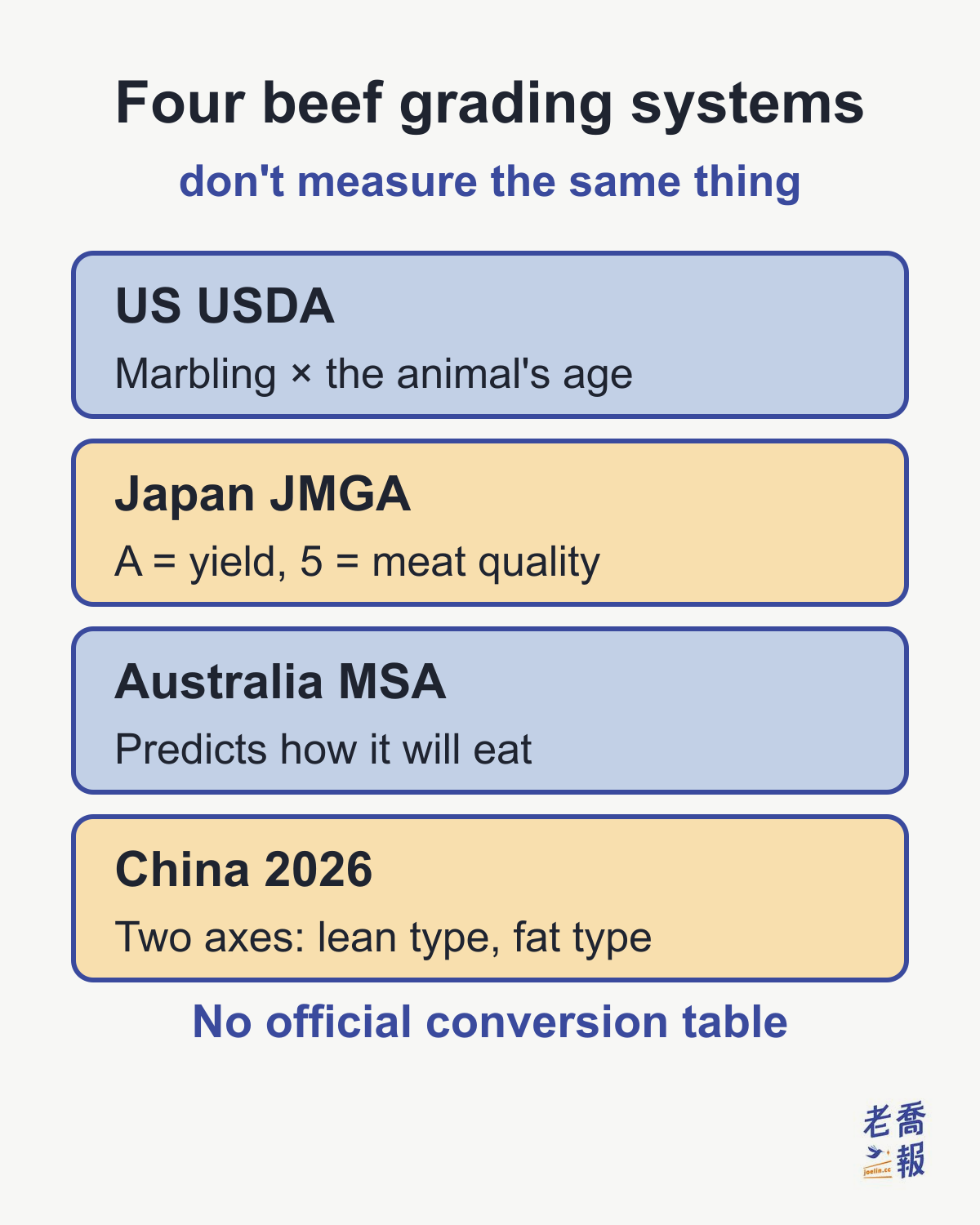
What this table really says is that the four rulers do not even overlap on what they measure. The US counts the animal's age in its quality grade; Japan puts "how much meat can this animal cut out" in the first letter of its grade code; Australia's MSA skips the carcass altogether and directly predicts how many stars each cut will earn with each cooking method; and China's new 2026 version first asks "is this lean type or fat type?" before deciding which grading axis to use. Put them in one table and rank them, and you are comparing four rulers marked in different units.
## 2. US USDA: marbling times age, read on a single cut surface
The US splits two things into two independent grades. One is the quality grade, the Prime, Choice and Select that consumers see; the other is the yield grade, 1 to 5, which estimates how much boneless retail meat the carcass will produce after trimming, with a lower number meaning higher yield. The yield grade almost never appears at retail; it is the language of carcass trading.
How is the quality grade set? Two axes, multiplied together:
- Physiological maturity is divided into five groups, A to E, based on ossification and on the color and texture of the lean; it reflects physiological age, not actual age in months.
- The standard specifications use only seven marbling degrees for grading, from most to least: slightly abundant, moderate, modest, small, slight, traces, practically devoid.
The Prime threshold is at least slightly abundant, Choice starts at small, and Select at slight. A common mistake needs correcting here: plenty of Chinese-language content says "Prime means abundant marbling". The standard does have three higher degrees, moderately abundant, abundant and very abundant, but they are used only in carcass evaluation programs, not in grading. In other words, abundant is not on the grading ruler at all.
One more thing deserves its own mention: for grading, the carcass must be ribbed between the 12th and 13th ribs, and the grader looks only at the cross-section of one muscle, the ribeye. An animal's place on the price scale is decided by a cut surface about the size of a palm.
USDA grading has another feature that is easy to misunderstand: it is a voluntary service that packers request and pay for, and it is not the same thing as mandatory hygiene inspection. A packer can choose not to submit a given animal. In practice, because of market pressure, the vast majority of fed cattle are still graded.
## 3. Japan JMGA: A is yield, only 5 is meat quality
If you remember just one thing from this article, make it this: the A in A5 is not quality.
A, B and C are yield grades (歩留等級), measuring how much meat the animal will cut out. They are determined by a formula that takes ribeye area, rib thickness (ばらの厚さ), carcass weight and subcutaneous fat thickness and produces a yield standard value (歩留基準値): 72 and above is A, 69 to under 72 is B, and under 69 is C. The formula answers "is this animal worth it for the slaughterhouse?", which has no direct bearing on how good it tastes.
The meat quality grade, 1 to 5, is set by four factors: marbling (脂肪交雑), meat color and brightness, firmness and texture of the meat, and fat color, luster and quality. The rule is lowest of four: however beautiful the marbling, if the fat is judged too yellow and scored at 3, the whole piece is a 3.
And the marbling itself? That is a third measure, the one consumers hear about least: BMS (Beef Marbling Standard), from No.1 to No.12. Meat quality grade 5 corresponds to BMS 8 to 12, covering five full steps.
I wrote a separate article on what this means: [The "A" in A5 Wagyu Is Yield, Not Quality](/en/p/9797).
## 4. Australia has two systems, and they are not a coarse and a fine version of the same ruler
Chinese-language content almost always lumps Australia's two systems together, but they are different things:
- AUS-MEAT marbling score: 0 to 9, in whole-number steps, measuring the amount of marbling on the ribeye cross-section. The "MB score" or "Marble Score 9+" you hear at retail is this one.
- MSA marbling score: 100 to 1190, in steps of 10, assessing both the amount and the distribution of marbling.
The official explanation from Meat & Livestock Australia (MLA) is blunt: the two scores are assessed independently, because the assessment criteria differ. Even within one country, the official side does not do a one-to-one conversion.
And what MSA as a whole does sits on a different level from the other three standards. It uses measurements collected by graders to predict the eating quality of 39 cuts from a carcass, across each cut's suitable cooking methods and aging periods of 5 to 50 days, and outputs three consumer grades: 3 stars is good everyday, 4 stars is better than everyday, 5 stars is premium. The MSA Index is the weighted average of these 39 cuts' scores under each cut's most common cooking method.
In other words, the other three systems all measure physical properties of the carcass and leave the buyer to infer how it will eat. MSA moves that inference into a model, and accepts that different cuts from the same animal will have different answers.
## 5. China: from December 1, 2026, the new national standard splits beef into two axes
The line "China has no official beef grading" still circulates in a lot of Chinese-language content, but it is out of date.
- GB/T 29392-2012 was the first version.
- GB/T 29392-2022, 畜禽肉質量分級 牛肉 (Quality grading of livestock and poultry meat: Beef), was published on July 11, 2022 and took effect on February 1, 2023. It is the current version.
- GB/T 29392-2026 was published on May 25, 2026 and takes effect on December 1, 2026.
All three versions are GB/T, meaning recommended national standards, not mandatory ones. So the more accurate statement is: China has had official grading for a long time, but it has no legal force, and consumers barely see it.
What deserves the most attention in the new version is the design itself. According to the published draft for public comment, it first sorts beef into two types, each with its own grading axis: lean type (no intramuscular fat visible to the naked eye on the cross-section of the longissimus dorsi) is graded S1 to S4, fat type (with visible intramuscular fat) is graded F1 to F4, and beef that meets neither is classed as out-of-grade. The grading principle says producers choose which axis to use, based on the principle of maximizing value.
This design was not drawn at random. China's main producing regions have large numbers of lean-type yellow cattle; copy a single marbling axis like the American or Japanese one, and most of the country's own beef would be stuck in the lower bands forever. The two-track design amounts to admitting that "lean beef can have grades too", writing the country's own industry structure into the ruler itself.
The new version also has the requirement consumers will notice most: packaging must show the quality grade, stores must display the grade mark in a prominent place, and online sellers must show it on the product detail page. A recommended standard has no legal force, but once chain retailers and e-commerce platforms write it into their purchasing specifications, it becomes a de facto ticket of entry.
One caveat needs to be clear first: the technical details above about S1 to S4 and F1 to F4 come from the 2025 draft for public comment, and I have not yet obtained the full text of the final published version. The version number, publication date and effective date come from the official entries on China's national public standards information service platform. Once it takes effect in December, I will come back and check this section.
## 6. Why there is no official conversion table, and there won't be one
The most widely circulated kind of content on this topic is the "beef grade comparison chart by country", which maps A5 to Prime and MB9 to A5. The problem with these charts is not whether the estimates are accurate; it is that they assume something that does not exist: a correspondence between these standards.
There isn't one. Within what we were able to verify, none of the USDA, the Japan Meat Grading Association, Australia's AUS-MEAT and MSA, or China's standards authorities has ever published any cross-country equivalence or conversion.
That is not because they can't be bothered; it is because it can't be done. USDA Choice includes a maturity condition, JMGA's A includes a yield condition, and neither is a pure marbling axis, so they cannot be projected onto one line. It is like plotting "height" and "body fat percentage" on the same number line and asking which is bigger.
So retail claims like "equivalent to the US Choice grade" are analogies, not certifications. They give consumers a reference point; they are a retail communication technique, not a determination made by the standard-setters. Telling the two apart is the single most useful thing in this article.
## 7. These rulers have been changed: three cases
This is the reason I think the topic is worth writing about.
The first case is in the US. In November 1987, the USDA renamed the U.S. Good grade to U.S. Select. The text of the standard is remarkably candid: the revision did not change any requirement of the grade, only its name. Why rename it? Because the word Good did not sell at retail, and the industry needed a respectable-sounding word to sell beef leaner than Choice. The same piece of meat was called Good in 1986 and Select in 1988, without a single molecule of the meat changing.
And that was not the only time. In December 1950, the old Prime and Choice were merged and called Prime, and the old Good was renamed Choice; the Choice you buy today is not the Choice of 1949. A revision announced in 1975 removed conformation from the quality factors on the grounds that it is unrelated to palatability (litigation delayed its implementation until February 1976).
The second case is in Korea. In December 2019, Korea loosened the intramuscular fat threshold for its 1++ grade from No.8–9 to No.7–9, introduced a lowest-of-four rule at the same time, and required retailers to display the number. The reason for lowering the threshold was that the old system was pushing producers to overfatten cattle; the standard itself was being used as a tool of industrial policy.
The third case is China's 2026 version, covered above: rather than copying the marbling axis, it switched to two tracks.
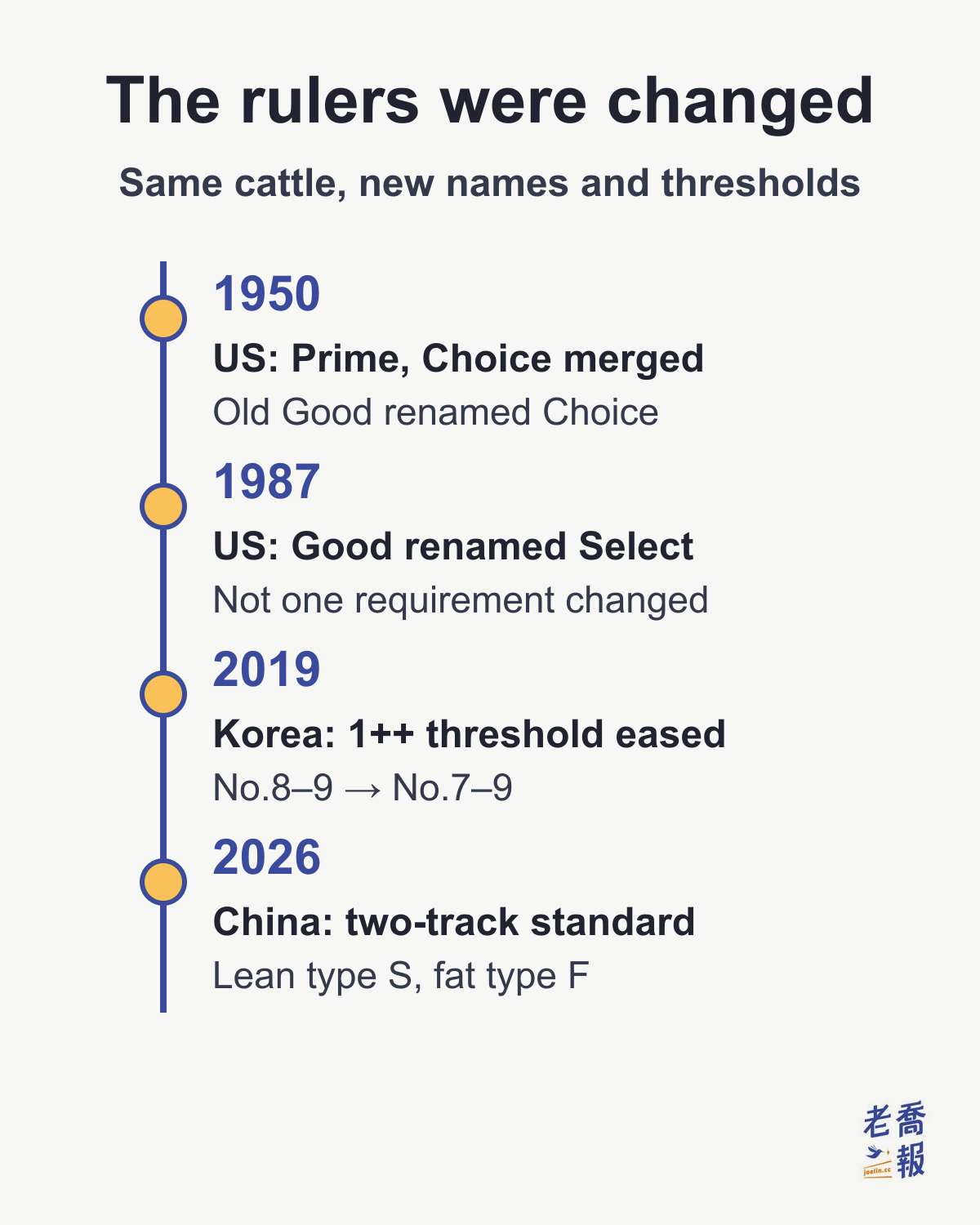
All three point to the same conclusion: a grade's name, its threshold and its axis are all policy variables that can be changed. Whoever holds the pen can move an entire price line without touching a single animal. That is also why the question "who sets the standard?" matters far more than "which grade tastes better?"
## 8. Where Taiwan stands on this
The original article was written for readers in Taiwan, and Taiwan makes a clear case of a market that only receives other people's standards.
Taiwan has no beef grading system of its own. Within what we were able to verify, Taiwan's Ministry of Agriculture has not set up a grading standard for domestic beef, and CAS is a hygiene and quality mark, not a grading ruler. For imported beef, Taiwan regulates mandatory country-of-origin labeling and border inspection, which cover safety and origin, not grade.
So Taiwanese shelves have a rather unusual property: every grade on them is someone else's ruler. Taiwan is a pure standard-taker, and it takes four mutually incompatible standards at the same time.
That is not necessarily a bad thing: Taiwan relies almost entirely on imported beef and has no industry base for building its own grading. But it does mean that in this category, the coordinate system for pricing is not in Taiwan's hands.
## 9. Three questions to ask on the spot
Next time you see any claim of a "grade", whether for beef, diamonds or anything else, ask three questions in order:
1. Who assigned this grade? A government agency, an industry association, or the seller itself? A seller-defined scale is not fraud, but it only means something inside that seller's own stores.
2. Which dimension does it measure? Marbling, yield, conformation, or a prediction of eating quality? Get the dimension wrong, and you will read "high yield" as "tastes good".
3. Is its correspondence to other standards an official determination or an analogy? Only an answer with a specific number (which BMS number, which Marble Score) is solid; an answer of "benchmarked to Japanese standards" is an analogy.
The third question is especially useful. At a hotpot restaurant in Shanghai, I saw a menu dividing beef into L2 and L3, and the restaurant said these were benchmarked to US and Japanese standards. Looking into it, those turned out to be a company-defined marbling scale with no published quantitative definition and no official equivalence of any kind. What the Shanghai authorities actually took part in was a separate standard of theirs for 無抗鮮牛肉 (antibiotic-free fresh beef), centered on safety and the absence of antibiotics and unrelated to marbling grades. Talk about the two in one breath, and it sounds like "an officially certified high grade".
Taken apart, a company drawing its own new coordinate system (not competing with Wagyu on the marbling axis, but on safety, antibiotic-free production and freshness instead) is actually an elegant business move. Its only problem is that, in the marketing, it presented its own ruler as someone else's. This case is worth taking apart on its own, and I wrote it up separately as [companies acting as their own standard-setters](/p/9801) (in Chinese).
## The other five articles in this series
This article is the overview; the details of each standard are covered in separate articles:
- [How USDA Beef Grading Works: Prime, Choice and Select Marbling Thresholds, and the Yield Grade Formula Nobody Looks At](/en/p/9798)
- [The "A" in A5 Wagyu Is Yield, Not Quality: Why A5 Doesn't Mean the Best-Tasting Beef](/en/p/9797)
- [Australian Beef Grading: MB Scores and MSA Stars Are Two Separate Systems, One Measures Marbling, the Other Predicts How It Will Eat](/en/p/9799)
- [China's New Beef Grading Standard Takes Effect December 2026: Lean Type S1–S4, Fat Type F1–F4, and Why It Didn't Copy the Marbling Axis](/en/p/9800)
- [When official grading hasn't reached the shelf, companies become standard-setters: 上海左庭右院 (Zuoting Youyuan, Shanghai) and its L2 to L5](/p/9801) (in Chinese)
That last article is the only one in the series that is not about a national standard. It is about what happens when nobody draws the ruler for your category, and companies step in to draw it themselves.
## Sources
- USDA AMS, United States Standards for Grades of Carcass Beef (version effective December 18, 2017), and the Carcass Beef Grades and Standards page
- USDA AMS, National Steer & Heifer Estimated Grading Percent Report
- Japan Meat Grading Association, Beef Carcass Trading Standards (牛枝肉取引規格)
- Meat & Livestock Australia (MLA), Solutions to Feedback explanations of marbling and the MSA Index; MSA Tips & Tools
- China's national public standards information service platform, entries for each version of GB/T 29392; the GB/T 29392 draft for public comment
- Republic of Korea policy briefing (korea.kr), 2019 explanation of the reform of livestock product grading
- EU Regulation (EU) No 1308/2013, Annex IV, and Commission Delegated Regulation (EU) 2017/1182
Keywords: beef grading, USDA Prime, A5 Wagyu, BMS, Marble Score, MSA, GB/T 29392, standard-setting
## Frequently asked questions
### Which is the highest grade: A5, Prime or MB9?
There is no answer, because the three are not on the same ruler. In Japan's A5, A measures yield and 5 is the lowest of four meat quality factors; US Prime is set by cross-checking marbling against physiological maturity; Australia's MB9 is an AUS-MEAT score for the amount of marbling. The USDA, the Japan Meat Grading Association, and Australia's AUS-MEAT and MSA have never published any cross-country equivalence table. The tables you see on the market are all informal analogies.
### Why don't countries just agree on one shared beef grading system?
Because each standard was designed for its own industry structure. The US counts physiological maturity in its quality grade, Japan puts yield in the first letter of its grade code, Australia's MSA directly predicts the eating quality of each cut, and China's new 2026 national standard splits beef into two grading axes, lean type and fat type, because its main producing regions have large numbers of lean-type yellow cattle; copy a single marbling axis, and most of the country's own beef would sit permanently in the lower bands. How a ruler is drawn reflects who wants to sell what, and who wants to protect what.
### Does China actually have an official beef grading standard?
Yes, and it is not new. GB/T 29392 was first published in 2012 (then titled 普通肉牛上腦、眼肉、外脊、里脊等級劃分, a grading standard for chuck roll, ribeye, striploin and tenderloin from common beef cattle; only the 2022 version was renamed 畜禽肉質量分級 牛肉, Quality grading of livestock and poultry meat: Beef). The 2022 revision (published 2022-07-11, in force 2023-02-01) is the current version, and the 2026 version was published on 2026-05-25 and takes effect on 2026-12-01. All three versions are GB/T, meaning recommended national standards with no legal force, and consumers barely see them today. So the accurate statement is not that there is no standard, but that there is one that has not yet reached the shelf.
### A restaurant says its beef is "benchmarked to US and Japanese standards". Can I trust that?
That is an analogy, not a certification. Ask one follow-up question: benchmarked to which marbling score, which BMS number or which Marble Score? Only an answer with a specific number is solid. A company-defined grade is not fraud in itself; in a market where official grading has not yet reached consumers, building your own scale is a reasonable business move. But a self-made ruler only means something inside that company's own stores. It does not automatically equal any country's official grade.
### Does Taiwan have its own beef grading?
Not within what we were able to verify. Taiwan's Ministry of Agriculture has not set up a grading system for domestic beef, and CAS is a hygiene and quality mark, not a grading ruler. For imported beef, Taiwan regulates mandatory country-of-origin labeling and border inspection, which cover safety and origin, not grade. In other words, every grade on a Taiwanese shelf is someone else's ruler, and four mutually incompatible standards sit there side by side.
Sources: Chinese original first published 2026-09-16; its information was revised 2026-10-27. US grades and marbling degrees follow the USDA standards for grades of carcass beef effective December 18, 2017; Japanese grades follow the Japan Meat Grading Association's beef carcass trading standards; Australian scales follow Meat & Livestock Australia's (MLA) explanations. China's version numbers and dates come from the national public standards information service platform; the S1–S4 and F1–F4 technical details come from the 2025 draft for public comment, and the final text will be checked after it takes effect in December 2026. Korea's 2019 grading reform follows korea.kr.
AI-assisted translation and editing: Caddy (AI)
[Original article](/p/9796)